Saltcrop by Yume Kitasei Summary, Characters and Themes
Saltcrop by Yume Kitasei is a near-future climate novel about three sisters from a struggling coastal town. Food is scarce, storms are harsher, and a corporate “Renewal” program controls the fight against crop blight.
When the eldest sister, Nora, vanishes after heading north on secret research, twenty-two-year-old Skipper refuses to wait for answers. She and her practical, ailing middle sister Carmen sail toward the Renewal centers looking for her. What starts as a rescue mission becomes a confrontation with a system that may be engineering the very disasters it claims to solve, and a test of what family owes one another in a damaged world.
Summary
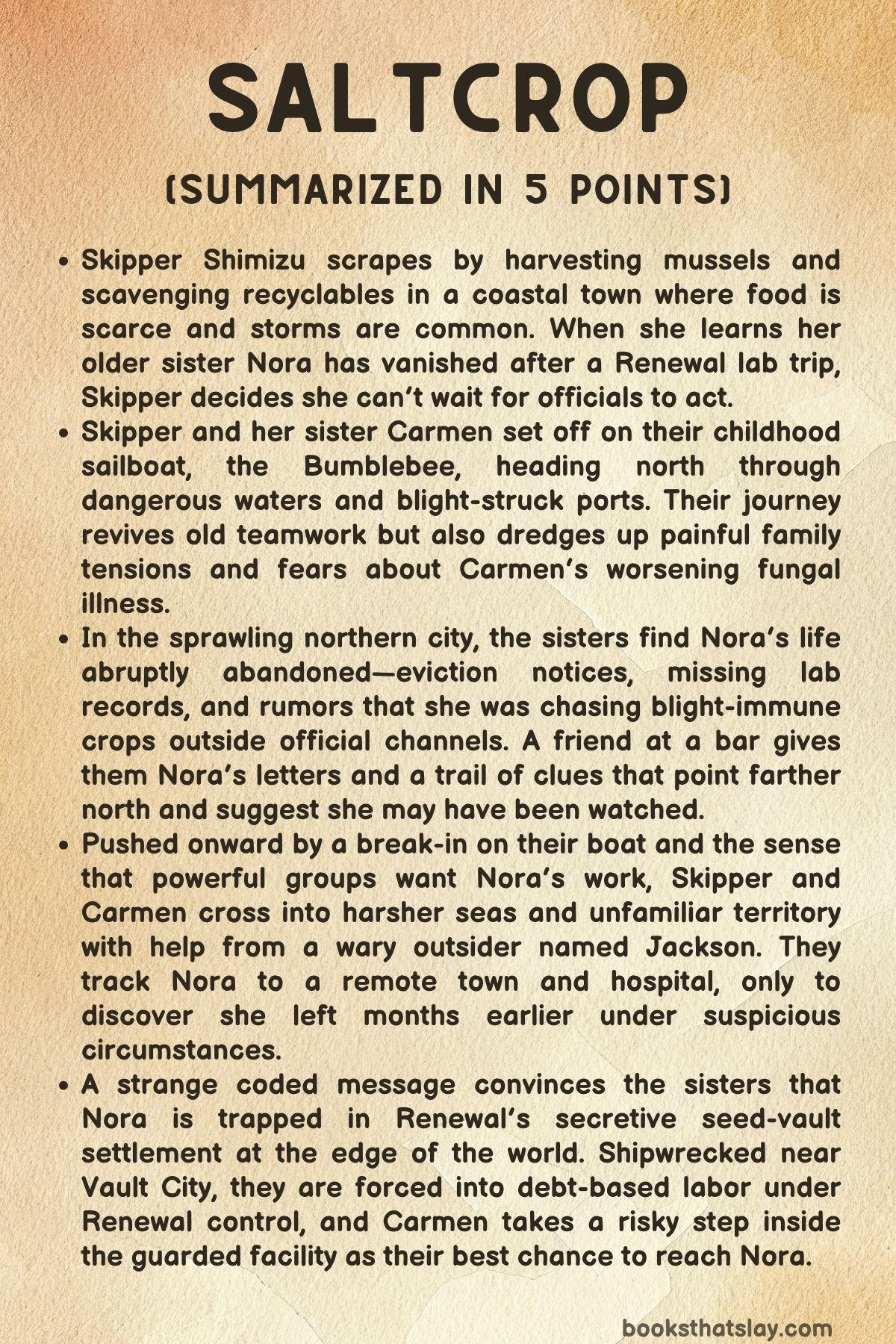
Skipper Shimizu spends her grandmother’s birthday morning doing what the family needs to survive: harvesting the mussels she has been raising on a rope at Gull Gang Rock and collecting recyclables to sell. A storm is rolling in, but her mind is on Nora, the oldest Shimizu sister, who left for college a decade earlier and now works at a Renewal lab in the far northern city.
Six weeks ago, Skipper received a troubling email from Dr. John Goode, Nora’s colleague, saying Nora had been missing for months and that her paycheck had bounced.
The message has sat like a stone in Skipper’s chest ever since.
At Gull Gang Rock she finds disaster waiting. The rope is stripped clean — every mussel stolen.
The loss is more than money. The mussels were meant to be the birthday meal, and food shortages make every bite count.
She runs home through the first burst of rain, furious and shaken.
The birthday gathering is tense even before Skipper speaks. Their grandmother’s dementia is worsening.
Carmen — the middle sister — and their Uncle Tot are arguing about whether local seeds can survive the blight and whether Renewal’s fungicide, Amaranthine, is help or harm. Skipper drops the news about the stolen mussels, and Carmen immediately shifts into problem-solving mode.
But the conversation veers when Carmen admits she told Goode to throw away Nora’s lab belongings because shipping them was too expensive. Skipper explodes at the thought of losing the small personal things Nora had left behind, especially a bumblebee-patterned mug Skipper once made for her.
This feels like another way the world is letting Nora disappear.
Skipper decides she is done waiting. She will sail north to the city and find Nora herself.
Tot agrees to stay behind to care for their grandmother. Skipper prepares the Bumblebee, the patched sailboat the sisters built as kids, and loads it with water, beans, rice, tools, and anything they can spare.
Carmen, newly single after a breakup with her girlfriend Ollie, helps gather supplies and then announces she’s coming too. She claims she won’t let Skipper go alone, and she doesn’t want to be home while Ollie packs up and leaves.
They depart before sunrise. The old teamwork comes back quickly, but so do their arguments.
Skipper mistrusts Renewal and the grip it has on food and medicine. Carmen believes Renewal is flawed but necessary.
Skipper takes a risky shortcut through a drowned ghost town, steering between half-submerged houses and drifting wreckage. They make it out, shaken but alive.
That night they anchor in a quiet inlet. Carmen shows Skipper a purple fungal mark spreading on her chest.
She has pills to slow it, but she needs surgery soon, something they can’t afford without steady work. Skipper promises she will take on more responsibilities at home if Carmen’s health gets worse, even though the promise scares them both.
The trip north is rough. Headwinds make Carmen sick, and their meager money dwindles with every stop and repair.
At a run-down resort town Carmen once dreamed of visiting, the blight has ruined the harvest; the only food they can buy is stale pickle sandwiches. At the marina, a crane accident bursts crates of Amaranthine, releasing a red dust cloud into the air.
The sisters flee before anyone can question them. That night Carmen receives a message: she’s been hired for a nursing job back home after an earlier application.
The pay could cover her surgery, but the start date is soon. It deepens the pull between family duty at home and the search ahead.
They reach the immense northern city and moor in a cheap cove because downtown berths cost too much. The next morning they try the police, but officers repeat that without leads they can’t act.
At Nora’s apartment a neighbor with a pet duck lets them in. Eviction warnings cover the door.
The superintendent says Nora paid rent in a lump four months earlier, then vanished; later, creditors forced their way inside looking for her.
Goode allows them into Nora’s lab but offers little comfort. He says she went farther north on a short field trip for a blight-resistance lead, then requested leave and stopped responding.
He admits her belongings were tossed, including the bumblebee mug. Outside the lab, a technician casually mentions Reny’s, a waterfront bar where Nora used to drink after work.
She gives them the address. It’s the first real clue they’ve had.
At Reny’s they meet Marcus, a Renewal technician and Nora’s friend. He gives them a box of Nora’s things recovered from her apartment and explains what he knows.
Nora had grown restless doing corporate testing for blight resistance and began a secret side project hunting for plants with natural immunity. She chased a rumor of blight-immune soybeans and even borrowed money from EarthWorks, a rival group, promising to deliver a sample.
The rumor collapsed, but Nora stayed up north anyway. Marcus shows them a letter Nora sent months earlier describing sickness spreading through her target town, a dead end with her contact, and her fear of being watched.
She planned to return by ferry and bus but never did.
Skipper wants to sail north right away. Carmen argues they should turn back because of her job, her health, and their grandmother.
That night an intruder boards the Bumblebee, leaving a wet boot print and disturbed papers. The sisters panic, suspecting EarthWorks or Renewal, and depart in haste.
After a bitter fight they agree to keep heading north together.
The farther they go, the colder and more controlled the ports become. Drones perform checks.
The Bumblebee’s motor fails repeatedly, forcing repairs that drain their funds. In a busy harbor city crowded with ships and Renewal workers, they meet Jackson Barker, a loud outsider who blames Renewal for his family’s suffering.
He flirts with Carmen and offers help. He arranges transport inland to the town described in Nora’s letter.
In that town, a store owner points them to 32 Maple Street, a guesthouse run by Lucy Walters. Lucy says Nora stayed there, asking about crops and non-Renewal seeds, then caught a severe lung infection and was sent to the harbor city hospital.
Lucy hands over Nora’s leftover clothes, seed samples, and papers, including an unfinished letter to her sisters. In it Nora remembers childhood trouble and their grandmother’s fierce protection, then ends with fear and a plea for them to find her.
At the hospital a nurse confirms Nora recovered but left three and a half months earlier without checking out. No one knows where she went.
Skipper and Carmen linger in the harbor city, waiting for a lead while Carmen’s illness spreads and Tot messages that their grandmother’s condition is unstable. Another intruder attacks Skipper on the Bumblebee but again takes nothing.
Jackson reveals he is pursuing legal action against Renewal and claims people tied to his case have been harmed, adding to the sisters’ dread.
Carmen finally tracks down Lili Liang, a retired botanist. Lili says Nora used a fake name and traced the immune soybeans to a Renewal seed vault on an island across the ocean, a secret research settlement called Vault City.
Before the sisters can decide what to do, a Renewal agent named Sasha visits, insisting Renewal hasn’t heard from Nora since the hospital and warning them about EarthWorks. The warning feels rehearsed.
That night a message arrives addressed to “Siz,” Skipper’s childhood nickname, claiming Nora is fine and will return soon. Skipper notices odd phrasing, then realizes the wording hides Morse code.
She deciphers it: “I’m trapped in the vault. ” Skipper tells Carmen, and despite Carmen’s surgery and delayed job start, they choose the crossing.
Jackson joins them in his boat, the Leviathan.
The sea voyage is brutal. Carmen spends more time aboard the Leviathan while Skipper handles the Bumblebee solo.
They pass a slick of crimson Amaranthine on the water and fish up mutated, tainted sea life to survive. Tempers fray, but they push onward until ice and fog swallow the horizon.
Near Vault City, harbor control warns them away. Skipper lies that they are out of supplies and power.
The harbor official gives reluctant permission. The egg-shaped navigation device dies, the motor quits, and they are forced to pole through ice floes.
A wave slams them onto hidden rocks, tearing open the hull. The Bumblebee sinks in the fog.
With only a dinghy and grab bags, the sisters stumble across unstable ice in a storm and reach Vault City half-frozen.
Vault City is a militarized company town under polar night, greenhouses glowing nonstop. At the clinic they are treated for starvation and exposure.
Security interrogates them, confiscates Nora’s seeds, and releases them under watch. A manager named Andi assigns them to dorm-like barracks and explains the trap: their rescue and medical bills are debt they must repay in Renewal points, the only currency in town.
Carmen is placed in the understaffed clinic. Skipper is sent to a worm-processing factory.
Skipper mourns the loss of the Bumblebee while Carmen tries to keep their focus on Nora.
Through Emilie and Jan, workers connected to Jackson, they learn how debt keeps people captive. Emilie shows them the vault gates and says Nora is likely inside, but entry requires an expensive badge.
Carmen sells their emergency gear and Jackson’s tooth necklace on the black market, earning far less than needed. Searching the registry yields no Nora, only hints that staff sometimes work under altered identities.
Emilie offers a test: she will confirm Nora’s status if Carmen steals drugs from the clinic. Carmen is terrified but sees no other route.
During a chaotic Amaranthine poisoning emergency, she uses a key fob Piotr hands her and takes the drugs. Emilie returns with the truth: Nora is in the vault, scared, and needs to be freed.
Emilie also reveals she plans to bomb Renewal’s mines. Carmen refuses to join the violence.
Soon after, a masked EarthWorks agent bribes Carmen to steal blight-resistant soybeans from the vault, claiming Nora promised them.
Before Carmen chooses a path, security detains her, saying Skipper has been helping Emilie gather explosives and was filmed stealing wire. To shield Skipper, Carmen blames Emilie.
Emilie is arrested, Jan is devastated, and Skipper rages at Carmen for sacrificing their best chance to reach Nora. Carmen’s fungal infection spreads, the sun finally returns, and still the vault remains closed to them.
Then a contagious outbreak hits vault workers. A dying employee in the clinic calls Carmen “Aurora,” their mother’s name, making Carmen suspect Nora is inside under that identity.
Renewal asks for volunteers to enter the vault to treat the sick. Seeing her only opening, Carmen volunteers, leaves without telling Skipper, and walks through the heavy doors.
Inside the vault, the narrative shifts to Nora’s path. She had chased the miracle soybean rumor north, found only ashes and fear, and fell ill.
Someone entered her hospital room with a syringe, and she barely escaped. Convinced her work had exposed something dangerous, she disguised herself, took a false identity, and secured a job in Vault City.
There she discovered heirloom soybeans fully immune to modern blight. Even worse, she found evidence that new blight variants originated inside the vault itself.
She concluded Renewal was engineering blight and then designing crops to stay ahead of it, profiting from the crisis.
Nora smuggled evidence out and, with help from a maintenance engineer, escaped Vault City with his teenage daughter Hilda. She reunited with Skipper and Carmen in the southern city and told them what she had learned.
Fear of retaliation split them. Carmen’s infection worsened and required risky surgery.
Nora matched the fungus to vault records, strengthening her belief that Renewal spread human-targeting infections too. She confided everything to her mentor, Professor Rafael Aguirre, who believed her and began planning trials to prove the soybeans’ properties and document the engineered blight.
Renewal responded with bribes, harassment, and threats, even targeting Tot back home.
Desperate to protect the truth, Nora cut a deal with EarthWorks to sell them samples so the story would go public. Before the handoff, Nora learned Renewal was acquiring EarthWorks.
She rushed to the lab to find it smashed and the physical samples stolen. Rafael, crushed, told her to leave for her safety.
Carmen flew home with a portion of seeds to help their town, then vanished for days, sending Nora and Skipper back into panic until Carmen finally messaged that she’d dodged Renewal surveillance and was safe.
Nora, Skipper, Rafael, and his lawyer friend Silvia decided to confront Renewal directly through a virtual meeting, demanding Carmen’s location and threatening to release the evidence. Renewal denied holding Carmen and offered to buy the remaining seeds.
Their evasive responses only confirmed Nora’s claims. Renewal agents moved to raid Nora’s apartment, tipped off by the neighbor, but the group executed their plan first: they went live with an interview, released the vault data publicly, and broadcast footage of the raid in real time.
Police arrived, and the story detonated worldwide.
Initial change was slow, but months later investigators uncovered proof of Renewal’s experiments on human blight. Governments seized Renewal’s assets and charged its leaders.
Nora joined Rafael’s new independent institute and began a doctorate. Carmen and Tot repaired the family home and planted the immune soybeans.
Their grandmother received a caregiver. Hilda’s father remained trapped in Vault City as efforts began to free him.
Skipper returned to the boatyard, built a rough new boat called Equilateral, and committed to a solo voyage around the world. In the end, Nora and Hilda watched Skipper sail into the distance, holding on to the hope that the seeds growing back home would mean a different future.
Characters
Skipper Shimizu
Skipper is the emotional and narrative anchor of Saltcrop, a twenty-two-year-old shaped by scarcity, coastal labor, and the old responsibilities that fall on the youngest sibling when everyone else has already been pulled into adulthood. Her daily routine—raising mussels, scavenging recyclables, patching up the Bumblebee—shows a person who survives through patience and practical skill, but the theft of her mussels snaps that steadiness into urgency.
Skipper’s defining trait is fierce, almost stubborn love; she cannot tolerate the passive waiting that her family has endured about Nora, because to her, waiting is just another word for giving up. This urgency makes her brave and reckless in equal measure: she sails into storms, threads a half-submerged ghost town, and keeps pushing north even when every rational pressure says to stop.
Yet beneath the grit is grief she doesn’t fully know how to carry—grief for the vanishing of food security, for the sea swallowing towns, for her sister’s absence, and later for the loss of the Bumblebee itself, which feels like losing a piece of childhood and proof that the sisters once made something whole together. Skipper’s growth is less about learning bravery—she already has that—and more about learning how to bear responsibility without collapsing into isolation.
By the end, her choice to build Equilateral and commit to a solo voyage isn’t an escape from family but a transformed continuation of who she is: someone who moves toward the horizon when love demands it, now with a clearer sense of purpose beyond survival.
Carmen Shimizu
Carmen is the pragmatic counterweight to Skipper, but Saltcrop gradually reveals that her practicality is a coping mechanism layered over tenderness and fear. She begins as the sibling who thinks in logistics—how to replace stolen mussels, how to ration supplies, how to keep Grandma safe, how to afford her own medical treatment—yet her break with Ollie and her worsening fungal infection expose how close she is to unraveling.
Carmen lives in the constant squeeze between duty and mortality: she is old enough to be a caregiver, sick enough to need care herself, and emotionally bruised enough that she tries to solve problems before they can hurt her. That tension fuels many of the sisters’ conflicts, especially around Renewal and around whether to keep chasing Nora, but it also makes Carmen decisive under pressure.
Her stealing of drugs from the clinic is not a thriller flourish so much as a moral tipping point—evidence that her love for Skipper and Nora can override fear, even if she hates herself for the risk. The betrayal of Emilie is Carmen at her most tragic: she chooses family safety over solidarity with rebels, and the cost is immediate and devastating.
What makes her compelling is that she never becomes a simple “responsible sibling”; she is volatile, funny, yearning for comfort, and angry at systems that have left her body to rot while demanding her labor. Her final act—volunteering to enter the vault—captures her essence: self-sacrifice driven not by martyrdom but by the brutal math of love when no other door is open.
Nora Shimizu
Nora functions as both missing person and catalytic force, and Saltcrop treats her absence as a kind of gravitational field that pulls every other character into motion. When we finally inhabit her viewpoint, she comes into focus as the most intellectually restless of the sisters, a scientist whose boredom with official Renewal work leads her to moral revolt.
Nora’s curiosity is inseparable from her conscience: she cannot unsee the human and ecological cost of blight, and once she suspects a conspiracy, she pursues it past the edge of safety, employment, and even identity. Her use of a false name, cosmetic alterations, and secret side deals with EarthWorks show a woman improvising survival while trying to outthink a massive institution.
She is brave but also paranoid for good reason; the attack in her hospital room confirms that her instincts about being watched were not delusion but pattern recognition. Nora’s major internal conflict is not whether to expose Renewal, but how to do so without destroying the people she loves.
That fear makes her cautious, then desperate enough to gamble on EarthWorks, and finally furious when Renewal swallows them too. She is the sister who carries the terrifying clarity that systems are designed to self-protect, and she learns to counter that with publicity, alliances, and data releases rather than solitary heroism.
By the end, she is still driven and sharp, but less alone—committed to science as resistance and to family as the reason resistance matters.
Grandma
Grandma is the fragile heart of the Shimizu household, embodying memory, tradition, and the slow violence of time. Her dementia is not a background detail; it is the quiet emergency that keeps tugging Skipper and Carmen back toward home, a reminder that love is also caretaking when the world is falling apart.
Even as her mind slips, her presence anchors the sisters’ sense of origin—birthday meals, old stories, and especially the remembered childhood incident with the blueberries, where Grandma’s fierce protection of the girls flashes through Nora’s unfinished letter. That memory complicates the image of Grandma as only vulnerable; she once was formidable in a way that shaped all three sisters’ understanding of family loyalty.
In the novel’s emotional economy, Grandma represents what is worth saving: not just people, but the continuity of kinship and place.
Uncle Tot
Uncle Tot is a bridge between generational worlds—part caregiver, part skeptic, part reluctant realist. He argues with Carmen about seeds and Renewal’s fungicide because he has lived long enough to see how corporate “solutions” become new chains, but he is also practical about survival and about Grandma’s decline.
His agreement to stay behind is an act of devotion that allows the sisters’ quest to happen, and his later endangerment by Renewal threats proves that the conspiracy is not abstract; it reaches directly into ordinary homes. Tot’s role is quiet but essential: he holds the line at home so the sisters can fight elsewhere, and he stands for the kind of stubborn local resilience Renewal tries to erase.
Marcus
Marcus, a Renewal technician and Nora’s friend, is the story’s first trustworthy guide into Nora’s hidden life. He is careful, worried, and fundamentally decent, the kind of person whose loyalty is personal rather than ideological.
By bringing Nora’s belongings and letter to Reny’s, he gives Skipper and Carmen the crucial map from rumor to trail, and his concern confirms that Nora’s disappearance isn’t just family anxiety—it is real danger. Marcus also embodies a subtle critique of Renewal’s workforce: not everyone inside the system is malicious, but good people can still be trapped in its machinery, powerless to protect the ones they care about.
Dr. John Good
Goode is the first institutional face of Renewal the sisters encounter, and he represents bureaucratic evasion disguised as professional detachment. His email triggers the plot, but once Skipper and Carmen arrive, he becomes obstructive, minimizing Nora’s work and refusing useful details.
Whether his coldness comes from complicity, fear, or self-preservation, the effect is the same: he is a gatekeeper who chooses the institution’s comfort over a missing colleague’s safety. The discarded bumblebee mug is a small cruelty that crystallizes his character—he may not be a mastermind, but he is a willing participant in a culture where people are disposable.
Jackson Barker
Jackson enters as charm and chaos—flirtatious, talkative, loudly anti-Renewal—and becomes a complicated ally whose motives are half sincerity, half self-myth. He frames Renewal as a personal enemy tied to family tragedy, which makes his anger feel real, but his swagger and opportunism keep the sisters wary.
Jackson’s value is practical—transport, local knowledge, another boat for the crossing—but narratively he tests the sisters’ judgment about whom to trust. His warnings about dead witnesses deepen the atmosphere of threat, and his shifting emotional temperature at sea shows someone trying to be heroic while struggling with fear.
He is not purely noble nor purely exploitative; he is a survivor who has decided that fighting Renewal gives his losses meaning.
Lucy Walters
Lucy is a small-town caretaker figure who briefly shelters Nora and then the sisters through information. She embodies the ordinary decency the world still contains: running a guesthouse, noticing sickness spreading, helping a stranger without asking for allegiance.
Her account of Nora’s stay—curious, feverish, frightened—adds human texture to Nora’s absence, turning her from legend back into sister. Lucy’s willingness to hand over Nora’s clothes and papers is another example of communal trust acting as resistance against corporate secrecy.
Robert Feder
Robert Feder, the store owner who points the sisters to Maple Street, is a minor character but thematically sharp. He shows how small towns function as informal networks in the wake of institutional collapse, where information travels by memory and neighborly obligation rather than official channels.
His matter-of-fact help contrasts Renewal’s stonewalling, highlighting how power corrodes empathy while hardship can strengthen it.
Lili Liang
Lili is a retired botanist whose expertise is both scientific and moral. She sees what Nora was chasing and validates it with professional clarity, proving that the “miracle” soybeans are not fantasy but a trail into Renewal’s deepest secrets.
Lili represents the older generation of science that still believes knowledge should serve life rather than profit. Her calm truth-telling gives the sisters hope, but also responsibility—they now know this fight is real, and that knowledge can’t be put back in the box.
Sasha
Sasha, the Renewal agent who visits the sisters in the northern harbor city, is menace delivered politely. She speaks in warnings about EarthWorks and concern for Nora, but the subtext is surveillance and control.
Sasha’s ambiguity is intentional; she might be lying, she might be partially sincere, but either way she is an instrument of Renewal’s strategy to isolate threats through misinformation. Her presence confirms to the sisters that they are no longer just searching family—they are tangled in a corporate security web.
Emilie
Emilie is the most openly revolutionary figure in Vault City, fierce in her hatred of Renewal and precise in her understanding of how debt enslaves workers. She offers Carmen and Skipper their first real route toward the vault, but her help comes with demands that test Carmen’s ethics.
Emilie’s bitterness is born of lived exploitation, and her planned bombing shows a person who has concluded that the system cannot be reformed, only shattered. Her arrest is a brutal turning point: it demonstrates how quickly Renewal crushes dissent and how costly even indirect association can be.
Emilie stands for the alternative path the sisters might have taken—collective rebellion rather than family rescue—and her removal narrows their options to desperation.
Jan
Jan, Emilie’s husband, is quieter than his wife but equally shaped by Renewal’s trap. His grief after Emilie’s arrest sharpens the moral stakes of Carmen’s decision to sacrifice solidarity for Skipper’s safety.
Jan symbolizes the collateral damage of fear-driven choices in authoritarian spaces: even people trying to help can be destroyed by the smallest misstep.
Piotr
Piotr is a senior nurse in Vault City, blunt and physically marked by hardship, and he serves as a reminder that competence can exist inside oppressive systems without softening them. He warns the sisters about security and the town’s reality, then later—perhaps without meaning to—creates Carmen’s opening to steal sedatives by trusting her with the key fob.
Piotr is not framed as villain or hero; he is a tired professional doing triage in a place engineered to grind people down. His presence adds realism to Vault City’s clinic, where survival depends on exhausted workers who can’t afford ideology.
Andi
Andi is Renewal management at the human scale: cheerful cruelty, procedural authority, and the ability to make exploitation sound like routine. By placing the sisters in barracks, pricing their escape, and assigning labor in points, Andi demonstrates how Renewal maintains control without constant violence—through debt, bureaucracy, and normalized deprivation.
She doesn’t need to snarl or threaten; the system she represents does that for her. Andi’s ordinariness is what makes her chilling, because it shows how oppression is often administered by people who treat it as a job description.
Hilda
Hilda is the teenage girl Nora rescues from Vault City, and she represents the next generation caught in Renewal’s experiments. Her fear of being followed continues the thread of paranoia that is, in this world, a survival skill.
Hilda’s presence also changes Nora: she is no longer only a whistleblower and sister but a protector to someone even more vulnerable. The ending’s image of Nora and Hilda going out for gelato after watching Skipper sail away is quietly radical—two survivors choosing a moment of sweetness in defiance of a system built on hunger.
Rafael Aguirre
Rafael is Nora’s professor and later collaborator, defined by integrity that hardens under pressure. He listens when Nora finally tells the truth, immediately thinking in terms of evidence, trials, and public proof rather than panic.
Rafael represents science as accountability, insisting on rigor so the accusation against Renewal cannot be dismissed as rumor. His fury at Nora’s EarthWorks deal comes not from ego but from fear that political shortcuts will corrupt the moral purity of their work.
When Renewal retaliates, he absorbs the cost and still returns, quitting the university and founding a private institute. Rafael is the adult ally the sisters desperately need: someone willing to share the burden of fighting power with method rather than martyrdom.
Silvia
Silvia, Rafael’s lawyer friend, is a tactical mind in a story full of improvisation. She helps translate Nora’s evidence into leverage—planning the confrontation with Renewal executives, anticipating raids, and using media exposure as a shield.
Silvia represents the legal and strategic side of resistance, showing that truth alone isn’t enough; it needs structure, timing, and protection to survive contact with power.
Ollie
Ollie appears mostly through Carmen’s breakup, but her absence still shapes Carmen’s early emotional state. Ollie stands for the personal losses that mirror ecological collapse: relationships strained by scarcity, illness, and the bleak calculus of survival.
Carmen’s decision to leave partly to avoid being home while Ollie moves out adds a layer of hurt beneath her practicality, revealing that her toughness is also a way to avoid sitting still with grief.
Prometheus
Prometheus, the rumored “miracle” soybean grower, is more myth than on-page presence, but he functions as a symbolic character in Nora’s arc. He embodies the hope that nature might still contain an answer beyond corporate engineering, and his disappearance signals how quickly Renewal erases threats to its monopoly on survival.
Prometheus is the spark that turns Nora’s curiosity into a crusade, even if he remains a shadow.
Themes
Ecologic collapse, food scarcity, and the moral weight of survival
From the opening image of Skipper harvesting mussels and scavenging recyclables, Saltcrop places everyday survival at the center of life. Food is not a background detail or a lifestyle choice; it is a constant calculation and a source of grief, conflict, and motivation.
The stripped mussel rope is not only a personal loss but evidence of a broader scarcity that turns neighbors into competitors and transforms a birthday meal into a fragile promise. This scarcity reshapes values.
Carmen’s arguments about seeds, blight, and Amaranthine are not academic; they are about whether anything will grow, whether a family will eat, and whether a town will endure another season. The world has been pushed into a state where normal pleasures like restaurant meals become fantasies, and even those fantasies collapse under the same ecological pressure that governs the coast.
The environment in Saltcrop is also a witness to human decisions. Flooded ghost towns, mutated rabbits, sickly cattle, and crimson chemical slicks show a system that has been strained beyond recovery by both climate and industrial responses to it.
These scenes suggest that catastrophe is not a single event but a long settling into consequences, where each adaptation creates a new problem. Renewal’s fungicide Amaranthine, meant to save crops, spreads poison clouds and produces new emergencies, pointing to the idea that survival strategies in a damaged world often carry hidden costs.
The sisters’ journey north exposes layers of this collapse: coastal communities starving quietly, company towns thriving artificially, and the vault itself operating like a sealed lifeboat for corporate power rather than for humanity. The ecological crisis becomes inseparable from ethics.
People steal mussels, smuggle seeds, and accept dangerous work because survival demands it. The book asks what happens to community, trust, and future planning when the line between need and harm gets thinner each year, and when saving life today might risk life tomorrow.
Sisterhood, memory, and the tug between duty and desire
Skipper leaving home is framed as an act of love and desperation, but it also exposes the complicated bonds that define her family. The sisters are connected by childhood teamwork and a shared boat, yet they carry different wounds and responsibilities into adulthood.
Skipper’s fixation on finding Nora comes from devotion, guilt, and memory, especially the bumblebee mug she made as a child. That mug matters because it symbolizes a relationship that has been interrupted and left unresolved.
When Carmen admits she told the lab to discard Nora’s belongings, Skipper’s rage is about losing a physical object, but more profoundly about losing a chance to protect the sister who once protected her. In Saltcrop, memory is not passive nostalgia; it is a force that guides present action, sometimes recklessly.
Carmen and Skipper embody different interpretations of duty. Carmen feels pulled back by her illness, her new job, and their grandmother’s fragile state.
Skipper feels pulled forward by the belief that waiting is a kind of betrayal. Their arguments are not petty sibling fights; they are clashes between two valid forms of care.
Carmen wants to keep the family functioning day to day. Skipper wants to save a missing sister before the world swallows her.
This tension deepens as they travel: Carmen’s chest infection makes her more aware of time and limits, while Skipper repeatedly chooses risk, as if speed itself might keep Nora alive. Their dynamic also shows how love can be both supportive and suffocating.
Carmen comes along partly to protect Skipper, but also to avoid the emotional wreckage of staying home. Skipper relies on Carmen’s competence but resents her caution.
They keep each other alive, and they hurt each other in the process.
The family story expands through flashbacks and the grandmother’s dementia. The unfinished letter recalling childhood violence highlights how protection in this family has always been fierce and messy.
Dementia removes the grandmother’s reliable grip on shared history, raising stakes for the sisters to carry that history themselves. Later, when the sisters reunite with Nora, the theme shifts from searching to deciding together what kind of family they will be now.
The end shows no neat return to harmony, but a continued negotiation between closeness and independence: Carmen goes home to plant soybeans, Nora commits to research, and Skipper sails away. Duty remains, but so does the right to choose a life beyond duty.
Corporate control, scientific manipulation, and the politics of knowledge
Renewal’s presence in Saltcrop is not that of a distant villain but an everyday authority shaping housing, employment, medicine, and even language. The company functions like a government where points are currency and surveillance is the norm.
By placing the seed vault in a militarized polar company town, the story shows how ecological crisis can be used to justify extreme consolidation of power. Renewal claims to be humanity’s lifeline against blight, but the vault city reveals a different logic: scarcity becomes a tool for control, and control becomes the true product.
Workers are trapped by debt, badges, and authorization rules that make the vault both a physical fortress and a social cage.
Nora’s investigation uncovers a deeper abuse: the possibility that Renewal manufactures blight to maintain dependence on its engineered crops and fungicide. This twist reframes every earlier argument about Amaranthine and seed access.
What looked like a desperate technological response to a natural disaster is revealed as a managed disaster. The book is not simply anti-science; it is sharply focused on who owns science and who bears the risk.
Nora’s secret project searching for natural immunity is portrayed as genuine curiosity and care for people starving outside corporate greenhouses. Renewal’s research is portrayed as weaponized innovation, calibrated to keep them indispensable.
Even Nora’s attempt to collaborate with EarthWorks shows how difficult ethical action becomes when every institution is compromised by profit motives or fear.
Knowledge in Saltcrop is dangerous. Data must be smuggled.
Patterns must be recognized in hidden Morse code. Witnesses die or vanish.
The sisters’ search repeatedly hits official walls: police demand leads they do not help gather, lab managers erase evidence under bureaucratic excuses, and Renewal agents appear with friendly warnings that may be threats. The result is a world where truth is not self-evident but actively buried, and where seeking it can ruin lives.
This is why the eventual exposure requires not only evidence but media spectacle, allies, and timing. The final broadcast scene shows that changing a system built on secrecy demands making secrecy impossible to sustain.
Yet the book also acknowledges limits: even after Renewal is charged, people like Hilda’s father remain trapped, and rebuilding is slow. The theme argues that corporate power thrives by controlling both resources and narratives, and that resistance must therefore fight on both fronts.
Illness, bodily vulnerability, and unequal access to care
Carmen’s fungal infection begins as a private confession in the cabin, a purple mark she hides until the sisters are far from home. This illness quickly becomes one of the book’s most intimate pressures.
It alters decisions, heightens conflict, and exposes how fragile the body is in a world with scarce medicine and expensive surgery. Carmen is not sick in a vacuum; she is sick in a system where treatment is tied to employment, points, and proximity to clinics.
Her new nursing job represents hope for care, but it also threatens to pull her away from the search for Nora. Illness here is not solely a personal tragedy.
It is a political condition shaped by environmental collapse and corporate control.
Nora’s lung infection and near-assassination in the hospital extend this theme. Hospitals are supposed to be safe, but in Saltcrop they are porous spaces where corporate agents can find, pressure, or even attempt to kill someone.
Medical authority is compromised by Renewal’s reach and by the broader scarcity that makes care uneven. Later, Nora matching Carmen’s fungus to vault data implies that disease itself may be a tool in Renewal’s ecosystem of control.
This possibility makes the body a battleground, where people are not only surviving ecological crisis but also surviving engineered vulnerability.
The book also uses illness to explore resilience without romanticizing suffering. Carmen continues working, traveling, and ultimately volunteering to enter the vault because her condition forces her to gamble on a narrow opening.
Her choice shows courage, but it also shows how sickness can corner people into risk. Skipper’s grief over the Bumblebee sinking and her exhaustion in Vault City parallel a kind of psychological illness, suggesting that trauma spreads like blight through the mind as well as the lungs.
Hunger, cold, and constant surveillance grind down decision-making, and moments of collapse are treated as human limits rather than moral failures.
By the end, Carmen’s surgery succeeds, soybeans are planted, and Grandma receives a caregiver. These outcomes show care as communal and practical, not miraculous.
Healing is portrayed as possible, but never detached from resources, solidarity, and truth. The theme insists that bodily vulnerability is universal, but protection from it is unequal, and that any real future must address who gets to be healthy and why.
Resistance, truth-telling, and rebuilding a future that is not owned
Skipper and Nora represent different forms of resistance that eventually converge. Skipper resists through action, refusing to wait for institutions that have already failed her family.
Her decision to sail north with limited supplies is reckless, but it is also a form of political refusal: she will not accept that missing people are inevitable casualties of a broken world. Nora resists through investigation, risking her career, safety, and reputation to follow evidence that powerful systems want erased.
Their paths meet in the realization that private bravery is not enough; resistance must be collective, strategic, and loud.
Vault City intensifies the cost of resisting. The sisters are forced into debt labor, constant light, and degrading factory work, all while knowing Nora is behind guarded doors.
Carmen’s deal-making on the black market, her theft of drugs, and her eventual entry into the vault show resistance as a chain of morally complicated acts made under pressure. The story refuses to portray rebels as pure.
Emilie’s planned bombing is understandable rage, yet Carmen rejects it, demonstrating that resistance also includes arguing about methods and protecting innocent people from becoming collateral damage. Jackson’s legal fight against Renewal introduces another layer: resistance through documentation and courts, which is slow and dangerous in a system that can kill witnesses.
These variations show how opposition develops in many forms when power is total.
Truth-telling is the climax of this resistance. The final exposure requires Nora to accept that secrecy will only protect Renewal, not her family.
Broadcasting the vault data and the live raid turns private evidence into public reality, forcing governments to act. Yet the aftermath is not a neat victory.
Change takes months, investigations are required, and even then the world remains scarred. What makes the ending hopeful is not instantaneous reform but the return of agency to ordinary people.
Carmen plants soybeans openly. Nora pursues a doctorate to continue the work.
Skipper builds a new boat and sets out alone, not as escape from responsibility but as a declaration that a life can still be chosen freely.
The future in Saltcrop is portrayed as something you build with imperfect tools in damaged conditions, not something handed down by a company that claims to own survival. Resistance, then, is not only overthrowing Renewal but reclaiming the right to imagine, to travel, to plant, and to care without permission.