Sisters in the Wind Summary, Characters and Themes
Sisters in the Wind by Angeline Boulley is a contemporary Native-centered thriller and coming-of-age story set in Michigan. It follows Lucy Smith, a young woman shaped by a loving childhood, sudden loss, and years in foster care.
When a bombing targets her at the diner where she works, Lucy is forced to stop running from her past. Two people connected to her late half-sister step in to protect her and help uncover who she really is. The novel moves between Lucy’s present danger and her memories, exploring identity, family ties, and survival in systems designed to erase and exploit vulnerable kids.
Summary
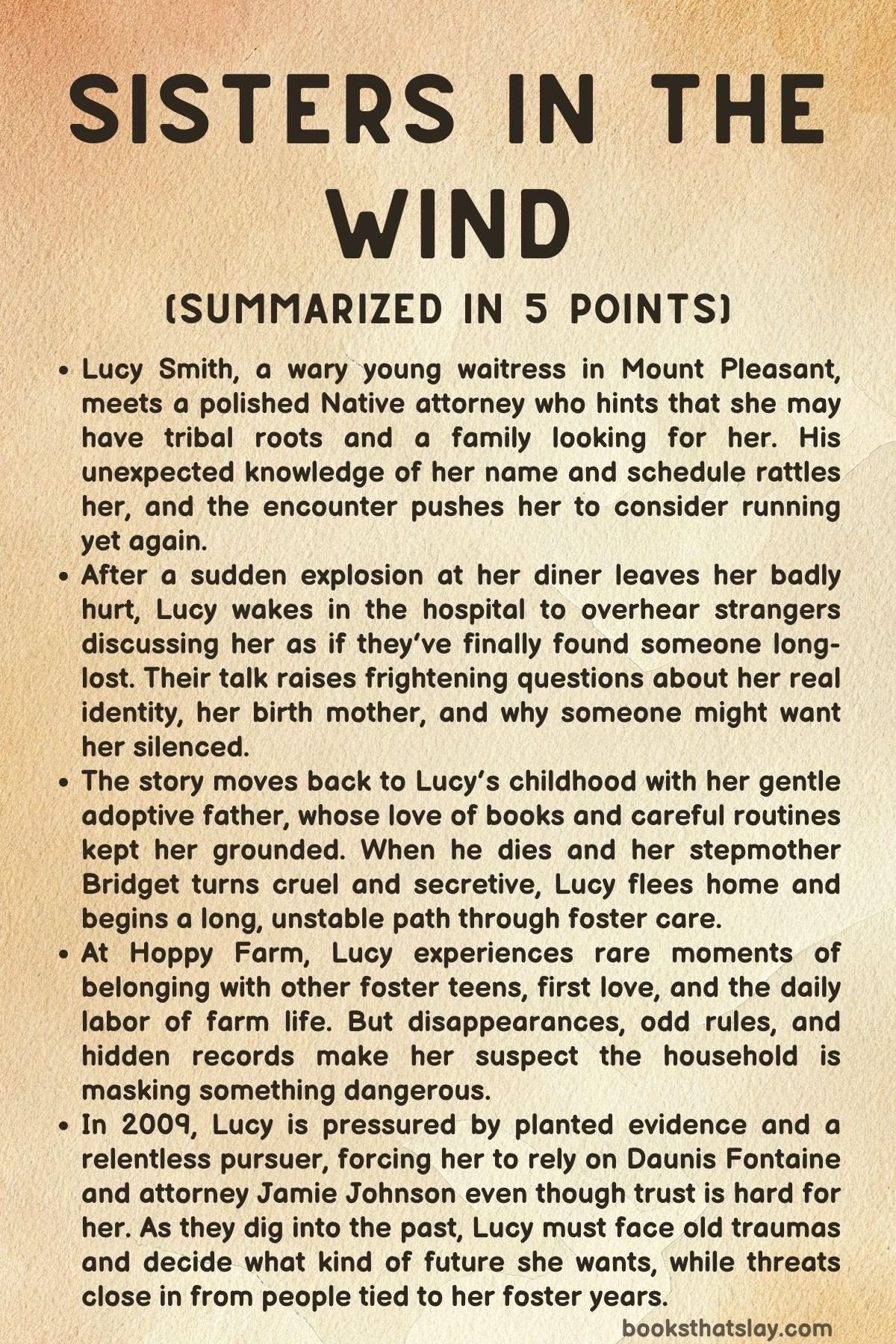
Lucy Smith is a guarded young waitress in Mount Pleasant, Michigan, trying to keep her head down and stay invisible. One quiet January morning in 2009, a well-dressed Native attorney named John Jameson sits in her diner section and greets her as if he already knows her.
The familiarity alarms Lucy; experience has taught her to watch for threats. Jameson says he helps foster kids who may be Native confirm their tribal roots and reconnect with family.
He urges Lucy to consider it. She doesn’t trust him, hardens fast, and accuses him of stalking her.
He looks genuinely confused and even calls her “Lily” by mistake before correcting himself. When he leaves, he slips her a business card marked with an Anishinaabe phrase and a handwritten note telling her to come home, where she is loved.
Lucy spirals after the encounter. If Jameson truly arrived only two days ago, someone else has been watching her longer.
She remembers feeling followed at a New Year’s Eve party. Certain she’s in danger, Lucy decides to vanish again the way she has so many times before.
She scrubs her rented apartment spotless, removes traces of her life, leaves her keys and rent for her landlord, and plans to buy a Greyhound ticket to anywhere and disappear along the route. She packs almost nothing besides essentials, cleaning supplies, and the birthday books her late father gave her each year.
In a small ritual of goodbye, she leaves her beloved childhood novel in a neighborhood book box, then heads to work with the secret knowledge that she won’t be coming back.
At the diner, her coworker Nancy surprises her with a tiny cake celebrating six months on the job. The kindness hits Lucy harder than she expects, pulling her back to rare moments of safety in childhood and foster care.
She spends the day serving familiar customers and quietly grieving the fact that she will leave them without explanation. After closing, the cook and owner send her home early while they finish cleaning.
Lucy walks out the back door and steps into a flash of terror: a bomb rips through the building. The blast throws her into the cold air, breaks her leg, and scorches her skin.
The smell of smoke and burned meat fills her lungs. Nancy, badly hurt, grips Lucy’s hand and says Lucy looks exactly like her mother.
The words land like a riddle as Lucy slips into shock.
Lucy wakes in the hospital half-listening while pretending to sleep. Jameson arrives with a woman named Daunis Fontaine.
Their reunion is emotional, suggesting a shared history. Daunis stares at Lucy and says she looks like “Lily.
” Jameson explains he recognized Lucy’s voice and took a coffee cup she used to run a DNA test. The two of them speak of Lily as someone they loved and lost.
Lucy’s mind races. Is Lily her mother?
Her sister? Why are these strangers sure of who she is when she herself isn’t?
The story reaches back into Lucy’s past. She grew up in Harbor Springs with a warm, strict Catholic father who adored her.
He taught her to swim, gave her fireworks on birthdays, and presented a new book every year with a personal inscription. He told Lucy her birth mother gave her up at birth, and that their family was Dutch and Italian.
When Lucy was nine, a security guard accused her of stealing and implied she was Native. The incident unsettled her, and she wondered if her father was hiding something.
After he developed colorectal cancer, he married her math teacher Bridget Mapother, who became Lucy’s stepmother and later adopted her. Not long after the adoption, Lucy’s father died during surgery.
After his death, Bridget changed overnight. She drank heavily, erased Lucy’s father’s presence from the home, and donated treasured belongings.
Lucy discovered Bridget had given away her father’s Seiko watch, bought it back herself, and felt her trust snap. Bridget’s spending became extravagant.
On the anniversary of her father’s death, Lucy met Abe Charlevoix, an elderly Native man who had been her father’s friend. Abe comforted Lucy, taught her a tobacco-offering prayer, and welcomed her as family.
Bridget reacted with anger and suspicion, deepening Lucy’s sense that something was wrong. Searching the house records, Lucy uncovered large credit-card payments, Bridget’s control of life-insurance money, and a grim fact: if Lucy died, Bridget would profit from her trust.
Lucy also found a key to Bridget’s storage unit.
The breaking point comes when Lucy is fourteen. Bridget slaps her during an argument and spits cruel remarks about Lucy’s birth mother, calling her a “reservation Indian” who left Lucy to rot.
Shaken and furious, Lucy packs the birthday books and her father’s jersey and flees into the freezing night. She cripples Bridget’s car by stabbing its tires, then tricks a college boy into driving her toward the storage unit.
Inside, she finds a hidden trove of luxury goods—designer shoes, bags, champagne flutes—evidence of Bridget’s secret life. Feeling betrayed by both Bridget and the father who trusted her, Lucy rigs fireworks in the unit and sets it on fire.
The explosion becomes the first public crack in her otherwise hidden life and the first mark on a juvenile record that will follow her.
Years later, back in 2009, Daunis tells Lucy hard truths: Lily was Lucy’s half-sister, killed in 2004 by her meth-addicted boyfriend Travis, who then died by suicide. Jameson—Jamie to Daunis—had been undercover in that drug investigation and dating Daunis at the time.
Their lives fractured after Lily’s death and Daunis’s brother’s imprisonment. The diner bombing brings them together again, and they vow to protect Lucy.
Daunis moves Lucy into a casino hotel suite while she heals, buys her clothes, handles bills, and tries to create stability. Jamie cooks, checks on her, and pushes the investigation.
Lucy stays defensive, convinced safety is temporary. Threatening flowers appear during physical therapy, confirming someone is still tracking her.
As pressure mounts, Lucy makes a desperate move to protect herself, falsely confessing in public that she planted the diner bomb. Tribal police arrest her; she spends a terrifying Easter weekend in custody, ends up bruised in a fight, and is released on bail arranged by Daunis and Jamie.
She’s fitted with an ankle tether after police claim to find planted evidence in her bag and apartment. Cornered, Lucy admits a darker history: she has a juvenile record for fires and once was blamed when a foster brother, Steven Sterling, died in a house fire.
The revelation makes her an easy scapegoat and plays into the real culprit’s plan.
Lucy finally explains the center of that past: her time at Hoppy Farm. As a teen in foster care, she lived on what seemed like a generous rural home that housed several teens.
She bonded with other kids, especially Diego, and saw how pregnant girls were quietly steered into adoptions. When Lucy later became pregnant herself, she grew convinced the Hoppys were running an illegal adoption operation.
She secretly gathered evidence, stole a journal listing illicit placements, and found an old note from a former girl suggesting the farm’s crimes stretched back decades and could include murder. Lucy escaped into the woods after a foster sister betrayed her, gave birth to a baby boy she named Luke, and chose a teacher named Isabella Rivera for a direct adoption.
But the farm and its allies intercepted the plan, forging papers to place Luke with the Sterling family instead.
In June 2009, Lucy receives a coded warning from twelve-year-old Stacy Sterling and races back to the farm, ditching her tether. At the old library, Lucy is ambushed by the Sterlings, who have Luke and demand the stolen key and journal.
They blame her for Steven’s death and march her toward the barn, claiming the Hoppys are waiting. Lucy realizes the Hoppys are already dead.
Chaos erupts when the barn explodes. Lucy crawls toward the fire as Stacy and Luke run inside.
Devery, the girl who once betrayed Lucy, rushes in and drags Luke out alive, collapsing from smoke. Mr.
Sterling pulls Stacy from the flames. Jamie and Daunis arrive; Daunis saves Stacy with CPR.
Mr. Sterling raises his gun at Lucy, and Jamie shoots him, but is hit in return.
Jamie dies in Lucy’s arms as help arrives.
By September 2009, Lucy proves the adoption was illegal and regains her parental rights. The Hoppys, both Sterlings, and the adoption ring are gone; federal agents dismantle the network and shut the farm down.
Lucy raises Luke, keeps a gentle connection between him and Stacy, and begins building a life that’s no longer defined by running or by what was stolen from her.
Characters
Lucy Smith
Lucy is the emotional and narrative center of Sisters in the Wind—a girl who has spent most of her life learning how to survive by disappearing. At the start she is a young waitress whose hypervigilance isn’t a personality quirk but a practiced skill born from foster care, poverty, and repeated betrayal.
She reads danger in posture and tone, trusts almost no one, and keeps contingency plans close at hand, which is why her first response to Jameson’s approach is to prepare for flight rather than connection. Yet beneath that defensive shell is someone deeply shaped by tenderness: her father’s rituals, the annual birthday books, and the solace of reading give her an inner life that resists the cruelty around her.
Lucy’s attachment to objects—especially her father’s watch and the birthday books—acts like a tether to identity when everything else is unstable. Her arc moves through suspicion, grief, and rage toward a hard-won kind of selfhood; she doesn’t “heal” by forgetting trauma, but by naming it, understanding its roots, and choosing to fight for her child, her heritage, and her future.
Lucy’s moral complexity is central to her characterization. She is capable of tenderness and caretaking, as seen in her calmness during Emily’s labor and her fierce protectiveness toward baby Luke, but she also carries destructive fire inside her—literal and symbolic.
The fires she sets come from a place of pain, powerlessness, and a desire to reclaim agency. Even when those actions have devastating consequences, Lucy is not framed as monstrous; instead, she is a traumatized child trying to survive systems that repeatedly fail her.
Over time, Lucy learns that survival alone is not enough. The closing events force her into direct confrontation rather than escape, and by reclaiming her son and rebuilding relationships, she begins transforming flight into rootedness without losing the sharp instincts that once kept her alive.
John B. Jamie
Jamie is introduced as a poised, slightly enigmatic lawyer whose calm persistence unsettles Lucy because it resembles the kind of control predators often wear. What distinguishes him is that his motives withstand scrutiny: his work helping Native foster kids reconnect to their tribal identities positions him as an advocate operating against the state systems that fractured Lucy’s life.
Jamie’s character blends professional competence with personal longing. His immediate recognition of Lucy’s resemblance to Lily and his secret DNA test show both the depth of his grief and his willingness to bend rules to repair what violence and bureaucracy destroyed.
That duality—ethical advocate but emotionally impulsive man—makes him feel real rather than idealized.
Jamie also reads as someone shaped by regret. The way he re-enters Lucy’s world alongside Daunis suggests unfinished business not only romantically but morally, tied to Lily’s death and the drug investigation that cost them years.
His protective role toward Lucy is partly justice-driven and partly a desperate attempt to save someone he feels he failed to protect before. His death, coming after he finally reconnects with Daunis and commits fully to Lucy’s safety, seals him as a tragic figure: he represents a path toward belonging and truth that is painfully costly, yet his sacrifice also breaks the cycle of people leaving Lucy without love.
Daunis Fontaine
Daunis functions as both caretaker and translator between Lucy and the world she has been cut off from. She arrives with authority—wealth, confidence, and access to systems Lucy can’t navigate alone—but she never wields that power to dominate Lucy.
Instead she offers structure: clothes, routines, advocacy, and a safe place to recover. Daunis’s steadiness is crucial because Lucy’s entire life has taught her that help comes with strings; Daunis slowly proves otherwise.
Her grief for Lily is not just background; it fuels her commitment to Lucy, turning her into a living bridge between sisters who never got to know each other.
What makes Daunis compelling is her blend of softness and steel. She is emotionally generous, allowing Lucy space to reject Maggie and to remain guarded, yet she is also strategic, pushing for truth, challenging assumptions, and holding the broader history of trauma in view.
Her willingness to reopen old wounds with Jamie and to re-enter danger for Lucy suggests someone who understands that community responsibility sometimes requires personal risk. Daunis embodies a different survival model than Lucy’s—one based not on vanishing, but on staying, witnessing, and fighting through connection.
Maggie Chippeway
Maggie is the absent presence whose life choices and trauma ripple through every layer of Lucy’s story. Though Lucy knows almost nothing about her for most of the narrative, Maggie becomes a symbol of origin, loss, and contested truth.
She is framed as a woman shaped by generational harm, particularly through Native history and the boarding school legacy that Daunis explains. That context is crucial: Maggie’s decision to give up children, her disappearances, and the family fractures around her are not treated as individual moral failures but as the aftershocks of systemic violence.
To Lucy, Maggie is both temptation and threat. Accepting her would mean accepting a past Lucy has been taught to distrust, including the possibility that her father lied to protect her or himself.
Maggie’s eagerness to meet Lucy suggests longing and remorse, but the narrative keeps her complicated rather than sentimental. She represents the hardest truth Lucy must face: that identity is not only personal but historical, and that “home” can be both loving and terrifying when it’s built on buried pain.
Lily
Lily exists mostly through memory and aftermath, yet she remains one of the most influential characters in Sisters in the Wind. She is Lucy’s half sister, Daunis’s best friend, and Jamie’s lost love, and the story treats her as a kind of emotional compass for the living.
Lily’s resemblance to Lucy is not just physical—it points to a shared vulnerability within violent systems and relationships. Her death at the hands of Travis crystallizes the stakes of the world Lucy is still trying to outrun: women like Lily and Lucy are targeted not only by individuals but by wider networks of exploitation.
Even without direct scenes, Lily is rendered vividly through the devotion others feel for her. Daunis’s grief suggests Lily was generous and magnetic, someone who inspired loyalty.
Jamie’s continued mourning implies a relationship of real depth rather than a youthful romance. Lily’s role is tragic but not passive; her life and death become a catalyst for justice, for Lucy’s rediscovery, and for the reweaving of family ties that were meant to stay broken.
Bridget Mapother
Bridget is one of the story’s sharpest portraits of betrayal dressed as respectability. She enters Lucy’s life as a teacher-turned-stepmother who seems stable enough for adoption, but after the father’s death her behavior reveals a colder core.
Bridget’s rapid erasure of Lucy’s father from their home, her drinking, and her sudden luxury spending suggest not only greed but a desire to control the narrative of the household. She is threatened by Lucy’s grief because grief keeps the father present, and Bridget needs him gone to secure her own power.
Her cruelty in the confrontation—especially the way she weaponizes Lucy’s birth mother and Native identity—shows a person who understands exactly where Lucy’s deepest insecurity lives and uses that knowledge to wound. Bridget doesn’t feel like a cartoon villain; she feels like a plausible abuser who justifies herself through entitlement.
The life insurance and trust revelations add a predatory layer, making Bridget a symbol of how easily legal systems can enable harm inside supposedly safe homes.
Nancy
Nancy is the first real maternal protection Lucy experiences in her present-day life, and the narrative makes her kindness matter precisely because it is ordinary. She doesn’t rescue Lucy through grand gestures; she watches out for her during shifts, celebrates her work anniversary, and creates a small community of care at the diner.
For someone like Lucy, who expects affection to be conditional or dangerous, Nancy’s steady warmth is radical. The cake scene is significant because it shows Nancy intuitively giving Lucy the kind of recognition that foster care denied her, triggering memories of Miss Lonnie and reminding Lucy what safety can feel like.
Nancy’s death is both a loss and a revelation. Her final statement about Lucy resembling her mother lands like a door blown open: even while dying, Nancy is still trying to give Lucy truth.
She becomes a reminder that Lucy is not unknowable, not unlovable, and not alone, which deepens the tragedy of her death and raises the emotional stakes of Lucy’s fight to survive.
Tim (the cook and owner)
Tim is a quieter figure, but he contributes to the diner’s sense of refuge. His insistence that Lucy go home while he and Nancy clean up shows a protective instinct and a paternal warmth that echoes Lucy’s father in subtle ways.
He represents the kind of working-class decency Lucy keeps encountering but struggles to trust—people who care without asking for anything back. The bombing that destroys his diner also destroys the fragile stability Lucy had built, making Tim part of the story’s broader argument that safety for someone like Lucy is always provisional under predatory systems.
Abe Charlevoix (Misho Abe)
Abe arrives at one of Lucy’s most vulnerable moments and becomes her first living link to the Native heritage her father denied. His gentleness, patience, and spiritual grounding offer Lucy an alternative way to hold grief.
The tobacco-offering prayer he teaches her is not just a cultural detail; it is the first time Lucy is invited into belonging without suspicion. Abe’s role also exposes Bridget’s fear and hostility toward Indigenous connection, suggesting that Lucy’s heritage was never a harmless fact in that home but a threat to Bridget’s control.
Abe stands for intergenerational care. He respects Lucy’s pain, never forces information on her, and allows her to name him “Grandpa,” letting her choose kinship rather than having it imposed.
In a narrative full of adults who exploit children, Abe is a corrective figure: an elder who gives without taking.
Miss Lonnie
Miss Lonnie is present mainly through Lucy’s memory, but she represents a formative model of foster care done with love. The birthday cake she once made for Lucy becomes a template for the kind of care Lucy later recognizes in Nancy.
Miss Lonnie’s importance lies in how she complicates Lucy’s worldview: even after years of instability, Lucy holds onto the proof that some adults can be safe. This memory keeps Lucy human, preserving her ability to accept love later.
Jennifer and Allen Hoppy (Missus and Mister Hoppy)
The Hoppys embody institutional harm wearing the mask of wholesome family life. Their farm is structured like a self-contained system of control: chore boards, routines, and food create the appearance of stability, but underneath is an illegal adoption ring that commodifies foster teens and babies.
Missus performs warmth through rituals like birthday dinners and songs, which makes her manipulation especially chilling—she knows how to simulate care to keep teens compliant. Mister is the operational muscle, managing logistics, intimidation, and the machinery of disappearance.
Together they represent a long-term predatory enterprise that depends on the invisibility of foster kids, especially those without advocates.
Their cruelty is systemic rather than impulsive. The journal showing decades of illegal adoptions and the hidden note from Mona Hix confirm they have been harming girls for years, refining methods that rely on secrecy, legal loopholes, and social trust in rural respectability.
For Lucy, their farm is the ultimate distortion of “home”: a place that feeds you, sings to you, and then steals your child.
Boyd
Boyd is the kind of charm-driven danger Lucy learns to recognize too late. At first he seems like a typical foster teen—flirtatious, playful, a source of normal adolescent experience for Lucy, including her first kiss.
But his later behavior reveals manipulation and entitlement. He supplies alcohol and weed, cultivating himself as the social center, and the drawer of keepsakes suggests a predatory pattern of collecting girls’ affection like trophies.
The discovery of Diego’s crucifix in Boyd’s possession is a quiet but devastating clue that he is connected to Diego’s disappearance, either through direct involvement or through a callous opportunism.
Boyd’s role shows how exploitation isn’t always adult and obvious. Sometimes it comes wearing teenage smiles and small kindnesses, which makes it harder for someone like Lucy—starved for normalcy—to protect herself.
Diego
Diego is Lucy’s most intimate experience of love within foster care, and his presence highlights both her longing and her vulnerability. He is portrayed as tender, devoted to Emily, and later drawn to Lucy in the quiet loneliness after Emily’s departure.
Their relationship is less about reckless passion than about two traumatized teens reaching for warmth. When he disappears, Diego becomes a symbol of unfinished grief in Lucy’s life: another person she cared for who vanished without closure.
His fixation on Emily, and the way guilt drives him to leave, suggest a boy who cannot reconcile love with loyalty. He’s not framed as malicious; rather he is someone broken by abandonment, acting out a desperate hope that he can restore what was lost.
His disappearance intensifies Lucy’s mistrust and reinforces the lesson her life keeps teaching: attachment is dangerous because people don’t stay.
Emily
Emily’s character anchors the tenderness of Hoppy Farm before its horror is revealed. She is pregnant, fragile, and loved deeply by Diego and the household, and her premature labor scene shows her courage and Lucy’s capacity for empathy.
Emily’s quiet departure with her aunt demonstrates how foster kids’ lives are subject to sudden reconfiguration, regardless of emotional bonds. She is not cruel to leave; her focus is survival for herself and her baby.
Emily also serves as contrast to Lucy. Where Lucy becomes suspicious and investigative, Emily chooses a simpler route: accept a safer home and detach from past attachments.
Her later phone call with Lucy conveys maturity and clarity—she knows what life she wants and recognizes that Diego’s romance doesn’t fit it. Emily represents a possible version of escape that isn’t self-destructive, though it still costs connection.
Tonya
Tonya illustrates the cyclical vulnerability of foster teens, especially around pregnancy and agency. She shares Lucy’s environment and risks but makes a different choice by allowing the Hoppys to adopt her baby.
The farm celebrates her decision, showing how effectively the Hoppys normalize coercion. Tonya is not naive; she is cornered by circumstance, and her compliance shows how survival can mean surrendering parts of yourself to adults who control your options.
Through Tonya, the narrative highlights how foster care can reduce choice to the least dangerous doorway, even when that doorway leads to exploitation.
Joy, Lexi, Devery, and the foster household teens
These teens form the social ecosystem of Hoppy Farm, each reflecting a different survival approach. Joy, with her offer of a tattoo and casual confidence, embodies a kind of tough, improvised family-making among kids who lack stable adults.
Lexi’s presence in Lucy’s later infiltration plan hints at trust and mutual aid among foster girls even under surveillance. Devery is the most complicated: she appears as a peer within the household but becomes an active betrayer when she tries to trade Lucy’s safety for her own future with Bruce.
Her confession—wanting security, marriage, and belonging—shows how abusive systems turn victims into collaborators. Devery’s later act of saving Luke from the burning barn complicates her moral shape; she is both betrayer and rescuer, someone trying to claw back a soul she nearly sold.
Collectively, the foster teens show that trauma does not produce a single personality type. In the same oppressive space, some kids bond, some comply, some betray, and some fight.
Lucy’s isolation among them is not because they lack humanity, but because she has learned not to risk hers.
Travis
Travis is a direct embodiment of intimate violence tied to addiction and criminal networks. His murder of Lily places him in the narrative as a force of destruction rather than a psychologically explored figure, and that choice matters: the story centers the victims and survivors, not the abuser’s interiority.
Travis represents the lethal convergence of meth culture, misogyny, and control. Even dead, his actions shape the living characters’ guilt, grief, and pursuit of justice.
Levi
Levi exists mostly through Daunis’s account, but he is important as a reminder of how drug economies entangle families. His involvement in the ring and subsequent imprisonment underline that exploitation isn’t an outside evil invading the community—it can grow within it, trapping people in cycles of harm.
Levi’s presence complicates any easy division between victim and perpetrator and reinforces the book’s theme that systemic pressures fracture kinship.
Steven Sterling
Steven is the foster brother whose death by fire becomes Lucy’s deepest wound and the stain she believes makes her irredeemable. He is not present as a developed on-page character so much as a living absence in Lucy’s conscience.
His death explains both Lucy’s terror of her own capacity for destruction and her willingness to accept blame when evidence is planted. Steven’s role is to show how childhood trauma can produce catastrophic consequences—and how those consequences, in turn, become new trauma that shapes identity for years.
Stacy Sterling
Stacy is a child caught in the machinery of adults’ greed, yet she retains a moral clarity that makes her stand out. Her coded phone warning to Lucy suggests bravery and loyalty despite being raised in a coercive household.
Stacy is not only a victim needing rescue; she actively tries to protect Lucy and Luke. After surviving the barn fire, she becomes part of Lucy’s reconstructed family world through ongoing visits, embodying the possibility that children can forge healthier bonds even when adults fail them.
Mr. and Mrs. Sterling
The Sterlings crystallize the story’s theme of entitlement toward vulnerable children. They manipulate the adoption system to steal Luke, then weaponize Steven’s death to justify brutality against Lucy.
Their obsession with the key and journal reveals self-preservation at any cost, and their willingness to threaten Lucy at gunpoint shows how far they will go to protect the structure they benefit from. They aren’t just individual villains; they are the “respectable” buyers who make the Hoppys’ enterprise profitable, proving that exploitation depends on demand as much as supply.
Luke
Luke is both a character and a symbol of Lucy’s transformation. As a baby he cannot have agency in the plot, but his existence reshapes Lucy’s decisions.
She moves from surviving alone to surviving for someone else, and that shift is what finally anchors her. Luke represents hope with teeth: not a sentimental promise that everything will be easy, but a reason for Lucy to stop vanishing and start building.
Her reclaiming of parental rights and commitment to raising him show that the cycle of disappearance can be broken when love becomes something you choose to fight for rather than flee from.
Harley and Max, Blake, and the Pleasant Diner regulars
These minor characters sketch the fragile community Lucy almost allows herself to belong to. Harley and Max, the young couple working at the casino, mirror a kind of ordinary future Lucy can imagine but doesn’t trust she deserves.
Blake, the college-aged driver, shows how Lucy’s survival instincts include performance and deception, but also how strangers’ small kindnesses can matter even if they are incomplete. The diner regulars and “silver-hairs” embody the everyday human decency Lucy keeps brushing against.
Their presence emphasizes what the bombing takes away from her: not just a job, but a tentative sense of being seen and valued in a place that felt almost like home.
Themes
Identity, Belonging, and the Right to Name Yourself
Lucy’s life is shaped by a long deprivation of reliable origins. She grows up with a loving father who gives her stability and a personal mythology of being Dutch and Italian, yet the world keeps pushing an alternative story onto her body.
The security guard who assumes she is Native and therefore a thief doesn’t just frighten a child; it plants the idea that others will define her before she can define herself. That pressure returns in adulthood when Jamie walks into the diner and greets her by name without looking at a tag.
His claim that she may be tribal and connected to a family she’s never known threatens the only identity she’s ever been allowed to hold. Her response is suspicion, not because the offer is cruel, but because Lucy has learned that identity can be a trap used by powerful people.
Over time, the book shows identity as something both stolen and returned. Bridget’s taunts about Lucy’s birth mother and “Indian reservation” are meant to humiliate her into accepting degradation as heritage.
Meanwhile, the Chippeway family history Daunis shares frames that same heritage as a place of survival and kinship that was violently interrupted by systems like boarding schools and foster care. Lucy sits between these forces, trying to keep control over a self that has been repeatedly renamed: “Lucy,” “Lily,” “Mary Clancy,” the girl with a juvenile record, the suspected bomber, the runaway.
Each label arrives with consequences, and each time she tries to outrun one, another appears. What finally shifts is not a single revelation but Lucy’s gradual decision that belonging doesn’t have to mean surrendering agency.
Her yearning for her father’s books and watch is a craving for continuity, for proof that she exists beyond other people’s narratives. Meeting Maggie and learning about Lily doesn’t erase her past; it gives her more pieces to assemble a life that is hers.
The story argues that ancestry can be both wound and medicine, and that reclaiming it is not passive acceptance but active choice. Lucy’s ultimate grounding comes from holding multiple truths at once: the father who raised her loved her, the birth family she never knew still loves her, and neither side gets to dictate who she becomes.
Identity here is not a puzzle solved by DNA alone; it is the daily labor of claiming one’s name in a world that keeps trying to assign it.
Survival, Trust, and the Cost of Living Guarded
From the opening scene, Lucy’s instincts are tuned to danger. She records her conversation with Jamie, keeps Nancy within view, and reads the smallest details as possible threats.
This isn’t paranoia for drama; it’s the learned intelligence of someone who has already been harmed and doesn’t expect adults to protect her. In foster care, she carried her life in trash bags, traveled through homes where affection could flip into exploitation, and learned that escape was sometimes the only form of safety.
The adult Lucy scrubbing her apartment to erase evidence before vanishing shows survival as a ritualized skill. She doesn’t pack keepsakes; she packs essentials.
She doesn’t say goodbye; she disappears. The book keeps asking what it costs to live this way.
Guardedness saves her, yet it also isolates her from the very people who might help. She aches while serving her diner regulars because she wants connection but can’t risk it.
Even after Jamie and Daunis offer care, she remains ready to bolt the moment her leg heals. Trust is something she assesses like weather, not something she feels freely.
The narrative draws a clear line between the institutions that failed her and the empathy she struggles to accept. Bridget’s transformation after her father’s death collapses Lucy’s sense that home is permanent.
Hoppy Farm offers routine, food, and affection, yet becomes another site of betrayal when its adoption scheme comes to light. Devery, who shares foster history with her, turns informant to protect her own status.
Boyd’s charm masks predation. Even the evidence planted against Lucy in 2009 relies on the credibility gap she carries from her past; authorities find it easy to believe she is guilty because the conditions of her survival have left traces that look like criminality.
Yet in the middle of this, the book repeatedly shows the alternative: chosen, earned trust. Nancy’s small cake matters because it is protection without motive.
Abe’s tenderness and tobacco prayer give Lucy a model of care that doesn’t ask her to perform gratitude. Daunis’s insistence on staying near Lucy is not presented as saving a helpless girl but as standing beside a capable survivor who is exhausted.
Jamie’s efforts to clear her name show a man trying to do justice without owning her story. The long arc suggests that survival alone is not the goal; survival with the possibility of intimacy is.
Lucy’s healing begins when she accepts that vigilance can coexist with relationship, and that letting someone help is not the same as being controlled. The book doesn’t romanticize trust as easy; it treats it as another survival skill, one that must be rebuilt slowly after being used against her.
Exploitation of Vulnerable Children and the Failure of Institutions
The world around Lucy is full of structures that claim to protect children but repeatedly put them in danger. Foster care, adoption systems, schools, and policing all appear not as abstract backdrops but as actors that shape what happens to her.
Lucy’s childhood is marked by constant movement and by the lesson that her safety depends on her ability to remain unnoticed or to run first. The Hoppy adoption ring takes this institutional weakness to its worst extreme: a household that presents itself as nurturing becomes a business built on coercion, intimidation, and disappearance.
The details are chilling not because of a single villainous act but because of how normalized the system is. The Hoppys have files, routines, legal paperwork, and long-term patterns suggesting decades of exploitation.
The Mona Hix note reveals a history of girls pressured into surrendering babies, promised material rewards, then threatened with death. The farm functions because institutions allow it to.
Doctors, attorneys, and agencies become part of the machine, whether through complicity or negligence. Lucy’s pregnancy and her fierce determination to breastfeed, choose adoptive parents she trusts, and gather proof of crimes show what it means for a child to take on the role of her own caseworker.
She must be strategist, investigator, and protector because nobody else will reliably be those things. Later, when Lucy is framed for the diner bombing, the investigation quickly centers on her because the system expects criminality from a former foster youth with a juvenile fire record.
That expectation becomes another kind of exploitation: her trauma is turned into evidence against her. The ankle tether, the holding cell fight, and the disdain of authorities underline how easily “protection” becomes punishment.
At the same time, the book refuses to say institutions are only evil; instead it shows how broken systems are made of individual choices. Nancy, Tim, Abe, Daunis, and Jamie represent people trying to build safety within or alongside damaged structures.
Tribal police and federal agents eventually dismantle the ring, suggesting that accountability is possible, but only after devastating costs are paid. The story’s power comes from showing exploitation not as rare horror but as a predictable outcome when vulnerable kids are treated as disposable.
Children without stable advocates become commodities: Lucy as a foster placement that can be moved, babies as profit, runaways as statistics, Native identity as something people can deny or manipulate as convenient. The repeated observation that danger comes from those who should be caretakers leaves the reader with the uncomfortable truth that survival for kids like Lucy often requires resisting the systems meant to serve them.
The narrative calls for a moral reorientation: protecting children is not a slogan, it is the hard work of transparency, accountability, and listening to the child’s own account of reality.
Grief, Memory, and the Objects That Carry Love
Loss is everywhere in Lucy’s story, and it doesn’t arrive as a clean before-and-after moment. Her father dies, but grief continues through the way Bridget erases him from the house, through the routines that vanish, and through Lucy’s sense that even happy memories are vulnerable to theft.
The book treats grief as a physical experience tied to objects and rituals. The birthday books her father gave her each year are not just sentimental gifts; they are a calendar of belonging, a record that he chose her over and over again.
When she packs those books in a backpack to flee at fourteen, she is trying to carry the father she’s losing into a future that feels unsafe. The Seiko watch is another anchor.
Lucy’s panic over it after the bombing reads like desperation to keep time itself from being overwritten. It is proof that she was loved by someone who didn’t want anything from her.
Even the fireworks tradition becomes charged with grief. She uses leftover fireworks to mark the anniversary of his death because the only language she has for that sorrow is the one he taught her.
Memory, in this book, is not soft; it is contested territory. Bridget’s spending, drinking, and rage are her own distorted grief, but they also become a mechanism for control.
By discarding the watch, redecorating, and mocking Lucy’s mother, Bridget attempts to rewrite the past so that Lucy’s grief becomes illegitimate. Lucy fights back through preservation.
Leaving Sisters in the Wind’s recurring motif of books in Little Free Libraries, porch shelves, and backpacks, the story suggests that reading and keeping stories is Lucy’s way of staying in conversation with the dead. Grief overlaps with the losses she experiences in foster care too.
Emily’s abrupt departure without goodbye, Diego’s disappearance, Lily’s death, and Jamie’s final moments all reinforce that her life is structured around sudden absences. Each time, the absence is made sharper by the fact that Lucy rarely gets closure.
She learns to live without explanations because explanations may never come. Yet memory also becomes a tool for rebuilding.
Abe’s prayer and the name “Misho Abe” allow Lucy to attach a new memory to a new caregiver, widening her concept of family. Daunis telling the story of Lily and Levi is another act of memory that refuses silence.
When Lucy regains parental rights for Luke and begins visits between him and Stacy, grief transforms into a commitment to continuity. She is doing for her son what no system did for her: creating a stable narrative he can grow inside.
The novel shows that grief does not fade through forgetting, but through carrying love forward in tangible ways. Objects matter because they hold the endurance of care.
When Lucy grips her father’s watch or re-reads a birthday book, she is not stuck in the past; she is gathering strength from it to keep living.
Motherhood, Choice, and Reclaiming Power
Lucy’s relationship to motherhood begins with abandonment myths and ends with radical self-determination. As a child, she is told that her birth mother gave her up at birth, and for years that fact is used against her, either to make her feel unwanted or to suggest that her origins are shameful.
Bridget weaponizes the idea of Lucy’s mother as someone who belongs in “the gutter” and on a reservation, trying to make Lucy internalize the belief that she comes from failure. Against that backdrop, Lucy’s own pregnancy at Hoppy Farm becomes more than a plot event; it becomes a test of whether she can break the cycle of powerlessness forced on her.
She doesn’t romanticize motherhood as saving her. She goes into it like everything else: with sharp vigilance, a plan, and the refusal to let anyone take her child through coercion.
Her objectives are practical and deeply emotional at once: keep Luke healthy through breastfeeding, choose adoptive parents she trusts, protect herself from the Hoppys’ retaliation, and preserve the medical and personal history that her child deserves. The direct-placement adoption with Isabella Rivera is crucial because it shows Lucy insisting on choice within a context built to strip it away.
She declines money and refuses future updates, not out of coldness but because she needs to ensure the adoption is about Luke’s well-being, not her own manipulation. Her decision is framed as love expressed through sacrifice on her terms.
Later, when she discovers the Sterlings forged the adoption to take Luke, the theft is not only of a baby but of Lucy’s agency. The confrontation at the barn becomes a brutal symbol of how motherhood has been controlled by others: the Hoppys running a ring, the Sterlings seeking revenge, the system that let the fraud happen.
Lucy’s eventual reclamation of parental rights in September 2009 shifts the theme from sacrifice to restoration. She becomes a mother not because she clings to Luke selfishly, but because she proves that the structures that stole him had no legal or moral right to do so.
The story also complicates motherhood by presenting multiple versions of it. Maggie’s longing to meet Lucy suggests a mother who was separated from her child by circumstances and trauma rather than indifference.
Miss Lonnie and Missus Hoppy represent foster motherhood at its most nurturing and most predatory, reminding us that mothering is not just a biological role but an ethical practice. Daunis’s care for Lucy is another kind of maternal protection rooted in friendship and responsibility.
By the end, Lucy’s motherhood embodies reclamation of power. She refuses to let her child’s life be a continuation of the disposability she faced.
Even maintaining visits between Luke and Stacy shows her resisting the easy route of cutting ties in fear. She chooses a harder, more healing path that acknowledges shared trauma without letting it control the future.
Motherhood in this novel is therefore about choice under pressure, the ability to protect without possessing, and the transformation of a girl who spent her life being moved around into a woman who decides where home will be.