The Good Girl Effect Summary, Characters and Themes
The Good Girl Effect by Sara Cate is a contemporary romance set in Paris that mixes grief, family repair, and sexual self-discovery.
The story follows Jack St. Claire, a widowed American father living with his young daughter and carrying the weight of loss like a second skin. When Jack and five others inherit a struggling club called Legacy, his already messy life gets even more complicated. Into this comes Camille Aubert, a quiet bookstore worker from Giverny who stumbles into Jack’s world by accident. What begins as a nanny job turns into a risky, transformative connection that forces both of them to face desire, guilt, and the possibility of starting over.
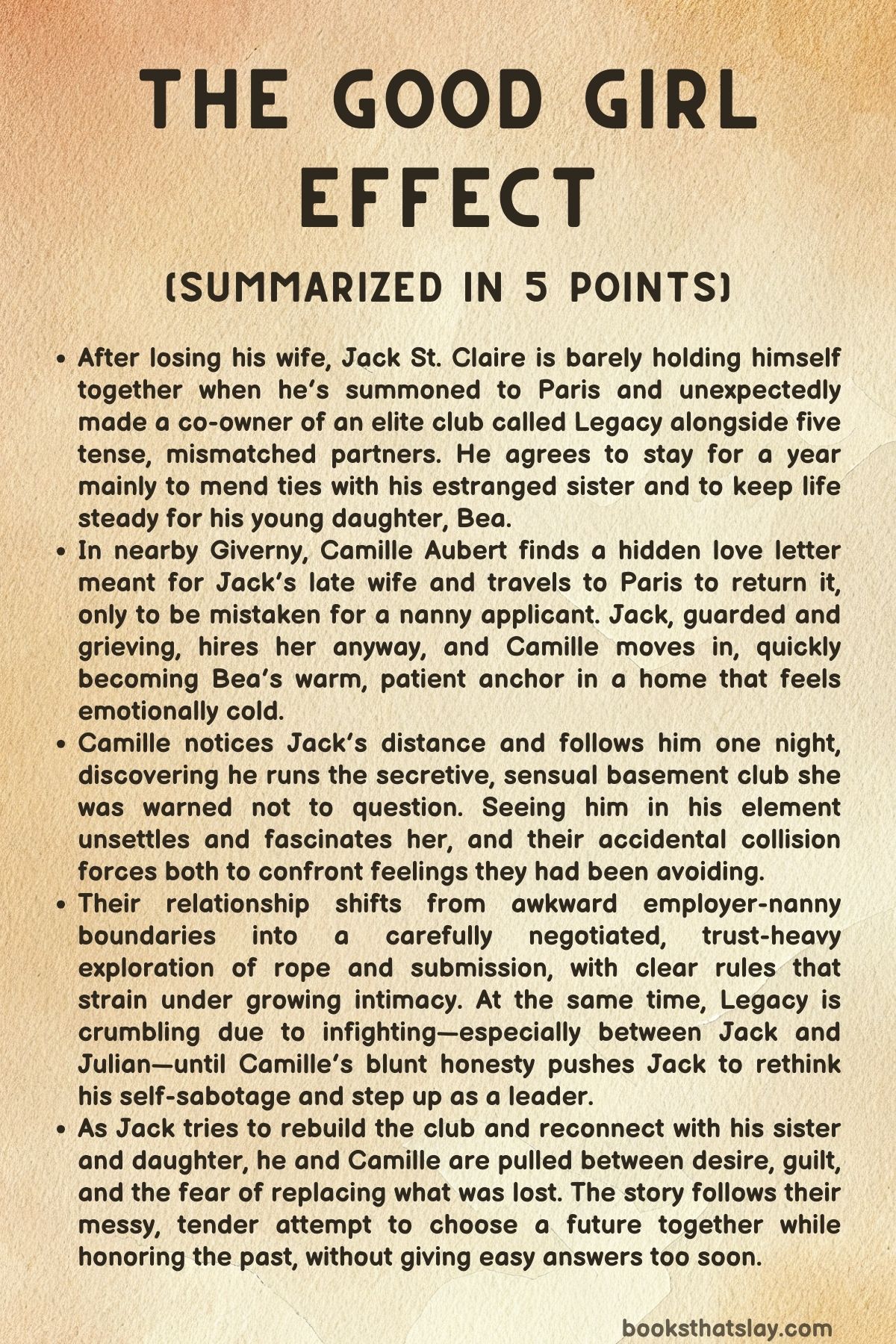
Summary
After receiving a sudden email from his godfather Ronan Kade, Jack St. Claire goes to Geo’s bar in Paris and meets five other people tied to Ronan and the club L’Amour.
With Jack are his best friend Phoenix Scott, coworker Weston, Ronan’s son Julian, Ronan’s daughter Amelia, Jack’s sister Elizabeth, and Ronan’s business partner Matis Moreau. Jack is still raw from the death of his wife Emmaline two years earlier, and he has been planning to leave Paris with his five-year-old daughter Beatrice.
Elizabeth is furious with him for vanishing into grief and leaving her to help raise Bea during the hardest months. Another message arrives while they sit together: Ronan is retiring and handing the sex club over to all six of them jointly.
For a full year they must run it as one team; if any heir quits, ownership reverts to Matis, who will sell the club. Julian rejects the plan and says they will fail.
Elizabeth starts to walk out. Jack stops them.
He sees this forced partnership as his last chance to keep his sister close long enough to fix their bond. He assigns jobs based on strengths, makes Julian his co-manager, and promises that at the end of the year Julian can keep the club if Jack still wants to return to California.
Reluctantly, Julian accepts. They rename the club Legacy and toast a fragile beginning, while Jack privately decides he’ll endure the year only for Elizabeth’s sake, then go home with Bea.
Ten months later, in Giverny, Camille Aubert works in a used bookstore and feels stuck in a small life since her father’s death. She passes her days shelving old paperbacks and absent-mindedly drawing tiny animals inside their covers.
One afternoon she finds an envelope hidden in a romance novel. It is addressed to Emmaline Rochefort and contains a photo of Emmaline with a man, plus a love letter signed “Jack.” Camille reads a few lines, then searches online and learns Emmaline died two years ago and had been married to an American named Jack St. Claire.
Feeling responsible for the lost letter, Camille takes a train to Paris to return it.
At Jack’s Montmartre apartment, a red-haired American woman answers. Assuming Camille is there to interview for a nanny position, she introduces herself as Phoenix Scott and pulls Camille inside.
Camille, startled and oddly curious, plays along. She fills out forms, wanders upstairs, and is caught by Jack’s cold stare.
Despite the awkwardness, Bea instantly likes Camille and proudly shows her room full of fairy art and unicorn toys. Camille leaves convinced she ruined her chance.
Days later, Jack appears at her bookstore. He says Bea liked her, he has already checked her background, and she starts Monday as a live-in nanny.
His tone is blunt and wary, but the offer is real. With no strong reason to stay in Giverny, Camille goes.
In Paris, Phoenix gives Camille the rules: follow Bea’s schedule, speak English only with her, and do not go upstairs where Jack lives. Camille settles into routines quickly.
She shops for groceries, cooks actual meals, dances in the kitchen with Bea, and draws with her at night. Jack keeps himself distant, often upstairs or out late, speaking to Bea in stiff fragments.
When Camille plays music too loud and burns rice on her first day, Jack storms in, shuts down the noise, snaps at her for speaking French, and questions her reliability. Camille refuses to shrink, and Jack retreats, leaving her shaken but also strangely proud of herself.
Over time, Camille sees how hard Bea works to be brave in a house where her father feels like a shadow. Camille’s affection becomes Bea’s anchor.
On her first evening off, Camille wanders Montmartre alone. Late at night she spots Jack moving through the streets with purpose and follows him, half out of worry and half out of fascination.
He enters a discreet nightclub. Inside, a bartender recognizes Jack as the owner and hints he is downstairs.
Camille rides a guarded elevator into a narrow hallway marked “Legacy” and discovers the private sex club. The air is low-lit and intimate; patrons are openly engaged in erotic play.
A staff member offers her a quick tour, pointing out VIP booths, private rooms, and a BDSM space. Drawn by curiosity she steps into that area and watches from a booth.
There she sees Jack shirtless, handling rope with calm control as a woman kneels before him. His voice is steady and intimate as he calls her a “good girl.” Camille is stunned by both the scene and her own reaction. Jack looks up, sees Camille, and explodes.
He drags her out, furious, and orders her home. Humiliated, Camille obeys, but the image of him stays with her.
Back at the apartment the tension thickens. Jack avoids her even more, yet small cracks appear.
Camille meets Elizabeth at a craft fair when Bea runs to hug her. Elizabeth is warm and sharp, fluent in French from Emmaline’s teaching, and she soon begins taking Bea to ballet.
When Jack finds out, he becomes icy and protective, and Camille realizes he is terrified of losing control over anything tied to his daughter. One night she hears him pacing and finds him near tears in the hallway.
He steps close, touches her face, whispers that hiring her was a mistake, and leaves her rattled. The next morning Camille breaks Phoenix’s rule and enters Jack’s floor.
She finds his office and a photo of Emmaline pregnant. She also finds a rope room with hooks and gear.
Jack catches her but, instead of throwing her out, he shows her the ropes, lets her touch them, and warns her never to go upstairs again.
Camille cannot stop thinking about what she saw. She researches rope bondage online and reads one of Jack’s old letters to Emmaline, filled with longing.
Impulsively, Camille writes her own letter asking Jack to teach her what submission in rope feels like. Jack is thrown off but also drawn in.
He replies with explicit boundaries and a clear description of what a lesson would involve, asking if she truly wants it. Camille answers yes.
Their first session happens at midnight in the rope room. Jack is careful, methodical, and unexpectedly gentle.
He explains safety, trust, and how rope quiets his mind. He binds Camille’s wrists, checks her comfort, and uses touch and voice to guide her into a new sense of surrender.
The dynamic ignites something fierce between them. They agree on rules—no full sex, keep work separate—but desire keeps pushing at the edges.
In later scenes at the club, Jack ties Camille in front of others, bringing her to orgasm through restraint and controlled teasing. Afterward he is attentive, unbinding her slowly and caring for her body.
Between sessions they talk more honestly. Camille challenges Jack about Legacy’s failing state and his passive sabotage of Julian.
Her bluntness forces him to see he is betraying Ronan’s wish.
A dangerous fight breaks out at the club because Julian ignored safety limits. Jack shuts Legacy down for the night, and Matis confronts Jack and Julian afterward, calling out their pride and grief-driven stubbornness.
Jack finally admits to himself he has been punishing the club and his own life. Soon after, Camille comforts him in a moment of collapse, and they cross their line into full sex.
Both know it complicates everything, yet neither wants to stop. The next morning Jack decides to rebuild Legacy properly.
He apologizes to Julian, proposes a four-week closure and a relaunch with a more intentional, romantic vision, and Julian agrees. The six heirs begin to work as a real team.
During a public rope demonstration, Jack realizes Legacy is not just about erotic escape but about belonging. Swept up by that clarity and his bond with Camille, he tells her he loves her.
She returns it, and for a brief stretch they feel like a family with Bea at the center. But the past strikes again when Jack finds the old letter to Emmaline in Camille’s drawer and recognizes her doodles inside.
Camille explains she found it in her bookstore and never planned to deceive him. To Jack, still haunted by loss, it feels like betrayal.
He fires her in anger, then retracts it when Bea panics. Their home becomes silent.
Jack spirals into drinking and avoidance, while Camille focuses on Bea and prepares herself to leave.
Elizabeth intervenes. She tells Camille how Jack disappeared after Emmaline died and how alone they all were.
She confronts Jack too, insisting Emmaline’s cancer was not his fault. Jack finally breaks.
He starts counseling, visits Emmaline’s memorial with Bea, and decides he wants a future that includes living, not just surviving. On Christmas Eve Camille plans to go back to Giverny.
Jack asks her to stay and gives her a gift to open alone. In a café at the station she opens it: her jewelry box with a letter from Jack apologizing, admitting he loves Camille as herself, and asking to build something real together.
She misses her train while reading. Jack arrives with Bea to bring her home, only to find Camille already there.
They reconcile, Bea overjoyed, and Camille stops being “just the nanny.
They attend a holiday party where the Legacy group welcomes Camille openly. Julian apologizes for meddling, and Camille finally feels what it’s like to be part of a chosen family.
Later that night Jack and Camille return to the rope room, sharing a quiet tie and then making love, no longer hiding from what they are to each other.
Two years later, Jack and Bea arrive at a hospital to meet Camille’s newborn son, Tristan. Bea cradles her baby brother, and Jack reflects on how Camille helped him rebuild his heart, his family, and the club that once felt like a burden.
The story closes with their home full of life again, shaped by grief faced directly, love chosen deliberately, and a future they made together.
Characters
Jack St. Claire
Jack St. Claire is the story’s emotional axis: a man shaped by loss, responsibility, and a stubborn instinct to control what feels uncontrollable.
When the novel opens, he is still living inside the crater left by Emmaline’s death, functioning more out of obligation than desire. His grief isn’t theatrical; it’s numbing and evasive, showing up in how he ghosts his own home, how he keeps Bea at arm’s length, and how he quietly plans to endure rather than live.
The inherited club becomes a mirror for this avoidance. Jack pretends pragmatism, but his early willingness to let Legacy fail is grief weaponized into self-sabotage, a way to punish the world and himself at once.
Yet beneath that rigidity is a deeply principled man with a tender, almost reverent view of intimacy and care. In the BDSM space, he is attentive, patient, and ethically grounded, using structure and consent as a refuge from chaos.
Camille’s arrival threatens his carefully sealed grief, not just because he wants her, but because she sees him clearly and refuses to shrink around his pain. His arc is about learning that love after loss is not betrayal and that leadership—of a club, a family, a self—is not control but presence.
By choosing therapy, reconciling with Elizabeth, and reimagining the club’s purpose, Jack moves from surviving to rejoining life, allowing desire, family, and community to be rebuilt rather than merely preserved.
Camille Aubert
Camille begins as someone paused in mid-life, stranded between a dead father’s absence and a future she can’t picture. Her used bookstore job and her habit of doodling animals in margins show both her quiet creativity and her longing to leave some small mark in a world that feels indifferent.
Finding Emmaline’s letter is less a plot accident and more a thematic invitation: Camille is drawn toward unfinished stories and feels compelled to set them right, even if it costs her comfort or safety. That compulsion becomes her defining trait—she moves toward truth even when it implicates her.
With Bea, Camille’s warmth is instinctive, but her nurturing is not naïve; she notices the emotional vacuum in the apartment and fills it deliberately, building routines, affection, and joy where there had been scarcity. Her relationship with Jack reveals another side of her: curiosity that turns into awakened desire, and a surprising appetite for surrender that coexists with her natural stubbornness.
Camille is not a passive “good girl” archetype; she wants the dynamic, interrogates it, and chooses it on her own terms. She also becomes Jack’s moral counterweight, calling out his sabotage and demanding he stop using grief as a shield.
At her core, Camille is a builder—of trust, of family, of selfhood—and her journey is about stepping out of stagnation into chosen belonging, not as a replacement for Emmaline but as a singular, undeniable love.
Beatrice (Bea)
Bea is small but pivotal, embodying the cost of adulthood’s unprocessed grief. She is perceptive and emotionally starved, used to a father who exists more like a silhouette than a caretaker.
Her instant attachment to Camille is not mere childlike charm; it’s a survival response to warmth after a long winter. Bea’s bilingualism and her fairy-unicorn world hint at resilience, imagination, and a quiet effort to comfort herself when adults cannot.
She also functions as the story’s truth-teller in miniature—her wish that Camille were her mother, her excitement at their reunion, and her blunt clarity about Emmaline’s death force Jack to confront realities he would rather avoid. Bea’s needs create ethical stakes for every adult choice, turning Jack and Camille’s romance from private indulgence into a question of what kind of home they will build.
By the end, Bea’s joy is the clearest sign of healing: she gets not only a present father and a beloved step-figure, but a family that feels alive again.
Phoenix Scott
Phoenix Scott is the steady fire in the background—competent, blunt, loyal, and emotionally braver than most of the people she’s trying to hold together. As Jack’s best friend and business partner, she serves as his first tether to life, even when he resists it.
Her initial “English-only” rules and warnings to Camille read like strict professionalism, but they’re also protective boundaries erected around a man Phoenix has watched unravel. Phoenix is the kind of friend who doesn’t indulge self-pity; she confronts Jack’s spirals with exasperated love, demanding he show up for Bea, the club, and himself.
She carries the practical weight of Legacy’s survival, which highlights her reliability and the emotional labor she performs for others. Phoenix also provides a more pragmatic model of intimacy and partnership, contrasting with Jack’s grief-infused intensity.
She isn’t a romantic obstacle or comic sidekick; she’s a stabilizing force whose loyalty is not quiet compliance but active intervention.
Julian Kade
Julian is volatility wrapped around a wounded son’s pride. As Ronan’s child and co-heir, Legacy is for him both inheritance and battlefield, a place where unresolved anger toward his father can be acted out without being named.
His early hostility toward Jack is thick with fear: fear of losing control, fear of being displaced, fear that the club’s future will confirm his father’s failures or his own. Julian’s mismanagement isn’t stupidity so much as reckless self-assertion—he pushes capacity, ignores safety, and resists shutdowns because order feels like surrender.
Yet Julian isn’t a villain; he’s a man grieving a living father’s emotional distance, lashing out because cooperation would require vulnerability he doesn’t yet trust. Matis’s confrontation forces him to see that his rebellion has become self-harm by proxy.
Once Jack meets him in honesty rather than rivalry, Julian steps into a more mature leadership role, showing that his anger was never about the club’s existence but about wanting to matter within it. His apology and later warmth toward Camille signal a real shift: Julian begins to want community more than conflict.
Elizabeth
Elizabeth is grief’s other face in the novel: the one who kept moving when Jack stopped. As Jack’s estranged sister, her resentment is earned, rooted in the months when she was left to shoulder Bea and her own mourning alone.
She is disciplined, high-functioning, and fiercely protective, traits reinforced by her identity as a ballerina. Her poise in French culture and her connection to Emmaline’s memory show someone who sought closeness rather than retreat after loss.
Elizabeth’s role in the inheritance scheme reveals her quiet strategy: she joined Legacy not for power, but as an emotional anchor to keep Jack near long enough to return to himself. She is blunt with him, refusing to let grief become an excuse for abandonment, and she becomes Camille’s unexpected ally not out of sentimentality but because she recognizes Camille as a catalyst for Jack’s healing.
Elizabeth’s arc resolves when Jack finally admits pain in her presence; their reconciliation restores a sibling bond that had been frozen by tragedy, and it positions Elizabeth as both family and conscience in the rebuilt community.
Emmaline Rochefort
Emmaline is physically absent but narratively constant, functioning as memory, wound, and yardstick. Through letters and photographs, she appears as a woman of warmth and romance, someone Jack loved with a kind of total devotion that now terrifies him to risk again.
Her death is not just a plot point; it is the gravitational force shaping Jack’s fear, Bea’s loneliness, and Elizabeth’s bitterness. Emmaline’s presence in the hidden letter also symbolizes unfinished love—Jack’s old words are beautiful but frozen in time, and they threaten to trap Camille in comparison.
Importantly, Emmaline is never treated as a rival to Camille; instead, she represents the truth that love can be real, devastating, and still not the end of a person’s story. Jack’s healing requires honoring Emmaline without living inside her shadow, and Camille’s self-worth requires being loved as herself.
Emmaline’s legacy, then, is not the man she left behind in grief, but the family he ultimately dares to rebuild.
Matis Moreau
Matis is the hard-edged mentor figure who refuses to let grief or ego disguise incompetence. As the club’s original co-owner and the one who can reclaim Legacy if they fail, he embodies consequence.
Matis’s value in the story is his clarity: he sees through Jack and Julian’s mutual sabotage and names it without softness, forcing them to confront the ways they’ve been using the club as an emotional proxy war. He is older, battle-tested, and uninterested in their excuses, which makes his approval meaningful when they finally choose to lead together.
Matis also represents the club’s deeper ethos—sex as community, structure as safety, pleasure as belonging—so his disappointment is less about profit and more about betrayal of purpose. His role is brief but catalytic, pushing the heirs toward maturity and restoring the club to what it was meant to be.
Ronan Kade
Ronan is the absent architect of the entire story. Even in retirement, his decision to hand the sex club to six heirs jointly is a deliberate, almost parental gamble on reconciliation.
He understood that Legacy was not merely a business but a bond between misfit family members, and his inheritance terms force them into proximity where healing might occur. Ronan’s influence is felt in Julian’s anger, Jack’s sense of duty, and Elizabeth’s hope that the arrangement could keep her brother from fleeing grief.
He represents a belief that chosen family can be built through shared responsibility, and though he is not on page much, his legacy is the structure that makes every transformation possible.
Amelia Kade
Amelia functions as part of the original heir group and a quiet reminder that not all conflicts are loud. In the early setup she is present, absorbing the shock of the inheritance and witnessing the fractures among the group.
While the summary doesn’t track her closely afterward, her role matters symbolically as another strand in Ronan’s web of family, someone whose life is entangled with Legacy whether she seeks it or not. She helps define the club as a collective inheritance rather than a battleground between men, and her presence broadens the sense of Legacy as community beyond Jack and Julian.
Weston
Weston is one of the heirs positioned as a coworker within the Legacy ecosystem, and his main narrative function is to underscore the club’s nature as a collaborative venture among people with different skills and baggage. Even without a foreground arc in the summary, Weston’s inclusion in the inheritance emphasizes that this is not a simple family handoff.
He represents the professional, operational stakes of keeping Legacy alive and highlights how the club’s survival depends on teamwork rather than any single protagonist’s will.
Tristan
Tristan appears at the end as the living emblem of renewal. He is not developed as a character yet, but his birth completes the book’s emotional logic: love after grief can create something new without erasing what came before.
Tristan’s arrival reframes the entire journey as generational healing—Bea gains a sibling, Jack becomes a father who stays, and Camille’s once-stalled life expands into a future she actively chose.
In that final scene, Tristan is less a plot extension and more a proof of concept for the title’s “good girl effect”—that trust, surrender, and love can reshape a broken life into a thriving one.
Themes
Grief, avoidance, and the slow choice to live again
Jack’s life is shaped by loss long before Camille arrives. Emmaline’s death has frozen him in a narrow routine where survival replaces connection.
He keeps to the upstairs rooms, moves through the apartment like a stranger, and treats fatherhood as another duty he is failing. His grief shows up less as tears and more as numbness, control, and distance.
The apartment’s silence, the sparse kitchen, and Bea’s quiet acceptance of his absence all underline how grief can make a home feel like a waiting room. Camille’s presence interrupts that stasis.
She doesn’t heal him by offering simple comfort; instead, she keeps pointing to what grief has taken from Bea and from Jack himself. Her insistence that Bea should take ballet, her anger at his withdrawal, and even her curiosity about his hidden life all force him to look at the parts of himself he has tried to lock away.
The story treats mourning as something that can be postponed but not escaped. Jack’s guilt is another expression of avoidance: if he can blame himself, then he can stay in punishment instead of moving forward.
When Phoenix and Elizabeth confront him, the narrative draws a clear line between remembering love and living inside a tomb of responsibility. Therapy is not shown as a magic fix; it is shown as the start of honest pain, the kind that finally allows movement.
By returning to Emmaline’s memorial park with Bea, Jack chooses remembrance without self-erasure. He isn’t asked to stop loving Emmaline; he is asked to stop using that love as a reason to disappear.
Camille’s refusal to be a substitute is crucial here. She demands to be seen as a full person, and that demand becomes part of Jack’s recovery.
In the end, grief becomes integrated into a larger life rather than dominating it. The two-year epilogue, with their newborn son and Bea’s joy, shows that healing is not forgetting, but building a future that can hold the past without collapsing under it.
Desire, power, and the meaning of being a “good girl”
Sexuality in The Good Girl Effect is never only about pleasure; it is a language for identity, permission, and control. Jack’s role in Legacy is tied to calm authority and careful dominance, and those scenes reveal how he uses structured power to manage emotions he cannot handle elsewhere.
Rope and restraint give him a space where rules are clear, consent is explicit, and chaos is held at bay. For Camille, the first encounter in the club is shocking not because it is erotic, but because it shows a side of Jack that is present, focused, and tender in a way she has not seen at home.
Her fascination grows into desire partly because submission offers her something she lacks in her everyday life: a way to feel chosen, guided, and safe inside intensity. The phrase “good girl” becomes a layered symbol.
On the surface, it is a kink-based affirmation, but it also challenges the moral pressure often attached to female sexuality. Camille is not rewarded for obedience to social rules; she is rewarded for honesty about what she wants.
The narrative reclaims “good girl” as a title earned through trust and courage rather than through purity or self-denial. At the same time, the story is careful about boundaries.
Their early rules against intercourse are less about prudishness and more about recognizing the danger of mixing need, grief, and employment. When those rules collapse, it isn’t framed as reckless passion alone; it is framed as the truth finally breaking through a structure that could not contain their feelings.
The audience at the club matters too. Public scenes highlight how desire can be witnessed without shame when consent anchors the space.
Legacy becomes a community not because it sells sex, but because it offers belonging to people who often hide what they want. Jack’s realization during the suspension performance shows that dominance and submission are not about harm or hierarchy in daily life; they are about chosen roles that allow people to meet each other more fully.
The book refuses to treat erotic power as a gimmick. Instead, it uses it to explore how intimacy can be both physical and emotional, how control can coexist with care, and how a woman’s desire can be active, curious, and proudly voiced.
Family, legacy, and rebuilding a home that works
The inheritance of the club sets up a broader question about what people owe to each other when blood, history, and responsibility collide. Jack, Elizabeth, Julian, and the others are tied together by Ronan’s final demand: stay, work, and learn how to rely on one another.
That condition turns Legacy into more than a business; it becomes a test of whether fractured relationships can be repaired through shared purpose. Jack initially agrees for a selfish-yet-human reason: he wants time near Elizabeth to try to fix what grief broke.
Julian resists because he reads the inheritance as manipulation and fears being trapped in a family role he never asked for. Their conflict shows how legacy can feel like love to one person and a cage to another.
Yet the year requirement also creates a kind of forced honesty. The club fails not because the idea is bad, but because the heirs are busy fighting old wars.
Matis’s blunt intervention makes the theme explicit: legacy isn’t something you protect by clinging to pride, but something you honor by learning to lead together. Parallel to this is Bea’s quiet storyline.
She is the emotional center of the home, and her needs keep exposing the adults’ failures. Camille steps into maternal care without erasing Emmaline, giving Bea stability, language, play, and affection that her father cannot yet offer.
The book treats parenting as more than biology. Camille becomes family to Bea through daily acts of attention, and Bea’s wish for Camille to be her mother is framed as a child recognizing love, not a child rejecting the past.
Elizabeth’s role strengthens this theme by showing sisterhood as another kind of parenthood: she has been holding Bea and Jack together while grieving her own losses. When Jack finally reconnects with Elizabeth, their repaired bond is part of rebuilding the household.
The club’s relaunch mirrors the home’s renewal. Both spaces move from cold control and sabotage into intentional care.
By the Christmas Eve reunion, family in the story includes friends, coworkers, and lovers who choose to stay. The epilogue confirms that legacy is not strictly what Ronan left behind; it is what Jack and Camille create: a home where Bea is not left waiting downstairs, where love is spoken, and where the future is actively built rather than passively endured.
Trust, truth, and the risk of being seen
Nearly every turning point in the story comes from a breach or restoration of trust. Camille’s entry into Jack’s life begins with a small lie, a nervous improvisation that leads to a job she never meant to seek.
Even though her motive is to return a letter, the concealment plants a seed of doubt that later explodes. Jack’s own trust issues are older and deeper.
He has trained himself to expect abandonment through death, so he keeps people at a distance, believing detachment is safer than hope. This is why his reaction to seeing Camille in the club is so fierce: it isn’t only about privacy, but about fear that something precious has crossed into a part of his life he doesn’t understand how to share.
As their relationship grows, communication becomes both the problem and the solution. Their letters are a key device because they allow honesty without interruption.
In writing, Jack can be clear about desire and fear, and Camille can ask for what she wants without shrinking. Those letters show that trust is built through explicitness, not through guessing.
Yet spoken conflict still matters. The fight over Bea’s ballet lessons is painful, but it also forces Jack to admit the truth of his absence.
Camille refuses to accept silence as love, and her refusal pulls Jack into reality. When Jack discovers Emmaline’s letter and connects it to Camille, his sense of betrayal is understandable even if his response is harsh.
The narrative does not excuse him, but it explains him: he sees a pattern of hidden truths and panics that he is being replaced or manipulated. Camille’s response is equally anchored in trust.
She will not beg to be a shadow of Emmaline; she insists that love must include full acknowledgment of who she is and how she entered his life. Trust finally rebuilds when Jack stops demanding perfection and starts offering accountability.
Therapy, the apology letter, and his public introduction of Camille as his girlfriend are all acts of letting himself be known. Camille, in turn, trusts that his love is not a grief reflex when he shows sustained change rather than temporary passion.
By the end, trust is presented as a daily practice: telling the truth early, staying through anger, and choosing to see each other clearly even when that clarity hurts. The love story works because it is not based on rescue fantasies, but on two people deciding that honesty is worth the risk.