What Fury Brings Summary, Characters and Themes
What Fury Brings by Tricia Levenseller is a fast-paced fantasy romance set in a matriarchal kingdom at war with its patriarchal neighbor. Princess-General Olerra Corasene is a feared Amarran commander who wants the crown, but her cousin Glenaerys is an equally ruthless rival.
To outmaneuver Glen politically, Olerra decides to seize a Brutish prince and force a strategic marriage that will win noble support. Instead, she captures Crown Prince Sanos, heir to an abusive king. What follows is a tense mix of power games, culture clash, and an uneasy attraction that grows into partnership amid looming invasion and court betrayal.
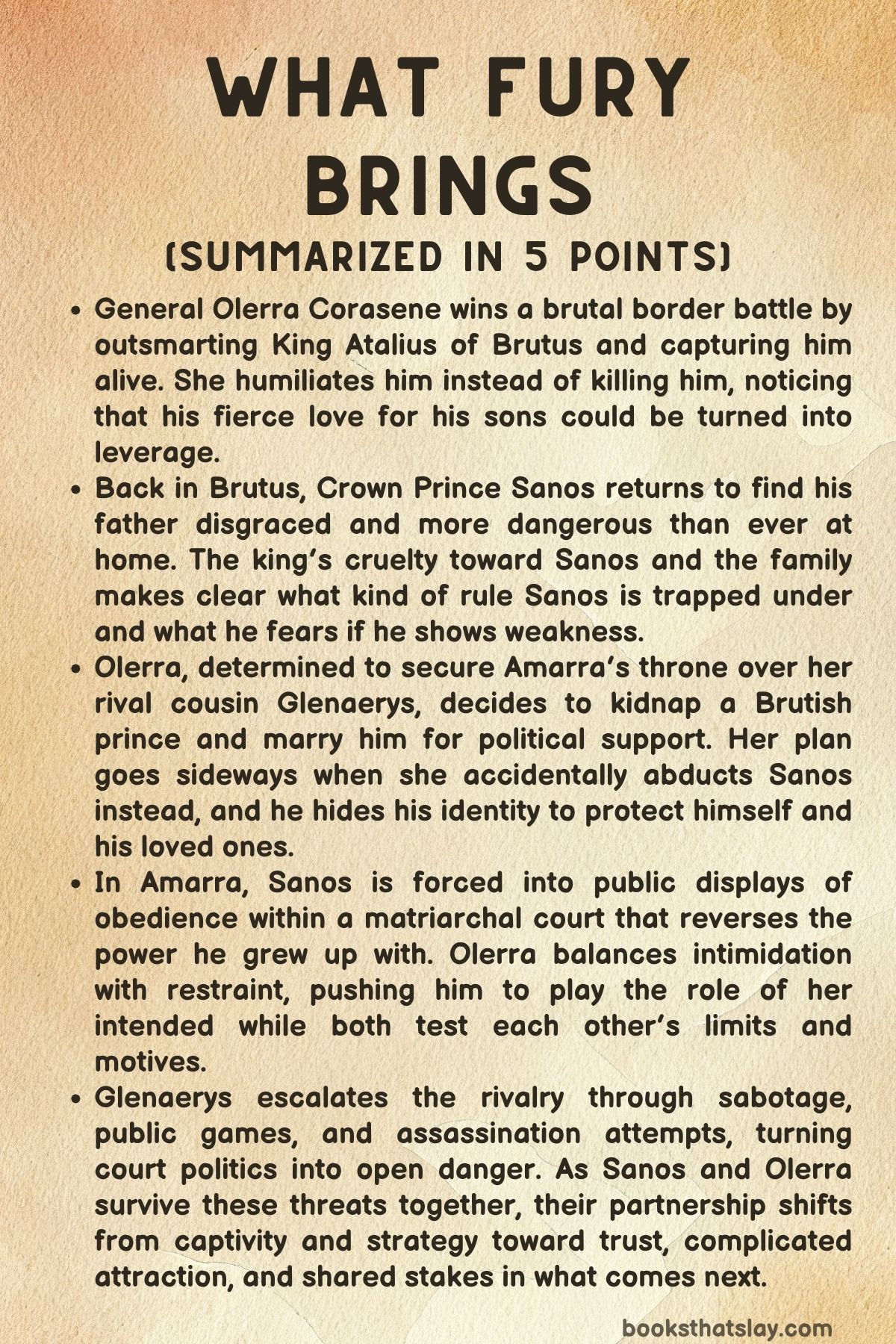
Summary
General Olerra Corasene defeats the Brutish army at the border city of Shamire by baiting King Atalius into a trap and knocking him unconscious in battle. She treats the wounded afterward with a soldier’s practicality, then questions Atalius in her tent.
He refuses to bargain for his sons, which convinces Olerra that his heirs are his true weakness. Rather than kill him, she humiliates him and sends him home naked, planning to use his family ties later.
Olerra returns to Amarra determined to secure her claim to the throne over her cousin Glenaerys, a wealthy noblewoman skilled at public manipulation.
In Brutus, Crown Prince Sanos comes home to find his father displayed in disgrace. Atalius explodes in rage and takes it out on Sanos, accusing him of wanting power too soon.
The king’s cruelty is routine: he torments Sanos with threats against his mother and sister, recalls past punishments, and beats his sons under the excuse of “training. ” Sanos’s mother Ferida quietly longs for Atalius’s reign to end, but she and the princes are trapped by his violence.
Olerra proposes a bold plan to Queen Lemya: kidnap one of Atalius’s sons, marry him, and gain the political advantage needed to be named heir. Lemya approves, and Olerra targets Prince Andrastus, described as handsome and easy to control.
To keep Glenaerys from interfering, Olerra feeds her cousin false information about where she will strike.
On Sanos’s birthday, Brutish princes celebrate hard and stumble into Blanchette’s brothel. Olerra arrives disguised, intending to seize Andrastus, but Sanos takes the woman’s appointment when his brother is too drunk.
In a private room, Olerra flirts with Sanos believing he is Andrastus, then poisons him with a paralytic. She steals him away in a cart before he can speak.
Once he understands he’s been taken by Amarra, Sanos chooses to hide his identity. If Atalius learns the truth, he might refuse to ransom him or even kill his family to punish him.
During the rough trip to Amarra, Sanos resists with every scrap of pride he has. Olerra answers defiance with control and clear threats: his survival depends on her success.
In the capital, Olerra stages a public “arrival” to show the court she owns a Brutish prince. Sanos is shaved, waxed, dressed in revealing Amarran clothing, and chained in her rooms.
Olerra explains Amarran sexual law and admits she is a virgin preparing for marriage. She promises she won’t force him, but she still expects obedience.
Sanos refuses to cooperate, furious at the humiliations and the mistaken name she calls him. Olerra shifts tactics from seduction to strategy, needing the prince to appear compliant so nobles will believe her match is legitimate.
In court, Sanos witnesses Amarra’s matriarchal order: noblewomen sit in power while men stand behind them marked by armbands, collars, and jewelry. Olerra parades him before influential women, while a spurned nobleman begs for her hand.
Glenaerys arrives eager to sabotage Olerra’s display and challenges her to prove the prince’s worth through a public fight. She selects Athon, a massive former soldier once tied to Olerra, as her champion.
In the amphitheater, Sanos is forced into naked wrestling. He nearly loses until Olerra coaches him mid-match, and he wins to roaring cheers.
The victory strengthens Olerra’s political standing and wounds Glenaerys’s pride.
Sanos tries to escape that night, testing the palace’s harem corridors, but Olerra anticipates him and defeats him handily. She makes his punishment another performance: leash, clamps, and forced kneeling at breakfast to reinforce her dominance in front of the court.
She then takes him through the Pleasure Market, exposing him to Amarra’s harsh justice and the controlled sexual economy men live under. Sanos is horrified by the punishments for male violence, especially a brutal sentence for rape, but Olerra insists the system exists to prevent the abuses women once suffered.
Her goal is not to terrorize him personally but to make him understand Amarra’s rules.
Glenaerys plots relentlessly. After Sanos accidentally injures her during a conflict, she demands he be punished.
Olerra steps in and takes the sentence herself, enduring a savage beating without pleading. Sanos watches, shaken by the fact that she chose pain to save him.
During recovery at Ydra’s estate, he learns Ydra’s “harem” is a shelter for boys she rescued, which complicates his view of Amarra. When Sanos is allowed to see Olerra again, gratitude mixes with resentment.
Olerra tells him bluntly that she protected what is hers.
Once she returns to the palace, Olerra works to repair her reputation and publicly display control over her captive. Glenaerys escalates to murder: she arranges an ambush during Olerra’s carriage tour.
Olerra tosses Sanos the key to his shackles so he can survive if she falls, and she fights alone. Sanos frees himself and kills an attacker who is about to spear her.
That night, attraction and adrenaline push them into sex, leaving Sanos unsettled by his desire and Olerra wary about trust.
Sanos begins training with Olerra’s soldiers, earning respect. Olerra declares him her seul—her only chosen partner—to sway nobles.
Glenaerys responds by privately summoning Sanos, offering freedom if he murders Olerra. She gives him a knife and orders patience.
Sanos pretends to agree but hides the weapon and keeps it as leverage, increasingly unsure of where his loyalty lies.
At Glenaerys’s grand party, she tries to humiliate Olerra by demanding Sanos perform for the court. Instead, he delivers a flawless knife act, even pinning an apple in Glenaerys’s hand without drawing blood.
His success wins over wavering nobles. Later, alone with Olerra, Sanos confesses Glenaerys’s assassination plot and hands her the hidden knife.
Their alliance becomes real intimacy, and Olerra begins to believe he may stand beside her by choice.
Their growing bond is interrupted when Glenaerys storms in with Athon and forces a test of Olerra’s supposed divine strength. Olerra can’t move Athon, revealing she is Giftless.
The court gasps, and Olerra is humiliated. Sanos defends her courage, but Glenaerys presses further.
Under the pressure, Sanos confesses his own secret: he is not Andrastus but Crown Prince Sanos. He took his brother’s place the night of the kidnapping.
Olerra feels betrayed and orders him removed. Seeking to control the fallout, she plans to trade Sanos for Andrastus and sends a taunting ransom note.
Before the exchange can happen, Atalius marches on Amarra with a massive army, far too quickly for a normal ransom response. Olerra realizes Glenaerys must have warned him, aiming to trigger war and ruin Olerra’s claim.
Olerra rallies her troops and publicly admits her Giftlessness. Her soldiers stay loyal because her victories were never based on magic alone.
She and Queen Lemya fortify the city and prepare to expose Glenaerys’s treason.
At the main gate, Olerra brings Sanos dressed as her intended husband and threatens him to provoke Atalius. She reads Atalius’s strategy aloud, revealing she knows about a southern force meant to enter through a gate Glenaerys would open.
She then challenges Atalius to single combat for Sanos’s fate. During the duel, Olerra takes wounds but pushes Atalius into boasting that he doesn’t need Glenaerys’s help.
The admission gives Lemya grounds to arrest Glenaerys for conspiracy. Olerra finishes Atalius with her whipblade, condemning his abuse of his family before killing him.
With Atalius dead, Sanos becomes king and orders his army to stand down. He sends his brother to retrieve their mother and sister before the kingdom collapses into chaos.
Olerra is healed and returns to court as a hero. Glenaerys is tried, found guilty, and stripped of power; her mother Shaelwyn is executed after confessing she murdered Olerra’s parents to clear Glenaerys’s path.
Olerra disowns her cousin and ends their bond for good.
At the Goddess’s Gift anniversary, the council and nobles vote almost unanimously to name Olerra crown princess despite her lack of divine strength. Peace with Brutus now rests on her marriage to Sanos, and both want a partnership built on equality rather than domination.
Their wedding is celebrated in Amarran style, binding them publicly as rulers and chosen partners, ready to lead their kingdoms together.
Characters
General (later Crown Princess) Olerra Corasene
Olerra is introduced as a battlefield commander who combines tactical patience with ruthless improvisation, and that mix defines her through the whole story. She’s fiercely competent even without the supernatural strength Amarran women are expected to have, which makes her drive to prove herself feel both personal and political.
Her ambition isn’t framed as vanity; it’s a survival instinct in a court where status depends on spectacle, lineage, and relentless dominance. That pressure hardens her into someone who can humiliate a king on one day and organize mercy for wounded enemies the next.
The contradiction is the point: Olerra believes power should be earned through discipline and strategy, not cruelty for its own sake, and she constantly measures herself against that ideal. Her early plan to kidnap and marry a Brutish prince shows her pragmatism and willingness to weaponize patriarchal expectations in reverse, yet she draws a line at rape or murder-as-shortcut.
As her relationship with Sanos deepens, we see her vulnerability—not as softness in battle, but as emotional risk. The revelation that she is Giftless threatens her entire identity, but instead of collapsing into shame, she reframes worth around choice, loyalty, and earned respect.
By the end of What Fury Brings, Olerra’s arc is a rebirth from “the woman trying to become a symbol” into “the ruler who decides what the symbol should mean,” insisting on partnership and equity even in a culture built on hierarchy.
Crown Prince (later King) Sanos
Sanos begins bound to fear, not weakness—fear of his father’s brutality and of being trapped in the role of heir. His inner life is defined by constant calculation: which truth to hide, which reaction will keep his family alive, which humiliation is safer to endure.
That makes his kidnapping especially sharp, because even captive he keeps performing survival, concealing his identity to avoid becoming a disposable bargaining chip. Under Olerra’s control, Sanos’s pride fights his instinct to endure; he refuses to be reduced to a decorative husband, yet he’s also perceptive enough to read Amarran politics and slowly realize Olerra is not Atalius in a different costume.
His growth is a shift from reactive endurance to chosen allegiance. He starts by seeking escape, then moves into reluctant respect, and finally into active partnership—training with her soldiers, defending her publicly, and turning Glenaerys’s assassination order into a confession of loyalty.
The emotional core of Sanos is his hunger for a relationship that isn’t built on terror. With Olerra he finds conflict without sadism, dominance without contempt, and intimacy that asks for consent rather than obedience.
When he reveals his identity, it’s both a betrayal and a liberation, forcing him to stop hiding behind a mask even if it costs him safety. By the finale, Sanos becomes king not because he seizes power, but because he outgrows fear and chooses a different model of rule—one that mirrors Olerra’s insistence on earned authority and shared strength.
King Atalius of Brutus
Atalius is the novel’s embodiment of violent patriarchy clinging to relevance. On the battlefield he’s a terrifying relic—skilled, tireless, and unyielding—yet his greatest wars are fought at home against his own children.
He rules through humiliation and unpredictability, making love and loyalty impossible because everything becomes a test of submission. His cruelty is not incidental; it is the structure of his identity.
The memories Sanos carries—killing a puppy, forcing a child to execute a friend, threatening his family—show Atalius using trauma as governance. He fears aging and replacement, and that fear curdles into paranoia that poisoned his relationship with Sanos long before Amarra entered the picture.
Even his refusal to trade his sons reveals a twisted form of attachment: he values them as extensions of his legacy, not as people. In the end, Atalius’s downfall is less about losing a duel and more about being exposed.
Olerra goads him into publicly admitting his dependence on conspiracy and his dishonor, stripping away the image he depends on. His death feels like the collapse of a regime built on terror, and it clears space for Brutus to become something other than its king’s rage.
Princess Glenaerys
Glenaerys is Olerra’s mirror turned inside out. Where Olerra seeks legitimacy through accomplishment and restraint, Glenaerys seeks it through manipulation, spectacle, and the thrill of pain.
She understands power as appetite: if she wants something, she takes it, whether that means buying bodies, humiliating rivals, or lighting wars to force outcomes. Her cruelty is not only strategic but eroticized, rooted in the backstory of her First Night and her near-murder of a man in a brothel.
That moment explains why Olerra refuses assassination as a path to victory; she doesn’t want to become Glen. Glenaerys is also deeply threatened by anything she can’t control, which is why Olerra’s battlefield fame and later her public romance with Sanos become intolerable to her.
She weaponizes other people’s fears—Atalius’s paranoia, court misogyny toward Giftless women, Sanos’s wish to go home—like tools in a kit. Yet she’s not a chaotic villain; she’s a patient conspirator who understands that legitimacy in Amarra can be staged.
Her eventual downfall comes from overconfidence, assuming everyone is as corruptible as she is, and from underestimating the loyalty Olerra inspires. House arrest is a fitting punishment: the woman who thrived on public dominance is caged by the very society she tried to seize.
Ydra
Ydra serves as Olerra’s second-in-command, conscience, and sometimes her harder edge. She’s pragmatic to the bone, urging harsher “housebreaking” because she understands court optics and the danger of looking weak.
But her pragmatism isn’t cruelty for sport; it’s protective strategy in a political arena where a single misstep can get Olerra killed. The reveal of her manor and the boys she shelters reframes her sharply.
The harem is a performance to survive in Amarra, while her real self is quietly nurturing, investing resources in boys society would discard. This duality makes her one of the most morally complex figures: she enforces systems of domination publicly yet undermines their worst outcomes privately.
Ydra also functions as a stabilizer for Sanos, refusing to romanticize his captivity but still drawing boundaries around what is acceptable treatment. Her loyalty to Olerra is fierce because she believes in Olerra’s specific kind of power—earned, strategic, and not fueled by sadism.
Queen Lemya
Queen Lemya is the political axis around which Amarra turns. She appears as a calm, almost ceremonial authority, but she is always measuring the realm’s stability and succession.
Lemya’s support of Olerra’s plan to secure a Brutish husband shows her realism; she’s willing to endorse morally gray tactics if they strengthen Amarra. At the same time, she is not blind to character.
Lemya values Olerra’s restraint and competence, and when Olerra admits being Giftless, Lemya’s response is not to discard her but to watch whether loyalty follows. Her decisive move to arrest Glenaerys during the duel—after extracting Atalius’s confession—shows her as a ruler who waits for certainty and then strikes cleanly.
She embodies statecraft over ego, and by naming Olerra crown princess despite tradition, she signals that Amarra’s future must evolve beyond the myth of the Gift.
Queen Ferida
Ferida is a quiet tragedy threaded through the Brutish court. She lives inside Atalius’s violence with the numb endurance of someone who has learned that open defiance is lethal.
Her tenderness with Sanos after beatings and her muted wish for Atalius’s reign to end are small acts of resistance framed as motherhood. Ferida doesn’t get the narrative space of Olerra or Sanos, but her presence matters because she represents what tyranny costs the people closest to it.
When Sanos sends Canus to retrieve her and his sister after Atalius dies, it underscores that Ferida’s survival is part of the new world Sanos wants to build.
Prince Andrastus
Andrastus is less a full character in the plot than a symbol of what Sanos is not. He’s described as beautiful, pliable, and drunk at the brothel, which is why Olerra targets him—she expects a compliant political prop.
That expectation becomes ironic once Sanos is the captive instead. Andrastus’s off-page identity still shapes the story because Sanos’s pain at hearing his brother’s name highlights how captivity can erase selfhood.
Andrastus also functions as a reminder that Brutish princes are not interchangeable; Sanos’s survival depends on refusing to become the “pretty second son” role Olerra planned for.
Prince Canus
Canus is a smaller presence but emotionally important. He shares Sanos’s childhood under Atalius, enduring the same “training” beatings, which makes him part of Sanos’s trauma and loyalty network.
He appears as a companion in drunken rituals and social bravado, but those moments are shaded by the fact that all their bonding is done under the shadow of a father who can weaponize affection. When Sanos sends him to retrieve their mother and sister, it’s a sign of trust and of Canus’s role as family protector in the fragile transition after Atalius’s fall.
Athon
Athon is a physical and symbolic weapon for Glenaerys. Formerly under Olerra’s command, he becomes Glen’s champion, turning his body into her method of humiliating Olerra.
His size and scars make him a spectacle of male strength repurposed for Amarran entertainment. Yet he’s also a warning about loyalty for hire: he switched sides not because he believed in Glen but because power seduced or compelled him.
His defeat by Sanos in the amphitheater helps validate Olerra’s political strategy, and Glen’s cruel treatment of him afterward shows how she consumes people as props. Athon’s limp, displayed bondage, and silence later emphasize the dehumanizing cost of Glen’s style of rule.
Daneryn
Daneryn is a nobleman whose desperation to marry Olerra reveals the gendered stakes of Amarran power. He wants proximity to her authority, but he frames it as romance, masking ambition under devotion.
Glenaerys later weaponizes him as a drugged consort to destabilize Olerra and Sanos at the party, making him another pawn in her theater of control. Daneryn’s role shows how men in this society navigate survival by aligning with powerful women, and how easily that survival can become exploitation.
Usstra
Usstra is one of the noblewomen who responds to court spectacle with instinctive political calculation. Her approval of Sanos’s barbed remarks and her visible interest in Olerra’s dominance signal how influence spreads in Amarra: not only through lineage but through public performance of control.
Usstra functions as a litmus test for shifting allegiance, representing the nobles Olerra must convince. She’s less a personal figure than a social barometer.
Shaelwyn
Shaelwyn is the hidden root of the rivalry. Her confession that she murdered Olerra’s parents reframes Glenaerys’s ambition as inherited corruption rather than mere personal envy.
She embodies the older generation’s willingness to erase lives to shape succession, and her spite in the trial shows a belief that power excuses atrocity. Lemya’s execution of Shaelwyn is a moral boundary for the new regime: there will be consequences, even for noble blood, and the throne will not be bought with murder.
Shaelwyn’s presence also clarifies why Olerra is so committed to honorable victory—her entire life was shaped by someone else’s dishonor.
The eunuch attendants and Ydra’s rescued boys
Though unnamed, these groups carry thematic weight. The eunuchs represent the machinery of Amarran court life: they enforce ritualized control over men’s bodies, turning dominance into visible custom.
Their later betrayal, when some collaborate with Glenaerys, shows that even institutions built for order can be corrupted by ambition. Ydra’s boys, by contrast, reveal a hidden tenderness beneath the palace’s cruelty.
Their existence exposes the difference between performative harems and real care, emphasizing that the society’s structures are not monolithic; inside them, individuals like Ydra carve out mercy where they can.
Themes
Power, Legitimacy, and the Right to Rule
From the opening battlefield victory to the final council vote, What Fury Brings is driven by a contest over who deserves authority and how that authority is proven. Olerra’s campaign is not simply about winning wars; it is about demonstrating a kind of leadership that her society will recognize as fit for succession.
Her actions after Shamire—tending wounded, organizing the dead, compensating townspeople—show that legitimacy in Amarra is tied to stewardship and responsibility, not just conquest. This stands in direct contrast to the Brutish model embodied by Atalius, whose rule relies on fear, humiliation, and personal dominance.
The story keeps pressing on the difference between having power and earning it. Olerra already holds military command, yet she still lacks secure political standing because the nobility can shift their loyalties based on spectacle, bloodlines, and public perception.
Her kidnapping-and-marriage plan reveals how legitimacy can be transactional and performative: she must gather symbols of strength—like a Brutish prince displayed as her future husband—to compete with Glenaerys’s wealth and manipulation. Even Sanos, the rightful heir of Brutus, learns that legitimacy can unravel when tied to a tyrant; his bloodline gives him claim, but his father’s cruelty poisons the meaning of that inheritance.
The duel at Zinaeya becomes the ultimate test of authority because it forces Olerra to prove her right to rule in the most visible way possible, but also in the most morally charged way—by exposing Atalius’s dependence on treason, condemning his abuse, and ending him publicly. When the council later votes for Olerra despite her lack of the Goddess’s Gift, it underscores that legitimacy has been redefined through her choices, sacrifices, and competence.
The theme argues that rule grounded only in intimidation collapses, while rule grounded in protection, clarity of purpose, and earned trust can survive even when tradition says it shouldn’t.
Gendered Power Reversal and Social Order
The matriarchal world of Amarra is not a decorative backdrop; it is a living system that shapes every relationship, humiliation, and act of resistance in the novel. Men are positioned as property, consorts, or political tools, and the court rituals normalize female dominance in ways that feel both ordinary to insiders and deeply unsettling to outsiders like Sanos.
The narrative uses his shock to show how power structures are learned, enforced by custom, and internalized through daily choreography—who sits, who stands, who wears marks of ownership. Yet the book doesn’t present Amarra as a simple mirror of patriarchy; instead it explores what happens when a society built to prevent one kind of abuse risks creating another.
The Pleasure Market, the bondage displays, and the punishment pit illustrate a world obsessed with controlling male bodies as a corrective to centuries of violence against women. Olerra explains the historical origin in explicitly moral terms: women’s dominance is framed as protection and justice.
Still, the story refuses to let that justification erase the discomfort of coercion. Olerra’s treatment of her captive highlights the tension inside the system: she uses public control to secure her political future, yet privately insists on consent and tries to separate desire from violence.
Sanos’s experience exposes how the reversal complicates identity. He is a warrior prince taught to lead men, but in Amarra he is dressed, handled, and displayed to signal someone else’s authority.
That humiliation is political, but it also forces him to confront how easily any gendered hierarchy can make a person feel reduced to a role. The theme broadens beyond individual scenes to ask what justice looks like after long oppression.
Amarra’s laws are severe because they grew out of survival, and the book acknowledges the historical pain behind them. At the same time, the plot shows that systems built on reversal can still become arenas for cruelty when people like Glenaerys use them for sadism or ambition.
By the end, the partnership Olerra and Sanos aim for—“equals” rather than ruler and kept spouse—suggests a possible evolution beyond reversal toward shared authority. The theme isn’t a claim that matriarchy is automatically righteous; it’s a study of how any social order, even one born from liberation, must keep wrestling with the ethics of control, punishment, and dignity.
Trauma, Abuse, and the Making of Violence
The emotional core of the novel sits in the long shadows cast by abuse, and how those shadows shape what characters believe they must become to survive. Sanos’s memories of Atalius are not just background pain; they explain his vigilance, his secrecy, and his deep aversion to vulnerability.
Atalius’s cruelty—killing a puppy to teach dominance, forcing a child to execute a friend, beating his sons under the label of “training”—shows abuse used as governance inside a family, producing heirs who associate love with threat. Sanos carries that conditioning into captivity: he expects violence as the final answer, assumes that power means harm, and hides his identity because he knows his father would sacrifice him without hesitation.
Olerra’s world is different, but she is also shaped by trauma, particularly betrayal. Her parents’ murder and Glenaerys’s manipulation create a constant pressure to prove herself and to distrust intimacy even while she craves it.
The story repeatedly demonstrates how trauma can feed violence without making violence inevitable. Olerra begins with a strategy of humiliation and ownership against Sanos, reflecting her society’s norms and her political desperation, yet she also draws lines—rejecting forced sex, taking a beating in his place, refusing assassination as a path to the throne.
Those choices show a character struggling against the easiest scripts of power. Glenaerys works as a foil: she channels trauma into cruelty, seeking arousal through hurting others and turning political competition into personal malice.
The contrast between them argues that pain does not excuse harm; it only explains the crossroads a person reaches. The battlefield itself is another arena where trauma reproduces violence.
Both nations have been at war for years, creating leaders who normalize death and revenge. Olerra’s fury when Atalius cuts down her women, and Atalius’s mania when he sees his son controlled, show how trauma can narrow vision until brutality feels like honor.
Yet the novel also makes room for healing through witnessing and accountability. Sanos’s loyalty shifts because Olerra protects him when she could have abandoned him, and because she acknowledges wrongdoing rather than hiding behind tradition.
The killing of Atalius is not framed as triumphant bloodlust but as a moral judgment on a man who turned violence into a family legacy. In showing abuse at personal and national scales, the theme asks whether a world soaked in harm can still produce leaders who refuse to pass that harm forward.
Consent, Desire, and Bodily Autonomy in Unequal Relationships
Captivity and attraction intersect throughout the story, creating a steady tension about what it means to choose intimacy when power is uneven. Olerra’s control over Sanos begins as political strategy, and the early sexualized coercion—parading him, shaving him, restraining him—makes it impossible to ignore that his body is being used as a symbol.
The narrative does not pretend that desire alone cleanses that imbalance. Instead, it tracks how both characters navigate the gap between being bound by circumstance and being drawn to each other.
Olerra’s insistence that she will not force sex matters because it marks a deliberate refusal to turn her authority into violation. Her explanation of Amarran law around women bleeding is also a way the text links bodily autonomy to legal structure; the society has made consent enforceable through extreme consequences.
Still, the book complicates this by showing Olerra herself as inexperienced and uncertain, needing tools to prepare her body because the culture expects women to be invulnerable. The power she holds publicly does not erase private fear.
Sanos’s reactions matter just as much. His arousal under paralysis, his discomfort with pleasure that arrives inside captivity, and his later decision to sleep with Olerra after saving her life all underline that consent is not a single moment but a shifting process of safety, trust, and agency.
The story is careful to show that Sanos’s eventual willingness grows after he gains leverage—he trains with troops, earns respect, rescues Olerra, and is offered room to refuse her. Their intimacy becomes more mutual as the political stakes make them partners rather than owner and asset.
Glenaerys provides a grim counterexample: her desire is fused with harm, and she treats bodies as toys, proving how easily erotic power can become predatory when unexamined. By exploring attraction in the middle of restraint, the theme highlights a difficult truth: the heart can respond even when the mind is furious, but ethical love requires rebuilding the conditions for choice.
The final promise of equality between Olerra and Sanos is meaningful not only politically but bodily; it signals a relationship where desire will not depend on chains, fear, or performance, but on the ongoing ability to say yes—or no—without punishment.
Identity, Performance, and the Masks People Wear
Nearly every major character in the novel is living behind a role, and survival depends on how convincingly that role is performed. Sanos’s first and most dangerous mask is literal: he must pretend to be Andrastus to avoid a fate he believes his father would gladly impose on him.
His identity becomes a negotiation between safety and truth, showing how oppression can force people to split themselves into what they are and what they must appear to be. Olerra is also performing, though in a different direction.
She has to act as the ruthless captor in public because Amarran politics demand displays of dominance. When she threatens Sanos at court or parades him through the city, she is not only disciplining him but also staging an image of strength for watching nobles.
The book keeps reminding us that political reality in this world is shaped by spectacle, and that identity is often a costume worn for the crowd. The discovery that Olerra is Giftless deepens the theme sharply.
She has been seen as a natural embodiment of Amarran female power, yet her lack of the Goddess’s Gift means she has been playing a part she is biologically not supposed to fill. Her fear of exposure is not shallow vanity; it is the terror of losing her future because society equates worth with a single trait.
When she admits the truth and her soldiers still follow her, the novel reframes identity away from divine approval toward action and character. Glenaerys represents another kind of performance: she crafts a persona of effortless superiority, using charm, wealth, and theatrical cruelty to keep others guessing.
Her public games are masks for insecurity and ambition, and when her conspiracy is revealed, her cultivated identity collapses instantly. Even secondary figures like Ydra add texture—she appears to run a harem but is secretly running a shelter and school, using the expected mask of a powerful noblewoman to protect boys who would otherwise be discarded.
The repeated shifting between private truth and public pose shows how individuals in rigid systems find space to breathe. In the final scenes, the wedding and shared rulership are not just romantic closure; they are moments where masks can fall, because both leaders have revealed what they are and still been chosen.
The theme ultimately suggests that identity becomes strongest when it no longer needs to be performed for survival, and that the most radical act in a world of roles is to be seen fully and remain standing.