The Second Death of Locke Summary, Characters and Themes
The Second Death of Locke by V. L. Bovalino is a fantasy novel set on the war-scarred island of Idistra, where magic flows through rare pairings of mages and their sworn Hands. The story follows Hand Captain Grey Flynn, a disciplined soldier with a dangerous secret, and her mage, Captain Kier Seward, whose life depends on Grey’s strength and loyalty.
When their company captures a mysterious girl claimed to be the lost heir of the drowned Isle of Locke, Grey is forced to confront the past she has buried. The book blends military tension, political intrigue, and an intimate bond tested by power, identity, and survival.
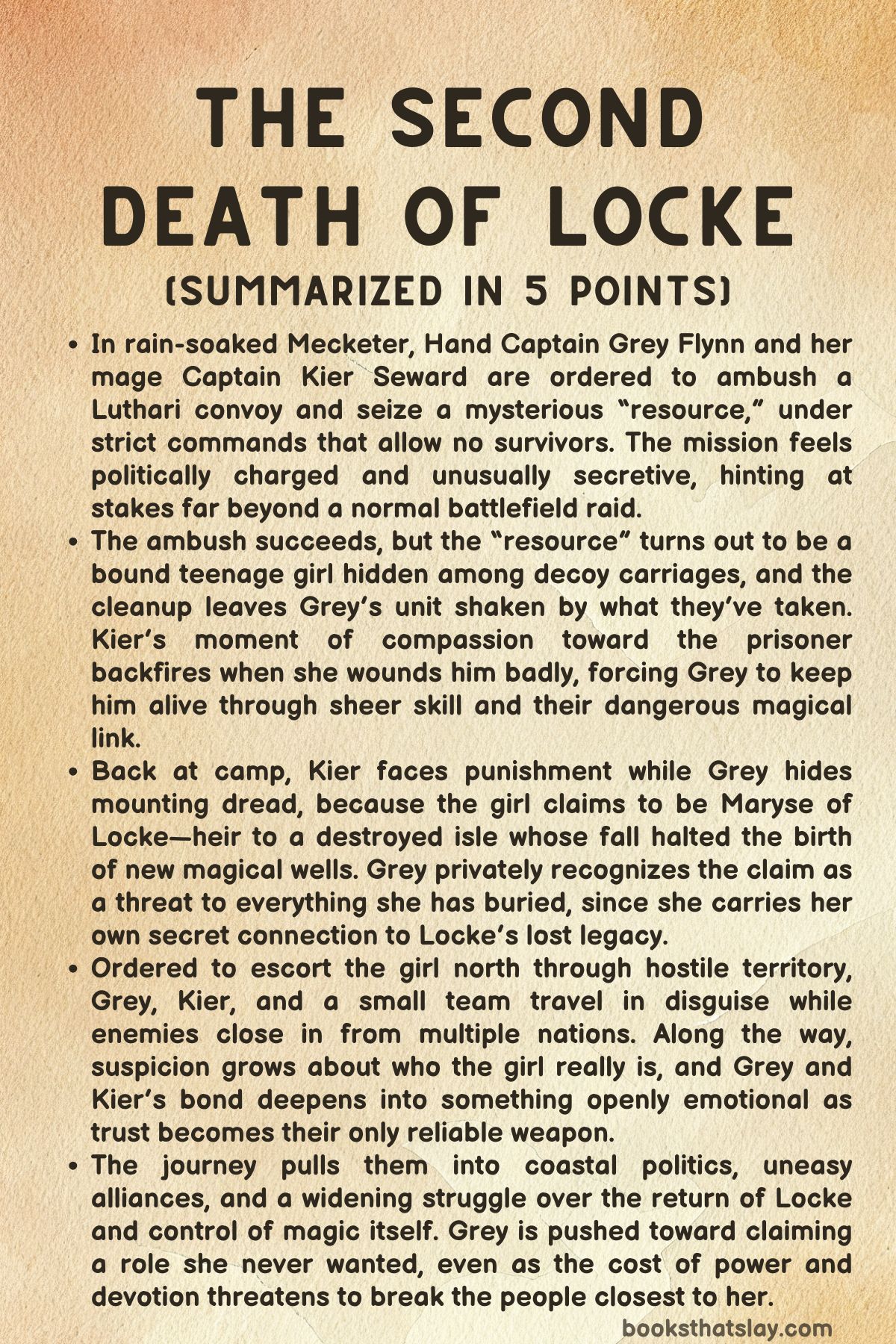
Summary
Grey Flynn serves in the Scaelan army as the Hand to Captain Kier Seward, a mage whose magic relies on the energy she feeds him through their tether. In a wet frontier camp at Mecketer, Grey is summoned alongside Kier to meet Master Attis, the commander of their mage company.
Attis delivers a ruthless order from the High Lord: a Luthari convoy is approaching a river crossing, guarded by many mages and four identical locked carriages. The company must erase the escort completely and seize a “resource” hidden among the wagons before it crosses into Luthar.
Attis refuses to say what the resource is, only that Kier will know it when he sees it, and she bars any cautious planning. Kier is disturbed by the secrecy, and Grey senses the order is tied to something much larger than a normal raid.
That night, away from command ears, Kier admits he saw a note implying Luthar believes it has found a way to create new wells—people born able to hold and channel magic. Wells have not appeared since the Isle of Locke was destroyed sixteen years earlier and its ruling family slaughtered.
Grey argues that only the return of Locke’s heir could truly restore wells. Kier tries to imagine other explanations, but Grey stays firm: Locke was the source of magic for all Idistran nations.
Whatever Attis wants, it touches that old wound.
At dawn the company sets an ambush along the ridge road. Rain slants down, the river below is swollen, and the convoy arrives under heavy guard.
Kier chooses the moment and launches the attack. Soldiers clash in mud and blood while mages trade lethal affinity strikes.
Grey fights at Kier’s side, sword and dagger flashing, while keeping their tether open so he can draw from her. The first two carriages are cracked open and found empty.
In the third, Grey kills the defending Hand and Kier kills the mage. Inside, instead of treasure or weapons, they find a bound teenage girl with black hair and pale eyes, frightened but defiant.
Kier lifts her out, the battle ends in brutal silence, and the Scaelan troops make sure no enemy survives.
Kier, shaken by the girl’s condition, steps away from the field and tries to help her. He loosens her restraints, calms her, and even puts his own armor on her for warmth and protection.
Grey is unsettled by his softness and by the risk of splitting up, and she calls him back. Moments later Kier staggers to her, bleeding hard: the girl stabbed him with his own barbed dagger during his attempt to free her.
Grey’s fury spikes—she wants the prisoner dead—but the “resource” is untouchable by order. She stuffs magic into Kier’s wound to keep him alive, binds him tight, and hauls him toward camp while he, in shock, keeps pulling too much power from her.
Other Hands warn Grey she is about to collapse. She refuses to let anyone else tether to him, fearing Kier might reject another link and fearing her own abnormal strength will be exposed.
When Kier finally realizes he is draining her, he orders her to stop. Grey snaps their tether to save herself, gambling with his life.
Back at Mecketer, Grey enters the medical tents as both Hand and healer. Kier is near death from a gut wound that threatens infection.
Grey operates using magic and skill, cutting him open, clearing contamination, and guiding tissue back together while fighting her exhaustion. Hand Master Mare Concord watches with sharp interest, praising her work but pointing out that Kier uses her as if they are a bound pair—an illegal form of bonding that would bring investigation.
Mare also hints Grey’s capacity is too large to hide. Grey is too depleted to answer.
As Kier wakes and stabilizes, Attis summons them. She lashes Kier for letting his guard down and for nearly killing Grey through overuse.
Then she reveals the truth: the prisoner claims to be Maryse of Locke, daughter of the last High Lady. If real, she could be the key to renewing magic on the island.
Attis orders Kier and Grey to escort her north to deliver her to High Lord Scaelas on the coast. Refusal, Attis implies, would invite scrutiny of their forbidden bond and Grey’s strange power.
The news hits Grey like a blade because she is not just a soldier named Grey Flynn. She is Gremaryse Masidic Locke, the true surviving heir of the drowned Isle, who remade herself and joined the army so the world would believe her dead.
If the prisoner is a fraud, she threatens everything Grey has sacrificed to hide. If the prisoner is real, then Grey’s entire life is a lie.
She retreats into work and silence, while Kier watches her with worried patience. Leonie, the lead healer, presses Grey to care for herself and challenges the way she throws her life into keeping Kier alive.
That night Grey slips into the prisoner’s tent and confronts her at knife-point, warning her never to hurt Kier again. The girl meets her with cold bravado.
Grey leaves shaken and climbs into Kier’s bedroll. In the dark she demands an oath that he will not die on this mission.
Kier swears on both her taken name and her true one, proving he already knows who she is and has kept her secret.
Attis allows only a small escort: Kier, Grey, Ola and her mage Brit, and Officer Eron Fastria. Kier forces Attis to promise honorable retirement for himself and Grey if they succeed, instead of a temporary leave.
Attis signs the bargain because she believes the journey is nearly impossible. Even before they depart, Leonie notes the prisoner’s bruises, dislocated shoulder, and foreign dental work, suggesting she may not be Locke at all.
She privately tells Grey that Grey herself is not a normal well and hugs her goodbye.
The road north is a gauntlet. The group travels disguised, dodging patrols and assassins.
In one savage attack, Grey unleashes a wave of power that burns her clothes, kills an entire enemy company, and leaves her weak and horrified by what she can do. While she recovers in a hut, Kier confesses he has loved her for years and cannot imagine life without her.
Grey, stunned by the admission, realizes his care has always been a quiet truth. She pulls him back, kisses him, and they finally claim what has been building between them.
Their tether, long strained by war and secrecy, begins to feel like something shared instead of stolen.
They reach the coastal fort city of Grislar, where Scaelas has arrived and a Cleoc delegation waits under armistice. To protect Grey’s identity, Eron poses as Kier’s Hand while Grey stays in the background.
Political tension is thick, but the meeting holds. At a formal dinner, the Cleoc leader embraces her daughter Sela, confirming the rescued girl is Cleoc’s child, not Locke’s heir.
The false claim collapses, but new dangers rise: someone in the fort has already moved against them.
That night attackers burst into Grey and Kier’s room with breakbloom, a substance that severs magic. Grey fights with steel while hearing Kier struck and pinned.
She is beaten into darkness. When she wakes, she and the others are bound in a stone cell with Kier badly injured and no access to power.
The capture pushes Grey toward a larger choice: stop running, reclaim her name, and return to the sea where Locke sank.
The story then moves to the later point where Locke has been raised from the ocean and Grey rules as High Lady. War gathers at the shoreline, enemy fleets closing in.
Grey is terrified of becoming a symbol people die for again. She asks Kier for poison and a blade so she will not be taken alive if the Isle falls.
Kier agrees, but insists they decide together how to survive. Grey senses her connection to every well carrying Locke’s old gifts, like threads across the island and beyond.
She wonders if she can end war by stripping enemies of magic. Ola warns that such power will frighten the world and might kill Grey, but Grey cannot accept watching her people be slaughtered.
When battle erupts early, Grey feels deaths through her tether to Kier and rushes into the fight. The beach becomes a killing ground.
She fights beside Kier until she instinctively pulls the magic out of a Luthrite attacker, revealing herself as the root of power. In the chaos she is stabbed through the side and collapses, her life fading as she feels thousands of tethers flaring around her.
In the space between life and death, Grey meets her mother, Alma, who explains that Locke’s heir is not merely a conduit but the source: she can grant or remove magic from any nation tied to Locke. Alma guides her to sense the web of power across Idistra.
Grey snaps the threads feeding Eprain and Luthar’s invading wells, dragging their magic into herself. The pain is vast, but the enemy collapses without magic and retreats.
Alma offers Grey a final choice: remain with her dead family or return to her body with no promise of survival. Grey chooses life, trusting her healers and choosing Kier and her people.
She wakes in Kier’s arms as the battle ends. Casualties are terrible, and Ola loses an arm, but Locke survives.
Grey holds the stolen magic as leverage, not revenge. With Scaelas and Cleoc, she drafts treaties that force peace across the nations.
Two weeks later she restores Eprain and Luthar’s power, even strengthening it, proving she will rule by renewal, not fear.
In the quiet after war, Grey builds her council and her home, and she and Kier decide to seal a bargain with the god Kitalma. Grey will keep her power so she can guide Locke safely.
Kier will surrender his freedom so Grey never has to face the Isle alone. The bargain binds him to Locke and to her, a sacrifice he chooses willingly.
Months later, during a festival celebrating the Isle’s rebirth, Grey brings Kier to a hidden cliffside cottage she built for him, shaped like his Scaelan home and facing his homeland. It is her way of giving him space, comfort, and a corner of freedom within the bond.
In that private refuge, they accept that Locke belongs to both of them now, and that whatever comes next, they will meet it together.
Characters
Grey Flynn / Gremaryse Masidic Locke
Grey is the emotional and moral center of The Second Death of Locke, a woman living inside a carefully built disguise while carrying the heaviest legacy in her world. On the surface she is Hand Captain Grey Flynn—disciplined, strategically sharp, and relentlessly protective of her mage.
Underneath, she is Gremaryse Locke, the surviving heir of a drowned Isle whose death she has been performing for sixteen years as a form of camouflage and penance. Her defining tension is between control and catastrophe: she has learned to be a soldier who follows orders, yet her very existence is an invitation to upheaval, and her power routinely exceeds the rules she tries to live by.
Grey’s loyalty is ferocious and sometimes self-destructive, most clearly in how she lets Kier drain her long past safety to keep him alive, and in how she reflexively shoulders responsibility for every death that occurs around her tether. She thinks of herself as a weapon or a conduit—useful, dangerous, and ultimately expendable—because that framing lets her avoid fully inhabiting the role of High Lady again.
What makes Grey compelling is not just her hidden identity, but her evolving understanding of what that identity means. She begins believing Locke’s legacy is only sacrifice: her parents died, Severin died, and the Isle itself was sunk through her grief and raw magic.
That trauma makes her allergic to being a symbol people die for, so she hides, minimizes herself, and trusts duty over hope. But as the story progresses, she is forced to confront that being the heir isn’t only about survival; it is about agency.
Her awakening on the battlefield and the conversation with Alma rewrites her self-concept: she is not merely a well or a vessel, but the root system of magic—able to grant, withdraw, and regulate power across nations. That shift matters because it turns her from someone running from history into someone re-authoring it.
Even then, she refuses tyranny; she uses stolen power as leverage for peace and returns it once equilibrium is possible. Grey ends The Second Death of Locke having accepted that her power is neither curse nor saintly gift, but a political and personal responsibility she will carry while choosing love, life, and governance on her own terms.
Captain Kier Seward
Kier is Grey’s mage, commander, and ultimately her chosen partner, and his arc is built on the tension between duty-bound hardness and a deep core of tenderness. In the early scenes he looks like the ideal Scaelan officer: competent, decisive, and lethal in battle.
Yet the mission at the ridge reveals his defining trait—he cannot detach himself from the humanity of the people he is ordered to destroy or capture. His gentle care for the “resource” is both an act of compassion and a tactical mistake that nearly kills him.
That moment establishes Kier’s internal conflict: he is a soldier trained to obey ruthless strategy, but he is morally unwilling to become ruthless himself. Attis sees that as weakness; Grey sees it as the reason he’s worth binding her life to.
Kier’s relationship with Grey is the beating heart of The Second Death of Locke, and it is shaped by years of unspoken devotion. He loves her long before she can allow herself to believe she is lovable; he fears her distance but never presses her past what she can bear.
Importantly, he is not possessive of her power—he worries about her exhaustion, accepts when she breaks their tether to survive, and consistently tries to make space for her to choose herself rather than martyrdom. When he finally confesses his love, it isn’t a dramatic claim but an exhausted truth that has been living in every small gesture between them.
Later, when Grey’s identity is fully acknowledged, Kier’s role changes from commander to consort-like partner, yet he never treats her as a figure on a throne. He argues with her when she tries to decide death alone, demands honesty, and insists on a shared future.
His final sacrifice—offering his freedom to bind himself to the Isle and to Grey—is not framed as a tragic loss but as an act of consented commitment: he chooses to live in tether to her because that tether is where meaning has always been for him. Kier ends the story as a man who remains morally soft without becoming politically naive, and whose love is steady enough to hold Grey’s storm without trying to control it.
Master Attis
Master Attis is the sharp embodiment of state power in The Second Death of Locke, a commander who treats war and politics as the same craft. She is strategic, unyielding, and comfortable with total annihilation if it serves the High Lord’s goals.
Her refusal to name the “resource” and her insistence on no survivors show how she operates: information is a weapon, and subordinates are to be used, not trusted. To Attis, Grey and Kier are assets with dangerous irregularities—an unusually powerful Hand, a mage who acts on sentiment, and a bond that skirts forbidden boundaries.
She probes Grey’s capacity through Mare and threatens Kier with demotion and separation partly as discipline and partly to keep their tether under institutional control.
Yet Attis isn’t a cartoon villain; she’s a product of a world collapsing without wells and thus without stability. Her ruthlessness comes from believing that only brutal certainty can prevent national extinction.
The reveal that the mission was about Maryse of Locke confirms Attis’s priority order: restoring magic outweighs individual lives and personal autonomy. Even her eventual concession—granting Kier and Grey retirement if they succeed—feels less like kindness and more like calculated incentive for a suicidal task.
Attis functions as the story’s pressure point, forcing the protagonists to act within systems they do not trust, and her presence keeps the stakes political rather than purely personal.
Hand Master Mare Concord
Mare Concord is the institutional conscience and quiet sentinel of Hand culture, a figure who understands both the intimacy and the danger of mage–Hand bonds. In the medical tent he watches Grey operate with a level of scrutiny that is half mentorship, half surveillance.
His praise of her stitches is genuine, but it is paired with a pointed warning about Kier overusing her and a probing interest in her unusually large capacity. Mare represents the social rules Grey has survived by bending: he is the kind of superior who can protect a Hand or report her, and Grey senses that ambiguity.
Importantly, Mare’s emphasis on reporting power and policing bonds reflects the Hand community’s precarious place in the military hierarchy. He knows what a bound pair looks like, knows the political risk of it, and warns them not because he hates them but because he understands how quickly love becomes an accusation in wartime bureaucracy.
Mare is therefore both threat and shield, and his role in The Second Death of Locke underlines that Grey and Kier are fighting not only enemies but also a system designed to control bodies and magic through regulation.
Ola Et-Kiltar
Ola is the story’s grounded healer-warrior, a woman whose competence is paired with blunt moral clarity. As a Hand to Brit, she understands tether strain intimately, which is why she pushes Grey to disengage from Kier when it begins to kill her.
Ola’s refusal to romanticize sacrifice makes her an essential counterweight to Grey’s martyr instincts. She is protective but not deferential; when she suspects Grey’s identity and power, she presses for truth because she believes secrecy endangers the group.
Ola’s later arc on the resurrected Isle shows her resilience and loyalty evolving into something almost familial. She is the one who talks with Grey on the roof before the invasion, naming the emotional knot at Grey’s core: the terror of being worth dying for.
Ola doesn’t solve that terror for her—she only steadies her long enough to choose. Her losing an arm during the battle and continuing to train and spar afterward symbolizes what Ola represents in The Second Death of Locke: survival with scars, devotion without worship, and the insistence that leadership must be shared rather than mythologized.
Brit
Brit, Ola’s mage, is quieter in his on-page presence but significant in thematic function. He is perceptive enough to notice the anomalies around Grey’s power and tether, and brave enough to challenge her about them.
His concern is not curiosity for its own sake but fear of what uncontrolled strength could do to them or to the mission. In the ambush aftermath he and Ola articulate a truth Grey is trying to deny: magic should not behave the way hers does unless she is something other than a normal well.
Brit’s steady professionalism and willingness to follow Grey and Kier into near-certain death make him part of the story’s portrait of chosen loyalty. He is also a reminder that trust is a collective resource in The Second Death of Locke; Grey’s refusal to explain to him is one of the costs of her secrecy, and his continued support anyway is one of the story’s quiet mercies.
Leonie
Leonie is the lead healer who becomes Grey’s mirror and anchor. Where military hierarchy pushes Grey toward exhaustion and silence, Leonie pushes her toward care and honesty.
She sees Grey’s depletion immediately, not as weakness but as danger, and she is one of the only people who scolds her without fear. Leonie’s perceptiveness goes beyond medicine; her observation of the prisoner’s bruises and continental dental work suggests she is thinking politically as well as clinically, and her hint that Grey is not a normal well shows she has pieced together more than Grey wants known.
Leonie’s warmth matters because it gives Grey an alternative model of intimacy. Their farewell—Leonie hugging her, urging her to write, and naming her abnormal power without exposing it—offers Grey a kind of friendship not built on tethered need.
In The Second Death of Locke, Leonie stands for the civilian ethic inside a war machine: the insistence that people are bodies that deserve rest, not only engines for magic.
Officer Eron Fastria
Eron is a typic officer whose courage expresses itself through discretion. He accepts the dangerous disguise plan in Grislar, stepping into Grey’s place as Kier’s Hand without complaint, which shows his deep trust in them.
Eron’s growing awareness of Grey’s identity is handled with tact; he never forces a confession, but his offers of support make clear he has chosen her cause.
What makes Eron memorable is his unglamorous loyalty. He is neither mage nor Hand, yet he stays near the center of a world-defining secret because he believes in the people carrying it.
His offer of his sword to help resurrect Locke later shows he is thinking beyond survival into rebuilding. In a story full of magic hierarchies, Eron represents ordinary honor, the kind that chooses the harder road because it is right, even when power isn’t his to wield.
Sela / “Maryse of Locke”
Sela is the most ambiguous figure in The Second Death of Locke, and that ambiguity is the engine of suspense. Initially she appears as a terrified, bound teenager used as cargo, then immediately complicates that image by stabbing Kier with his own dagger.
Her violence can be read as desperation, deception, or both, and her harsh attempt to intimidate Grey later suggests a survival strategy built on bluffing power she may not truly have. Leonie’s clues—her bruises, dislocated shoulder, and dental work from the continent—undermine her claim to be Maryse of Locke, but the story uses that uncertainty to explore what identity means in a world starving for heirs.
As the plot unfolds, Sela’s role shifts from threat to political catalyst. She is likely Cleoc’s daughter, smuggled into danger for armistice leverage, which reframes her earlier aggression as the fury of a child weaponized by adults.
Her private question to Grey about seeing her on Locke one day reveals genuine attachment and hope, and Grey’s cautious “maybe” acknowledges both affection and the realities of power. Sela is therefore less a villain than a portrait of what war does to the young—turning them into symbols before they are ready—and her presence forces Grey to confront the difference between bloodline and belonging.
High Lord Scaelas
Scaelas is a distant but gravitational political force. Even when off-page, his orders shape campaigns, and his unexpected arrival in Grislar signals that he understands stakes larger than the current front.
His brief, haunting stare at Grey during dinner suggests recognition or suspicion, implying he may know the truth of Locke’s heir even if he chooses not to expose it publicly.
In the aftermath of the Isle’s resurrection, Scaelas becomes a pragmatic ally, helping craft treaties and guiding Grey toward leverage rather than vengeance. He embodies the possibility of a ruler who can be both self-interested and peace-minded.
In The Second Death of Locke he functions as the political adult in the room: wary of power, respectful of Grey’s position, and willing to accept uneasy peace if it prevents extinction.
Cleoc
Cleoc is a ruler and mother whose dual role shapes her demeanor. Her fierce embrace of Sela at dinner, the gifts she gives the escort, and her promise of welcome into Cleoc Strata show a leader who understands the soft power of gratitude.
Unlike Attis, who rules through threat, Cleoc performs legitimacy through relational bonds.
Her cooperation with Scaelas after Grey’s battlefield miracle also reveals her flexibility. She doesn’t try to seize Locke’s power or punish enemies blindly; she works to stabilize the region even when the peace is uneasy.
Cleoc’s significance in The Second Death of Locke lies in how she models a different kind of authority than Grey fears becoming—one based on alliance, ceremony, and maternal protectiveness rather than terror.
Alma
Alma appears in the liminal battlefield vision as Grey’s mother and as the voice of ancestral truth. She is not a sentimental ghost; she is direct, instructive, and resolutely focused on what Grey must understand to survive and lead.
Alma’s central revelation—that Grey is the source of magic and can grant or remove power—reframes everything Grey believed about herself. Through Alma, the story gives Grey permission to stop thinking like a hunted child and start thinking like a sovereign.
Alma also embodies the pull of rest and reunion in death, offering Grey the choice to stay with her family. The power of that moment comes from its tenderness without coercion: Alma wants Grey with her, but she wants her alive more.
Her goodbye is a command to wake, not a plea to remain. In The Second Death of Locke, Alma represents inherited strength that is loving rather than burdensome, and she is the hinge that turns Grey from survival into leadership.
Eprain
Eprain is less a character with intimate scenes and more a looming antagonist nation and leadership, symbolic of those who would rather control magic than coexist. The fact that Grey can identify and snap Eprain’s threads in the web of power marks Eprain as one of the primary exploiters of Locke’s legacy.
Their implied role in hunting Grey and destabilizing treaties positions them as the kind of power that feeds on scarcity and fear.
Eprain’s narrative purpose in The Second Death of Locke is to test Grey’s ethics. She could annihilate them permanently, but she restores their power after peace, proving that her rule will not mirror the cruelty that shaped her childhood.
Eprain thus functions as the temptation toward vengeance that Grey refuses.
Commander Reggin
Reggin is a secondary figure whose brief appearances still matter. He is competent, politically aware, and respectful to Kier’s group, and his acceptance of Grey’s religious and honor-based argument to keep Sela under their watch shows he is not a petty bureaucrat.
His death during the invasion underscores the cost of resurrecting Locke: even good leaders fall in the violence orbiting Grey’s power.
Reggin’s role in The Second Death of Locke is to personify the decent structure within Scaelas’s command, making the later losses feel personal rather than abstract.
Severin of Locke
Severin exists largely in memory, but he is foundational to Grey’s psychology. He is the protector who saved her during the Isle’s fall, told her how to draw power from wells and the Isle itself, and died so she could live.
Grey’s cry of his name during the flare of magic reveals how deeply his sacrifice is wired into her body. Severin is the ghost of love-as-loss, and his memory is why Grey fears anyone dying for her again.
In The Second Death of Locke, Severin represents the past’s bargain: survival purchased with ruin, and love fused to catastrophe. Grey’s journey is partly about honoring him without repeating his fate.
Kitalma
Kitalma, the goddess who accepts Kier’s freedom, is a quiet but potent embodiment of divine law in the story’s world. She is not treated as a comforting spiritual presence; she is transactional, absolute, and real in her consequences.
Her taking Kier’s freedom binds the personal romance to the political fate of Locke, making love a literal covenant rather than a private feeling.
Kitalma’s function in The Second Death of Locke is to make commitment irrevocable and sacred without romanticizing it.
Kier’s sacrifice is validated not by sentiment but by a god who enforces bargains, and Grey’s creation of the cottage afterward becomes her answer to that enforcement: if she cannot give him freedom, she will give him chosen sanctuary.
Themes
Power as Burden, Not Glory
Grey’s relationship to power is defined less by triumph than by fear of what her power costs other people. From the opening ambush onward, she carries a constant awareness that her strength is abnormal, politically dangerous, and physically draining to those linked to her.
The mage–Hand system makes power literal: it is pulled from her body into Kier’s, and every act of magic has a price she feels in muscle fatigue, blurred vision, and near-collapse. That physicality turns “being powerful” into a kind of chronic injury.
She is not simply strong; she is a resource to be extracted, protected, and, when needed, exploited by command. Attis’s refusal to explain the mission emphasizes how institutions treat power holders as tools while keeping them ignorant for “safety.
” Grey’s instinctive disgust at this treatment doesn’t lead to immediate rebellion because she is trained to obey and because her secret identity makes survival depend on compliance.
As the story progresses, the scale of her power expands from battlefield advantage to national fate. Once Locke is resurrected, Grey becomes the root of magic itself, capable of granting or denying power to entire peoples.
That revelation could have positioned her as a tyrant, but the narrative stresses how terrified she is of becoming one. She repeatedly searches for ways to save lives without turning her gift into a threat.
Even her moment of greatest dominance—stripping enemy wells of their magic—arrives through desperation and pain, not ambition. The horror of feeling thousands of tethers flare as people die forces her into a moral corner that no ordinary soldier could face.
The theme therefore frames power as a responsibility that isolates the person who holds it. Grey cannot simply fight or rule like others; every decision she makes echoes through the lives of thousands.
Importantly, her eventual choice to restore enemy power shows that her authority is defined by restraint. She uses stolen magic as leverage for peace, then relinquishes it once treaties exist.
In that sense, power in The Second Death of Locke is not validated by conquest but by the willingness to carry consequences and still refuse cruelty. Grey’s arc insists that true control is not the ability to destroy, but the ability to stop yourself from destroying when you easily could.
Identity, Survival, and the Cost of Remaining Hidden
Grey’s life is shaped by the necessity of being “dead” while living. She survives the fall of Locke by erasing her own name, shortening Gremaryse into Grey, and burying herself inside military structure.
This is not a casual disguise; it is a lifelong strategy that requires emotional starvation. She cannot grieve openly, cannot claim heritage, and cannot allow herself to be known fully, because recognition would turn her into a political prize or a target.
The early chapters show how this secrecy affects even her body: she refuses to disengage from Kier’s tether not only out of loyalty but from fear that her unusual capacity will be witnessed. Her identity is therefore guarded at the most intimate level—inside the exchange of breath and magic—where secrets usually can’t survive.
The arrival of the captured girl claiming to be Maryse of Locke throws that hidden life into crisis. Grey’s reaction is not only suspicion but a sharp, private panic: someone has appeared wearing her history and threatening to reopen a grave she built to survive.
Her midnight confrontation with the girl is fueled by more than jealousy or caution. It is the rage of a person who has spent sixteen years holding herself together by pretending she doesn’t exist.
The narrative also complicates identity by raising the possibility that the girl is fraudulent, injured, and manipulated by international politics. In a world where people are traded and labeled as “resources,” identity becomes something that can be manufactured for strategic ends.
Grey must therefore ask not just “Who am I? ” but “Who gets to decide who I am?
Her bond with Kier becomes the earliest place where her hidden self is partially safe. When he swears on both her true and taken names, the theme clicks into place: identity is not only something you declare; it is something another person can honor.
Yet even this safety is unstable, because Attis threatens investigation into their bond and because exposing herself risks war. Grey’s struggle is thus a constant negotiation between selfhood and survival.
By the end, the theme resolves not through a simple reveal, but through Grey choosing to rule as herself while still knowing what that costs. Resurrecting Locke makes her impossible to hide, but it also gives her a framework where her identity is no longer only a vulnerability; it becomes the basis of belonging and responsibility.
The story suggests that survival sometimes requires disappearance, but healing requires the courage to be seen—on your own terms, not the enemy’s.
Love as Partnership Under Extreme Conditions
The romance between Grey and Kier is built in a world where love is dangerous because it creates leverage. Their bond is already regulated by magic and military protocol: a Hand exists to fuel a mage, and their closeness is officially functional, not personal.
Yet their connection keeps slipping beyond function. Grey’s hand on Kier’s shoulder to complete the link is a ritual of duty, but the narrative also makes it a charged gesture of trust and intimacy.
When he is stabbed, Grey’s fury and her refusal to abandon him show that their relationship exceeds command structure. Love here is not a soft refuge; it is a force that repeatedly collides with the demands of war, secrecy, and hierarchy.
Kier’s tenderness toward the prisoner is what triggers the stabbing, which in turn exposes the fault lines between compassion and survival. Grey’s instinct to kill the girl is checked not by mercy but by the reality that she cannot harm the mission’s center.
Their love is forced to operate inside brutal constraints, meaning they must constantly reinterpret what loyalty looks like. Kier’s confession that he has loved her for years is not timed for peace; it is timed for the moment when Grey believes she is only a tool and is about to emotionally retreat forever.
He chooses honesty as a rescue rope. Grey’s response—anger at his silence, then full acceptance—shows that love between them is not romantic fantasy.
It is a hard negotiation between two people trained to swallow need.
Later, once Grey rules Locke, the partnership theme intensifies. Grey tries to make solitary, sacrificial decisions, including asking for tools to kill herself rather than be captured.
Kier’s reaction is not to forbid her fear but to insist they decide together. His demand to know what happened during his previous death, and his willingness to trade his freedom to keep her power intact, recasts love as mutual sacrifice rather than one-sided rescue.
Neither of them is allowed the comfort of being only protected or only protector. The bargain with Kitalma is the clearest expression of partnership: Grey keeps what the nation needs, Kier gives what he can, and they step into the future with eyes open.
The cliffside cottage at the end is not a grand romantic gesture in the ordinary sense; it is a practical, ethical one. Grey cannot return his freedom, so she gives him space that is his alone.
Love becomes an architecture of respect. The Second Death of Locke therefore treats romance as a disciplined, lived partnership shaped by care, consent, and the shared management of consequences.
War, Dehumanization, and the Politics of “Resources”
From the moment Attis describes the convoy’s cargo as a “resource,” the story highlights how war turns people into objects. The mission is framed in strategic language: annihilate the escort, seize the prize, accept no risk.
The secrecy around the cargo intensifies this theme because it demonstrates that soldiers are ordered to kill without even knowing what they are killing for. Grey’s discomfort in the tent scene signals a moral fracture already present in the system.
The convoy battle itself continues this logic: four identical carriages, heavy guards, deliberate misdirection. The valuable thing is hidden at the center, while expendable human lives surround it in layers.
When the “resource” is revealed to be a gagged teenage girl, the abstraction collapses into horror. The reader is forced to feel the violence of strategic terminology.
Yet the theme doesn’t stop at condemnation of enemy tactics; it also implicates Grey’s side. Scaelan troops perform “clean-up” to ensure no survivors.
The efficiency of that practice shows a machinery of war that is normalized. Grey is not naive about this; she counts bodies, orders retreat, and accepts that obedience is required.
The tragedy is that even decent people become operators of a system that commodifies life. Kier’s compassion toward the girl is a momentary revolt against that conditioning, but it also risks the mission and nearly kills him.
The narrative thereby admits how hard it is to sustain humanity inside warfare without paying for it.
When Grey later learns the prisoner might be a political fake, the theme shifts from individual cruelty to international manipulation. Nations hunt the girl because she might restore wells.
Even if she is not truly Locke, she is still treated as a key to power rather than a person. This echoes Grey’s own situation.
She survives by pretending to be a normal Hand, but the moment she is recognized, she becomes the axis of treaties, invasions, and sacrificial expectations. War in this world is not only fought with swords and magic; it is fought through ownership claims over bodies who carry lineage or affinity.
The final conflict on Locke’s shore replays the same dehumanization on a grander scale. Soldiers surge in waves, tethered to wells, acting as extensions of distant commanders.
Grey’s discovery that she can snap enemy threads and remove power reveals the depth of the political economy of magic: nations depend on inherited gifts from Locke, so warfare is also a struggle over access to that shared source. Peace only becomes possible when Grey uses her control over “resource” status—her ability to withhold magic—to force treaties, then refuses to keep enemies weak.
The theme insists that war depends on treating people as things, and that lasting peace requires restoring personhood even to former enemies.
Freedom, Choice, and the Meaning of Sacrifice
Choice in the story is never clean; every decision is boxed in by magic, duty, and survival. Grey and Kier begin with almost no freedom at all.
Attis orders a mission without context and threatens punishment for hesitation. Their tether is lifesaving but also coercive: it ties Grey’s body to Kier’s magic, making her both partner and supply line.
Even their retirement bargain is a negotiation under threat. The narrative repeatedly shows characters choosing within narrow corridors, which makes the idea of sacrifice complicated.
Giving something up may look noble, but it may also be forced by circumstance.
Grey’s personal sacrifices are layered. She sacrifices her name to stay alive, her safety to keep Kier alive, and her emotional distance to let herself love him.
These are not performed for applause; they happen because she believes she has no other option. Kier’s sacrifices evolve differently.
Early on, he risks himself to comfort the prisoner, not because he is reckless but because he refuses to let duty erase compassion. Later, he offers to surrender his freedom to Kitalma so Grey can keep her power.
This is a sacrifice chosen with clarity. He does not do it to be a martyr.
He does it because he wants to live, wants Grey to live fully, and believes he can bear the cost better than the nation can bear her diminished power. The theme stresses that sacrifice is meaningful only when it is chosen, not when it is extracted.
This becomes explicit in the liminal scene where Alma offers Grey three prices for Kier’s return: his freedom, her power, or his life. The moral weight sits in the structure of the choice itself.
Grey is not allowed a perfect outcome; the world demands payment. Her refusal to accept the option guaranteeing his death is a declaration that sacrifice has limits.
When she later accepts Kier’s freedom as the price for victory, she does it after they have both consented. The readiness with which they speak of poison, blades, and bargains might look cold, but it is actually an attempt to reclaim agency in a reality built to strip it away.
After the war, the theme resolves into a quieter version of freedom. Kier is bound to the Isle, but Grey builds him a private cottage and insists it is his space alone.
This gesture doesn’t undo the bargain, but it recognizes the human need for autonomy inside unavoidable bonds. The story suggests that freedom is not only the absence of ties; sometimes it is the presence of respect within ties you cannot escape.
The Second Death of Locke ends by redefining sacrifice from a path to loss into a path to shared future—one where choice, even limited choice, is treated as sacred.