The Shattered King Summary, Characters and Themes
The Shattered King by Charlie N. Holmberg is a fantasy novel about duty, power, and the cost of healing in a kingdom at war.
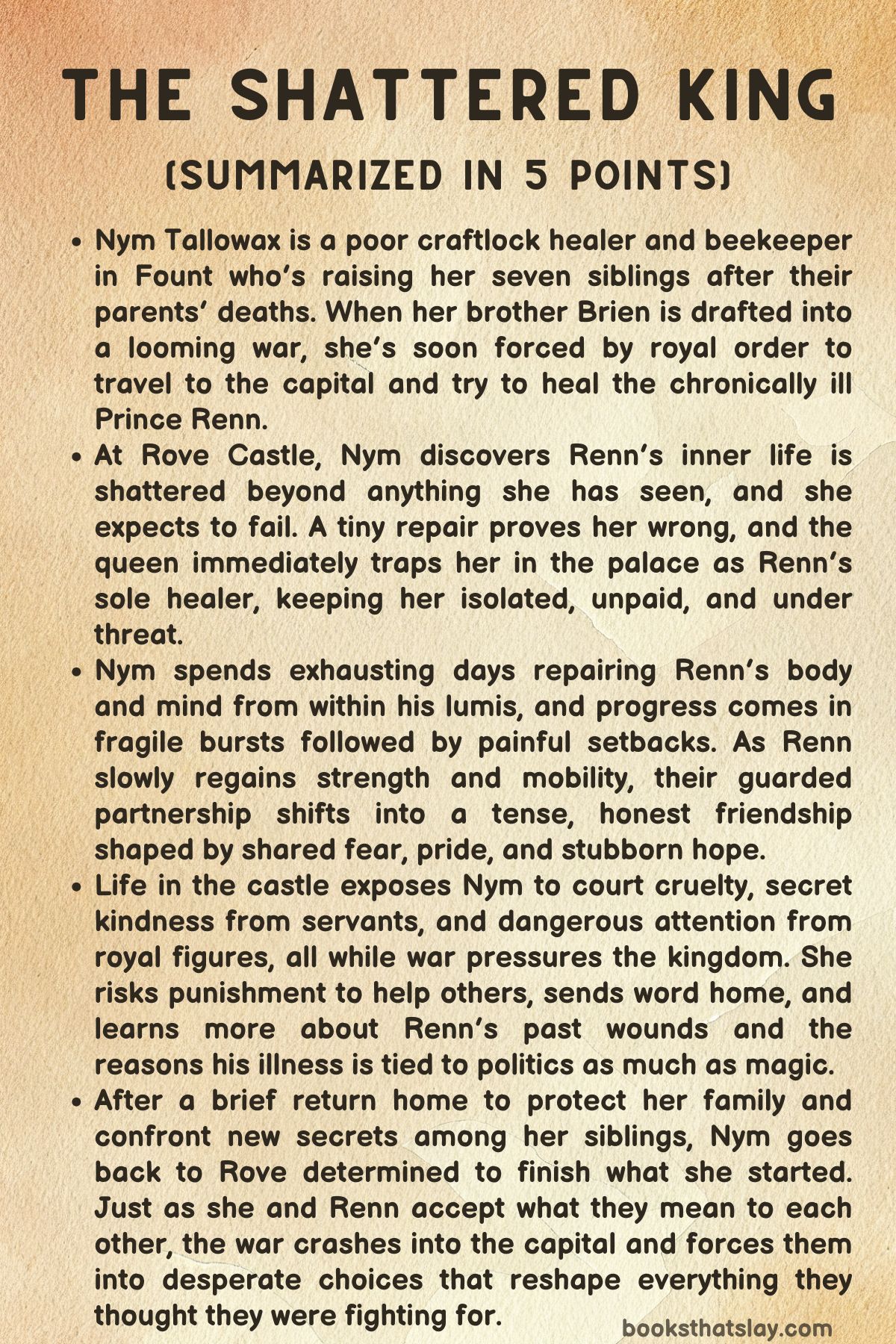
Nym Tallowax, a young craftlock healer from a poor village, is supporting her seven siblings when the crown drags her to the capital. There she’s forced to treat Prince Renn, a royal son who has been sick and unable to walk for most of his life. What begins as a desperate attempt to survive turns into a slow, risky restoration of a broken heir—and a confrontation with cruelty at the heart of the court.
Summary
Nym Tallowax lives in the small village of Fount, where she keeps bees, practices healing magic, and holds her family together after their parents’ deaths. She is barely scraping by while raising seven younger siblings.
When war with the neighboring country of Sesta grows worse, her oldest brother Brien is drafted. His leaving rips away both emotional support and vital income, and Nym is left to steady the household while her sister Lissel fears starvation and her brother Dan tries to bury himself in his tannery work.
Not long after, a royal summons arrives with the Noblewight seal. Nym is ordered to travel to Rove, the capital, to join the crown’s healing program.
Her task is nearly impossible: she must attempt to cure Prince Renn Reshua Noblewight, the queen’s son who has been bedridden and coughing blood for twenty years. Nym is furious at the timing and terrified of abandoning her siblings.
She considers destroying the letter, but Dan warns that refusal would brand her a deserter and bring punishment on Fount. With no safe choice, she promises her family she’ll return quickly, gives Dan authority over the home, leaves Lissel in charge of the apiary and little ones, and sets out.
The trek to Rove takes about ten days. Nym travels mostly on foot, accepting occasional help, and pays for a ship crossing to speed her journey.
Reaching the enormous capital overwhelms her; crowds and stone towers make her feel small and powerless. Her draft letter gets her into Rove Castle, where guards escort her to wait with other healers.
One healer leaves the queen’s chambers defeated, which only strengthens Nym’s belief she will fail fast and be sent home.
Inside a richly decorated parlor, Queen Winvrin sits beside Prince Renn. Renn is twenty, pale and fragile, lying beneath a blanket that hides crippled legs.
The queen orders Nym to “dowse” into his lumis—the inner magical structure that reflects health—and cure him. In the lumis, Nym finds devastation: a vast ruin of shattered glasslike fragments scattered beyond any repair she has ever seen.
Certain he cannot be healed, she fixes a single tiny piece out of pity. Back in the parlor she tells the queen there is nothing she can do.
As Nym turns to leave, Renn gasps that he can feel his foot. The queen pulls back the blanket and sees him wiggle a toe for the first time in years.
The small change shocks her into declaring Nym a miracle worker. On the spot, she names Nym Renn’s exclusive healer and forbids her to leave.
Nym is given a cramped room, no pay, no supplies, and no permission to write home. The queen makes it clear that refusal will bring harm on Nym’s family and village.
Each day Nym is marched to Renn’s suite and forced to work from dawn to dusk. She enters his lumis repeatedly, sorting fragments and trying to rebuild the shattered patterns of his legs and body.
The work drains her to the edge of collapse, and repaired sections often slip out of place between sessions. Still, slow progress comes.
Renn’s pain lessens, and after weeks Nym stabilizes enough of his legs for him to try standing. Supported by guards, he rises on straightened legs for the first time in years, and the queen celebrates wildly.
The victory doesn’t last. That night Renn’s legs fail again.
The queen storms into Nym’s room, hauls her back to the suite, and forces her to fix the shifted pieces on the spot. When Nym admits she doesn’t understand why the healing won’t hold, the queen strikes her for speaking as if Renn is “broken.
” Nym insists that physical therapy must accompany the magical repairs, and castle doctors begin painful daily exercises. Renn manages a few shaky steps, but his illness still surges and retreats unpredictably.
The queen’s cruelty expands to Nym’s basic life. After noticing Nym’s exhausted, unwashed condition, she humiliates her and throws her into the dungeon.
Nym survives the cold cell by talking to Ursa’s spirit—her dead sister whose green lumis fragments still live inside Nym, keeping her partially sustained. The next dawn the queen drags her out, not to free her but to have servants scrub her raw in the stables.
Nym returns to work hollowed out with anger, yet determined to finish and go home.
A kitchen maid, Lonnie, becomes Nym’s quiet ally. Grateful that Nym once healed her eye, Lonnie sneaks her food, shares a midnight bath, and keeps her company.
Nym also tries to help Renn emotionally. She teaches him danerin, a strategy game, refusing to let him win out of pity.
Their bickering grows into an odd friendship. During a rare moment of privacy in the gardens, Nym steals parchment and ink to write home.
Lonnie later agrees to send the letter if Nym secretly heals an old blind woman named Ann. Nym restores Ann’s sight, though Ann reacts with fear, calling Nym’s craft sinful.
Leaving the shrine, Nym notices Prince Adrinn watching from the shadows.
Renn’s first public appearance arrives: he attends a hall function using a cane while Nym shadows him marked by a healer’s sash. The day succeeds, but afterward Nym is called to an emergency.
A servant bitten by a rat is dying of a corrupt sickness; in his lumis Nym sees death spreading too far to stop. The man dies despite her attempt.
The incident leaves Nym sick, and the strain of constant work finally breaks her. She collapses and wakes in the infirmary, healed by another crafter.
Renn is subdued and a little ashamed, offering her food and rest. Small kindnesses follow—better clothes, a wash tub, and slightly more freedom.
As Renn strengthens, the queen still summons additional healers, refusing to stop hunting for a cure beyond Nym. Renn privately tells her that other healers find her lumis unnatural, hinting that something about Nym’s connection to Ursa marks her as different.
Nym brushes it aside. When a soldier is injured by a falling gate, Nym saves him in front of the court, sealing off death lines in his lumis.
The queen responds not with thanks but with fresh punishment, ordering Nym back to the dungeon for leaving Renn’s side.
Renn begins to trust Nym enough to confess his despair. He admits he tried to kill himself twice when healers kept failing him and he felt worthless.
Nym is shaken but refuses to treat him like glass. She tells him his lumis is bright, only damaged, and threatens to kill him herself if he ever tries again.
Their bond deepens as he starts pushing against the queen’s control. For his name-day celebration, a Sestan tailor fits him for bold new clothes.
Nym learns of an old scar from an assassination attempt, showing how long danger has circled him.
The day after the party, an ugly turning point hits. In a corridor, Prince Adrinn publicly grabs Nym.
She freezes in terror. When Renn learns what happened, he attacks Adrinn in a fury, earning a brutal beating in return.
Nym heals Renn’s injuries and scolds him for risking his fragile health. Still, they go into the city together as promised.
For Renn the outing is like breathing air after years underground: he buys sweets, listens to music, and gives Nym a tundra agate necklace as apology and partial wage. In the aspen woods they talk about dreams of a kinder future.
Renn takes her hand, and she pulls away, frightened by feelings she believes she cannot afford.
Soon after, Adrinn appears injured in Nym’s room late at night and demands healing. She saves him only after forcing him to swear never to touch her again.
His lumis is a set of silver cages holding animal spirits; one crushed cage is killing him. Nym restores it and releases the trapped spirit.
Renn reacts by moving her to safer rooms beside his suite. Tension in the castle rises when King Adoel Nicosia of Sesta arrives for negotiations.
The talks are brittle, and Nicosia hints at a much larger war. Nym senses something cold in him, though she can’t explain why.
Time passes through autumn. Renn improves, yet relapses still strike without warning.
During one city trip, a book merchant triggers Nym’s buried trauma, leaving her shaken. Renn cares for her privately, and during the aftermath he finally tells her she is beautiful.
Nym breaks, confessing to Ursa’s spirit that she cannot survive loving again, especially a prince. Renn overhears her speaking to Ursa, and instead of mocking her, he believes her.
He greets the spirit awkwardly and even jokes about whether she helps Nym cheat at danerin. The strangeness becomes something they share rather than hide.
With early snowfall, Nym is temporarily allowed home. Fount welcomes her with tears.
She brings gifts and money and uses it to repair their roof and hives. She also confronts Dan’s tannery master, forcing him to pay Dan fairly.
Dan then reveals a dangerous secret: he is a mindreader. Nym panics, knowing mindreading is illegal and punishable by hanging.
She makes him swear never to use it or tell anyone.
Nym returns to Rove sensing faint traces of death in the bailey. She reaches Renn to find him violently ill, his lumis degrading in ways another healer couldn’t fix.
Nym stabilizes him, and he confesses he feared she wouldn’t come back. Nym admits she loves him.
That night, siege trumpets sound. Sestan soulbinders ride warbirds into the castle, slaughtering soldiers.
Nym, Renn, Ard, and Sten flee into a hidden tunnel through halls of blood. Nym stops to heal the wounded, is slashed across the belly, mends herself while pretending to be dead, and witnesses dragons kill Prince Adrinn.
Rove falls. Nym crawls into a burning, occupied city where refugees scatter and dragons hunt survivors.
She finds the severed heads of King Grejor, Queen Winvrin, and Adrinn on spikes. Renn and Princess Eden are missing.
Nym hides in a brothel, heals the injured there, and learns Eden has been captured and taken to Sesta. After days searching, she finds Ard tortured and dying; his last word is “Speth.
Nym walks through snow to Speth using craftlock to ward off frostbite. Sten finds her and leads her to his blind mother’s house, where Renn lies feverish but alive in the basement.
Nym tells him of his family’s deaths and Eden’s capture. They grieve together, confess love fully, and kiss.
Nym realizes Renn’s lumis is like a hive without a queen: it cannot knit itself without a living core. She offers a brutal solution—tearing it down and rebuilding it to match hers.
With Sten’s consent, she spends three days reshaping Renn’s lumis, then gives him half of her own heart as a foundation. The act leaves her weakened, but Renn’s lumis becomes whole and radiant.
Sestan forces attack Speth. Sten stays behind to delay them while Nym and Renn run.
Nym takes an arrow and heals it. Renn, newly powerful, catches another arrow and kills pursuing dragons with speed that feels beyond human.
Yet King Adoel Nicosia appears, seizes Nym, and mindreads her identity. He reveals she is both mindreader and soulbinder, and claims she has undone his work on Renn.
He binds her body so she cannot escape. With her last surge of magic, Nym shields her mind and collapses in his grip, the future of the kingdom—and her love—hanging on what comes next.
Characters
Nym Tallowax
Nym Tallowax is the emotional and moral center of The Shattered King. She begins as a poor craftlock healer and beekeeper in Fount, defined by practical resilience: she is raising seven siblings, running an apiary, and patching the village’s wounds while still grieving her parents and sister.
Her conscription exposes a fierce core of defiance and love—she hates leaving her family, but she also refuses to let them be punished for her resistance. In Rove, Nym’s character sharpens under pressure.
She is treated as property, unpaid and threatened, yet her compassion keeps breaking through the cruelty around her: she heals servants, saves a soldier at the gate, and keeps trying to stabilize Renn even when it nearly kills her. Her craftlock ability is intertwined with trauma and memory; her lumis is “macabre and unnatural” because it contains the green pieces left by her dead sister Ursa, meaning her power is literally haunted by love and loss.
Nym’s arc is about agency—learning to survive coercion without losing herself, setting boundaries even with a prince, and accepting that tenderness is not weakness. By the end, her willingness to rebuild Renn’s lumis using her own heart shows the full extent of her sacrificial nature, but it is not blind martyrdom; it is a deliberate choice rooted in partnership, grief, and a beekeeper’s instinct for rebuilding a broken hive into something that can live again.
Prince Renn Reshua Noblewight
Prince Renn is introduced as fragile, bitter, and nearly mythic in his long illness, but the story slowly reveals a young man shaped by two decades of pain, confinement, and failed hopes. His lumis is catastrophically shattered, especially in the structures tied to his legs and vitality, mirroring how his identity has been splintered by the court’s obsession with “fixing” him rather than seeing him.
At first, Renn’s frustration spills out as childish anger—throwing danerin pieces, snapping at Nym, demanding impossible healing schedules—yet those outbursts are defenses against despair. When he confesses his suicide attempts, Renn becomes fully legible as someone who has internalized worthlessness from years of being both a political symbol and a medical project.
Nym’s refusal to pity him, combined with her steady insistence that emotional healing counts, helps him rebuild not just muscle and lumis-structure but also self-respect. His delight in the city outing, his longing to travel, and his awkward first reach for intimacy show a deprived capacity for joy slowly returning.
After the siege and the loss of his family, his transformation accelerates into something almost elemental: once his lumis is rebuilt to match Nym’s, he becomes radiant and unnaturally strong, suggesting both rebirth and danger. Renn is thus a portrait of recovery that isn’t linear—he is vulnerable, sometimes selfish, sometimes brave, and ultimately capable of profound devotion once he feels human again.
Queen Winvrin Noblewight
Queen Winvrin is the novel’s primary embodiment of power without empathy. Her love for Renn is undeniable, but it is a love twisted into control: she wants her son whole not only for his sake but for the stability of her reign and her own refusal to accept loss.
This desperation makes her ruthless. She drafts Nym like a tool, withholds pay and supplies, isolates her from home, and enforces compliance through threats against Fount.
Winvrin’s cruelty is not casual; it is calculated, a monarch’s instinct to break one life to preserve another that matters more to her. Yet the narrative also frames her as tragically human—she is a mother who has watched her child suffer for twenty years, and that prolonged helplessness has hardened into tyranny.
Her oscillation between elation at progress and violent punishment when healing slips reveals a mind clinging to certainty in a world sliding into war. By her death in the siege, Winvrin stands as a warning about what grief becomes when fused to unchecked authority: devotion can rot into brutality when the object of love is treated as an extension of the self.
Brien Tallowax
Brien is more absence than presence, but his role is vital to understanding Nym’s starting world. As the eldest brother drafted into the army, he represents the family’s lost stability and the way war drains villages before it ever reaches castles.
His leaving forces Nym into a double sacrifice—first as acting parent, then as unwilling royal healer. The fact that Nym searches for him in Rove and finds no trace keeps Brien a lingering worry and a symbol of the gulf between rural lives and royal machinery.
He functions as a quiet measure of what Nym is trying to protect: kinship, home, and the simple future that conscription keeps stealing.
Lissel Tallowax
Lissel is Nym’s closest sister and emotional foil. Where Nym responds to crisis with grit, Lissel responds with fear and visible grief, crying over Brien’s draft and worrying about survival.
Yet Lissel is not weak; she becomes a caretaker of the apiary and the youngest children, holding the household together in Nym’s absence. Her presence underscores how much Nym’s identity is rooted in family leadership, and the letter Nym writes to her is both a lifeline and a passing of authority.
Lissel’s tearful reunion with Nym later confirms that the family bond is real, reciprocated, and sustaining—not just a burden Nym carries alone.
Dan Tallowax
Dan begins as the brother who retreats into work, apprenticed in a tannery and emotionally contained compared to Lissel’s panic and Nym’s rage. His caution is practical—he understands the danger of refusing royal summons and becomes the voice that keeps Nym from destroying the letter.
Later, Dan’s revelation as a mindreader reframes him from background sibling to potentially explosive figure. His gift is illegal and lethal if discovered, making him both vulnerable and dangerous, and his ability hints that extraordinary power exists even in the poorest households.
Dan’s promise to hide his gift shows loyalty, but the secrecy also plants tension: in a kingdom where mindreading and soulbinding decide wars, Dan may be a silent axis on which future events turn.
Ursa Tallowax
Ursa is physically dead but narratively alive, bound into Nym’s lumis through green pieces that keep Nym partly sustained. She acts as comfort, conscience, and sometimes a thorn in Nym’s self-protective logic, especially around love and fear of loss.
Ursa’s presence makes grief a shared, ongoing relationship rather than a past event; Nym doesn’t “move on,” she carries Ursa as part of her body and mind. The fact that Renn believes Nym and even greets Ursa shows how Ursa helps bridge intimacy between the living.
Ursa embodies the novel’s idea that love leaves literal structures inside us, shaping what we can endure and what we can risk again.
Lonnie
Lonnie is a kitchen maid whose kindness becomes Nym’s first real shelter in the castle. She represents the servant-class solidarity that contrasts the queen’s aristocratic cruelty.
Lonnie helps Nym bathe, feeds her, listens to her homesickness, and risks punishment to deliver Nym’s letter home. Her practicality—stomping rats, navigating shrines, arranging secret favors—shows a survivor’s intelligence within oppressive systems.
Lonnie is also a lens on the social world’s superstition and prejudice; she is less fearful of craftlock than others, but she knows exactly how dangerous open magic can be. Her friendship steadies Nym, reminding her that even in the heart of power, ordinary compassion still exists.
Whitestone
Whitestone is the castle physician and a figure of institutional skepticism. He pushes physical therapy for Renn, which becomes essential, yet he mistrusts Nym and is quick to blame her when Renn relapses.
His anger reads partly as professional pride wounded by an outsider succeeding where court healers failed, and partly as fear—Renn’s condition is unstable, and Nym’s methods are unfamiliar and unsettling. Whitestone illustrates the tension between official medicine and craftlock magic, and his hostility contributes to the pressure that nearly kills Nym.
He is not purely villainous, but he is a gatekeeper of the castle’s hierarchy, unwilling to relinquish control to someone beneath him.
Ard
Ard is one of Renn’s guards, initially just a escorting presence but later a symbol of loyalty amid collapse. He helps support Renn during early walking attempts, accompanies outings, and stays close through the siege.
His tortured death and final word—“Speth”—is a quiet heroic act, giving Nym the clue that saves Renn. Ard’s character is defined by duty grounded in care rather than mere obedience; even as the kingdom falls, he tries to protect the people who matter.
Sten
Sten, another guard, evolves into a protector beyond his station. His panic when Renn disappears shows how tightly his identity is tied to Renn’s survival, but later his actions become more personal: he leads Nym to safety, shelters her in his blind mother’s house, and trusts her with Renn’s fragile, rebuilt existence.
Sten choosing to stay behind to delay Sestans in Speth is an act of sacrificial courage that parallels Nym’s own willingness to bleed for strangers. He represents the best of the Noblewight household—the quiet, steadfast humanity that survives when royalty does not.
Prince Adrinn Noblewight
Adrinn is the story’s clearest portrait of predatory entitlement. His public grabbing of Nym is not just sexual assault; it is a reminder that power in this court assumes ownership of others’ bodies.
Yet Adrinn is also complex in small ways. His lumis full of silver animal cages suggests a psyche built around containment and cruelty, but the crushed cage and trapped spirit that Nym repairs hint at a wounded core or fractured morality.
His late-night demand for healing exposes cowardice and dependence beneath arrogance. Still, his refusal to respect boundaries and his reliance on status to escape consequences make him a moral foil to Renn.
Adrinn’s death by dragon fire is abrupt, but it fits his arc: entitlement offers no protection when real violence arrives.
Princess Eden Noblewight
Eden appears less often, but she stands out as a stabilizing presence among the siblings. She breaks up the fight between Renn and Adrinn, suggesting both authority and concern.
Her later capture by Sesta frames her as a political asset and a personal loss, the remaining thread of the Noblewight line besides Renn. Eden functions as a symbol of what the war consumes: not just armies and crowns, but the possibility of a gentler royal future.
King Adoel Nicosia
King Adoel Nicosia is the looming strategist behind the Sestan threat, carried in the narrative first by his unsettling gaze and violet cincture, then by the brutal efficiency of his invasion. His ability to mindread and soulbind makes him a terrifying mirror to Nym: he shares her forbidden talents but uses them for conquest and control.
Where Nym heals and rebuilds, Nicosia dismantles identities, binds bodies, and treats people as tools in a larger design. His revelation that he had previously “worked on” Renn’s lumis implies long-term manipulation, positioning him as an architect of suffering rather than a mere wartime opponent.
By capturing Nym and binding her body, he becomes the embodiment of violated autonomy—the ultimate antagonist to her hard-won agency.
King Grejor Noblewight
King Grejor is largely off-page, which itself is meaningful. His absence from Renn’s sickroom and from Nym’s daily struggle suggests a monarchy where the public face of rule is distant from private decay.
His death and severed head on spikes reduce him to a symbol of fallen sovereignty. Grejor represents old, brittle authority that cannot withstand a war fought with newer, darker magics.
Verdanian Truline
Verdanian Truline, the Sestan tailor, brings a brief but telling outside influence into the castle. His boldness in measuring Renn and suggesting stronger clothing reflects a Sestan cultural confidence that contrasts with Rove’s anxious stiffness.
He helps mark Renn’s shift from hidden invalid to visible prince, using fashion as a kind of social healing. His presence also foreshadows the coming collision between kingdoms, with diplomacy arriving first through fabric and ceremony before it arrives through fire.
Talla
Talla, the seamstress who gifts Nym a sage-green dress, is a quiet figure of kindness within the palace machine. Her gift is not required by status or duty; it is a small act of recognition, affirming Nym as a person rather than a tool.
That dress matters because it lets Nym enter the name-day celebration not as a servant-healer but as someone visible, which in turn deepens the emotional stakes of her bond with Renn.
Lord Fell
Lord Fell exists as a traumatic hinge in Nym’s history. His carriage accident killed Nym’s parents and sister, so his name carries the weight of injustice that never healed.
Even without on-page scenes, Fell shapes Nym’s distrust of nobility and her fear of loving someone tied to that world. He is part of the reason Nym recoils from Renn’s affection: to her, aristocratic power is already stained with personal loss.
Ann
Ann, the blind old woman at the shrine, reveals the kingdom’s spiritual hostility toward craftlock. Her horror at being healed and her condemnation of magic as sinful show how deeply superstition and doctrine police bodies and gifts.
Ann is not evil; she is frightened, conditioned by belief, and her reaction underscores the social risk Nym lives with daily. Through Ann, the novel shows that Nym’s battle is not only against royal coercion but also against cultural narratives that label her very nature as wrong.
Torr
Torr, the servant bitten by a rat, appears briefly but powerfully as a reminder of death’s inevitability within healing work. His corrupted lumis collapsing into death lines demonstrates the limits of Nym’s power and the brutality of plague in a crowded castle.
Torr’s death also pushes Nym into critical illness, showing the physical cost of empathy and the constant proximity of healers to contagion, grief, and failure.
Pern Fursmade
Pern Fursmade, Dan’s tannery master, embodies everyday exploitation. He uses contracts and apprenticeship traditions to keep Dan unpaid despite profiting from his work.
Nym confronting Pern shows her leadership extending beyond magic into advocacy and bargaining. Pern’s quick capitulation under threat of royal pressure reveals how even small local tyrannies rely on the myth that the powerless will not push back.
Kari
Kari, the brothel keeper who shelters Nym after Rove falls, is another figure of pragmatic mercy. Her home becomes a refuge that stands in contrast to the castle’s collapse, and her willingness to let Nym heal the wounded there shows a community ethic outside official institutions.
Kari’s space is where survival, not status, decides who belongs.
Thom
Thom, Renn’s trainer, is part of the prince’s restoration. He represents disciplined, bodily rebuilding to complement Nym’s lumis work.
His presence makes clear that healing is not a single miracle but a partnership between magic, muscle, and will. In a story full of coercion, Thom’s role hints at a healthier form of guidance—training that supports Renn’s emerging autonomy.
Hem
Hem, the god honored at the shrine, is not a character in the usual sense, but the shrine scenes make Hem a social force shaping behavior. Through offerings and prophecy scrolls, Hem represents the religious framework that both comforts and condemns.
For Nym, Hem’s world is a place where healing can be labeled heresy, so the deity’s presence amplifies the stakes of her gift in a society that fears what it needs.
Themes
Sacrifice, duty, and the weight of family survival
Nym’s life is shaped by obligation long before the crown summons her. The death of her parents forces her into a role that is both parent and provider, and the apiary, healing trade, and household management are not hobbies but the thin line between her siblings eating or starving.
When Brien is drafted, it is not simply a personal loss; it is an economic collapse that shifts even more burden onto her. The conscription order to heal Prince Renn is therefore experienced as a second theft: the state takes the one remaining adult who keeps the family stable.
What makes the theme sharp is that Nym does not romanticize sacrifice. She is angry, scared, and practical, calculating consequences for Fount if she refuses.
The story keeps returning to the idea that duty is not chosen freely by the poor; it is enforced by necessity and by law. Even in Rove, her primary mental refuge is the promise to return home quickly, and her most dangerous act of resistance is writing a letter to Lissel so the household can stay afloat without her.
Later, when she does return briefly, the narrative underlines how her responsibilities never truly pause: she fixes the broken hive, confronts Dan’s exploitative apprenticeship situation, and tries to control the risk of his illegal mindreading. Sacrifice is shown as continuous labor, not a single heroic moment.
In the end, her decision to give Renn half of her heart repeats this pattern in a new register. It is intimate and voluntary, but still shaped by the same instinct that kept seven younger siblings alive.
The theme argues that love and duty are not opposites in Nym’s world; they are fused through a lifetime of carrying other people so they can stand.
Power, coercion, and the politics of the body
From the first encounter in Rove Castle, power is expressed through access to bodies and choices. Queen Winvrin positions Nym as a tool rather than a person: she is not paid, not allowed to leave, and even denied parchment to contact her family.
The threat is not subtle; the queen repeatedly ties Nym’s compliance to the safety of Fount, turning a healer’s duty into hostage labor. The castle setting makes coercion feel normalized.
Guards escort Nym everywhere, her exhaustion is treated as insolence, and basic hygiene becomes something she can be punished for lacking. Her body is policed, scrubbed, imprisoned, and publicly marked with a sash that signals ownership.
Adrinn’s sexual assault pushes this theme into another form of dominance, showing how aristocratic entitlement extends beyond policy into casual violation. Nym’s panic afterward isn’t only fear of him; it is recognition that her body is unsafe inside a hierarchy that will protect him.
Renn’s response complicates the power structure. As a prince, he benefits from privilege, yet his own body has been a site of control and despair for two decades, managed by others, hidden from public view, and treated as a political symbol.
His suicide attempts reveal how power can trap its supposed beneficiaries, turning them into prisoners of expectation and image. When Rove falls, the theme widens: warbirds bypass walls, nobles are beheaded, and the ruling family’s bodies are displayed as propaganda.
The same system that coerced Nym collapses into brutality, suggesting that domination breeds its own fragility. Even King Nicosia’s mindreading and binding of Nym shows coercion evolving rather than disappearing, now executed by an invader instead of her own monarch.
The theme presents power not as abstract governance but as daily control over movement, labor, safety, and physical autonomy.
Healing as labor, identity, and a contested kind of magic
Healing in The Shattered King is never depicted as gentle or effortless. Craftlock work requires Nym to enter lumis landscapes filled with shards, death lines, and unstable structures, and the physical toll matches the emotional one.
Her labor is treated as skilled, exhausting, and often punishing; she spends dawn to dusk repairing fragments that fall apart overnight, and her own health deteriorates because the system around her refuses to treat a healer as someone who also needs care. The queen’s refusal to pay her is central because it turns healing into extracted labor, paralleling how Brien’s drafting stole the family’s income.
Yet Nym’s identity is also inseparable from her craft. She heals not because she’s saintly, but because she understands bodies as systems that can be supported and rebuilt.
Her hive knowledge mirrors this: she reads patterns, searches for queens, and stabilizes communities of fragile creatures. The story sets healing against open hostility from parts of society.
Ann’s accusation that magic defies the gods shows how spiritual fear can stigmatize the very acts that save lives. This is not a superficial conflict; it exposes how healing can be framed as sacrilege depending on who controls the narrative.
Nym’s lumis itself becomes a controversy, called unnatural by other healers, suggesting that even within craftlock culture there are hierarchies of legitimacy. Her relationship with Ursa’s spirit deepens the theme: healing is not only technical work, but also a way of carrying the dead, negotiating grief, and borrowing strength from loss.
The final rebuild of Renn’s lumis is the most extreme expression of this theme. Healing becomes creation, not repair, and it demands a price that cannot be repaid in coin: half her heart, her lingering weakness, and a shared identity between healer and patient.
The theme insists that true healing is messy, expensive, and bound to questions of who gets to decide what counts as natural, moral, or acceptable life-saving power.
Trauma, love, and the refusal to let despair win
Pain in the story is not a background mood; it sits inside the characters as memory and expectation. Nym’s fear of losing another loved one is rooted in the carriage accident that killed her parents and Ursa, and it shapes how she reacts to Renn’s growing tenderness.
When he holds her hand in the aspen woods, she recoils not from cruelty but from terror of repeating old grief. Her breakdown after Renn calls her beautiful is another moment where trauma speaks louder than romance, because affection feels like the first step toward a future she suspects will be taken from her.
Renn’s trauma is equally persistent. Two decades of sickness, failed healers, and being treated as a symbol rather than a person have left him ashamed, angry, and convinced his recovery is a false promise.
His confession of suicide attempts is not melodrama; it is the logical end of a life lived under constant disappointment and surveillance. What makes the theme compelling is how love is positioned as a practice rather than a rescue fantasy.
Nym doesn’t heal Renn emotionally by flattering him; she argues with him, teaches him a strategy game that forces humility, demands he walk even when it hurts, and jokes about killing him if he tries to die again. Renn, in turn, learns to see her beyond the role assigned by the crown, offering food, clothing, a necklace, and ultimately protection when Adrinn threatens her.
Their bond forms through shared endurance, not through idealized purity. After Rove’s fall, grief becomes communal and immediate: heads on spikes, friends tortured, a kingdom in ashes.
Yet the story keeps a stubborn insistence on choosing life anyway. Nym and Renn confess love in a basement while everything familiar has ended, and they take the risk of rebuilding a future from ruin.
The theme argues that hope is not naive optimism; it is a decision made repeatedly in the face of evidence that despair would be easier.
War, collapse of kingdoms, and the human cost of political games
The war with Sesta is present from the first page as a force that reaches into small homes. Brien’s drafting demonstrates how national conflict starts by emptying villages of labor and safety.
The state’s needs override personal lives, and the burden lands hardest on families already living at the edge. Inside the castle, war is treated as strategy meetings, negotiations, and signs of troop movement, but Nym’s viewpoint keeps returning to effects rather than rhetoric: wounded soldiers, rat-spread sickness, and a city tense with fear.
King Nicosia’s arrival for talks highlights how diplomacy can be a performance hiding deeper aggression. He speaks of surrender while hinting at a larger war, and his violet cincture becomes a quiet warning of power that does not rely on honesty.
When siege finally comes, the abstractness of politics evaporates. Rove is not conquered through noble duels but through slaughter in corridors and dragons hunting survivors.
The deaths of Queen Winvrin and Adrinn are abrupt and public, making clear that aristocratic status does not shield anyone once violence is unleashed. The horror of heads on spikes is not only revenge; it is messaging, a way to terrorize the living into submission.
Refugees flooding the snow, brothels turning into makeshift hospitals, and villages like Speth becoming last shelters show how war forces ordinary people into roles they never consented to. Even Renn’s post-rebuild ferocity against dragons suggests how war twists healing into weaponized survival.
The theme portrays kingdoms as fragile structures sustained by belief and force, and once those crack, everyone pays—peasants, servants, princes, and healers alike. In the final capture of Nym, war’s cost becomes personal again: her hard-won agency is stripped by an invader who uses mindreading to reduce her to a resource.
The theme leaves no room for glory. It shows war as a machine that feeds on bodies, labor, and hopes, and it measures victory not in borders but in what is destroyed in the process.