The Wasp Trap Summary, Characters and Themes
The Wasp Trap by Mark Edwards is a dual-timeline thriller that begins as a story about youthful ambition and ends as a tight, claustrophobic reckoning. In 1999, a group of recent graduates spend a summer at a country house helping a brilliant, unsettling professor build a dating website and a side project meant to spot psychopaths.
Twenty-five years later, the same people reunite for a memorial dinner in London. What should be nostalgic turns ominous when the house locks down, a stranger’s presence raises questions, and someone demands the truth about what really happened that summer.
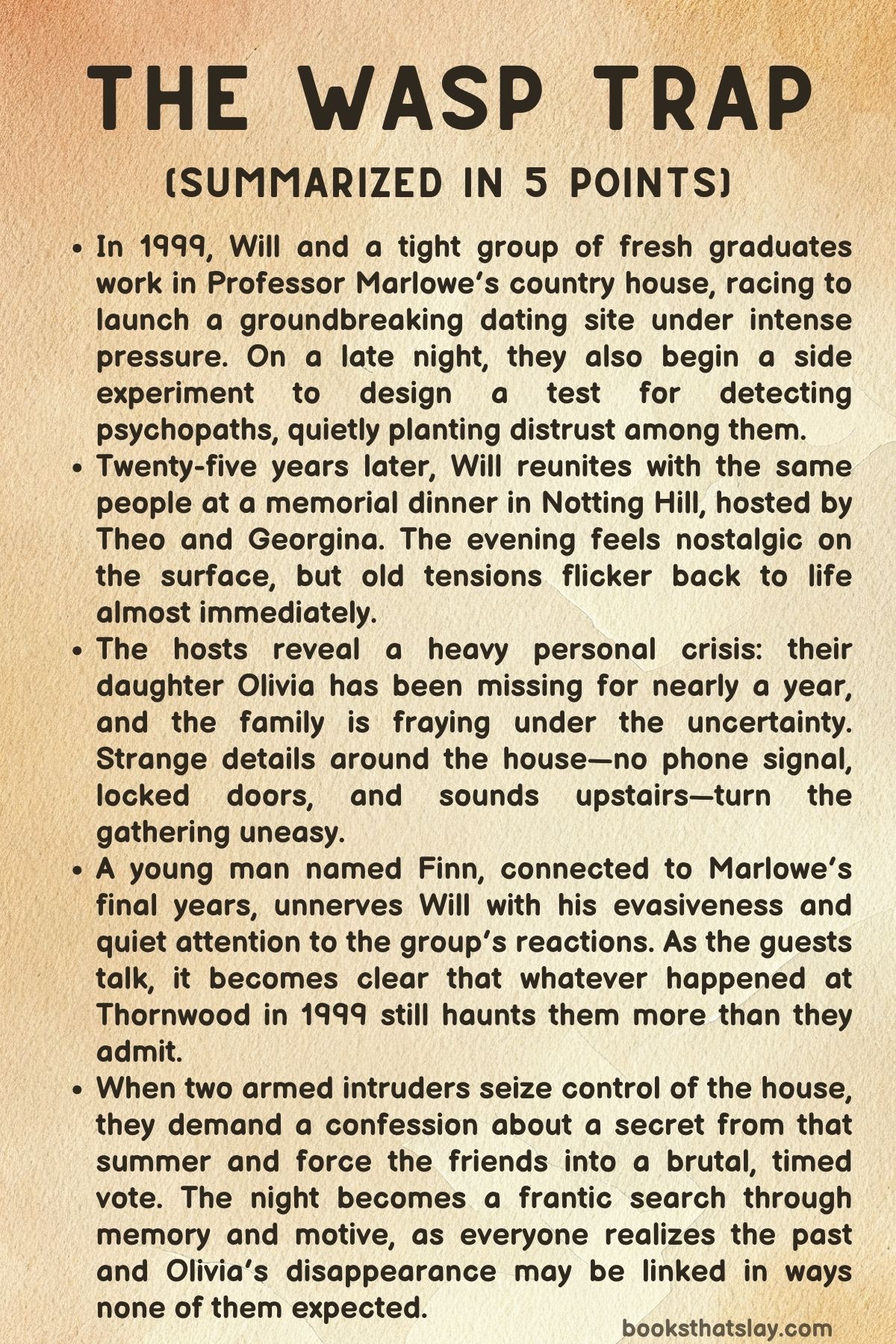
Summary
In July 1999, Will joins a small team of graduates at Thornwood, the imposing estate of Professor Sebastian Marlowe. The library has been converted into a pressure-cooker startup space where Will, Lily, Sophie, Theo, Rohan, and Georgina work to launch a cutting-edge online dating site before a rival beats them.
Sebastian is mercurial and exacting, hovering over the project while guarding his reputation as a researcher of psychopathy. One late night, Lily proposes a “helpful” side experiment: build a screening test for psychopaths that can serve both Sebastian’s research and the site’s matching algorithm.
Everyone agrees to be a subject. Will is fascinated by Sebastian’s work and privately feels he can already guess who among them might score dangerously high.
The story shifts to February 2024. Will travels to Notting Hill for a dinner hosted by Theo and Georgina Howard, former teammates who are now wealthy and influential.
The gathering is meant to honor Sebastian, recently dead. Will is uneasy: his writing career has stalled, his friendships from Thornwood dissolved without explanation, and his relationship with Sophie ended painfully that summer.
Outside the Howards’ grand townhouse he bumps into Rohan, who jokes about how little fame Will has gained. Will also thinks he hears a distant cry from one of the empty neighboring houses, but it stops before he can place it.
Inside, Theo and Georgina welcome Will and Rohan warmly and make a point of showing off a sophisticated, app-controlled security system. Both houses beside them are empty—one being renovated, one owned by an absent Russian oligarch—so they rely on technology to feel safe.
Upstairs, their sitting room has been arranged to resemble Sebastian’s old room at Thornwood, including a painting of the estate he once gifted them. Sophie arrives soon after.
She seems friendly, which relieves Will, and she brings Finn, a younger man introduced as Sebastian’s former assistant. Finn’s polite attentiveness feels slightly forced, and at one moment Will catches his smile vanish into something colder when he thinks no one is watching.
Georgina gives a tour. The dining table is laid for seven even though only six old colleagues are present, hinting at an expected guest who never arrived.
Will spots a family photo showing two daughters, Mia and an older girl. When he asks about it, Theo and Georgina deflect.
In the kitchen they meet the caterer Callum and his assistant Amber, whose red hair reminds Will of Eve, another helper from the Thornwood summer. Tension flickers between Theo and Georgina, and Rohan notes Theo has been drinking hard.
Lily arrives last, delayed by custody problems. Over drinks, Finn presses the group about why they lost touch.
Lily shuts the question down; Rohan snaps back bitterly about missed fortunes. Another argument breaks out between the hosts, and the group overhears Georgina say she is “going to tell them.” Theo gathers everyone and reveals the truth: their eldest daughter, Olivia, disappeared eleven months earlier. She left after a breakup, taking cash, valuables, and her journal.
Police believe she ran away voluntarily, but Georgina is wrecked by uncertainty, and Theo’s anger toward Olivia’s ex-boyfriend Felix borders on obsession.
As they move toward dinner, practical problems start stacking up. Phones lose reception, the wi-fi drops, and the thick walls are blamed.
When Lily tries to step outside to get signal, the front door refuses to open. Theo explains the smart security needs the internet to unlock, but the router is down and the system has slipped into lockdown.
A dusty landline is produced, but no one calls the security company. The house is sealed, and no one can contact the outside world.
At the table, conversation turns slowly to Thornwood. Will admits he’s writing a novel based on that summer.
The group reacts sharply, especially when Dominic’s name surfaces. Dominic was Sebastian’s nephew and their driver in 1999; he died by drowning in the estate’s lake shortly after they left.
The mention cracks old fear open. Finn and Amber exchange a look.
Finn excuses himself, and Will follows, suspicious. He hears heavy footsteps upstairs, finds a bedroom computer newly active, and returns downstairs to locate Finn.
A crash comes from the kitchen. Will and Sophie rush in—only to find Callum and Amber holding shotguns, and Finn battered and zip-tied in a cupboard.
The caterers are imposters.
Callum forces everyone back to the dining room, collects their phones, and announces they want a secret from 1999. They give the group an hour to confess, promising escalating violence if they don’t.
After they leave, panic explodes. Theo admits he never called for help.
With no signal and no exit, the only way out is to understand what the intruders are hunting.
Will recognizes a phrase Callum used—“everything echoes”—the same words Finn had repeated earlier. When the captors step out again, the group makes a noisy distraction so Will can reach Finn.
Finn, barely conscious, reveals he’s a private detective hired to investigate Olivia’s disappearance. Sebastian had told him “everything echoes,” hinting Olivia’s case tied back to Thornwood.
Finn tries to point Will to his jacket pocket, where a small notebook is hidden. Before he can explain further, Callum catches Will and shoots Finn dead.
Georgina then admits Mia hired Finn secretly because she never believed Olivia just ran away. Will and the others search Finn’s notes and find a printout: a draft message from March 2023 written by Olivia, saying she followed the cat Claude into a hidden passage, found something terrifying, and blamed Claude for leading her there.
While the adults are trapped upstairs, Mia searches the top floor and discovers the entrance to the passage in a wardrobe. She crawls through a narrow space behind shelves and down a staircase inside the walls.
In darkness she hears Callum speaking to someone named Dominic, threatening to burn the house. The internet suddenly reconnects, letting Mia listen through her AirPods as the adults read Olivia’s message aloud.
She lights candles, reaches a trunk inside the passage, and finds Olivia’s journal.
Back upstairs, Dominic appears—alive, furious, and clearly in league with the captors. He forces a lie-detector style test using Lily’s phone and a smartwatch, demanding admissions about 1999.
Rohan confesses he once tried to steal Lily’s algorithm after being offered money, but Dominic dismisses it. Under pressure, Georgina slips and reveals knowledge only a witness would have.
Dominic finally admits the core secret: in 1999, he and Sebastian killed Eve and dumped her in the lake, and on Sebastian’s deathbed Dominic learned someone had seen it and kept evidence. Callum realizes he’s been used.
Fighting erupts; Georgina kills Amber and shoots Callum, then the survivors flee to the cellar.
Mia bursts into the cellar with the journal and accuses her mother of killing Olivia. The journal shows Olivia found Georgina’s hidden diaries and proof in the passage and threatened to expose her.
Georgina confesses everything: she witnessed the 1999 murder, recorded Dominic and Sebastian, stole the weapon, and blackmailed Sebastian for years. She even swapped her psychopath-test score with Dominic’s to hide her own result.
When Olivia discovered these secrets, Georgina killed her and staged a disappearance. She plans to eliminate the remaining witnesses, but Mia turns on her, striking her with the old bloody branch and knocking her out.
Dominic and Georgina are arrested, Eve’s body is recovered, and Olivia’s death is finally confirmed.
In the aftermath, Sophie survives her gunshot wound, Theo mourns publicly, and the scandal consumes the press. Mia goes to live with her grandparents and keeps Claude.
In the hidden passage she finds the old floppy disk labeled “Wasp Trap,” loads Lily’s original test on a vintage laptop, and prepares to take it herself—frightened that her mother’s nature might run in her blood.
Characters
Will
Will is the novel’s emotional lens and moral barometer, a man whose life has been quietly shaped by the summer of 1999 even as he tries to pretend it hasn’t. In the Thornwood timeline he’s young, bright, and hungry to prove himself, drawn to Sebastian’s intellectual charisma and to the thrilling newness of their dating-site project.
His curiosity about psychopathy—and his willingness to help build a test for it—shows both ambition and a tendency to intellectualize danger rather than confront it directly. In 2024 he returns as a stalled writer and teacher, carrying a low simmer of regret: regret about lost opportunities, about how things ended with Sophie, and about not showing up for Dominic’s funeral.
He’s observant to the point of anxiety, reading micro-expressions and noticing inconsistencies that others miss, which makes him the first to suspect Finn and later to piece together what the intruders want. Yet he’s also vulnerable to self-doubt and guilt, especially once the “secret” hunt forces him to admit he has his own buried truth.
Across the story, Will’s arc is about moving from passive witness to active protector—he risks himself for others repeatedly, and his final choices signal a man trying to redeem a past he never fully understood.
Sophie
Sophie is both a catalyst and a mirror for Will, carrying the same past but processing it in a different emotional register. In 1999 she’s open, adventurous, and quietly influential in group dynamics—she supports Lily’s psychopathy-test idea without hesitation, suggesting a comfort with pushing boundaries if it serves curiosity or progress.
Her relationship with Will is tender but complicated by the toxic undertow of Thornwood’s hierarchies and secrets, and by Dominic’s flirtations which sharpen Will’s insecurity. When the narrative returns to 2024, Sophie has learned to armor herself with practicality and distance; she’s cordial but cautious, clearly unwilling to be pulled back into old chaos.
That guardedness makes her skeptical of Will’s suspicions at first, not because she’s naïve, but because she knows how fast paranoia can spiral in a group already weighted with history. Once danger becomes undeniable, Sophie’s steadiness surfaces—she aligns with Will, endures violence, and survives with lasting physical cost.
She embodies the theme of survival through adaptation: not untouched by trauma, but not defined by it either.
Lily
Lily is the story’s sharpest intellect and its deepest reservoir of unresolved pain. In 1999 she’s the one who dares to expand the project beyond dating algorithms into the morally explosive territory of psychopathy detection, combining idealism (a tool that might protect people) with career ambition (helping Sebastian’s work).
Her confidence masks how much she relies on the group’s cohesion; when things fracture that summer, the betrayal lands hard enough to calcify into lifelong resentment. In 2024 she returns guarded, blunt, and quick to shut down talk of the past, suggesting she has carried the wounds more consciously than anyone else.
Lily’s relationship to truth is uncompromising—she hates evasions, refuses to perform forgiveness, and becomes a target precisely because the intruders believe she holds the key. Under coercion her physical fear is real, but so is her moral spine; even when forced into Dominic’s lie-detector ritual, she remains the least willing to bend her reality for comfort.
By the end, Lily stands as the counterpoint to Georgina’s manipulative use of psychology: Lily seeks understanding to prevent harm, while Georgina weaponizes understanding to enable it.
Rohan
Rohan is the novel’s portrait of corrosive grievance: a man who has built his adult identity around the belief that life cheated him. In 1999 he’s already competitive and opportunistic, smart enough to contribute but restless enough to look for shortcuts, which later connects directly to his attempt to steal Lily’s code for money.
That act is not just greed but early evidence of how he justifies moral compromise when he feels owed. In 2024 his bitterness is louder, his jokes sharper, and his desperation more palpable—he measures himself against the successes he thinks the others stole from him, especially Theo’s wealth and Will’s “almost” literary career.
At the dinner party he oscillates between apology and hostility, revealing a man who wants belonging but can’t stop resenting the people he wants it from. Under the captors’ game he becomes pragmatic, even rationalizing the voting system as a survival window, which shows his strategic mind hasn’t dulled.
His confession about the 1999 theft attempt is humiliating but oddly cleansing—it’s the one moment he stops performing victimhood and admits agency. Rohan survives physically, but the story leaves him facing the harder survival: living without the myths he used to excuse himself.
Theo Howard
Theo is success on the surface and volatility underneath, a character defined by love, pride, and the rot of secrets. In 1999 he’s energetic, eager to impress Sebastian, and receptive to the project’s entrepreneurial promise; he seems the type who found his adult path in that summer’s intensity.
By 2024 he is wealthy and socially dominant, hosting the reunion in a shrine-like reconstruction of Thornwood, which hints at nostalgia and a need to control the narrative of that time. His grief over Olivia’s disappearance has metastasized into rage, especially toward Felix, and alcohol becomes his poor substitute for helplessness.
Theo is not malicious in intent—his protectiveness for Georgina and yearning for his daughters are sincere—but he’s impulsive and easily steered by emotion, which makes him vulnerable to manipulation by stronger predators like Dominic and Georgina. His shooting is one of the novel’s cruelest turns: the man who built a secure life is struck down in his own fortress, emphasizing how little wealth or tech can shield a family from internal decay.
Even in death, Theo functions as a tragic measure of what secrecy costs the innocent.
Georgina Howard
Georgina is the story’s true architect of horror: a character who presents as polished warmth while operating from cold, predatory self-interest. In 1999 she blends into the graduate-team dynamic as competent and personable, yet beneath that she is already watching, recording, and calculating.
Her overhearing of Dominic and Sebastian’s cover-up, her decision to keep the bloody branch, and her long-term blackmail of Sebastian reveal not just opportunism but a frightening comfort with leverage and moral inversion. The most chilling detail is her switching of psychopathy test scores with Dominic, an act that shows she understands her own nature and actively hides it to maintain access to power.
In 2024 she performs the role of distraught mother with convincing force, channeling grief into group cohesion, which makes her manipulation even more effective: she uses people’s empathy as camouflage. The eventual revelation that she killed Olivia to protect her secret archive is consistent with her worldview—other humans are obstacles or instruments, even her child.
Georgina’s downfall comes not from lack of intelligence but from underestimating Mia’s capacity for moral revolt. She represents the novel’s core warning: a psychopath in a family doesn’t just hurt strangers; they hollow out the meaning of love itself.
Finn
Finn enters as an unsettling mystery and dies as a tragic near-savior. Introduced as Sebastian’s former assistant, he is immediately off-rhythm with the group, materially younger and socially peripheral, which allows him to observe without being observed.
His masked expressions, notebook, and probing questions create a predator-like aura, and Will’s suspicion of him feels reasonable in the claustrophobic setting. The twist that he is actually a private detective hired by Mia reframes his weirdness as professional vigilance and physical fear—he is undercover in the most dangerous possible room, surrounded by people tied to an old murder.
Finn’s loyalty is to truth rather than to any person there; he’s willing to endure suspicion to protect Mia and find Olivia’s fate. His whispered clue, “pocket,” and his connection to the “everything echoes” phrase show he had nearly assembled the puzzle.
His abrupt murder by Callum, before he can speak fully, is a narrative gut-punch that underlines how secrecy weaponizes time: the truth can be inches away and still arrive too late.
Callum
Callum is menace wearing a uniform of service, a man who uses performative competence to conceal sadism. Posing as a caterer, he engineers the lockdown and the power imbalance with calm efficiency, making the house itself an accomplice.
His violence has structure: he isn’t killing randomly but staging a game to force confession, which makes him feel like a twisted moral adjudicator. Yet his later admission that certain acts were “just a bet” exposes the emptiness beneath that structure—he enjoys control for its own sake, not because he believes in justice.
Callum’s relationship with Amber adds another layer; he is the more composed half of a predatory duo, controlling her rage while also exploiting it. His threats toward Dominic in the passage reveal that he’s not a mastermind but a hired parasite, angry that he’s risking everything for secrets he doesn’t even understand.
Callum dies not as a tragic villain but as the logical endpoint of his own cruelty—outgunned by someone who finally refuses to be terrorized.
Amber
Amber is volatility embodied, a character whose ferocity is both frightening and pitiable. Disguised as Callum’s assistant, she leans into intimidation theatrics—collecting phones, jabbing guns at temples, taunting victims—suggesting she thrives on the emotional high of domination.
Her red hair’s echo of Eve is a deliberate narrative sting, linking past trauma to present threat and keeping both Will and the reader on edge. Unlike Callum’s colder strategy, Amber’s violence feels personal, driven by a hunger to hurt rather than a plan to extract truth.
Her fury when tricked by Georgina’s toilet ruse shows a fragile ego beneath the bravado. The revelation of her affair with Callum makes her less a partner in ideology and more a partner in appetite: she and Callum are bound by mutual cruelty and greed.
Her death—stabbed by Georgina—carries bitter irony: a predator killed by a deeper predator, both collapsing the moment power shifts.
Dominic
Dominic is the story’s long shadow, an embodiment of entitlement turned lethal. In 1999 he functions as gatekeeper and tempter, driving the recruits in his dead parents’ Jaguar—already a symbol of inherited trauma and fixation on the past.
His flirtations and detachment position him as someone accustomed to attention, and his closeness to Sebastian grants him quiet authority over the group. The later truth that he murdered Eve and dumped her in the lake, then helped Sebastian cover it up, reveals a man for whom empathy never existed in the first place.
In 2024 he returns as the hidden master of the intruders’ scheme, still obsessed with protecting his inheritance and reputation. His insistence on turning the confession hunt into a pseudo-scientific lie-detector ritual is grotesquely fitting: he wants to control reality by controlling narrative, just as he did in 1999.
Dominic’s rage is always tethered to self-preservation, not justice, and his willingness to burn the house with people inside confirms his total moral vacancy. Taken into custody with Georgina, he stands as proof that some people don’t evolve—they just refine their methods.
Professor Sebastian Marlowe
Sebastian is the absent center around which both timelines orbit, a charismatic academic whose brilliance is inseparable from moral decay. In 1999 he is domineering, brilliant, and restless, pushing graduates to the edge in pursuit of innovation and status.
He fosters a seductive atmosphere where intellect feels like permission, which helps explain why the group is drawn into side projects like psychopathy testing without fully grasping the ethical landmines. Yet Sebastian’s most defining trait is cowardice masked as authority: he covers up Eve’s murder with Dominic instead of facing consequences, and later shuts down the Thornwood project abruptly, leaving the recruits emotionally and professionally stranded.
Even on his deathbed, his phrase “everything echoes” shows a flicker of conscience, but it arrives as warning rather than repair. Sebastian’s legacy is thus double-edged—he opens minds and futures, but he also models a worldview where genius outranks responsibility, and that ranking poisons everyone who comes after him.
Eve
Eve is present mostly through absence, but her role is crucial as the story’s moral wound. In 1999 she appears as a new helper at Thornwood, vivid and immediate in contrast to the insulated graduate clique.
The fact that she is outside their intellectual bubble makes her more vulnerable to Dominic’s predation and Sebastian’s protectionism. Her murder—and the casual disposal of her body—becomes the original sin of the novel, the event that literally and psychologically contaminates the lake, the house, and the lives of the people who witnessed or enabled it.
Eve’s long-hidden body being recovered at the end is not just plot closure; it is the narrative’s demand that the erased be restored to truth. She represents every cost that the powerful try to bury, and her reemergence ensures the past can no longer be treated as a ghost story.
Mia Howard
Mia is the novel’s brave hinge between generations, a teenager forced into adulthood by the failures of her parents. She begins as a mostly unseen presence, a girl in the upstairs rooms while adults drink and circle their memories, which mirrors how children often sit adjacent to family trauma without being told its shape.
Her love for Olivia is fierce and practical; she doesn’t accept the runaway narrative and instead sells treasured jewelry to hire Finn, showing initiative far beyond her years. Mia’s discovery of the passage and Olivia’s journal turns her from investigator to truth-bearer in a house built on lies.
The moment she accuses Georgina in the cellar is the emotional climax of the book: a child finally naming what the adults have refused to see. Her hesitation when Georgina tries to recruit her, followed by her decisive strike with the bloody branch, reveals a young person wrestling with inherited darkness and choosing resistance.
In the epilogue, her decision to run the psychopath test on herself is poignant—not because it confirms anything, but because it shows how trauma breeds self-doubt, and how courage can coexist with fear.
Olivia Howard
Olivia is the missing heartbeat of the present timeline, a character defined by the traces she leaves behind. Her disappearance is first framed as teenage flight, but the later revelation of her secret investigation recasts her as principled and brave, someone who stumbled onto a horror too large for her safety.
Olivia’s curiosity mirrors Will and Lily’s younger intellectual hunger, but unlike them she follows curiosity into a literal hidden passage of family secrets. Finding Georgina’s diaries and the evidence from 1999 brings her to a moral crossroads: keep silent and live with corruption, or expose it and risk everything.
She chooses exposure, and for that she is murdered by her own mother. Olivia thus becomes the novel’s clearest emblem of truth’s danger inside a corrupt family system.
Her journal is her voice after death—steady, frightened, but determined—and it is the tool that finally collapses Georgina’s façade.
Claude
Claude, the cat, is a small but meaningful character as a symbolic guide through hidden spaces. His sudden appearances and disappearances foreshadow the literal passageways in the townhouse and Olivia’s earlier movements within them.
Claude’s role in leading Olivia toward the passage, and later living with Mia after the tragedy, ties him to the theme that truth often slips through cracks the powerful ignore. He is a quiet narrative tether between innocence and discovery, reminding us that the house’s secrets were never as sealed as Georgina believed.
Felix
Felix is a peripheral figure, yet he functions as a narrative decoy and a measure of Theo’s grief. As Olivia’s ex-boyfriend, he becomes Theo’s focus of rage and the convenient villain in a story the adults want to believe: a breakup leading to a runaway.
The police theory, Theo’s obsession, and the group’s early sympathy all orbit Felix, which makes the eventual revelation feel even more devastating—Felix was never the real story. His main purpose is structural: he shows how easily families reach for outside explanations rather than confront the possibility of danger within their own walls.
Themes
The long shadow of the past and the cost of unfinished truths
From the opening return to a group that has not met in twenty-five years, The Wasp Trap frames the past as something that never stays buried. The dinner party is meant to honor Sebastian and offer a tidy ritual of closure, yet the house itself becomes an instrument that forces old events back into the room.
The characters arrive carrying private versions of 1999: Will with guilt and stalled ambition, Lily with anger and self-protection, Rohan with resentment, Sophie with guarded nostalgia, Theo and Georgina with a curated replica of Thornwood as if reenactment could domesticate memory. The lockdown and hostage ordeal are not random shocks; they literalize what the group has been doing emotionally for decades—sealing doors, hiding keys, and hoping the signals don’t come through.
When Finn appears and starts poking at the summer they refuse to discuss, the story shows how denial functions like a short-term sedative and a long-term poison. The phrase “everything echoes” is less a hint than a thesis: choices made in youth have a way of returning through new mouths and new victims.
Olivia’s disappearance extends this idea across generations. Her curiosity about the passage and diaries becomes the mechanism by which the earlier crime reactivates, proving that a secret never belongs only to its keepers; it leaks into futures they don’t control.
By the time Georgina’s confessions spill out, the narrative has made clear that avoiding truth doesn’t erase it—it multiplies its damage. The ending, with funerals, arrests, and recovered bodies, isn’t catharsis so much as a reckoning that arrives late and at a terrible price.
The theme insists that time does not neutralize wrongdoing; it merely delays the moment when someone—friend, child, stranger—forces the account to balance.
Psychopathy, moral masking, and the danger of mistaking charm for safety
The idea of testing for psychopaths begins as an ambitious side project for clever graduates, but The Wasp Trap uses it to question how reliably anyone can read another person’s inner life. The 1999 setting is full of youthful confidence in metrics: an online dating algorithm, an academic test, a belief that personality can be mapped and risk can be quantified.
Yet the arc of the story exposes the limits of that faith. People who are dangerous are not necessarily loud, chaotic, or obviously cruel; they can be organized, patient, and socially fluent.
Georgina’s eventual reveal is the sharpest demonstration of moral masking. For years she performs stability—marriage, wealth, motherhood, hospitality—while privately sustaining blackmail, manipulation, and murder.
Her ability to cultivate trust is not incidental; it is a tool. The swapped test scores underline a brutal irony: even when a diagnostic instrument works, power can still game the results.
In other words, the threat is not only the existence of psychopathy, but the systems that assume labels and numbers will protect them. Finn’s fate deepens this critique.
He is competent and cautious, yet he is still outmaneuvered because he, like the others, expects truth to look a certain way. Meanwhile Dominic represents another form of camouflage: inherited entitlement wrapped around vulnerability.
He can present as the wounded nephew or the loyal caretaker while still being capable of lethal violence. The hostage scenario turns the social world into a lab where moral performance is observed under stress.
Votes, confessions, and coerced disclosures show how quickly people revert to self-preservation when terrified, and how a skilled predator can exploit that. By closing with Mia preparing to use the old test on herself, the book doesn’t offer reassurance; it offers uncertainty.
The theme lands on a chilling point: evil often hides behind normality, and the desire to find a clean method for identifying it can itself be a trap, because it tempts people to trust the measure more than their lived evidence.
Technology, control, and the illusion of secure systems
Both timelines in The Wasp Trap orbit technology as a promise of mastery over human chaos. In 1999, the online dating site is imagined as revolutionary—a way to translate attraction and compatibility into code, to make intimacy efficient and predictable.
In 2024, the Howards’ smart security system embodies a similar fantasy: app-controlled safety, automated locks, a house that can be managed like software. The plot systematically dismantles both fantasies.
The dating project’s underlying assumption is that human desire can be optimized without unintended consequences, but the very summer building that system ends in secrecy and death, implying that human darkness can’t be safely abstracted away. The security system’s breakdown is even more direct.
Thick walls, lost keys, a router down, and an “internet-dependent” override trap the guests in a cage they paid to build. What is sold as protection becomes vulnerability the moment anyone malicious understands the dependencies.
The intruders do not need to be geniuses; they exploit predictable failure points—no reception, no manual failsafe, no functional landline. The story uses these failures to suggest that modern control is often performative.
People feel safe because screens say they are safe, not because safety is structurally real. Theo’s refusal to call the security company even when he can is another angle on the theme: technology doesn’t replace human responsibility, and when fear, denial, or pride interfere, the best system in the world won’t matter.
There is also a subtler critique about surveillance and data. Finn is a private detective gathering observational evidence much like an algorithm gathers behavioral evidence, and he still misses the full shape of danger because some things are hidden in analog forms—diaries, tapes, a bloody branch.
The passage behind the walls becomes a metaphor for what technology can’t see: motives, buried histories, and private decisions that never enter a database. By staging the climax amid broken devices and dead signals, the book argues that reliance on tech can dull basic survival instincts and community trust.
Control, it suggests, is never purely technical; it is moral and relational, and the moment you outsource it completely, you give predators a ready blueprint.
Ambition, envy, and the corrosive politics of success
The gathering in The Wasp Trap is thick with comparisons, and the book treats ambition not just as a personal drive but as a social toxin that reshapes loyalty. In youth, they are a high-pressure team racing a rival company, already learning to connect self-worth to winning and being first.
Sebastian’s agitated oversight and the startup stakes create a culture where speed matters more than care, a setting ripe for shortcuts and ethical drift. Decades later, the same hierarchy persists inside their casual conversation.
Rohan’s bitterness over missed wealth, his fixation on being “screwed over,” and his awkward pitch to Theo show how old competition never fully left. Will’s shame about not becoming a bestselling novelist reveals how success standards can colonize identity; he doesn’t just want to write, he wants to be seen as having made it.
Even Sophie and Lily carry their own scars of opportunity and loss, measuring what might have been if that summer hadn’t ended the way it did. Georgina’s blackmail scheme is ambition in its most predatory form.
She turns witnessing a murder into financial leverage, using the money to build a prosperous life while others stagnate. Her success is not portrayed as admirable hustle; it is depicted as a structure built on harm.
Theo’s alignment with her, whether through complicity or ignorance, points to another dynamic: ambition can make people accept moral compromises as the “price of a future. ” The hostage votes expose how envy and fear feed each other.
People choose targets partly based on who seems to have something—knowledge, opportunity, a secret, even creative hopes. Rohan assumes Will must be hiding something because Will is writing a book; Will is resented for daring to shape the past into art.
In that sense, ambition becomes a reason to suspect and to sacrifice. The theme lands on a bleak insight: when success is treated as the ultimate verdict on a life, friendships turn transactional, memories become resources to exploit, and ethics become negotiable.
The book doesn’t say ambition is inherently wrong, but it shows how quickly it mutates under pressure and how its aftertaste can linger for decades, warping what people owe each other.
Inheritance, motherhood, and the fear of becoming what harmed you
The story’s final movement shifts from the original group to Mia, and The Wasp Trap uses her perspective to explore inheritance as both legacy and threat. The Howards’ household is initially presented through surfaces—wealth, controlled aesthetics, a formal hospitality that imitates Thornwood.
Underneath sits a family wound: Olivia’s absence, Theo’s rage, Georgina’s grief performance, and Mia’s quiet determination to find the truth. Mia’s choice to hire Finn is a child’s rebellion against adult resignation.
She refuses to accept the police narrative or her parents’ forced calm, revealing a theme about how children often become guardians of truth when parents choose comfort over reality. Georgina embodies the nightmare version of motherhood.
Her love is real only insofar as it serves her self-image and security. When Olivia threatens exposure, Georgina chooses self-preservation and kills her own child, then manufactures a story of loss to bide time.
In doing so, she weaponizes the social expectations of maternal innocence. The passages where Mia emerges holding Olivia’s journal and confronts her mother are not just plot turns; they are ethical births.
Mia steps into moral adulthood by recognizing that family loyalty has limits. Her act of striking Georgina with the old branch is symbolic: she uses the relic of the first crime to stop the person who extended that violence into the next generation.
The aftermath keeps this theme alive rather than sealing it. Mia goes to live with grandparents, but she carries a new dread—what if her mother’s capacity for harm lives in her too?
The floppy disk and the old test become her way of seeking an answer, but the emotional question is larger than any score. She is trying to separate identity from bloodline, to prove to herself that nature is not destiny.
The theme therefore holds two truths at once: abuse and violence can be inherited socially and psychologically, but agency still matters. Mia’s fear is credible, yet her actions across the crisis show empathy, courage, and a refusal to lie to herself.
By ending on her poised between knowledge and uncertainty, the book presents inheritance as a moral crossroads. What we receive from parents can be a warning as much as a template, and breaking a legacy may start with the willingness to look at it without flinching.