To Clutch a Razor Summary, Characters and Themes
To Clutch a Razor by Veronica Roth is a dark urban fantasy rooted in Slavic folklore and the moral wreckage of inherited violence. It follows Dymitr, once a Holy Order Knight sworn to kill monsters, who has been turned into a zmora—one of the very creatures he used to hunt.
Half human, half fear-eater, he’s caught between the Order’s brutal certainties and a new life built with Ala, a zmora illusionist he once tried to destroy. When an ancient witch takes Dymitr’s soul-sword, he must choose what kind of monster—or person—he wants to be, and how much he’s willing to lose to become that.
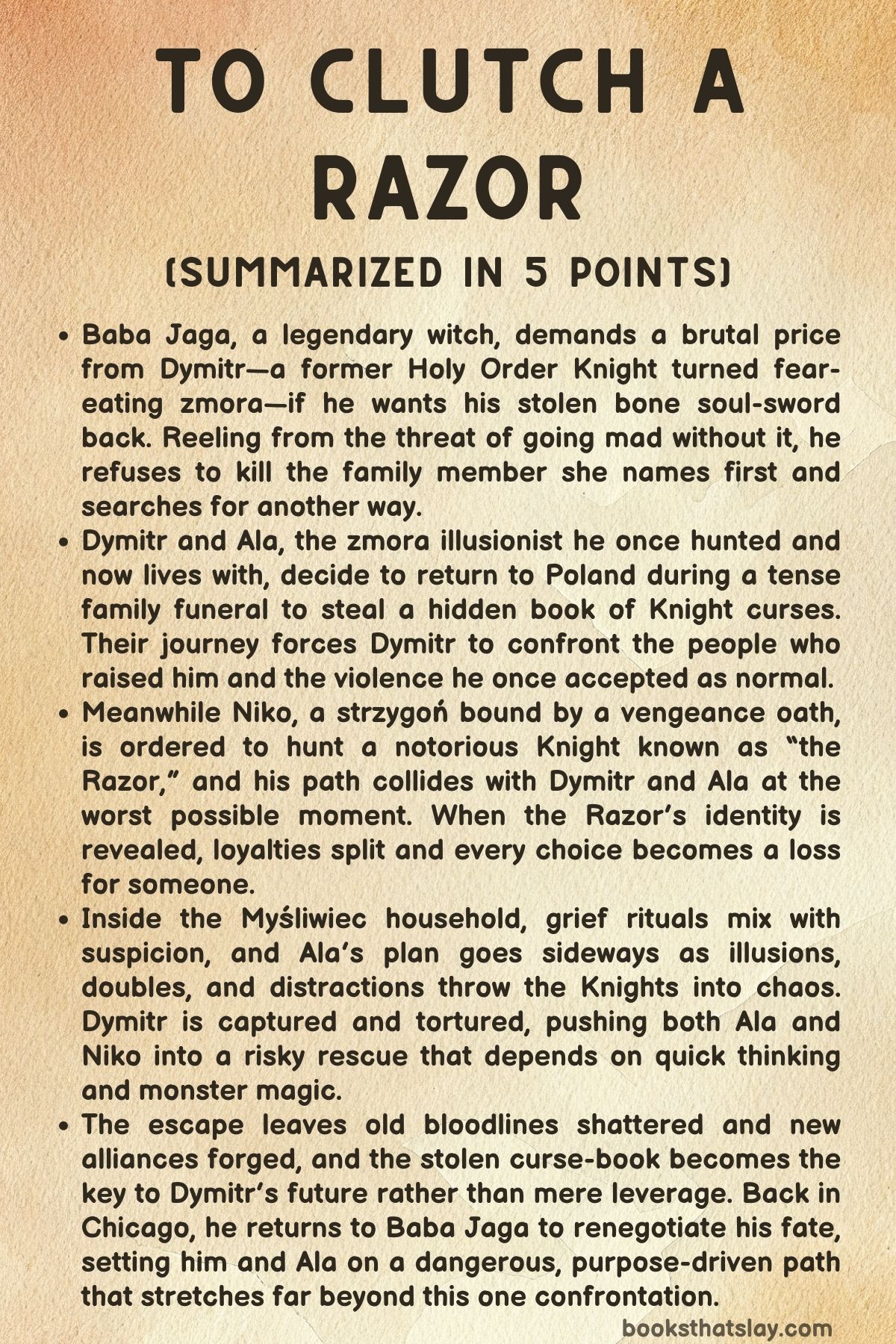
Summary
Baba Jaga, a legendary witch who trades in transformations and debts, calls Dymitr to her shifting house. She has taken his bone soul-sword, the weapon bound to every Knight’s split soul, and fixed it like a trophy on her wall.
Dymitr, now a zmora who feeds on fear, asks what he must pay to get it back. Baba Jaga tells him he’s bargaining from weakness: without his sword he is half-souled and sliding toward ruin.
Her price is cruel—thirty-three bone swords lifted from dead Knights, starting with the sword of Babcia, Dymitr’s own grandmother. Dymitr begs her to relent.
He knows Knights are murderers dressed as saints, but he loves the woman who raised him. Killing her would shatter what remains of him.
Baba Jaga dismisses him, furious that he wants change without accepting what change demands.
Dymitr remembers growing up inside a Polish Knight family. His uncle Filip explained what it means to live with a bone sword embedded in your back: drawing it out and putting it away always hurts, so Knights keep it inside to stay ready and to avoid the agony of separation.
Filip also described the rite that makes a sword—an older Knight cuts a novice’s back, pours their blood into the wound, and splits the novice’s soul so the blade can live inside them. The memory makes Dymitr’s present terror sharper.
He already feels the pull of the missing sword like an exposed nerve.
Back in Chicago, he seeks John Moore, a Knight historian. John tells him about a relative who lost his sword to a monster.
The man spiraled quickly: constant pain, hollow hunger, and then hallucinations of every creature he had killed. Within months, he ended his own life.
John warns Dymitr that if he doesn’t recover his sword soon, he’ll suffer the same fate. Dymitr goes home to Ala’s cramped apartment, heavy with dread.
He tells her Baba Jaga’s demand and John’s warning. He refuses to kill his grandmother.
If that means madness or death, he’ll accept it. Ala refuses to let him fold.
She’s survived worse than despair, and she promises they’ll find another way to bargain.
At the same time, Nikodem Kostka—Niko—an undead strzygoń bound by a zemsta oath to hunt and kill Holy Order Knights, is summoned by his matriarch, Lidia. She’s furious that he protected Ala and Dymitr during an earlier conflict, and now orders him to hunt a notorious Knight called Brzytwa, “the Razor.
” Niko knows this mission may be meant to erase him, but he accepts. Before leaving, he returns Dymitr’s bow to Ala’s porch, shares a charged goodbye with Dymitr, and warns him to approach Baba Jaga differently.
Both men understand too well what debts can do.
News arrives from Poland: Dymitr’s uncle Filip is dead, killed by a strzyga, and the family is gathering for the funeral vigil. Dymitr’s sister Elza leaves him a voicemail asking him to come home.
Ala, meanwhile, is tormented by nightmares tied to her bloodline curse—visions of Joanna, Dymitr’s grandmother, mutilating a zmora. Ala becomes convinced Joanna must die.
She suggests a new bargain: steal Joanna’s hidden book of Knight curses from the family house and use it to trade for Dymitr’s sword. Dymitr tests his lingering Knight sight by cutting his hand; his eyes flash red, proving he can still perceive Order magic.
They decide to go.
They fly to Poland, detouring through New York so Ala can bargain with a wiła for temporary Polish fluency. The price is strange but steep: a baby tooth and the promise of losing her voice for twice as long afterward.
When they land near Gdańsk, Dymitr learns the whole clan will be at Joanna’s house for Filip’s rites. That makes the theft harder, but Dymitr insists on attending the funeral anyway.
He needs to mourn, and the chaos of so many Knights in one place might cover their movements.
They drive into rural northwest Poland and feel the oppressive weight of Holy Order magic pressing on the land like old bruises. At a cheap hotel, Dymitr sleeps badly, dreaming of the monsters he once helped kill.
Ala returns with a knife, warning that zmoras are nearby. The next day they stop at Basia’s Cafe and unexpectedly see Niko there.
Niko has been preparing his hunt. He sought out a wieszczy woman—scarred, starving, and half-mad from her undead hunger—and offered her a bargain.
If she appears at Filip’s grave, the Knights will scatter to chase her, giving Niko a chance to corner the Razor. In return, he promises her refuge and a path toward redemption.
She agrees out of desperation.
When Niko pulls Dymitr aside, they clash over the oath. Dymitr tries to drive him away, calling the mission a death sentence.
Under pressure, he reveals the truth: the Razor is Marzena Myśliwiec, his own mother. Niko is stunned but unmoved.
Marzena is a killer and he must complete his vow. Dymitr is torn between losing his mother and losing Niko.
Before fleeing in anguish, he gives Niko a detail that might keep him alive: Marzena keeps a knife in her left boot.
At the Myśliwiec house, the vigil begins. Mirrors are covered, clocks stopped, and Filip’s body is washed and laid out.
Elza moves through chores with numb grief. Dymitr arrives suddenly, apologizes for old cruelty, and reunites with her.
Joanna watches him with sharp suspicion, saying he seems different, but sends him on an errand instead of exposing him. The house fills with relatives and hymns meant to ward off evil.
Dymitr spots the curse book hidden under the bathroom sink, fighting grief and guilt over stealing from people he still loves. During dinner, Marzena speaks casually about using informants and discarding them when convenient.
The coldness of her words makes Dymitr sick.
Outside, Ala sees Niko kneeling at swordpoint before a possessed teenage girl. The spirit is a dybbuk, exhausted by wandering.
Ala bargains with it: it can enter the Knights’ house by attaching to someone not yet a Knight, saving at least one future victim. The dybbuk agrees, gives its name—Adam—and clings to Ala’s back.
Niko warns her five minutes is all he can buy with the distraction. Ala slips inside, heads for the false panel by the sink, and finds the hiding place empty.
Footsteps approach. Panic spikes.
From Elza’s view, something feels off. She speaks with Dymitr in the hallway, then hears a crash and sees him elsewhere at the same moment.
She realizes there are two Dymitrs. When the wieszczy appears at the cemetery, Knights surge out in a coordinated hunt.
Joanna drags the family into emergency roles. In the weapons room, Elza arrives with a second “Dymitr,” and Joanna instantly recognizes zmora illusion.
She strikes the real Dymitr, deciding he is the monster, and binds him. Ala, still wearing his face, improvises and is sent away with Elza to “hunt” the threat, while Joanna and Marzena interrogate their captive.
Dymitr is tortured brutally. Joanna demands answers about his plans and allies.
Marzena joins in, and Joanna amplifies his pain with a curse until his screams fill the house. Ala finds Niko in the woods, tells him the Knights have Dymitr and now know he’s a zmora, and proposes a desperate rescue.
Niko uses dybbuk magic to take Ala’s shape. Ala then recreates her Dymitr illusion, loosely binds Niko’s wrists to make him look like her prisoner, and they reenter the house.
The Knights misread the scene, and Joanna decides to separate the prisoners for questioning.
In the courtyard, Ala drops her illusion and reveals herself to Joanna as the survivor of Joanna’s bloodline curse. She attacks, but Joanna moves faster, carving her open and finally stabbing her in the abdomen.
Inside, Niko reveals his true strzygoń form, turning into an owl-like predator and fighting Marzena. Her curse-commands tear his body apart, but Niko uses the hidden boot knife Dymitr warned him about.
He stabs through her arm, breaks her knee, takes her bone sword, and escapes alive.
Dymitr, half-broken and watching Ala die, drags himself to a Saint Michael statue, seizes the dagger there, and lets the last of his Knight self rise alongside the zmora. He stabs Joanna through the ribs.
She recognizes him as both grandson and monster, tries to strike back, and collapses. Her death snaps the pain curse and ends her control.
Ala, Niko, and Dymitr flee to a hotel, where Niko helps them heal. Elza tracks their blood but pauses when she hears Dymitr sobbing—real grief, not a trick.
She confronts Ala at a childhood fort where the curse book is hidden. Ala admits Dymitr chose to become a zmora because he couldn’t keep murdering.
Shaken, Elza lets Ala leave with the book, warning she won’t show mercy again.
Back in Chicago, Dymitr goes to Baba Jaga to bargain anew. She heals his injuries and explains that lasting transformation usually requires a final severing of the past.
Joanna’s death was the lock he needed broken. Dymitr offers the stolen curse book for his sword, but Baba Jaga already owns similar volumes.
Still, she changes the deal: instead of thirty-three dead Knights, he owes her thirty-two broken curses, undoing the Order’s harm one spell at a time. She fuses the bone sword back into his spine in a painful ritual, telling him it will fade as he completes the task.
She also demands he protect her grandson, Niko, from his own family’s attempts to kill him.
The story closes with new bonds and new wars ahead. Ala regains her voice and moves with Dymitr into a small basement apartment.
Dymitr finds Niko at a crowded nightclub, jealousy flaring into honesty, and they finally admit their growing attachment. Later, at Lake Michigan, Niko wants to throw Marzena’s sword away, but Dymitr stops him.
He knows without it Marzena will unravel, haunted by her dead, and he proposes a trap instead. If they plant the sword somewhere chosen, Marzena will come for it.
This time, Dymitr swears, he won’t hesitate—he will face his mother with Niko beside him, and both will decide what kind of future they’re willing to carve out of the past.
Characters
Dymitr Myśliwiec
Dymitr is the emotional and moral core of To Clutch a Razor, defined by being caught between what he was trained to be and what he is becoming. Once a Holy Order Knight whose vocation depended on pain, obedience, and sanctioned violence, he now exists as a half-souled hybrid zmora who eats fear—an existence that forces him to confront the interior cost of every monster he ever hunted.
The loss of his bone soul-sword is not only a physical and magical danger but also a metaphor for his fractured identity: without it, he risks madness and the ghostly judgment of his victims, meaning his very mind is a battleground for guilt. His love for his family, especially his grandmother and Uncle Filip, complicates the Order’s black-and-white worldview and reveals that his humanity never fully died, even at his most loyal.
His arc moves from desperation and self-loathing to a grim, chosen responsibility: he kills Joanna not out of devotion to Baba Jaga’s bargain but to save Ala and to sever the blood curse that bound his soul. By the end, he is no longer asking to be destroyed; he is choosing to live differently, even if it means hunting down the Order’s legacy curse by curse.
His relationships clarify his transformation: Ala reflects his capacity for tenderness and ethical revolt, while Niko draws out his desire for connection and a future not scripted by the Knights. Dymitr finishes the story with restored power but a new kind of burden—one he accepts willingly, which is the strongest proof that he has reclaimed agency from a life built on coercion.
Aleksja “Ala” Dryja
Ala is a zmora illusionist whose defining trait is stubborn, almost feral hope in the face of systems designed to crush it. She carries deep trauma from her bloodline curse and from being hunted, which manifests as nightmares and an intimate familiarity with fear—yet she refuses to let that fear set the limits of her life.
Her love for Dymitr is not passive comfort but a chosen commitment to fight for his salvation even when he is ready to surrender. The plan to steal Joanna’s curse book is a clear expression of Ala’s pragmatism and courage: she is willing to walk back into the den of people who once tried to kill her, not for revenge alone but for the possibility of a future where Dymitr survives whole.
Her power as an illusionist is tied to identity play and deception, but Ala’s deeper struggle is about truth—specifically the truth of who she is beneath imposed narratives of “monster. ” When she disguises herself as Dymitr, it is both tactical and symbolic: she literally steps into his life to protect it, showing how intertwined their fates have become.
Her confrontation with Joanna is a culmination of years of inherited harm; she seeks to end the nightmare lineage at the source, even if it costs her life. After Joanna’s death, Ala does not become triumphant—she becomes quiet and honest, confessing her intent to kill and accepting Dymitr’s complicated forgiveness.
She emerges as a survivor who transforms suffering into forward motion, and her regained voice near the end underscores her thematic role as someone who refuses silence, even when silence would be safer.
Baba Jaga
Baba Jaga stands as the story’s most formidable moral enigma: ancient, manipulative, and yet unexpectedly purposeful. She is the keeper of bargains and the architect of transformations, operating on a scale of time and consequence far beyond the Knights’ limited moral imagination.
Her cruelty is real—she humiliates Dymitr’s weakness and sets a grotesque price—but the narrative reveals that her harshness is calculated toward a larger end. She understands transformation not as a costume change but as a soul-deep re-authoring that demands sacrifice, and her own past confession frames her as both warning and mirror to Dymitr.
By forcing him toward the death of his grandmother, she strips him of the last blood-anchored lock on his split soul, meaning her bargain is simultaneously punitive and liberating. She collects magic like a scholar-predator, and her interest in the curse book is not greed but an ongoing project of power and preservation.
Still, she is not indifferent: her fondness for Nikodem and request that Dymitr protect him show that beneath her inhuman posture, she maintains attachments that shape her choices. Baba Jaga represents the brutal truth that redemption in this world is transactional and painful, yet possible—if the one seeking it is willing to remake themselves completely.
Nikodem “Niko” Kostka
Niko is a strzygoń bound by a zemsta oath, and that binding defines the tension between his autonomy and his duty. He is introduced as a weapon forged by vengeance and family expectation, yet he consistently behaves like someone searching for a self beyond that script.
His matriarch Lidia sends him after the Razor in what he suspects is a sacrificial assignment, revealing how disposable he is to the Kostka power structure. Despite that, Niko is not purely reactive; he negotiates with the wieszczy woman, calibrates risk carefully, and tries to steer Dymitr toward a better bargain, showing strategic intelligence beneath his fury.
The most compelling part of Niko’s character is his capacity for tenderness where it should not survive: he protects Ala and Dymitr despite cultural pressure, shares a painfully intimate goodbye with Dymitr, and later literally reshapes his body to save him. His fight with Marzena exposes both his physical ferocity and his ethical line—he takes her sword and devastates her, but he does not kill her, suggesting that vengeance for him is not identical with slaughter.
Niko’s romantic bond with Dymitr grows out of shared trauma and mutual recognition, and their final commitment is less a soft ending than a radical act of choosing attachment over inherited hatred. As a character, Niko embodies the theme that monsters are often the people most systemically wounded, and that breaking oaths of violence requires not only strength but also someone to stand beside you while you do it.
Joanna Myśliwiec
Joanna is the terrifying embodiment of Holy Order ideology made flesh: a matriarch whose authority rests on pain, purity rituals, and the conviction that cruelty equals righteousness. She commands the funeral rites with a ritualistic rigidity that reveals how thoroughly she has replaced grief with doctrine.
Her perceptiveness makes her dangerous—she senses Dymitr’s difference quickly and recognizes magic distortions when they matter—yet her certainty becomes her fatal weakness, because she cannot imagine a reality in which her grandson is both family and monster. Joanna’s violence is not impulsive but institutional, treated as holy labor; even her interrogation of Dymitr is framed as duty rather than personal sadism.
That makes her death larger than a single villain’s fall: it severs a generational mechanism of harm. Her blood curse on Dymitr, and its dissolution upon her death, underscores that she functioned as a magical and psychological anchor for the family’s brutality.
Joanna is thus less a complex moral struggler and more a chilling portrait of what devotion to a violent cause looks like when it is reinforced by tradition, power, and love twisted into ownership.
Marzena Myśliwiec (“Brzytwa,” the Razor)
Marzena is one of the story’s sharpest examinations of moral rot disguised as maternal protection. As the feared Razor, she represents the Knights’ ideal: prolific, efficient, and emotionally armored.
Yet her identity as Dymitr’s mother creates a cruel irony, because the person he remembers as a caregiver is simultaneously a figure of legend for slaughter. Her dinner conversation about informants becoming targets reveals a worldview in which people are only tools in a war for purity, a mindset that chills Dymitr more than any monster.
Marzena’s confrontation with Niko in the weapons room displays her as a virtuoso of pain-magic—precise, merciless, and confident in her entitlement to break another body. The detail of the knife in her boot becomes emblematic: she is always armed, always prepared to cut, even in domestic space.
Yet she is not untouchable; her near-defeat and loss of her bone sword expose how fragile Knight identity actually is when stripped of its magical anchor. Dymitr’s insistence that she cannot be separated from her sword without going mad reveals that her cruelty has a cost she has never had to face.
She survives, but her survival is framed as impending reckoning, making her a continuing threat and a haunting reminder that leaving the Order does not automatically erase the people still inside it.
Elza Myśliwiec
Elza is the narrative’s lens on grief, doubt, and the slow cracking of indoctrination. Returning from America, she walks into a home where death is processed through ritual rather than tenderness, and her sorrow for Filip is sincere, private, and isolating.
She is competent in Knight practice—able to check Dymitr for illusion and navigate the vigil’s obligations—yet her emotional truth keeps surfacing in ways the Order cannot accommodate. The double-Dymitr incident is pivotal for her: she senses wrongness not through magic but through her relationship with her brother, indicating that love gives her a perception the Order’s tools lack.
After Joanna’s death, Elza tracks the fugitives with lethal intent, but hearing Dymitr sob breaks the spell of certainty long enough for her to choose restraint. Her final scene at the childhood fort is not forgiveness but an unsettled mercy; she lets Ala take the book because she is beginning to recognize that the monsters her family hunts may be the people her family creates.
Elza stands at the threshold between legacy and conscience, and the warning that she will not be merciful next time suggests a future defined by conflict, not closure.
Uncle Filip Myśliwiec
Filip exists in the story as both memory and catalyst, shaping Dymitr’s past while his death drives the present plot. In Dymitr’s childhood recollections, Filip is the instructor who normalizes pain as preparation and explains the grotesque rite of sword-making, thereby illustrating how violence is passed lovingly from one generation to the next.
There is intimacy in his mentorship, but it is an intimacy that binds Dymitr to a weaponized identity. Filip’s death at a strzyga’s hands triggers the family gathering that enables Ala’s and Dymitr’s infiltration, and it forces Dymitr to confront what Knighthood ultimately yields: a life ended in sanctioned war and celebrated by survivors who have learned to call killing faith.
Filip therefore symbolizes the tragedy of people who can be kind within a brutal system while still serving as its instruments.
John Moore
John Moore functions as a quiet but crucial foil to the Polish Knights, representing an outsider-within perspective on the Order. As an American Knight historian, he is steeped in the institution’s lore but not blinded by its myths, and his story about his great-grandfather’s sword loss provides Dymitr with a terrifying, concrete view of what awaits him without his own.
John’s warning is compassionate but clinical, emphasizing that identity, magic, and sanity are fused for Knights in ways they rarely admit. His role is small in pages but large in impact: he supplies the existential ticking clock that makes every subsequent decision urgent, and his presence broadens the world beyond the Myśliwiec family feud into a transnational legacy of harm.
Lidia Kostka
Lidia is the cold engine behind Niko’s predicament, representing the Kostka family’s ruthless commitment to vengeance and hierarchy. She is not present often, but her influence saturates Niko’s choices, because she wields the zemsta oath as both cultural mandate and political leverage.
Her insistence that Niko hunt the Razor reads like a punishment for compassion, and the suspicion that she expects him to die suggests a leader who protects tradition by sacrificing inconvenient members. Lidia is a portrait of how oppressed communities can reproduce cruelty inwardly when survival is defined by perpetual war.
Adam, the dybbuk
Adam is a rare instance of a spirit treated with empathy rather than fear, and that makes him symbolically important. Exhausted from wandering and longing for an end, he represents the suffering that persists after death in a world saturated with magical violence.
Ala’s bargain with him reframes possession not as violation but as rescue: by entering a not-yet-Knight, he can halt a future cycle of harm. Adam’s choice to cling to Ala after naming himself signals trust and consent, and his presence highlights Ala’s consistent preference for solutions that reduce suffering rather than multiply it.
Lena Dryja
Lena appears only through Dymitr’s dreams and memories, but she haunts him as a symbol of irreversible harm. As Ala’s cousin whom he once helped kill, she represents the personal toll of his Knight years and the intimate ways violence contaminates love.
The dread he feels dreaming of her suggests that his transformation is not an escape from guilt but a life lived with its weight, making Lena a spectral measure of what redemption must confront.
Kazik Myśliwiec
Kazik is a minor but functional representative of the broader clan, characterized by obedience and urgency rather than introspection. His role in announcing the wieszczy sighting helps propel the household into chaos, showing how efficiently the family mobilizes toward violence.
He reflects the collective body of Knights who follow Joanna’s commands without questioning their moral cost.
Themes
Identity, Transformation, and the Cost of Becoming
Dymitr’s story in To Clutch a Razor is driven by the struggle to decide who he is allowed to be after violent change, and whether a self built through harm can be rebuilt without it. His forced transformation into a zmora doesn’t simply alter his body; it tears away the moral scaffolding that once justified his actions.
As a Holy Order Knight, he had identity through purpose: kill monsters, protect people, endure pain as proof of righteousness. After becoming what he hunted, he is left with cravings, fear-eating instincts, and a life depending on someone he once would have executed.
The missing bone sword makes this fragility literal. Without it, he risks madness and death, but with it, he risks returning to the version of himself that killed without question.
The price Baba Jaga demands confronts him with the deepest contradiction in his past: the Knights are “monsters,” but he loves his grandmother and uncle, and those feelings are real even if his family’s ideology is not. His refusal to kill Babcia at first isn’t weakness; it is identity resisting reduction to a single role.
The theme becomes sharper when Baba Jaga explains that permanent change is almost impossible unless something essential is cut away. Her own history shows transformation as a deliberate tearing from one self into another, and she frames the killing of his grandmother not as revenge but as the removal of the blood-magic anchor that kept his soul split.
That reframes Dymitr’s final act: he kills Joanna not only to save Ala but also to end the curse that trapped him between states. Yet the book refuses to present transformation as a clean rebirth.
Dymitr becomes a hybrid Knight/zmora, then is carved again as Baba Jaga embeds a golden sword into his back. Each stage leaves residue: guilt, love, hunger, grief.
Even at the nightclub, sorrow-eating creatures are drawn to him because pain still clings. Transformation here is both liberation and sentence.
To become someone new, he must accept that parts of the old self survive, and that the “new” self is obligated to repair what the old one broke. The fading sword tied to broken curses makes identity an ongoing act rather than a finished state: he will be healed only by repeatedly choosing to undo past violence.
Family, Inheritance, and the Violence Passed Down
The Myśliwiec family embodies how love and brutality can be transmitted together, complicating any simple rejection of one’s roots. Dymitr’s childhood memories show a household where affection exists inside a culture built on sanctioned pain.
His uncle Filip is caring and instructive, teaching him about swords and readiness, but those lessons normalize a rite that literally splits the soul. Pain is called duty, and duty becomes family legacy.
When Filip dies, the funeral rituals reveal how deeply that legacy shapes everyone’s emotional grammar. The hymns, the stopped clocks, the covered mirrors, the vigil itself—these are not only grieving practices but also mechanisms for keeping the Order’s worldview unchallenged.
The family gathers to mourn, yet their talk slips casually into hunting, informants, and the certainty that all targets deserve death. Elza feels this dissonance as emptiness and unease rather than open rebellion, because she has grown up inside it.
Joanna, as matriarch, is the clearest symbol of inheritance as coercion. She reads bodies and behavior as threats, and her authority is upheld through ritual and terror.
Her household is the place where the young are taught what a Knight is supposed to be, and that teaching includes stripping empathy from killing. Marzena illustrates the next generation of that inheritance: feared as “the Razor,” she is lethal not only because of skill but because she has fully accepted the family’s moral framing.
Her comment that all informants become targets eventually shows how violence becomes an everyday ethic, inherited like a surname. For Dymitr, returning home means facing the truth that his earliest feelings of safety and love were braided with a system that trained him to be an executioner.
That is why the town feels unchanged yet horrific: his emotional past is inseparable from the ideology that shaped it.
The theme also runs through Niko’s connection to Lidia and Baba Jaga. Niko is bound by a zemsta oath, which is another form of inherited violence: vengeance passed down as obligation.
Lidia uses family authority to send him toward likely death, showing how kinship can be weaponized. Baba Jaga, though not gentle, offers a different model of inheritance.
She acknowledges cruelty but redirects it into repair: the bargain becomes breaking curses instead of killing people. Dymitr’s final acceptance of this task is a refusal to let family legacy define the future.
Still, the cost is enormous. To step out of inherited violence, he has to kill the person who represents its source, ending not just Joanna’s life but the structure she maintained.
The grief afterward is not a neat emancipation; it is the lingering ache of loving people who taught him to harm.
Guilt, Accountability, and Repair Instead of Revenge
A moral shift from justified killing to accountable repair sits at the heart of the plot. Dymitr knows the Knights did monstrous things, and he is haunted not only by what he was forced to do but also by what he willingly accepted as righteous.
John Moore’s story about his great-grandfather losing his sword exposes guilt as a living, predatory force: the ghosts of the slain appear, jeer, and drive a man to suicide. This is not just a warning about missing magic; it is a metaphor for how violence returns to claim the person who committed it.
Dymitr experiences a similar threat as half-souled pain and hunger grow, suggesting that guilt is both psychological and bodily. His fear of madness is also fear of being swallowed by the moral weight he has tried to ignore.
Ala’s arc mirrors this tension in a different direction. Her nightmares and bloodline curse make her feel hunted by a past she didn’t choose, and her decision to kill Joanna is framed as survival.
Yet even when she acts with resolve, the book shows the danger of letting revenge become the only language for justice. The dybbuk bargain is a key counterpoint: Ala offers the spirit a way to save future victims by attaching to a not-yet-Knight.
That moment treats repair as a form of courage, not softheartedness. It insists that the right response to harm can include preventing harm, not just answering it.
Baba Jaga’s revised bargain crystallizes the theme. She does not deny Dymitr’s desire for relief, but she refuses to let it come through a body count.
Instead of thirty-three dead Knights, he must deliver thirty-two broken curses. This transforms punishment into responsibility.
Repair is not symbolic here; it is labor, one curse at a time, for people harmed by the Order. The embedded golden sword that fades only through that work turns accountability into something Dymitr carries on his skin.
It also rejects the fantasy that guilt can be erased through a single act or confession. Healing requires repeated confrontation with what was done, and repeated choice to undo it where possible.
Even the question of Marzena’s sword continues the theme in an uneasy way. Dymitr stops Niko from throwing it away, not from pity but from understanding consequence: without her sword, Marzena will be tormented by the dead, driven mad by her own victims.
He recognizes that what the Knights did rebounds on them, and he chooses strategy over simple vengeance. They plan to use the sword as bait to end a threat and also re-balance Niko’s standing with his matriarch.
Justice here is not clean. It involves traps, violence, and risk.
But the narrative keeps returning to the idea that revenge alone cannot rebuild a destroyed moral world. By the ending, Dymitr’s path is not about becoming a better killer, but about becoming someone who accepts guilt as a reason to repair rather than a reason to self-destruct or lash out.
Love, Loyalty, and Chosen Bonds in a World of Monsters
Affection in To Clutch a Razor is never separate from danger; instead, it becomes the main force that pulls characters out of isolation and inherited roles. Dymitr’s love for his grandmother and uncle lived alongside the ideology that made them killers.
That painful contradiction is what allows him to change. If he had only hatred for them, killing Joanna would be easy and morally thin.
Because he loves them, the act becomes tragic and complicated, and the grief that follows proves he is not just swapping one identity for another. His bond with Elza shows how loyalty can survive ideological fracture.
He apologizes for cruelty, worries about her safety, and finally calls Ala his sister—expanding family beyond blood. Elza’s decision to let Ala take the book, even after Joanna’s death, is loyalty shifting from the Order to the person she recognizes as her brother’s moral lifeline.
Ala and Dymitr’s partnership is shaped by mutual rescue rather than romance. She refuses to accept his fatalism, chooses a risky plan, and bears a curse that has made her life a chain of fear.
He trusts her enough to return to the place where he was formed, and to expose his weakness without the sword. Their bond is built on shared damage and shared refusal to let that damage define the future.
When Dymitr stops her apology on the plane and calls her his sister, it seals the idea that chosen bonds can be more honest than inherited ones.
Niko’s relationship with both of them deepens this theme further. He is tied to a revenge oath, yet he repeatedly chooses care over obedience: warning Dymitr, escorting Ala, risking himself to rescue Dymitr from torture.
His farewell before leaving Chicago is intimate and tender, and later he literally takes Ala’s body to execute the rescue plan, showing trust that goes beyond convenience. The fight with Marzena exposes how loyalty becomes a form of self-definition.
He doesn’t kill her when he could; he takes the sword and leaves, aiming not for cruelty but for survival and future leverage. Afterward, he holds Dymitr while he breaks down.
This is not incidental comfort; it is the story’s proof that softness can exist without denying hardness.
The romantic turn between Dymitr and Niko does not replace this broader loyalty; it intensifies it. Dymitr’s jealousy at the club is less about possessiveness and more about fear of losing the one person who understands his hybrid existence without flinching.
Their kiss and agreement to be “entitled” to each other lands as a deliberate claim to belonging in a world where both have been defined as monsters by bloodline or transformation. Love becomes a chosen rule that competes with the old rules of the Order and the zemsta oath.
By ending on a plan they will face together, the narrative suggests that loyalty is not just an emotion but a strategy for living ethically when every system around you demands violence.