Undeniably Corrupt Summary, Characters and Themes
Undeniably Corrupt by J. Saman is a contemporary romantic suspense set in Boston, orbiting a brilliant tech CEO and the woman he never stopped thinking about.
Vander Moore is the polished face of a cybersecurity empire, but behind the boardroom persona he’s still a hacker who fights dirty to protect what matters. Liora James, once his high-school love, is now a nursing student and single mom doing whatever it takes to survive. When their worlds crash together after ten years apart, old grief, buried secrets, and present danger force them into close quarters. Love returns fast, but trust comes slower—and the stakes are life, death, and family.
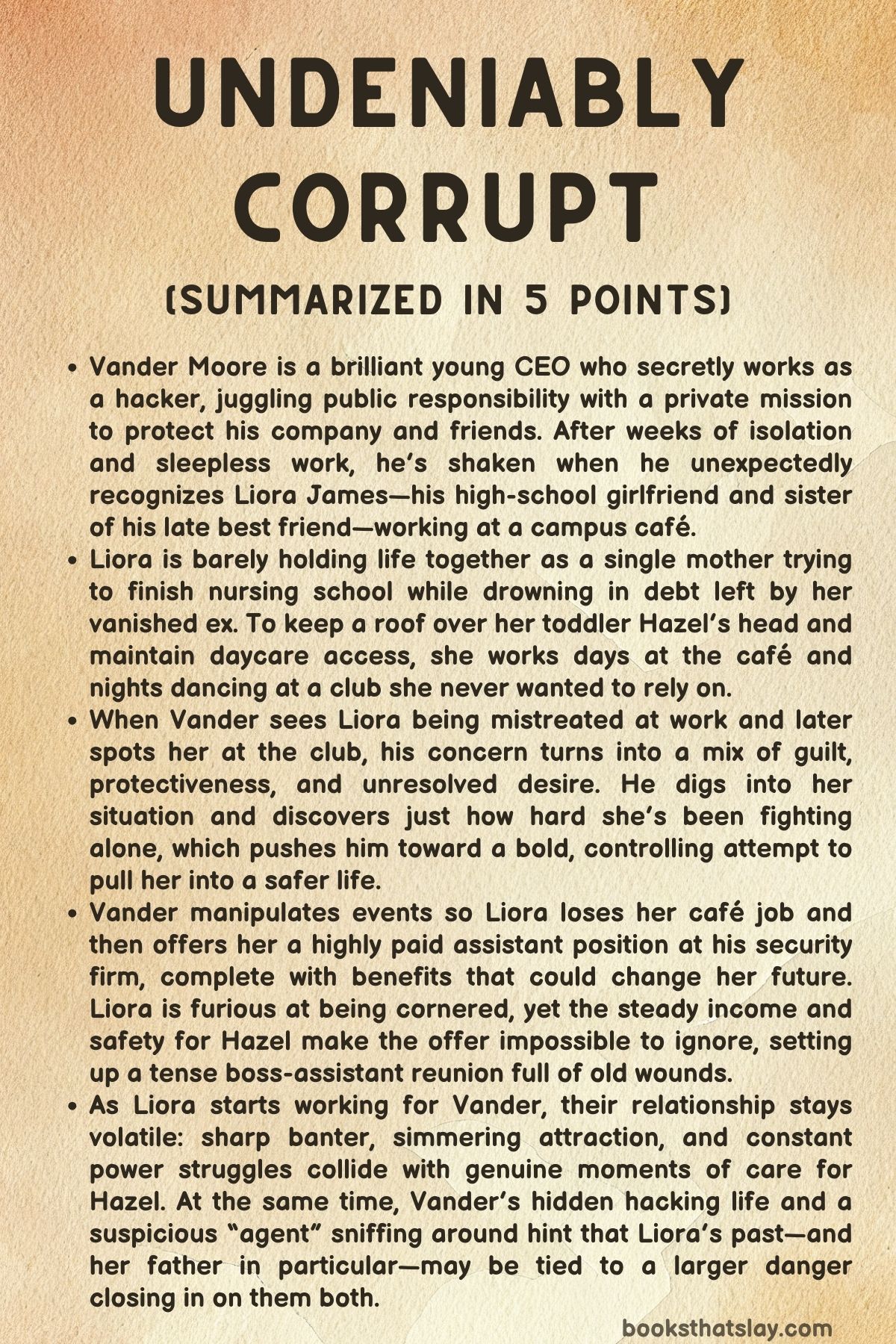
Summary
Vander Moore, the young CEO of Monroe Securities, has been running himself into the ground. For days he hides in a biometric room off his office, surviving on adrenaline while tracking two threats: a cyberattacker aiming at his company and a separate danger circling his closest friends.
His veteran assistant, Champagne Goodall, drags him out, reminds him he’s acting reckless, and warns she’ll retire in eight weeks. With a board meeting looming, Vander heads to a campus café for coffee, trying to reset his brain.
At the café he sees a barista who knocks the air out of his lungs: Liora James—his high-school girlfriend, and the sister of Cassian, his best friend who died years ago. They haven’t spoken since Cassian’s death and Vander’s abrupt departure for MIT.
Liora doesn’t recognize him, so Vander uses a fake name to order. When a demanding customer complains, the manager publicly shames Liora and threatens to dock her pay.
Vander snaps, steps in, pays for the remake, and leaves shaken by how much looking at her still hurts.
Liora’s life now is nothing like the girl Vander knew. She picks up her toddler daughter Hazel from daycare, returns to a crumbling studio in a rough neighborhood, and counts every dollar.
She took the café job because it provides daycare while she finishes nursing school. Hazel’s father, Mattia Vita, vanished after stealing Liora’s savings and student-loan money, leaving Liora trapped under debt.
At night, once Hazel is safe with a teen sitter, Liora works as a dancer at a strip club called The Landing Strip just to keep them afloat.
One night a drunken celebrity actor, Tommy Hardgrave, crosses lines with Liora, forcing her into a private room and demanding sex. A stranger dressed in black interrupts, scares Tommy off, and leaves $500 in Liora’s locker.
The stranger is Vander. He was at the club to hack Tommy’s phone because Tommy has been hurting Vander’s friends Loomis Powell and Keegan Fritz.
Seeing Liora onstage rattles him; he can’t understand why she needs this job.
The next day Vander returns to the café and overhears a daycare call for Liora, learning she has a child. He ignores Champagne’s scheduled interviews and digs into Liora’s life through the club’s records.
He finds her buried in bills while Mattia lives comfortably in Italy. Vander’s shock shifts into fury.
He wants to help her, but he also wants control—especially after realizing someone may be using her as a route to him.
Soon after, Liora is laid off from the café so the owner can hand the job to his son, which also costs her daycare slot. Outside, Champagne approaches her.
She warmly explains she’s retiring and wants Liora to meet her boss about a new assistant job with strong pay, benefits, tuition support, and on-site daycare. Liora, desperate, agrees to talk.
Walking into Monroe Securities, she sees Vander’s name on the CEO’s door and realizes who is behind the offer.
The reunion explodes. Vander admits he engineered her firing to push her toward him.
He offers her the executive assistant role outright. Liora is furious at the manipulation, calls him corrupt, refuses, and storms out.
Champagne later confronts Vander for using her as a pawn. But Liora’s fear for Hazel and her own safety keeps tightening.
After a local dealer attacks her near her apartment and blames her for having a “pimp” beat him, Liora accepts she can’t keep living this way. She takes Vander’s job, even though she doesn’t trust him.
On her first day, Champagne welcomes her. Vander has prepared a private office stocked with a laptop, nursing-school support, and toys for Hazel, expecting Liora might need to bring her daughter to work.
Liora stays guarded. She refuses to quit dancing, pointing out it isn’t prohibited.
Their workplace dynamic turns into sharp banter stitched with lingering desire. Liora pushes Vander’s buttons on purpose, and Vander fights to stay professional while failing spectacularly.
Liora introduces herself at a staff meeting and casually mentions she and Vander dated in high school. The room reacts; the COO Alesha becomes instantly hostile toward her.
Vander arrives late, bruised knuckles taped up, and Liora suspects he’s already been protecting her in the shadows. Their tension spills into flirty, combative texts during the meeting, leaving Liora disturbed by how much she wants him despite her anger.
Away from work, Vander’s friends call him out for what he did: hacking Liora, getting her fired, and cornering her into the job. Vander doesn’t pretend he’s innocent.
He admits he wants to destroy Mattia for abandoning Liora and Hazel, and to shield Liora from a threat he can sense but hasn’t mapped yet. His fixation grows stronger, and so does his fear that her past is tied to the fake FBI agent who suddenly appears at his office.
A man calling himself Vincent Vega arrives claiming to be FBI and interrogates Vander about a former MIT hacking arrest and his decision to hire Liora. He knows details he shouldn’t.
Vander realizes the “agent” is fake, confirms this through security checks, and starts tracking him. The danger feels personal and close.
Meanwhile Liora’s life improves in concrete ways: clinical rotations go well, Hazel thrives in daycare, and the paycheck gives her breathing room. But Vander’s control and curiosity press on her.
One day, after a heated argument in the garage, their attraction finally breaks through. Vander gives her a sexual release that both of them try to frame as a one-time lapse, but it shifts the ground beneath them.
Soon Liora and Hazel move into Vander’s home for safety, and their emotional walls crack. Vander cares for Hazel during a fever scare, consults a doctor friend for guidance, and proves he can be steady when it counts.
Liora is shaken by how natural it feels to let him in.
Their relationship turns physical again, this time without pretense, and becomes a mix of tenderness, dominance, and old love resurfacing through new scars. Vander buys clothes for Liora and Hazel, pays off her student loans, and secretly wrecks Mattia financially, recovering stolen money and setting up child-support funds.
Liora is overwhelmed by the scale of his help and the way he decides things for her. They argue hard, then reconcile through desire that keeps pulling them together.
Still, Liora knows a storm is coming from her past. She suspects her father Corbin James has been watching her and controlling her mother for years.
She also believes Cassian didn’t die by accident. To protect Hazel, she arranges for a trusted doctor, Katy Lawson, to take Hazel overnight without Vander knowing.
Then Liora goes to a public university lot, ready to meet Vega and force answers.
Vega reveals he’s actually Agent Shien from the FBI. He staged the earlier visit and posed as Corbin’s hitman to pressure the case forward.
The FBI needs a hacker to break Corbin’s systems, and Vander has already stolen critical files. Liora tells Shien about her father’s abuse and that she witnessed the real story behind Cassian’s death.
Shien warns Vander is already marked for death because of what he knows. Liora says she would leave Vander if it meant saving him, even while hating the idea.
Vander and Liora negotiate hard. They agree to hand over evidence only with immunity and protection for themselves, Hazel, and Liora’s mother.
Shien accepts. He takes the drive, leaves to arrest Corbin, and promises safety.
But Corbin strikes first. He ambushes them in Monroe Securities’ garage with a gun.
Liora confronts him face-to-face, demanding the truth about Cassian. Corbin admits he had Cassian killed because Cass discovered his bribery, laundering, and involvement in a prosecutor’s disappearance.
He planned to frame the death as an accident. Corbin says he meant to kill only Vander, but now Liora must die too.
Vander tries to trade himself for her life, offering the files, saying he’ll die for her. Corbin fires anyway.
Vander tackles Liora down. Shien bursts in, shoots Corbin’s hand, and arrests him.
Liora, consumed by rage and years of fear, attacks Corbin until he collapses. Shien lets it happen, then orders them home and asks for statements later.
Safe again, Vander tends Liora’s bruises, showers her, and holds her through the crash of aftermath. Liora admits she needs to feel powerful and safe after a lifetime without either.
They make love, not as escape but as a promise. By morning they plan to pick Hazel up and begin their life as a real family—no running, no secrets between them, and no one left to threaten their future.
Characters
Vander Moore
Vander Moore is introduced as a brilliant but self-destructive young CEO of Monroe Securities who lives in a constant double life: the polished public face of a cybersecurity leader and the secret, obsessive hacker working off the books to protect his company and his friends. That split defines him.
On the surface he carries authority, wealth, and strategic coldness, but privately he runs on insomnia, guilt, and a vigilantism that blurs ethics. His reappearance in Liora’s life reveals how much of his identity is anchored in unfinished emotional business: grief over Cassian’s death, regret about leaving, and a lingering devotion he tries to deny even to himself.
Vander’s corruption is not cartoonish greed; it’s a conviction that he knows what is best and can force outcomes for “good” reasons. Engineering Liora’s firing to pull her into his orbit is the clearest example—he frames it as rescue, but it’s also control.
Across the plot, Vander softens in tangible ways: caring for Hazel without being asked, stocking Liora’s office with what she needs, and repeatedly choosing Liora’s safety over his pride. Still, his instinct is always to dig, hack, and dominate situations before trusting people, which is why the threat from Corbin and the FBI hits him so hard—he’s used to being the one holding the secrets.
By the end, Vander’s arc is about learning that love and protection can’t be built only on surveillance, money, or force; they require consent, truth, and shared vulnerability.
Liora James
Liora James is the emotional core of Undeniably corrupt because her life embodies survival with teeth. She begins as a single mother balancing nursing school, poverty, stripping, and fear, yet she never collapses into helplessness.
Liora’s defining trait is defiance in the face of humiliation—whether it’s a café manager belittling her, a coworker like Alesha sneering at her, or Vander trying to rewrite her life through money and manipulation. She refuses to let anyone decide who she is, even when she accepts help.
Her relationship with Vander is fueled by equal parts history, attraction, and rage, and she uses sharp humor and sexual provocation as armor against being controlled again. What makes Liora compelling is that her distrust is earned.
She was abandoned by Mattia, trapped by debt, and terrorized by her father’s shadow. So when Vander offers rescue, she sees both safety and another cage.
Over time, her arc becomes an act of reclaiming agency: she chooses Vander not because she’s bought, but because she decides stability and partnership are worth the risk, and because she confronts the darkest force in her life—Corbin—on her own terms. Liora’s willingness to walk away from Vander to save him, even though she loves him, shows her love is not dependency but sacrifice with boundaries.
The finale with Corbin crystallizes her growth: she is no longer the girl running from terror but a woman who meets it head-on to protect her child and her future.
Hazel James
Hazel is small in page-time but enormous in narrative weight. She is the living reason every adult choice matters, especially for Liora.
Hazel represents innocence inside a world of predation, debt, and secrecy, and she is also the measure of whether Vander and Liora’s relationship can be more than heat and history. Her wariness toward Vander at first, followed by gradual trust as he cares for her during her fever, quietly validates his potential as a safe partner rather than only a possessive lover.
Hazel also functions as Liora’s emotional anchor: no matter how volatile Liora and Vander become, Hazel keeps the stakes grounded in real-world responsibility. By the end, Hazel symbolizes the family they are trying to build—one defined not by blood alone but by chosen protection and earned trust.
Champagne Goodall
Champagne Goodall is more than the longtime assistant archetype; she is the moral thermostat around Vander. She sees his genius and his damage clearly, and she is the first person to call him out when he crosses lines, especially in using her retirement and influence to corner Liora into the job.
Champagne’s role is caretaker mixed with stern realism—she drags Vander out of self-imposed isolation, scolds him about sleep and health, and tries to ensure he doesn’t become the tyrant he flirts with becoming. Her impending retirement gives urgency to her mentoring, because she knows Vander is about to lose a stabilizing force.
Champagne’s warmth toward Liora, and her refusal to let Vander excuse manipulation as benevolence, positions her as a quiet ethical backbone in the office and in Vander’s life.
Alesha
Alesha, the COO, functions as both workplace antagonist and social mirror. Her immediate hostility toward Liora reveals insecurity about power, status, and proximity to Vander.
She reads Liora as a threat not only professionally but personally, and she leverages corporate coldness to undermine her. What makes Alesha important is that she shows the kind of elitist cruelty Liora has been fighting all along: judgment masked as “professional standards.
” In a story where love is tangled with control, Alesha represents an external control system that rewards image over humanity. Liora standing up to her is another way Liora asserts that she belongs in rooms that were never built for women like her.
Cassian James
Cassian is physically absent but emotionally present everywhere. As Liora’s brother and Vander’s best friend, his death is the crater that shaped both protagonists.
For Vander, Cassian is guilt and unfinished loyalty; for Liora, he is grief that never had justice. Cassian’s murder is also the narrative fuse that links romance to conspiracy: without his death, Vander and Liora might have stayed a broken teenage memory.
Instead, Cassian becomes the shared wound that keeps pulling them toward answers and toward each other. The revelation that Corbin had Cassian killed reframes Cassian from tragic accident to targeted silencing, intensifying the story’s themes of corruption and the cost of truth.
Mattia Vita
Mattia Vita is a ghost villain: he appears mostly through consequence rather than presence, yet those consequences are brutal. By stealing Liora’s savings and loan money and disappearing, he becomes the origin of her financial desperation and her need to strip.
He represents a very personal kind of corruption—intimate betrayal—contrasting with Corbin’s institutional evil. Vander’s vendetta against Mattia shows both Vander’s protective love and his dangerous need to dominate outcomes.
Mattia’s comfortable life in Italy is a steady reminder of how unfair the world has been to Liora, which is why Vander’s revenge feels emotionally satisfying even as it raises ethical questions.
Tommy Hardgrave
Tommy Hardgrave is a localized predator whose role is to spotlight the vulnerability of women like Liora in spaces built to exploit them. His entitlement, vulgar tipping, and demand for “extras” show a man used to buying access and violating boundaries.
Tommy’s presence also ties into Vander’s vigilante hacking side, because Tommy is connected to harm done to Vander’s friends. Functionally, Tommy is the doorway through which Vander re-enters Liora’s life in its rawest form, forcing Vander to reconcile the girl he loved with the woman surviving under pressure.
Vincent Vega / Agent Shien
Vega, later revealed as Agent Shien, is the story’s embodiment of controlled deception. His fake FBI visit rattles Vander because it threatens the one arena Vander usually owns—information.
As Vega, he is menacing and ambiguous, tailing Liora and delivering threats in the name of her father, pushing her toward fear and confession. As Shien, he becomes a pragmatic lawman willing to bend procedures to catch a larger monster.
He occupies a gray zone similar to Vander’s: both are willing to break rules for a perceived greater good. The difference is that Shien ultimately offers a path toward lawful resolution, while Vander’s instincts pull toward private justice.
Shien’s grudging respect for Liora’s courage and Vander’s skills makes him a key bridge between their personal war and the institutional takedown of Corbin.
Corbin James
Corbin James is the central embodiment of the book’s title. He is not corrupt in a casual way; he is systemically rotten, using money, violence, surveillance, and political bribery to sustain power.
As Liora’s father, he twists the natural role of protector into the ultimate threat, turning family into a prison and love into leverage. His control over Liora’s mother and his orchestration of Cassian’s death reveal a man who treats people as assets to be managed or eliminated.
Corbin’s confrontation in the garage is chilling because he is calm about evil—he sees murder as a business correction. His downfall matters not only because he is stopped, but because Liora finally stops running from him.
Beating him after he threatens Hazel is Liora’s symbolic severing of fear, and Vander’s willingness to die for her shows how Corbin’s cruelty forged their bond into something unbreakable.
Stone
Stone is a small but important piece of Vander’s support system. As a doctor friend, he provides calm, competent guidance when Hazel is sick, which shows Vander leaning on someone else rather than trying to handle everything alone.
Stone’s presence reinforces that Vander does have people who care about him and trust him, and his professional advice helps frame Vander’s caretaking as responsible rather than impulsive.
Dr. Katy Lawson
Dr. Katy Lawson represents safe female solidarity in Liora’s world.
When Liora needs to hide Hazel for a night, she goes to Katy not because Katy is convenient, but because Katy is trustworthy and protective without strings. Katy responds immediately and without judgment, giving Liora proof that help can be clean rather than transactional.
In a narrative full of men trying to control Liora, Katy is a reminder that support can exist without domination.
Vander’s Mother
Vander’s mother acts as a soft counterweight to Vander’s hardness. Her joy at seeing Liora and pride in Liora’s nursing path contrasts sharply with Vander’s manipulative schemes and emotional avoidance.
She humanizes Vander’s past, showing that his affection for Liora was once open and family-visible, and her presence pushes Liora and Vander out of their private war into a more communal reality where feelings can’t be hidden so easily.
Mason Powell
Mason is part of Vander’s inner circle and functions as the blunt truth-teller among friends. He calls Vander out for hacking Liora and forcing her into the job, refusing to let Vander romanticize his behavior.
Mason also serves as a narrative anchor to the broader friend network, reminding readers that Vander’s choices ripple outward. His new child and stable relationship further highlight the kind of grounded life Vander secretly wants but doesn’t know how to build.
Sorel Powell
Sorel, mostly seen through family scenes around the newborn, reinforces the theme of chosen family and the life Vander is orbiting. She represents warmth, domestic stability, and the supportive environment Vander visits but feels separate from, until Liora and Hazel start pulling him toward something similar.
Nolan
Nolan, Mason and Sorel’s baby, is a symbolic mirror to Hazel. His birth frames family as something ongoing and hopeful, and it sharpens Vander’s awareness that his life could include tenderness and permanence rather than only battle and secrecy.
Lucas
Lucas exists in Vander’s past as betrayal. As his MIT roommate who helped set up his hacking arrest, Lucas explains why Vander’s default mode is suspicion and why authority figures, especially federal ones, trigger deep panic.
Lucas is a narrative seed for Vander’s paranoia and his reluctance to trust anyone with power over him.
Sadie
Sadie, also part of Vander’s MIT betrayal, reinforces that Vander’s trauma isn’t only professional. She is a personal proof that people close to him can weaponize intimacy.
Her mention deepens the psychological logic behind Vander’s obsession with control.
Loomis Powell and Keegan Fritz
Loomis and Keegan are part of Vander’s protected circle and are key reasons he keeps hacking despite the risk. Their harm at Tommy Hardgrave’s hands motivates Vander’s vigilante streak, showing that his illegal work is rooted in loyalty.
They help define Vander as someone who loves fiercely but acts dangerously when those he loves are threatened.
Ricky
Ricky appears as a minor but telling figure from Liora’s present, likely a nuisance or ex she must fend off. Vander’s split knuckles and implied violence toward Ricky underline Vander’s possessive reflexes and his tendency to solve threats physically as well as digitally.
Sebastian
Sebastian appears only in the teaser, but even there he is framed as a cursed king shattered by his wife’s death and isolated with children. The setup positions him as a future male lead shaped by grief, duty, and the search for a caretaker figure, echoing themes of loss and family reinvention.
Aston
Aston, also teased, is introduced through a charged mistake—kissing his best friend’s younger sister unknowingly at a party. He signals a future story centered on taboo attraction, identity shock, and the messiness of desire colliding with loyalty.
Themes
Power, Control, and the Fight for Agency
From the first reunion between Vander and Liora, power sits at the center of their dynamic, not as an abstract idea but as something bodily, financial, and emotional. Vander’s wealth and position let him shape Liora’s choices in ways that look like help on the surface and coercion underneath.
He gets her fired, engineers a new path, and offers stability she cannot reasonably refuse because her child’s safety and future are on the line. The story keeps returning to that uncomfortable overlap: when survival is at stake, “choice” can become a narrow hallway with locked doors.
Liora’s anger is not just about the act itself but about what it represents—being reminded that the world is tilted toward people like Vander, and that her life can be rearranged without her consent.
At the same time, Liora constantly pushes back, refusing to be a passive recipient of rescue. She keeps dancing even after being hired, refuses to let Vander rewrite her boundaries, and uses sharp humor and provocation to reclaim space in interactions where she feels cornered.
Her sexuality becomes another arena where control is negotiated. Scenes of intimacy are framed as contests over who gets to decide what happens next, who names the terms, and who walks away owning their body rather than feeling owned by someone else’s desire.
What makes this theme complex is that Vander is not portrayed as a simple tyrant. He genuinely believes he is protecting her and Hazel, and he often anticipates her needs with tenderness.
But intention does not erase imbalance. The book stays in the tension between care and domination, showing that love can be real and still tangled with entitlement.
Liora’s journey is about taking help without surrendering selfhood, and Vander’s journey is about learning that devotion does not grant him the right to steer another person’s life. Their relationship only moves forward when control shifts toward mutual consent and openly negotiated boundaries rather than silent leverage.
Corruption, Justice, and Vigilante Morality
The plot is driven by the idea that official systems meant to protect people are either too slow, too compromised, or actively harmful. Liora’s father uses influence, bribery, and violence to hide crimes; Liora’s ex escapes accountability while she carries the debt; even the workplace fires her for nepotism.
Against that landscape, Vander’s secret life as a hacker becomes a parallel justice system. He doesn’t trust institutions to act, so he acts first—tracking threats, digging into private records, and setting traps for people who abuse power.
Yet the book refuses to present vigilantism as clean or purely heroic. Vander’s methods include illegal surveillance and manipulation, and Liora calls him corrupt because she recognizes that his power allows him to break rules without facing consequences.
The irony is sharp: he fights corrupt men while using similarly unchecked tools. The narrative forces the question of whether justice achieved through morally gray means is still justice, or just another version of control.
Vander punishes Liora’s ex by destroying him financially and routing money into an offshore account. The outcome helps Liora, but it also sidesteps due process and replaces one man’s domination with another man’s decision-making.
The confrontation with the FBI agent heightens this theme. The state wants Vander’s skills but still holds the threat of punishment over him.
The agent’s deception mirrors Vander’s own tactics, implying that institutions also use manipulation when convenient. The eventual deal—evidence in exchange for protection and silence—suggests that even lawful justice is transactional.
By the end, corruption is not only something villains do. It is a condition of the world everyone must navigate.
The book argues that when systems fail, people build their own forms of justice, but those forms carry risk: they can save lives and also reproduce the very arrogance they oppose. Vander’s growth lies in accepting limits and partnering with Liora rather than assuming he alone should decide what justice looks like for her family.
Trauma, Grief, and the Long Shadow of the Past
Every major character action is haunted by earlier losses and betrayals. Vander’s life split began with Cassian’s death and the rupture of his relationship with Liora.
He carries guilt that he never fully names, and that guilt turns into obsessive protectionism. His hacking, his sleeplessness, his hypervigilance, even his inability to stay emotionally present for long stretches, all read like coping strategies for a wound that never closed.
He wants to prevent another loss the way he couldn’t prevent the first, and that fear drives him into extremes.
Liora’s trauma is different but equally defining. She lives with years of abuse from her father, the disappearance of her brother, and abandonment by Mattia, all layered with the daily grind of poverty and danger.
Her toughness is not a personality quirk; it is a survival skill built from being let down repeatedly. She expects betrayal because betrayal is a pattern in her history.
That expectation explains why she reacts so fiercely to Vander’s manipulation—he steps into the role of yet another man deciding her fate.
The book also shows trauma as something stored in the body. Liora’s stripping is not framed as shameful, but it does carry the weight of sacrifice.
She uses her body as currency in a world that leaves her few other options, and the emotional cost leaks out in flashes of anger, mistrust, and self-protective distance. Vander’s physical markers—split knuckles, exhaustion, sexual intensity that borders on aggression—suggest a man whose emotions are too large to sit quietly inside him.
Healing here is not a neat arc. It happens unevenly, with backslides.
Liora stops Vander from confessing about Cassian because she knows that naming pain can open a floodgate neither of them is ready for. Later, her decision to confront Vega and her father is not only strategic but psychological: she refuses to keep running from the story that shaped her.
Vander, in turn, learns that love cannot be built on preventing fear by force. The past remains present, but the theme insists that survival can become something more than endurance when people face the truth together.
Class Inequality, Survival Work, and Human Dignity
The contrast between Vander’s world and Liora’s world is not subtle, and it isn’t meant to be. Liora’s life before Monroe Securities is a rotation of compromises: a low-wage café job tied to daycare access, night shifts dancing to cover rent, navigating a violent neighborhood, and raising Hazel with no net.
The book shows poverty as a constant decision pressure—every choice carries risk, and even “good” options come with hidden costs. Losing her café job isn’t just losing income; it’s losing childcare and momentum toward nursing school.
That dependency exposes how institutions quietly control poor women through access points like daycare and employment.
Vander’s wealth, by contrast, functions like a cheat code. He can walk into a situation, pay to fix it, twist it, or erase it.
He offers Liora a salary that transforms her future, sets her up with an office stocked for Hazel, and later wipes out her loans. The story never pretends money isn’t powerful; it is.
What it interrogates is the emotional price of receiving that power from someone who also desires you. Liora is grateful, but gratitude is complicated when help comes tied to a history of manipulation.
Her insistence on keeping her strip-club job for a time becomes a statement that dignity includes the right to decide how you survive, even if someone richer disapproves.
The book also challenges stereotypes around sex work. Liora is not “saved” from dancing by moral awakening; she is escaping a financial trap created by men who stole from her and a system that offered no cushion.
Her competence in nursing school and her fierce parenting undermine any attempt to reduce her to a single role. Dignity, here, is portrayed as something claimed through resilience, not granted by social status.
At the same time, Vander’s discomfort with executives staring at Liora, his desire to dress her differently, and his need to control her image in corporate spaces show how class power polices bodies. The theme pushes readers to notice how respectability is often a luxury standard set by the wealthy.
Liora’s arc is about entering a privileged world without letting it rewrite her worth, proving that survival labor does not erase intelligence or value.
Motherhood, Protection, and the Meaning of Family
Hazel is not a background detail; she is the axis around which Liora’s decisions turn. Motherhood in the book is portrayed as relentless, practical love shaped by scarcity.
Liora measures every risk through Hazel’s safety—where they live, what jobs she takes, whether she accepts Vander’s offer. Her fear is not abstract; it’s the fear of being one lost paycheck or one violent encounter away from failing her child.
That pressure makes her fierce, cautious, and sometimes willing to swallow pride to secure stability.
Vander’s relationship with Hazel develops in a way that reveals another side of him. His instinct to pick her up from daycare, consult a doctor friend, buy supplies, and comfort her through illness is not performative.
It shows how care can be learned through action even before it is spoken aloud. The moment Hazel falls asleep on him is a quiet turning point: he is no longer only Liora’s past or her employer, but someone capable of being a safe adult in Hazel’s world.
The tenderness of washing Liora’s hair later echoes that same caregiving impulse, suggesting that his love is expressed through service as much as through desire.
The theme also explores the tension between protection and autonomy within family bonds. Vander wants to keep Liora and Hazel physically safe, but his protective drive sometimes crosses into control.
Liora accepts protection while still insisting on being the mother who decides what happens to her child. Their eventual partnership works only when Hazel’s well-being becomes a shared responsibility without erasing Liora’s authority as her parent.
Family in Undeniably corrupt is both biological and chosen. Liora’s father embodies a family bond that is poisonous, built on surveillance and threat.
Vander’s friends, Champagne, Katy, and the wider support network embody chosen kinship, people who step in when blood ties fail. By the epilogue, the family Liora and Vander build is not defined by traditional structure but by safety, emotional honesty, and shared commitment to Hazel.
The theme argues that real family is measured by who protects your future without demanding your freedom in return.
Secrets, Trust, and Identity in a Double Life
Almost every relationship in the story is filtered through secrecy. Vander’s double identity as CEO and hacker forces him to split himself into versions that cannot easily coexist.
Publicly he must be controlled, competent, and lawful; privately he is obsessive, ruthless, and driven by personal codes. That split creates constant tension because intimacy requires being seen whole, yet his survival depends on hiding half of himself.
The fake FBI agent encounter is terrifying not only because of legal danger but because it threatens to expose the self Vander has buried.
Liora is living a double life too, though hers is driven by necessity rather than choice. Nursing student by day, dancer by night, she manages identities that society judges differently.
She hides her past, her father’s crimes, and the danger trailing her because truth has historically meant punishment. Secrecy becomes both shield and prison.
It protects Hazel in the short term but corrodes trust with Vander in the long term.
The theme becomes sharpest when secrecy collides with love. Vander investigates Liora without her consent, convinced that knowing the truth is protection.
Liora withholds information, convinced that telling the truth will destroy what little stability she has. Both are acting from fear, and both avoid the risk of vulnerability.
The result is a relationship that runs hot with attraction but unstable with suspicion.
Trust is earned through moments where secrets are voluntarily surrendered. Liora’s decision to engage Vega on her own terms is a step toward reclaiming her narrative rather than letting others uncover it first.
Vander handing evidence to the FBI, risking his own safety, shows a willingness to act transparently when it counts. By tying resolution to a negotiated alliance rather than a solo rescue, the story suggests that love built on secrecy stays fragile, while love built on shared truth can survive outside threats.
Identity, in the end, is not about hiding the ugly parts but about finding someone who can hold them with you without using them against you.