What We Can Know Summary, Characters and Themes
What We Can Know by Ian McEwan is a speculative literary novel about memory, history, art, guilt, and the limits of human knowledge.
Set mainly in the twenty-second century, it follows literary historian Thomas Metcalfe as he investigates a famous poem that disappeared after a private reading more than a century earlier. His search gradually becomes less about recovering a lost work and more about understanding the people who surrounded it, especially Vivien Blundy, the poet’s wife. Through Tom’s research, the book asks whether archives can ever reveal a complete human life and whether imagined versions of the past can become more powerful than the truth.
Summary
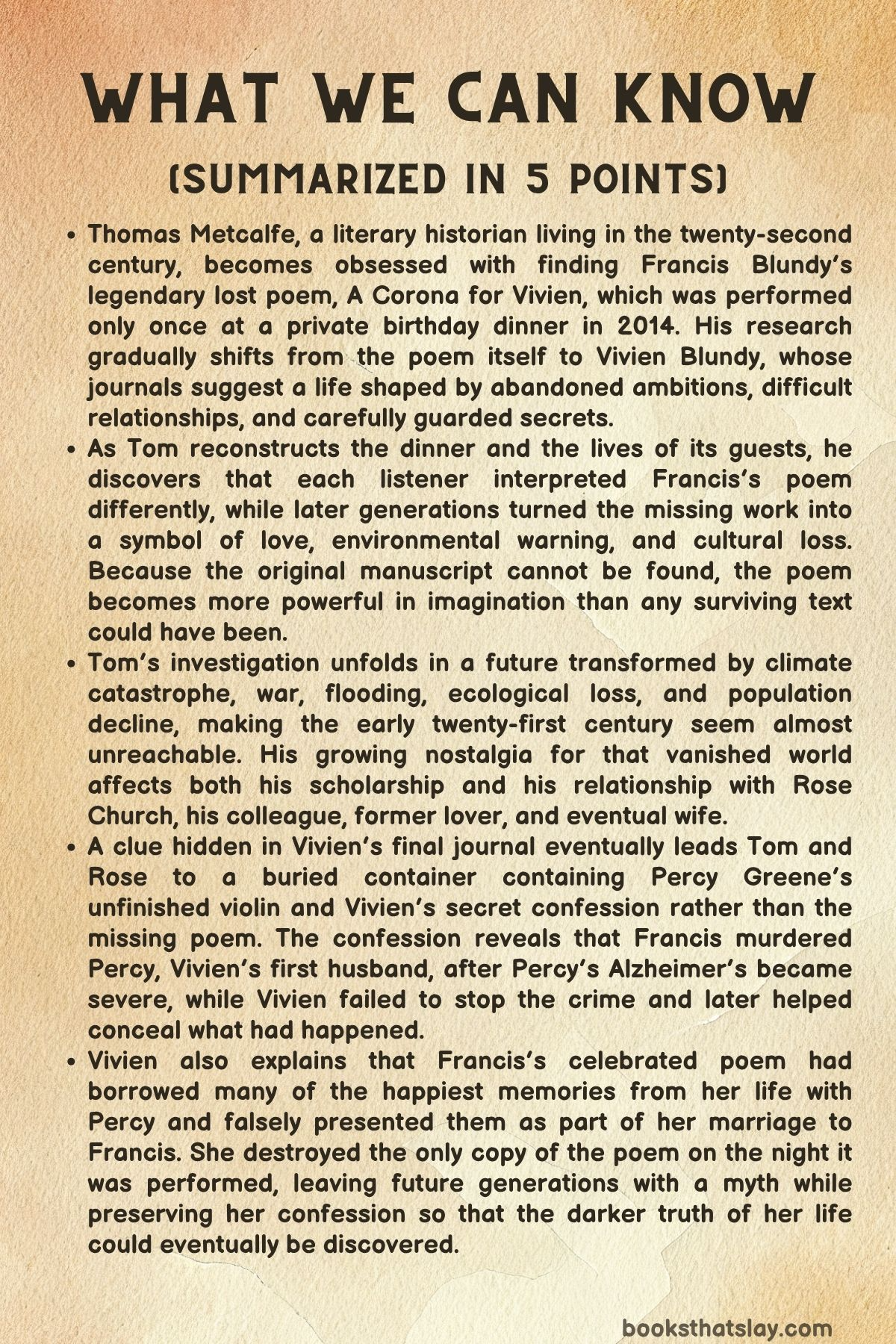
In 2119, literary historian Thomas Metcalfe travels to the Bodleian Snowdonia Library to continue a long-running investigation into a legendary lost poem by Francis Blundy. The poem, A Corona for Vivien, was performed only once, during a private birthday dinner for Francis’s wife, Vivien, in October 2014.
Tom has spent years searching for the missing manuscript, yet his research increasingly draws him toward Vivien herself. Her surviving journals reveal a woman who had once possessed serious academic ambitions but gradually surrendered much of her independent life to the men around her.
Before marrying Francis, Vivien had been an Oxford scholar interested in writing a biography of John Clare. Her first husband, Percy Greene, developed early-onset Alzheimer’s disease, forcing her into the exhausting role of full-time caregiver while much of her intellectual and professional identity disappeared.
After Percy’s death and her eventual marriage to Francis, Vivien again found herself supporting another man’s career. She managed Francis’s correspondence, meals, travel, home, and everyday responsibilities while he concentrated on poetry.
Tom reconstructs the events surrounding Vivien’s fifty-fourth birthday dinner from journals, emails, digital records, photographs, and later testimony. Yet he repeatedly confronts a problem that defines his profession: evidence can establish what people did, but it rarely establishes exactly what they thought or felt.
Francis intends the birthday poem to be his great personal gift to Vivien. He has written a sequence of fifteen tightly structured sonnets on vellum and destroyed the drafts so that only one handwritten copy exists.
His confidence in the work is enormous. He believes he has created something formally brilliant and emotionally lasting, perhaps even a work capable of securing his literary immortality.
Guests arrive at Francis and Vivien’s home carrying private tensions of their own. Novelist Mary Sheldrake and her husband Graham are facing the collapse of their marriage after both have been unfaithful, although their shared betrayal unexpectedly forces them to reconsider what their relationship might still become.
Other guests include botanist Tony Spufford, veterinarian John Bale, Francis’s editor Harry Kitchener, Francis’s sister Jane, journalist Harriet Gage, her husband Chris, and their baby Todd. Their conversations range across politics, literature, animals, climate change, marriage, and contemporary public scandals.
Francis is particularly outspoken about climate change. Although intelligent and culturally sophisticated, he dismisses warnings of environmental disaster and treats predictions of large-scale catastrophe with contempt.
From Tom’s twenty-second-century position, Francis’s confidence appears tragically misguided. Tom lives after the Derangement, a long period of climatic collapse, flooding, war, mass migration, ecological destruction, and social transformation that has permanently altered Britain and much of the world.
When Francis finally reads the poem aloud, everyone hears the same words but experiences them differently. Harriet responds emotionally to its descriptions of nature, love, and mortality, while Chris barely follows it because poetry does not naturally engage him.
Tony admires the accurate descriptions of plants but knows that Francis has little genuine interest in natural history. Mary, meanwhile, is shaken by the sensual richness of the poem and begins questioning the emotionally restrained fiction on which her own reputation has been built.
Jane listens through the filter of old resentment toward her brother, while Harry immediately recognises the poem’s technical achievement. Harry later praises it so extravagantly that his description helps establish the work’s reputation even though almost nobody outside the dinner has actually encountered it.
Vivien’s reaction is far more complicated. She understands that the poem is artistically impressive, yet she also knows that Francis has invented a romantic version of their marriage that does not correspond to the life they actually shared.
Many of the experiences Francis presents as memories of himself and Vivien belong more accurately to Vivien’s earlier marriage to Percy. The walks, swimming, attention to wildlife, physical intimacy, and closeness to nature described in the poem recall the happiest period of her life before Percy’s illness.
Tom becomes increasingly fascinated by this discrepancy between artistic representation and lived experience. It strengthens his belief that even a seemingly intimate work of art can conceal rather than reveal the truth about its creator and subject.
Meanwhile, his investigation unfolds within a transformed future Britain. Sea-level rise, nuclear conflict, tsunamis, population decline, and the Inundation have turned much of the old country into islands and erased landscapes that Francis and Vivien would once have regarded as permanent.
Tom works closely with Rose Church, a fellow academic and former lover. They teach the literature and history of the decades surrounding the global catastrophes, although their students are often impatient with teachers who continually focus on everything humanity has lost.
Tom and Rose disagree deeply about historical method. Tom believes a biographer can carefully reconstruct likely thoughts and emotions when evidence is incomplete, whereas Rose believes such invention risks converting history into fiction.
Their intellectual disagreement exists alongside unresolved romantic feelings. After years of friendship following their earlier relationship, they become lovers again, marry, and attempt to build a shared life.
Tom’s obsession with the past nevertheless begins creating tension. He increasingly idealises the vanished world of abundant wildlife, books, landscapes, and intellectual culture, while Rose argues that his nostalgia prevents him from recognising value in the world that still exists.
The Corona itself acquires an extraordinary cultural afterlife. Because the manuscript cannot be found, people gradually turn it into whatever they need it to represent.
Climate activists claim Francis as a prophetic environmental voice. Others treat the poem as evidence of perfect lifelong romantic devotion, even though the reality of Francis and Vivien’s marriage was far less ideal.
After wars, nuclear exchanges, environmental collapse, and the catastrophic Inundation, later generations imagine the missing poem as an unmatched celebration of a natural world that has largely vanished. Attempts to recreate it fail because an actual poem cannot compete with the flawless work people have constructed in their imaginations.
Tom continues searching because he cannot believe Vivien would deliberately destroy an important work of poetry. He becomes particularly interested in mysterious numbers written near the end of her final journal, though their meaning initially remains unknown.
At the same time, his personal and professional life deteriorates. A class rebellion led by graduate student Kevin Howard exposes how strongly younger generations resent being burdened with their teachers’ nostalgia and grief about the past.
Soon afterward, Tom returns unexpectedly from a research trip and discovers that Rose has been having an affair with Kevin. The shock breaks their marriage apart, although Tom experiences the betrayal with a strange emotional numbness.
Separated from Rose, he retreats almost entirely into his research. While reviewing old material, he learns that Donald Drummond’s mathematically gifted niece Dolly has recognised Vivien’s mysterious sequence of digits as geographical coordinates.
The coordinates identify the location of Vivien’s old dairy study. Another cryptic phrase appears to indicate a precise place nearby where something has been buried.
Tom immediately believes the buried object must be the missing Corona. Despite their separation, he contacts Rose because he knows she is the person most capable of testing his assumptions and helping organise the difficult expedition.
Their common purpose begins repairing their relationship. They travel with Captain Jo Mideksa to the wooded island containing the remains of Vivien and Francis’s former property, then make their way through the landscape to the ruined dairy.
After careful measurement and excavation, Tom and Rose uncover a sealed metal container. Inside are two preserved objects: Percy Greene’s unfinished replica of a Guarneri violin and a thick manuscript.
Tom expects poetry, but the manuscript is prose. It is Vivien’s confession, deliberately hidden so that someone in the future might eventually uncover a history she had concealed from everyone around her.
The confession transforms Tom’s understanding of her life. Vivien reveals that she had once had an affair with Harry Kitchener while still married to Percy, meaning even her apparently candid journals had been selective constructions rather than complete records.
The most devastating revelation concerns Percy’s death. As Percy’s Alzheimer’s became increasingly severe, Francis decided that Percy stood between himself and a future with Vivien.
Vivien rejected Francis’s suggestion that they needed to act, yet she failed to warn Percy or seek help. Francis eventually entered the house, threw Percy down the stairs, and then struck him with a metal mallet when the fall did not ensure his death.
Vivien witnessed the murder. She then followed Francis’s instructions in destroying evidence and allowed Percy’s death to be officially accepted as an accident.
Her later guilt came from knowing that although she had not delivered the fatal blow, she had permitted Francis’s plan to unfold and helped conceal the crime. Her marriage to Francis was therefore founded on an act she could never morally escape.
The Corona became unbearable because Francis had taken Percy’s experiences with Vivien and rewritten them as his own. He transformed Percy’s love of nature, their shared walks, swimming, intimacy, and happiness into evidence of Francis’s supposedly profound marriage.
For Vivien, this was not merely artistic borrowing. Francis had first removed Percy physically and then attempted to replace him inside her memories.
She also feared that the poem contained enough disguised echoes of the murder for a perceptive reader to suspect what had happened. Its artistic greatness therefore made it more dangerous rather than more precious.
Vivien finally reveals the answer to the mystery that has consumed Tom for years. The Corona was never hidden for future discovery because it ceased to exist on the night Francis performed it.
Vivien deliberately placed the vellum manuscript into the fire and destroyed it. By doing so, she prevented Francis from permanently taking possession of Percy’s memories while also ensuring that Francis’s celebrated masterpiece could survive only through other people’s imagination.
Her hidden prose confession becomes the true document she chooses to preserve. She places it beside Percy’s unfinished violin, joining her written truth to a physical reminder of the man whose life and memory had been taken from him.
For Tom, the discovery answers one historical question while proving that his larger problem has no final solution. Vivien’s journals, letters, daily records, and digital traces had seemed extraordinarily complete, yet the most important facts of her life remained concealed until she chose to reveal them.
The novel closes with the knowledge that Tom later edits Vivien’s confession for publication, with contributions from Rose and Donald Drummond. What survives is therefore not the perfect lost poem generations dreamed about, but a human confession revealing how memory, guilt, love, art, and history depend upon choices about what is preserved and what is destroyed.
Characters
Thomas Metcalfe
Thomas Metcalfe is the intellectual centre of What We Can Know, and his personality is inseparable from his obsession with recovering the emotional reality of the past. He is not satisfied with dates, documents, and verified events because he wants history to regain the density of lived experience.
That ambition makes him both an imaginative scholar and an unreliable interpreter. His willingness to infer motives allows him to bring historical figures vividly to life, but it also exposes him to the danger of mistaking his own desires for historical understanding.
Tom’s fascination with Vivien becomes especially revealing. What begins as scholarly interest develops into an emotional attachment so strong that he idealises a woman who lived a century before him and even tells Rose that he could imagine having married her.
His nostalgia extends beyond Vivien to the entire pre-Derangement world. Butterflies, bookstores, landscapes, cultural abundance, and ordinary records from the early twenty-first century become objects of longing, suggesting that his research is partly an attempt to escape dissatisfaction with his own age.
His relationship with Rose exposes the cost of that backward-looking desire. He loves her, but he repeatedly places the dead and the vanished at the centre of his emotional life, making Rose compete with people and worlds that cannot answer back.
The discovery of Vivien’s confession ultimately forces Tom to confront the limits of his method. He possessed an extraordinary quantity of evidence and still misunderstood crucial parts of Vivien’s life, proving that access to information is never identical to possession of truth.
Vivien Blundy
Vivien Blundy is the moral and emotional centre of What We Can Know because nearly every major question about memory, guilt, authorship, and historical truth eventually leads back to her. She appears first through journals and reconstructed evidence, yet the later confession reveals how carefully she had controlled the version of herself available to others.
Her life contains repeated acts of self-surrender. Academic promise gives way to caring for Percy, and later her marriage to Francis turns her into the administrator of another person’s creative life.
Yet Vivien should not be reduced to a victim of circumstance. Her confession reveals desire, secrecy, resentment, infidelity, passivity, moral failure, and a powerful capacity for controlling what later generations will know about her.
Her relationship with Percy contains genuine love and happiness, which makes her later conduct more disturbing. Exhaustion from his illness helps explain her vulnerability without excusing her failure to prevent Francis’s violence.
Vivien’s greatest moral burden comes from complicity rather than direct action. She does not kill Percy, but she understands Francis’s intentions, fails to protect Percy, witnesses his murder, destroys evidence, and then lives inside the future made possible by his death.
Her destruction of the Corona is therefore an act with several meanings at once. It expresses anger toward Francis, protects the memories he appropriated from Percy, conceals possible evidence of the crime, and denies the world access to a poem she nevertheless recognises as artistically extraordinary.
Her final decision to preserve a confession rather than the poem also gives her a form of authorship she had long surrendered. Instead of allowing Francis’s poetry to provide the permanent version of their marriage, she creates the document through which the buried truth will eventually become known.
Francis Blundy
Francis Blundy combines artistic brilliance with vanity, selfishness, intellectual arrogance, and eventually terrible violence. His poetic achievement cannot simply be dismissed because the people who heard the Corona recognise genuine beauty and technical skill in it.
At the same time, his art depends heavily on material gathered from other people. He borrows Vivien’s knowledge of wildlife and transforms experiences from her marriage to Percy into an idealised account of his own relationship with her.
This appropriation reflects his larger treatment of Vivien. He expects her labour, attention, organisation, and emotional support while showing limited interest in the parts of her identity that exist independently of him.
His climate scepticism further reveals his confidence in his own judgement. He is capable of sophisticated political reasoning in some areas, yet on environmental catastrophe he repeatedly dismisses warnings that the future will prove devastatingly accurate.
The murder of Percy exposes the darkest form of Francis’s possessiveness. Rather than accepting the moral boundaries created by Vivien’s existing marriage and Percy’s dependence, he treats Percy as an obstacle to be removed.
Francis consequently becomes an unsettling example of the separation between artistic greatness and moral character. The possibility that the Corona is truly magnificent does not redeem the actions of the man who created it, and the book refuses to make aesthetic achievement a substitute for ethical judgement.
Rose Church
Rose Church acts as both Tom’s closest intellectual partner and his strongest corrective in What We Can Know. She shares his devotion to literature and history but distrusts his willingness to fill evidentiary gaps with imagined thoughts and motives.
Her insistence on documentary limits places her in direct opposition to Tom’s more speculative approach. Where Tom wants history to recover emotional completeness, Rose is more willing to accept that some forms of knowledge remain permanently inaccessible.
Rose also resists Tom’s idealisation of the past. She recognises the cultural and ecological losses produced by catastrophe, but she refuses to treat the present as merely an impoverished remainder of a superior age.
Her affair with Kevin seriously complicates her moral position. It causes genuine harm to Tom and makes her capable of the same contradictions and failures that their historical research continually reveals in other people.
Yet Rose is not defined solely by betrayal. Her return to the search, practical leadership during the expedition, renewed intimacy with Tom, and pregnancy create the possibility that their relationship can continue without pretending the damage never occurred.
Her role therefore reinforces the book’s rejection of simple moral categories. Love, loyalty, failure, forgiveness, and intellectual disagreement can exist within the same relationship without cancelling one another.
Percy Greene
In What We Can Know, Percy Greene initially exists at the edges of the historical investigation, but the later revelations establish him as one of the story’s most important figures. He represents the life that Francis first destroys physically and then attempts to replace symbolically.
Before his illness, Percy is cheerful, capable, affectionate, creative, and deeply connected to the natural world. His work as a violin maker gives him a patient, practical artistry that contrasts with Francis’s public literary ambition.
His relationship with Vivien appears physically and emotionally fulfilled. Their walking, swimming, interest in wildlife, and shared pleasures later become the material Francis appropriates for the Corona.
Alzheimer’s strips Percy of independence and transforms Vivien into an exhausted caregiver. His vulnerability also makes the circumstances of his murder especially disturbing because he has become almost completely dependent on the people around him for protection.
The unfinished violin preserved beside Vivien’s confession gives Percy a final material presence. Unlike Francis’s vanished poem, the instrument remains tangible evidence of a life interrupted before it could be completed.
Harry Kitchener
In What We Can Know, Harry Kitchener occupies several conflicting positions in the story as Francis’s editor, fellow poet, brother-in-law, prospective biographer, and Vivien’s former lover. These overlapping roles make him far more personally involved in the Blundys’ lives than his public connection to Francis initially suggests.
His enthusiasm for the Corona plays a major role in creating its reputation. His extravagant praise helps transform a private birthday performance into a literary event that later generations treat as historically significant.
Yet Harry privately recognises Francis’s controlling personality. His decision to withdraw from writing Francis’s biography suggests that he understands how difficult it would be to produce an independent account while Francis remained capable of managing his own image.
The revelation of Harry’s earlier affair with Vivien further destabilises the apparent historical record. His relationship with her demonstrates how easily major emotional events can disappear from apparently rich archives.
Harry consequently represents both the construction of literary reputation and the incompleteness of recorded history. He helps create the myth surrounding Francis while simultaneously belonging to a private history that the myth excludes.
Mary Sheldrake
Mary Sheldrake is a celebrated novelist whose private insecurity becomes visible during the birthday dinner. Her marriage to Graham is already damaged by mutual infidelity, yet the discovery that both have betrayed one another unexpectedly creates room for reconsideration rather than immediate separation.
Her response to the Corona is especially significant because she experiences it as an artistic challenge. Francis’s sensual and emotionally expansive language makes her recognise limitations in her own highly controlled fiction.
Mary therefore demonstrates the capacity of art to alter another artist’s understanding of her work. She does not simply judge Francis’s poem; the experience forces her to judge herself.
Her later public acknowledgement of the poem’s beautiful descriptions of nature also contributes to its mythology. Because she provides only limited confirmation rather than a full account, her testimony strengthens belief in the lost masterpiece without resolving the mystery surrounding it.
Graham Sheldrake
Graham enters the birthday gathering after confessing an affair, apparently bringing his marriage to Mary close to collapse. His discovery of Mary’s own affair changes the emotional balance by making betrayal mutual rather than one-sided.
His character contributes to the book’s interest in the difficulty of knowing another person even within intimate relationships. Two married people can share years of life while simultaneously maintaining hidden emotional and sexual realities.
The moment in which Mary and Graham exchange an intense but ambiguous glance captures this uncertainty. Even direct physical presence cannot guarantee accurate interpretation, making their marriage a small-scale version of the historical problem that preoccupies Tom.
Jane Kitchener
Jane is Francis’s sister and Harry’s wife, but her significance comes partly from the resentment accumulated through years of being taken for granted by her brother. During the Corona reading, those feelings shape her response more strongly than the poem itself.
Her perspective demonstrates that art is always received through personal history. The same poem that overwhelms Mary or Harriet reaches Jane through decades of unresolved family experience.
After Harry’s death, Jane becomes closer to Vivien, and Vivien eventually moves to Scotland to live with her. Their later silence about Francis and the poem contributes to the mystery while suggesting a private alliance built partly around things neither woman wishes to explain publicly.
Harriet Gage
In What We Can Know, Harriet Gage helps transform the Corona from a private literary memory into a cultural phenomenon. As a journalist who had previously written about Francis and grown close to Vivien, she possesses both public credibility and personal access.
Her emotional response during the original reading is sincere. She hears the poem as a meditation on love, mortality, natural beauty, and environmental loss.
Years later, however, memory and activism reshape the meaning she assigns to that experience. Her newspaper article increasingly presents the poem as an environmental warning, demonstrating how later concerns can alter the interpretation of an earlier event.
Harriet is therefore crucial to the creation of the Corona’s public afterlife. Her question about the missing manuscript turns uncertainty into mystery and helps create the cultural conditions in which an unseen poem can become more famous than many published works.
Chris Gage
Chris Gage provides an important contrast to the highly literary people surrounding Francis. He is practical, adaptable, and relatively uncomfortable with poetry, so much of the Corona passes him by while his attention moves toward ordinary logistical concerns.
His response prevents the dinner scene from becoming an unrealistically unanimous celebration of literary greatness. The fact that a supposedly extraordinary poem can leave one listener largely unmoved reinforces the idea that artistic value is experienced differently by different people.
Chris also represents the ordinary practical world that continues around intellectual and artistic ambition. His presence reminds the reader that life is not always organised around the cultural objects that historians later decide were important.
Tony Spufford
Tony Spufford’s expertise as a botanist in What We Can Know, gives him a distinctive response to Francis’s poem. He recognises the accuracy of its descriptions of plants while simultaneously knowing that Francis has little serious firsthand interest in natural history.
This contradiction leads Tony toward an important question about artistic creation. Francis has transformed borrowed knowledge into convincing poetry, leaving open whether such transformation should be regarded as imaginative achievement or a form of appropriation.
Tony’s reaction anticipates the later revelation about the poem’s deeper borrowing from Percy and Vivien. What initially appears to involve botanical knowledge eventually proves to involve entire memories and experiences taken from another relationship.
John Bale
John Bale, a veterinarian, brings questions of moral responsibility toward nonhuman life into the dinner conversation. His stories about treating injured animals reveal a practical ethic based on extending care toward creatures radically different from ourselves.
His response to the Corona is shaped less by literary reputation than by his own experience of animal vulnerability. This connects the personal morality of care with the ecological concerns that later generations attach to the lost poem.
John also provides an implicit contrast to Francis. While Francis can produce powerful poetic descriptions of nature without deeply living according to their implications, John’s relationship with other species is expressed through concrete acts of responsibility.
Donald Drummond
Donald Drummond is an archivist in What We Can Know, whose importance grows because he takes seriously a detail Tom initially neglects. His attention to the mysterious digits in Vivien’s journal ultimately helps redirect the entire investigation.
His role highlights the value of patient archival work. Tom’s imagination often dominates his research, but the decisive breakthrough comes from looking carefully at a seemingly minor piece of evidence.
Donald also becomes part of the eventual publication of Vivien’s confession. His contribution shows that historical knowledge is rarely produced by a single heroic investigator and instead depends on collaboration across different kinds of expertise.
Dolly
Dolly appears only briefly, yet her insight is decisive in What We Can Know. Her mathematical ability allows her to recognise that Vivien’s mysterious digits are geographical coordinates rather than an ordinary sequence of numbers.
This discovery turns an abstract archival puzzle into a physical destination. Without her interpretation, Tom might have continued searching indefinitely in the wrong places.
Her role also reinforces the story’s respect for forms of intelligence outside literary scholarship. The great breakthrough in Tom’s literary investigation comes from mathematical pattern recognition rather than literary interpretation.
Kevin Howard
Kevin Howard represents a younger generation frustrated by the emotional burden that Tom and Rose place on the past. His classroom protest argues that students cannot build a future if their teachers continually define the present through catastrophe, extinction, and historical loss.
His criticism is uncomfortable partly because it contains genuine force. Tom and Rose believe they are educating students about history, but Kevin exposes how easily historical consciousness can turn into inherited guilt and nostalgia.
His affair with Rose makes his role far more personal and morally complicated. He becomes simultaneously a critic of Tom’s intellectual outlook and the person whose relationship with Rose destroys Tom’s sense of marital security.
Kevin therefore confronts Tom on both professional and private levels. Through him, Tom is forced to recognise that devotion to the dead can damage relationships with the living.
Jo Mideksa
Captain Jo Mideksa transforms Tom and Rose’s academic investigation into a practical expedition. She possesses the local knowledge, navigational experience, and confidence required to reach the island containing the ruins of the Blundys’ former home.
Her competence contrasts with Tom’s primarily intellectual skill set. Once the search leaves archives and enters a dangerous physical landscape, knowledge of texts becomes insufficient.
Jo’s presence also shows how radically geography has changed since Francis and Vivien’s time. What was once ordinary countryside has become difficult island terrain requiring specialised navigation, making environmental catastrophe physically present in the search for historical truth.
Lars Corbel
Lars Corbel appears during Tom’s later journey to Snowdonia and serves primarily as an intellectual companion during a period of doubt. Their discussions about declining societies, old ideas, and cultural stagnation echo Tom’s growing uncertainty about the value of his own work.
His presence encourages Tom to consider whether intense attachment to past civilizations can become intellectually limiting. In this sense, Lars helps externalise questions Tom is already asking himself about scholarship, nostalgia, and the usefulness of the humanities.
Leonard
Leonard, Mary’s architect lover, remains largely outside the central action, yet his existence is important because it destroys Graham’s assumption that he alone has violated the marriage. Mary’s secret relationship with Leonard reveals a private life Graham had failed to perceive.
Leonard therefore contributes indirectly to the story’s larger concern with hidden knowledge. Even a marriage lived in the present can contain major realities unknown to one partner, making the historian’s attempt to understand relationships from a century away even more uncertain.
Themes
The Limits of Historical Knowledge
The central question of What We Can Know concerns the difference between possessing information and possessing truth. Tom lives in an era when extraordinary quantities of material from the early twenty-first century can be recovered, including messages, photographs, journals, browsing histories, recordings, and personal correspondence.
Such abundance initially appears to give future historians an advantage unavailable to scholars studying distant figures such as Shakespeare. Yet Vivien’s story demonstrates that people can leave enormous documentary records while successfully concealing the events that matter most.
Her journals contain ordinary frustrations, domestic details, memories, and personal reflections, creating an appearance of remarkable intimacy. What they omit, however, includes her affair with Harry, her knowledge of Francis’s intentions toward Percy, her complicity in Percy’s murder, and the true reason she destroyed the Corona.
Tom’s own method makes this problem more complicated because he believes careful imagination can bridge evidentiary gaps. His reconstructions may create psychological coherence, but the confession demonstrates how plausible interpretation can still be fundamentally wrong.
The book therefore distinguishes evidence, inference, interpretation, and certainty without pretending they are interchangeable. Historical knowledge can become extraordinarily detailed while the interior truth of another person remains partly inaccessible.
Vivien’s hidden confession does not completely solve that problem either. It provides a new version of events, but it remains another authored document shaped by memory, guilt, selection, and the desire to control what future readers will know.
Art, Ownership, and Appropriation
The Corona raises a difficult question about whether an artist has the right to transform experiences that morally belong to someone else. Francis produces a poem that appears to celebrate his marriage, yet many of its most beautiful images originate in Vivien’s earlier life with Percy.
At one level, such borrowing resembles ordinary artistic practice. Writers frequently combine observation, research, imagination, and other people’s experiences in order to create something that did not previously exist.
Tony’s response to Francis’s botanical descriptions already establishes this problem before the darker truth becomes known. Francis understands little about plants in daily life, yet he can transform information taken from field guides and Vivien’s knowledge into convincing verse.
The later confession gives that process a far more disturbing meaning. Francis has not merely borrowed facts about nature; he has taken the intimate memories of the man he murdered and rewritten himself into Percy’s position.
For Vivien, the poem becomes an attempt at symbolic replacement. Francis first removes Percy from the future they might have shared and then claims Percy’s happiest past as material for his own artistic identity.
Her destruction of the manuscript therefore becomes an argument about ownership as much as revenge. By burning the Corona, she refuses to allow artistic achievement to permanently overwrite the emotional truth behind the experiences it transforms.
Memory, Myth, and the Creation of Meaning
The disappearance of the Corona allows the poem to become more culturally powerful than an accessible manuscript might ever have become. Since almost nobody can read it, each generation constructs a version suited to its own fears, ideals, and political circumstances.
Those who remember the performance disagree even though they heard exactly the same words. Harriet experiences ecological warning and emotional beauty, Mary encounters artistic liberation, Tony notices botanical precision, Jane responds through sibling resentment, and Chris barely engages with the poem at all.
Once the manuscript disappears, these differences become even larger. Climate activists turn Francis into an environmental prophet, lovers treat the poem as evidence of perfect devotion, and later generations facing ecological devastation imagine it as the definitive elegy for a vanished natural world.
The irony is that these interpretations often contradict Francis’s actual life. He dismisses catastrophic climate predictions, his marriage to Vivien is deeply troubled, and many of the poem’s supposed memories belong to Percy.
The poem’s absence protects it from contradiction because nobody can compare the legend with the actual text. Attempts to recreate it inevitably disappoint because an invented masterpiece can remain perfect in ways that a real poem cannot.
Memory therefore becomes a creative cultural force rather than a passive container of facts. Communities do not merely preserve the past; they continually reshape it according to the emotional needs of the present.
Guilt, Complicity, and Moral Responsibility
In What We Can Know, Vivien’s confession places moral responsibility in the uncomfortable space between committing an act and allowing an act to occur. She does not personally murder Percy, yet she understands enough about Francis’s intentions to recognise danger and still fails to intervene.
Her situation is complicated by exhaustion, desire, resentment, and the crushing demands of caring for a husband with severe Alzheimer’s disease. These circumstances explain how her moral judgement deteriorates, but they do not erase the consequences of her choices.
The decisive moment is not limited to the murder itself. Vivien watches Francis complete the killing, follows his instructions afterward, helps destroy evidence, accepts the official account of an accident, and eventually builds a life with the man responsible.
Her guilt therefore comes from a chain of omissions and actions rather than a single decision. The story rejects the comforting idea that responsibility belongs only to the person who performs the final violent act.
The theme extends beyond Vivien’s private crime into the environmental history surrounding the novel. Earlier generations knew that ecological catastrophe was possible, yet knowledge frequently failed to produce sufficient action.
Through both personal and collective history, the book asks what responsibility belongs to people who understand that harm is approaching but remain passive because intervention is difficult, inconvenient, frightening, or contrary to what they desire.