You’re Next by Tata James Summary, Characters and Themes
You’re Next by Tate James is a dark reverse-harem romantic suspense where Ashley “Layne” Weston is trying to recover from trauma while staying alive. After a night that ends with her vanishing, she wakes in a psychiatric hospital being told her entire life is imagined.
Back home, four men who love her—Royce, Heath, Carter, and her stepbrother Nate—refuse to accept that story and start hunting for her. The book mixes danger, loyalty, tangled desire, and a secret-society conspiracy driven by Nate’s mother, Jocelyn, whose mind-control experiments have ruined lives.
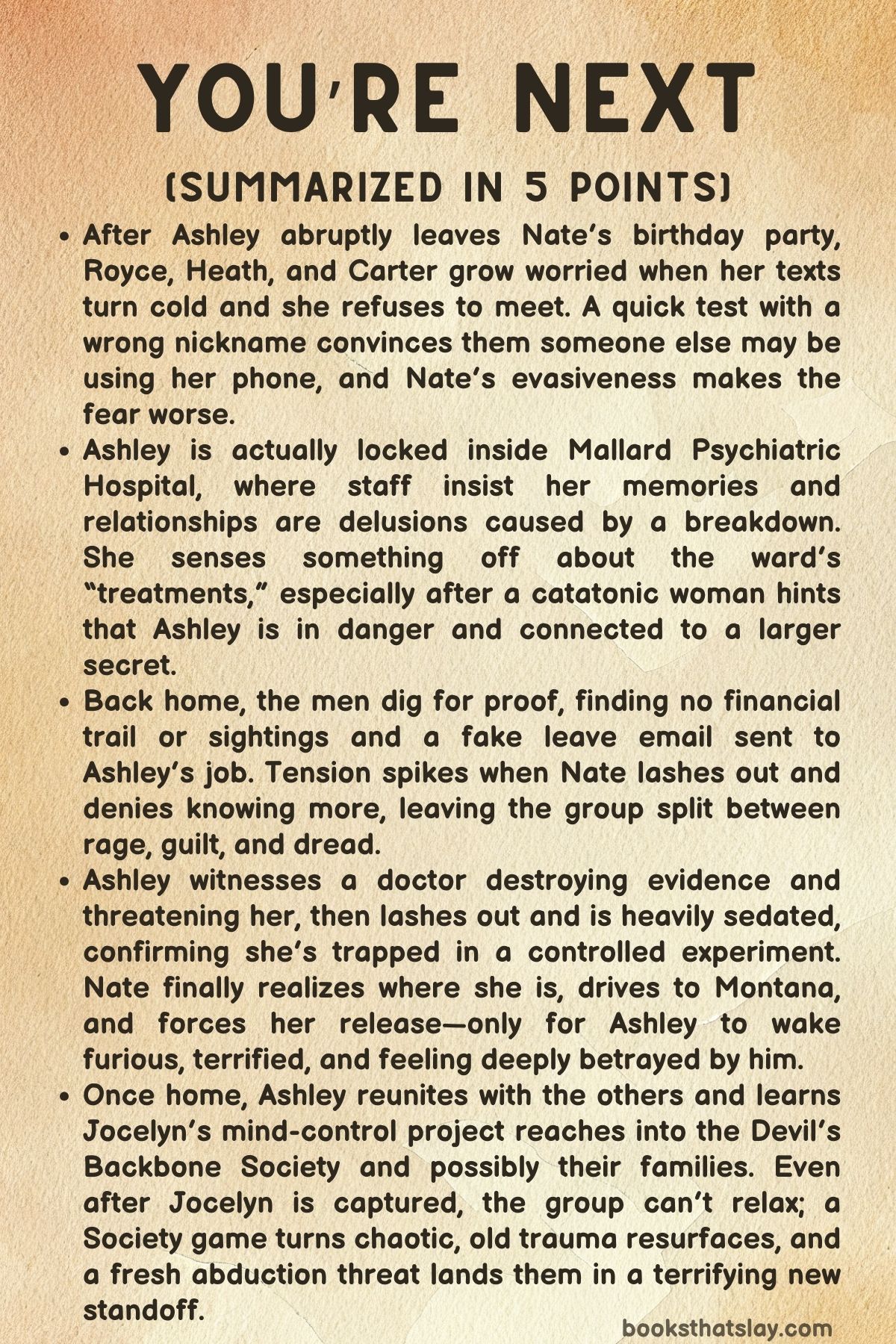
Summary
After leaving Nate’s birthday party upset, Ashley stops answering calls and sends only cold, clipped texts. Royce, Heath, and Carter sense something is wrong.
Carly arrives with class notes Ashley supposedly wanted, but Ashley is already ahead in school. None of the men have heard her voice or seen her on video, and Carter’s tracker glitches.
Heath has Carter text her with a nickname she would never accept. The reply is a bland emoji.
Convinced someone else has her phone, they fear Ashley has been taken.
Ashley’s side reveals she has been drugged and locked inside Mallard Psychiatric Hospital in Montana. Staff insist she suffered a breakdown and that her memories of the men, the Devil’s Backbone Society, and recent violence are delusions.
Ashley knows she is being controlled. She demands Nate, her stepbrother and legal power of attorney, but is told he is unreachable.
In the garden she meets a catatonic patient called Abby who briefly wakes to warn her that the hospital will kill her if she resists. Ashley later overhears Jocelyn talking about “experiments” and “test subjects,” making it clear Ashley is not there for treatment but for a project.
Back in Prosper City, investigators find no bank use or travel records after the party. Ashley’s job receives a suspicious leave email, and Carina, Ashley’s mother, hasn’t heard from her.
Nate resists panic at first, hiding his own guilt and fear, but when Annette, a sympathetic nurse, leaves him a voicemail naming Mallard, he finally listens, realizes Ashley is there, and drives to Montana alone, without telling the others.
At Mallard, Nate forces her discharge by invoking the power-of-attorney clause in their prenup.
Annette checks that Ashley wants to go; half-drugged and furious, she agrees.
Nate takes her to a hotel to recover.
Ashley wakes shaken and convinced he betrayed her, yet their escape triggers a confusing, real intimacy between them that she had thought was only a drug haze.
The reality of it rattles her even more than the hospital, because it means her body’s reactions were never imagined.
On the drive home Ashley refuses to give Nate her new phone number and demands answers.
He swears he didn’t commit her and says the paperwork is reciprocal, giving her the same authority over him.
They stop at Carina and Max’s house.
Ashley is stunned to find both alive after being told they died in a plane crash.
She spills everything: the gaslighting, Abby’s warning, and Jocelyn’s involvement.
Carina admits she once discussed a voluntary secure facility with Nate to protect Ashley from enemies, but insists Ashley never consented to being taken, and neither she nor Max knew it had happened.
Royce, Heath, and Carter arrive, and Ashley collapses in relief that Heath is alive after Jocelyn used a fake suicide story to break her.
The five try to rebuild a routine of classes and shared nights, though Nate withdraws under guilt for his past treatment of Ashley and for being Jocelyn’s son.
Colonel Mike D’Arenberg, Royce’s powerful father, visits and confirms military funding was tied to Jocelyn’s mind-control work but is now being pulled.
He urges them to leave town for safety.
They refuse, deciding they won’t run from a war Jocelyn started.
To make Jocelyn believe she has won and to flush her out, Carina and Max fake their deaths in a staged plane crash and flee under security.
Ashley and Nate must act devastated at Nevaeh University and even plan a public funeral to sell the lie.
The performance keeps Jocelyn unaware, but it grinds on Ashley, who is already struggling to trust her own memories.
The Devil’s Backbone Society soon summons Carter, Heath, Royce, and Nate to an elders’ council.
The elders demand silence about Jocelyn and reveal Ashley bound on a table as leverage.
The men refuse and fight their way free, killing the elders and guards to save her.
With police involvement impossible, they call Heath’s grandfather, a top Society leader, who removes evidence, replaces local leadership, and promises Jocelyn will be hunted down.
Ashley quits her job afterward, realizing how easily the Society can reach her anywhere.
Royce’s uncle Henry warns that although Jocelyn’s program is shut down and a warrant has been issued, she may still come after surviving subjects.
Royce surprises Ashley with a restored 1971 Plymouth Hemi ’Cuda, and she accepts as proof she is valued beyond her usefulness in the men’s fight.
Nate confides that guilt and their violent escape have rewired his desires, and Ashley chooses not to reject him for it, even if she doesn’t fully understand what it means yet.
Colonel Mike then brings new information: after a break-in at Swansong Memorial Home, Jocelyn has been captured alive and transferred to maximum security at Clearview.
The group visits only to confirm she is locked away, avoiding direct contact for fear of hypnosis.
Wanting to reclaim control of their lives, they decide to attend the next Society event anyway: a masked forest laser-tag hunt, with the location and equipment changed at the last second to prevent sabotage.
During the game Ashley panics, convinced she sees Jocelyn in the woods. Royce catches her and proves it was a false alarm, but the terror leaves her raw.
Afterward Heath finds her with worse news—Nate is missing, his phone and gear abandoned at the forest edge.
Ashley receives a message signed “Abigail” warning her she should have watched her back.
Another text from an unknown number offers a trade: Ashley for Nate, and orders her not to involve anyone else.
Believing Nate will be killed if she refuses, Ashley agrees to the exchange, choosing to walk into the trap to save him as the story drives toward its next showdown.
Characters
Ashley (Layne)
Ashley is the emotional and narrative center of Youre Next.
She’s intelligent, driven, and used to being the one who keeps moving even when fear is chewing at her from the inside.
The abduction and psychiatric imprisonment fracture her sense of reality, and watching her fight to hold onto her memories is key to understanding her resilience.
What makes Ashley compelling is that she isn’t just a victim surviving trauma; she’s also someone who refuses to hand over her agency, even when the system around her insists she is delusional.
Her reactions after rescue show the two halves of her character rubbing raw against each other: she craves normalcy—classes, routines, the boys’ apartment—yet her body and mind keep snapping back to threat mode.
Her romantic entanglement with all four men isn’t framed as confusion, but as an extension of how she loves: intensely, loyally, and without shrinking herself.
Even when she is terrified, she takes responsibility for the people she cares about, which is why she agrees to trade herself for Nate.
That decision isn’t naïve; it comes from a core belief that love means choosing sacrifice before letting someone else pay the price.
Nate
Nate is built out of contradictions: protective yet secretive, dominant in the outside world yet craving submission and pain in intimacy, rational on the surface while emotionally wrecked underneath.
His distance after the party and his explosive defensiveness when the others push about Ashley make him look suspicious, but the deeper truth is guilt rather than malice.
He carries the weight of being Jocelyn’s son and Ashley’s stepbrother, and those ties poison his sense of self-worth.
Nate’s decision to drive to Mallard alone shows his biggest flaw and his deepest virtue at once: he believes he must fix everything himself, and at the same time he cannot abandon Ashley once he realizes she’s trapped.
His sexual dynamic with Ashley, sparked by her attempt to smother him, becomes a psychological language for his guilt—pain as penance, surrender as proof he deserves her.
He isn’t chasing cruelty; he is trying to feel forgiven in a way words can’t reach.
By the time he’s taken again, Nate has shifted from being a problem the group can’t read to being the person they most need to save, and that arc is driven by how fiercely he loves Ashley even while hating what his family legacy has made him.
Royce
Royce is the sharp-edged anchor of the group, a man who operates through control, intensity, and loyalty that borders on feral.
His first instinct is always to protect Ashley, and when her texts go cold, he doesn’t accept the “she wants space” explanation because he knows her patterns too well.
Royce’s love expresses itself through action—tracking, hiring investigators, pushing forward when others hesitate—and through possession, not in a shallow jealous way but as a primal refusal to lose her.
He is the one most attuned to the possibility of a deeper conspiracy, partly because his own family history already feels contaminated by Jocelyn’s experiments.
Royce’s sexual closeness with Ashley often mirrors his personality: urgent, territorial, and reassuring in its own way, as if desire is another form of protection.
The gift of the 1971 Hemi ’Cuda is classic Royce—grand, practical, and emotionally loaded—because he tends to speak affection through decisive gestures rather than soft explanations.
Beneath the aggression, he is also the man who quietly believes Ashley can carry trauma without breaking, and that belief lets her feel strong even when she’s terrified.
Heath
Heath is the group’s steady heart, the one who blends empathy with quiet authority.
His closeness to Ashley feels less like romance first and more like sanctuary, especially after she returns from Mallard still haunted by the lie that he died by suicide.
Heath knows what it is to be in the pit of despair, and that past vulnerability gives him a gentler kind of strength now.
He’s often the mediator when tension spikes—like the scholarship argument with Carter—because he understands the stakes of control and autonomy better than the others.
Heath also bridges worlds: he is both family to Carly and heir to a Devil’s Backbone lineage, so he moves between affection and power without forgetting either. When his grandfather’s cleanup team arrives after the elders’ council massacre, Heath is the living proof that the Society is not just a shadow threat but also a tool they can wield if forced to.
Through it all, his devotion to Ashley is protective but not suffocating, and that makes him essential to the emotional balance of the group.
Carter
Carter is the pragmatist with a reckless streak, a man who uses humor, sexuality, and money as ways to keep fear at arm’s length.
He is the first to push for concrete solutions—investigators, security, donations to fix Ashley’s absence problem—because he can’t tolerate helplessness.
Yet his tendency to “solve” issues with resources also reveals his blind spot: he sometimes underestimates how much Ashley needs choice more than comfort. The scholarship conflict shows this perfectly; he’s sincere in wanting to protect her future, but he doesn’t realize how patronizing it feels until Heath intervenes.
Carter’s bond with Ashley is playful and volatile, full of dark flirting even in places like a funeral home showroom, which doubles as a coping mechanism for both of them.
In group dynamics he’s the spark—often starting conflicts, but also keeping everyone from collapsing into paralysis.
His loyalty is unquestioned; when danger hits, Carter is already moving, already planning the next barrier between Ashley and harm.
Carly
Carly serves as Ashley’s external lifeline and the story’s early truth detector. She is practical, observant, and emotionally fierce in a way that complements Ashley’s own stubbornness.
Carly’s quick suspicion about the texts and her insistence on testing the nickname show she doesn’t just support Ashley emotionally; she actively protects her. Her frustration with Nate and willingness to storm out when he gets cruel underline that Carly will not play peacekeeper if she thinks someone is lying.
Even though she isn’t central to the romantic core, her presence reinforces what Ashley means to people outside the boys’ orbit, grounding the stakes in friendship and family rather than only desire.
Carly reminds everyone that Ashley is a whole person with a network and a future, not just the focus of the men’s obsession.
Jocelyn
Jocelyn is the novel’s main human predator, a figure who weaponizes authority, science, and psychological manipulation.
She is terrifying not because she is unhinged in a loud or chaotic way, but because she is methodical, funded, and convinced of her own right to control others.
At Mallard, Jocelyn embodies institutional abuse: gaslighting Ashley about her memories, burning Abby’s diary to erase evidence, and ordering sedation as punishment while framing it as treatment.
Her obsession with Carina and the repeated hints of hypnosis and experimentation reveal a long-running project rather than a spontaneous breakdown, making her evil feel systemic.
Even after her arrest, she remains a ghost in Ashley’s mind; the laser-tag hallucination proves that trauma has given Jocelyn a permanent residence in Ashley’s fear.
Her escape and final trade demand show her core belief in ownership—Ashley is not a person to her, but a subject and leverage.
Abigail (Abby)
Abigail is the story’s eerie mirror for Ashley, representing what happens when someone is broken by Jocelyn’s system long before Ashley arrives. Her catatonia, sudden warning, and secret diary suggest she holds buried knowledge about the experiments, but her power is limited by how closely she’s monitored.
The fact that Jocelyn calls her “Abby” with familiarity implies history and possibly complicity, blurring the line between victim and collaborator.
When Ashley receives a message from “Abigail” near the end, it points to Abby’s continuing relevance as a shadow presence in the conspiracy, either as someone still trapped and trying to warn Ashley, or as an instrument Jocelyn can use even from afar.
Abby fuels Ashley’s paranoia, but she also validates that Ashley’s fear is not imaginary, and that the hospital’s version of reality was manufactured.
Nurse Annette
Annette is a small but crucial symbol of human decency inside a corrupt institution.
She’s cautious, sympathetic, and not fully aware of how deep Jocelyn’s project runs, which makes her believable and effective.
Annette is the one person Ashley can reach without violence or strategy, and their exchange shows Ashley’s ability to persuade through logic even while terrified. By leaving the voicemail for Nate, Annette becomes the hinge between captivity and rescue.
Her wariness at the discharge moment also matters, because she insists on Ashley’s consent, subtly pushing back against the hospital’s coercive norms. In a world full of masks, Annette is one of the few faces that feels real.
Dr. Marion
Dr. Marion represents institutional complicity, whether through genuine belief in Ashley’s “breakdown” or through alignment with Jocelyn’s experiment.
Her calm insistence on sedation and control, and her refusal to allow Nate to extract Ashley easily, show how power hides behind clinical language.
She isn’t as personally theatrical as Jocelyn, but that actually sharpens her menace: she’s the kind of professional who can make cruelty look like protocol.
Even if she’s not the architect of the conspiracy, she’s one of its enablers, and her role highlights the story’s theme that systems can be just as dangerous as individuals.
Colonel Mike D’Arenberg
Mike is the tactical adult presence the younger group lacks, but he’s not a savior who takes charge so much as a force multiplier.
He is disciplined, connected, and emotionally distant in a way that contrasts with Royce’s raw loyalty.
Mike’s confirmation of military funding gives the conspiracy real-world weight and scale, shifting it from “family madness” into something institutional and geopolitical.
He respects the autonomy of the five despite advising them to leave town, which shows he understands that survival isn’t only about safety—it’s also about choosing your own battlefield.
His promise to investigate Royce’s mother and his involvement in Jocelyn’s capture make him both protector and living reminder that the Society and the military are tangled far above the group’s heads.
Carina
Carina is Ashley’s emotional home base and a quiet example of maternal strength.
Her immediate belief that something is wrong when Ashley returns, and her willingness to confront Nate without hedging, show that she’s protective without being controlling.
The fake plane crash plan reveals her courage and strategic thinking; she’s willing to sacrifice her public existence to bait Jocelyn into complacency.
Carina also embodies a softer kind of survival—she doesn’t fight with fists like Ashley, but she fights with planning, trust, and the refusal to let fear dictate her family’s future.
Her love helps re-stitch Ashley’s shattered reality because it proves the hospital’s lies were just that: lies.
Max
Max plays the role of grounded ally and pragmatic father figure.
He is perceptive about Jocelyn’s instability and the likelihood of hypnosis and drug-based control, which helps the group translate scattered horrors into a coherent threat.
His steady presence supports Carina’s bolder moves, like the staged crash, and gives Ashley a model of calm endurance amid chaos.
Max’s relationship to Nate complicates the emotional landscape too, because his supposed death becomes another tool Jocelyn used to isolate Ashley, and his survival reinforces the theme that truth can be reclaimed even after the world tries to rewrite it.
Henry
Henry arrives as charm wrapped around sharp legal teeth.
He’s socially smooth, reading the room easily, but he carries serious intelligence about the dismantling of Jocelyn’s project.
By confirming the data destruction, the warrant, and Jocelyn’s likely desperation, Henry reframes the danger into its final, most volatile stage.
His flirtation with Ashley isn’t only personal; it’s a stress test for Royce, revealing how tightly Royce’s protectiveness coils around her.
Henry’s real function is to widen the group’s strategic horizon, warning them that the experiment may be ending but the cleanup phase could be the deadliest.
Paige
Paige is mostly offstage, but she matters as contrast.
Her mention highlights what Nate’s intimacy with Ashley is not: it isn’t a replay of old patterns, but something newly awakened, tangled with guilt and need for surrender.
Paige symbolizes Nate’s previous life of emotional compartmentalization and possibly safer, more conventional relationships.
By explicitly separating Paige from his current desires, Nate reveals how uniquely Ashley has reshaped him, turning her into the axis of his transformation rather than just another lover.
Themes
Gaslighting, Reality Control, and the Fragility of Truth
In Youre Next the story keeps returning to how easily a person’s sense of reality can be rewritten when the people and systems around them coordinate a lie. Ashley is not simply taken away; she is placed in a setting designed to define her memories as symptoms.
The hospital staff insist that major parts of her life are delusions, including relationships and deaths she remembers.
That move is terrifying because it doesn’t just imprison her body, it attempts to confiscate her inner narrative.
The threat is doubled by the fact that the staff are not acting like neutral caregivers.
They block contact with Nate, swap medical authority into a weapon, and use sedation and restraints as punishment disguised as treatment.
The warning from Abigail—“They’ll kill you”—is important not because it confirms a conspiracy outright, but because it shows how the institution itself has become a stage for fear where patients are treated as unstable by default.
Ashley’s resistance is forced to become strategic: she learns to perform compliance in order to survive, which shows how gaslighting often makes victims police themselves.
Outside the hospital, the men also face distorted truth: texts from “Ashley” create a fake emotional surface that nearly convinces them she’s safe.
The nickname test (“Squirrel”) is a small moment with big thematic weight; it shows that truth in this world is not obvious or officially guaranteed, it has to be tested through intimacy and pattern recognition.
Even after Ashley returns, reality remains unstable.
She is told her mother and Max died, only to discover their “crash” was staged.
That twist is protective, but it still highlights the psychological cost of living in a world where survival requires deception.
The result is a constant tension: characters are not only fighting enemies, they are fighting to hold on to what they know is real.
The book treats truth as something vulnerable, dependent on trust, and easily corrupted when power decides what counts as sanity.
Loyalty Under Extreme Pressure and Chosen Family
The relationships in Youre Next are set inside danger that never lets up, and loyalty becomes less like a promise and more like a daily act.
Royce, Heath, Carter, and Carly refuse to accept Ashley’s disappearance as a “break.” Their reactions show different shades of devotion: Royce’s panic and emotional rawness, Carter’s practical response through investigators and quiet donations, Heath’s blunt moral pressure on Nate, and Carly’s sharp intuition that something is wrong.
Loyalty here is not passive support.
It is surveillance, confrontation, and risk.
When the elders’ council threatens Ashley’s life, the men choose open violence against their own society rather than sacrifice her safety.
That decision is crucial because it reframes “family” away from bloodlines and social orders and toward chosen bonds.
The Devil’s Backbone Society represents inherited loyalty: obedience to elders, secrecy, and status.
The five main characters represent chosen loyalty: mutual protection, refusal to abandon someone who is hurting, and a willingness to burn old rules if those rules demand betrayal.
Ashley also practices loyalty in ways that are messy and human.
She tries to shield Nate from the others’ suspicion even while furious at him. She holds him through the night when guilt is eating him alive.
Later, when Nate is taken, she immediately prioritizes his life over her own and accepts the trade.
The theme isn’t saying loyalty is always healthy; it shows how loyalty can be dangerous, especially when the loyal person feels responsible for everyone else’s survival.
But the book still argues that loyalty is the only force strong enough to push back against manipulation and institutional power.
Even the staged deaths of Carina and Max come from loyalty to protect their children and starve Jocelyn of control.
In this world, loyalty is a survival strategy, an emotional anchor, and sometimes a weapon.
The story keeps asking what people will do when loyalty clashes with fear, with authority, or with self-preservation, and answers by showing characters repeatedly choosing each other anyway.
Power, Consent, and the Meaning of Control
Control in Youre Next appears in two opposite forms: the abusive control of Jocelyn and the society, and the negotiated control inside Ashley’s relationships. Jocelyn’s project is about domination through hypnosis, drugs, and institutional cover.
She treats people as “test subjects,” burns evidence, and speaks of killing Ashley as a logistical option. The elders’ council echoes that same logic: they don’t argue or persuade, they restrain, threaten, and punish.
Their power depends on secrecy and on the belief that they can decide who lives safely and who does not.
Against that, the romantic and sexual dynamics are built around consent even when they look violent on the surface.
Nate’s desire to be hurt is linked to guilt, but it is also explicitly discussed, admitted, and responded to with Ashley’s choice to accept or reject it.
Their encounters show a complicated blend of anger, desire, and agency, but they are not framed as coercion; Ashley is repeatedly the one setting the terms when she has the space to do so.
The contrast is deliberate: the same actions—restraint, pain, surrender—mean something completely different when chosen rather than imposed.
Carter offering to pay for Ashley’s degree and her fierce refusal adds another layer.
Money can become control in a softer form, and Ashley is alert to that risk. Heath stepping in to promise they will not use wealth to manage her life reinforces the point that love without respect for autonomy can still become a cage.
Even the polyamorous structure in the story picks up this theme.
Ashley is romantically entangled with four men, but the narrative treats the arrangement as something that must be negotiated through openness, boundaries, and continual reaffirmation, not taken as entitlement.
The book is not pretending that power disappears inside romance; it is showing how power must be handled responsibly if intimacy is going to stay safe.
In short, the story keeps separating control that erases personhood from control that is invited, trusted, and reversible.
That separation becomes one of the clearest moral lines in the entire plot.
Trauma, Guilt, and the Uneven Path to Healing
Ashley’s abduction and forced commitment are not treated as brief plot obstacles; they leave lasting psychological residue that shapes how she thinks, reacts, and connects to others.
When she returns, normal life feels “almost normal,” but the word almost matters because trauma makes safety feel temporary.
Small triggers—missing lectures, a mask smelling wrong, a sudden glimpse of a robed figure—ignite panic that her mind struggles to untangle.
Her breakdown in the woods during laser tag shows how trauma can turn a harmless situation into a perceived threat.
The terror isn’t irrational in her world; it is a learned response formed by being hunted and disbelieved.
Alongside her trauma is Nate’s guilt, which functions like a parallel injury.
His silence, distance, and journal-writing show a person trapped in self-blame, especially because the villain is his mother and because he holds legal authority that was used against Ashley.
His arousal response to pain is a psychological scar turned into a sexual pattern, and he names it as penance.
That confession matters because it shows that guilt does not stay abstract; it rewires desire, self-worth, and the belief that one deserves love at all.
The group’s shared journaling after Heath’s earlier suicide incident adds another communal dimension to healing.
They have already seen how close death can get, and now they try to build rituals that keep them grounded.
Healing in the book is not shown as linear.
Ashley can be playful one moment and terrified the next.
She can love Nate and still want to hurt him for what happened.
She can feel safe in the group and still decide to trade herself away when Nate is taken.
Those contradictions are part of trauma’s reality: survival instincts don’t switch off just because danger pauses.
Still, the story offers a form of healing through presence.
Heath holding her while she cries, Royce comforting her without pushing her to “get over it,” Carter quietly fixing practical problems, and even Nate staying close while she wakes from drugs—these moments argue that recovery is relational.
It depends on being believed, being allowed to rage, and being protected without being owned.
The theme recognizes trauma and guilt as forces that twist people, then insists that love and honesty are the only things that might slowly untwist them.
Secrecy, Corrupt Institutions, and Cycles of Violence
The world of Youre Next is filled with structures that claim legitimacy while operating like criminal networks.
Mallard Psychiatric Hospital is supposed to represent care, yet it becomes an extension of Jocelyn’s experiment.
The Devil’s Backbone Society positions itself as tradition and order, but it is willing to silence witnesses, threaten murder, and cover up bodies without consequence.
Colonel Mike’s information about military funding reveals that even national institutions are entangled in the project, suggesting that corruption is protected by layers of authority rather than isolated in one villain.
This makes secrecy itself a kind of engine driving violence.
Because the Society can’t risk exposure, it escalates from intimidation to kidnapping to attempted execution.
Because the hospital hides behind medical language, it can sedate and restrain without external scrutiny.
The characters are forced to navigate a system where the usual routes for justice—police, courts, public pressure—are either compromised or too slow to save lives.
That is why they end up solving problems through direct force: killing elders to rescue Ashley, calling Heath’s grandfather to erase evidence, staging deaths to bait Jocelyn.
None of these choices are clean, and the story doesn’t fully sanitize them.
Instead it shows how living under corrupt secrecy pushes people into becoming both victims and participants in violence.
The laser-tag riot at Clearview and Jocelyn’s escape underline the theme again: when a system is rotten, containment is temporary, and danger keeps returning in new forms.
Ashley quitting her job after being taken shows the personal cost of institutional failure.
She cannot trust the physical spaces of normal life anymore because hidden power can reach into them.
Even the promise that records are being destroyed and warrants issued does not feel like closure, because secrecy has already taught the characters that official outcomes are fragile.
The theme ultimately paints a bleak but clear picture: violence is not just personal cruelty here, it is a side effect of organizations that prioritize self-preservation over human life.
Breaking that cycle requires not only defeating Jocelyn but also refusing the culture of silence that enabled her.
The group’s repeated choice to speak to Colonel Mike, to resist council orders, and to protect each other publicly is the story’s way of pushing back against that entire machinery.