You’ve Found Oliver Summary, Characters and Themes
You’ve Found Oliver by Dustin Thao is a YA contemporary novel with a light speculative twist, centered on grief, first love, and the way memory can keep people tethered to the past. Oliver is trying to survive the aftermath of losing Sam, his best friend, whose presence shaped his teenage years in quiet, essential ways.
When Oliver finally attempts to let go by deleting Sam’s number, a stranger answers the call. That accident opens a new connection with Ben, a boy tied to Sam’s old phone line and, somehow, to Oliver’s fractured sense of time. The story moves between tender recollections and present-day uncertainty as Oliver learns what it means to move forward without abandoning who he loved.
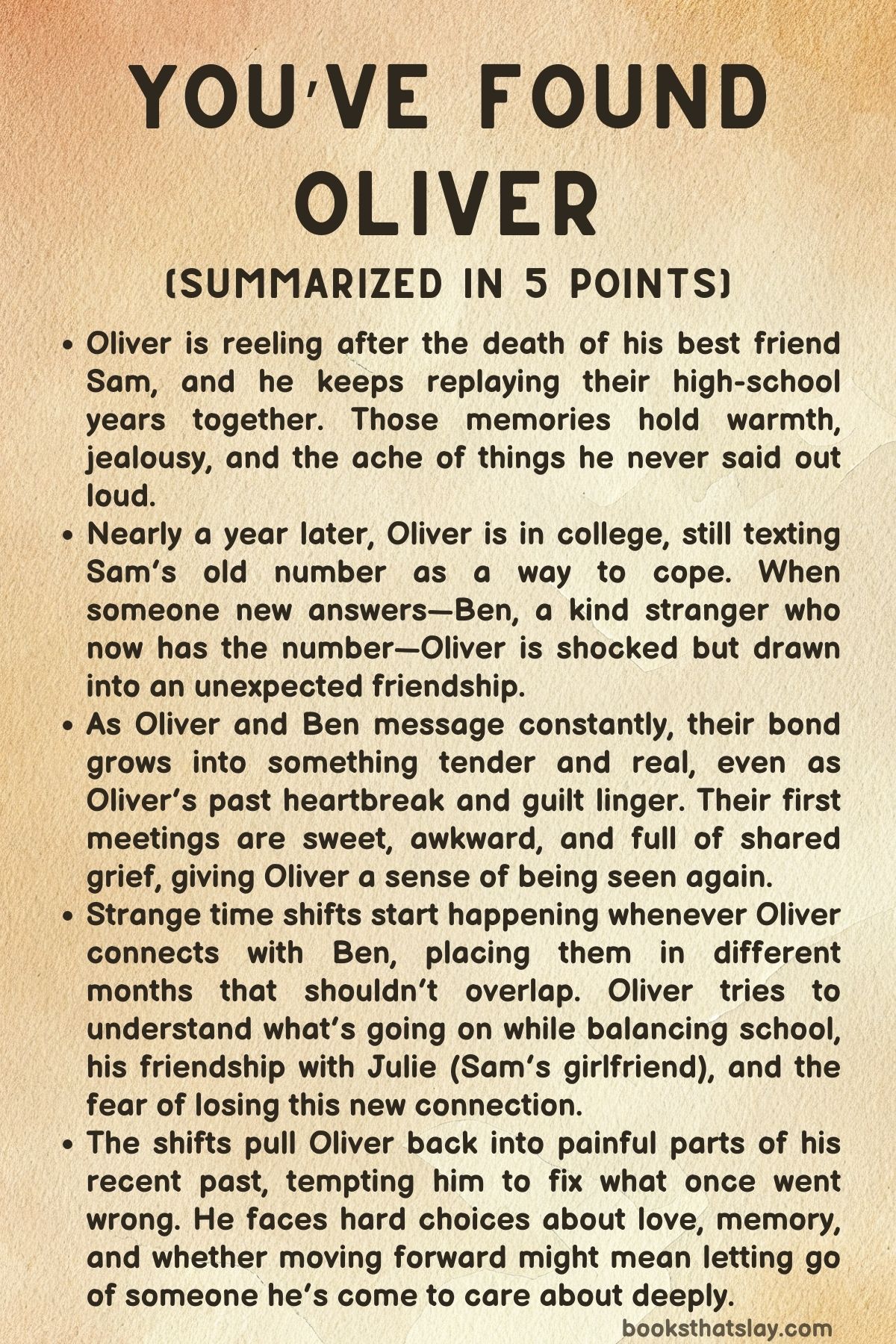
Summary
Oliver’s world is split in two: the life he had with Sam, and everything after Sam’s death. In the past, Oliver and Sam are inseparable through high school.
Their friendship is built on small rituals and shared adventures. Freshman year, Sam sketches Oliver asleep by a lake, surrounding him with white roses.
Sophomore fall brings a night of mischief at the Sagamore hotel, where they sneak into a wedding, eat from the buffet, and dance to Sam’s favorite song, “Escape (The Piña Colada Song),” before slipping out laughing. They make a habit of turning ordinary moments into something magical, and Oliver quietly clings to Sam as his safest home.
Oliver also begins to feel things he can’t name. After months of texting with a boy named Zach, he travels for a first date, only to be stood up and erased.
He waits in the rain until Sam finds him, shelters him with an umbrella, and brings him for pizza, steady and loyal. But their closeness grows complicated when Sam starts liking Julie, a girl from their school.
Oliver sees Sam nervously making her a honey lavender latte at his café job, and later watches them slow-dance at prom. Jealousy stings Oliver even as he tries to hide it, because his feelings for Sam run deeper than friendship, and he fears naming them would ruin everything.
At home, Oliver’s life is unstable. On Halloween junior year, he and Sam return to find Oliver’s stepdad raging at his mom.
Oliver steps between them, the fight turns violent, and Oliver smashes his own prized TV in a burst of anger. Sam helps Oliver’s mom escape, reinforcing that Sam isn’t just a friend but Oliver’s anchor.
By senior week, Sam and Julie have been together for years and plan to attend college in Portland. During a bonfire goodbye, Oliver tries to confess what Sam really means to him, but Sam is distracted by frantic calls from Julie.
He rushes off, promising they’ll talk later. Oliver senses unease in their last hug.
That night, Sam dies in a hit-and-run crash while driving to pick Julie up.
Almost a year later, Oliver is a college freshman at Central Washington University. Grief has reshaped him into someone cautious and lonely.
He’s grown close to Julie through shared mourning, while carrying fresh hurt from Nolan, his first boyfriend after Sam, who cheated on him. On the night before Julie leaves for a four-month study abroad program in Copenhagen, Oliver worries about being left alone again.
After she goes to finish packing, Oliver wanders town: the bakery he loved with Sam is closed, Sam’s café is only a shadow of memory, and Oliver ends up at Sam’s grave with white roses, still texting Sam’s number as if Sam could read them.
Back in his dorm, Oliver decides to send one last goodbye text and delete Sam’s contact. Instead, he accidentally calls.
A stranger answers. Oliver panics, blurts out Sam’s name, and hangs up.
The stranger texts back gently, explaining he’s been receiving Oliver’s messages for months and is sorry about Sam. He’s kind, not annoyed.
Oliver learns his name is Ben, a student at the University of Washington who got the phone number last summer. When Oliver admits he can’t remember one of Sam’s favorite songs, Ben identifies it instantly.
Oliver is startled that this unknown boy knows something Sam loved, as though the line between past and present has cracked open.
Oliver and Ben keep talking. What begins as awkward apology turns into everyday companionship through constant texts about music, classes, and grief.
Ben suggests meeting at a diner in North Bend. Oliver travels there, but the diner is locked and empty.
Ben insists he’s inside. They can’t locate each other until Oliver calls and hears Ben’s voice right behind him.
The mismatch feels impossible, but once they sit together, conversation flows easily. Both confess they’d been pretending to like the Velvet Underground because they thought the other cared more.
Oliver admits the band mattered to Sam, and Ben shares that he lost an older brother, Peter, years ago. They leave the diner already missing each other.
Their relationship grows into something hopeful. Ben helps Oliver with Professor Clarke’s class on perception, memory, and time.
They meet again in Seattle for a movie and rooftop stargazing through Ben’s telescope. Their hands linger, their closeness deepens, and Oliver starts to feel like he’s stepping into a future that might be his.
Then something breaks: Oliver wakes in his dorm with frantic texts from Ben, but Ben says it’s November 3 while Oliver’s phone reads April. Calls won’t connect.
Oliver realizes that he and Ben exist in different timelines, slipping toward and away from each other through triggers he can’t control.
Despite the instability, they keep trying. Oliver visits Ben at a street fair, arriving in empty April streets until a sudden shift fills the place with tents and music.
Ben introduces his little cousin Leah, and the three spend the day eating street food, playing games, and winning her a giant blue panda. Later, at Ben’s apartment, Oliver sees Ben’s Polaroid wall and learns the camera belonged to Peter.
Ben takes a picture of Oliver for his “guest tradition. ” That night they talk openly about the time slips, about fear, and about not wanting to lose what they’ve found.
Oliver finally admits he once wanted more with Sam, and that they kissed once. Ben doesn’t flinch.
He stays, and Oliver falls asleep beside him, only to wake back in April alone again.
Oliver tries to understand the rules. Professor Clarke speaks about branching universes, and Oliver begins to suspect his shifts are tied to grief and to moments when he resists moving forward.
When Oliver slips fully into the fall timeline — the one where Nolan cheated — he tries to change the past, but ends up missing his mom’s birthday and learning the betrayal happened earlier than he remembered. Ben visits Ellensburg during this stretch, charming Julie and making Oliver fear the future is rewriting itself.
Julie then announces she may not go abroad after all, making the timeline feel even more unstable.
Oliver finally tells Julie everything. She believes him, gives him Sam’s old phone, and when Oliver puts in his SIM card, it shows April 29 — his real present.
He thinks this is a doorway back. Knowing he might lose Ben forever, Oliver drives to Seattle for a last meeting.
On the UW rooftop, he shows Ben the date and admits he may be able to return to his true timeline. They share a goodbye filled with love and dread.
Oliver says Ben deserves a future unburdened by Oliver’s stuckness. They kiss for a long time, then let go.
Back in Ellensburg, Oliver repairs what he neglected: he apologizes to his mom, remakes the ceramic plate he ruined, and chooses presence over regret. That night he texts Ben that he loves him and falls asleep.
He wakes in spring, back where he belongs — but Ben is gone from his phone, the messages erased as if they never existed. Time passes.
Oliver learns to live anyway, with the ache of someone who feels real but unreachable.
In the epilogue, a year and a half later, Oliver is studying in Amsterdam. He sees Ben in a café.
This Ben doesn’t recognize him. Oliver sits down regardless, and they talk as strangers, trading names and small truths.
The moment suggests that even if memory can’t hold everything, connection can still start again.
Characters
Oliver
Oliver is the emotional center of Youve found Oliver, a boy whose inner life is shaped by grief, longing, and an almost stubborn hope that connections can outlast time. In high school he is tender and observant, the kind of friend who remembers Sam’s favorite songs and quietly orbits Sam’s moods, yet he’s also someone who hides big feelings until they corner him.
His avoided answers about Zach, his jealousy at prom, and his stalled confession at the bonfire show a pattern: Oliver tends to protect relationships by swallowing his own truth, even when that silence costs him. After Sam’s death, Oliver’s grief becomes both anchor and trap.
Texting Sam’s old number is less about denial and more about ritual—his way of keeping a conversation alive when everything else has ended. The timeline slips externalize his psychology: he is literally pulled between past and present because emotionally he can’t let either go.
With Ben, Oliver re-learns intimacy on new terms, but the romance is braided with fear that loving again betrays Sam or invites fresh loss. His growth comes from choosing motion over stasis—confessing to Julie, reconciling with his mother, and finally sitting with an unrecognizing Ben in Amsterdam.
By the end, Oliver isn’t “fixed,” but he is braver about living forward, holding memory without being swallowed by it.
Sam
Sam exists in Youve found Oliver as both a living character in flashback and a continuing presence in absence, which makes him feel almost mythic without losing his human edges. In life, Sam is magnetic and quietly bold: he pulls Oliver into small adventures like crashing a wedding, turning ordinary teenage nights into something glowing and worth remembering.
He is also attentive in a way that reveals how deeply he knows Oliver—he notices Zach’s texts, senses Oliver’s evasions, and later pins the white-rose boutonniere on him with a tenderness that blurs friendship and something more. Yet Sam is not defined only by warmth; his growing relationship with Julie shows his capacity for romantic certainty that Oliver never allows himself.
He is someone who loves fully and forward, making plans for college and a future, which heightens the tragedy of his sudden death. Afterward, Sam becomes the axis around which others grieve, but he is not reduced to a symbol.
His playlist, his café job, his favorite songs, and even his impulsive Halloween steadiness during Oliver’s family crisis all underline that Sam was vivid, grounded, and real. The single kiss Oliver reveals suggests Sam may have felt a complexity he never named, but what matters most is that Sam’s love was expansive enough to shape Oliver’s life long after he is gone.
Ben
Ben is the strange miracle of the story: a boy who enters through a wrong-number call and becomes the right person at the right impossible time. In Youve found Oliver, Ben initially appears as an anonymous kindness—someone who could have ignored Oliver’s grief-texts but instead replies with gentle curiosity.
That instinct to meet pain with patience defines him. Once he is fully present, Ben is revealed as quietly brilliant and emotionally open, a contrast to Oliver’s tendency to retreat.
His passion for astronomy is more than a trait; it’s a worldview. He thinks in constellations and black holes, which makes him naturally comfortable with paradox, and that intellectual flexibility helps him accept the time slips without panicking or mocking Oliver.
Ben’s own grief over his brother Peter gives him a private understanding of Oliver’s loss, and it also explains his sensitivity: he knows what it costs to keep loving someone who isn’t there. Romantically, Ben is both steady and vulnerable.
He wants mornings with Oliver, a normal timeline, a shared future, yet he doesn’t pressure him into certainty. Even when Oliver decides to let him go, Ben meets that goodbye with love rather than resentment.
The epilogue sharpens his role: Ben is not only a destined lover but also a possibility. The fact that another Ben exists—one who doesn’t remember Oliver—makes him a symbol of second chances that are earned, not guaranteed.
Julie
Julie begins as a classic “best friend’s girlfriend” figure, but Youve found Oliver steadily reframes her into something richer: a co-bearer of grief, a moral compass, and eventually a friend Oliver chooses for herself rather than through Sam. In high school, Julie is seen mostly through Oliver’s jealous ache, which makes her feel distant and idealized as the person who “won” Sam.
After Sam’s death, however, she becomes deeply human—raw, practical, and fiercely loyal to the people still standing. Her friendship with Oliver in college is tender in a way that isn’t sentimental; they can talk about Sam without turning him into a saint, and they can give each other space to fall apart.
Julie’s caution about Nolan and her protective “people watching Oliver” energy show that she sees how grief can make someone reckless with love. When Oliver confesses the timeline truth, Julie’s belief is an act of radical trust, proving she values Oliver not as Sam’s leftover friend but as her own family of choice.
She also has her own unsettled life—study abroad plans, pressure from her father, the possibility of staying when she wanted to go—which mirrors Oliver’s own tug between futures. Her growing warmth toward Ben is especially moving because it shows she is capable of letting new people into a world that Sam’s death shattered, even while still loving him.
Julie is the story’s clearest example that grieving together can become a new kind of love.
Nolan
Nolan represents the danger of Oliver trying to replace grief with something that looks like moving on but isn’t kind or safe. In Youve found Oliver, he is Oliver’s first boyfriend after Sam, which already places him in a fragile, loaded role.
Nolan’s cheating is not just a plot event; it is a rupture that teaches Oliver to distrust his own ability to choose love without losing himself. What makes Nolan unsettling is his blend of charm and entitlement.
He shows up at Oliver’s dorm uninvited, apologizes in a way that centers his own loneliness, and continues to hover in Oliver’s orbit even after causing harm. In the past timeline, his party becomes a focal point of dread, suggesting a pattern of manipulation or at least careless self-indulgence that hurts others.
Nolan’s gift of the Pindar Dance tickets is complicated: it looks generous, but it also tries to rewrite the narrative of their breakup by inserting himself back into Oliver’s emotional life. He isn’t a cartoon villain; he’s a realistic portrait of someone who wants closeness without responsibility.
Functionally, Nolan forces Oliver to confront the difference between being loved and being safe, and that contrast makes Ben’s gentleness shine brighter.
Ethan
Ethan is a small but telling presence in Youve found Oliver, functioning as a barometer of Oliver’s isolation in college. As Oliver’s roommate, Ethan is physically close but emotionally sealed off—symbolized by the rubber band on the door that asks for distance without explanation.
Ethan’s preference for privacy isn’t cruel, but to Oliver it feels like another kind of abandonment in a life already full of it. He highlights how alone Oliver is even among people, and how much Oliver craves a person who will actually let him in.
Ethan also subtly demonstrates Oliver’s habit of accommodating others; Oliver doesn’t push back or demand comfort, he simply turns away. In that sense Ethan is less a character arc and more a quiet mirror of Oliver’s loneliness.
Rami
Rami brings levity and grounded friendship into the college portion of Youve found Oliver. He is playful, a little nosy, and openly expressive in ways Oliver isn’t, which makes their dynamic feel like a soft corrective to Oliver’s inwardness.
The image of Rami trying to iron a water-damaged copy of Swann’s Way is both comic and revealing—he’s someone who wants to fix things even when they’re beyond repair, echoing Oliver’s own impulse with grief. Rami’s teasing about Ben and Julie’s watchful care shows he notices emotional undercurrents quickly, and his casual concern suggests a friendship that could deepen if Oliver let it.
While he doesn’t enter the time-slip secret, his presence keeps Oliver tethered to ordinary life, reminding the story that healing also happens in mundane spaces like library shifts and joking conversations.
Professor Clarke
Professor Clarke acts as the narrative’s intellectual and thematic guide in Youve found Oliver. She is not just a quirky academic; she’s the voice that legitimizes Oliver’s experience when he most doubts it.
Her class, Disrupting the Senses, introduces the idea that perception is braided with memory and time, opening a framework where Oliver’s slips can be understood without immediately being dismissed as madness or metaphor. The sealed white box exercise is a microcosm of her philosophy: reality is not only what you can touch, but what you can imagine otherwise.
Clarke’s willingness to discuss branching timelines when Oliver comes to her alone is crucial—she doesn’t demand proof, she encourages interpretation. In doing so, she becomes an odd kind of mentor, nudging Oliver toward agency.
She helps him see that the past is not a prison unless you keep building the bars, and that sometimes imagining another universe is the first step toward surviving this one.
Connor
Connor appears mainly through the fallout of Nolan’s cheating, yet his role in Youve found Oliver is significant because he embodies betrayal’s collateral damage. He isn’t painted as malicious; when confronted, he admits the hookup without excuse.
Still, his involvement reveals how fragile Oliver’s rebuilt sense of trust was, and how much Oliver had been clinging to a version of the past that was already rotting. Connor also symbolizes the way Oliver’s fixation on Nolan blinded him to warning signs—Oliver only searches Connor’s bed when he is desperate to change history.
Connor’s confession cracks that illusion. His purpose is to make the past undeniable, forcing Oliver to stop trying to edit what happened and start choosing what happens next.
Zach
Zach is the early wound that teaches Oliver what rejection feels like before the larger grief enters his life. In Youve found Oliver, his long texting buildup and last-minute disappearance create a formative humiliation for Oliver, sharpening his fear of being unwanted.
Zach’s abrupt “not ready” message and deletion of Oliver’s contact are especially cruel because they erase Oliver’s vulnerability rather than honoring it. What matters narratively is less Zach himself and more what his absence triggers: Sam’s rescue in the rain, the pizza comfort, and the deepening of Oliver’s dependence on Sam as the person who will always show up.
Zach is a brief figure, but he leaves a long shadow in Oliver’s later anxiety about trusting romantic hope.
Oliver’s Mother
Oliver’s mother is the quiet backbone of his family story in Youve found Oliver. She is protective but worn down by a home life that has become unsafe.
During the Halloween crisis, her choice to pack and leave signals courage, and the way Sam helps her escape makes clear she has been surviving more than Oliver fully understood. Later, her birthday ceramics class becomes a moral test for Oliver in the past timeline—his decision to skip it reveals how grief and desperation can distort priorities.
Their reconciliation, built around remaking a broken plate, is one of the story’s gentlest images of repair. She doesn’t demand perfection from Oliver; she accepts his apology and meets him in the work of rebuilding.
Through her, the book insists that love within families can be damaged and still worth returning to.
Oliver’s Stepdad
The stepdad in Youve found Oliver is a concentrated source of fear and volatility. His rage during the Halloween scene creates one of the book’s most visceral moments, forcing Oliver into a protective role far too adult for a teenager.
The stepdad’s violence is not explored in depth beyond that incident, but he functions as a clear representation of a home that is dangerous and unpredictable. Oliver smashing the TV in response is important—an act of rebellion against both the man and the powerless feeling the man imposes.
The stepdad is less a character to understand psychologically and more a force that shapes Oliver’s protective instincts, his anger, and his impulse to shield the people he loves even at great personal cost.
Leah
Leah, Ben’s little cousin, adds warmth and normalcy to a story full of temporal disorientation. In Youve found Oliver, her shyness and gradual trust in Oliver give a tangible measure of Oliver and Ben’s relationship moving into ordinary life.
Winning her the blue panda isn’t just cute; it shows Oliver acting as part of Ben’s world rather than only as a visitor from another timeline. Leah’s presence makes the time slips feel higher-stakes because she represents a future life Oliver wants with Ben—one that includes family, laughter, and afternoons that aren’t interrupted by disappearance.
Peter
Peter never appears alive in Youve found Oliver, but his imprint on Ben is tender and lasting. The Polaroid camera tradition, inherited from Peter, reveals a brotherhood that was playful, intimate, and creative.
Peter’s death is the private grief Ben carries into his relationship with Oliver, giving Ben a depth of empathy that doesn’t need explanation. He also subtly parallels Sam: both are lost brothers of the heart whose absence shapes the living into gentler, more complicated people.
Will
Will is a brief yet meaningful spark in Youve found Oliver, showing Oliver that connection can exist outside the gravity of grief and romance. Sitting beside Will at Pindar, Oliver experiences easy conversation with a stranger who expects nothing from him.
Will’s lightness doesn’t solve Oliver’s problems, but it cracks open the possibility that Oliver can still belong in rooms alone, can still be interesting and liked without Sam or Ben or a tragic backstory in the center. Will is a small signpost pointing toward Oliver’s eventual ability to start again.
Themes
Grief, Memory, and the Refusal to Let Go
Oliver’s life after Sam’s death is shaped by the way grief distorts time and attention. He keeps texting Sam’s old number not because he expects an answer but because the act preserves a rhythm they once shared.
His walks through town—past the bakery, past the café, to the grave with white roses—show how bereavement turns ordinary places into living archives. The past doesn’t sit quietly behind him; it keeps showing up in his body, in habits, in sudden emotional weather.
Even his first real attempt at romance after Sam, with Nolan, is haunted by the need to feel close to someone the way he felt close to Sam. When that relationship breaks, the betrayal hits harder because it repeats the central injury of being abandoned by someone he trusted, whether by death or choice.
The book makes clear that grief is not only sadness but also a kind of loyalty to what was lost. Oliver’s jealousy at prom, his inability to confess before the bonfire night, and his reflex to replay moments when Sam was alive all come from the same wish: to hold on to a version of life that felt safe and full.
Yet the story steadily pressures the idea that memory alone can substitute for living. Professor Clarke’s class challenges Oliver to accept that perception includes what isn’t in front of him anymore, and that missingness can become a place a person lives inside.
Oliver’s slipping between timelines becomes a literalization of grief’s psychological loop: he is carried backward again and again to the moments that injured him, as if his mind is trying repeatedly to solve an unsolvable event. The eventual return to his spring timeline without Ben’s messages suggests a painful truth about loss: even the new connections that help us survive can disappear, and we may not get neat closure.
Still, grief changes shape across the novel. By the epilogue, Oliver is no longer anchored to Sam’s grave as his only link to meaning.
Sam remains part of him, but not as a chain. The final café scene in Amsterdam doesn’t erase mourning; it shows that grief can coexist with curiosity, and that remembering someone deeply does not forbid stepping into another day.
Love, Desire, and the Complications of Unspoken Truth
Oliver’s bond with Sam is charged with affection that neither of them names clearly while he is alive. Their closeness reads as a first home for Oliver’s emotional life: shared jokes, small rituals, dancing at the wedding, the white roses, the prom boutonniere.
Underneath that friendship sits an unspoken desire that Oliver can’t risk articulating, partly out of fear of losing Sam, partly out of uncertainty about himself. Sam dating Julie intensifies this tension, not because Oliver resents Julie personally, but because her presence forces him to confront what he wants and what he might never be allowed to have.
The result is a slow pattern of self-erasure. Oliver keeps choosing silence, hoping his feelings will remain manageable if he doesn’t give them words.
After Sam’s death, the silence becomes a wound of its own. The kiss they shared once and the confession Oliver never made turn into artifacts he replays obsessively, the way people replay a sentence they didn’t say before someone left.
This theme continues with Ben. Their relationship begins through a misdirected phone call, but it quickly grows into a space where Oliver allows himself to be wanted and understood.
Ben’s kindness doesn’t demand that Oliver compress his grief into something tidy. Instead, Ben listens, remembers the Velvet Underground detail, and gives Oliver room to be both broken and funny.
Their dates—burgers in North Bend, French film, rooftop stargazing, street fair with Leah—are built on soft trust rather than performance. Still, love in the novel is never simple because it is tied to the ethics of truth.
Oliver hides the timeline reality from Ben and Julie for too long, convinced that honesty might destroy what he is trying to protect. That choice mirrors his earlier silence with Sam.
The book suggests that withholding truth is often an act of fear disguised as care. When Oliver finally tells Julie everything, he begins to break that cycle.
With Ben, their love becomes a constant negotiation against disappearance. They cannot wake up together in a normal way; mornings reset the relationship into a new uncertainty.
Yet their emotional intimacy deepens because they keep choosing each other despite that instability. The farewell on the UW rooftop captures both the beauty and the cost of love when it involves letting someone go.
Oliver believes Ben deserves a future without being tethered to his anomaly, even if it hurts him. By the epilogue, the possibility of meeting Ben again as strangers reframes love as something that can reappear in different forms.
The “new beginning” is not a fantasy of perfect reunion; it is a recognition that love may not survive intact, but the capacity to love can.
Time, Perception, and the Search for Meaning in What Feels Impossible
The novel uses time slips not as a puzzle to be solved but as a way to dramatize inner life. Oliver’s experience is full of small dislocations even before the explicit shifts: the locked diner, Ben’s voice suddenly behind him, doors that don’t obey ordinary rules.
Professor Clarke’s course gives language to these sensations by insisting that perception includes memory and subtle intuitions, not only sight and touch. The sealed white box exercise becomes a metaphor for Oliver’s situation.
He is asked to imagine beyond what seems possible, to accept uncertainty as a legitimate mode of knowing. As Oliver begins shifting between April and November, the story treats time like something personal rather than mechanical.
Each era carries its own emotional temperature. April is tied to the “true” present where Sam is already gone, while the fall timeline is saturated with unfinished business: Nolan’s betrayal, missed chances with his mother, and the fragile early stages of his bond with Ben.
The slips expose how the mind handles trauma. Oliver doesn’t move through time at will; he is pulled by emotional gravity.
He wakes in the past when he most wants to fix it, when guilt about his mother or horror at Nolan’s party becomes unbearable. The strange physics of his world reflects the way regret works—returning you to the same scene until you finally face what it means.
Ben’s astronomy becomes a parallel image system. He studies black holes whose orbits synchronize like a dance before merging, an academic echo of Oliver and Ben finding each other across discontinuity.
Star-forming clouds, comets, telescopes, and rooftop skies all offer a scale that makes Oliver’s slips feel less like a glitch and more like one possible version of reality. Clarke’s openness about alternate universes gives Oliver permission to live with a question instead of demanding an immediate answer.
Importantly, time here is not romanticized. Shifting does not grant Oliver power; it costs him stability.
The more he slips, the more he risks losing the people he cares about, and the more he realizes that forcing a timeline to cooperate might damage it. His decision to step back so Ben can follow his fellowship in the Netherlands shows an ethical maturity that grows from living inside uncertainty.
When Oliver returns to his spring timeline and finds every trace of Ben erased, the book refuses the comfort of a neatly preserved love. The world doesn’t reward him with proof.
Instead, the epilogue suggests meaning isn’t only in continuity; sometimes meaning is in what changes you even if it doesn’t stay. The time theme therefore becomes a statement about accepting life’s instability without giving up on connection.
Healing, Agency, and Learning How to Live Forward
Oliver’s arc is not a straight line from brokenness to wholeness; it is a messy education in choosing life even when it feels unsafe. Early on, his coping tools are avoidance and endurance.
He dodges Sam’s questions about Zach, waits in the rain for a date that never happens, leaves the café when he notices Sam likes Julie, and keeps his own longing locked behind jokes. After Sam dies, avoidance returns in new forms: not telling Julie about Ben, refusing to face Nolan directly, and suppressing fear about the time slips.
Yet every major turn in the story pushes Oliver toward agency. Some of this comes through relationships.
Sam’s presence during the stepdad incident shows Oliver what it means to care for someone actively, not just emotionally. Julie’s friendship after Sam’s death gives Oliver a mirror for grief that isn’t solitary.
Ben, with his steady patience and directness, models a softer way of being brave. But Oliver also has to learn agency alone.
When he confronts Connor about Nolan, he finally stops protecting a lie that hurts him. When he goes to Clarke and hears that alternate realities might exist, he starts naming his experience instead of shrinking from it.
The past timeline becomes a test of whether he will keep trying to rewrite pain or accept the limits of his control. His most decisive act is not traveling to Seattle or manipulating dates; it is repairing the relationship with his mother.
Missing her birthday class becomes a concrete symbol of how grief and obsession can steal the present. His apology, the cake, and the private ceramics session are not grand gestures but everyday acts that reassert his commitment to living among the living.
Sam’s graduation playlist reminding Oliver not to live in the past lands here as an ethical instruction. Oliver chooses to honor Sam by moving forward rather than clinging to the injury.
The disappearance of Ben’s messages after Oliver returns to April is a harsh training ground for that lesson. Healing is shown as accepting that some losses will remain unresolved, and that even the most meaningful connections might not be proven to anyone else.
Oliver does not “get over” Sam or Ben. He learns to carry them without freezing.
The final scene in Amsterdam demonstrates this mastery. He sits with a Ben who doesn’t remember him, not to force memory back into place, but to allow a new reality to exist.
That is agency at its most mature: not control over outcomes, but openness to the next conversation.
Identity, Queer Experience, and the Fear of Being Seen
Oliver’s journey is framed by the specific pressures of queer adolescence and early adulthood, especially in how he navigates visibility. With Sam, Oliver feels a love that is hard to categorize within the labels he has access to.
Their friendship is a shelter, but it is also a space where Oliver fears that honesty could shatter what he relies on most. That fear isn’t abstract; it is shaped by the social world around him.
Sam is dating Julie, and Oliver has no clear evidence that his feelings would be returned, or even welcomed. So he stays quiet, and queerness becomes something he experiences internally rather than publicly.
His tentative steps toward dating—Zach first, then Nolan—show a longing to be chosen and affirmed, but also a vulnerability to rejection that is heightened by earlier silence. Zach ghosting him after months of texting reinforces a belief that queer desire might be disposable or embarrassing.
Nolan cheating reinforces another belief: that even when Oliver is finally visible to someone, that visibility can be exploited. These experiences don’t just hurt romantically; they threaten Oliver’s sense of who he is allowed to be.
Ben’s arrival changes this dynamic because Ben sees Oliver whole from the start. He is interested in Oliver’s grief, humor, and confusion, not in a polished version of him.
Their relationship gives Oliver room to talk about kissing Sam, to admit what he wanted, and to be met with reassurance instead of discomfort. That acceptance helps Oliver untangle love from shame.
Still, the time slips make visibility risky again. Oliver can’t fully integrate Ben into his social world because he can’t promise Ben will exist in the same timeline tomorrow.
His secret becomes another closet, though built from circumstance rather than society. Telling Julie the truth is a step toward stepping out of that isolation.
The novel’s queer theme is therefore not only about romance, but about the slow practice of letting oneself be known—even when certainty isn’t guaranteed. In the epilogue, Oliver meeting Ben as a stranger while still choosing to sit and talk shows an identity that no longer depends on being remembered to feel real.
Oliver is queer, grieving, loving, and alive in the present. Being seen becomes less about securing a permanent witness and more about the courage to show up anyway.