Backslide by Nora Dahlia Summary, Characters and Themes
Backslide by Nora Dahlia is a contemporary second-chance romance that moves between late-90s New York and present-day California. It follows Eleanor “Nellie” Park, a sharp, creative woman whose life feels stuck as her magazine job ends, and Noah Rivera, the boy who once felt like fate and later became her deepest regret.
When their best friends host a long-overdue “un-wedding” weekend in Sonoma, Nellie and Noah are thrown into close quarters. Old attraction snaps back fast, but so do old wounds. The story asks what growing up really changes, and what trust costs to rebuild.
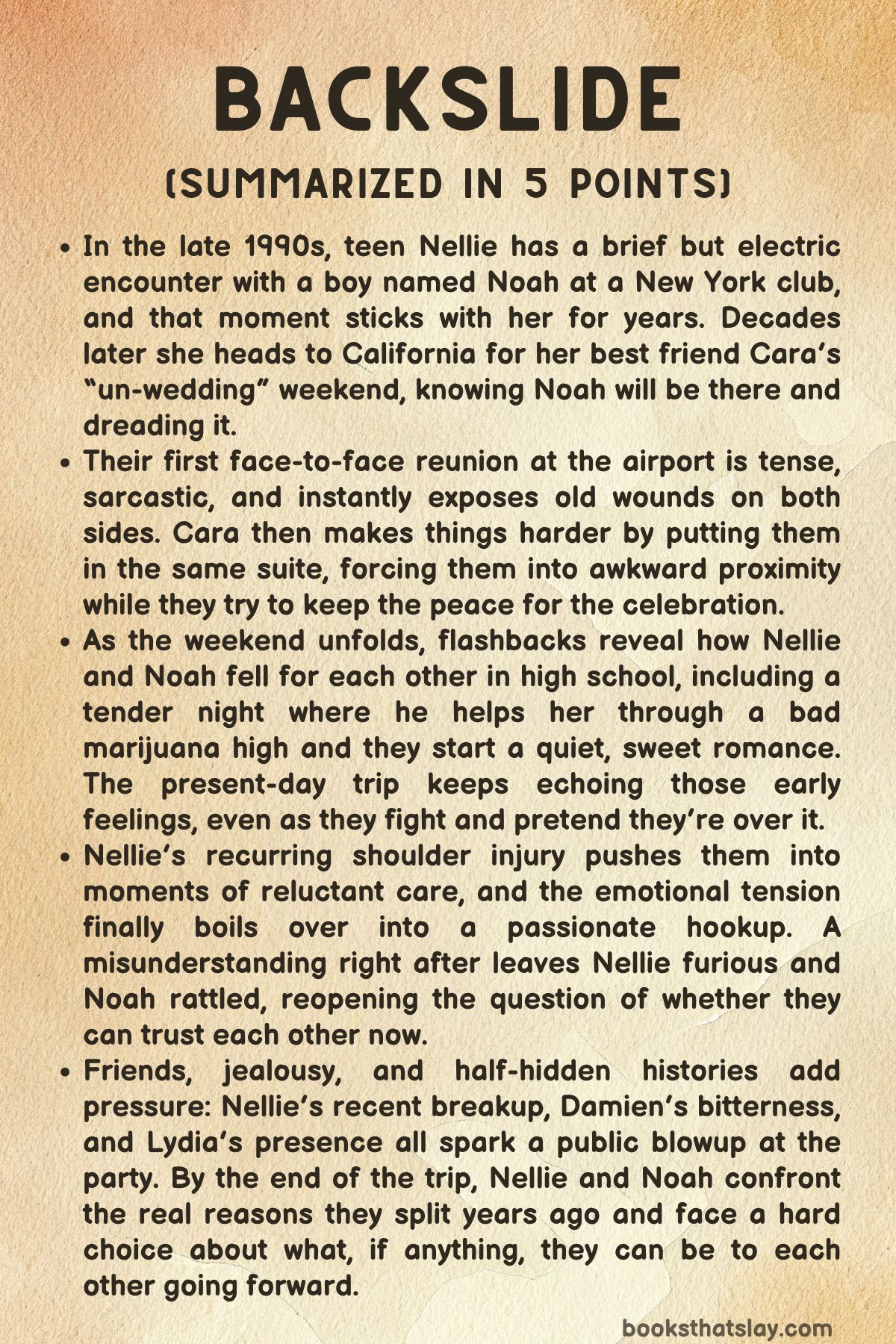
Summary
As a teenager in late-1990s New York, Nellie slips into an underage club night with her friends Cara and Sabrina. The party feels electric and a little dangerous.
Nellie spots a boy on a raised platform—Noah—who seems to stand out from the haze and strobe lights. They lock eyes in a moment that lands hard for both of them, but they never manage to meet.
The memory becomes a private hinge in Nellie’s life, a “what if” that never quite lets go.
Decades later, Nellie boards a flight from New York to San Francisco for Cara and Ben’s small vineyard “un-wedding,” a delayed celebration after their elopement. She’s already frayed: her magazine job just ended, and she has no clear next step.
She also dreads the trip because Noah will be there. In her mind he’s both her first love and her first real heartbreak, and she has promised herself she’ll avoid him completely.
The reunion happens immediately at baggage claim. Nellie wrestles with her huge green suitcase, aggravating a long-standing shoulder injury.
A stranger lifts the bag for her, and she looks up to find Noah—older, relaxed, still disarming. He greets her by her old nickname, “Nell,” but she insists on “Eleanor.” Their conversation turns snappish fast, each jab carrying years of history.
He remembers her shoulder and offers help. She refuses it, partly out of pride and partly because being near him makes her feel too much.
They quarrel in public, alarming an airport employee who asks Nellie if she’s safe. She storms off into her car service, leaving Noah standing there furious and stung.
A flashback fills in their early connection. Weeks after that first club night, Nellie runs into Noah and his friend Damien on the Upper West Side.
Noah is quieter than the boys around him, but when he pays attention to Nellie and asks about her art class, she feels seen. He introduces himself properly, calls her “Nell,” and leaves her giddy.
Noah walks away looking back, already tethered to her.
At the Sonoma estate, Nellie reunites with Cara and is shown the property, only to learn the twist: she and Noah have been assigned separate bedrooms within the same suite. Cara is anxious about the arrangement but wants her closest friends nearby during the weekend.
Nellie swallows her irritation for Cara’s sake; Noah says they’ll act like adults. Once alone, Nellie shuts down any attempt to talk, retreating to her room.
Noah, in his own head, is unnerved by how quickly old feelings return.
That evening on the estate deck, the whole group gathers: Cara, Ben, Sabrina, Rita, Damien, Noah, and later Lydia—Cara’s childhood friend who has a tense past with Nellie. Noah keeps a glass of wine in hand like armor.
Damien is openly impressed by Nellie, which needles Noah more than he wants to admit. Nellie’s shoulder pain is obvious; she winces during hugs and simple movements.
Cara asks about her rotator cuff. Damien urges her to let Noah take a look, boasting that he works with pro athletes.
Nellie mocks him as a glorified “ball boy,” which Noah dryly plays along with, and the two slip into bickering that makes everyone squirm.
Damien, half teasing and half serious, offers to trade rooms with Noah so he can stay in the suite with Nellie. The suggestion sends Nellie into instant panic and annoyance.
Noah shuts it down, saying he’s already unpacked. Lydia then offers to swap with Nellie instead, implying she’d be happy to room near Noah.
Nellie doesn’t respond; she slips away to find Sabrina and Rita. After she leaves, Cara mentions Nellie is engaged to a journalist named Alfie.
The news hits Noah like a punch even as he tells himself it should make things simpler.
A flashback explains the start of Noah and Nellie’s romance. At a smoky apartment hangout, Nellie takes too big a bong hit trying to seem cool and spirals into a panic.
Noah finds her alone in the kitchen, talks her down gently, and hands her a bowl of Cheerios with milk, claiming it might help. The odd kindness works.
They talk easily, flirt, and Nellie laughs for the first time that night. Later, Noah follows her outside, gives her the “spare” Cheerios she forgot, and asks for her number “for emergencies.” They scrawl their digits on gum-wrapper foil, pocket the scraps, and share a shy, sweet moment that turns into a spark neither can ignore.
Back in the present, Nellie wakes the next morning hungover and stiff with shoulder pain. She tries to hide, but runs into Noah on the patio.
He examines her shoulder with calm competence and offers to call in anti-inflammatories. Nellie is shocked to learn he’s now an orthopedic surgeon.
Soon after, he hears her struggling in her room, tangled in a dress she can’t zip because of her injury. She reluctantly lets him help.
He frees her hair from the zipper, then has to slip the dress off and re-dress her carefully. The moment is close and loaded, and when it ends Nellie snaps the door shut on her feelings.
Tension builds through the trip until they finally give in in the hot tub late one night. The kissing feels both new and familiar.
Noah stops mid-heat to ask if she still has a fiancé. Nellie admits she and Alfie broke up six weeks ago and no one knows.
Relieved, Noah asks if she’s rebounding; she says she doesn’t think so. They joke about Cheerios and the old myth, and Nellie tells him he’s the only one who ever called her “Nell” in a way she liked.
She lets him use it again. They tumble back into each other—until a stab of pain in her arm makes Noah pause.
Worried because she’s on a muscle relaxer he prescribed, he checks her consent again. Nellie hears doubt instead of care.
Angry and embarrassed, she storms out, calling him an asshole. Noah tries to explain his concern, but she won’t stay.
Later, Nellie confides in Sabrina and Rita. They’re thrilled she and Noah hooked up, then cautious when she describes his behavior.
They say he might have been trying to do the right thing and remind her she tends to shut people out. Nellie also learns they’ve both been quietly close to Noah in Los Angeles for a while, which makes her feel foolish for carrying her anger alone.
After a messy but honest talk, she forgives them and admits something of her own: she’s been single for weeks. The confession loosens her chest.
She feels supported, even as her feelings about Noah stay complicated.
Near the end of the weekend, Nellie and Noah sneak out to a barn and sleep together again, this time softer, fuller, and harder to deny. Noah tells her he wants more than a secret fling and asks her to consider moving to Los Angeles now that her job is ending.
Nellie doesn’t say yes or no; they agree to keep things quiet for Cara’s sake.
A flashback reveals why trust is so fragile between them. As teens, Noah tore his ACL, losing his baseball future and spiraling.
Around the same time, Nellie went through a pregnancy scare largely alone. Noah handled it badly—panicked, withdrew, then drunkenly kissed another girl.
His apologies were clipped and incomplete. When Nellie left for college in Los Angeles, he felt abandoned, and their relationship ended without a real reckoning.
Back at the party, dawn and alcohol loosen everyone’s edges. Damien corners Nellie, bitter and jealous.
He accuses her of lying about being engaged and says he saw her with Noah in the barn. Their argument turns ugly.
Nellie looks up and sees Noah standing close to Lydia, his hand at her side. To Nellie, it mirrors the betrayal that ended them as teenagers.
Noah insists Lydia only asked him to check her shoulder, but Damien refuses to back him up. Lydia smirks.
The music cuts, the crowd stares, and Nellie says she’s leaving.
The confession detonates the weekend. Sabrina blurts that Noah and Nellie are together.
Cara realizes Nellie hid both the breakup and the rekindled relationship. Hurt that her best friend kept so much during a trip meant to celebrate Cara, she storms off.
Sabrina follows, furious at the chaos. Noah tries to talk Nellie down, but she breaks.
She tells him trust was always the fault line: he disappeared when she needed him most, still bends to other people’s demands, and never fully faced what he did. Noah throws back that she left when his life collapsed.
Nellie says their choices were always on his clock, and now it’s already wrecked her friendships again. She says goodbye.
The next morning Noah has gone. Cara comes to Nellie’s suite, and after a raw talk they reconcile.
Nellie finally lays out everything: her job ending, the breakup with Alfie, the pregnancy scare, and the old kiss. Cara and Sabrina believe Noah has changed, but Nellie says she can’t risk her life and heart on hope.
In Los Angeles, Noah cuts Damien out and admits to Ben he’s tired of waiting to be chosen. Weeks later, Nellie returns to New York, trying to rebuild.
She walks into her apartment to find it filled with boxes of Cheerios—and Noah, waiting. The cereal is his clumsy, perfect callback to the night he steadied her.
He tells her he doesn’t want their story to stop halfway again. He’s moving to New York for her and even shows a mock Yankees-style ad for an East Coast practice.
Nellie is overwhelmed by the certainty he’s finally offering. She kisses him and says yes.
In the epilogue, Nellie and Noah marry on Dillon Beach with their friends and family. Around a fire afterward, they joke, tease, and look ahead together—older, bruised, and finally on the same side.
Characters
Nellie “Eleanor” / “Nell”
Nellie is the emotional center of Backslide, a woman who carries the imprint of her teenage self into adulthood while trying to outgrow it. As a teen, she is dreamy, observant, and quietly hungry for a life that feels bigger than her tight New York orbit; her instant, almost mystical attraction to Noah shows how deeply she craves being seen and chosen.
As an adult, that same sensitivity is layered under armor: she is sharp-tongued, defensive, and determined not to need anyone, partly from habit and partly from a fear that dependence will expose her to disappointment again. Her rotator cuff injury works like a physical metaphor—she keeps trying to lift burdens alone until her body forces her to accept help.
Nellie’s core conflict is trust: she wants intimacy, but old wounds make her interpret care as control and closeness as danger. Her secrecy about Alfie and her career collapse isn’t just plot fuel; it reveals her shame about falling behind her friends’ life milestones and her reflex to manage pain privately.
Across the story she doesn’t become a different person so much as a more honest one—learning to let friends hold the messy truth, and letting Noah prove love through choices rather than promises.
Noah
Noah begins Backslide as a memory weighted with both first love and first betrayal, and the adult version of him must fight against that frozen image. Teenage Noah is quiet, magnetic, and steadier than his environment suggests; the Cheerios scene defines his instinct to protect and soothe without performing it for attention.
His early tenderness toward Nellie is genuine, but his immaturity under pressure—especially after his ACL injury and during the pregnancy scare—shows a boy who can’t yet carry fear without letting it spill onto others. The adult Noah is outwardly successful and controlled, a man who has built discipline from the wreckage of his teenage derailment.
Yet he still has a compulsive caretaker streak that can tip into people-pleasing, especially with women like Lydia and friends like Damien, and Nellie is right to see that pattern as risky. What makes Noah compelling is that his growth is real but incomplete; he is better at healing bodies than navigating the emotional bruises he caused.
His arc hinges on agency: by moving to New York, cutting Damien off, and choosing Nellie without demanding she reshape her life for him, he finally acts with the consistency he failed to show as a teen.
Cara
Cara is the gravitational friend in Backslide, the one around whom the past and present collide. She is warm, blunt, and community-driven, someone who believes that love is sustained through shared rituals and proximity—hence the un-wedding and her insistence on keeping her people close.
Her decision to put Nellie and Noah in the same suite is not cruel, but it is impulsive, revealing how much she romanticizes resolution and trusts her own vision of what others need. Cara’s nervousness around Nellie’s arrival, and later her hurt at Nellie’s secrecy, underline her central trait: she is loyal to the point where exclusion stings like betrayal.
Yet her loyalty isn’t possessive; once she understands the full truth, she makes room for Nellie’s complexity and pain. Cara functions as both catalyst and conscience, forcing the main characters into contact while also reminding Nellie that friendship, not romance, is her most reliable home.
Ben
Ben, though less flamboyant on the page, is quietly crucial in Backslide as a stabilizing counterweight to the volatile emotional weather. He is Cara’s chosen partner in patience, someone who reads stress quickly and steps in to shield her from unnecessary strain, as seen in how he frames the suite arrangement and tries to keep the gathering smooth.
Ben is also perceptive about Noah; he sees the old dynamic returning but doesn’t hang Noah’s past around his neck. His conversations with Noah show a man who believes adulthood means making deliberate choices rather than waiting for life to fix old mistakes.
Ben’s calm practicality grounds the group, and his role highlights a theme of the novel: enduring love is often made of steady actions, not dramatic declarations.
Sabrina
Sabrina is the sparkplug of Backslide, a friend who uses humor, teasing, and boldness to cut through tension. As a teenager she is the social engine—confident in crowds, reckless enough to pull others into smoky apartments and underage clubs, and happy to push boundaries for the thrill of it.
As an adult, she keeps that brazen energy but directs it with more care, having matured into someone who can be both irreverent and deeply supportive. Her secret friendship with Noah is a morally messy choice, but it fits her psychology: she prioritizes tangible reality over stories Nellie has been trapped inside, and she trusts her own judgment even when it risks conflict.
When she confronts Nellie about hiding Alfie and the hot-tub hookup, she is acting like a fierce sister rather than a nosy friend—she wants truth because she sees how secrecy corrodes Nellie from within. Sabrina embodies the tough-love version of friendship: she laughs first, but she also shows up.
Damien
Damien is the most openly disruptive force in Backslide, a character who initially reads as charmingly playful but gradually reveals a darker undertow. As a teen he is chatty, flirty, and socially agile—the kind of boy who can make any sidewalk feel like a stage.
In adulthood he still performs ease and desire, immediately zeroing in on Nellie with an almost competitive admiration. His offer to swap rooms isn’t just a joke; it’s a probe for weakness in Noah and Nellie’s boundary, and when denied it hardens into resentment.
Damien’s drunken confrontation with Nellie exposes long-held jealousy and a need to position himself as a “protector” while actually trying to poison trust. He represents a specific kind of arrested development: someone who confuses closeness with possession and uses sarcasm as a mask for bitterness.
By cutting Damien out, Noah symbolically rejects the version of himself that used to orbit insecurity and ego.
Lydia
Lydia is the embodiment of unresolved history in Backslide, a person whose presence is less about what she does in the present and more about what she represents in Nellie’s emotional map. As a teen she is snarky, performatively cool, and quick to compete for attention, especially around boys.
Her dynamic with Damien hints at a comfort with manipulation and social game-playing. In the present, Lydia’s flirtation with Noah and her smirking at Nellie during the dance-floor blowup show someone who still thrives on destabilizing Nellie’s footing.
Whether she truly intends harm or simply enjoys being central, the effect is the same: she triggers Nellie’s oldest fear of being humiliated and replaced. Lydia’s character underscores how some relationships in youth don’t fade—they fossilize into symbols, and a single smirk can reopen a decade-old wound.
Rita
Rita is a quieter but essential supporting character in Backslide, functioning as a bridge between Nellie’s private anguish and the friend-group’s collective reality. She is pragmatic, comfortable in adult life, and less invested in teenage-era grudges; her connection to Noah through work makes her a living reminder that people can evolve beyond the roles they once played.
Rita’s reaction to Nellie’s hot-tub confession is layered—excited like a friend with popcorn, but also thoughtful enough to question Nellie’s interpretation of Noah’s consent-checking. That balance captures her role: she doesn’t coddle, she reorients.
By confirming that Noah has been kind and still cares, she gently destabilizes Nellie’s single-story narrative, helping Nellie consider that trust can be rebuilt if both people do the work.
Alfie
Alfie appears mostly through absence, but in Backslide that absence is revealing. He is a political journalist, a detail that positions him as serious, public-facing, and ideologically engaged—traits that likely appealed to Nellie during a phase of wanting adulthood to look orderly and impressive.
Yet Nellie’s breakup with him before the trip, and her friends’ admitted dislike, suggest a relationship that fit on paper more than in her nervous system. Alfie functions as a mirror for what Nellie thought she should want: stability without risk, commitment without history.
The fact that she hides the breakup shows how much she attached her worth to being “settled.” Alfie isn’t villainized; he is more like a checkpoint Nellie passes on her way back to her true axis.
Sebastian
Sebastian is a minor character but a clear narrative tool in Backslide for highlighting Noah and Nellie’s early chemistry. He is described as handsome but dull, a skater boy whose vibe is more aesthetic than substance.
The contrast between Sebastian’s stoned emptiness and Noah’s calm attentiveness in the kitchen scene clarifies what Nellie is drawn to: not just attractiveness, but the feeling of being safely understood. Sebastian’s presence also sparks Noah’s early jealousy, showing how quickly Noah’s feelings move from curiosity to devotion.
Even with little page time, Sebastian helps define the emotional stakes of first love by showing what it is not.
Themes
The long shadow of first love and the possibility of a second chance
The story opens with a teenage moment that feels tiny in action but huge in consequence: two kids in a club exchange a look that becomes a personal myth for both of them. That early spark isn’t treated as nostalgia for nostalgia’s sake; it’s an emotional blueprint that keeps shaping Nellie and Noah long after they stop being teenagers.
Their reunion decades later exposes how first love can freeze people in a particular version of themselves. Nellie enters Sonoma already tense, calling Noah her first love turned first hate, which shows that for her the relationship never settled into a neutral memory.
It stayed active, like an old injury that flares under stress. Noah, meanwhile, is stunned by how quickly his body and mind return to the old pull, suggesting that even growth doesn’t erase original attachment.
The forced proximity of the shared suite acts like a pressure cooker, pushing them to confront what was left unfinished. Their attraction is still real, but now it shares space with adult fear, pride, and grief about the past.
The hot tub hookup is a key pivot: it proves the connection is alive, yet it also reveals how fragile it is when old wounds are touched. The narrative keeps asking whether a second chance is a cure or a repeat.
The barn night feels like a mature version of what they once had—tender, mutual, and chosen—yet it collapses under the same trigger as before: suspicion of divided attention and a reflex to run. Only at the end does the second chance become credible, not because passion returns, but because Noah changes the terms.
By moving to New York, he stops waiting to be forgiven from a distance and shows up in Nellie’s life on her ground, accepting that love now requires tangible commitment, not just feelings. The theme lands on the idea that second chances work only when they are built by new behavior rather than the hope that chemistry alone will rewrite history.
Trust as a fragile structure built from actions, not intentions
Trust in this story isn’t a vague moral ideal; it’s a practical, breakable structure that both characters have learned to live without. Nellie’s hostility at the airport is less about rudeness and more about self-defense.
Her body remembers what her mind refuses to romanticize: Noah once vanished when she was scared and needed him, and he once crossed a line with another girl when their relationship was already wobbling. Those events form the hidden core of her anger.
For Noah, trust is tangled with shame and the fear of being judged for who he used to be. He keeps insisting they need to be “okay” for the weekend, but that insistence reads to Nellie as another version of him managing optics rather than her feelings.
Even when he tries to help—lifting her suitcase, offering medical care, helping her dress—she doubts the reliability underneath his gestures. The hot tub scene is especially revealing: Noah’s consent check is responsible and caring, yet Nellie receives it as a sudden withdrawal because past Noah also backed away when things got serious.
This mismatch shows how trust is not improved by good intent alone; it depends on whether the other person can believe the intent will hold in a hard moment. The dance-floor misunderstanding with Lydia is the same test in a different outfit.
Noah claims he was helping an injury; Nellie sees a replay of betrayal. It matters less what was “true” in the moment than what history makes believable.
Their argument afterward is basically a negotiation over what counts as trustworthy behavior: Nellie wants loyalty and clear prioritization; Noah wants acknowledgment that people can change and that her leaving for college also hurt him. The resolution arrives when Noah finally accepts that restoring trust requires cost.
Cutting Damien off is one cost; moving across the country is another. He stops expecting Nellie to meet him halfway on faith and instead proves dependability through sacrifice and consistency.
The theme suggests that trust is rebuilt when someone chooses to be steady in the exact places they were once unreliable.
Identity, reinvention, and the tension between who you were and who you are
Both leads are caught in a tug-of-war between past identity and present self. Nellie’s insistence on being called “Eleanor” instead of “Nell” looks like a simple preference at first, but it reveals a deeper struggle with ownership.
“Nell” belongs to a version of her that existed inside Noah’s gaze: youthful, open, excited to be seen. By rejecting that nickname, she tries to keep distance from the girl who trusted him and got hurt.
Yet she also admits she likes it, implying that she doesn’t want to erase her younger self, only to protect her. Her career uncertainty adds another layer.
Losing her magazine job makes her feel unmoored, as if adulthood has quietly taken away the stable role she thought she had. That insecurity turns her into someone who hides, avoids help, and tries to appear “fine,” because admitting drift would mean admitting she doesn’t know who she is next.
Noah’s reinvention is clearer on paper. The teenage athlete who thought baseball would define him becomes an orthopedic surgeon, a shift that comes out of pain and forced adaptation after his ACL injury.
But the story doesn’t portray this as a neat glow-up. His new identity carries echoes of the old one: competition, discipline, and the habit of being chosen by others rather than choosing for himself.
That’s why Ben’s advice lands so hard: stop waiting to be picked. Both characters are thus learning to author their own lives instead of letting youth, injury, or romance define them.
When Noah decides to move to New York, it isn’t only a romantic gesture; it’s him stepping into a self he owns. When Nellie accepts him, it isn’t just surrender to old feelings; it’s her allowing the parts of her past she still values to exist in her present without shame.
The theme argues that growth doesn’t mean replacing your past self; it means integrating it, keeping what was true, and refusing to be trapped by what was painful.
Friendship, loyalty, and the complicated ethics of “protecting” someone
The friend group in Backslide functions like a second storyline that tests loyalty under pressure. Cara, Sabrina, Rita, and even the disruptive presence of Lydia show different models of friendship—some nurturing, some competitive, some performative.
Cara’s un-wedding is designed to be a safe container for intimate reunion, yet it also becomes the stage where old tensions surface. Cara’s decision to place Nellie and Noah in the same suite is a well-meaning attempt to manage closeness and harmony, but it also shows how friends sometimes control a situation to force healing without consent.
Sabrina and Rita’s hidden friendship with Noah is the sharpest knot. They believe they’re sparing Nellie feelings by keeping it secret, but the secret itself becomes a betrayal.
When Nellie learns the truth, her humiliation isn’t about Noah alone; it’s about realizing her closest friends have been living in a world she wasn’t invited into. Yet the story doesn’t villainize them.
Their choice comes from a kind of loyalty that is flawed but not cruel: they wanted to preserve the version of Nellie they knew, the one who said Noah hurt her, and they didn’t trust that she could handle grayness. The blowup at the party shows how friendships can be collateral damage when people refuse honesty.
Cara feels robbed of her weekend because Nellie hid both her breakup and her renewed connection with Noah, which makes Cara wonder whether Nellie trusts her at all. The reconciliation the next morning is important because it doesn’t erase the hurt; it reframes friendship as something that can survive rupture when people finally tell the full story.
The theme recognizes that loyalty isn’t only about taking someone’s side. Sometimes loyalty means refusing to let a friend live inside a partial truth, even if that truth feels protective in the short term.
The story lands on a more adult vision of friendship: not a shelter from discomfort, but a relationship that can hold discomfort without breaking.
Secrecy, communication breakdown, and how silence becomes a character
Silence does as much plot work here as any spoken line. The teenage breakup is a classic example of how missing conversations can harden into lifelong narratives.
Noah doesn’t fully apologize for mishandling the pregnancy scare or for kissing another girl; Nellie leaves for college without resolution. Their younger selves speak around the real issues, then let distance do the talking.
That silence becomes a ghost that follows them into adulthood. In the present timeline, Nellie repeats the pattern with Alfie: she ends the engagement and keeps it hidden, telling herself it’s for Cara’s sake.
But the effect is the same as before—people make assumptions in the absence of truth. Noah assumes she is still committed elsewhere; Cara assumes her best friend is stable and happy; Sabrina assumes Nellie is exaggerating her hatred of Noah.
Each wrong assumption adds pressure until it pops in public. Even the hot tub fight is a communication problem more than a moral one.
Noah tries to check consent; Nellie hears rejection. She storms away instead of staying to clarify, because her reflex is still to protect herself through exit.
Damien’s meddling thrives in this environment because secrecy gives him oxygen. When people don’t speak directly, someone else gets to narrate.
The final movement of the story shows a different choice. Nellie finally tells Cara and Sabrina everything, and while it hurts, it also restores reality between them.
Noah, too, stops communicating through hints or waiting games; he arrives in New York and says plainly that he wants their story to continue and is willing to build a life where she already stands. The Cheerios boxes are playful, but the message is straightforward.
The theme suggests that silence is rarely neutral. It is an action that shapes outcomes, often in the direction of misunderstanding.
Healing happens only when characters risk the awkwardness of truth rather than the seeming safety of omission.
Care, vulnerability, and the body as a site of emotional truth
Physical injury in Backslide isn’t a side detail; it is one of the main ways the novel talks about vulnerability. Nellie’s shoulder flare appears right when she is least willing to need anyone.
She is freshly job-insecure, emotionally rattled by Noah’s presence, and determined to keep a hard shell. Her body doesn’t cooperate with that plan.
She can’t lift her suitcase, can’t dress herself easily, can’t hide her pain when hugged. This forces a kind of honesty she resists.
Noah’s response is equally revealing. His medical competence lets him care for her in a skilled, non-performative way.
He notices details, remembers her history, offers real solutions. But because their emotional past is tangled, even care becomes risky.
When he helps her with the dress, the intimacy is not romanticized as pure sweetness; it is awkward, tense, and charged because it requires Nellie to trust him with her body before she trusts him with her heart. The hot tub moment flips this theme into moral territory.
Noah’s anxiety about consent arises precisely because he is a doctor, someone trained to attend to bodily autonomy and safety. He can’t separate that responsibility from desire.
Nellie reads this as doubt, highlighting how differently two people can interpret the same caring act when their histories differ. Later, the Lydia misunderstanding also circles back to the body: Noah is again accused for helping someone physically, which shows how his caretaking identity collides with Nellie’s fear of being replaced.
In the end, the body becomes a place where truth can no longer be faked. Nellie’s pain makes her accept help; Noah’s medical role makes him face the stakes of closeness.
Their reunion succeeds not because they ignore vulnerability, but because they accept it as part of love. The theme argues that care is not a soft accessory to romance.
It is the daily proof of commitment, the way people show up when someone else cannot carry their own weight.