Boom Town Summary, Characters and Themes
Boom Town by Nic Stone is a suspenseful adult novel set in Atlanta’s strip-club world, told through the lives of Black women trying to survive a city that profits from their bodies and ignores their disappearances. The story centers on Boom Town, a famous club on the edge of respectability, and on Lyriq, its sharp, battle-scarred dance manager.
When a gifted teenage dancer vanishes, Lyriq is forced to confront the club’s secrets, her own past with a missing headliner, and a powerful man who treats women like property. The book examines exploitation, loyalty, and what it costs to be unseen.
Summary
Lady Josephine, an older unhoused woman who lives near the Chattahoochee River, staggers through the woods toward her campsite. She feels ill and dizzy after drinking from a bottle offered by men under the Lee Street Bridge.
She knows the forest is dangerous after dark and tries to follow the river by memory. As she walks she sings an old Anita Baker tune, thinking about the years when she felt beautiful and wanted, back when Atlanta still felt like a city that could hold her.
She remembers the convenience store owners who treat her kindly, and the strip club across the street called Boom Town. The song brings up a more bitter thought too: she recently overheard talk about missing girls, especially Black girls, the kind no one searches for.
She realizes she was never searched for either. She slips into the cold river, fights her way onto rocks, and sees her blue tent nearby.
But something red floats against the current. When it rises, she recognizes it as clothing around a body.
She vomits in horror.
Days earlier, Boom Town is running on legacy and hustle. Lyriq, once a legendary headliner, now manages dancers while still carrying the weight of breast cancer recovery and a past she can’t file away neatly.
A young woman named Damaris Wilburn arrives for an audition, arranged by her cousin Tink. Damaris has training but no strip-club instincts; her routine feels like ballet staged for the wrong room.
The general manager Bones wants to pass, but Lyriq hires her on the spot. Part of it is obligation to Tink, part of it is the shock of resemblance: Damaris looks uncannily like Felice Jade Carothers, Lyriq’s former stage partner and lover.
Felice performed as Lucky; together they were the Lovely Ladies, the duo that turned Boom Town into a destination. When Lyriq’s illness forced her offstage, Felice carried the spotlight alone, then disappeared a year earlier without explanation.
Hiring Damaris feels like grabbing a thread back to that loss.
Lyriq trains the new dancer personally. Damaris works with a ruthless intensity, showing up early, practicing until her body learns the club’s language.
Within two weeks she can command the stage nude, turning raw skill into something that fills the room with heat. Lyriq gives her the stage name Charm, hoping she might bring luck rather than another ghost.
Still, Lyriq feels a warning under her pride.
Charm suddenly misses a shift. Then another.
A young man comes to the club asking for her by her real name. He introduces himself as Dejuan Taylor and says she rents a basement apartment in his mother’s house.
She hasn’t been home for days. Lyriq’s concern sharpens into fear when she sees a familiar figure enter the club: Thomas McIntyre, a wealthy white regular who started coming around during Felice’s last months.
Lyriq remembers how he ignored everyone until Felice walked out, then locked onto her like a predator who knew he could pay for whatever he wanted. His presence now feels like a threat returning to finish something unfinished.
Bones pressures Lyriq to fire Charm for repeated no-shows. Lyriq empties her locker—number 22, the same locker Felice once used—and takes the contents home.
The items are ordinary until she finds photos of teenage Damaris with an older white man who looks like Thomas. Mixed in is a stack of customer cards, including one black card with a handwritten number and the name Thomas J. McIntyre.
The sight hits Lyriq so hard she opens Felice’s old box of belongings. Inside is another black Thomas card from the year Felice vanished.
The numbers are different. Lyriq’s certainty turns cold: Thomas is tied to both disappearances.
Trying to build a timeline, Lyriq questions other dancers. They joke about Charm being rattled by a “dirty old white man,” and Lyriq hears the fear beneath their humor.
That night Thomas doesn’t show, and Lyriq goes home to Felice’s old flip phone, which she has kept like a relic of guilt. It still works.
The only saved contact is “Jeff.” The last outgoing text from Felice reads: “Just found out I’m pregnant.” Lyriq reels; Felice never told her she was expecting. The numbers on Felice’s phone don’t match the Thomas cards, and Lyriq can’t figure out who Jeff is.
What she can’t ignore is that Felice was carrying a child before she went missing.
Old memories return in pieces. Felice once avoided public meetings with clients, but she agreed to meet Thomas at a café called the Real Americano.
She wanted privacy; he wanted something more personal. In their conversations he complained about his marriage and confessed he wanted a baby his wife didn’t.
He showed her his ID and revealed his full name: Thomas Jefferson McIntyre. Later, Felice ran into him at a farmers market and met his wife, LaBrettney, a stylish Black woman who seemed kind and open.
Not long after, Thomas summoned Felice to a hidden VIP room at Boom Town. There he crossed every boundary and assaulted her.
Lyriq had been asleep behind the curtains in that suite, exhausted and in pain from her cancer. She woke to the violence, gasped, and startled Thomas, who fled.
Felice lay unmoving. Lyriq, panicked and desperate for money, grabbed the cash Thomas left and ran.
That moment has been rotting inside her ever since.
Back in the present, Lyriq follows clues from Felice’s Bible and texts to the abandoned Americano site, now under renovation. A local calls the new owner “Mr. Mac,” and Lyriq recognizes him immediately as Thomas.
She drives off shaken, then receives another call from Bones: Dejuan has returned, saying Charm is nineteen and he will report her missing. Bones is furious that Lyriq hired someone underage; he orders her to find the girl before police come near the club.
As if that isn’t enough, security footage shows Charm entered Bones’s locked office on her first shift and stole $10,000. Lyriq had sent her in with her keys, so Bones holds her responsible.
Lyriq realizes Charm is not only missing—she may be running from something, or someone.
Lyriq searches deeper into Thomas’s life. An address tied to Felice’s phone brings her to a house where Thomas lives with LaBrettney and a baby.
She doesn’t knock. She doesn’t need to.
She already knows the pattern: women vanish, and Thomas’s world stays spotless. When Lyriq investigates property records, she learns Thomas bought the Americano building and is a co-owner of Boom Town, hidden behind paperwork.
She breaks into Bones’s office, finds the deed, and confronts him for selling part of the club to Thomas. Bones tries to shrug it off as business, but Lyriq sees it as a trap set years ago.
Felice’s later past fills in through remembered scenes. Pregnant and unable to keep dancing much longer, she took a part-time job for LaBrettney’s education consulting firm, hiding her work at Boom Town.
Brett became a real friend—warm, admiring, with a closeness Felice didn’t know how to name. When a doctor client at the club noticed Felice’s pregnancy and urged her to leave the stage, Felice panicked.
She went to Brett’s house sick and broke the news. Brett was thrilled.
Thomas walked in on their celebration, demanded to know the father, and Felice lied, naming Micah, a woman she loved and planned to coparent with. Thomas accepted the lie too quickly.
Later he threatened Lyriq directly, warning he could destroy her by claiming she trafficked minors. Lyriq fired back that he raped Felice and Charm, that he hunted young dancers who vanished.
Thomas told her to forget everything.
LaBrettney’s point of view reveals the worst truth. She has long known about Thomas’s affairs, his condo for Felice, and his investment in Boom Town.
When Felice told Thomas the baby was his, he panicked about reputation and demanded Felice be removed. Brett handled it coldly, cleaning the condo of evidence and giving Thomas Felice’s cut braid as proof.
She then presented adoption paperwork and a story about a teen birth mother. Months later she brought home a caramel-skinned infant, and Thomas named her Felicity.
The baby everyone sees as a blessing is also a cover for violence.
Charm’s own journal finally explains her recent disappearance. Nineteen, newly in Atlanta, she hated dancing at Boom Town.
Thomas became her biggest customer, reminding her of an older abuser from her past. When Tink was jailed in a raid, Charm stole $10,000 from the club to help with bail and went into hiding.
Thomas sheltered her in his condo, pretending to protect her, then insisted she keep showing up at the club so nothing looked suspicious. When Charm asked too many questions about Felice and Brett, Thomas’s patience snapped.
Her last entries end in fear, sensing she is caught in a net she can’t see.
The final strand is Damaris herself. She wakes in Thomas’s condo as a prisoner.
He takes her phone, interrogates her about the stolen money, her fake ID, and her age. He tells her she is almost twenty, adopted from North Carolina, and alone enough to be controlled.
He claims sheltering her makes him vulnerable and threatens to turn her in if she disobeys. He gives her a precise escape plan for the next morning, a route through elevators and staff stairs to a garage where a white Honda Accord waits.
Before she can question him, a woman sneaks into the condo at night, searching through drawers as if she owns the place. Damaris realizes Thomas isn’t the only one with keys.
On Sunday, Damaris follows Thomas’s instructions and drinks coffee he hands her. She blacks out and wakes in a luxurious lake house on Lake Lanier.
Thomas tells her the place is safe, then leaves her. She finds her phone in a pouch and a note claiming no cell service and no charger.
Every door is locked from outside. She is trapped.
After a day without food or water, Damaris’s phone pings with messages from Dejuan. She tries to reply that she’s being held against her will, but nothing sends.
Thomas speaks to her through hidden audio, admitting cameras are everywhere and signal blockers prevent escape. He says he will arrive Tuesday at noon and may move her across state lines.
Damaris plans to hide her journal and be ready.
Instead, Tuesday night she jolts awake naked and bound in the trunk of a moving car. The faux-fur rug tells her it’s the Honda.
She remembers a drink, then darkness, then Thomas smothering her in the lake house while ranting about Felice, obsession, pregnancy, and fixing a “problem.” He thought she was dead. Now she isn’t.
She listens to the road and waits for any chance to survive, while the city above continues to spin, profitable and indifferent, around the women it keeps swallowing.
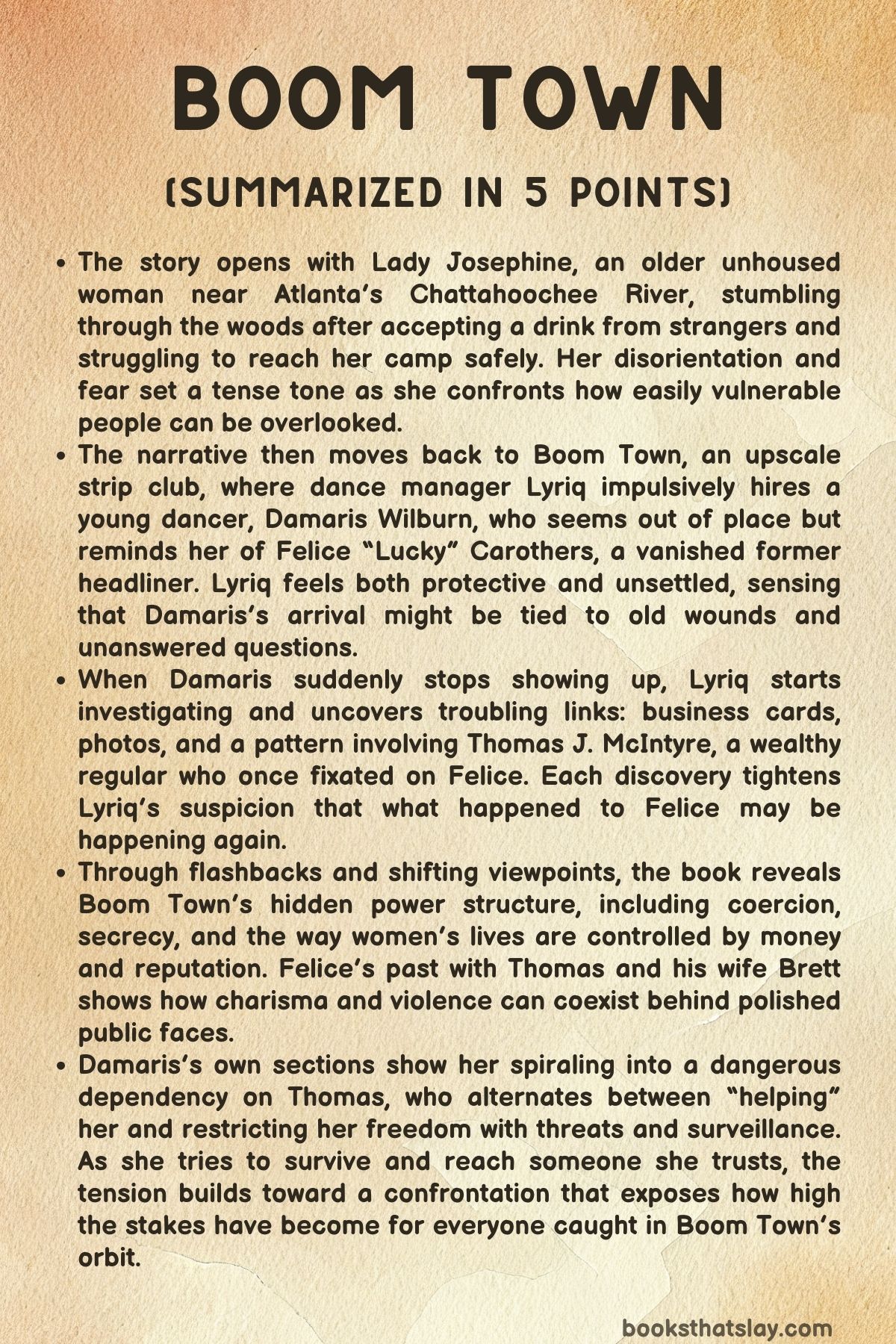
Characters
Lady Josephine
Lady Josephine opens the story as a vulnerable but perceptive witness whose lived experience on the margins gives the novel its moral weather. She is an older unhoused Black woman surviving near the Chattahoochee River, and her disorientation after drinking from a bottle given by men at the bridge immediately frames the world of Boom Town as one where predation hides in ordinary encounters.
Her thoughts drift between present danger and past glamour, revealing a layered identity: she was once a celebrated call girl in Atlanta, a life that still supplies her with a sense of beauty, agency, and memory even as her current reality denies her safety. The song she hums is not nostalgia for its own sake; it’s a survival tether, something that helps her orient herself in a body and city that have both changed.
Her realization that missing Black girls rarely get searched for—and that no one ever searched for her either—makes her more than a plot device for discovering a body. She embodies the novel’s critique of whose lives are treated as grievable and whose disappear quietly, and by the time she vomits at the sight of the submerged arm, she has already forced the reader to sit inside the fear and invisibility that power the rest of the book’s tragedy.
Lyriq
Lyriq is the novel’s emotional engine: a veteran dancer turned manager who carries both the glamour and the rot of Boom Town in her bones. Her past as a headliner with Felice made the club legendary, but her present is marked by recovery from breast cancer, financial precarity, and guilt about the night Felice vanished.
That guilt shapes nearly every choice she makes, especially her impulsive decision to hire Damaris despite the mismatch in style; Lyriq isn’t just staffing a stage, she’s trying to rewrite a failure, almost willing to believe that rescuing a young dancer can redeem what she couldn’t save before. Her instincts are sharp and protective, yet constantly compromised by the club’s economics and her own fear of losing what little stability she has.
The way she moves between tenderness (training Damaris, worrying about her safety) and hardened pragmatism (emptying lockers, rummaging for clues, calculating risks with Bones) shows a woman forced to become both caregiver and cop in a system that offers her no clean role. Her growing suspicion of Thomas is not paranoia but pattern recognition; her memory is the archive the club refuses to keep, and she becomes a reluctant investigator because no institution is stepping in.
When Thomas threatens her in VIP, Lyriq’s rage finally pierces her self-blame, turning her into the story’s clearest voice of accusation against a structure that weaponizes race, wealth, and gendered secrecy.
Felice Jade Carothers / “Lucky”
Felice, performing as Lucky, is the haunting center of the novel—a woman whose disappearance ripples outward and whose inner life reveals the true cost of the club’s shine. She is gifted, magnetic, and ambitious, but her vulnerability sits right beside her talent.
As one half of the Lovely Ladies act with Lyriq, Felice experiences real love and artistic partnership, yet the bond is strained by Lyriq’s illness and the instability of strip-club fame. Felice’s relationship to Thomas is especially complicated: she “hate-loved” him, a phrase that captures how survival under coercive desire can distort into something that feels like attachment even when it’s rooted in power imbalance.
Her pregnancy intensifies both her physical limits and her existential panic; she wants out of dancing but is trapped by economics and the shame that the world attaches to her work. The assault in the Jade VIP room is not just a personal catastrophe—it’s the moment the novel makes explicit how violence is enabled by the club’s culture of silence and transactional intimacy.
Felice’s later attempt to leverage Thomas for a legitimate job, while lying about the father, shows a sharp strategic mind trying to exit a burning building using the only door it thinks is unlocked. Her longing for Micah and her past teen pregnancy add depth beyond victimhood; she is a woman with history, desire, and plans, not a symbol.
Even after her disappearance, her flip phone, Bible, and highlighted verse keep her present as a voice struggling to be heard through the artifacts she left behind.
Damaris Marie Wilburn / “Charm”
Damaris, who becomes Charm onstage, is both mirror and escalation of Felice’s story—a young woman pulled into the same gravitational field of exploitation. She arrives at Boom Town with genuine dance training and a kind of raw hope, but also with the precariousness of a nineteen-year-old using fake documents to survive.
Her rapid transformation from interpretive dancer to a sexually commanding performer under Lyriq’s guidance is not framed as moral downfall but as learned adaptation: she is talented enough to master the club’s language quickly, yet still young enough to believe she can control the terrain. Her underage status makes her especially vulnerable to the club’s power structures and to Thomas’s particular appetite for control.
Charm’s theft of $10,000 is less a character flaw than a survival reflex tied to family loyalty and fear; her cousin’s arrest triggers the kind of desperate, messy decision-making that marginalized young people often make when institutions feel hostile or unreachable. Once in Thomas’s custody, we see her intelligence sharpen into a different kind of dance—performing compliance to stay alive.
Her journal entries and internal fears show her growing recognition that she is not sheltered but owned, and her final awakening in a trunk naked and bound strips away any remaining illusion. Damaris’s character embodies the novel’s warning about how quickly “help” can mutate into captivity when offered by someone whose power goes unquestioned.
Thomas Jefferson McIntyre
Thomas is the novel’s clearest predator, but he is written not as a cartoon villain so much as the logical product of entitlement protected by money. He moves through Boom Town with the swagger of ownership even before Lyriq discovers his stake, and that sense of untouchability shapes how he treats dancers: as resources, not people.
His fixation on Felice begins in voyeuristic obsession and evolves into something more dangerous when he sees her pregnancy as a solution to his personal dissatisfaction. The dual-phone identity—Thomas and “Jeff”—captures his core method: partitioning his life to avoid consequence while still consuming whatever he wants.
His violence is patterned, not impulsive; he uses private spaces, alcohol, threats of law enforcement, and racialized leverage to isolate women and force their dependence. Even his moments of seeming care—offering Felice a condo, sheltering Damaris—are transactional cages built to preserve his narrative of control.
His panic spirals whenever women start connecting dots, which reveals that what he fears most is not guilt, but exposure. The lake house sequence completes his portrait as a man who will escalate to murder to maintain dominance and protect the fragile architecture of his public respectability.
LaBrettney “Brett” McIntyre
Brett is one of the novel’s most unsettling figures because she complicates easy moral binaries. She is charismatic, glamorous, and deeply competent—someone who could have been a liberating ally to Felice, and in some ways is.
Her genuine friendship with Lucky, their intellectual partnership, and the unspoken attraction between them show that Brett can love and respect a dancer as a person. Yet her choices prove that intimacy doesn’t guarantee ethics.
Brett has long understood Thomas’s affairs and the machinery of his desires, and rather than dismantle it, she weaponizes it to preserve her household and social position. The act of scrubbing the condo, producing Lucky’s ponytail as proof, and manufacturing an adoption narrative shows a woman who has translated betrayal into managerial cruelty.
She is not naïve; she is strategic in a way that makes her complicit in violence even if she frames it as protection of her marriage or child. Brett represents how patriarchal systems reproduce themselves not only through men’s actions but through women who decide that survival within the system is worth others’ destruction.
Her affection for the baby Felicity is real, but it is built on erasure, which is precisely what makes her tragic and frightening at once.
Dejuan Taylor
Dejuan is a grounding presence—one of the few characters whose relationship to the dancers is not rooted in consumption or control. He is young, earnest, and worried, and his search for Damaris/Charm functions as the moral counterweight to the club’s indifference.
Living in the same house where Damaris rents a basement, he sees her as a real person in daily life rather than a stage image, which is why he notices her absence quickly and refuses to accept easy explanations. His willingness to confront Lyriq and threaten to report Damaris missing highlights both his courage and the desperation of someone who senses danger but lacks power to intervene directly.
Dejuan’s texts, especially the ones that reach Damaris in captivity, show how thin the line is between connection and helplessness; he can offer love and alarm, but not rescue. In a novel filled with exploitative men, Dejuan matters because he shows what care looks like when it is not transactional.
Latasha “Tink” Jenkins
Tink operates as both catalyst and cautionary shadow in Boom Town. As Damaris’s cousin and the one who arranges her audition, she is part of the informal survival networks that many vulnerable young women rely on.
Her “safe house” suggests she has been running from danger for a while, perhaps helping others do the same, and her later arrest during a raid implies that these networks are constantly targeted by policing rather than supported by social safety nets. Tink’s presence in Lyriq’s mind is tied to obligation and guilt, which hints at prior history between them and underscores how the club’s world is knitted together by favors, debts, and the need to protect one another from external threats.
Even off-page for much of the plot, Tink represents the precariousness of community among the marginalized: vital, risky, and always one step from collapse.
Bones
Bones is the club’s general manager and a portrait of institutional self-preservation. He is not the central predator like Thomas, but he is the infrastructure that lets predators operate.
His priorities are the club’s profits, reputation, and legal insulation, and he repeatedly pressures Lyriq to cut Damaris loose, not because he believes she is safe, but because her absence threatens operations. When he discovers the theft, his anger is less about the harm to a teenager and more about liability and money, and the fact that he sold a stake of the club to Thomas without transparency shows how easily moral compromise can be disguised as business necessity.
Bones is also opportunistic in the way he weaponizes rules—like the threat of investigators over an underage dancer—while ignoring the larger violence happening under his roof. He is the kind of manager who can say “I didn’t know” while actively making sure he doesn’t.
Dr. Kia Chamblee
Dr. Chamblee appears briefly but leaves a strong ethical imprint. She is a customer with elegance and authority, yet her interaction with Felice is marked by care rather than entitlement.
The way she recognizes Felice’s pregnancy and urges her to plan an exit reveals both clinical perceptiveness and genuine concern, as if she can’t unsee the danger once she notices it. Her confession that her husband forbids contact outside the club shows how even “good” patrons are constrained by rules that protect their own social world at the dancers’ expense.
She represents a kind of thwarted allyship—someone who wants to intervene but is trapped inside her own privilege and marital boundaries. Her presence underscores that the dancers’ survival often depends on help from people who feel sympathy yet still obey the systems that endanger them.
Micah
Micah is mostly an absence, but a meaningful one. She is Felice’s friend, lover, and imagined co-parent, and the grief Felice feels over Micah’s disappearance threads through her pregnancy like a second heartbeat.
Micah represents the possibility of queer love and chosen family outside male control, which is why her vanishing hits Felice so hard and why Felice clings to naming Micah as the father. In the narrative logic of Boom Town, Micah is what Felice wants to return to: a life where intimacy might be mutual instead of bought.
Her absence also parallels Felice’s later erasure, reinforcing the novel’s theme that women who exist outside mainstream protection—especially Black women—can disappear with terrifying ease.
Olivia “Via” McIntyre
Via is not fully foregrounded, but her role as the link between Charm and the McIntyre household makes her significant. As Brett and Thomas’s daughter, she represents the respectable public family that Thomas uses as camouflage.
The fact that a cousin of Via recruits Charm as a nanny suggests how the McIntyres’ social network quietly pulls vulnerable young women inward, often under the guise of opportunity. Via’s existence also heightens Lyriq’s fear in VIP, because Thomas’s threats about “wife and daughter” show that he sees them as possessions to guard, not people with agency.
Via is the innocent face of the world that Thomas and Brett are trying to preserve, even at monstrous cost.
Karma
Karma, the dancer who injures her ankle, is a small but telling portrait of the disposable labor behind the club’s glitter. Her injury triggers chaos, and the speed with which Bones pivots from a dancer’s pain to servicing Thomas’s demands shows exactly where power sits.
Karma’s presence reminds us that for every headliner like Felice, there are many other women whose bodies are constantly at risk, and whose crises are treated as inconveniences unless they affect profits.
Felicity
Felicity, the baby Thomas brings home and names, is the embodiment of stolen futures. She is the living proof of the violence done to Felice and the lengths Brett and Thomas went to in order to manufacture a family on their terms.
The photos Charm shares with Dejuan show Felicity as adored and cared for, which complicates the horror: she is innocent, cherished, and yet rooted in a crime hidden in plain sight. Felicity’s existence makes the novel’s moral stakes generational, asking what it means for a child to grow up inside a legacy of erasure and control.
Themes
Erasure of Black women and the politics of being unmissed
Lady Josephine’s opening disorientation sets a moral baseline for the story: a Black unhoused woman can be poisoned, stumble through a riverbank, and discover a body without anyone expecting their concern to matter. Her thought that no one ever looked for her, paired with the rumor about missing Black girls who draw no search parties, marks a world where disappearance is ordinary when the vanished are poor, Black, female, or all three.
Boom Town keeps returning to this idea through different lives. Felice’s vanishing is treated as a problem inside the club and in Lyriq’s conscience, but outside that circle it becomes an absence people learn to live around.
Damaris and Charm are missing in quick succession, and the people with institutional power—Bones, security, the club owners, even the city that might investigate—care most about liability, optics, and profit. The threat Bones makes about investigators is not rooted in fear for a teenager’s safety; it is fear for the business.
This contrast exposes how systems decide who counts as a full person. When Thomas uses the possibility of trafficking charges as a weapon against Lyriq, he exploits that same social reality: he knows society is quicker to suspect Black women of wrongdoing than to protect them.
The club itself is a space that advertises fantasy and desire, yet it functions as a sorting machine for empathy. A dancer can be adored on stage and still deemed disposable off it.
The missing girls are not missing in a neutral sense; they are removed from public concern by race, class, and stigma. Even Lyriq, who is determined to find answers, has to fight the learned assumption that “she probably just quit.” The theme is not only that Black women go missing; it is that they are trained to be missing in advance, by a culture that narrates their lives as temporary, their pain as expected, and their absence as convenient.
Sexual power, labor, and the machinery of exploitation
The strip club is not portrayed as a simple symbol of liberation or victimhood. It is work, it is performance, it is community, and it is also a marketplace where women’s bodies become currency for men’s status.
Lyriq remembers a time when she and Felice were treated like stars, and the pride of craft in their act is real. Damaris arrives with a dancer’s discipline that is not initially suited to the club, and her rapid transformation into “Charm” shows how the venue trains bodies to meet male appetite.
Yet this professional arc is framed by coercion. The club offers income, but it also produces vulnerability: customers have access to dancers’ time, attention, and sometimes their offstage lives.
Thomas is the clearest image of that predatory entitlement. His wealth lets him treat private dances as auditions for ownership, and his gaze is not erotic curiosity but selection.
The hidden VIP room, the private numbers on black cards, and the secret condo form an ecosystem where desire becomes capture. Even when he pays, his payment reads like buying silence.
The assault on Felice is not a rupture in an otherwise consensual order; it is the violent truth of a system that already rewards men for ignoring boundaries. Lyriq’s later realization that Thomas is co-owner of the club confirms that exploitation is baked into the business model.
Ownership gives him both proximity to dancers and institutional cover. That cover extends to threats—he can ruin Lyriq through legal narratives that society is ready to believe.
The story also examines how exploitation can masquerade as rescue. Thomas shelters Charm and Damaris after they steal money, framing confinement as protection.
The more they depend on him, the more he claims moral authority over their bodies and movement. Boom Town insists that sexual labor occurs within layered power relations: dancers negotiate agency nightly, but a single wealthy man with structural control can collapse that agency into terror.
The theme lands not as a condemnation of sex work, but as an indictment of the male entitlement and economic imbalance that turn a workplace into a hunting ground.
Motherhood, reproductive control, and children as leverage
Pregnancy is the story’s pressure point, revealing how women’s bodies become contested property. Felice’s late discovery of pregnancy reshapes her relationship to the club, to Lyriq, and to Thomas, because it introduces a life that others try to claim.
Her earlier pregnancy at fifteen already taught her that motherhood can be forced into adoption and silence, and she carries that history like a bruise. When Felice becomes pregnant after rape, the pregnancy is not treated as fate or moral test; it is evidence, a wound, and a source of danger.
Thomas’s obsession with wanting a child turns the fetus into a trophy for his legacy and a bargaining chip for his marriage. He does not respond to Felice’s pregnancy with care, only strategy: hide her stripping work, control her story, and ultimately erase her.
Brett’s perspective shows another side of reproductive control. She is not naive; she manages Thomas’s affairs with a ruthless clarity, and her solution to motherhood is acquisition.
The baby becomes a project that secures her marriage and status. Her act of scrubbing the condo, cutting Felice’s hair, and presenting adoption paperwork reveals a chilling logic: a missing woman can be reduced to proof of completion, while the child is rebranded as the couple’s miracle.
Even the naming of Felicity carries symbolic theft—taking Felice’s echo and folding it into the McIntyre family line. For Charm and Damaris, the baby is also a trap.
Charm is pulled into nanny work for a child who is living evidence of Felice’s fate, and the moment she asks questions, she is endangered. Motherhood here is not romantic; it is a site where race, class, and male power collide.
A Black dancer’s pregnancy is treated as a problem to be solved quietly, while a wealthy couple’s desire for a child is treated as a right. The story highlights how women’s reproductive lives are policed by men and, sometimes, by other women seeking to survive within patriarchy.
Yet it also frames motherhood as a stubborn claim to future. Felice’s hope to leave the club, Damaris’s longing for connection, and even Lyriq’s grief over what Felice might have wanted all point to pregnancy as a reason to imagine a life beyond exploitation.
The tragedy is that the same hope becomes the handle by which power drags women into deeper danger.
Trauma, memory, and the fight to hold on to self
The narrative is saturated with people trying to stay whole while living inside repeated harm. Lady Josephine’s humming of “Sweet Love” is not just nostalgia; it is a coping tool that anchors her to a past self who felt desired and in control.
The song becomes a bridge between who she was and who she is now, showing how memory can be both refuge and ache. Lyriq’s storyline is shaped by illness, guilt, and the scars of witnessing violence.
Her breast cancer recovery leaves her physically fragile, but also emotionally raw, and that rawness fuels her refusal to forget Felice. The flip phone, the Bible, the old photos, and the replayed timeline are acts of remembrance against a world that prefers amnesia.
Trauma in Boom Town is not a single event; it is cumulative. Felice carries the trauma of rape, of poverty, of her first pregnancy and adoption, and of living in a luxury cage where nothing she owns is truly hers.
Charm’s trauma predates the club through Todd Vickery’s abuse, making Thomas feel like a familiar threat she cannot immediately name. Damaris’s trauma is the loneliness of adoption, the hunger for family, and the terror of confinement.
What unites these experiences is how trauma distorts time. Past violations keep reappearing in present choices, and present danger reactivates old fear.
Yet memory is also a tool for survival. Lyriq’s recollections are her investigative method; she reads the past for patterns the authorities will not see.
Felice’s journal and texts become evidence that she existed as a thinking, hoping person rather than a rumor. Even Charm’s entries, written in fear, are an insistence on telling her own story before someone else edits it.
The theme argues that to remember is to resist. The characters are not allowed the luxury of clean closure, but they keep trying to hold their names, their friendships, and their truth in place.
That holding-on is portrayed as exhausting and necessary, because without it the world’s indifference wins by default.
Complicity, survival ethics, and the cost of staying alive
No one in the story escapes moral compromise, and the book’s tension comes from how survival can demand actions that haunt you later. Lyriq’s worst moment—running from the VIP room after taking Thomas’s cash while Felice lay unmoving—defines this theme.
She is not written as a villain; she is a sick woman desperate for money, terrified, and trained by hardship to grab what keeps her afloat. But the guilt is real, and it becomes the engine of her later pursuit of truth.
Bones embodies institutional complicity. He knows the club’s vulnerabilities, controls footage, threatens dancers, and sells part ownership to Thomas.
His priority is keeping the doors open, even if that means partnering with the very predator destabilizing the place. Brett offers the most unsettling portrait of complicity because her actions are strategic and calm.
She chooses to protect her marriage and child at the expense of another woman’s life, and she uses her social power to make that choice look orderly. Even Charm and Damaris are pulled into ethically messy survival.
Charm steals from the club to free Tink, then relies on Thomas’s shelter because she has no safe alternative. Damaris works underage with forged papers because she is untethered from family and needs a foothold.
Their wrongdoing is framed as a response to structural abandonment rather than a personal flaw. The story suggests that when systems fail you, survival becomes improvisation, and improvisation rarely stays clean.
This theme also highlights how predators exploit that messiness. Thomas repeatedly positions himself as the only path to safety for women who are already precarious; once they accept help, he converts it into ownership.
The line between help and captivity narrows when the helper controls your housing, money, and legal exposure. Boom Town doesn’t hand out easy moral rankings.
Instead, it asks what choices remain when society offers you either hunger or risk, either silence or retaliation. The tragedy is not simply that people make harmful decisions; it is that their environment trains them to see harm as the entry fee for another day alive.
By showing guilt alongside necessity, the book forces attention on the real culprit: a world where survival regularly requires complicity, and where powerful men thrive precisely because everyone else is exhausted from trying to get through the night.