Cowboy Casual Summary, Characters and Themes
Cowboy Casual by Holly Renee is a contemporary small-town romance about second chances, family loyalties, and choosing your own life. Blaire Monroe, polished daughter of a powerful senator, has built a careful future that looks perfect from the outside: political job, high-profile engagement, and a life smoothed out for optics.
When proof of her fiancé’s long-term cheating arrives, she walks away from the career and the image her father controls and heads back to Willow Grove, Tennessee—the strawberry farm, the Calloways, and Colt, the boy who once shattered her heart. Back home, she has to decide what her future really looks like.
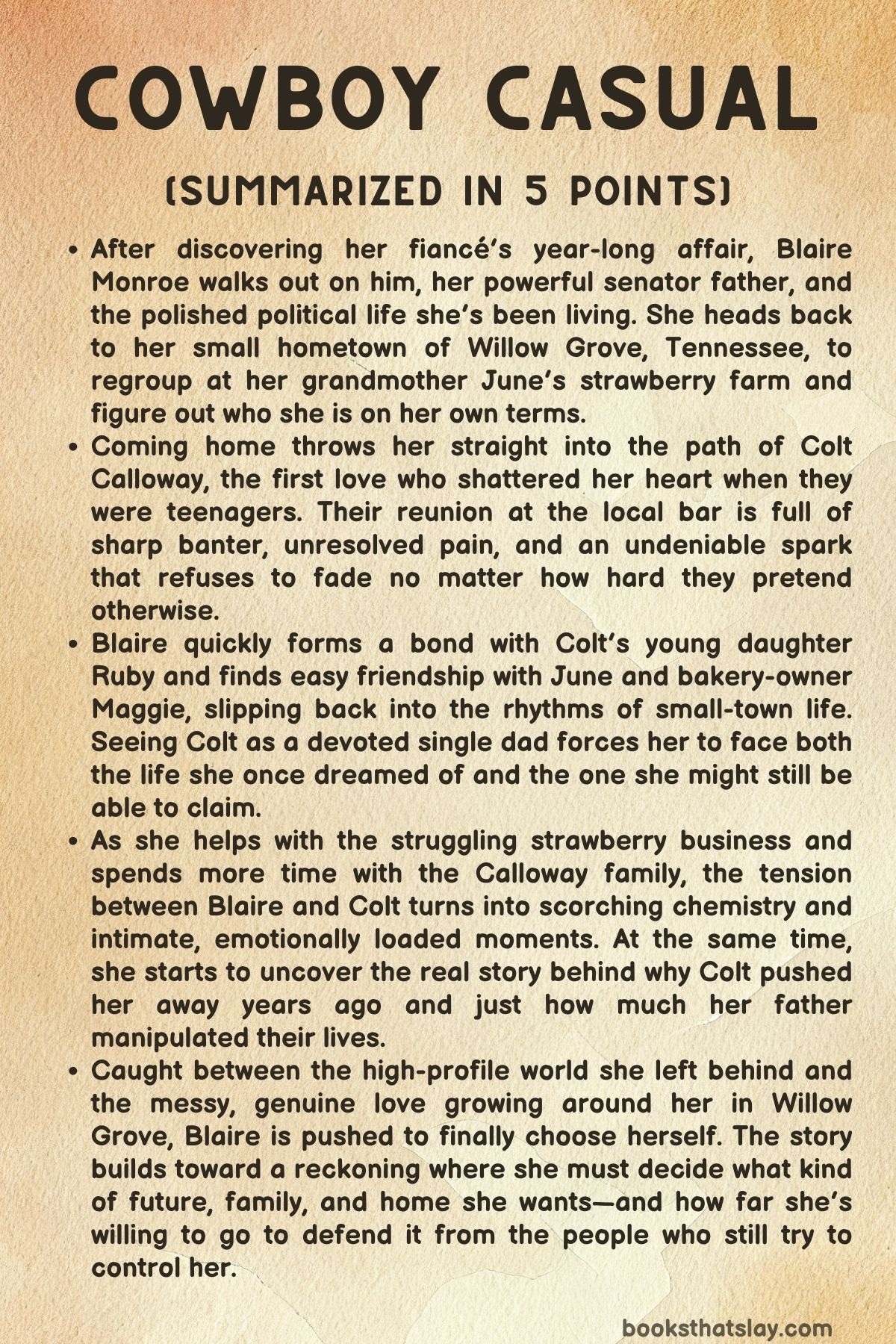
Summary
Blaire Monroe’s carefully arranged life in Raleigh collapses with a single email: anonymous photos of her fiancé, Grant Chandler Jr., in a year-long affair with his assistant. Grant is more concerned with optics and her senator father’s reaction than with what he’s done to her, reminding Blaire that her home, job, and future are tied to his money and her father’s campaign.
When her father calls and dismisses Grant’s cheating as a “mistake,” expecting her to play along, Blaire finally refuses to be managed. She tells him off, leaves her engagement ring on Grant’s office floor, and walks out of the life they planned for her.
With nowhere she wants to be except away from all of it, Blaire calls her grandmother June in Willow Grove, Tennessee. June welcomes her home without question.
A week later, Blaire returns to the strawberry farm where her mother raised her, the land that borders the Calloway Ranch, and the place where she loved Colt Calloway as a teenager before everything fell apart. The small town hasn’t forgotten either of them, and neither has she.
At June’s farmhouse, Blaire is wrapped in warmth, strawberries, and memories. She’s quickly put to work helping with an overwhelming strawberry harvest, grateful for the distraction from calls she ignores from Grant and her father.
She runs into Hunter Calloway, Colt’s younger brother, who hints that she can’t avoid Colt forever in a town this small. Through June she meets Maggie Dawson, the sharp-tongued bakery owner who becomes her fast friend and co-conspirator in bad-men jokes, with some unresolved sparks flying between Maggie and Hunter in the background.
Maggie drags Blaire to The Dusty Spur, the local bar loaded with memories of her and Colt. Colt is there with Hunter and their friend McCoy.
When Blaire walks in, old emotions slam into both of them. Their banter is edged and electric—he calls her Strawberry, pokes at her vanished engagement ring, and bristles when a cocky ranch hand puts his hands on her.
Colt steps in, warning the man off, and Blaire snaps at him for playing the hero. She refuses to run away and instead chooses to sit right at Colt’s table, matching his sarcasm while their unresolved history hums under every word.
That night ends with Colt insisting on driving a very drunk Blaire and Maggie home, because he will not leave her unsafe, no matter how angry or distant he tries to act. Blaire goes to bed in June’s house filled with the ache of old love that never really burned out.
The next morning she wakes to a child’s laughter and discovers Ruby, a little girl with Colt’s eyes and dimples, standing in June’s kitchen in pink sneakers. Ruby proudly announces that Colt Calloway is her dad.
Blaire is stunned. Colt has built a family—with a daughter named Ruby Louise, after his mother—while she was gone.
She feels as if the life she once dreamed of is standing right in front of her, only she isn’t the one who lived it.
Ruby immediately takes to Blaire, and June gently nudges them toward each other, asking Blaire to take Ruby to the lake while Colt works. Blaire agrees, even though the lake is saturated with memories of summers with Colt.
At the water, Blaire and Ruby form an easy bond over swimming and games. When Colt arrives and sees his daughter laughing with Blaire on the dock, he is shaken by how naturally Blaire fits next to Ruby.
Ruby invites Blaire to Sunday dinner with the Calloways, and Colt backs the invitation, saying his parents have wanted to see Blaire since hearing she was back. Blaire can’t refuse Ruby’s hopeful eyes and their pinkie promise.
At Sunday dinner, Blaire steps back into the Calloway farmhouse that once felt like a second home. Colt’s mother, Lou, and his father, Owen, fold her into their family chaos.
Ruby proudly shows off matching bracelets she made for herself and Blaire, decorated with a strawberry and a sunflower—symbols tied tightly to Blaire’s heart. In the kitchen, Lou quietly tells her that Ruby’s mother left when Ruby was three and never really came back.
Colt has been raising Ruby with his family’s help, doing his best with a little girl who has had more abandonment than any child deserves.
Lou also gently confronts Blaire about why she left town years ago. Blaire admits that Colt told her she was holding him back and that she should go with her father for a better future.
Lou’s expression shows that this isn’t the full story. From Colt’s memories, we learn that Blaire’s father cornered him at eighteen, threatening complex legal moves that could cost both June’s farm and the Calloway land if Blaire stayed.
Colt, terrified of losing both their families’ homes, pushed Blaire away with brutal words so she would leave with her father and be safe.
Now, years later, Colt is a single father shouldering the ranch, his dad’s worsening health, and Ruby. When Ruby gets sick at school and calls for him, he can’t get away from work.
June is unreachable, and in desperation, he calls June’s phone again—Blaire answers. She takes charge, picks Ruby up, and brings her home.
She nurses Ruby through her fever with medicine, cartoons, and the lullaby her own mother once sang to her. While Ruby sleeps against her, Blaire finally stands up to her father over the phone, refusing to come back, to marry Grant, or to be used as a political accessory.
As Blaire and Ruby’s bond deepens, Blaire is drawn further into Colt’s everyday life: lake days, family dinners, games on the floor, and late-night talks. The attraction she shares with Colt flares higher until a charged night at the lake leads to an explicit, emotional reconnection.
They cross a line they’d both been circling, and soon after, they stop pretending it’s casual. Colt finally confesses the full truth about her father’s threats and the loan that bound June’s farm to his own family’s land.
Blaire is devastated that he took away her choice, but she understands the fear that drove him then. She tells him that from now on, she decides what she can survive.
Ruby’s quiet love for Blaire anchors that decision. The little girl’s crayon drawing of Colt, Ruby, and Blaire holding hands, and the strawberry necklace Colt saved all these years, show Blaire that she is already part of their world.
She chooses Willow Grove and texts her father that she knows what he did, she is never coming back to Raleigh, and this town is her home.
When her father and Grant arrive to drag her back, Blaire stands on the porch and refuses. They threaten June’s loan and the land, but Colt reveals he has spent a decade paying off June’s debt and placed her property into a trust in Blaire’s name.
Her father no longer has leverage. Mr. Calloway backs Blaire and Colt, explaining the difference between a man who controls and a man who sacrifices.
Blaire warns her father that if he comes after her or her family again, she will expose him. Colt knocks Grant out when he insults Ruby and Blaire, and the men leave defeated.
Inside, Ruby asks if Blaire can be like a mom. Blaire tells her the choice is hers, and Ruby chooses her without hesitation.
Blaire and Colt embrace the messy, joyful reality of being a family. Three months later, Blaire lives with Colt and Ruby on the ranch, running a booming jam business with June—especially her hit flavor, “Saddle Up Strawberry.” At the lake where everything began and began again, Colt surprises her with a romantic evening and promises that this time, he isn’t letting her go.
Blaire knows she is exactly where she wants to be: in Willow Grove, with the man who finally tells her the whole truth and the little girl who calls her home.
Characters
Blaire Monroe
Blaire is the emotional core of Cowboy Casual, and her journey is about reclaiming her voice after a lifetime of letting powerful men define her choices. At the beginning, she is the Senator’s perfectly polished daughter and the carefully curated fiancée of a wealthy heir, living in a world where appearances and loyalty to the campaign matter more than her actual feelings.
When she receives proof of Grant’s long-term cheating, her reaction is telling: instead of collapsing, she feels numb, oddly relieved, and immediately thinks of Colt. That mix of detachment and instinctive longing shows how disconnected she has been from her own life and how deeply her past with Colt still shapes her.
Her decision to walk out of both her father’s office and Grant’s power games in one day is the first visible act of rebellion: she chooses humiliation in public over further silence in private, signaling that she is finally done being handled.
Back in Willow Grove, Blaire’s complexity becomes more apparent. She is both the girl who once skinny-dipped in lakes and rode around with cowboys, and the woman who can strategize in a political office and walk in heels through a hedge-fund lobby.
Her initial defensiveness with Colt and Hunter, her sharp humor with Maggie, and her stubborn choice to stay in the bar instead of fleeing all show that she refuses to run from pain anymore, even when it hurts. Around Ruby, though, Blaire’s tenderness takes over.
She moves from guarded sarcasm to fierce, almost instinctive caretaking: picking Ruby up from school, worrying over Tylenol dosages, holding her through a fever, and letting the little girl crawl into her arms. Ruby becomes a mirror that exposes who Blaire really is when she is not being watched by the press or her father: nurturing, playful, and deeply loyal.
Blaire’s biggest wound is the way choice has been taken from her. As a teenager, Colt shattered her by saying she was holding him back; as an adult, she learns he did it under financial blackmail from her father.
Grant’s affair is just another expression of men assuming her life can be negotiated without her consent. When Colt finally confesses the truth, Blaire loves him but refuses to gloss over the damage; she explicitly insists that no one gets to decide what she can handle ever again.
This insistence on honesty, on being told the whole ugly truth instead of being protected, marks her transition from passive participant to author of her own life. By the end, she is no longer the Senator’s daughter who left town because it was decided for her; she is the woman who tells a powerful politician to get off her porch, threatens to expose his secrets, and claims Willow Grove, Colt, Ruby, and June’s farm as her chosen home.
Her arc is not just romantic; it is about returning to her roots, honoring her mother’s legacy, and finally aligning her external life with the brave, stubborn girl she has always been inside.
Colt Calloway
Colt is a study in quiet sacrifice and frustrated desire, a man who has built his adult life on one catastrophic decision made as a scared eighteen-year-old. When Blaire first comes back, he masks everything behind sarcasm, denial, and control.
He insists they were never really a couple, even though the town carved them into its memory and he once carved their initials into a tree. His behavior at The Dusty Spur reveals his conflict: he claims indifference yet is the first to stride across the bar when a stranger touches her, uses her old nickname Strawberry, and bristles with possessive protectiveness he no longer has any right to claim.
That mixture of denial and instinctive care shows a man who has spent a decade forcing his feelings into a box and fails the second she walks back into the room.
Colt’s responsibilities define him almost as much as his love for Blaire does. He is juggling a failing ranch, a sick father, a lien that entangles June’s land with his own, and single fatherhood to Ruby.
The backstory with Senator Monroe reveals the pressure he was under: he chose to break Blaire’s heart and let her think he did not love her in order to save both families’ land. That decision is both selfless and damaging.
It shows Colt as the kind of man who will emotionally destroy himself if he thinks it protects the people he loves, but it also exposes his tendency to take control without allowing Blaire any say. He carries guilt as quietly as he carries responsibility, working for years to pay off June’s debt, selling part of his own land, and moving June’s property into a trust for Blaire long before he knows if she will ever come home.
That long-term, invisible labor is his way of loving: not grand speeches, but quiet, grinding sacrifice.
With Ruby and Blaire together, Colt’s vulnerability surfaces. He watches Blaire braid Ruby’s hair and fit perfectly into their little life and is torn between longing and terror.
The erotic tension between him and Blaire, from the lake dock to the kitchen counters, is charged not only with desire but with years of unspoken grief. When they finally give in fully, he drops the last of his defensiveness and admits he has never stopped loving her.
The moment he confesses the truth about her father’s threats is the moment he stops trying to be the silent protector and allows himself to be a flawed partner instead. By the end, when he stands on the porch of his home facing Blaire’s father and Grant, Colt is done letting other men dictate Blaire’s fate.
He physically protects her, emotionally stands behind her, and lets Blaire do the talking, embodying the difference between a man who controls and a man who supports. His arc takes him from a boy who thought he had to choose for her to a man who trusts her strength and walks beside her.
Ruby Calloway
Ruby is the emotional bridge between past and present, and she quietly pushes the adults around her toward truth and healing. Introduced as a burst of giggles and pink sneakers in June’s kitchen, she destabilizes Blaire’s assumptions the instant Blaire realizes this bright, dimpled child is Colt’s daughter.
Ruby’s joy and openness force Blaire to confront that Colt has built a family without her, but Ruby herself is anything but a symbol; she quickly becomes a fully present character. She wants to swim at the lake, mash potatoes, make friendship bracelets, and create rituals out of pinkie promises.
Through these small rituals, Ruby anchors Blaire in the everyday, pulling her out of political scandals and adult heartbreak into the simpler world of games and bedtime stories.
Ruby’s backstory adds depth to her sweetness. Her mother left when she was three and almost never calls, which means most of Ruby’s experience of love is filtered through Colt, her grandparents, and now Blaire and June.
Despite that abandonment, Ruby is not written as fragile so much as brave in an unknowing way. She builds a canopy tent as her private “bravery” space, clutches onto symbols like the gold strawberry necklace, and repeatedly asks if important people are going to leave.
That mix of resilience and fear reveals how deeply she understands, even at her age, that adults can vanish. When she fastens the strawberry necklace around Blaire’s neck and tells her she needs it more, Ruby is not just being cute; she is handing Blaire both forgiveness and a mandate to be courageous.
Ruby’s acceptance of Blaire as a mother figure comes before the adults fully articulate their new family. She calls Blaire her friend, asks if Blaire can come to Sunday dinner, demands pinkie promises for future play, and later straightforwardly asks if Blaire can be like a mom.
Her love is uncomplicated where Colt and Blaire’s is tangled, and that clarity pushes them to stop dancing around what they feel. Ruby’s presence also raises the stakes: Colt is terrified of Blaire leaving again because it will not just break him this time; it will break the daughter who has already been abandoned once.
By embracing Blaire so completely, Ruby becomes the heart that everyone is trying to protect, and the child who, in her own way, chooses this new family too.
June
June is Blaire’s safe harbor and the living embodiment of her mother’s side of the family. Her farmhouse and strawberry fields represent the life Blaire might have fully claimed if politics and fear had not pulled her away.
From the moment Blaire calls her in crisis, June responds without hesitation: her home is always open, no questions, no judgments. That unconditional welcome contrasts sharply with Senator Monroe’s conditional love and Grant’s transactional loyalty.
June grounds Blaire back in sensory memory: strawberries in the air, the same kitchen, the same affection. She does not push, but she does nudge, asking Blaire to help with the harvest and encouraging her to spend time with Ruby at the lake even though she knows how painful it may be.
June is not just a warm grandmother; she is also a woman carrying her own burdens. Her farm is financially precarious, linked by a lien to the Calloway ranch, and heavily dependent on a good harvest and the jam business.
Yet she never uses that to guilt Blaire. Instead, she frames work as a way for Blaire to ground herself and regain a sense of purpose after abandoning the high-pressure world of campaigns.
June also quietly collaborates with the Calloway family in protecting Blaire, as seen when she literally lies behind an SUV to delay Senator Monroe and Grant, giving Blaire and Colt time to get ready. That act shows a streak of mischievous courage that mirrors Blaire’s own.
Emotionally, June keeps Blaire connected to her late mother. She sends strawberries to Blaire in college when she is homesick, a gesture that leads Blaire to adopt Colt’s pancake preference as a way to remember both him and home.
In the present, June stands firmly on Blaire’s side, but she also sees Colt’s love and pain clearly and never tries to turn Blaire away from him out of bitterness over the past. Her support is expansive rather than controlling: she wants Blaire to choose her own happiness and provides space, comfort, and a little chaos to make that possible.
Senator Monroe
Senator Monroe embodies the story’s theme of control disguised as care. As a powerful politician and Blaire’s father, he operates from a worldview where image and leverage matter more than individual feelings.
When Grant’s cheating is exposed, he immediately frames it as a “mistake,” a thing “all men” do, and expects Blaire to fall in line to protect the campaign and the alliance with the Chandler family. His first instinct is not to comfort his daughter but to manage the scandal.
That response reveals both his emotional distance as a father and his deeply ingrained entitlement to Blaire’s life as an extension of his political brand.
His earlier confrontation with Colt, when Blaire was still a teenager, exposes how ruthless he can be behind the scenes. He uses loan papers and legal threats to corner an eighteen-year-old boy, tying June’s and the Calloways’ land together and effectively making Blaire’s relationship the hostage in a financial standoff.
Rather than speak honestly to his daughter or negotiate openly, he chooses manipulation that weaponizes both money and land, two things small-town families cannot easily risk. That decision shatters Blaire’s first love and drives her away from the only home where she felt fully herself, all while allowing him to pose as the savior who gave her “opportunities” in Raleigh.
Years later, when he confronts Blaire on Colt’s porch, he is still using the same tactics: ordering her to return, invoking the loan as leverage, belittling her plans to grow the jam business, and insisting that her education and worth are wasted in Willow Grove. His inability to see Blaire as a separate person with her own dreams is his defining flaw.
In that climactic scene, however, the power balance finally shifts. The loan has been quietly paid off; the trust has moved June’s land beyond his reach; and Blaire is no longer the girl desperate for his approval.
When she threatens to expose his secrets, he experiences what it is like to be on the other side of political leverage. He does not repent so much as retreat, but his loss of power in that moment underscores the story’s central victory: Blaire is no longer living under his shadow.
Grant Chandler Jr.
Grant is less a romantic rival and more a symbol of the hollow security Blaire has been living in. As a wealthy hedge-fund heir and the son of a powerful family backing Senator Monroe, he fits perfectly into the glossy life Blaire has been performing.
Yet from the first scene, his true character is exposed through the affair with his assistant, which has been going on for over a year and even overlaps with public campaign events. His reaction when confronted is not genuine remorse but damage control: he warns Blaire not to “make a scene,” worries about her father’s reaction, and treats the whole situation as a solvable optics problem.
That focus on appearances over honesty reveals his deep entitlement and emotional shallowness.
Grant’s grip on Blaire’s life is mostly structural. She lives in his condo, her father’s campaign is funded by his family’s money, and their engagement is an asset for both men.
He weaponizes that dependency when he reminds her that everything around her exists because of him. This possessive, transactional mindset is what Blaire ultimately rejects when she drops the ring on his office floor.
Later, when he arrives at Colt’s house with Senator Monroe, he continues to sneer at Blaire’s choices and at Colt and Ruby, making it clear he sees Blaire as someone who has downgraded her station rather than someone who has reclaimed her happiness.
Grant’s role in the story’s resolution is to be publicly stripped of power. Blaire threatens to expose his affair with a younger assistant, undercutting both his polished image and any moral authority he thinks he has over her.
Colt punching him is less about macho posturing and more about physically embodying the line they are drawing: Grant no longer has access to Blaire’s life or body. Grant leaves based not on understanding but on losing leverage, which reinforces the idea that his connection to Blaire was always about convenience and control, never true partnership.
Hunter Calloway
Hunter is Colt’s younger brother and a blend of teasing mischief and quiet emotional complication. When Blaire returns, Hunter is the first Calloway she encounters, and their easy banter and shared history soften her reentry into Willow Grove.
He sees through her immediately and warns her that she cannot avoid Colt forever in a town this small, playing the role of the blunt, slightly exasperated younger brother. His reaction at the bar, where he is visibly rattled by Blaire’s presence, shows that he, too, has been living in the shadow of what happened ten years ago and how much it changed their family.
Hunter’s own romantic tension with Maggie adds another layer to his character. He once dated Maggie’s sister, Ella, and clearly still has feelings for Maggie, yet he maintains distance out of loyalty and guilt.
His discomfort when he arrives at the lake with a date and sees Maggie reacting speaks to his emotional conflict. He participates in the group’s teasing and crude jokes, but there are moments when he calls Colt out, warning him not to stare Blaire into bolting and later emphasizing how obvious Colt’s feelings are.
That suggests Hunter is more emotionally perceptive than his laidback cowboy persona implies.
In the confrontation with Senator Monroe and Grant, Hunter shows up not just as a brother but as a protector of the family as a whole. He arrives with his father, helps manage Ruby and the logistics, and stands solidly behind Colt and Blaire.
He does not take over the confrontation, but his presence signals the Calloways’ united front. Hunter’s role overall is that of the supportive sibling whose own love story is simmering in the background, someone who both sharpens the tension with his teasing and reinforces the family’s loyalty when it counts.
McCoy
McCoy is the comic relief and the shameless instigator, but his antics help reveal deeper truths about the others. As Colt’s friend and part of the tight-knit group around the lake and bar, he is the one who pushes conversations into uncomfortable honesty through jokes and drinking games.
When he cracks sexual jokes about Colt and Blaire nearly hooking up in his truck, or drags Maggie into a “who would you choose, me or Hunter?” bit, he is deliberately stirring the pot. That can be obnoxious, but it also forces characters like Hunter and Blaire to respond instead of hiding behind their usual defenses.
During the Never Have I Ever game, McCoy is the one who makes Blaire drink for calling off an engagement, publicly pulling her broken relationship with Grant into the open. His “stamina” joke, which prompts Ruby’s innocent question, creates a moment where Blaire cleans up the explanation with a clever, PG answer, showcasing her quick thinking and protective instinct.
McCoy’s crudeness contrasts with her care and highlights how the adults around Ruby have to navigate their messy adult histories in front of a perceptive child.
Despite his brashness, McCoy is loyal. He teases Colt, calls out Hunter, and pushes Maggie, but he is always on the Calloway side of any conflict.
He is comfortable enough in the group to say what everyone is thinking in exaggerated form, and that function gives the story a sense of lived-in camaraderie. McCoy may not have a big emotional arc of his own within the summarized plot, but his presence enriches the social texture of Willow Grove and reminds the reader that this community is full of long-standing friendships and shared mischief.
Maggie Dawson
Maggie is Blaire’s key female ally in Willow Grove and a character who balances humor with her own quiet, unresolved feelings. As the owner of the local bakery, she represents another kind of small-town ambition: building a business, feeding the community, and doing it with personality.
She quickly bonds with Blaire over bad men and sarcasm, giving Blaire a peer who is outside the high-stakes world of politics yet sharp enough to keep up with her wit. Inviting Blaire to The Dusty Spur is more than a friendly offer; it is Maggie nudging Blaire back into spaces she associates with Colt and her younger, freer self.
Maggie’s romantic entanglement with Hunter remains mostly in subtext, but it adds emotional shading. Her reaction when Hunter arrives with a date at the lake—stiff, tense, clearly bothered—shows that the history with Ella, her sister, is still a raw wound.
Maggie insists Hunter is off-limits, but her body language and quick shutdown when Blaire asks if they will ever talk about it point to unresolved longing and resentment. McCoy’s loud joking about whether she would choose him or Hunter drags those feelings closer to the surface and shows how much the group knows and quietly respects her boundaries anyway.
As a friend, Maggie plays an important role in Blaire’s story. She calls Blaire “hopeless” with affection when Blaire tries to deny the obvious chemistry with Colt, and she bluntly observes how Colt looks at Blaire, refusing to let her hide behind the idea of nostalgia.
Maggie also provides balance: she is not a family member or an ex, so she can see certain dynamics more clearly and say what others will not. Her friendship proves that Blaire is not just coming home to Colt and June; she is building a present-life support system of her own choosing.
Lou Calloway
Lou is Colt’s mother and a quietly formidable presence whose warmth hides a spine of steel. She welcomes Blaire back into the Calloway farmhouse without hesitation, folding her into dinner prep and family banter as if no years have passed.
That open-armed acceptance makes Blaire acutely aware of the family she lost when she left and emphasizes how deeply the Calloways once considered her one of their own. Lou’s affection for Blaire is not contingent on the past being neat; she laughs at potato-mashing mishaps, delights in Ruby’s joy, and gently gives Blaire space to feel everything.
Lou’s conversation with Blaire about Ruby’s mother is one of her most important moments. She explains that Ruby’s mom left when Ruby was three and has barely called since, revealing how much emotional and practical work the family has taken on.
Lou’s tone is compassionate rather than bitter, a sign of her focus on what Ruby needs rather than on grievances. She shows Blaire that Colt has been doing his best in difficult circumstances and subtly asks Blaire to see him not only as the boy who hurt her but as the man who stayed and parented alone.
When Lou learns the truth about why Blaire left, she realizes Colt has not told his side honestly either. Her expression lets Blaire know that Colt’s version of events has been incomplete, and that silent reaction speaks volumes about how she values truth and transparency.
Later, Lou orchestrates a “top-secret camping adventure” to give Colt a break from single parenting and give Ruby joy, but also to create space for Colt and Blaire to be alone together. She is not manipulating; she is trusting that, given space, the two will find their way.
Lou’s blend of kindness, practicality, and subtle matchmaking energy makes her one of the emotional anchors of the Calloway family.
Owen Calloway
Owen, Colt’s father, is a quieter presence in the summary, but his role carries weight. His declining health and the financial strain on the ranch are key factors in Colt’s fateful decision to let Blaire go as a teenager.
The lien that ties the Calloway land to June’s farm means that Owen’s stability is directly threatened by Senator Monroe’s legal leverage. Colt’s drive to protect the land is also a drive to protect his father’s legacy, the ranch he is supposed to inherit and keep alive.
Owen thus represents both the burden and the heritage Colt is trying to preserve.
Even with his health issues, Owen maintains humor and warmth. At family dinners, he participates enough to remind everyone of the man he has always been, and his presence creates a sense of continuity in the Calloway home.
In the final confrontation, he arrives with Hunter to stand behind Colt and Blaire, and later offers a crucial perspective on the difference between controlling and sacrificial men. He articulates what Colt did for Blaire, making explicit to her what Colt himself struggles to say.
Owen’s insight helps Blaire reframe the narrative of her past not as a cowardly abandonment but as a flawed act of love. His role may not be as large as others, but his voice carries the moral authority of a father who has watched his son suffer for a decade.
Ella Dawson
Ella, Maggie’s older sister, only appears in the background, but her history with Hunter drives some of the present tension. Hunter dated Ella, which complicates his feelings for Maggie.
Out of loyalty to her sister and perhaps to her own sense of right and wrong, Maggie declares Hunter off-limits, even though her reactions suggest she is far from indifferent. Ella’s absence in the present-day scenes but presence in everyone’s memories creates a triangle that shapes how Maggie and Hunter behave.
The unresolved nature of that situation hints that Ella’s story, or at least the fallout from her relationship with Hunter, is still influencing the group. Ella’s role is a reminder that small-town relationships are rarely cleanly severed; history lingers, and people carry old entanglements into new crushes.
Alicia
Alicia appears as Hunter’s date at the lake, and her function is to stir up latent emotions rather than to act as a fully developed character. Her presence makes Maggie visibly uncomfortable and forces Hunter to perform indifference in front of the group.
During the Never Have I Ever game, Alicia’s admission of having been cheated on adds another thread to the story’s recurring theme of betrayal in relationships. She is an outsider to the core group, which highlights how tightly knit the others are and how difficult it is for anyone new to step into a space so full of shared history.
Alicia’s brief part underscores the idea that, in Willow Grove, the past is always sitting at the table, even when new people show up.
Themes
Reclaiming Agency from Controlling Men
Blaire’s entire arc in Cowboy Casual moves from being managed to being self-directed, and that shift is framed again and again through the men who try to decide her life for her. At the start, her fiancé and her father treat her less like a person and more like a useful accessory.
Grant is more concerned about optics than her heartbreak, warning her not to “make a scene,” reminding her that she lives in his condo and that his family funds her father’s campaign. Her father reduces a year-long affair to a “mistake” all men make and expects Blaire to help preserve his political image.
In both relationships, love is conditional and transactional: Blaire is valuable as long as she plays her assigned role. Her first act of agency is deceptively simple but emotionally huge: saying no.
She walks out of Grant’s office, drops the ring on the floor, tells her father to go to hell, and physically leaves the world that defined her. Returning to Willow Grove, she starts making choices based on what she wants rather than what looks good—helping June on the strawberry farm, caring for Ruby, rebuilding a career around the jam business instead of polished politics.
Even with Colt, who once hurt her for what he thought was her own good, she refuses to accept a future where men decide what she can or cannot bear. When she learns the truth about her father’s coercion, she names the harm, demands full honesty, and insists on being an equal partner, not a protected princess.
By the time she texts her father that she is not coming back and publicly takes her stand on the porch, her agency is no longer reactive but grounded; she is not just rejecting control, she is actively choosing her home, her work, and her family. The story frames that hard-won autonomy as the core of her happiness, more vital than any ring, title, or political future.
Second Chances at Love and the Weight of the Past
The romance at the heart of Cowboy Casual is not about strangers meeting fresh; it is about two people confronting a love that never really died. Blaire and Colt share a history that is both golden and painful—carved initials in trees, shared childhood, and a brutal breakup framed as rejection.
When they meet again in The Dusty Spur, their interaction is immediately charged because the past sits in every look and insult. Colt claiming they were “not a couple” hits so hard precisely because Blaire remembers how total their bond once felt.
Their second chance is not granted automatically by fate; it is earned through uncomfortable truths, awkward proximity, and constant reminders of what they lost. The story uses small domestic moments as much as big dramatic ones to show that this is more than nostalgia.
Colt watching Blaire braid Ruby’s hair, Blaire unconsciously adopting Colt’s pancake preferences, the way they slip back into the rhythm of teasing and protecting each other at the lake and in the kitchen—all of it shows that their connection survived years and distance, even when they tried to outgrow it. But the past is never romanticized completely.
Blaire’s wounds from Colt’s earlier rejection are real; she has to face that he took away her choice “for her own good.” Colt has to own not only his sacrifice but the harm his lies caused. Their deeply physical encounters—the dock, the kitchen, Colt’s bedroom—are intense precisely because emotional truth is tangled up in desire.
Each step toward intimacy risks reopening old scars. Their second chance only becomes viable when they stop hiding behind “casual” and name what they want: a real, public, messy life together that includes Ruby and the town.
The theme underscores that true second chances demand accountability, vulnerability, and a willingness to rewrite old narratives rather than pretend they never existed.
Home, Belonging, and the Meaning of Roots
Willow Grove functions almost like another character in Cowboy Casual, testing and ultimately anchoring Blaire’s sense of self. When she returns, she arrives with two suitcases and a lifetime of feeling like she doesn’t fully belong anywhere: not in her father’s polished political world, where she is useful but disposable, and not entirely in the small town she left, where her departure looked like a rejection.
The town holds memories of first love and gutting heartbreak, but it also holds June’s farmhouse that still smells like strawberries, the Calloway family home that once treated her like a daughter, and the lake that witnessed so many turning points in her relationship with Colt. At first, Blaire treats Willow Grove as a safe stopover, a place to heal before deciding what’s next.
Work in the fields gives her a sense of grounded competence that her press-assistant role never did; her efforts directly affect June’s survival and the success of the jam business. As she reconnects with Maggie, Lou, Owen, Hunter, and especially Ruby, the town becomes a network of relationships rather than a nostalgic backdrop.
Belonging emerges through shared labor, shared meals, and shared crises—from Sunday dinners to caring for Ruby when she is sick. Even the bar, once a symbol of her wild younger self, turns into a place where she asserts her present identity, choosing to stay instead of fleeing when memories of Colt overwhelm her.
The contrast with Raleigh is sharp. Her life with her father is built on image and performance, while Willow Grove centers on authenticity and shared history.
When Blaire ultimately tells her father that Willow Grove is her home and legally secures June’s land in her own name, home stops being a sentimental idea and becomes a concrete commitment. The book suggests that belonging is less about geography and more about the people and values you are willing to fight for, and Blaire’s choice cements that her roots are not a limitation but a source of strength.
Parenthood, Abandonment, and Found Family
Parenthood in Cowboy Casual is never simple or idealized; it is shown as a mix of sacrifice, failure, and fierce devotion. Ruby sits at the center of this theme.
Her mother walked away when Ruby was very young, leaving Colt and the Calloway family to patch together a stable life around a gaping absence. Lou and Owen step in as grandparents who love without reservation; June becomes an extra grandmother figure, opening her home and heart.
Colt’s version of fatherhood is rough around the edges but deeply committed. He juggles ranch work, his father’s illness, and a scared, sensitive child who calls him when she has a fever and wants only her dad.
Yet the book does not pretend he can do it alone; he leans on his family, sometimes reluctantly, and gradually leans on Blaire as she forges her own bond with Ruby. Blaire’s position is layered.
She still carries the pain of her mother’s death and the emotional neglect of a father who sees her as an asset more than a daughter. Her initial jealousy when she discovers Colt has a child is tied to the life she once imagined with him, but that bitterness transforms as she gets to know Ruby’s vulnerability.
Caring for Ruby when she is sick, teaching her to swim, cooking with her, and playing games on the floor become small acts of healing for both of them. Ruby’s canopy tent, her “brave place,” and the strawberry necklace Colt passed on become symbols of how love and courage can be passed across generations.
When Ruby asks if Blaire can be like a mom and is told the choice is hers, the story reframes motherhood as something built by day-to-day presence and trust rather than biology or legal titles. Against this, the Senator’s cold manipulation of Blaire underscores what parenthood should not be.
Found family—June, the Calloways, Maggie, and eventually Blaire herself—shows that real parents are the ones who stay, protect, and choose each other again and again.
Power, Money, and Moral Compromise
Underneath the romance and small-town charm, Cowboy Casual is sharply aware of how money and power shape people’s choices. Senator Monroe leverages loans, legal threats, and political influence to control Blaire’s life and the future of both the Monroe and Calloway lands.
His willingness to tie June’s property and the Calloway ranch into predatory agreements shows a worldview where land and people are just pieces on a board. Grant, with his hedge-fund wealth and family money, mirrors this attitude.
He views Blaire’s engagement as part of a mutually beneficial arrangement between elite families, something to be managed for appearances even while he cheats with his assistant. When the affair is exposed, his reaction is not remorse but damage control.
The brutal part is that for years, Blaire accepts this system, internalizing the idea that her stability depends on these men and their connections. Colt faces another form of compromise as a young man.
Cornered with loan papers and the threat of losing both his family’s ranch and June’s land, he chooses what feels like the only option: breaking Blaire’s heart to free her and protect their families. The moral cost is immense; he carries that guilt for a decade.
His later decision to work tirelessly, sell part of his land, and quietly pay off June’s debts represents a very different use of power—sacrifice instead of control. The climactic confrontation on the porch is not just emotional; it is economic and legal.
When Colt reveals that June’s land is now in a trust in Blaire’s name, Senator Monroe’s leverage vanishes. Blaire’s threat to expose his secrets flips the script as well, showing she is no longer a pawn in his political ambitions.
The theme underscores how financial systems can trap people but also how integrity and long-term sacrifice can loosen those chains, transforming power from something used to dominate into something used to protect.
Honesty, Secrets, and the Work of Trust
Trust in Cowboy Casual is repeatedly broken and rebuilt, and the story treats honesty not as a simple virtue but as a difficult, ongoing choice. At the beginning, Blaire’s life implodes because of hidden truths: Grant’s year-long affair, aided by secrecy and public facades, shatters whatever illusion she had of their relationship.
Her father’s refusal to acknowledge the seriousness of that betrayal deepens the lie, insisting she pretend everything is fine for the sake of his image. On a deeper level, the biggest wound in Blaire’s past comes from Colt’s lies.
As a teenager, he told her she was holding him back and that he did not want a future with her, when in reality he was sacrificing his own heart under her father’s financial blackmail. The book makes clear that his motives were protective, but it does not excuse the damage; Blaire’s sense of unworthiness and displacement comes partly from believing she was not chosen.
When Colt finally confesses the truth, it is in the most vulnerable context possible: after they have reconnected physically and emotionally, when a new betrayal would hurt Ruby as well. Blaire’s response is complex—hurt, anger, understanding, and a firm boundary.
She refuses to keep living in stories written for her by men, even well-intentioned ones, and demands complete honesty going forward. Their renewed relationship only becomes stable when they start sharing the hard things: Colt admitting his fear of losing her and Ruby, Blaire confessing she never truly loved Grant and still thought of Colt, both of them acknowledging their regrets.
Transparency extends beyond romance. Lou’s revelation about Ruby’s mother, June’s open support, and even McCoy’s blunt jokes during drinking games pull hidden histories into the light.
The contrast with the Senator, who hides behind spin and threats, sharpens the book’s stance that love based on concealment cannot last. Trust here is not a one-time choice; it is a daily practice of telling the truth even when it risks conflict.
Female Friendship and Solidarity
Alongside the central romance, Cowboy Casual builds a quiet but powerful network of women around Blaire, emphasizing that her growth does not happen in isolation. June is her first anchor, offering unconditional welcome and a physical space where Blaire can begin again.
The farmhouse full of strawberries, the pet name “little strawberry,” and the shared work on the farm are all acts of steady care that contrast starkly with her father’s coldness. Lou extends that warmth, treating Blaire as family the moment she returns, sharing hard truths about Ruby’s absent mother, and gently challenging Blaire’s understanding of the past.
Neither woman pushes her with harsh lectures; instead, they offer perspective, food, and a place at the table, trusting her to make her own choices. Maggie, meanwhile, represents a more peer-level solidarity.
From bad-men jokes in the bar to tailgate margaritas and blunt commentary about Colt’s obvious desire, Maggie gives Blaire someone to laugh with and confide in. She refuses to let Blaire minimize what she feels, calling her out when she hides behind the excuse of “old history.” At the same time, Maggie’s own unresolved tension with Hunter shows that she is not a flawless advisor but another woman stumbling through complicated feelings.
Their friendship is built on honesty and shared vulnerability, not perfection. Ruby adds a different dimension; though she is a child, her instinctive trust and affection give Blaire a new role to grow into.
By the time Ruby is asking if Blaire can be like a mom, it is clear that Blaire’s sense of identity is supported not just by a man’s love but by a lattice of female relationships across generations. Together, these women model a version of solidarity that includes emotional support, practical help, and fierce protection.
They hold Blaire accountable, catch her when she falls, and stand beside her when she finally tells her father to leave for good, affirming that her new life is not built only on romance, but on a community of women who choose each other.