Dating After The End Of The World Summary, Characters and Themes
Dating After The End Of The World by Jeneva Rose is a zombie-apocalypse rom-com that asks what happens when your dad really is right about the end of days—and your childhood bully might be the person you’re stuck surviving with. Equal parts chaos, dark humor, and slow-burn romance, it follows Casey Pearson, a former “crazy prepper kid” turned doctor, as the world collapses into biters, raiders, and ruined cities.
Between trauma, betrayal, and a heavily armed family compound in Wisconsin, Casey has to figure out who she is now, who she can trust, and whether love still has a place in a ruined world.
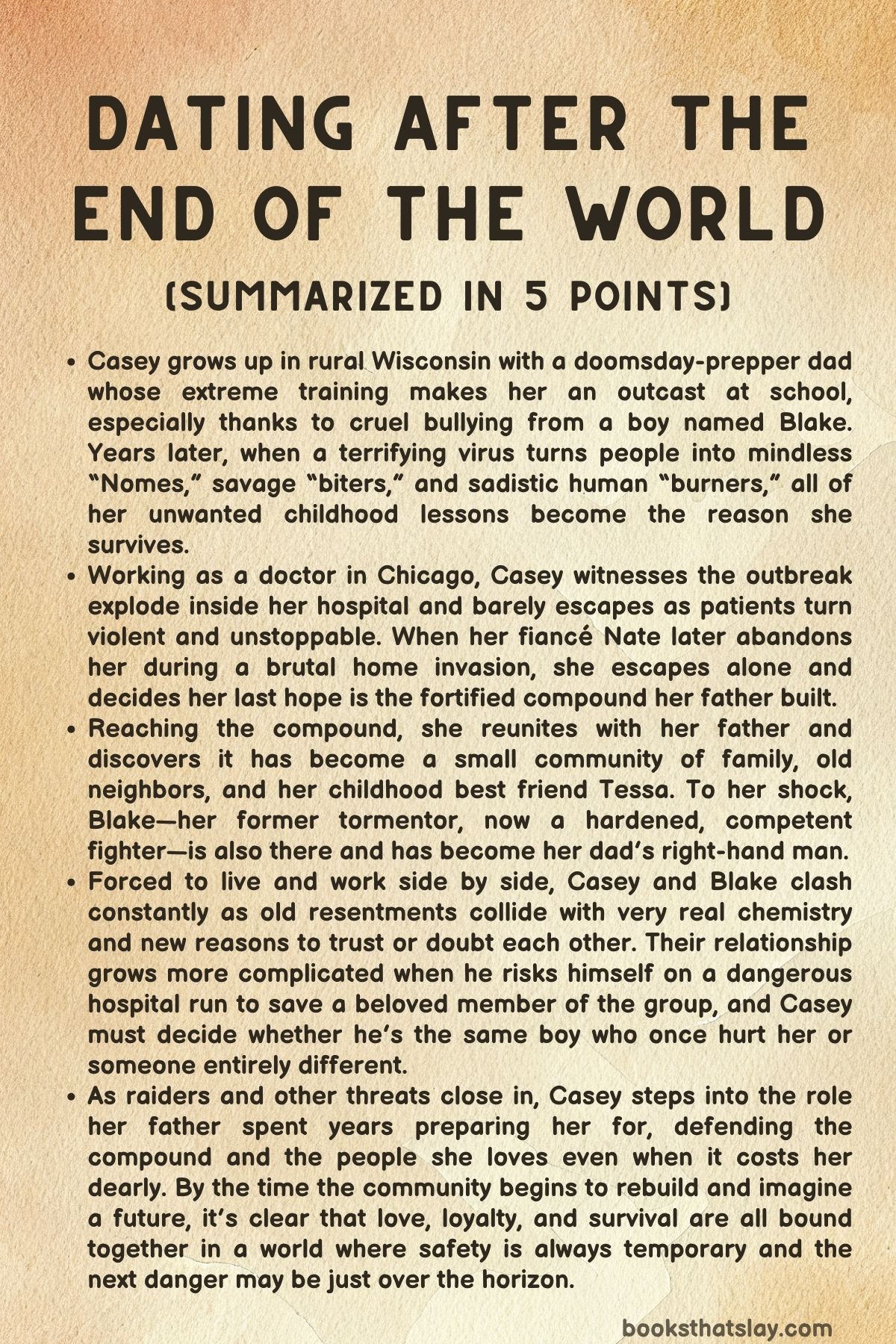
Summary
Casey Pearson grows up in rural Wisconsin with her doomsday-obsessed father, Dale, who spends her childhood drilling her in combat, gardening, and bunkers instead of sleepovers and malls. At fourteen, Casey is exhausted and furious.
Her classmates mock her mercilessly after she writes a school report about her prepper chores, dubbing her “Crazy Pearson” and stuffing canned food into her locker. The worst of them is Blake Morrison, a smug boy who turns her life into a running joke.
When she breaks down and tells her dad she hates all of it, Dale reassures her that everything he’s doing is to keep her safe, even if she can’t see it yet.
Sixteen years later, Casey is a doctor in Chicago, engaged to fellow physician Nate Warner and doing her best to live a normal life far from the compound. While on shift, she treats patients with a strange flu-like illness: nausea, headaches, confusion, and terrifying temperature swings.
One woman, Ms. Klein, wakes up with no memory of who she is. A male patient suddenly attacks and bites Casey, and chaos erupts as others turn feral, tearing into staff and patients.
Security bullets barely slow them down. Casey and Nate fight their way out of the hospital as the world outside begins to collapse.
Six weeks on, Chicago is a dead city. Power is gone, streets are dangerous, and Casey and Nate are holed up in his apartment, living off scavenged food.
Casey survived her bite, growing deathly ill and then recovering, leaving a scar and the realization that the infection affects people in different ways. Some become confused wanderers she calls Nomes.
Some become ravenous, violent biters. Others stay human but turn into burners, brutal raiders who prey on everyone else.
As supplies dwindle and burners move into the neighborhood, Nate pushes for them to head to Dale’s fortified property. Casey has avoided her father for years and bristles at the idea, but a burner attack forces a decision.
A group of men tricks Nate at the door; during the fight, Nate panics and runs, abandoning Casey. She relies on the skills Dale forced on her—eye gouges, knives, boiling water—to survive the assault and escape.
At the rendezvous spot, she finds Nate gone with his Porsche. Hurt but alive, she reaches the old truck her dad once gave her and fights through a pack of biters to get it started.
Leaving the burning, broken city behind, she drives toward the one place she swore she’d never return.
Arriving at the compound, she slips through the familiar defenses and is nearly shot by her cousin JJ, who is stunned to see her alive. The property has become a haven for family and rescued strangers.
Dale, older but very much himself, breaks down when he sees her. Inside, Casey learns that the house now shelters cousins, an aunt and uncle, neighbors, the Carter family, and—unbelievably—Blake Morrison, the boy who bullied her relentlessly in school and now shares her bedroom as a bunkmate.
Blake has grown into a competent, infuriatingly attractive ex–Navy SEAL who works closely with Dale. He teases her with old nicknames, and their arguments crackle with resentment and unwanted attraction.
Casey reconnects with her childhood friend Tessa, who has her own grim survival stories, and meets the rest of the compound residents. When Casey insists on joining Blake and JJ on supply runs, her father refuses.
Blake challenges her to prove herself in hand-to-hand combat and easily beats her, though she lands a few solid moves. Dale promises to train her again and proudly shows her how their old preparations—fences, livestock, water systems, solar power—are the backbone of this new community.
Casey grudgingly acknowledges that Dale’s paranoia saved lives, even as she still blames him for a stolen childhood. Their old wounds spill out during training.
He sees a daughter who walked away; she sees a father who never believed in a future that wasn’t catastrophic. Meanwhile, Blake proves himself as a protector and leader on runs and patrols, even as Casey clings to memories of the cruel way he once humiliated her after a high school party.
On night watch, the simmering tension between them breaks. Blake kisses her; she kisses him back before memories of the past snap her out of it.
She shoves him away, convinced he’s just playing with her again. He tries to bridge the gap, sharing that he lost his mother young and understands complicated grief, but she refuses to trust him.
When Elaine, the compound’s maternal anchor, collapses from a hypoglycemic episode, Casey discovers Elaine has been rationing insulin and has almost none left. The only hope is a hospital raid, which Dale considers a suicide mission.
Casey argues they have to try; Blake backs her up and insists she’s necessary because she understands hospitals. A small team sets out.
At the hospital, they carefully clear biters from a rear entrance and move through decayed halls. Casey uses a dead doctor’s ID to access the pharmacy and discovers a huge stock of insulin and medications, still cold in powered fridges.
While she loads up, Blake freezes when confronted by a staggering biter. He is bitten before Casey can kill it.
She drags him through a harrowing escape down an elevator shaft while biters tumble after them, then out to the truck where JJ and Greg are waiting with food and gear.
On the drive back, Blake repeatedly tries to throw himself from the truck rather than risk turning on his friends. Casey refuses to let him go, physically holding him down and promising to stay with him no matter what.
When they return, they find that burners have already tested the compound’s defenses and been killed, a chilling sign that human predators are moving closer. Blake reveals his bite to Dale but lies to protect Casey, claiming he was bitten while saving her.
He volunteers to isolate himself in a holding cell, pointing to Casey’s survival as proof that turning is not guaranteed.
Later, time jumps forward to the fallout of an unseen emotional turning point: Casey has chosen Nate over Blake, despite everything. She wakes to find Blake’s packed rucksack and realizes he has decided to leave the compound.
Nate arrives, asking her to walk with him to retrieve his hidden car. As they leave, Casey sees Blake and Dale embrace goodbye.
On the road, Nate reveals the truth: he cut a deal with burners, trading the location and access codes of the compound for his own safety and a promise they would spare Casey. Horrified, she fights him for control of the car, which crashes.
Injured but alive, she overhears burners on his radio confirming they are already attacking her home. Nate mocks her family and admits he would abandon her again.
Casey injures him with a throwing star, leaves him bleeding by the wreck, and forces herself to run back.
The compound is a war zone, with trucks on the lawn, fires burning, and bodies scattered. Instead of charging in across open ground, Casey slips through the woods and runs into Tessa and Molly, who escaped the initial assault.
Using one of Dale’s hidden weapons caches in the forest, they arm themselves and begin methodically clearing out the raiders. Casey dispatches guards with throwing stars and knives; Tessa and Molly handle others at close range, Molly making her first kill to save Greg.
A sniper in the tower threatens to pin them down, so Casey fakes out his aim with a corpse and sprints to retake the tower under covering fire. There she frees a bound Greg and leaves him and Molly to hold the high ground and protect the yard.
Inside the main house she and Tessa find Elaine and Aunt Julie tied up and Meredith badly injured but alive. They free them and head to the armory, where Casey kills more burners and discovers Blake locked in a cell.
He explains that he fought back against a guard and overheard that Dale, JJ, and Uncle Jimmy have been forced to dig their own graves at the burn pit.
Armed from the untouched armory, Casey and Blake slip through the trees to the pit, where they find the three men digging under the watch of about a dozen burners led by a horribly scarred man—the same leader Casey disfigured months earlier in Chicago. With odds heavily against them, Blake proposes a two-pronged attack.
As the leader prepares to burn the prisoners alive, Casey opens fire, scattering the raiders. Blake hunts them through the trees, silently killing the ones who chase her.
Cornered, the leader drags Dale and the others to their graves and uses them as leverage, demanding surrender. Blake appears to comply and is ordered to burn the prisoners himself in exchange for Casey’s life.
Instead, he uses the moment to strike, turning the gas can into a weapon and attacking the guards, while Casey’s throwing stars take down the man threatening Dale and wound the leader. The leader recovers and beats Dale, then aims his gun at Casey.
Dale throws himself in front of the shot, taking the bullet meant for his daughter.
As Dale bleeds out, Blake and JJ kill the leader and burn him in the grave he dug for others. Casey and Blake try desperately to save Dale, but he knows he is dying.
He apologizes for the harshness of her upbringing and explains that his mission was never just about the end of the world, but about teaching her that she could survive anything—that her life didn’t have to end when everything else did. He tells her her mother would be proud and makes Blake promise to look after her.
Then he dies in Casey’s arms.
Casey buries her father beneath the apple tree where they once shared quiet lunches and ice cream. She insists on digging the hole alone, wrapping him in the blanket that belonged to her mother and filling the grave herself.
When she is finished, Blake joins her with two Drumstick ice cream cones Dale had saved. They sit together at the grave, sharing the treat in his honor.
Casey realizes that Dale didn’t just prepare for the end; he prepared her to build something new.
Six months later, the compound has grown into a small, functioning community. More survivors have joined, including tough, capable fighters and older wanderers who bring music and stories.
Food is more secure, the defenses are stronger, and the ruined world has pockets of joy. The story closes on Molly and Greg’s wedding, a makeshift celebration with scavenged dresses, mismatched chairs, and a harmonica processional.
Casey stands with Blake, Tessa, and the community they have built, feeling the fragile hope of a new chapter—only for a white semi-truck to appear on the distant highway. Armed men climb onto its trailer and aim at the gathered guests.
As Aunt Julie reaches the traditional line inviting objections, Casey understands the danger and screams for everyone to run, just as bullets tear into the ceremony and the story ends on a violent cliffhanger.
Characters
Casey Pearson
In Dating After The End Of The World, Casey is the emotional and moral center of the story, and her arc tracks the journey from humiliated, angry teenager to hardened but hopeful leader. As a fourteen year old in rural Wisconsin, she is trapped between love for her father and resentment of the life he has forced on her.
Digging post holes, building fences, and training for disaster makes her a target at school, where she is mocked as Crazy Pearson and Doomsday. That cruelty imprints in her a deep shame about her upbringing and a hunger to be normal.
Her early breakdown in the yard, when she tells Dale she hates the life he has built, shows how much she craves choice and autonomy rather than constant survival mode.
As an adult Dr. Pearson, she initially embodies everything the teenage Casey thought she wanted: a prestigious career, city life, a respectable fiancé, and distance from her prepper past. Yet the moment the mysterious virus hits her hospital, it becomes clear that the skills she tried to run from are the ones that will keep her alive.
Her quick clinical thinking, her pattern recognition about Nomes and biters, and her ability to adapt to escalating horror all come from that childhood training. Surviving a bite and recovering instead of turning marks her as different, but she responds less with self pity and more with grim pragmatism, categorizing the infected and the human predators with the same cool clarity.
Emotionally, Casey is defined by abandonment, betrayal, and the fear that trusting people will always be a mistake. Childhood bullying, Blake’s high school cruelty, and Nate’s repeated desertion all reinforce the belief that relying on others is dangerous.
Her reaction to Molly and Greg’s relationship, where she brutally blurts out the truth instead of cushioning the blow, shows how she uses blunt honesty and harshness as armor. Yet underneath, she is fiercely loyal and protective: she risks her life to get insulin for Elaine, refuses to let Blake throw himself from the truck after he is bitten, and races back to the compound on foot after the car crash because she cannot bear the idea of her family being attacked without her.
By the time she leads the counterassault on the burners, she is acting as a tactician and field commander, not just a survivor.
Her relationship with Dale is the core emotional conflict she must resolve. For much of the story she blames him for stealing her childhood, for making her the freak at school, and for denying her the illusion of a normal future.
When she erupts at him in the armory, accusing him of never giving her anything to look forward to, it exposes years of suppressed hurt. Dale’s death transforms that anger into grief and understanding.
His sacrifice, when he throws himself in front of the bullet, and his final explanation that he wanted her to know that the end of the world did not mean the end of her world, allow her to reinterpret her upbringing as a twisted form of love rather than cruelty. Digging his grave alone and finishing it without help is both a farewell and an acceptance of the strength he built in her.
Romantically, Casey is caught between the comfortable promise of Nate and the complicated pull of Blake. Nate represents the old world: status, stability, and the kind of partner who looks perfect on paper but collapses when true danger arrives.
Blake represents everything messy: past trauma, unresolved anger, physical chemistry, and the risk of genuine intimacy. Her initial refusal to accept that he might have changed is part self protection and part refusal to admit she misjudged him.
The turning point comes not only from his heroism but from his willingness to be vulnerable, to let her see his fear and his shame. By the end, when she shares ice cream by her father’s grave with Blake and then a kiss, Casey is not choosing between two men so much as choosing the version of herself who can build something real in this harsh new world.
Dale Pearson
Dale is introduced as the archetypal doomsday prepper father, but the story complicates that stereotype by showing both the damage and the salvation his choices bring. To young Casey, he is a tyrant who trades her weekends and childhood for barbed wire and combat drills.
He is so focused on preparedness that he forgets to consider how lonely and humiliated she feels at school, and his insistence that everything he does is to keep her safe sounds hollow to a teenager who just wants a sleepover and a mall trip. In those early scenes, his attempts at comfort, like joking about scaring Blake and promising ice cream, reveal a man who genuinely loves his daughter but does not know how to balance that love with his fear of global collapse.
Once the world actually ends, Dale is vindicated in practical terms. The compound he built becomes a fortress and a sanctuary for family, neighbors, and strangers.
The fences, water systems, solar panels, livestock, armory, and decoy house are physical proof that his paranoia saved lives. However, he does not gloat.
Instead, his first reaction when Casey returns is overwhelming relief and guilt that he could not find her. He fusses over her like she is still a child, and that overprotectiveness clashes with her hard earned independence.
When he refuses to let her go on runs until she passes training, he is caught between seeing her as the little girl he raised and the capable warrior she has become.
Dale’s leadership is a mix of rigid rules and quiet generosity. He rescues the Carter family when their car breaks down, offers refuge to neighbors, and builds a communal structure where everyone has roles and protection.
The fact that he hired Blake before the outbreak and grew close to him suggests he was trying to expand his circle and share responsibility, perhaps anticipating that he could not carry everything alone forever. That close bond with Blake is a source of jealousy for Casey and highlights Dale’s blind spot: he does not always see how his decisions might reopen her old wounds.
Even so, he tries to bridge the gap, encourages her to channel anger into training, and nudges her to reconsider her hatred of Blake, clearly hoping they can reconcile.
His death is thematically loaded. Faced with the burner leader’s sadistic execution plan, Dale remains defiant even when forced to dig his own grave.
When the leader turns his gun on Casey, Dale does what he has always been preparing for: he interposes his body between danger and his daughter. The literal act of stepping in front of the bullet is the ultimate expression of his philosophy.
All the fences, drills, and bunkers were meant to buy the moment where she survives even if he does not. His final words recast his prepping not as obsession with endings but as a stubborn faith that she would outlive the apocalypse.
By asking Blake to promise to take care of her, he also symbolically passes the guardianship he has clung to onto someone she chose to let in, acknowledging that it is time for her to have a different kind of partner and protector.
Blake Morrison
Blake is one of the most complex characters in the story, evolving from a textbook high school bully into a deeply flawed but ultimately heroic partner. In their school years, he torments Casey mercilessly: filling her locker with canned goods, calling her Head Case and Doomsday, and reinforcing her social exile.
The gum in her hair and the humiliating party scene, where he publicly ridicules her after months of secret closeness, suggest that his cruelty is not simple malice but self hatred and fear turned outward. He seems genuinely drawn to her before sabotaging that connection as soon as peer pressure or his own insecurity kicks in.
By the time the world ends, Blake has become a Navy SEAL, a career that both fits his talent for combat and hints at attempts to prove himself through service and sacrifice. At the compound he is a crucial protector: lethal with blades, physically fearless, and deeply involved in fortifying the property.
His arrogance, loudness, and habit of barking orders, especially at Greg, are partly a professional mentality and partly a defense mechanism. He expects to be resented, so he leans into being the abrasive tough guy before anyone can reject him.
His cocky teasing of Casey when she first returns, calling her Doomsday and mocking her smell, is both a return to their old dynamic and a clumsy attempt to cover surprise, attraction, and guilt.
Under that bluster, Blake craves belonging and struggles with trauma. His admission that his mother died of cancer before they moved to Wisconsin cracks his armor, revealing a boy who lost the primary source of gentleness in his life.
The hospital run exposes another fracture: when he freezes at the sight of an emaciated biter and is bitten, it reads like a post traumatic stress reaction, where his body refuses to move in a moment of horror. His response afterwards is not denial but self sacrifice.
He tries repeatedly to throw himself out of the truck to protect the others, lies to Dale that he was bitten while pushing Casey out of danger to preserve her standing, and voluntarily isolates himself in the holding cells. These choices show a man who believes his life is expendable and that redemption must be earned through suffering.
Blake’s relationship with Casey oscillates between antagonism, banter, and genuine tenderness. Their sparring match, where he easily overpowers her but also recognizes her skill, is loaded with sexual tension; he is physically attracted to her but determined not to underestimate her as a fighter.
The night watch scene, where he tackles her under the guise of testing her and then kisses her, exposes his inability to communicate cleanly. When she slaps him and accuses him of repeating his old pattern, he is forced to confront the fact that apologies and a few kind gestures cannot erase years of pain.
Instead of defending himself endlessly, he shifts to showing his remorse through action: backing her up on the insulin run, following her plan in the hospital, and later risking his life in the rescue at the burn pit.
In the final confrontation with the burners, Blake’s tactical mind and fierce protectiveness are on full display. His idea to attack the raiders velociraptor style, flanking them while Casey draws fire, is both effective and a nod to his military training.
When the leader offers him a horrific bargain, he pretends to comply, only to turn the gasoline and a hidden knife into a coordinated takedown. His willingness to mutilate the man who maimed him earlier and then burn him alive speaks to how far he is willing to go to keep Casey and her family safe, even if it means sinking to the level of brutality he despises.
By the time he kneels beside Dale as he dies, accepting the charge to look after Casey, Blake has moved from being the source of her teenage humiliation to the partner willing to bear the weight of her grief and future. The final scene at the grave, where he brings ice cream and sits quietly with her, shows a softer, patient side that suggests he now understands that love sometimes means simply staying when someone is broken.
Nate Warner
Nate begins as the picture of a high functioning, successful partner in the pre apocalypse world. As a fellow doctor and Casey’s fiancé, he is competent, respected, and seemingly devoted.
In the chaotic first hours of the outbreak, he performs well, reorganizing the overwhelmed emergency room and working alongside Casey. This initial competence makes his later cowardice feel even more jarring.
The first big crack appears when, during the burner attack on his Chicago apartment, he panics and runs, taking the Porsche and leaving Casey to die. That desertion is not a split second mistake but a fundamental revelation: when pushed to choose between self preservation and solidarity, he chooses himself without hesitation.
His return to the narrative at the compound does not come with remorse or growth. Instead, he has negotiated a deal with the burners to save his own skin by sacrificing Casey’s family and community.
He wheels her out of the safety of the compound under the pretense of retrieving his hidden car, then coolly reveals they are leaving and that he has already arranged the attack. His rationalizations, that the burners would have killed them all anyway and that this is the only way to survive, expose a worldview where loyalty, love, and morality mean nothing compared to staying alive and maintaining control.
When the car crashes and he wakes injured, his instinct is still to sneer at her family and double down on his choices.
Nate’s function in the story is to embody the values of the old world that no longer fit. He is status driven, attached to his Porsche and his professional identity, and believes that deals with powerful men are more valuable than integrity.
In contrast, Casey’s community is built on mutual risk, shared hardship, and the willingness to fight for one another. Her decision to throw a star into his shoulder, physically punish his betrayal, and leave him behind marks a crucial emotional break.
She is not just ending an engagement; she is rejecting the version of herself who would tolerate being minimized and abandoned in exchange for the illusion of stability. Nate’s betrayal also sharpens the contrast with Blake.
Whatever Blake’s past sins, he chooses to stand and bleed beside her, while Nate repeatedly chooses to run and trade others’ lives for his own.
Tessa
Tessa is Casey’s enduring link to the world of friendship and normalcy, but she is far from a comic sidekick. Introduced as the one person at school who was kind to Casey, she represents the rare presence who accepted Casey despite the prepper stigma.
Their reunion at the compound is full of dark humor, a coping mechanism both women use to keep despair at bay. Tessa’s offhand comment about having to decapitate her cheating boyfriend after he turned into a zombie encapsulates her blend of trauma and toughness.
She does not wallow in the horror; she integrates it into her story with a kind of grim wit.
Throughout the compound sequences, Tessa acts as Casey’s emotional mirror and conscience. When Casey bluntly demolishes Molly by spelling out that Greg only wanted a one night stand, Tessa calls her out for being unnecessarily cruel, reminding her that honesty does not have to be a weapon.
When Casey confesses Blake kissed her, Tessa cautiously suggests he might have changed, illustrating her capacity to hold nuanced views rather than staying locked in old narratives. That cautious optimism pushes Casey to at least consider that her perceptions may be outdated.
In action, Tessa is a capable fighter and partner. During the counterattack on the burners, she does not hesitate to slit throats, provide covering fire, and follow Casey’s lead into lethal danger.
Hiding with Molly in the woods, she does not succumb to paralysis; instead, she listens to Casey’s quick plan, arms herself from the secret cache, and executes coordinated strikes with precision. Her relationship with her mother Meredith, who is gravely injured in the attack, adds an extra layer of personal stakes.
Tessa is not only fighting for survival in the abstract; she is fighting for the chance to keep her remaining parent alive. By the time of the wedding scene, she stands as part of the found family that has emerged from the compound’s ordeal, embodying the possibility of joy and friendship even after immense loss.
JJ
JJ, Casey’s cousin, is a steady presence who bridges family loyalty and military practicality. His first appearance, where he accidentally gets flipped by Casey before recognizing her, underscores both his competence as a guard and his joy at seeing her alive.
He has been part of Dale’s defensive efforts, patrolling the perimeter and treating the compound’s security as a serious responsibility. His astonishment that Casey survived the city and his quick move to bring her home highlight his warmth and openness.
Within the group dynamic, JJ often plays mediator. He defends Blake when Greg complains about Blake’s constant criticism, pointing out the practical reasons behind Blake’s strictness.
This puts him in the position of translating Blake’s rough edges for others, signaling that he understands both Blake’s value and his social shortcomings. On runs, like the hospital mission, JJ works smoothly in tandem with Blake and Greg, showing that he can operate under pressure without drama.
Later, during the burner attack and the grave digging scene, JJ’s role is more tragic. Forced to dig his own grave beside his father and uncle, he is humiliated and brutalized, but he remains defiant enough to act instantly when Blake whispers the plan behind him.
In the climactic rescue, JJ proves himself as quick thinking and lethal, helping Blake turn the gasoline can and knife into a surprise takedown. He helps douse the burner leader in gasoline and, alongside Blake, participates in the grisly execution that ends the man’s reign of terror.
After Dale’s death, JJ transitions into one of the senior male figures in the community, a role underscored by his presence at the later wedding and his ongoing work defending the compound. He embodies the notion that extended family can become the backbone of survival, providing a sense of continuity after the loss of the patriarch.
Greg
Greg is initially framed as somewhat immature and hapless, yet he grows into a more grounded figure by the end. On the surface, he is the cousin who cannot shoot straight, wasting ammo on a single trapped biter while Blake yells at him from across the yard.
His banter with JJ and his irritation at Blake’s constant critiques paint him as the younger, less serious member of the crew, eager to prove himself but not always disciplined. His situation with Molly, whom he calls his clingy not really girlfriend, adds to that picture.
He confesses to having only meant it as a casual hookup before the world ended, yet now feels stuck and smothered by her devotion.
That immaturity is tested during the hospital mission. Paired with JJ to gather food, Greg manages to complete their task and later helps push the gurney and laundry cart while under pressure from biters.
In the chaotic escape, he does not panic or run, indicating that when it truly counts, he can show up. During the burner assault, he is captured and tied up in the sniper tower, a victim rather than a combatant in that phase.
However, once Casey rescues him and gives him a clear job to do, he steps into it fully. Staying in the tower with Molly to serve as overwatch is not glamorous, but it is crucial, and he accepts that responsibility rather than charging into the fray to chase glory.
By the time of the wedding six months later, Greg has clearly committed emotionally as well. Marrying Molly in Casey’s mother’s wedding dress signals that he has moved past seeing her as an accidental burden and now views her as his chosen family.
The goofy Pookie dynamic survives, but it sits atop a foundation of shared danger and mutual protection. Greg’s arc, while quieter than Casey’s or Blake’s, illustrates how ordinary, imperfect people can grow into partners and protectors when the world forces them to.
Molly
Molly starts as comic relief and becomes a surprisingly poignant example of how the apocalypse twists young love. At first, she is the overly attached not quite girlfriend, smothering Greg with pet names and acting as if a single hookup has destined them to be together forever.
The rest of the group treats her with mild annoyance and bemusement, and Casey, in a particularly harsh moment, shatters her illusions by bluntly revealing Greg’s original intentions. Molly’s meltdown in response is not just humiliation; it is grief for the world she thought she still had, where romantic narratives were simple and untested by true catastrophe.
When the burners attack, Molly’s role shifts dramatically. Hiding with Tessa in the woods, she is terrified but does not stay passive.
Once armed from the hidden cache, she participates in the ambush near the dummy house, slitting a guard’s throat from behind. The act shakes her; she is visibly rattled by her first kill, but she regains focus when reminded that Greg’s life is on the line.
Her willingness to step into violence for someone who hurt her previously underscores the complicated nature of love and loyalty in their world. Later, she holds the sniper tower with Greg, providing covering fire and acting as a lookout, positions that require vigilance and nerve.
The wedding finale cements Molly as someone who has transformed her desperation into resilience. Wearing Casey’s late mother’s dress, she is haunted by the absence of her own family but comforted by Casey’s reminder that the family you choose can be just as real.
Her marriage to Greg is less a fairytale ending and more a declaration that she will keep building a future even in the shadow of constant danger. That she is caught in the line of fire when the semi truck arrives and the snipers open up heightens the stakes: the story has invested enough in her growth that the threat to her feels genuinely painful.
Elaine
Elaine is the community’s maternal heart, an older neighbor whose warmth contrasts powerfully with the harshness of the world around them. When Casey returns, Elaine greets her with a hug and immediately feeds her apples and omelets, grounding her in sensations of home and care.
She is the kind of person who fusses over others, smoothing tensions and providing quiet comfort in the background of the compound’s daily life.
Her diabetes introduces a critical plot element that reveals both the fragility of the group’s stability and Casey’s sense of responsibility. Elaine secretly rations her insulin, choosing to endanger herself so as not to be a burden, a choice rooted in selflessness and denial.
When she collapses in the bathroom and her condition is revealed, the community is confronted with the reality that no amount of fences and ammo can replace modern medicine. Casey’s insistence on raiding a hospital, even against Dale’s instincts, is driven as much by love for Elaine as by medical duty.
Elaine’s illness and the successful mission to obtain insulin deepen the theme of interdependence. She is not a fighter on the front lines, but her existence pushes the warriors to take risks beyond simple survival raids.
Her presence in the later scenes, being helped by JJ down the aisle at the wedding, shows that the community measures its strength not only by how many enemies it can kill but by how many vulnerable people it can keep alive.
Aunt Julie
Aunt Julie stands at the intersection of family, practicality, and a kind of makeshift spirituality. In the basement armory, she greets Casey warmly, a reminder that there are older women in this world who provide support that is not purely maternal.
She works alongside Uncle Jimmy, maintaining the weapons and helping with the logistical backbone of the compound. Her presence there suggests she is fully integrated into the more traditionally masculine sphere of defense.
Yet Julie also serves as the community’s ceremonial voice. At the wedding, she officiates, opening with the classic dearly beloved line that momentarily transforms the battered compound into a place of ritual and hope.
She represents the urge to retain social structures, traditions, and a sense of sacredness even when the world has lost its institutions. Her concussion and captivity during the burner attack highlight that she is not invulnerable, but her survival allows the group to reclaim a sense of continuity through her.
Her role in marrying Molly and Greg, just before the attack interrupts again, underscores the tension between fragile celebration and ever present danger.
Uncle Jimmy
Uncle Jimmy is a quieter but solid presence, anchoring the family’s defense efforts with a steady hand. Working in the armory with Julie, he helps manage the weapons and logistics that keep the compound functional.
During the burner attack, he is captured alongside Dale and JJ, forced to dig his own grave under the sadistic oversight of the raiders. His suffering, being beaten and humiliated, brings home the vulnerability of even the most prepared defenders.
In the climax, Jimmy becomes an active combatant in Blake’s improvised counterstrike. When Blake’s whispered plan springs into action, Jimmy’s guard is taken out, and Jimmy and JJ help subdue the raiders at the graves.
After the battle, he steps back into a caretaker role, resuming his responsibilities in the rebuilt community. At the wedding, he fills a fatherly role by preparing to walk Molly down the aisle, a symbolic gesture that shows how familial roles are reassigned and shared after losses.
Jimmy’s character reinforces the idea that survival is a family effort, with each member willing to endure terror and then get back to the work of living.
Meredith
Meredith, Tessa’s mother, represents the older generation of ordinary adults swept into catastrophe. While she does not feature heavily in action scenes, her injury during the burner attack functions as a powerful motivator for Tessa and Casey.
Finding her bound and suffering from a severe head wound in the master bedroom emphasizes the raiders’ cruelty and the vulnerability of non combatants. Meredith’s faint pulse offers hope and urgency; she becomes a person who must be protected and treated, not just a symbol of loss.
Her presence also reinforces the theme of intergenerational responsibility. Tessa’s drive to fight back and defend the compound is tied not only to romantic and friendship bonds but also to saving her mother.
Meredith’s injury creates another medical burden for Casey, alongside Elaine, showing that the role of healer in this world is constant and emotionally taxing. Though the summary does not detail Meredith’s long term outcome, her inclusion adds depth to Tessa’s character and the community’s emotional landscape.
Helen and Chris Carter and their Sons
The Carter family embodies the way Dale’s compound has shifted from a private refuge to a community lifeline. Their backstory, that Dale rescued them after their car broke down and brought them into the fold, demonstrates his willingness to extend help beyond blood relatives and neighbors.
Helen and Chris arrive not as fully developed individual characters but as representatives of the many families shattered by the apocalypse and redeemed by human kindness.
Their gratitude deepens Casey’s reluctant respect for her father’s decades of preparation. Hearing how his actions saved the Carters forces her to acknowledge that his paranoia did more than isolate her; it built a place where others could survive.
The Carter sons add a sense of continuity and future to the compound, children who may grow up knowing only the compound and its improvised traditions. Through them, the story hints at a next generation that might inherit a safer world if the community can hold.
Ms. Klein
Ms. Klein is a minor character in terms of page time but crucial in terms of worldbuilding and psychological impact. As one of Casey’s early patients at the Chicago hospital, she transitions from a somewhat ordinary elderly woman with a headache and fever to a disoriented figure who does not recognize her own name.
Her sudden cognitive collapse and the dramatic temperature drop signal that this illness is not a normal flu. When Casey names the memoryless infected Nomes, she is thinking of people like Ms. Klein, whose identities have been stripped away, leaving them wandering and helpless.
Ms. Klein’s transformation is haunting because it happens in a clinical environment where Casey expects to have control. The shock of seeing a patient become something unrecognizable primes Casey to understand and categorize the virus’s effects quickly.
Ms. Klein also serves as a reminder, later, of what could have happened to Casey when she was bitten. The existence of Nomes complicates the moral landscape, because they are dangerous but also pitiful, victims as much as threats.
SATIN and the Burner Leader
The man with SATIN tattooed on his forehead and the disfigured burner leader form a composite portrait of human depravity in the post apocalyptic world. SATIN is the face of immediate, intimate threat in the Chicago apartment scene.
His flat tone at the door and bad intentions when he approaches Casey embody predatory opportunism. Casey’s ruthless response, blinding and maiming him with a bat and then surviving the assault, leaves him disfigured and humiliated.
He becomes a personal enemy rather than just another faceless raider.
The burner leader who later attacks the compound appears to be the same man, now driven by a vengeful obsession with the woman who destroyed his face. He epitomizes sadistic power: using families as bait, crossing fences with rugs, forcing captives to dig their own graves, and planning to burn them alive.
His offer to Blake, which demands that Blake burn his own allies in exchange for a twisted mercy, is designed to corrupt and degrade. In counterpoint to Dale’s ethic of sacrifice for loved ones, the leader celebrates cruelty for its own sake.
His death, burned in the very grave he prepared for others, is a darkly poetic reversal. Blake’s merciless mutilation of his remaining face before setting him alight underscores how the apocalypse has pushed even the story’s heroes toward brutal methods.
SATIN’s arc demonstrates that, in this world, human monsters can be more terrifying than the infected. They are capable of planning, betrayal, and a scale of violence that is personal and ideological rather than mindless.
Terrance
Terrance is one of the newer arrivals to the compound by the six month time skip, representing the community’s growth and diversification. As an older, tough man who also plays the harmonica, he brings both resilience and culture.
His music at the wedding provides a fragile but meaningful layer of normalcy, echoing how, even in dire circumstances, people crave art and beauty. Terrance stands as proof that the compound has become known enough for other survivors to find it, and that those survivors bring more than just hands for labor.
They bring skills, history, and small joys that help make life worth living.
Sloane
Sloane, described as a capable ex military woman, adds another dimension to the compound’s defensive and organizational capabilities. Her focus on details for the wedding reception, even as she remains deeply practical, shows that she is trying to reclaim a sense of ordinary civilian life.
She fusses over the event like a planner, until Casey gently forces her to sit and enjoy the moment, reminding her that even the most tactical minds need time to breathe. Sloane’s presence indicates that Blake is no longer the only trained professional fighter in the group and that leadership is becoming more distributed.
Her combination of logistical efficiency and desire for beauty suggests a future where the community can be both secure and humane.
Themes
Survival, Preparedness, and the Meaning of Being Ready
From its first scenes of a teenage girl digging post holes in rural Wisconsin to the final image of a sniper sighting in on a makeshift wedding, Dating After The End Of The World keeps circling one central question: what does it actually mean to be prepared for disaster? The story contrasts Dale’s obsessive physical preparations with Casey’s emotional and psychological journey, showing that stockpiled food and fences are only one part of survival.
As a child, Casey sees prepping as a bizarre burden that isolates her socially and steals her chance at a “normal” adolescence. The barbed wire, bunkers, and combat lessons feel like a prison imposed by a paranoid father.
Yet when the world collapses, all of those hated drills become the infrastructure of hope: the compound, the hidden keys, the backup truck, the caches of weapons and food. Survival is not presented as glamorous; it looks like blistered hands, sleepless nights on watch, and hard moral decisions in hospital hallways and burning farmyards.
The novel pushes beyond the basic “can you stay alive?” version of survival. Casey’s immunity to the virus raises the stakes: survival becomes not just enduring, but deciding what kind of person she wants to be when outliving others.
She has to choose whether to use what her father taught her purely as a weapon or as a means to protect community, rescue Elaine, and defend vulnerable people during the raid. Even Dale’s philosophy evolves in retrospect: he finally articulates that his goal was not merely to keep her breathing through catastrophe but to make sure that if the world ended, her world could still contain love, loyalty, and purpose.
By the time the compound hosts a wedding, survival has shifted from hiding behind barricades to daring to celebrate, grieve, form families, and rebuild structures of meaning, even while danger literally lines up on the horizon with a sniper rifle.
Fathers, Daughters, and the Burden of Protection
The relationship between Casey and her father Dale shapes almost every emotional beat of Dating After The End Of The World. As a teenager, Casey experiences him as overbearing and controlling, a man whose obsession with doomsday robs her of carefree weekends and social acceptance.
Her classmates mock her because of him, and she directs her rage at the man making her dig trenches instead of going to parties. In those early scenes she cannot separate his love from his fear, and all his efforts blur into one suffocating project: the end of the world.
Sixteen years later, after the virus has broken society, the meaning of that childhood shifts. The fences, the decoy house, the sniper tower, the armory, and even the hidden weapon caches are proof that he cared enough to build a future she could come back to.
Their reunion at the compound is both tender and awkward: Dale still fusses over her as if she were a child, making sure she eats and insisting he’ll always take care of her, while she is almost thirty and capable. The novel uses their arguments to explore the cost of protection.
Dale’s prepping saved many lives—Tessa’s family, the Carters, neighborhood survivors—but it also damaged his relationship with his daughter, who felt she never got to dream about college, careers, or a life beyond disaster scenarios. When she finally hurls those accusations at him, it cuts him deeply, yet he doesn’t defend himself with “I told you so.” Instead, he channels her anger into training, as if accepting that the only way to make up for her stolen childhood is to help her own her skills on her own terms.
His death at the burn pit crystallizes the theme. Dale’s last act is literally to step in front of a bullet for her, turning his lifelong drive to protect from abstract paranoia into a concrete sacrifice.
In his final words, he reframes his entire parenting philosophy, explaining that preparedness was never meant as a prophecy of doom but as an assurance that she would never be powerless, no matter what the world did. By burying him herself under the apple tree they once shared, Casey claims both the weight and the gift of his legacy, carrying forward a version of his teachings that includes compassion, community, and her own voice.
Trauma, Betrayal, and the Question of Trust
Trust is fragile in Dating After The End Of The World, repeatedly shattered by betrayal and slowly rebuilt in surprising places. Casey’s formative experiences are marked by cruelty: Blake publicly humiliates her as a teen after privately drawing close to her, turning their secret connection into a weapon against her.
That betrayal cements her belief that people cannot be trusted when reputations, status, or fear are at stake. Sixteen years later, her fiancé Nate proves that lesson again on a life-or-death scale.
He abandons her during the burner attack in Chicago, fleeing with the car they were supposed to share, and later makes an even more unforgivable bargain: selling out her father’s compound to the burners in exchange for his own safety. Nate embodies a particular kind of trauma: the realization that someone you loved did not see you as a partner but as expendable collateral.
This history explains why Casey meets every gesture of care with suspicion, especially when it comes from Blake. His bullying past, paired with that drunken party humiliation, has lodged itself in her memory as proof that any softness from him is a temporary performance.
When adult Blake trains her, backs her at the meeting about raiding the hospital, and later risks his life on that mission, she reads those actions through the lens of old wounds. Even the kiss on watch, which briefly feels mutual and real, gets choked off by a flashback of teenage cruelty.
The story captures how trauma doesn’t just live in memories; it hijacks present moments, yanking her out of intimacy and hurling her back into danger that is no longer there.
Yet trust also becomes a conscious choice. In the ICU, when Blake freezes and takes a bite wound, Casey refuses to let him give up or jump from the truck.
She literally hauls him back into life, promising she will stay with him even if he turns. Later, during the burn pit showdown, he asks her to surrender, then executes a plan that gambles his own life to save her family.
Dale’s dying request—that Blake take care of Casey—forces her to reconsider who has actually stood by her in the worst moments. The betrayal by Nate makes Blake’s constancy stark by comparison.
By the time she sits at her father’s grave eating Drumsticks with Blake, the novel suggests that trust is not about erasing trauma but about recognizing who chooses, repeatedly, to stand in the fire with you instead of running.
Bullying, Shame, and the Construction of Identity
Casey’s identity is forged in the furnace of ridicule long before the world collapses. As a teenager, her classmates turn her father’s prepping into a circus, naming her “Crazy Pearson,” “Head Case,” and “Doomsday.” They stuff canned goods in her locker and turn her summer report into a joke.
Those moments are small compared to later zombie attacks and firefights, but emotionally they cut deeper. They teach her that her home life is something to hide, that the skills her father values mark her as a freak in the eyes of her peers.
Blake is the ringleader of that cruelty, and his betrayals leave scars just as real as the tooth-shaped mark on her arm. Her high school trauma doesn’t vanish with time; it shapes how she interprets every interaction when she returns to the compound.
As an adult, Casey’s competence is unquestionable. She survives the hospital outbreak, kills burners in close combat, escapes Chicago alone, and navigates back roads to Wisconsin.
Yet her inner narrative is still colored by those old labels. She resents that Blake has a bed in her childhood room, feels threatened by his teasing, and reacts to his mockery of her terminology (“burners,” “Nomes”) as if she is back in those hallways being laughed at.
The novel shows how shame lingers, long after circumstances change. Even when Dale’s prepping is proven right and their compound becomes a lifeline for many, Casey struggles to fully accept that what once made her weird now makes her invaluable.
The story also explores how identity shifts when the social order collapses. In the old world, Blake was the popular bully and Casey the odd girl.
In the new one, the same skills that made her a punchline—knife work, shooting, strategic thinking—place her at the center of the community’s survival. Casey’s blunt honesty with Molly about Greg’s half-hearted feelings is another echo of her past shame; she lashes out with brutal truth, perhaps projecting her own hatred of being strung along and humiliated.
Over time, though, she begins to define herself less by her bullies’ words and more by her choices: volunteering for dangerous runs, leading the counterattack on the burners, and ultimately becoming a pillar of the rebuilt compound. The evolution from “Doomsday” as an insult to “Doomsday” as a kind of darkly affectionate nickname marks her journey from being defined by others’ scorn to owning the parts of her history that once hurt the most.
Humanity and Monstrosity: Viruses, Burners, and Moral Choice
The infected in Dating After The End Of The World are frightening, but the novel makes it clear that the most chilling monsters are human. Casey categorizes the infected into “Nomes,” “biters,” and then faces “burners,” who are not infected at all.
Nomes are tragic, wandering figures stripped of memory and identity, like Ms. Klein, whose confusion and helplessness frighten Casey in the ER. Biters are the feral, flesh-eating manifestation of the virus, attacking instinctively, shredding security guards and nurses in scenes of chaos.
The physical horror is intense: teeth tearing flesh, guns emptied to little effect, and hospital hallways flooding with snarling bodies. Yet these creatures are never described as malicious; their terror lies in their lack of agency, the way a normal patient becomes a predator because something in their biology flicked off the switch of personhood.
Burners, by contrast, are chilling precisely because nothing in their DNA made them this way. They exploit the apocalypse for power and cruelty.
The trap at Nate’s apartment door, the fake plea about a wife and child, the almost casual sexual menace aimed at Casey, and the gleeful use of Nomes as bait show a group that has chosen to discard empathy. Later, in rural Wisconsin, the burners who raid the compound are not desperate scavengers but executioners, forcing Dale, JJ, and Jimmy to dig their own graves and planning to burn them alive.
The leader’s vendetta against Casey, fueled by the eye she destroyed in Chicago, underscores how personal and vindictive human evil can be.
The novel repeatedly blurs the line between “infected” monsters and human ones to ask what actually defines monstrosity. Casey, Blake, and others commit brutal acts—throat slitting, eye-gouging, setting enemies on fire.
These actions are framed not as heroic triumphs but as grim necessities, choices made to protect others. The difference between them and the burners is motive and restraint.
Casey kills to save her family and community; the burners kill to dominate and entertain. Even Blake’s most savage moment, mutilating the burner leader before setting him ablaze, is rooted in rage over Dale’s murder and years of witnessing human atrocities.
In that sense, the virus functions less as the central villain and more as a backdrop against which human morality is exposed. When bullets rain down on the wedding from the semi truck at the end, the sense of horror doesn’t come from zombies but from other survivors who see a joyful ceremony as a target, reminding readers that in this ruined world, the hardest enemy to face is the one who still has a choice.
Community, Found Family, and Building a New Society
Although Dating After The End Of The World begins with isolation—a lonely girl on a rural property mocked by her peers—it gradually becomes a story about community and chosen family. By the time Casey returns to her father’s compound, it has become more than a prepper’s hideout.
It is a refuge filled with people linked by gratitude and shared survival: cousins, aunts, uncles, neighbors, childhood friends, the Carter family, and later new arrivals like Terrance and Sloane. Each of them carries their own losses and histories, but within the compound they rebuild routines: shared meals cooked by Elaine, training sessions, patrol schedules, and even petty drama like Greg and Molly’s messy almost-relationship.
This ordinary friction is part of the point; community is not portrayed as idealized harmony but as real people annoying, comforting, and relying on one another.
Elaine’s insulin crisis dramatizes how interdependent everyone has become. Without Casey’s medical knowledge, Blake’s combat skills, and the group’s willingness to risk a hospital run, Elaine would die.
The mission is not just about medicine; it’s a collective decision that her life is worth the danger. Later, when raiders attack, the compound’s survival depends on cooperation under extreme stress: Casey, Tessa, and Molly turning into a stealth strike team in the woods; Greg and Molly holding the sniper tower; Aunt Julie and Elaine enduring captivity; Dale, JJ, and Jimmy keeping each other alive long enough for a rescue to be possible.
Even in the aftermath of brutal losses, the community rallies to rebuild, fortify, and expand, taking in others who are adrift.
The final time jump, six months after Dale’s death, shows how far this found family has come. They have enough food from a scavenged warehouse to host a wedding feast.
Molly is walked down the aisle by Uncle Jimmy because her biological family is gone, and Casey comforts her by reframing family as something you can build, not just something you inherit. Terrance’s harmonica, Sloane’s fussing over reception details, mismatched chairs, and bucket-seats all highlight a community insisting on ceremony even when the world is still broken.
The white semi truck on the horizon threatens this fragile society, but the very existence of the wedding proves that people have chosen not just to survive side by side, but to care for each other, form new bonds, and create a culture out of the ashes. The compound becomes less a bunker and more a nascent village whose greatest strength lies in the relationships that have grown within its fences.
Love, Second Chances, and Complicated Romance
Romantic love in Dating After The End Of The World is messy, painful, and deeply entangled with questions of trust and forgiveness. At the start of the outbreak, Casey is engaged to Nate, a fellow doctor who, on paper, seems like the perfect match: intelligent, capable, and committed to saving lives.
The collapse of the world reveals his true character. Under pressure he prioritizes his own survival, first by abandoning Casey during the burner invasion of their apartment building and later by betraying her family’s location for a deal with the same violent group.
Their engagement becomes a symbol of the pre-apocalypse life that Casey has to shed—a life where she believed credentials and shared ambition equaled reliability.
Blake, on the other hand, is the embodiment of a second chance that Casey does not want to grant. Their high school history is shaped by cruelty and mixed signals: he tormented her publicly while showing glimpses of genuine interest in private, then humiliated her at a party when she trusted him.
These experiences form a hard shell of resentment. When she discovers him half-naked in her childhood bedroom, now her roommate and apparently her father’s closest ally, the story sets up a classic enemies-to-lovers dynamic but grounds it in real emotional history rather than playful banter.
Every teasing remark and argument carries the weight of past wounds. Her attraction to his adult competence—his sword work at the fence, his leadership on runs—clashes with her memory of being mocked as “Doomsday.”
Their relationship progresses through actions rather than declarations. Blake advocates for Casey to join the hospital run, backs her strategic assessments, and resists being placed on a pedestal as the only one who can fight.
When he freezes in the ICU and is bitten, Casey’s refusal to let him throw his life away becomes a turning point: she literally holds onto him, insisting his life still matters. Later, he lies to Dale to minimize Casey’s responsibility, claims the bite was for her sake, and voluntarily isolates himself to avoid risking the group.
During the burner siege, he repeatedly chooses danger over self-preservation, coordinating with Casey at the burn pit and then honoring Dale’s dying wish to look after her.
Their romantic connection is threaded through this shared experience of risk and sacrifice. The kiss in the sniper tower is interrupted by past trauma; the kiss at Dale’s grave, with Drumsticks in hand, emerges from shared grief and mutual respect.
Love here is not a magical cure for old hurts: Casey still has to decide whether she believes Blake has changed, and Blake has to live with what he did as a teenager. The book presents their bond as a work in progress, a fragile but real attempt to build something honest in a world where promises have often been broken.
Even at the wedding, where they walk down the aisle arm in arm as members of the bridal party, their flirtation sits beside the looming threat of violence, underscoring that love in this world is always negotiated under the shadow of loss—but pursued anyway.
Female Agency, Competence, and Growth
Casey’s evolution from resentful teenager to central defender of a community underscores a strong theme of female agency in Dating After The End Of The World. As a girl, she is dragged into prepping by her father’s choices, not her own.
She participates in digging, combat drills, and fence building because she has to, and she yearns for autonomy: the ability to choose weekends at the mall over bunker projects. Her early meltdown in the yard, confessing that she hates their life and just wants to be normal, marks her as someone who feels controlled rather than empowered by survival training.
Yet those same skills become the foundation of her independence later.
In Chicago, once the virus hits, Casey is no longer a reluctant participant but an active decision-maker. She pushes Nate to flee when the hospital becomes a slaughterhouse, categorizes the infected based on observation, and survives a brutal bite and illness.
When burners attack the apartment, she uses a bat, eye gouges, boiling water, and her father’s knife to defend herself. Nate runs; she fights, escapes, and gets to the truck he gave her.
Every step of the journey back to Wisconsin is directed by her judgment: choosing back roads instead of highways, avoiding both infected and human predators. Her agency only expands at the compound.
She demands inclusion in supply runs, argues policy with her father, and accepts intensive training to earn that responsibility rather than wait to be granted permission out of pity.
The novel also surrounds her with other capable women. Tessa decapitates her cheating boyfriend when he turns, then becomes a fierce ally in patrols and raids.
Elaine manages the emotional heart of the house while facing chronic illness. Molly moves from clingy, uncertain girlfriend to someone who slits a guard’s throat to save Greg, then learns to handle a sniper rifle in the tower.
Sloane arrives later as an ex-military organizer, fussing over logistics and security. During the burner attack, it is Casey, Tessa, and Molly who form the first counterstrike team, arming themselves from a hidden cache and systematically retaking ground, from the patrolling guards to the sniper tower to the basement cells.
Importantly, the narrative respects their competence without stripping away emotion. Casey feels fear, guilt, jealousy, and grief, but those emotions don’t sideline her; they inform her decisions.
She can comfort Molly about her dead family one moment and plan a tactical assault the next. By the end, she is not simply Dale’s daughter or Blake’s potential partner; she is a leader whose choices shape the destiny of the compound.
Even the cliffhanger at the wedding positions her as the person who notices the danger first and screams for everyone to run, suggesting that whatever happens next, she will again be at the center of resistance. The theme of female agency emerges not in speeches but in repeated scenes where women choose, act, fight, heal, and rebuild on their own terms.