Female Fantasy Summary, Characters and Themes
Female Fantasy by Iman Hariri-Kia is a fizzy, emotional romcom about what happens when the fantasy boyfriend in your head meets the messy, inconvenient humans in your life. Joonie is a fanfic writer, an immigrant kid from a small Connecticut town, and a survivor of a controlling relationship.
Her safe place is a mer-prince named Ryke from a cult fantasy series and the online fandom who loves him with her. The novel follows Joonie as she tests whether real people can ever live up to the stories that saved her, and what it means to choose real, imperfect love instead of a perfect dream.
Summary
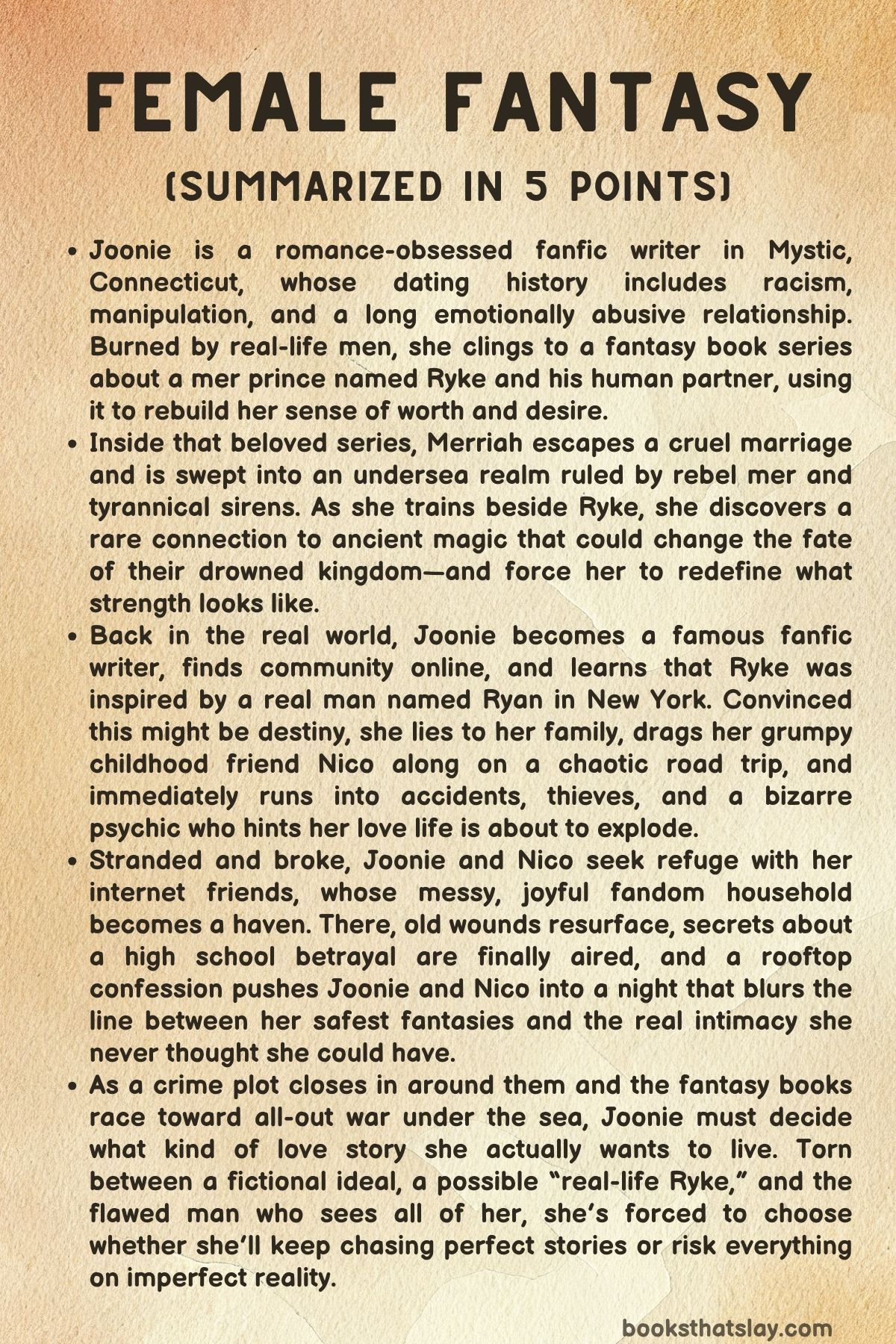
Joonie has built her romantic standards around Ryke, the noble mer prince from her favorite fantasy series, A Tale of Salt Water & Secrets. The book opens with her dumping her boyfriend Job in a bar because he never plans dates, rarely texts first, and is selfish in bed.
He accuses her of confusing fantasy and reality, but Joonie knows Ryke didn’t ruin real men for her; he simply proved she doesn’t have to settle. After Job storms out, she calmly orders fries and wine and returns to the only man who has never disappointed her: the fictional Ryke on the page.
The story cuts into the fantasy world she adores. Merriah, a human woman escaping an abusive marriage, wakes in a glass chamber at the bottom of the sea.
She remembers breaking into a creek cottage, feeling an almost magical compulsion to blow a strange conch shell, and being seized by a stranger. That stranger is Ryke.
He reveals he is mer, lives in a hidden undersea stronghold, and that the conch she sounded is the Conch of Hippios, an ancient artifact whose call has just summoned mer forces to rebellion against the sirens who toppled Atlantia.
Back in Mystic, Connecticut, Joonie works as a copywriter, secretly writes wildly popular Ryke/Merriah fanfiction, and helps at her parents’ kabob shop run by her overprotective brother Tey. Her attempts at dating are a parade of microaggressions: a man fixates on where she is “really” from and calls her “exotic” before she escapes out a bakery’s back door.
Her history explains why she clings to fantasy. As a kid, a white best friend dropped her after framing Joonie as “one of them” during the Afghanistan war.
In college, Joonie tried to blend in, only to end up with Kyle, an emotionally abusive boyfriend who controlled her clothes, food, and time while insisting it was love.
The breaking point arrives when Joonie comes home to find Kyle ripping up her journals and forbidding her to write. Writing is her sanctuary.
She walks out, moves back to Mystic, and wanders into Ends Whale Books, shaking. The kind owner, Rona, doesn’t press for details and instead hands her a fantasy novel, A Tale of Salt Water and Secrets, promising it might restore her faith in love.
Joonie devours the book and its sequels, falling hard for Ryke: a hero who respects consent, treats Merriah as an equal, and recognizes her courage in leaving abuse.
Inside that series, Ryke explains the mythic history of man, mer, and winged maecenas; how forbidden magic turned some mer into sirens who gained power by killing human lovers mid-act; and how the sirens murdered his family and took Atlantia. Merriah, who sees herself as weak for leaving her husband quietly, learns that walking away is an act of power.
Ryke offers her a choice: return to shore or stay and help the resistance. She chooses to fight, trains with him, and grows into a leader and warrior.
Joonie’s obsession deepens. Under the username StepOnMeRyke432, she joins a fan group called the Salty Girls and becomes a beloved fanfic writer, her long-running Ryke/Merriah story going viral.
In a surprise livestream, the author Evelyn Grace Carter reveals that Ryke is based on her real college friend Ryan. Joonie hunts him down online as Ryan Mare, an environmentalist in New York City, and convinces herself that meeting him might be destiny.
To chase this dream, she lies to her family, claiming she’s attending a prestigious NYU romance-writing workshop called “Write Guy, Wrong Time,” and borrows Tey’s truck. Over dinner with Tey, his boyfriend Oliver, and their childhood friend Nico, the banter between Joonie and Nico crackles with years of unresolved tension.
Nico insists on coming to New York too, for his own casual hookup. On the road, they argue about romance novels until Joonie explains how the genre helps women reclaim agency over love and sex.
Nico softens and apologizes. Feeling bold, Joonie admits she is going to find Ryan, the real-life Ryke.
Nico reacts so sharply that he causes an accident, and they crash into a ditch.
Stranded, their plans spiral into chaos, and a string of misadventures follows, including petty criminals and a psychic who steals their wallets after issuing a mysterious prophecy about three men in Joonie’s life: Ryke, Ryan, and Nico. With no IDs or money, Joonie turns to the only safe place she can think of in New York: the home of Angel, one of her long-time online fandom friends.
Angel and their fellow fans Roya and Kalli welcome Joonie and Nico into a warm, chaotic townhouse full of books, fandom jokes, and support.
Over dinner, the friends urge Joonie and Nico to tell the whole story. The group treats their ordeal like a sprawling fan plot, analyzing the psychic’s prophecy and teasing out theories.
Nico finally demands to know why Joonie has resented him for years. She explodes, recounting the high school formal where he asked her as a date, then got blackout drunk and made out with other girls, including the ex-friend who bullied her.
She remembers him calling her pathetic and delusional for believing in love. Nico, stunned, explains that his parents’ divorce destroyed him, that he intended to take her as a friend to protect her from feeling left out, and that his memory is fragmented.
He had apologized only for standing her up and then kept his distance, convinced he would only hurt her again.
Later, on Angel’s rooftop, Joonie explains how the fantasy series and fan community helped her rebuild after Kyle’s abuse. Nico admits he has secretly read the books and finally understands their power.
They revisit their shared past, recognizing how much pain and miscommunication has been left to rot between them. Nico confesses that he never hated her; if anything, his feelings were much more intense.
He believes in her, even if he struggles with the idea of love itself. They finally kiss, and with affectionate, careful communication, they sleep together.
Nico pays attention to her desires, reveals he has read all her writing, and Joonie experiences real intimacy that lives up to her fantasies. That night she no longer dreams of Ryke; she dreams of Nico.
Meanwhile, the fantasy storyline builds to a climax. At the Ball of Sinking Stars, Merriah uncovers a hidden trove of divine artifacts and lifts the Trident of the Gods, channeling raw power that forces the siren queen Talassa to flee.
Later, Merriah sacrifices her own safety in battle and is killed. Ryke’s grief unleashes a storm of magic that, combined with their bond and her divine lineage, resurrects her as a mer with a golden tail and the mantle of Amphitrite’s heir.
She emerges as a queen and war leader, ready to guide the revolution.
Back in New York, Joonie and Nico are cornered again by the petty criminals and a mobster’s nephew who want a stolen ledger they believe Nico has. Drawing on her self-defense training, her fandom’s encouragement, and the stories that taught her she deserves better, Joonie fights back.
With timely backup from Angel, Roya, and Kalli—armed with mace, a bat, a taser, and a livestream that alerts the police—she helps take the criminals down. The officers praise her courage.
Nico insists she never needed a fantasy hero to save her; she has always been the hero of her own story. Joonie finally admits she loves him and chooses him, not Ryan or any fictional prince.
In the fantasy realm’s resolution, Merriah stands beside Ryke before a reborn Atlantian army, wielding the Trident and a golden whip, ready to lead a new era. In the contemporary epilogue, Joonie and Nico live together in Mystic, where she turns their wild trip into a novel.
The livestream of their kidnapping turns her family restaurant into an unlikely tourist hit. Her brother considers expansion, and Joonie settles into a real relationship that requires work, communication, and honesty, not blind faith in destiny.
A final teaser introduces Laia Grace, an ultra-curated influencer whose carefully constructed life sets the stage for the next story in the universe of Female fantasy.
Characters
Joonie (Joon)
Joonie is the emotional core of Female Fantasy, a young woman whose life has been shaped by stories, misogyny, racism, and the long, slow work of reclaiming herself. She begins the novel clinging to fantasy as a survival tool: her devotion to Ryke, her fanfiction persona, and the Salty Girls fandom all give her a sense of control and validation she never gets from real life.
Her history of racism in Mystic, the humiliation with Sam, and the microaggressions from men who call her “exotic” leave her feeling simultaneously hypervisible and unseen, desired and dehumanized. That tension sets her up to fall into relationships like Kyle’s and Job’s, where she is expected to be grateful for any attention at all.
Yet Joonie is never just a victim; she is also stubborn, imaginative, and deeply analytical about love. As a writer, she is constantly interrogating what it means to desire and be desired, and she uses romance narratives as a lens to critique how patriarchy scripts women’s relationships.
Her arc is about distinguishing between escapism that numbs her and fantasy that nourishes her. At first, she confuses her devotion to Ryke with a refusal to settle, which is partially true but also a way to avoid risking real intimacy.
The trip to New York forces her out of the safe, controlled space of online fandom and into chaotic, absurd danger: car crashes, kidnappings, psychic thefts, and mobsters. In those moments she discovers that her courage and resourcefulness are not borrowed from fictional heroes; they have been hers all along.
Her decision to walk away from Kyle, to leave Job, to ghost racist dates, to stand up to criminals, and finally to choose Nico over the fantasy of Ryan are all variations on the same internal move: trusting her own worth. By the end, Joonie remains a romance-loving fangirl and fanfic writer, but her relationship to fantasy has matured.
She no longer clings to Ryke as an ideal that real men must match; instead, she uses what she learned from the books to shape a reality where she can demand respect, mutual enthusiasm, and safety. Her final decision to write her own novel and live with Nico in an imperfect, evolving partnership shows that her greatest love story is not with a prince but with her own voice.
Merriah
Merriah, the heroine of the in-world fantasy series, acts as a mirror and mythic counterpart to Joonie. Like Joonie, she begins as a woman worn down by an emotionally abusive husband who has chipped away at her brightness.
She internalizes the idea that endurance is weakness and leaving quietly is cowardly, so she initially views herself as small and timid. Ryke, the rebellion, and the Conch of Hippios all invite her into a grander narrative where her sensitivity and persistence are reframed as strength.
Crucially, though, her journey is not about being “rescued” by a prince; it is about being recognized as someone who already has power. Ryke repeatedly insists that walking away from abuse is an act of courage, and Merriah’s later choices—to stay and fight, to wield the trident, to share her life force with him—affirm that she is an active subject, not a sidekick.
Her godly lineage as Amphitrite’s heir literalizes what the novel argues on a metaphorical level: that women who survive abuse and reclaim their lives are, in their own way, divine. When Merriah lifts the Trident of the Gods and boils the water in the sirens’ bodies, the scene transforms her trauma into elemental wrath.
Her power is not neat or polite; it is overwhelming, destructive to oppressive systems, and frightening even to allies. The fact that she dies, has her spine snapped, and is then reborn as mer dramatizes the idea that leaving an abusive life often feels like a kind of death and resurrection.
By the time she stands beside Ryke as queen and war leader, golden tail flashing, whip and trident in hand, she has become a symbol of what Joonie is trying to believe about herself: that being hurt did not ruin her, it refined her. Merriah embodies the fantasy of a woman whose pain becomes world-changing power, which Joonie translates back into her own, less magical but equally radical choice to rewrite her life.
Ryke
Ryke is both an individual character in the fantasy series and a powerful symbol within Joonie’s psyche. On the surface, he is an ancient mer prince in exile, noble and damaged, with centuries of grief behind him and a rebellion on his shoulders.
His backstory—fleeing a coup, hiding for centuries, nearly surrendering to despair—gives his gentleness with Merriah a weight that distinguishes him from the human men in Joonie’s life. There is always a tension between his immense power and his restraint.
Unlike the sirens who exploit the life-force-transfer for domination, Ryke refuses to use others as fuel, even when he is desperate. His reluctance to draw on Merriah’s blood-powers unless she explicitly consents encapsulates his role as a romance ideal: he is powerful but never entitled to her body or her sacrifice.
At the same time, Ryke is not a flawless fantasy; he is haunted and deeply lonely, and his decision to abduct Merriah to his safe house is ethically murky. He hides their interloched bond so she can “choose freely,” but he is still shaping her reality in ways she does not understand.
The novel allows that complexity while ultimately framing his love as transformative rather than possessive. The revelation that he has watched over her since infancy, building a rebellion in the hope she might one day join it, is both romantic and unsettling, underscoring how fantasy can blur lines.
For Joonie, Ryke represents the possibility of a man who treats her as a partner rather than a project. Her obsession with him is less about his tail and princehood than about his fundamental orientation toward equality, consent, and belief in her strength.
When she finally shifts her romantic focus to Nico, Ryke remains important as an internal standard: a reminder that if real love cannot match Ryke’s respect, it is not worthy of her.
Nico
Nico is the messy, realistic counterpart to Ryke: flawed, human, and rooted in the same small-town history and class constraints as Joonie. As Tey’s best friend and Joonie’s long-term crush, he occupies that frustrating space between family and potential partner.
His early pattern—asking her to a dance, then standing her up and getting drunk with other girls—positions him as another disappointing man in Joonie’s life, someone who dismisses her feelings and confirms her fear that she is “too much.” Only later do we see the depth of his own pain: a kid reeling from his parents’ ugly divorce, drinking to numb himself, and then choosing cowardly distance over honest apology because he believes he will only hurt her again. His job in crisis insurance echoes this worldview; he expects disaster, prepares for the worst, and frames himself as someone who absorbs damage so others will not have to.
Nico’s growth is closely tied to his willingness to interrogate his own cynicism. At the start of the road trip, he mocks Joonie’s romance obsession, embodying the cultural dismissal of “women’s genres” as frivolous.
When she passionately explains how romance helps women reclaim their bodies and boundaries, he listens, reads the series, and eventually admits he was wrong. This shift is not just about liking a book; it is about respecting Joonie’s inner life and taking her desires seriously.
His confession that he has secretly read everything she has written online is one of the most quietly romantic gestures in the story: he has been witnessing her voice long before he fully understood its importance. During the kidnapping, Nico initially tries to sacrifice himself, playing the martyr, but Joonie’s self-defense and strategic thinking force him to see her as the hero too.
By the end, when he tells her she never needed fictional heroes because she has always been the bravest person he knows, he is no longer the boy who stood her up but a man willing to stand beside her, humbled, attentive, and in love.
Tey
Tey, Joonie’s older brother, embodies a complicated blend of protective sibling, immigrant son, and small-business co-owner. Managing the family kabob shop, he carries the financial and emotional burden of keeping their parents’ dream alive in a town that has not always welcomed them.
His protectiveness sometimes veers into overbearing, as when he tracks Joonie’s location during the road trip or initially approves of Kyle, reflecting a conflict many children of immigrants face: balancing love and security with respect for individual autonomy. Tey wants stability for Joonie and may initially mistake outward markers of success—like Kyle’s respectability—for true safety.
His own romantic life with Oliver, however, shows that he understands queer and nontraditional love, and that his conservatism is more about fear of Joonie being hurt than about rigid morality.
As the story progresses, Tey becomes a grounding figure and a symbol of how family can grow. He is the person whose couch Joon crashes on after leaving Kyle, the one whose truck she borrows to chase a possible soulmate, and later the relative who jokes about franchising Kabobs ’n’ Bits after the viral livestream rescues the restaurant.
His reactions—frustration, worry, teasing—signal that he respects Joonie enough to be honest with her, but ultimately trusts her judgment. The novel hints that he continues to evolve, considering expansion and embracing the bizarre true-crime tourism that now surrounds their family business.
In that way, Tey reflects a generational shift: an immigrant son adapting survival strategies into entrepreneurial opportunity, while learning to step back and let his sister chart her own path.
Angel, Roya, and Kalli
Angel, Roya, and Kalli represent the transformative power of online friendship and fandom. Each of them meets Joonie first through her writing, not through her family, her appearance, or her small-town reputation.
That reversal matters: they know her as StepOnMeRyke432, a passionate, creative storyteller whose voice they admire. Angel, who opens her Fort Greene townhouse to Joonie and Nico when they are stranded and broke, functions as a fairy godmother figure grounded in real-world hospitality.
Her home—chaotic, book-strewn, and full of fandom artifacts—gives Joonie a physical glimpse of the community that has long sustained her virtually. Roya and Kalli, with their irreverent usernames and sharp commentary, embody a particular kind of queer, female, and POC-centered internet culture that turns analysis into play and trauma into memes.
Their dynamic during the storytelling dinner, when they treat Joonie and Nico’s ordeal as an epic plot to be theorized, highlights both the strengths and limits of this world. On one hand, they help Joonie reframe her fear as narrative, giving her psychological distance and intellectual tools to process what is happening.
On the other, their detachment irritates Nico, revealing how constant “shipping” and meta can flatten real danger. Yet when it counts, these women are not just spectators; they are combatants.
In the final confrontation with Shrug, they show up armed with mace, a taser, and a baseball bat, along with Kalli’s livestream. The fandom that once existed only in comment sections becomes an Upper Shoal, a literal support pod that protects Joonie.
Their presence underscores the novel’s belief that fantasy communities can spill over into tangible solidarity, and that women hyping each other up online can, when necessary, also throw hands in a parking lot.
Job
Job, the boyfriend Joonie dumps in the bar, is a concise portrait of complacent mediocrity. His disbelief that she would break up with him “because of” a fictional character reveals his refusal to take her inner life seriously.
For Job, Joonie’s love of Ryke is evidence that she is confused or irrational, rather than an expression of her values. He embodies a common type of modern partner: someone who believes that showing up minimally is enough and that he should be rewarded simply for not being overtly horrible.
The details Joonie lists—how he never initiates contact, never plans dates, is selfish in bed—paint him as a man who expects emotional and sexual labor without reciprocating effort.
His eventual explosion, calling her a bitch, confirms that his earlier passivity was not kindness but entitlement. He is angry not because he truly loves her but because she has disrupted the comfortable arrangement in which he receives affection without work.
By staging their breakup in a public bar where Joonie calmly orders fries and wine and returns to her book, the novel uses Job as an early litmus test: he is the baseline of what Joonie will no longer accept. In contrast to Ryke’s attentive partnership and Nico’s eventual willingness to examine himself, Job is the man who refuses to grow and expects Joonie to shrink around him.
Ending things with him is an important, if relatively easy, early step in her process of refusing to settle.
Kyle
Kyle is a more insidious, dangerous version of the same patriarchal script. Unlike Job, he initially seems gentle: a quiet English major, shared literary interests, a soft-spoken demeanor.
This persona allows him to bypass Joonie’s defenses and win her trust, which he then slowly weaponizes. His controlling behavior escalates gradually—dictating what she eats, wears, and does, mocking her in public while claiming it is love—mirroring real patterns of emotional abuse.
Because his cruelty is incremental and wrapped in the language of concern, Joonie struggles to recognize how trapped she has become. Her fear that she will never find another chance at love keeps her tethered to him, revealing how patriarchal narratives of scarcity and urgency can keep women in harmful relationships.
The turning point comes when she finds him ripping pages from her private journals and forbidding her to write. This attack on her writing is symbolically an attack on her selfhood; he is not content to control her external habits but wants to annihilate her internal refuge.
Her decision to walk out at that moment is one of the bravest acts in the novel, especially given that her parents approve of him and she knows leaving will complicate her relationship with them. Kyle functions as a dark mirror of the creative men Joonie might have imagined sharing a life with: instead of nurturing her stories, he tries to erase them.
His presence in the narrative sharpens the stakes of Joonie’s later choices; when she demands that love be collaborative and respectful, it is not abstract idealism but hard-earned survival wisdom.
Ryan Mare
Ryan Mare exists largely as a projection, the real-world body onto which Joonie pins years of fantasy. He is introduced not through his own actions but through Evelyn Grace Carter’s offhand comment that Ryke was based on a real college friend named Ryan who is still single.
The narrative details about him are sparse—he works at an environmental startup in New York, he attended the same college as the author—but that sparseness is the point. Joonie fills in every blank with her desires, assuming that because he inspired Ryke, he must also embody Ryke’s ethics and emotional availability.
In reality, he is almost irrelevant; what matters is what he represents to her at that moment: a last-ditch hope that the line between fantasy and reality can be crossed, that her years of loving a fictional prince might produce a tangible payoff.
The journey toward Ryan is thus less about meeting a person and more about testing a belief. The wild misadventures that derail her path to him—car accident, kidnapping, lost wallets, mob entanglements—are narrative ways of showing that the universe, or at least the plot, is more interested in her relationship with Nico and with herself than in this distant, idealized man.
By the time Joonie chooses Nico and begins writing her own novel, Ryan has served his function: he helped her leave Mystic, confront old wounds, and discover what she actually needs from a partner. He remains a ghost of an almost-story, a reminder that pinning hope on an imagined stranger risks missing the real love right beside you.
Rona
Rona, the owner of Ends Whale Books, plays a small but pivotal role as the quiet mentor who points Joonie toward the stories that will save her. When Joon comes into the bookstore shattered from Kyle’s emotional abuse, Rona does not demand explanations or insist on practical solutions.
Instead, she listens just enough to understand that Joonie needs “a book that will restore her faith in love and maybe herself.” Her choice to give Joonie a fantasy novel rather than a classic romance is significant. It signals an intuition that Joonie needs not only reassurance that love exists but also a new, expansive framework for imagining herself in relation to power, violence, and agency.
The oceanic, mythic scale of A Tale of Salt Water and Secrets offers that.
Rona represents the best version of the bookseller archetype: someone who sees reading as medicine and trusts readers to interpret it for themselves. She does not lecture Joonie about leaving Kyle or push her toward any specific outcome; she simply hands her a story and, in doing so, silently affirms that Joonie is worth a grand narrative.
Though she appears briefly, her action ripples through the rest of Female Fantasy, setting in motion Joonie’s fandom involvement, her confrontation with fantasy versus reality, and ultimately her new career as a novelist. In a book full of dramatic gestures and wild adventures, Rona’s quiet recommendation is one of the most life-altering.
Sam
Sam, Joonie’s former best friend, embodies the painful intersection of adolescent loyalty and racial betrayal. As a popular white lacrosse player, she initially offers Joonie social validation and a sense of belonging in a town where her family is often treated as foreign.
Their friendship seems to promise a bridge between worlds—until Sam demands to know whose side Joonie is on in the Afghanistan war and decides she is “one of them.” That moment reveals the conditional nature of Sam’s acceptance: Joonie is welcome only as long as she aligns with Sam’s worldview and distances herself from her own community. The fact that Sam’s parents influence this perspective underscores how racism is taught and reinforced in seemingly respectable homes.
The fallout from Sam’s rejection runs deep. It teaches Joonie that love and friendship from white peers can be revoked without warning, and that her identity will always be suspect in their eyes.
This trauma echoes years later when adult Joonie is asked where she is “really” from on dates and called “exotic.” Sam is also part of the high school formal humiliation, making out with Nico while drunk, another moment where Joonie feels sidelined and foolish. In that sense, Sam is both a specific former friend and a broader symbol of the kind of betrayal that makes fantasy worlds appealing.
If real-world bonds can be severed by geopolitics and prejudice, then the unconditional loyalty promised in romances and epic fantasies becomes even more alluring.
Thomas, Clarisse, and M.C. “the Shrug” Lester
Thomas, Clarisse, and Shrug are the novel’s most overtly criminal antagonists, but they also function as exaggerated versions of everyday gendered violence. Thomas and Clarisse, the low-rent kidnappers, are initially almost comedic in their incompetence, yet their willingness to abduct and threaten Joonie and Nico reveals a casual disregard for other people’s autonomy.
Clarisse’s willingness to go along with Thomas’s schemes highlights how women can become complicit in patriarchal harm when they align with abusive men for survival or profit. Shrug, the mobster’s nephew, is more chilling: he is violent, connected to a larger criminal infrastructure, and sees Joonie’s life as a bargaining chip in his conflict with the Albanian Mafia.
The key to their role in Female Fantasy is not just the danger they pose but how Joonie responds. When Shrug threatens to break her bones, she remembers the prophecy, identifies him as the “goat dressed as a lamb,” and refuses to be merely a hostage.
Her tae kwon do and self-defense skills are not abstract; she uses them to neutralize Thomas, gouge his eyes, and buy time. Even under the gun, she thinks strategically, faking hysteria while planning her next move.
The arrival of Angel, Roya, and Kalli with a livestream reconnects the criminal threat to the online world that has nurtured her. The police praise Joonie for saving herself, underlining that she is not a passive damsel but the active architect of her survival.
Thomas, Clarisse, and Shrug thus become catalysts that allow Joonie to enact the heroism she once relegated to Ryke and Merriah.
Talassa, Nix, Naia, and Dylan
These fantasy-world characters deepen the political and mythic dimensions of Joonie’s beloved series. Talassa, the tyrant siren queen, is a chilling embodiment of power unmoored from empathy.
Her rule is built on the exploitation of the life-force-transfer ritual, weaponizing intimacy and pleasure into a mechanism of domination. By seizing Atlantia and hunting dissident mer, she literalizes the fear that even marginalized groups can reproduce oppressive structures when they accept violence as a path to survival.
Her decision to kill Merriah specifically to hurt Ryke demonstrates a ruthless understanding of emotional bonds as vulnerabilities. Yet her parting declaration that “a life has repaid a life” hints at a twisted sense of cosmic accounting, as if she sees herself as maintaining balance even while doing monstrous things.
Nix and Naia, her siblings and enforcers, help articulate the lore around interloched pairs and power-sharing. Nix’s explanation that Merriah and Ryke can safely exchange energy reframes their union as collaboration rather than extraction, while Naia’s brutal act of snapping Merriah’s spine underlines the stakes of resisting Talassa.
Dylan, by contrast, is an ally who attempts to protect Merriah by locking her away, a gesture that mixes paternalism with concern. His overprotectiveness highlights the series’ central question: who gets to decide what risks a woman takes with her own body and power?
In these characters, the fantasy narrative externalizes themes of control, sacrifice, and autonomy that echo through Joonie’s real-world experiences with Kyle, the kidnappers, and the men who presume to know what is best for her.
Laia Grace, Harlow Belle, and Harrison
The epilogue’s shift to Laia Grace, influencer @Laiability, introduces a new constellation of characters that preview a different facet of the novel’s world. Laia’s meticulously curated day—whale-semen skincare, manifestation mantras, Pilates, content shoots, branded boric-acid events—reads as both satire and empathy.
She lives in a hyper-mediated version of reality where every action is potential content and every relationship is partly a brand partnership. Her friend Harlow Belle appears as a fellow influencer, a mirror and accomplice in this performance-driven lifestyle.
Harrison, the long-distance private-equity boyfriend, functions as a glossy accessory to her image: a symbol of traditional capitalist success that complements her wellness aesthetic.
These characters are only sketched in the summary, but they highlight the next thematic frontier Female Fantasy wants to explore: how fantasy operates in the age of social media. Laia’s dependence on followers and metrics is a different kind of escapism from Joonie’s fandom world, one that turns the self into both product and commodity.
The eclipse she walks under at the end of the teaser hints at impending upheaval, suggesting that her seemingly perfect, heavily edited existence may soon fracture. By closing the book on Laia’s tightly controlled routine rather than Joonie’s settled life in Mystic, the novel signals that stories of female fantasy and reality are ongoing and multifaceted.
Where Joonie uses fiction to reclaim her private interiority, Laia uses platforms to construct a public persona; both are negotiating how to be real in environments that reward illusion.
Themes
Fantasy, Escapism, and the Search for Real Love
Joonie’s devotion to Ryke and to the series “A Tale of Salt Water and Secrets” runs through Female Fantasy as both lifeline and trap. Her breakup with Job in the bar is already framed through the lens of fantasy: he accuses her of confusing reality with fiction, while she insists that Ryke hasn’t ruined real men for her, he has simply clarified what effort, tenderness, and reciprocity should look like.
Fantasy is not an optional hobby for her; it is the measure by which she judges whether her life is worth living. When she goes to New York in search of Ryan Mare, the real-life inspiration for Ryke, that impulse becomes literal: she tries to cross the boundary between page and world, hoping a man who resembles her fantasy can also embody the emotional safety and adoration she has only found in fiction.
The mer-world narrative reinforces this pull. Merriah’s introduction to Ryke’s underwater kingdom is lush, seductive, and explicitly tied to freedom from abuse and loneliness, making magical escape feel like the only path to selfhood.
At the same time, the novel shows the cost of staying in fantasy too long. Joonie initially uses Ryke and fanfic as a shield against the risk of real intimacy, clinging to the perfect prince while overlooking the flawed, present man beside her: Nico.
It is not that fantasy is dismissed as childish; rather, the book suggests that escapist worlds can be rehearsal spaces for the courage and standards needed in real life. By the time Joonie stops dreaming of Ryke and instead dreams of Nico, fantasy has done its job.
The mer rebellion, the prophecies, and the swoony underwater scenes have taught her to want more, but the story insists that emotional fulfillment must eventually be lived in messy apartments, family restaurants, and Brooklyn rooftops, not only in glass oratories at the bottom of the sea.
Abuse, Trauma, and the Fight to Reclaim Self
Emotional abuse appears in multiple mirrors across Female Fantasy, and the narrative treats it with a seriousness that undercuts any idea that romance is just about hearts and flowers. Joonie’s relationship with Kyle is not spectacularly violent; it is insidious.
He controls what she eats, wears, and does, mocks her in public, and then insists this control is a sign of how much he cares. The moment he tears pages from her private journals and announces that she will no longer write crystallizes what has been true for a long time: he wants to own not just her schedule or her appearance, but her inner life.
Walking out is terrifying because abuse has already eroded her sense of worth and her belief that anyone else could love her. Merriah’s human husband in the fantasy series plays a parallel role.
He has diminished her brightness so thoroughly that she doubts her strength even as she manages the enormous feat of leaving him. Both women have internalized the message that endurance equals loyalty and that quiet suffering is just the price of love.
The book reframes leaving as an act of radical bravery. Ryke’s insistence that Merriah is powerful precisely because she walked away from harm echoes the way Joonie’s journey is framed: she is not reckless for fleeing Kyle; she is rediscovering her right to safety.
Later, the criminal threat in New York literalizes what once was emotional. Shrug, Thomas, and Clarisse try to restrain and hurt Joonie’s body the way Kyle once caged her mind.
Her decision to fight back using her self-defense training, to stay clear-headed while pretending to panic, and to strategize even under a gun barrel shows how her earlier trauma has become fuel rather than a permanent wound. Abuse leaves scars, but the story insists those scars can coexist with agency, rage, humor, and a future built on different terms.
Consent, Partnership, and Feminist Romance
Sex and power are explicitly linked in Female Fantasy, not just as a trope but as a political question. The siren origin story is stark: some mer discovered that they could gain immense power by killing a partner at the moment of sexual union, turning intimacy into a literal weapon.
The sirens’ predation dramatizes what it means to treat another person’s body as a resource rather than a subject with rights. Against that background, Ryke and Merriah’s relationship is written as a counter-argument.
Even when Merriah proposes the dangerous idea that he could draw on her divine life force through blood and sex, Ryke’s first response is fear of harming her. He refuses until she thoroughly understands the risk and insists that she trusts him.
The scene where they finally make love becomes not just romantic but ideological: shared pleasure, mutual decision-making, and the refusal to sacrifice her life even for the rebellion’s sake. Their bond is framed as partnership, not ownership, and the text makes clear that any power Ryke gains is meaningful only because she survives and remains his equal.
Joonie’s romantic trajectory follows the same logic. Kyle’s controlling behavior is a caricature of the domineering hero sometimes glamorized in older romance narratives, and the book pointedly rejects it.
Job’s laziness in bed and emotional passivity signal another form of disregard. Nico, by contrast, is attentive, communicative, and explicitly responsive to Joonie’s desires.
On Angel’s rooftop, their first time together is built from verbal consent, humor, and his focus on what she enjoys. His revelation that he has read everything she has written online is not played for creepiness but as a sign that he has paid attention to her inner world rather than just her body.
Joonie’s own defense of the romance genre on the road, where she explains to Nico that these stories teach women to claim sexual and emotional agency, underlines the book’s thesis: the “fantasy” is not about a perfect man who dominates, but about a relationship where both people are safe, heard, and fully human.
Race, Immigration, and Outsiderhood
Underneath the love story, Female Fantasy is attentive to how racism and xenophobia shape Joonie’s sense of self and her expectations in love. Growing up as the child of immigrant parents in Mystic, she learns early that her family is viewed as suspicious and foreign.
Sam’s sudden withdrawal of friendship after demanding to know where Joonie stands on the Afghanistan war shows how quickly affection can turn into policing when you are seen as “one of them.” The young Joonie is cast as a potential enemy within her own school, judged not by her actions but by a geopolitical narrative imposed on her body and family. As an adult, the microaggressions evolve but do not vanish.
The dating-app match who arrives looking like a liberal hipster but immediately asks where she is “really” from and calls her beauty “exotic” reenacts the same dynamic in a subtler register. His voicemail bragging about being a good ally while condemning her for leaving the date simply adds a layer of self-congratulation to his entitlement.
These experiences feed into her complicated relationship with fantasy. Books offer worlds where she is not the suspect other; Ryke and Merriah’s story contains no racialized suspicion of Merriah’s worth.
Yet, in college, she initially reacts to prejudice by trying to erase visible difference—straightening and lightening her hair, muting her clothes, making herself palatable. That self-erasure parallels the suppression demanded by Kyle, who wants not a partner but an ornament compliant with his vision.
The narrative counters this with community and affirmation. Tey’s kabob shop and its eventual transformation into a beloved tourist destination, Nico’s confrontation with Sam’s parents long ago, and Angel’s immediate acceptance of Joonie as her online friend stepping into physical space all work against the idea that assimilation is the only route to safety.
Joonie’s final position—living openly in Mystic with Nico, her writing, and her heritage central to her identity—suggests that a true happy ending must include belonging without self-betrayal.
Storytelling, Fandom, and Community as Survival
Books and stories are not just background elements in Female Fantasy; they are the architecture of Joonie’s survival. When she flees Kyle after he attacks her journals, what she seeks from Rona at Ends Whale Books is not advice but a narrative that might restore her faith in love and in herself.
Receiving “A Tale of Salt Water and Secrets” instead of a conventional realist romance signals a turning point: fantasy becomes the medium through which she can imagine a future that is not dictated by past harm. Her evolution into “StepOnMeRyke432,” the prolific fanfic writer whose Cold War Ryke–Merriah AU goes viral, is more than a cute fandom detail.
Writing lets her re-script power dynamics, rearrange plot outcomes, and center women’s pleasure in a way real life has denied her. The Salty Girls fandom group—Angel, Roya, Kalli—becomes a form of found family.
Their enthusiasm, shared language, and endless theorizing about prophecies offer her a space where she is not too much, too romantic, or too “obsessed,” but exactly right. The New York sections make this literal when these friends step out of her phone to become physical protectors, charging in with tasers, baseball bats, and a livestream that both documents and disrupts the violence around her.
Fandom, often mocked as frivolous, becomes an actual shield. Meanwhile, the fantasy series inside the book mirrors Joonie’s world so closely that the two narratives comment continuously on each other.
Merriah’s journey from abused wife to queen and war leader gives Joonie a template for her own transformation; Ryke’s steadfast respect sets the bar for how a man should behave. Later, Joonie’s decision to turn her kidnapping and road-trip chaos into a novel of her own completes the cycle.
She moves from reader to writer of original work, claiming authority over her story. The closing shift to Laia Grace, a lifestyle influencer whose days are curated for followers, hints that storytelling can also be a trap when it is driven by algorithm and sponsorship rather than genuine need.
The contrast underscores that narrative has power: it can cage you in performance, or it can crack open a way out.
Destiny, Prophecy, and the Power of Choice
Both the underwater saga and Joonie’s contemporary storyline are saturated with prophecy, but Female Fantasy continually tilts those prophecies toward choice rather than rigid fate. Merriah’s connection to Amphitrite and her status as Ryke’s loch are foretold in mer lore long before she is born.
The Trident of the Gods responds to her alone; her ability to unlock the treasure chest and command its artifacts marks her as the destined heir. Yet, the narrative refuses to reduce her to a passive chosen one.
Critical turning points hinge on her decisions: blowing the conch, opting to join the rebellion instead of returning safely to shore, insisting on sharing her divine power with Ryke through a dangerous ritual, and facing Talassa’s regime despite personal risk. Destiny frames the possibilities, but Merriah’s choices give them shape.
In Joonie’s world, the psychic’s prophecy about three men and the warning to “beware the goat dressed as a lamb” functions like a modern oracle. It tempts her to read Ryan, Ryke, and Nico as candidates in a romantic puzzle, inviting her to treat life like a narrative whose outcome is already sketched.
This temptation sits neatly beside her fanfic habits, where plot arcs and ship endgames can be controlled. The story subverts this expectation by steering her away from the obvious “fantasy” pick.
Ryan, the man who supposedly inspired Ryke, ends up largely irrelevant; Nico, flawed, grieving, and skeptical about love, turns out to be the person who meets her as an equal and walks alongside her in reality. Even the criminals’ appearance can be read through prophetic language, yet Joonie survives not by waiting for destiny to save her but by using her own training, quick thinking, and friends’ support.
The book suggests that prophecies and myths can help people name what they desire or fear, but they cannot substitute for the hard work of choosing partners, confronting danger, and writing one’s own ending. Fate might light up possible paths; feet still have to move.
Transformation, Rebirth, and Becoming the Hero
The arc of transformation in Female Fantasy is both literal and metaphorical, most spectacularly realized in Merriah’s death and resurrection but echoed throughout Joonie’s life. Merriah begins as a woman whose spirit has been ground down by an abusive marriage, convinced that quiet endurance is all she can manage.
Her journey with Ryke gradually reveals reserves of courage and latent divine power, culminating when Talassa orders her execution. The breaking of Merriah’s spine, the dissolution of her mortal body, and the subsequent reformation into a mer with a golden tail dramatize a rebirth that refuses final defeat.
Amphitrite’s declaration that the divine line cannot die affirms that some parts of a person—their capacity for leadership, love, defiance—can survive even the most brutal attempts at erasure. By the time Merriah stands before the rebel army with the trident and whip, crowned beside Ryke, she has become the visible symbol of revolution.
Joonie’s transformations are less magical but no less profound. She moves from a girl who changes her hair and clothes to blend in, who stays with boyfriends that diminish her, to a woman who leaves an abusive partner even when family approval is against her, who names her sexual desires and boundaries, and who confronts violent criminals on a New York street.
The moment where she uses her martial arts training to disable Thomas is a hinge: she literally fights for her life and Nico’s, becoming her own protector rather than waiting for a prince. Her dreams shifting from Ryke to Nico signal another internal shift: reality has finally become rich enough to compete with fantasy.
By the epilogue, she is no longer hiding on a pull-out couch but coauthoring her life—living with Nico, turning their ordeal into art, and participating in the growth of her family’s restaurant. Transformation is not depicted as a single decisive moment but as a series of choices that accumulate until the old self is no longer recognizable.
Both women demonstrate that heroes are not born in coronation halls; they are made in kitchens, bookstores, underwater caverns, and streets where real fear coexists with stubborn hope.
Performance, Image, and the Commodification of Femininity
While much of Female Fantasy centers on private inner change, the book also interrogates how womanhood is packaged and sold. Joonie’s attempt to pass as a more acceptable version of herself in college—lighter hair, muted clothes, less visible passion—already hints at a life lived for others’ gaze.
Kyle intensifies this by dictating what she should wear and how she should present, turning her into an accessory to his image of success. The public face of her family’s kabob shop similarly becomes a site of negotiation between authenticity and marketable story, especially after Kalli’s livestream of the kidnapping incident turns it into a true-crime destination.
The restaurant’s new status as a tourist draw, with merch and investors, is a comic subplot but also a commentary on how trauma can be repackaged as entertainment for outsiders. The final shift to Laia Grace pushes this critique into sharper, satirical focus.
Laia’s “day in the life” routine reads like a grotesque exaggeration of influencer culture: luxury skincare involving whale semen, relentless content creation, and a constant awareness of how every moment will appear on camera. Her relationship with Harrison is managed like a brand partnership, and her gratitude mantras are aimed as much at maintaining follower engagement as at personal peace.
She embodies a different kind of female fantasy—the fantasy of perfect optimization, endless beauty, and total control over narrative through algorithms and branding. Placing Laia after Joonie’s quieter, hard-earned happy ending invites comparison.
Joonie’s final fantasy is a life where she gets to write, love, and exist without apology, even if that includes arguments over money, restaurant grease, and small-town gossip. Laia’s fantasy is externally glossy but fragile, dependent on clicks and perception.
The contrast suggests that the stories women are sold about what happiness should look like—from social media to self-help mantras—can be as constraining as any abusive boyfriend or tyrant queen. The book asks whose fantasy is being served: the woman living the life, or the audience consuming it.