Fortress of Ambrose Summary, Characters and Themes
Fortress of Ambrose by J Elle is an epic fantasy that explores power, sacrifice, and destiny in a collapsing world of magic. Set in a fractured realm where ancient Houses govern the balance between light and dark forces, the story follows four intertwined characters—Jordan, Quell, Nore, and Yagrin—whose choices determine the fate of all magic.
The narrative unfolds across war-torn cities, haunted estates, and secret chambers where loyalty and betrayal blur. With its intricate worldbuilding and focus on love, morality, and survival, the book captures the struggle of those burdened by power they never asked for yet cannot escape. It’s the 3rd book in the House of Marionne series.
Summary
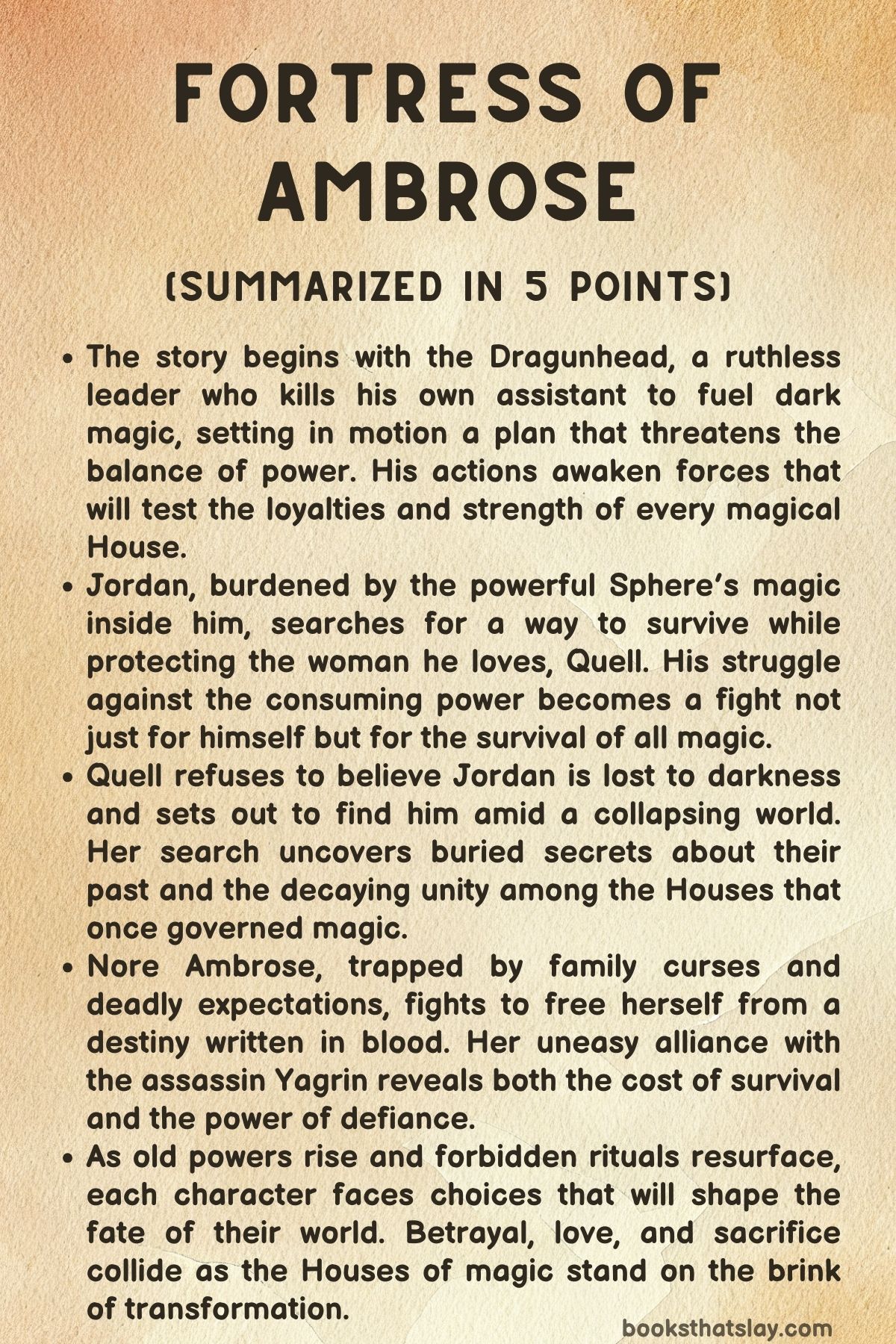
The story begins with the Dragunhead, the ruthless leader of a dark magical order, enraged upon discovering that the Sphere’s immense power has bonded with a human host. His failed schemes push him toward darker acts.
During a chilling encounter, he kills his secretary Maei, draining her soul through a ritual to strengthen himself. This act signals the return of an ancient evil capable of reshaping the world’s fragile magical balance.
Weeks later, Jordan—the human now carrying the Sphere’s power—searches through the ruins of the Sixth Ward in Washington, D.C. The burden of the magic is slowly destroying him. Haunted by the knowledge that his lover, Quell, will die if he loses this power, he seeks the elusive Lady Ruby, a black-market trader who may know how to extract and contain magic using the mythical Retentor stone.
His journey through the devastated city exposes him to corpses marked with Darkbearer symbols, a sign that his enemies are near. When assassins strike, he’s aided briefly by Harmony, a young Emoter, before she’s killed in the chaos.
Meanwhile, Quell, the new Headmistress of House Marionne, searches desperately for Jordan. The world is unraveling—magic is unstable, the great Houses are collapsing, and the line between savior and traitor is fading.
She refuses to believe the rumors that Jordan stole the Sphere’s power for himself. Her search leads her into a violent confrontation where she finds Jordan again.
Together, they fend off their attackers, though he remains distant and tormented. Quell realizes his magic is consuming him and that he’s hiding the depth of his suffering.
In another corner of the realm, Nore Ambrose, heir to House Ambrose, plots to escape a family curse that forces each Headmistress to surrender her heart for magical power. Without magic, she would die in the ritual.
Determined to live, she seeks the lost half of the Immortality Scroll. To get clues, she seduces and deceives Dublin Kyn, a former member of the Order.
With her ally Yagrin—Jordan’s estranged brother and a haunted assassin—she steals Dublin’s journal, hoping it contains clues about the Scroll’s location. Their uneasy alliance deepens as they uncover the Scroll’s ties to four great Houses, but trust between them is fragile.
Back in the ruins of the Dragun Headquarters, Jordan and Quell find the remnants of the Order slaughtered. Maei’s lifeless body confirms the return of soul-draining dark magic.
They rescue Knox, a captured ally, and flee. Knox leads them to a secret black-market dealer named Lennox Audubon.
Quell and Jordan reluctantly trust him to guide them toward a cure, though both sense treachery. At the same time, Nore and Yagrin infiltrate Chateau Soleil, the Marionne estate, under false pretenses.
Inside, they locate a fragment of the Scroll hidden within the walls, assisted by the loyal servant Maezre Dexler. Nore’s cunning and Yagrin’s strength help them escape with the artifact intact.
Quell and Jordan eventually reach a countryside safe house led by Willam, a rebel against the old magical order. Distrust hangs in the air.
Willam refuses Jordan entry, seeing him as a Dragun. Quell defends him passionately, demanding he reveal the scars that prove his suffering.
Jordan reluctantly does so, and Willam grudgingly agrees to shelter them temporarily. The fragile peace between all factions begins to crumble as mistrust and exhaustion spread.
Elsewhere, Nore returns to her family’s estate, Dlaminaugh, after surviving her brother Ellery’s attempt to imprison her heart in a glass box. The ancestors’ ghosts force her home, where she discovers she’s been named the new Headmistress of House Ambrose.
Bound by ancient law, she seals her heart away, losing her ability to feel love. Yagrin, still devoted to her, stays by her side despite her coldness.
Their relationship teeters between duty and longing. As her coronation nears, Nore finds herself trapped by tradition, unable to escape the destiny she once fled.
In the capital, Jordan and Quell help evacuate survivors after defeating Zecky, a scientist trying to harness dark magic. But the Dragunhead’s shadow looms again.
At Chateau Soleil, Quell uncovers Willam’s secret—he bears the Darkbearer mark. Though furious, she spares him after learning he leads a pacifist faction.
Later, she and Jordan reaffirm their love, vowing to destroy the Dragunhead and find freedom from the Sphere’s curse. When Jordan’s toushana magic flares out of control, they nearly destroy the forest before managing to regain control together.
The night ends with a rare moment of intimacy, rekindling the connection they thought lost.
At dawn, Nore’s coronation proceeds. Despite her hollow heart, she defies expectations, inserting small acts of rebellion into the ritual.
Later that night, she faces a horrifying tradition—the “final sacrament,” which demands she conceive an heir with a chosen stranger. Her protest is ignored, showing how deeply power has corrupted her lineage.
As Quell and Jordan continue their struggle, they receive an invitation summoning them to a secret meeting at Monument Park. At the same time, the Houses prepare for Nore’s funeral, though she is secretly alive.
Quell plans to lure the Dragunhead there, believing him to be her father. With help from Lady Ruby and Abby, she crafts a cloak enchanted with paralyzing Shadow Cell magic to trap him.
At the funeral, under heavy snow, the Dragunhead arrives and confirms the truth—he is Yaque Paru, descendant of the Mother of Magic and creator of the House system. He admits to fathering both Nore and Quell, claiming all his actions were meant to preserve balance.
He proposes absorbing all magic himself to protect the world.
Quell feigns compliance, embracing him so Nore can strike. The plan nearly fails as he overpowers them, but Jordan and Yagrin arrive.
In the ensuing chaos, they trap the Dragunhead with Shadow Cell magic during a blood exchange ritual. His power collapses, and the heroes finally defeat him.
However, Jordan’s life fades during the ritual. Realizing that the world cannot survive if magic is centralized, Quell devises a plan to distribute the Sphere’s magic among everyone through blood.
The act saves Jordan and restores balance to the realm.
In the aftermath, Nore fulfills her pact with the dead by offering them the Dragunhead’s immortal heart instead of Jordan’s. Freed at last, she restores her own heart and reunites with Yagrin.
Months later, peace returns. The Order is reborn as Nova Misa, uniting all Houses under shared magic.
Quell leads as Headmistress, Jordan by her side, while Nore and Yagrin begin new lives. Together, they create a world where power no longer corrupts, and magic belongs to everyone.
Characters
Jordan
Jordan stands as the emotional and moral core of Fortress of Ambrose, embodying the torment of a man burdened by forces beyond his control. Once a Dragun, trained in a brotherhood of power and violence, he becomes the unwilling host of the Sphere’s magic—an ancient force sustaining the balance of the magical world.
His transformation from soldier to savior mirrors his internal conflict between darkness and love. The power within him corrodes his body and mind, yet his enduring devotion to Quell gives him strength.
His guilt for past sins and fear of losing control humanize his heroism, revealing a man torn between redemption and self-destruction. Jordan’s journey is ultimately one of sacrifice, as he struggles to preserve both Quell’s life and the world’s magic at the cost of his own soul.
Quell
Quell is portrayed as fierce, intelligent, and deeply compassionate, yet her power as Headmistress of House Marionne isolates her. Her identity as both leader and lover defines her complexity.
Her love for Jordan transcends political and magical divisions, forcing her to question duty versus emotion. As her magic wanes and the world fractures, she demonstrates resilience not through invulnerability but through persistence—continuing to fight even when hope fades.
Her discovery of her lineage to the Dragunhead complicates her sense of morality, positioning her between creation and destruction. Quell’s courage lies not in her strength alone but in her willingness to forgive, lead, and believe in redemption even amidst chaos.
Nore Ambrose
Nore’s evolution throughout Fortress of Ambrose is one of the most intricate character arcs. Born into the ruthless House Ambrose, she begins as a cunning manipulator driven by fear and ambition but becomes a symbol of emancipation and moral clarity.
Her search for the Immortality Scroll and later her forced role as Headmistress reflect her struggle for autonomy within a system that trades hearts for power. Stripped of both magic and agency, Nore’s battle is internal—between the coldness imposed by her heart’s imprisonment and her innate capacity for love and empathy.
Her eventual defiance of tradition and reclaiming of her heart signify her triumph over generational curses, making her both tragic and transcendent.
Yagrin
Yagrin represents loyalty fractured by grief. Once a ruthless assassin, his pursuit of resurrection for his lost love, Red, exposes his deep vulnerability.
His partnership with Nore oscillates between tension and affection, reflecting his inner battle between vengeance and hope. His complex morality—willing to kill but equally capable of mercy—underscores the theme of blurred lines between good and evil.
In aiding Nore, Yagrin slowly rediscovers purpose, transforming from a man enslaved by memory into one capable of love and forgiveness. His eventual redemption, crowned by his leadership of the reformed brotherhood, marks him as a figure of renewal.
The Dragunhead (Yaque Paru)
The Dragunhead is the embodiment of corrupted wisdom and divine arrogance. Once a visionary who created the Houses to maintain magical balance, he becomes consumed by his belief that only he can safeguard magic.
His intellect and ancient power render him both mentor and monster, a creator who cannot relinquish control of his creation. The revelation that he fathered Quell and Nore adds a chilling dimension to his character—his manipulation of bloodlines mirrors his manipulation of history.
In his conviction to absorb all magic, he becomes the very threat he claims to prevent. His fall, orchestrated by his daughters, serves as both justice and tragedy—a god undone by his own ambition.
Maei
Maei’s brief but haunting presence casts a long shadow over the novel’s moral landscape. As the Dragunhead’s secretary, she is a portrait of loyalty twisted into victimhood.
Her murder—cold, ritualistic, and purposeful—reveals the depravity of her master while setting the tone for the novel’s exploration of sacrifice and corruption. Her soul’s theft to fuel dark power becomes a recurring metaphor for how innocence is consumed by ambition.
Maei’s death, though early, establishes the emotional and ethical stakes of the story, reminding readers that even minor figures can embody immense thematic weight.
Dublin Kyn
Dublin Kyn stands as a bridge between the scholarly and the dangerous. A former member of the magical Order turned adventurer, he represents knowledge untethered by morality.
His pursuit of the Immortality Scroll and confrontation with Nore reveal both his brilliance and ruthlessness. Yet beneath his bravado lies an intellectual curiosity bordering on obsession—his need to uncover secrets outweighs empathy.
Dublin’s clashes with Nore highlight the conflict between intellect and ethics, making him a cautionary reflection of what unrestrained pursuit of power can yield.
Lady Ruby
Lady Ruby, though operating largely in the background, epitomizes the pragmatic survivor in a crumbling world. As a Trader steeped in black-market dealings, she straddles legality and necessity.
Her alliances are fluid, dictated by profit and instinct rather than ideology. Yet, beneath her cunning exterior lies a sense of loyalty to the few she deems worthy, evidenced by her later aid to Quell and Jordan.
Ruby’s character offers insight into the underbelly of the magical hierarchy, showing how even those on the margins shape history through quiet influence and decisive cunning.
Knox
Knox is a figure of resilience and loyalty, her pragmatism serving as a counterbalance to Jordan and Quell’s idealism. A survivor and a fighter, she represents the grounded strength of those who endure rather than dominate.
Her connection to the black-market network and her cautious alliance with Jordan underline her adaptability. Knox’s loyalty is not blind but chosen, rooted in trust hard-won through shared peril.
She stands as a quiet moral anchor—never seeking glory, yet often ensuring survival when hope seems lost.
Isla Ambrose
Isla Ambrose, Nore’s mother, personifies the haunting legacy of generational trauma. Once a powerful matriarch who traded her heart for dominion, she becomes both mentor and warning to her daughter.
Her manipulative tenderness and cryptic love embody the tragedy of a woman consumed by the very power she sought to master. Isla’s message—“The sun shines, and it reminds me of you”—encapsulates her paradox: capable of warmth but forever shadowed by her own choices.
Her relationship with Nore captures the painful cycle of inherited ambition and emotional starvation that defines the Ambrose lineage.
Ellery Ambrose
Ellery functions as the face of corruption within House Ambrose. His lust for power leads him to imprison Nore’s heart, symbolizing the theft of both agency and humanity.
Unlike his sister, Ellery embraces tradition without question, embodying the House’s cold creed that survival justifies cruelty. Yet his eventual downfall underscores the collapse of an old order built on sacrifice and control.
Ellery’s role as both oppressor and victim of ancestral expectation positions him as a tragic mirror to Nore—a man undone not by weakness but by obedience to legacy.
Harmony
Harmony’s death is one of the story’s most tragic early moments. As an Emoter, her gift of manifesting feelings through color contrasts sharply with the darkness surrounding her.
Her brief encounter with Jordan offers a fleeting glimpse of beauty and innocence amid chaos. Her murder is senseless yet significant—it reinforces the omnipresent danger and cruelty of a world where empathy itself becomes a liability.
Harmony’s presence lingers as a reminder of what is lost when magic becomes synonymous with power rather than wonder.
Themes
Power and Corruption
In Fortress of Ambrose, the possession and pursuit of power define the moral and emotional trajectories of nearly every character. Power, whether magical or political, is depicted not as a gift but as a burden that distorts identity and loyalty.
The Dragunhead’s hunger for absolute control exposes how authority becomes self-justifying—he convinces himself that only by centralizing magic within his immortal body can balance be achieved. Yet, this belief masks an underlying fear of mortality and insignificance.
His manipulation of Maei’s death early in the narrative sets the tone for how domination corrodes empathy. Similarly, Jordan’s internal struggle with the Sphere’s magic illustrates how even reluctant power can consume its bearer.
His decaying body mirrors the moral decay that power threatens to bring, as the line between protection and destruction blurs. The Houses themselves embody systemic corruption, their rigid traditions sustained by blood pacts and deceit.
Nore’s forced ascension to Headmistress exposes how authority in this world is often inherited through coercion rather than earned through virtue. The novel repeatedly contrasts control with surrender—those who cling to dominance, like the Dragunhead, lose their humanity, while those who accept vulnerability, like Jordan and Quell, rediscover it.
Power, in this world, is cyclical; it corrupts those who wield it and resurrects through those who resist it, emphasizing that balance, not possession, defines true strength.
Love and Sacrifice
Love in Fortress of Ambrose is both salvation and curse, demanding sacrifices that blur moral boundaries. Jordan’s relationship with Quell is marked by constant loss—their love sustains them emotionally even as it physically endangers them.
His willingness to absorb the Sphere’s power to save her life transforms affection into martyrdom, redefining love as endurance rather than desire. Quell’s persistence in standing by him, despite the danger, underscores devotion as a radical act in a world collapsing under mistrust.
For Nore and Yagrin, love is haunted by betrayal and memory. Nore’s inability to feel after losing her heart is symbolic of the emotional cost of duty; even when love resurfaces, it is shadowed by the knowledge that survival demands deception.
Yet, their reconciliation toward the end, when Nore restores her heart, represents love’s redemptive power—a reminder that even broken souls can reclaim warmth. The theme expands beyond romance into familial and collective sacrifice.
Quell’s confrontation with the Dragunhead, who might be her father, turns love into a weapon of defiance. Ultimately, the novel suggests that love’s truest form lies not in possession but in relinquishment—the willingness to let go, to die, or to endure for another’s sake.
Identity and Transformation
Identity in Fortress of Ambrose is fluid, shaped by memory, lineage, and the struggle between light and dark. Characters are forced to confront versions of themselves that challenge their sense of belonging.
Jordan’s dual nature, as both human and vessel for the Sphere’s magic, positions him between savior and destroyer. His transformation from hunted outcast to redeemer questions whether identity is defined by one’s origin or by the choices made under pressure.
Quell’s arc mirrors this—once a loyal leader, she becomes a rebel questioning the very foundations of her House. Her discovery of her possible connection to the Dragunhead forces her to reconcile inherited darkness with chosen goodness.
Nore’s journey is perhaps the most striking portrayal of identity’s fragility. Deprived of her heart, she becomes emotionally numb, enacting power without feeling it.
Yet, her eventual restoration signifies the reclamation of agency from a destiny imposed by bloodline. Across these narratives, transformation emerges as both a curse and liberation.
The characters’ evolving identities reveal that selfhood in a fractured world requires continuous reinvention, and that the truest transformation often begins in loss.
Death and Resurrection
Death in Fortress of Ambrose is not final but cyclical, a recurring force that tests the limits of morality and magic. The Dragunhead’s ritualistic murders and attempts at resurrection expose his obsession with defeating death, transforming it into a tool of dominance.
Maei’s soul consumption marks the beginning of a pattern where death fuels survival, merging violence with vitality. Yagrin’s longing to resurrect Red underscores how grief drives defiance against natural order.
Yet, each resurrection exacts a price—souls are fragmented, and life returns diminished. Nore’s “death” and subsequent rebirth as Headmistress redefine mortality as transformation rather than end, linking resurrection with reclaiming identity.
Jordan’s near-death during the extraction ritual parallels the rebirth of the magical world itself, reinforcing the notion that renewal requires sacrifice. The closing formation of Nova Misa, where magic is redistributed among all, symbolizes collective resurrection—the death of tyranny and the birth of equilibrium.
Through this theme, the book meditates on how humanity’s refusal to accept mortality breeds destruction, but acceptance of death’s role in renewal leads to balance and peace.
Freedom and Destiny
Freedom in Fortress of Ambrose exists in constant tension with the chains of prophecy, bloodline, and obligation. The Houses, bound by ancient pacts, reduce individuals to instruments of lineage, while destiny is portrayed as both oppressive and seductive.
Nore’s coronation, forced upon her through manipulation and ancestral pressure, captures the suffocating nature of predetermined fate. Yet, her rebellion—stealing knowledge, deceiving her allies, and ultimately reclaiming her heart—reflects the human impulse to resist imposed destiny.
Jordan’s conflict with the Sphere’s power dramatizes the paradox of freedom: he must carry the burden of the world’s magic to save it, even though it enslaves him. Quell’s defiance of tradition, particularly her refusal to abandon Jordan, challenges the notion that loyalty to legacy should outweigh loyalty to self.
The novel concludes with the creation of Nova Misa, where individuals choose their own path between light and dark magic. This new order stands as a metaphor for liberation through collective will—the triumph of self-determination over inherited constraint.
In the end, Fortress of Ambrose portrays freedom not as the absence of control but as the courage to reshape destiny through compassion, defiance, and shared renewal.