Future Boy Summary and Analysis | Michael J. Fox
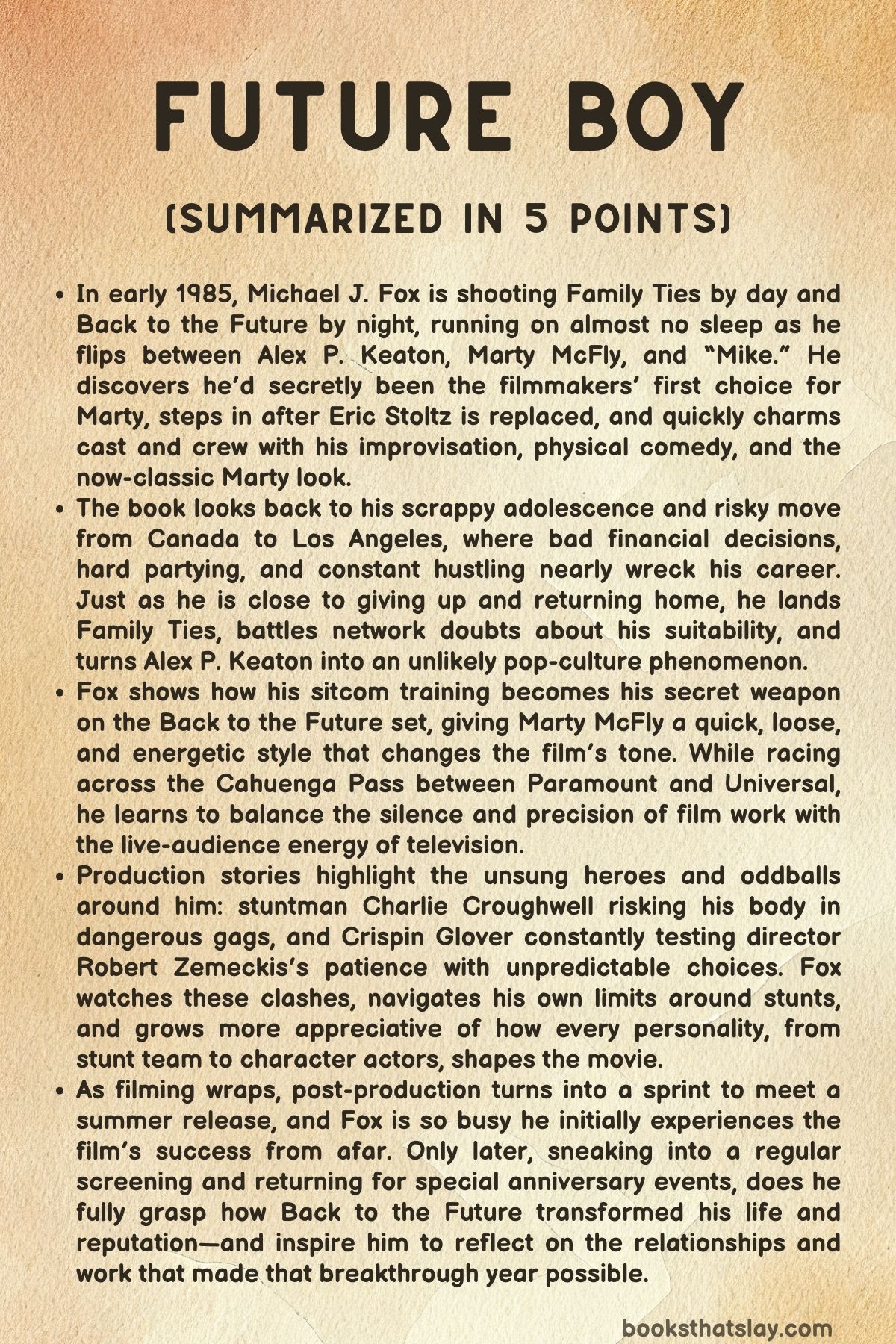
Future Boy by Michael J. Fox is an engaging reflection on the defining years of the actor’s early career — from his humble beginnings in Canada to his meteoric rise in Hollywood during the 1980s. Told with wit, humility, and an acute sense of self-awareness, the memoir captures Fox’s balancing act between television stardom on Family Ties and his breakout film role as Marty McFly in Back to the Future.
The book offers a vivid behind-the-scenes look at his relentless work ethic, comedic instincts, and the friendships and challenges that shaped him. It is both a nostalgic time capsule and a portrait of determination, creativity, and resilience.
Summary
The story opens in early 1985, when Michael J. Fox is working nearly around the clock — filming Family Ties by day and Back to the Future by night. His life at that moment becomes a blur of overlapping identities: Alex P. Keaton, Marty McFly, and simply Mike.
He humorously admits that while Einstein’s space-time theories dominated the movie’s dialogue, his real experience of time was defined by exhaustion and adrenaline.
Fox recalls stepping into Back to the Future midway through production, replacing Eric Stoltz. His first scene opposite Lea Thompson — the now-famous bedroom sequence where Marty wakes up in 1955 — is both awkward and exhilarating.
Lea, initially loyal to Stoltz, keeps her distance until Fox’s humor and improvisation win her over. By tweaking lines and adding comic touches, Fox immediately transforms the energy on set, earning laughter from director Robert Zemeckis and the crew.
That moment marks the beginning of his unique chemistry with the cast and his sense that the project could be something special.
Flashback to a month earlier: Fox learns from Family Ties showrunner Gary David Goldberg that he had been the filmmakers’ first choice for the role of Marty McFly. Months before, Steven Spielberg and Robert Zemeckis had approached Goldberg to borrow Fox, but with Meredith Baxter on maternity leave, the show couldn’t spare him.
After six weeks of filming, the producers realized Stoltz wasn’t the right fit and returned to Goldberg, desperate to get Fox. This time, the deal was struck — but with the condition that he couldn’t miss a single minute of Family Ties.
Fox didn’t hesitate; he accepted the role without even reading the script.
The dual schedule was grueling. He filmed sitcom scenes until evening, then drove to Universal Studios to shoot Back to the Future through the night.
Sleep was rare, but his enthusiasm never waned. The first night of filming — the Twin Pines Mall scene — was freezing and chaotic, yet exhilarating.
Fox describes running from the Libyans, driving the DeLorean, and performing with Christopher Lloyd amid exhaustion. Despite the relentless pace, his comedic precision revitalized the production, restoring the film’s missing spark.
As the film continued, Fox marveled at the professionalism around him: elaborate lighting rigs, fast-working prop crews, and the sheer scale of a Spielberg-backed project. His performance brought humor and rhythm that contrasted with Stoltz’s somber interpretation.
By the end of his first week, the crew could sense the difference — laughter had returned to the set, and Zemeckis knew the movie was back on course.
Interspersed with these memories are reflections on Fox’s earlier struggles. After finishing high school in British Columbia, he moved to Los Angeles in 1979 chasing acting dreams, only to face harsh realities.
Mismanaged finances, loneliness, and reckless living defined his early years. He nearly gave up, until a last-chance audition for Family Ties in 1982 changed everything.
Despite an initial rejection, casting director Judith Weiner gave him another shot, and he delivered a sharp, charismatic audition that landed him the part of Alex P. Keaton. NBC’s Brandon Tartikoff doubted his potential, claiming Fox would “never be on a lunchbox.” When Family Ties became a massive hit, Fox cheekily sent him a lunchbox with his face on it.
His comedic instincts and improvisation shaped the character of Alex Keaton, winning over audiences and co-stars alike. As Family Ties soared in popularity, Fox was suddenly balancing his hit series with a high-stakes film production.
The pressure was immense: shooting schedules overlapped, leaving him only a few hours of rest. Yet, his energy and professionalism impressed both Goldberg and Zemeckis.
Even while juggling scripts for two projects, he maintained sharp performances and boundless humor.
Fox’s narration shifts to the production’s behind-the-scenes chaos. Stuntman Charlie Croughwell joins the crew after bluffing his way onto the Universal lot and quickly becomes Fox’s double for dangerous sequences.
Fox admires Charlie’s courage, especially during risky skateboard stunts and explosive scenes. The DeLorean, however, was universally despised by the crew — uncomfortable, hot, and nearly impossible to maneuver.
On set, tensions occasionally flared, particularly between Zemeckis and Crispin Glover, who played George McFly. Glover’s eccentric behavior frustrated the director, often refusing to hit his marks.
Fox recalls trying to mediate, only to realize Glover operated on his own wavelength. Despite the friction, Fox later came to admire Glover’s performance, even writing him a letter years later praising his work.
Filming wrapped in April 1985. Fox could barely remember his final day on set, worn out after months of sleepless nights.
As Zemeckis and Gale screened the first cut for Spielberg and the Universal team, the response was overwhelmingly positive. A successful test screening in San Jose sealed the deal for an early July release.
While Fox was in London filming a Family Ties movie, he received news that Back to the Future had become a sensation. When he finally saw it in theaters, he was astonished by the audience’s reaction — laughter, applause, and sheer excitement.
He realized the film had transformed his life overnight.
The movie went on to become the highest-grossing film of 1985 and a cultural milestone. Fox describes sneaking into a theater to watch it anonymously, seated behind Jodie Foster, and leaving stunned at his newfound fame.
Years later, watching it at home, he finally allowed himself to feel proud, recognizing that his performance truly worked.
In the epilogue, Fox recounts reconnecting with Eric Stoltz years later. Though Stoltz had declined to participate in the book, they eventually met in New York and bonded over their shared passion for acting and film history.
The encounter reminded Fox that their careers had diverged, but both had found fulfillment in their own ways. What began as a professional overlap in 1985 had turned into mutual respect.
Throughout Future Boy, Fox reflects not only on fame but also on perseverance, humor, and human connection. The memoir captures a young actor learning to balance ambition with gratitude, discipline with spontaneity, and exhaustion with joy.
His journey from a struggling Canadian teen to an international icon is told with warmth, honesty, and self-deprecating wit — a reminder that the future he once raced toward was built one sleepless night at a time.
Key People
Michael J. Fox
At the heart of Future Boy, Michael J. Fox emerges as a dynamic and deeply reflective figure whose relentless drive, humor, and vulnerability define the narrative. Fox is portrayed as a man in constant motion, both literally and metaphorically, juggling his dual commitments to Family Ties and Back to the Future with almost superhuman determination.
His work ethic borders on obsession, driven by gratitude for every opportunity after years of financial instability and professional rejection. Despite the glamour surrounding him, Fox remains grounded in his humility—still seeing himself as the kid from Vancouver trying to make it in Hollywood.
His energy and charm, evident in his portrayal of both Alex P. Keaton and Marty McFly, become an extension of his personality: witty, instinctive, and fiercely committed. Yet beneath the humor lies exhaustion and a quiet fear of failure.
His recollections show a man grappling with identity—constantly shifting between his roles as actor, son, and celebrity—while learning to balance ambition with self-awareness. Fox’s emotional growth, from reckless young dreamer to mature performer, forms the emotional core of the book.
Gary David Goldberg
Gary David Goldberg, the showrunner of Family Ties, plays a paternal yet pragmatic role in Fox’s story. Initially a gatekeeper who denies Fox the chance to film Back to the Future due to production conflicts, Gary ultimately becomes one of the key enablers of Fox’s success.
His relationship with Fox is one of tough love and deep respect—he recognizes Fox’s immense talent but also feels responsible for keeping him grounded. Goldberg embodies the mentor archetype, offering both opportunities and boundaries that shape Fox’s discipline and loyalty.
Even when Fox’s fame threatens to eclipse Family Ties, Gary’s integrity and sense of fairness prevent resentment, creating a lasting bond rooted in mutual trust.
Robert Zemeckis
Director Robert Zemeckis is depicted as both visionary and exacting—a creative force who understands cinematic rhythm and timing as intimately as Fox understands comedic instinct. His perfectionism often leads to friction on set, particularly with actors like Crispin Glover, yet it is precisely this meticulousness that ensures Back to the Future’s timeless quality.
Zemeckis recognizes Fox’s comedic precision immediately and adjusts the film’s tone to align with his strengths, restoring the humor and energy lost during Eric Stoltz’s earlier tenure. Though demanding, Zemeckis also appreciates spontaneity and collaboration, laughing at Fox’s improvised lines and encouraging his physical humor.
His relationship with Fox reflects the delicate balance between director and performer—structured vision meeting raw instinct—and together they elevate the film into cinematic history.
Lea Thompson
Lea Thompson, who plays Lorraine Baines, begins as a distant and skeptical costar, loyal to Eric Stoltz, but her dynamic with Fox evolves rapidly into one of mutual respect and easy chemistry. Initially cold, she soon recognizes Fox’s quick wit and improvisational brilliance, which not only enhance their scenes but also ease the tension of his late arrival to the project.
Their playful rapport and professional camaraderie inject warmth into the film’s emotional core, making the mother-son dynamic both endearing and comedic. Thompson serves as a mirror to Fox’s adaptability—her openness allows him to integrate seamlessly into a production already in motion, demonstrating how mutual trust among actors can transform a film’s atmosphere.
Christopher Lloyd
Christopher Lloyd, as Doc Brown, represents the perfect foil to Fox’s Marty McFly—a blend of eccentric genius and grounded sincerity. On and off screen, Lloyd’s quiet intensity complements Fox’s kinetic energy.
Their relationship is built on respect and rhythm; Fox often relies on Lloyd’s steadiness to match his improvisations. The two actors share moments of silent camaraderie, especially during tense days on set, highlighting the unspoken bond between professionals who understand the demands of their craft.
Lloyd’s meticulous attention to timing and gesture deepens the duo’s chemistry, creating one of cinema’s most iconic partnerships.
Eric Stoltz
Eric Stoltz’s shadow lingers throughout Fox’s recollections, serving as both a cautionary tale and a source of reflection. Originally cast as Marty McFly, Stoltz’s performance is described as earnest but tonally misaligned with the film’s lighthearted spirit.
Fox portrays him with empathy rather than condescension, recognizing Stoltz’s seriousness as an artistic difference rather than failure. Their eventual meeting years later, where they bond over shared experiences and artistic ideals, underscores Fox’s maturity and grace.
Stoltz becomes a symbol of the unpredictable nature of success—proof that talent alone does not guarantee the right fit—and Fox’s treatment of him reflects both humility and respect.
Crispin Glover
Crispin Glover, who portrays George McFly, stands out as a mercurial and unpredictable presence. His eccentric behavior and resistance to direction make him a challenge for both Zemeckis and his fellow actors.
Fox recounts Glover’s unconventional methods with a mix of amusement and bewilderment—his refusal to hit marks, his sudden “sweep of indignation,” and his deep commitment to misunderstood motivations. Despite these frustrations, Fox later acknowledges Glover’s uniqueness, recognizing that his quirks ultimately enrich George’s awkward authenticity.
Glover embodies the artistic rebel—brilliant, difficult, and uncompromising—and his clashes with the structured filmmaking process highlight the tension between creative freedom and collaborative discipline.
Charlie Croughwell
Charlie Croughwell enters the narrative as an unsung hero—the stunt double who becomes Fox’s physical alter ego. Discovered almost by chance, Charlie’s resemblance to Fox and fearlessness earn him a pivotal role in executing Back to the Future’s most daring stunts.
His professionalism and quiet courage command Fox’s admiration, especially after he sustains injuries yet continues to work without complaint. Charlie represents the invisible labor behind cinematic illusion, a reminder of the teamwork and trust that underpin every star performance.
His partnership with Fox transcends utility; it becomes a metaphor for duality—the actor’s visible face paired with another’s unseen bravery.
Themes
Ambition and the Relentless Pursuit of Success
In Future Boy, Michael J. Fox’s story reveals how ambition can propel a person toward unimaginable heights while simultaneously testing the limits of endurance. His commitment to fulfilling dual responsibilities—shooting Family Ties by day and Back to the Future by night—shows a young actor driven by an almost ferocious desire to prove himself.
The hunger for success is not merely professional; it stems from deep-seated insecurity about his place in Hollywood. Having once faced near destitution and the threat of returning to Canada, Fox views opportunity as something to be seized at all costs.
Ambition becomes his fuel, pushing him beyond physical and emotional exhaustion. Yet, it is not portrayed as blind obsession.
Fox’s ambition is intertwined with gratitude and self-awareness; he understands the precariousness of fame and the fragility of success in an industry that can forget overnight. His determination to honor his commitments—to Gary David Goldberg for Family Ties and to Robert Zemeckis for Back to the Future—reflects his belief in discipline as much as drive.
The narrative portrays ambition as both a survival mechanism and an act of faith: a belief that effort and resilience can overcome fatigue, doubt, and circumstance. Fox’s journey demonstrates how ambition, when tempered with humility, transforms from raw desire into purposeful motion.
It is not about domination or ego, but about building a life worthy of the chances given. Through his sleepless months of overlapping productions, Fox embodies ambition as endurance—a willingness to give everything to a dream before it slips away.
Identity and the Search for Self
Throughout Future Boy, Fox’s life oscillates between different identities—Alex P. Keaton, Marty McFly, and Michael J. Fox himself. This fluidity becomes a central theme, exploring how professional roles shape, obscure, and ultimately refine one’s sense of self.
The early chapters portray Fox in constant transformation, caught between sitcom rehearsals and film sets, literally crossing Los Angeles each night to inhabit new realities. Yet beneath the costume changes lies a more profound struggle: the attempt to understand where performance ends and the person begins.
The book suggests that identity is not static but cumulative, built from fragments of experience and memory. Fox’s portrayal of Alex and Marty reflects two sides of his personality—the calculated intellect of the former and the impulsive energy of the latter.
Balancing both simultaneously exposes his adaptability but also his vulnerability. The blurring of self and character mirrors his own confusion about fame and authenticity.
As his stardom grows, he must reconcile the version of “Mike Fox” his family knows with the public figure adored worldwide. His reflections on youth, risk, and insecurity underline a deeper awareness that self-definition is a lifelong process.
By the end, Fox’s identity feels less divided and more integrated—his work and life no longer competing forces but parts of a coherent whole. His correspondence with Eric Stoltz reinforces this realization: that even rivalries and replacements contribute to self-understanding.
Identity, in Fox’s narrative, emerges not from certainty but from movement—the continual negotiation between who one is, who one plays, and who one becomes.
Perseverance and Resilience in Adversity
Resilience stands as a cornerstone of Future Boy, underscoring Fox’s evolution from struggling actor to cultural icon. The obstacles he faces—financial instability, physical exhaustion, creative uncertainty—are presented not as moments of defeat but as turning points that forge character.
His willingness to endure punishing work schedules without complaint demonstrates a remarkable mental and emotional toughness. The Hollywood system, indifferent and often cruel, tests him repeatedly, yet his perseverance stems from a blend of humor, optimism, and sheer stubbornness.
The early years of hardship, marked by poor living conditions and rejection, serve as the crucible that prepares him for the pressures of fame. Fox’s resilience is not limited to external challenges; it also encompasses his internal discipline to stay grounded amid chaos.
Whether dealing with tense production dynamics, such as Crispin Glover’s unpredictability, or the unrelenting demands of dual shooting schedules, he responds with adaptability rather than resentment. His humor becomes both armor and release, transforming fatigue into performance energy.
What makes Fox’s perseverance compelling is its humanity—he does not present himself as invincible but as someone who keeps showing up regardless of circumstances. His later realization that exhaustion and triumph coexisted in those years reveals the paradox of resilience: it is sustained not by strength alone but by belief in the worth of the struggle.
Through his journey, perseverance becomes less about heroism and more about endurance with grace—the quiet courage to continue when success demands more than one thinks they can give.
Friendship, Collaboration, and the Creative Bond
A recurring theme in Future Boy is the significance of collaboration—the interplay of trust, humor, and respect that defines Fox’s relationships with colleagues and mentors. The book portrays Hollywood not as a collection of egos but as a fragile ecosystem where chemistry determines success.
From his bond with Lea Thompson and Christopher Lloyd to his partnership with Gary David Goldberg, Fox’s career flourishes through shared creativity rather than isolated genius. Each relationship shapes his artistry differently: Goldberg offers guidance and stability, Zemeckis inspires precision and experimentation, and Lloyd models professionalism under pressure.
These collaborations remind Fox that acting is less about individual brilliance than about listening, timing, and generosity. The narrative’s depiction of behind-the-scenes dynamics—like the delicate handling of Stoltz’s replacement or the camaraderie with stunt performers—highlights how respect builds trust even in high-stakes environments.
The friendship that later develops between Fox and Stoltz becomes an emblem of emotional maturity, showing how competition can evolve into mutual appreciation. Fox’s awareness of others’ contributions contrasts sharply with the self-absorption often associated with stardom.
He acknowledges that without the support of crews, directors, and friends, his own performances would have lacked the vitality audiences loved. Collaboration, for Fox, is the invisible force behind creativity—a shared rhythm that turns long nights and chaotic shoots into moments of collective triumph.
It reinforces the idea that great art is born not from isolation but from the synergy of people united by purpose, humor, and respect.
The Passage of Time and the Meaning of Legacy
Time functions as both literal and symbolic thread throughout Future Boy. Fox’s constant commute between television and film mirrors the temporal dislocation that defines his life—days and nights blending, years collapsing into moments of success.
The motif of time extends beyond the film Back to the Future and into Fox’s reflections on aging, memory, and legacy. His recollections of childhood trips through the Cahuenga Pass and early struggles in Los Angeles serve as emotional checkpoints in a life shaped by relentless motion.
Time, for Fox, is both adversary and teacher. It exhausts him through endless schedules yet rewards him with perspective.
The film’s success immortalizes him as Marty McFly, freezing a version of himself in cinematic history even as he continues to grow beyond it. This awareness of legacy permeates the later sections of the narrative, where he watches the movie years later and finally allows himself to feel pride rather than self-criticism.
Time becomes a measure not only of career milestones but of emotional growth—the shift from restless ambition to reflective gratitude. The enduring popularity of Back to the Future, celebrated decades later with orchestral performances and audience cheers, reminds him that art transcends its moment.
Legacy, then, is not the preservation of fame but the endurance of connection—how one’s work continues to inspire and entertain long after the exhaustion fades. In embracing the passage of time, Fox recognizes that his greatest achievement lies not in perpetual motion, but in the moments that endure beyond it.