Girl Dinner Summary, Characters and Themes
Girl Dinner by Olivie Blake is a dark satirical novel about female ambition, motherhood, power, hunger, desire, and the systems that determine what women are permitted to want. Through the parallel lives of Sloane Hartley, an exhausted academic mother, and Nina Kaur, an ambitious college student seeking entry into an elite sorority, the story examines how women respond to institutional inequality and personal vulnerability.
What initially appears to be a story about academia, marriage, sisterhood, and sorority culture gradually becomes something far stranger and more disturbing. The women at the center of the novel discover that power can demand sacrifice, and the book turns the language of female hunger into a literal, violent question about what women are willing to consume in order to survive and succeed.
Summary
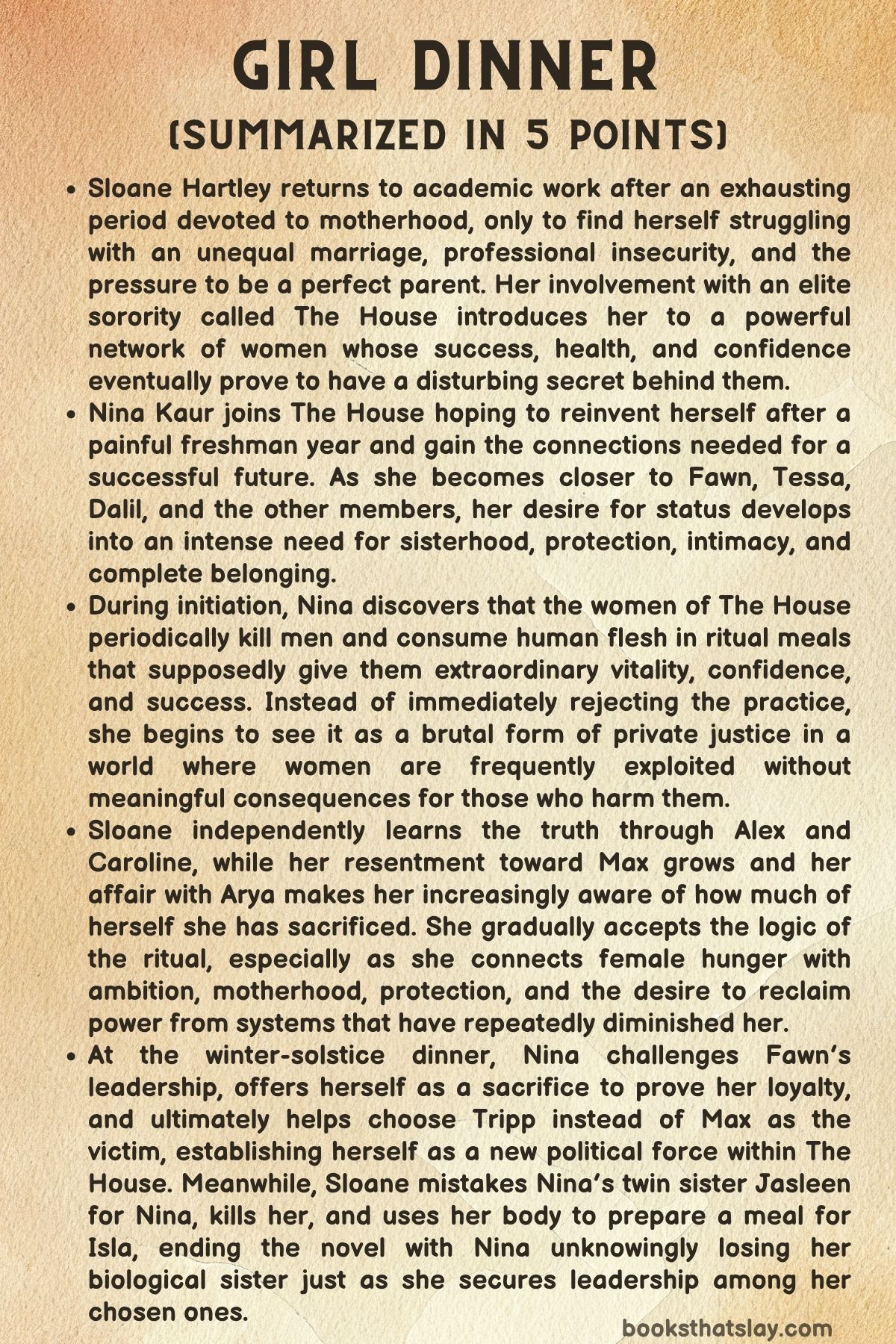
Sloane Hartley is preparing to return to academic work after spending an extended period at home with her eighteen-month-old daughter, Isla. Motherhood has transformed her life, leaving her exhausted by childcare, household labor, worries about Isla’s development, and the realization that her husband, Max Villanueva, has continued living with far greater freedom.
Sloane once possessed a promising academic career of her own, but she abandoned a tenure-track position so Max could accept a prestigious University appointment. Now she works there in an insecure role and feels that she has become an accessory to her husband’s career rather than an intellectual equal.
Her return to work offers no immediate relief. Leaving Isla at daycare fills her with guilt, while Dean Burns expects professional involvement that ignores the practical demands of motherhood.
At the same time, Sloane becomes attracted to Arya, the handsome doctoral student assigned as her teaching assistant. The attraction embarrasses her, but it also reminds her that beneath the identities of mother, wife, and struggling academic, she still possesses an independent sexual self.
Elsewhere at the University, sophomore Nina Kaur participates in sorority recruitment. Nina is ambitious, intelligent, financially conscious, and determined to transform herself after a disastrous first year.
Her greatest goal is admission to an elite sorority she privately thinks of simply as The House. Its members seem unusually beautiful, accomplished, healthy, connected, and confident, making membership appear to Nina like entry into a protected class of women destined for success.
Nina’s twin sister, Jasleen, distrusts the values represented by the organization. Their arguments about privilege, feminism, capitalism, race, and ambition repeatedly challenge Nina’s desire to use an elite institution as a route toward opportunity.
Nina nevertheless continues recruitment and becomes fascinated by Fawn Carter, the sorority president. Fawn possesses the beauty, confidence, charisma, and authority Nina associates with everything she wants from The House.
Sloane becomes connected to the same organization through Alex Carlisle, an accomplished alumna and mother she first meets outside daycare. Alex understands Sloane’s anxieties about motherhood without judging them and gradually draws her into a community of capable women.
Sloane agrees to become The House’s faculty adviser, partly because she needs extracurricular work to strengthen her position at the University. Yet what attracts her most is the experience of female support: women share responsibilities, children are cared for, and Sloane briefly feels that motherhood does not have to isolate her.
Nina successfully receives a bid and begins the initiation process. As she spends more time with members such as Tessa, Dalil, Alina, and Fawn, her original interest in professional connections develops into an emotional need for complete belonging.
The rituals, communal meals, private traditions, and declarations of loyalty make The House feel increasingly separate from ordinary campus life. Nina notices that its members also possess extraordinary health and vitality, while their relationship with food carries a strange intensity.
Meanwhile, Sloane begins developing a new research project about female ambition and the contradictory ways women acquire social power. Her work leads her to study House alumnae, including Caroline Collins, an educated former member who has become a successful traditional-homemaking influencer called The Country Wife.
Caroline fascinates Sloane because she has transformed domestic femininity into a lucrative business. Rather than fitting neatly into Sloane’s assumptions about conservative homemaking, Caroline demonstrates that domesticity itself can become another strategy for gaining money, independence, status, and influence.
Sloane’s investigations occur while her resentment toward Max continues increasing. She recognizes that their supposedly progressive marriage still leaves her performing most childcare and household management while Max assumes his career and personal time deserve protection.
Nina reaches initiation believing more sincerely in the sorority than she ever expected. Blindfolded rituals, vows of loyalty, ceremonial behavior, and intense physical intimacy create the feeling that she is crossing into something older and more serious than an ordinary student organization.
During the final stage, Nina drinks from a ceremonial cup and realizes the liquid is blood. She soon learns the complete secret: members periodically kill men and consume human flesh in ritual meals that supposedly provide extraordinary health, energy, beauty, clarity, and success.
Rather than immediately rejecting the practice, Nina begins rationalizing it through her existing beliefs about injustice. Her own history includes a sexual violation during her first year, and she knows that conventional institutions did not deliver meaningful justice afterward.
The House therefore offers her something both terrible and seductive: a private system in which women possess the power to punish men and protect one another. Nina’s attraction to Fawn also becomes sexual, further connecting desire, sisterhood, violence, and belonging.
Sloane independently discovers the same secret after interviewing Caroline at her farmhouse. Caroline hints that The House’s respectable public image conceals something far more disturbing, and Alex eventually confirms that the women conduct ritual meals involving human flesh.
Sloane reacts with horror, but Alex forces her to consider what she would sacrifice for health, beauty, professional success, security, and power. The question becomes harder for Sloane to dismiss because the ordinary systems around her have already demanded sacrifices while offering much less in return.
Her professional situation deteriorates when Dean Burns threatens to reduce her teaching hours because she has not contributed enough outside the classroom. His refusal to treat parenthood as a legitimate constraint confirms Sloane’s growing belief that institutions define success according to standards created around lives unlike hers.
Her marriage deteriorates as well. Max continues behaving as though his professional goals should determine the family’s structure, and Sloane begins suspecting that something serious has happened between him and a student.
Sloane starts a sexual affair with Arya. The relationship restores some of her sense of desirability and independence, but it also reveals how far she has emotionally moved from Max.
Nina’s relationship with Fawn similarly becomes more unstable. As Nina becomes a full member, she realizes that Fawn’s politics are inconsistent and that much of the principled language Nina admired actually came from women such as Tessa.
When House politics turn toward the next presidential election, members begin considering Nina as an alternative to Fawn. Fawn reacts angrily, revealing that her commitment to sisterhood becomes conditional whenever her personal authority is threatened.
The conflict intensifies when Fawn dismisses concerns about compromising material from Dalil’s past because it could damage the careers of other sisters. Nina is horrified that Fawn treats another young woman’s victimization as a strategic liability rather than something deserving compassion.
Nina accepts the nomination for president. By this point, she has not rejected The House’s violence; instead, she believes its power should serve the collective interests of the women rather than the personal revenge of whoever happens to lead it.
Sloane also moves closer to accepting the logic surrounding the ritual. During another visit with Caroline and Alex, she eats food presented in a context where its origins are deliberately uncertain and experiences an extraordinary improvement in her physical and emotional condition.
Caroline later explains that choosing a victim cannot be based simply on hatred. According to her, the ritual requires a complicated form of desire or attachment, suggesting that consumption has meaning only when something emotionally significant is being surrendered.
Sloane begins thinking about Nina, whom Arya describes as intelligent, earnest, open, and vulnerable. Nina comes to represent the young women Sloane fears will eventually suffer the same disappointments, exploitation, and dangers that generations before them have faced.
The winter-solstice dinner at The House brings these conflicts together. Each member brings a potential male candidate, and Fawn arrives with Max, whom she has secretly selected as a possible victim.
Nina is shocked to learn that Fawn knows Max personally and believes he represents the kind of powerful professor who exploits younger women. Max is stunned and incapacitated before he can escape.
When Nina is asked to nominate a candidate, however, she does something unexpected and offers herself. She argues that if sisterhood truly requires sacrifice, then she should be willing to feed the women she has sworn to protect.
The House refuses to kill Nina, but her gesture transforms her political position. By offering everything she has, she demonstrates a level of devotion that Fawn cannot easily challenge.
The women then debate whether they should kill Max or Tripp, Alina’s privileged boyfriend. Fawn favors Max because of her personal grievances, while others argue that the decision should be based on what would most benefit the entire group.
Nina chooses Tripp, demonstrating the leadership philosophy she intends to follow. She accepts the ritual and its violence but believes individual vengeance must remain subordinate to the collective interests of the sisterhood.
After the meal, Nina emerges as the likely future leader of The House. She no longer believes power must be innocent to be legitimate; what matters to her is choosing a side and remaining loyal to it.
Sloane, meanwhile, prepares her own private version of dinner. She leaves Isla with Britt and Finn, buys supplies, acquires a stun gun, and approaches a dark-haired young woman outside The House whom she believes to be Nina.
The woman is actually Jasleen, Nina’s twin sister, who has come to campus as a surprise. Because the sisters resemble one another, Sloane makes a devastating mistake.
Nina later learns from Arya that Jas has arrived on campus but has disappeared. Her unanswered phone and absence indicate that something terrible has occurred while Nina has been inside celebrating her new authority.
The final scene returns to the domestic image with which Sloane’s story began: spaghetti Bolognese. After disposing of a disemboweled body at Caroline’s farmhouse, Sloane cooks a sauce using fresh liver, focusing specifically on its iron because Isla has been iron deficient.
For the first time, Isla enthusiastically eats the meal and asks for more. Sloane experiences the moment as a maternal success, even though the reader understands that the nourishment has resulted from an act of horrifying violence.
Max arrives home shaken and announces that he needs to confess something, but Sloane refuses to deal with him immediately. She orders him to eat while Nina continues desperately trying to reach Jas.
The novel therefore ends with two radically altered women. Nina has gained the powerful sisterhood she once wanted but unknowingly lost the sister who existed before it, while Sloane has finally created the nourishing family dinner she desired by embracing the very appetite that once seemed unimaginable.
Characters
Sloane Hartley
Sloane is the central adult consciousness of Girl Dinner, and her struggle begins with the collision between motherhood and an identity built around measurable achievement. She loves Isla intensely, yet the constant demands of parenting leave her feeling physically depleted and professionally diminished.
Her frustration is intensified by the unequal structure of her marriage. Max may consider himself progressive, but Sloane gradually realizes that his career, hobbies, and personal time continue to receive protection while her own ambitions are treated as flexible.
Sloane’s anxiety about being a “good” mother grows from the same perfectionism that once shaped her academic life. Because parenting provides no grades, promotions, or clear measures of success, she becomes vulnerable to obsessive worries about Isla’s food, teeth, iron, sleep, daycare adjustment, and development.
Her attraction to Arya marks the return of a self that motherhood has suppressed. The affair is reckless and ethically complicated, but psychologically it allows Sloane to experience desire without immediately translating herself into someone else’s wife or mother.
Her intellectual development is equally important. Studying The House and Caroline allows her to examine how women transform beauty, domesticity, motherhood, sexuality, education, and social networks into different forms of power.
Sloane’s eventual movement toward violence is disturbing precisely because it develops gradually from ordinary frustrations. By the ending, protecting and nourishing Isla have become fused with hunger, resentment, ambition, and a willingness to cross boundaries she once considered absolute.
Nina Kaur
Nina is the younger protagonist of Girl Dinner, and her story begins with reinvention. After suffering during her first year, she approaches sorority recruitment as a strategic opportunity to secure connections, achievement, prestige, and a future in which she will never again feel powerless.
Her ambition is not shallow. Nina understands money, debt, social capital, race, family expectations, and the uneven distribution of opportunity, so joining The House becomes part of a deliberate plan to build security for herself and eventually help her parents.
Her emotional needs soon exceed that original plan. Nina wants not only the institution’s advantages but also its intimacy, traditions, approval, protection, and certainty that she has been selected as someone worthy of belonging.
Her fascination with Fawn reflects this longing. Nina initially idealizes Fawn as the perfect embodiment of beauty, confidence, sexuality, authority, and ideological independence, which makes their eventual relationship extraordinarily powerful for her.
The revelation of cannibalism does not destroy Nina’s loyalty because her own experience with sexual violation has already damaged her faith in conventional justice. She begins treating the ritual as an extreme response to a world where women routinely experience exploitation without adequate consequences for those responsible.
Her development culminates in political clarity. Nina stops idealizing Fawn but does not abandon The House, choosing instead to believe that power becomes defensible when it is directed toward the collective rather than private revenge.
Her offer to sacrifice herself demonstrates both genuine devotion and extraordinary political instinct. It proves she has become capable of using symbolic sacrifice, moral language, and dramatic action more effectively than the leader she once worshipped.
Max Villanueva
Max is central to Sloane’s disillusionment because he represents the supposedly enlightened man whose progressive identity does not prevent unequal behavior. He benefits from Sloane giving up a stronger academic position, yet he rarely treats that sacrifice as something requiring continuing repayment or adjustment.
His selfishness is usually mundane rather than theatrical. He fails to anticipate domestic needs, leaves logistical responsibility to Sloane, assumes his time is available for personal priorities, and often treats family work as something she naturally manages.
That ordinariness is important because it explains why Sloane tolerated the imbalance for so long. Max does not initially appear monstrous, which allows his privileges to hide inside apparently normal marital routines.
Nina’s early attraction to him also demonstrates how authority can make ordinary men appear more fascinating than they are. Once she encounters him outside the classroom, much of that attraction disappears because she can finally see the middle-aged husband behind the academic performance.
His eventual appearance as Fawn’s proposed victim introduces the possibility that his behavior with students has crossed much more serious lines. The book leaves some details incomplete until the closing moments, when Max returns home prepared to confess something Sloane already suspects will confirm her fears.
Isla Villanueva
Isla is too young to understand the adult conflicts surrounding her, but she is one of the most powerful forces shaping Sloane’s decisions. Sloane’s love for her daughter creates both extraordinary tenderness and relentless fear.
The child becomes the center of Sloane’s anxieties about motherhood. Every issue involving food, health, separation, daycare, or development becomes evidence Sloane uses to judge herself.
Isla also represents the future Sloane wants to protect. Sloane knows that her daughter will eventually encounter the same social judgments, sexual dangers, institutional inequalities, and pressures that have affected the women around her.
The ending turns Isla’s hunger into one of the novel’s darkest symbols. When she finally enjoys the Bolognese Sloane prepares, maternal success and moral horror become inseparable.
Alex Carlisle
Alex is one of the most influential figures in Girl Dinner because she introduces Sloane to a model of female adulthood built around confidence, mutual assistance, and unapologetic ambition. Their friendship begins when Alex understands Sloane’s daycare distress in a way that immediately makes Sloane feel recognized.
She repeatedly challenges the assumptions governing Sloane’s life. Alex questions why women must continually prove their competence, why motherhood should require martyrdom, and why Sloane treats institutional expectations as naturally legitimate.
Her support is genuine, but it also draws Sloane closer to the secret practices of The House. Alex believes the ritual provides tangible advantages and has morally accommodated violence as the price of protecting and strengthening women within her community.
What makes Alex persuasive is her refusal to behave like a stereotypical villain. She is funny, competent, maternal, professionally accomplished, attentive to Sloane, and capable of practical care, making her worldview far harder for Sloane to dismiss.
Fawn Carter
Fawn initially appears in Girl Dinner as the personification of everything Nina believes The House can provide. Her beauty, authority, sexual confidence, composure, and status give her an almost unreal presence during recruitment.
For Nina, attraction and aspiration become inseparable around Fawn. Nina wants Fawn sexually, but she also wants to become the kind of woman whose approval carries the same force.
Fawn’s limitations emerge once her authority is threatened. Although she speaks the language of sisterhood and liberation, she can dismiss another woman’s victimization when it threatens the reputation or ambitions of members she considers strategically valuable.
Her relationship with Caroline further reveals Fawn’s attraction to personal justice and transgression. She prefers a model of power that permits individual vengeance, especially against men she regards as exploitative.
Fawn’s selection of Max demonstrates this weakness. Her motive may involve real wrongdoing, but her inability to separate private anger from collective judgment allows Nina to challenge her legitimacy.
Tessa
Tessa becomes one of Nina’s most important links to the internal culture of The House. As Nina’s Big Sister, she provides the intimacy and long-term connection Nina hoped membership would create.
Unlike Fawn, Tessa possesses greater awareness of the moral contradictions within the organization. She believes in the institution while still recognizing the difference between collective principles and personal power struggles.
Tessa’s support of Nina as a potential president is therefore significant. She sees that Nina’s idealism has survived even after initiation, making Nina capable of renewing the institution rather than merely inheriting Fawn’s habits.
Her final discomfort with Nina’s harder worldview shows that Tessa did not fully anticipate what Nina would become. She hoped Nina might represent a morally cleaner alternative, whereas Nina ultimately embraces the violent foundation of The House without pretending otherwise.
Dalil Serrano
Dalil is one of Nina’s earliest genuine friends during recruitment. Her humor and confidence make the exhausting process less isolating, and their shared initiation creates a bond based on secrets unavailable to outsiders.
Her past also demonstrates the cruelty of institutional respectability. When compromising sexual material associated with her is discussed as a potential political liability, Fawn treats Dalil’s vulnerability as a threat to other women’s careers.
Nina’s reaction to this becomes a turning point because she recognizes that a sisterhood willing to sacrifice a young woman’s dignity for reputation has reproduced the same logic it claims to resist. Dalil’s continued belief in The House nevertheless shows how powerful the promise of belonging remains even when the institution itself has failed its members.
Jasleen Kaur
Jasleen is Nina’s twin and her most important connection to a life outside The House. Her political skepticism, humor, and arguments with Nina provide a constant counterweight to Nina’s hunger for prestige and institutional approval.
Jas questions capitalism, elite networks, racial privilege, sorority culture, and the compromises Nina accepts in pursuit of power. She rarely provides easy alternatives, but her criticism forces Nina to confront the moral cost of the choices she makes.
The twins remain emotionally connected despite their disagreements. Nina can joke that The House has given her new sisters, but Jas represents a sisterhood that requires no initiation, ritual, achievement, or proof.
Her death is therefore the novel’s harshest irony. Nina sacrifices symbolically for her chosen sisters while Sloane accidentally takes the life of the sister Nina never needed to earn.
Arya
Arya functions as both an object of Sloane’s desire and a bridge between the novel’s older and younger characters. His competence, attractiveness, and attentiveness contrast sharply with the exhaustion and neglect Sloane associates with domestic life.
Their affair gives Sloane temporary access to a less burdened version of herself. Yet the relationship never becomes a simple escape because Sloane knows that desire alone cannot repair her marriage, career, or broader dissatisfaction.
Arya’s connection to Nina and Jas also becomes crucial. His protective description of Nina helps Sloane imagine her as a vulnerable young woman rather than merely another student.
His messages near the ending reveal Jas’s disappearance. Without understanding what Sloane has done, Arya becomes the person who connects the mistaken identity outside The House to Nina’s growing realization that her twin is missing.
Caroline Collins
Caroline is one of the most intellectually provocative characters in Girl Dinner because she openly commercializes a version of femininity that Sloane initially views with contempt. Her Country Wife persona appears traditional, submissive, and domestic, yet Caroline herself is educated, calculating, entrepreneurial, and highly independent.
She understands contradiction as a source of power rather than embarrassment. By monetizing homemaking, she argues that she receives compensation for labor women are often expected to perform privately without recognition.
Caroline differs from The House because she personalizes violence. Instead of following a carefully controlled collective ritual, she chooses victims according to her own moral judgments and acts as a private executioner.
She is also the person who helps Sloane understand that hatred alone is insufficient for the ritual’s meaning. Her claim that sacrifice must contain desire, attachment, or love pushes Sloane toward a much more dangerous interpretation of nourishment.
Britt Landau
Britt helps connect Sloane with the alumnae network and provides another example of an adult woman who has benefited from an intensely female community. Her discussions of motherhood validate Sloane’s sense that competence does not eliminate exhaustion.
Her household also offers Sloane a practical vision of shared care. Watching Finn handle children comfortably allows Sloane to experience social connection without constantly monitoring Isla.
Finn
Finn appears primarily through his domestic competence. His willingness to care for children without treating the task as extraordinary provides a quiet contrast with Max.
He also remains outside the secret shared by the women. Sloane’s realization that Finn apparently does not know about the ritual demonstrates how carefully female intimacy and institutional secrecy exclude even supportive men.
Dean Burns
Dean Burns represents institutional authority within academia. His judgments reinforce Sloane’s belief that professional standards are presented as neutral even when they depend upon workers having few responsibilities outside their careers.
He dismisses the research questions that genuinely excite Sloane and later threatens to reduce her work because her extracurricular contributions are insufficient. His behavior transforms academic precarity from an abstract concern into a direct threat to Sloane’s financial and intellectual independence.
Alina Antwerp
Alina is an important participant in the political structure of The House. She helps expose tensions surrounding Fawn’s leadership and considers alternatives capable of representing the institution more effectively.
Her decision to bring Tripp to the solstice dinner demonstrates the severity of her commitment. She is willing to offer someone personally connected to her if she believes the sacrifice will benefit the collective.
Tripp
Tripp functions primarily as a potential sacrifice. His youth, privilege, physical vitality, and social position make him valuable in the logic used by members during the dinner.
His selection over Max reveals Nina’s developing philosophy of leadership. She chooses according to what she believes will most benefit the group rather than what would best satisfy Fawn’s anger.
Simone
Simone belongs to Nina’s pre-House social life and helps show how quickly Nina’s identity changes after initiation. Her relatively calm acceptance of Nina moving into The House contrasts with the deeper transformation Nina herself is undergoing.
As Nina becomes absorbed by the sorority, relationships such as her friendship with Simone gradually become secondary. This emphasizes the extent to which membership reorganizes Nina’s emotional priorities.
Maud
Maud appears most significantly during the pledge gathering in which the women share intimate secrets. Her teasing observations about Nina and Fawn help Nina acknowledge desires she has been trying to manage privately.
Her presence also contributes to the atmosphere of confession that makes the pledge class feel emotionally bound together. Personal disclosure becomes another form of initiation long before the blood ritual reveals the organization’s deepest secret.
Theo
Theo is one of the children within the alumnae social circle. Although he plays only a minor role, his presence contributes to Sloane’s realization that children can exist within adult social life without consuming the entire identity of their mothers.
The easy interaction among children, mothers, and caregivers contrasts with Sloane’s isolated experience at home. That difference helps explain why the alumnae network feels so attractive to her.
Themes
Female Hunger, Desire, and Consumption
Hunger in Girl Dinner operates simultaneously as physical appetite, sexual desire, ambition, resentment, intellectual curiosity, and the craving for recognition. Women are repeatedly told to restrain themselves, whether the appetite involves food, career advancement, anger, sex, authority, or simply the wish to possess more time for themselves.
The House turns this cultural pressure into literal consumption. Its members do not merely describe themselves as hungry for power; they consume bodies and believe the meal strengthens their health, intelligence, confidence, and future prospects.
That literalization forces an uncomfortable comparison between socially accepted and forbidden forms of consumption. Institutions consume time, ambition, emotional energy, domestic labor, and even the futures of people with less power, yet those forms of extraction remain ordinary because society has normalized them.
Nina understands this logic through capitalism and sexual injustice. If success already depends on benefiting from unequal systems, the House ritual begins to look to her like an unusually visible version of a structure that normally hides who is being sacrificed.
Sloane reaches the same idea through motherhood and marriage. She has spent years feeding everyone else emotionally, professionally, and domestically until the possibility of feeding herself becomes associated with reclaiming something she believes she has been denied.
The final Bolognese scene completes this theme with brutal precision. Sloane finally succeeds in nourishing Isla, but the meal reveals what happens when care, hunger, love, and possession lose the boundaries that once separated them.
Sisterhood, Belonging, and the Price of Protection
Nina initially wants The House because she believes belonging to an elite network will improve her future. What she discovers is far more emotionally powerful: a community that offers ritual, intimacy, professional assistance, physical safety, shared secrets, and a ready-made identity.
This explains why learning the truth does not immediately drive her away. She has already experienced the outside world as a place where harm can occur without justice, while The House promises that a woman who enters its walls will never face danger alone.
Sloane is attracted by a related form of protection. Alex, Britt, and the other alumnae provide the support she expected marriage and academia to provide but often did not.
The novel nevertheless asks whether protection becomes dangerous when loyalty is treated as morally sufficient. The House protects its members, but that protection depends upon secrecy, exclusion, violence, and eventually murder.
Fawn demonstrates how easily the language of sisterhood can serve personal authority. When Dalil’s past becomes politically inconvenient, Fawn is willing to treat her suffering as a reputational problem, revealing that solidarity can disappear when power is threatened.
Nina responds by creating her own standard of loyalty. Her willingness to offer herself as food represents an extreme belief that leadership should demand sacrifice from the leader before demanding it from others.
The tragic contrast is Jasleen. While Nina proves loyalty to chosen sisters, the biological sister who has loved and challenged her without requiring any ritual becomes the accidental casualty of the same world Nina has chosen to enter.
Motherhood, Domestic Labor, and Impossible Standards
Motherhood in Girl Dinner is presented as both genuine love and relentless labor. Sloane never doubts her devotion to Isla, but devotion does not erase exhaustion, resentment, boredom, fear, or the professional consequences of being the parent who automatically absorbs disruption.
Much of Sloane’s distress comes from invisible work. She remembers appointments, meals, clothing, daycare arrangements, iron levels, sleep routines, emotional transitions, developmental expectations, and countless small details Max rarely has to anticipate.
Her perfectionism makes this burden even heavier. Having spent her earlier life succeeding through measurable achievement, Sloane approaches parenting as though enough effort should eventually produce proof that she is doing it correctly.
No such proof exists. Isla can cry at daycare, reject food, become ill, or experience ordinary developmental difficulties regardless of how carefully Sloane performs motherhood.
The Country Wife fascinates Sloane because Caroline presents domestic labor as purposeful, beautiful, controlled, and economically productive. Sloane dislikes the ideology surrounding the image but envies the certainty it seems to offer.
Caroline ultimately reveals that domestic femininity can itself become a business strategy. Her life exposes the contradiction between condemning traditional domestic roles and ignoring how much uncompensated labor supposedly liberated women still perform.
The final dinner represents Sloane’s most disturbing attempt to solve the problem. She finally produces the nourishing meal Isla eagerly eats, yet success is achieved only after maternal devotion has been transformed into destructive entitlement.
Power, Ambition, and Moral Compromise
Nearly every major character wants some form of power, but the novel refuses to define power through a single model. Nina wants educational, financial, social, and institutional advancement, while Sloane wants intellectual independence, economic security, recognition, sexual freedom, and control over her own time.
Alex finds power through professional achievement and networks. Caroline finds it by selling an idealized domestic identity, while Fawn finds it through beauty, charisma, political control, and eventually violence.
These women often disagree about what liberation should look like, yet all of them operate within systems that demand compromise. Nina and Jas repeatedly debate whether meaningful purity is possible when capitalism, privilege, race, education, and institutional access shape every available path.
Sloane faces the same problem in academia. The institution claims to reward merit while quietly favoring people able to devote themselves to work without carrying disproportionate caregiving responsibilities.
The House responds to structural inequality by creating a system of power that is unapologetically partisan. It protects its own members first, even when doing so requires violence against outsiders.
Nina’s final political development comes from accepting rather than denying this fact. She does not become less ambitious after discovering corruption; instead, she decides that hypocrisy is more dangerous than acknowledging the costs of power openly.
Sloane reaches a darker version of that conclusion. Once she accepts that every system extracts something, the old distinction between respectable sacrifice and forbidden consumption begins to collapse, leaving her willing to commit an irreversible act in the name of nourishment, protection, and control.