His Grace, The Duke Summary, Characters and Themes
His Grace, The Duke by Emily Rath is a lush, scandal-kissed historical romance that throws open the doors on what a happily ever after can look like. Set between London society and the country estate of Alcott Hall, it follows Rosalie Harrow, a clever, passionate woman caught between duty, desire, and the expectations of the ton.
At the center are three men who love her in very different ways: James Corbin, the duty-bound future duke; his wild-hearted brother Burke; and their loyal friend Tom Renley. Together they build an unconventional family, testing the limits of love, honor, and reputation.
Summary
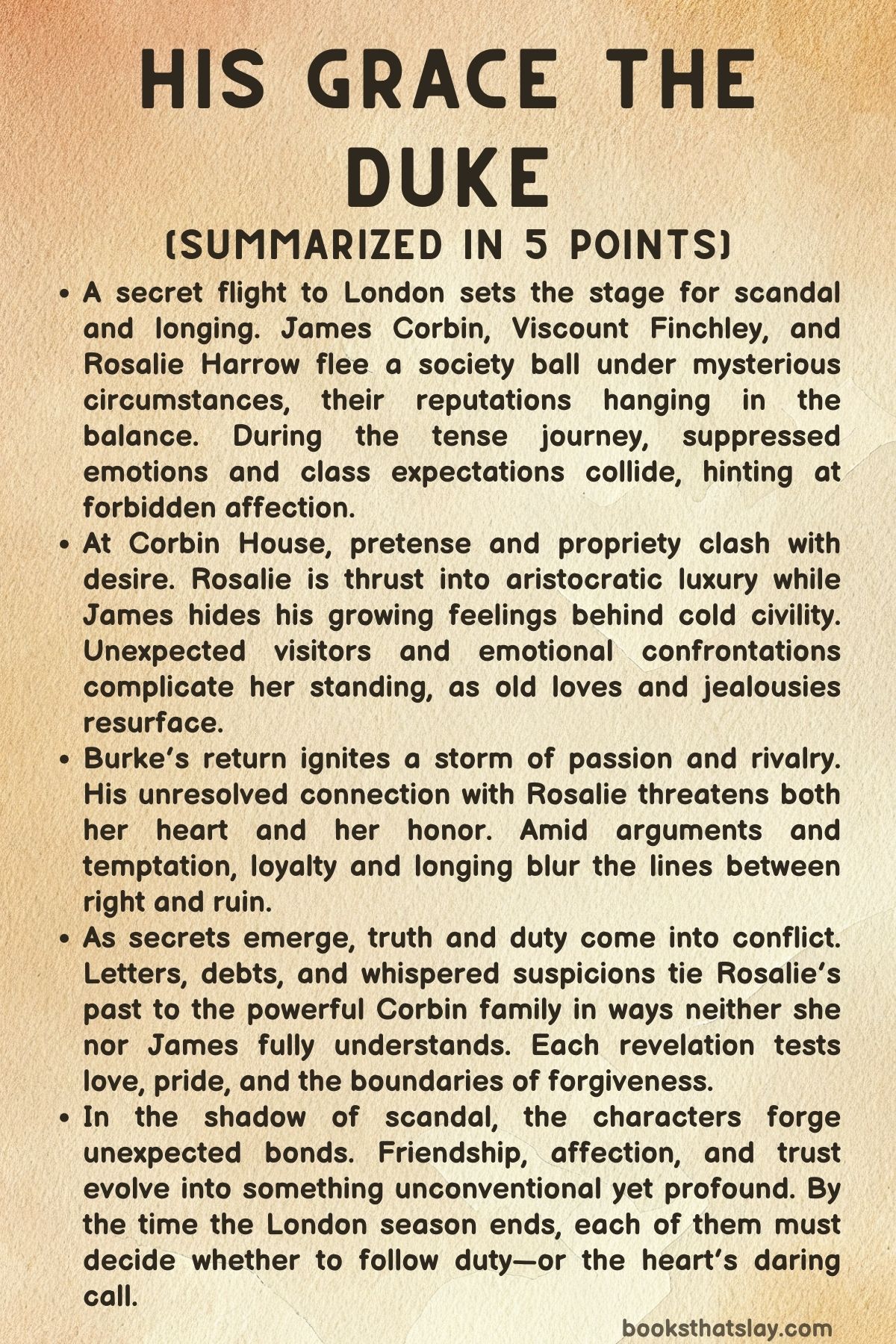
The story opens with Rosalie Harrow and James Corbin, Viscount Finchley, fleeing Alcott Hall overnight after a scandalous evening. Rosalie sleeps against James in the carriage, unaware that the man who once treated her with cold disdain is now consumed with desire and guilt over their charged encounter in the library.
As dawn approaches London, they agree on a cover story: they left early to plan a surprise engagement celebration for James’s brother, the Duke, Burke Corbin, and his intended, Piety.
At Corbin House, James resumes his icy, aristocratic composure, presenting Rosalie as his mother’s ward and assigning her to help prepare the festivities. He also secretly arranges a new wardrobe for her, hiring the stylish modiste Madame Lambert to outfit Rosalie like a lady of fashion.
Rosalie is overwhelmed and embarrassed by the extravagant clothes, sensing James’s possessive care beneath his formal manner.
Burke arrives unexpectedly during the fitting, furious and jealous. Convinced Rosalie might have eloped with James after his own engagement to Lady Olivia Rutledge was forced on him, he storms in and demands to speak with her.
Once alone in the library, anger turns to passion. Burke kisses Rosalie, confesses his obsession, and reveals he cannot bear the idea of losing her.
She insists nothing improper happened with James, and though she loves Burke, she refuses to let marriage become a cage or be the cause of his ruin. He admits his true name, Horatio, and they vow honesty while clinging to each other emotionally and physically.
Meanwhile, Tom Renley confronts his past when his former lover, Marianne Young, falsely claims they are engaged. He goes to her house, gently but firmly ending their connection, making it clear he has outgrown their youthful romance and urging her to find real happiness.
Back at Corbin House, Rosalie proposes a daring scheme to free Burke from his unwanted engagement. At a tense dinner with James, Burke, and Tom, secrets spill: James exposes Burke and Rosalie’s intimacy in the music room, Burke reveals James’s stolen kiss with Rosalie in the library, and everyone understands just how entangled their lives have become.
Despite jealousy and hurt, Rosalie persuades them to work together to encourage Olivia to break off the engagement herself by steering her toward more suitable suitors during an upcoming house party.
Rosalie’s connections with all three men deepen. James puts her in a room adjoining Burke’s, hoping to nudge them together.
Burke sneaks into her room one night, and they give in to fierce passion. Their intimacy is interrupted by Tom, who slips into bed beside them simply to be near Rosalie.
Awkwardness gives way to a strange comfort as she realizes how much she cares for them both. In the morning, Burke publicly kisses her at breakfast, refusing to hide their affection, while James observes from a distance, his emotions tightly controlled.
Rosalie continues to manage preparations for the engagement party and the household. In a quiet stairwell, she and James share a moment of rare tenderness.
Exhausted and brittle from responsibility, he allows her to comfort him. She tells him he does not have to shoulder everything alone, and he lets himself lean on her, if only for a moment, before duty calls him back.
Later, Rosalie finds James run ragged from work and forces him to rest, locking his study door and coaxing him to sleep with his head in her lap while she reads. He speaks of his dead father and complicated feelings about his younger brother George inheriting the title.
Their bond strengthens as he admits wanting to protect her. When George later discovers and delivers Rosalie’s secret packet of financial records, James learns that his mother paid off an enormous sum of Rosalie’s father’s debts.
Shocked by the seventeen-thousand-pound total, he briefly suspects Rosalie might be his father’s illegitimate child, a suspicion that horrifies both of them when he confronts her in a dark parlor.
Rosalie fiercely denies it and refuses to betray the duchess’s confidence about the true motive behind the payments. Realizing his cruelty and mistake, James burns the letters in the fireplace, symbolically freeing Rosalie from her father’s shame.
Overcome by emotion, they nearly consummate their attraction before James pulls back, afraid of destroying whatever fragile trust lies between them.
At the engagement party, tension explodes when Marianne publicly attacks Rosalie, accusing her of seducing men of rank. Rosalie, pushed too far, responds with a shocking remark that sends Marianne into a rage.
The two women come to blows until George intervenes, ejecting Marianne and defending Rosalie. Afterwards, Tom rushes to Rosalie’s side.
Alone with her, he confesses his love, insisting she completes him and belongs with him, Burke, and James. Rosalie admits she loves him too, and they make love, Tom both reverent and possessive as he begs her to bring James into their circle.
That night, James appears at Rosalie’s door, sleepless and restless. Burke is already in her bed.
After a moment of hesitation, James joins them, with Burke’s silent consent. The three share a tender night, their bodies mostly at rest, their closeness emotional rather than purely physical.
Rosalie understands that winning James’s trust will require patience and a willingness to bend just as he does.
Scandal soon explodes outside their private world. Burke is shot in a duel, and rumors about the “Corbin Affair” sweep London.
While the household hides from gossip, Olivia elopes with Captain Hartington to Gretna Green, finally choosing her own happiness. At the same time, George inherits the ducal title and refuses to return to country life, leaving James and Rosalie’s situation in flux.
Once Burke is well enough to travel, the group returns to Alcott Hall. There, James gathers Rosalie, Burke, and Tom and reveals the results of his investigation into her family.
Her long-lost uncle has died in India, leaving her a fortune of around one hundred and twenty thousand pounds. James began the search in London to secure her independence so she could marry Burke freely if she wished.
With George now the unmarried duke, Rosalie can no longer remain in James’s household as his ward without provoking further scandal. The only respectable solution is for her to marry James himself.
Burke and Tom support the plan, seeing it as a way to keep their unconventional family together. Rosalie balks at first, worrying about future children and reputations, but James calmly promises to claim any of her children as his own, no matter which man fathered them.
Finally, she accepts his proposal, moved by their combined devotion.
Their wedding night becomes a declaration of shared vows. James marries Rosalie legally, then the four of them complete their commitment in a passionate ceremony of the heart, recognizing spiritual marriages between Rosalie, James, Burke, and Tom.
They pledge equality, loyalty, and love, building a home that belongs to all of them.
Two months later, James’s formidable mother returns to Alcott Hall with guests and plans for a grand Christmas ball. To Rosalie’s surprise, the dowager duchess not only accepts her new daughter-in-law but admits she secured the Special License that allowed the rushed marriage.
She grants Rosalie the family tiara and quietly tolerates the unconventional household, so long as the public face of the dukedom remains dignified.
On the eve of the ball, Tom receives orders sending him back to sea for six months. The news shakes Rosalie and the men, but she encourages James not to retreat into fear.
That night, James and Tom finally act on their long-suppressed desire, with Burke and Rosalie sharing the moment, the four of them once again affirming their bond. Afterwards, Rosalie reveals she is pregnant.
Joy replaces anxiety as they look toward the future.
An epilogue set five years later shows their success. Rosalie, now the Duchess of Norland, has two daughters and a newborn son, Michael James Corbin.
Tom returns from sea just in time to meet the baby. Surrounded by laughter, children, and enduring affection, Rosalie stands at the heart of a family built on choice, trust, and a love strong enough to defy the expectations of the world beyond Alcott Hall.
Characters
Rosalie Harrow
Rosalie Harrow is the emotional and moral center of His Grace The Duke. Her evolution from a woman ensnared by circumstance to one who commands love, respect, and autonomy marks the novel’s emotional journey.
At the start, Rosalie appears as a dependent ward—sheltered yet dignified, navigating scandal and propriety with quiet strength. Beneath her composure, however, lies a woman of deep feeling and quiet rebellion.
Her complex entanglement with James, Burke, and Tom reveals the depth of her emotional intelligence and capacity for empathy. Rosalie’s compassion tempers James’s severity, steadies Burke’s recklessness, and nurtures Tom’s gentleness.
She is never a passive heroine; rather, she challenges the social strictures that confine women to ornamental roles. Her insistence that marriage must not be a cage, and later her acceptance of a polyamorous marriage on her own terms, signals her transformation into a self-possessed duchess who defines love as freedom, not submission.
Her nurturing of the men around her—emotionally, intellectually, and physically—becomes the novel’s ultimate act of defiance against convention.
James Corbin, Viscount Finchley
James Corbin is a man of contradictions—stern yet vulnerable, powerful yet haunted by emotional restraint. His journey in His Grace The Duke mirrors the transformation of duty into desire, and repression into intimacy.
Initially, he embodies the archetype of the cold aristocrat: disciplined, commanding, and loyal to family obligation. Yet his interactions with Rosalie expose a fractured humanity beneath the façade.
His inability to confess love stems from fear—fear of impropriety, loss, and emotional exposure. James’s development is gradual and painful, culminating in a quiet surrender to love that neither diminishes his authority nor compromises his integrity.
Through Rosalie, he learns tenderness; through Burke and Tom, he learns humility. His eventual acceptance of a shared marriage represents not weakness but evolution—a man of rigid codes learning to redefine love on unconventional but profoundly human terms.
In the end, James’s grace lies not in his title but in his ability to love fully and fearlessly.
Burke Corbin (Horatio)
Burke Corbin, James’s brother, is the passionate counterpoint to James’s restraint. Where James hides behind decorum, Burke acts on instinct, his emotions unfiltered and often destructive.
Yet this volatility conceals an aching sincerity—his love for Rosalie is fierce, consuming, and deeply loyal. Burke’s defiance of his family’s expectations marks him as a romantic revolutionary in a society obsessed with lineage.
His jealousy, impulsiveness, and reckless affection often threaten to undo him, yet his honesty redeems him. Through Rosalie, Burke learns the balance between passion and patience, understanding that love must be freely chosen, not demanded.
His eventual participation in the unconventional union with James, Rosalie, and Tom reveals his capacity for growth; the man who once saw love as possession learns to share it without diminishing its depth. Burke’s journey is that of transformation from youthful impetuosity to emotional maturity—a man redefined by love’s generosity.
Lieutenant Thomas (Tom) Renley
Tom Renley brings emotional light to the darker passions of His Grace The Duke. As a naval officer and loyal friend, he embodies compassion, humor, and quiet devotion.
Tom’s love for Rosalie is gentle and patient, contrasting sharply with Burke’s fiery intensity and James’s tortured reserve. His role in the narrative expands beyond romantic interest—he is the moral compass of the quartet, the bridge that harmonizes their competing desires.
Tom’s own arc, from unrequited lover to equal partner, underscores the novel’s message about love’s inclusivity. His maturity is evident in his farewell to Marianne Young, where he rejects nostalgia for genuine self-respect.
Later, his openness to emotional and physical union with James and Burke marks him as a man of rare emotional courage. Tom’s love is restorative; he grounds the others in empathy and warmth, and his presence ensures that their union transcends mere passion to become a sanctuary of trust.
George Corbin
George Corbin, the Duke and younger brother of James and Burke, serves as both catalyst and conscience throughout the story. Charming, mischievous, and sharp-witted, he provides levity amid tension, yet his insights often cut to the core of truth.
Though he avoids emotional entanglements, George’s interventions often push others toward self-awareness—particularly James and Rosalie. His playful manipulation of situations, such as provoking James to confront his feelings, reveals an intuitive understanding of human nature.
George’s refusal to return to country life underscores his discomfort with conventionality, yet his teasing promise to marry Rosalie if she does not wed James reflects both affection and wisdom. He stands apart from the central love story but anchors it with familial warmth and realism, reminding the reader that love, though chaotic, thrives best in honesty and humor.
Lady Olivia Rutledge
Lady Olivia Rutledge functions as both foil and mirror to Rosalie. At first, she appears as the shallow aristocrat, driven by ambition and desperation for security.
Yet as her story unfolds, Olivia emerges as a tragic figure shaped by societal expectations. Her attempts to seduce James and later secure Burke’s hand reveal a woman trapped by the same structures Rosalie defies.
Her eventual elopement with Captain Hartington marks her redemption—a courageous choice that values emotional truth over social advantage. Through Olivia, the novel exposes the cruelty of class-bound morality, contrasting Rosalie’s liberation with Olivia’s hard-won dignity.
Olivia’s transformation from pawn to agent of her own fate offers a quieter, but equally significant, victory of self-determination.
Captain William Hartington
Captain Hartington is a symbol of integrity and lost opportunity in His Grace The Duke. His reappearance stirs old emotions and unresolved regrets, particularly for Tom Renley and Olivia Rutledge.
Once a man burdened by unspoken love, he becomes the agent of closure and healing. His dialogue with Burke and later with Olivia reveals a man governed by compassion and moral clarity.
By eloping with Olivia, he not only redeems her but also restores his own sense of honor and purpose. Hartington represents a different form of masculinity—measured, respectful, and quietly brave—serving as a counterpoint to the volatile passions of the Corbin brothers.
Marianne Young
Marianne Young serves as the embodiment of jealousy and the dangers of unrestrained ambition. Once Tom Renley’s childhood sweetheart, she cannot accept that love has evolved beyond youthful fantasy.
Her deceit—claiming engagement to Tom—reveals both desperation and self-delusion. Yet she is not portrayed as purely villainous; rather, she is a tragic reflection of those unable to grow beyond the past.
Marianne’s downfall, culminating in her public humiliation and banishment, underscores the novel’s moral that love without respect is ruinous. She serves as Rosalie’s dark mirror, showing what becomes of a woman who lets envy consume her instead of finding self-worth.
Themes
Love and Emotional Freedom
In His Grace The Duke, love exists not as a singular romantic ideal but as a complex, layered force that both liberates and entangles. The relationships among Rosalie, James, Burke, and Tom form a study in emotional plurality—where affection transcends conventional boundaries of monogamy, class, and propriety.
Each character’s experience of love becomes a form of self-realization. Rosalie’s journey from uncertainty to embracing multiple lovers without shame challenges the social fabric of Regency England, where passion is expected to be hidden beneath duty.
Her love is not submissive but self-directed, an assertion of her right to choose freely. James, by contrast, begins as a man constrained by lineage and expectation, seeing love as weakness.
Through his connection with Rosalie, he gradually discovers tenderness as strength. Burke’s fiery devotion and Tom’s gentle loyalty further expand the emotional spectrum, proving that love can coexist in varied forms without diminishing its truth.
The novel suggests that genuine affection does not thrive under rules or restraint—it must be honest, reciprocal, and chosen. Love here is transformative; it rescues characters from isolation, shame, and self-denial.
When the four unite, their relationship becomes symbolic of balance—reason and passion, dominance and vulnerability, loyalty and independence. This portrayal turns love into a rebellion against repression, and through that rebellion, the characters achieve freedom—not from society alone, but from their own fears of unworthiness and loss.
Class, Power, and Social Constraint
The novel situates its characters within a rigid social order that defines worth through birth and wealth. In His Grace The Duke, class operates as both a cage and a mirror—reflecting how status dictates behavior while revealing the hypocrisy of aristocratic virtue.
Rosalie, as a woman of uncertain parentage and limited means, exists at the mercy of those above her. Yet she consistently challenges their authority through intellect and composure.
Her resistance exposes the moral fragility of an elite that values appearance over sincerity. James embodies this duality most clearly: a nobleman who masks vulnerability behind command, perpetually torn between the demands of title and the desires of his heart.
His internal conflict mirrors the broader decay of aristocratic rigidity—the awareness that duty without empathy breeds loneliness. The novel’s settings—lavish estates, carriages, and drawing rooms—serve as visual emblems of control, where even affection must wear a mask.
Against this backdrop, Rosalie’s growing influence destabilizes hierarchy, suggesting emotional power can transcend social rank. The act of James purchasing her wardrobe, initially an assertion of dominance, evolves into an acknowledgment of her equality.
Through Rosalie’s defiance and eventual acceptance into nobility, Emily Rath critiques the false sanctity of lineage and asserts that integrity, compassion, and self-knowledge are the true measures of nobility.
Identity, Secrets, and Self-Discovery
Identity in His Grace The Duke is a shifting construct, shaped by secrets, lineage, and the courage to confront truth. Every major character conceals something vital—James hides his tenderness behind stoicism, Burke masks insecurity with bravado, and Rosalie carries the shadow of her family’s debt and rumored illegitimacy.
These concealed truths drive the emotional undercurrents of the story, revealing how self-deception can be more imprisoning than societal constraint. The discovery of Rosalie’s inheritance and her possible blood connection to the Corbins forces every character to confront what defines belonging: is it bloodline, or choice?
For James, the possibility that Rosalie might share his lineage brings both horror and revelation—it exposes his dependence on class boundaries for moral certainty. For Rosalie, identity becomes an act of authorship rather than inheritance; she chooses who she will be, refusing to let the sins or secrets of others dictate her worth.
The act of burning the letters symbolizes this reclamation—the destruction of false histories to create space for authentic selfhood. Rath uses secrecy not merely as plot but as transformation: by confronting what is hidden, the characters emerge truer and more whole.
Ultimately, the novel asserts that identity is not fixed by birth or rumor but is shaped through love, honesty, and the willingness to face one’s own contradictions.
Gender, Autonomy, and the Redefinition of Marriage
Rosalie’s story redefines what it means to be a woman in a patriarchal world. In His Grace The Duke, female autonomy becomes a radical act—expressed through Rosalie’s refusal to be traded, silenced, or confined.
Though surrounded by powerful men, she consistently commands her own narrative, setting the emotional terms of every relationship. Her acceptance of multiple lovers is not submission to desire but ownership of it.
She transforms the idea of marriage from a legal or social transaction into a covenant of equality. The final union among Rosalie, James, Burke, and Tom defies the structure of Regency propriety, creating a household built on consent and shared devotion.
It stands as a symbolic rejection of a society that views women as property and fidelity as possession. Even the Dowager Duchess’s eventual acceptance of their unconventional family signals a generational shift—a recognition that stability can arise from truth rather than control.
Rath uses Rosalie’s journey to critique the limited avenues available to women and to propose a model of love that honors choice, respect, and mutual care. Rosalie’s autonomy is not achieved through rebellion alone but through wisdom and emotional intelligence, proving that power lies not in domination but in the courage to live authentically.
Family, Redemption, and Forgiveness
Family in His Grace The Duke exists as both burden and salvation. The Corbin brothers are haunted by their parents’ expectations, financial secrets, and emotional distance, each responding differently to inherited pain.
James’s transformation from dutiful son to compassionate partner reflects the human need to heal generational wounds through understanding rather than resentment. Burke’s impulsive love, often reckless, becomes a form of redemption—a way to prove that passion can coexist with loyalty.
Rosalie’s integration into the Corbin household redefines family altogether, blending chosen and blood relations into one circle of acceptance. Forgiveness emerges as the silent backbone of the narrative: forgiveness of self, of past wrongs, and of love that did not fit society’s mold.
Even the dowager’s eventual grace reveals that forgiveness can coexist with dignity. The shared home at Alcott Hall becomes a sanctuary where past grievances dissolve, replaced by compassion and shared purpose.
Through its conclusion—marked by new life, laughter, and harmony—Rath suggests that family is not bound by convention but by the capacity to forgive and begin anew. The redemption each character finds is not in erasing mistakes but in embracing them as part of their shared humanity, proving that love, at its deepest, is an act of forgiveness continually renewed.