How to Fake a Haunting Summary, Characters and Themes
How to Fake a Haunting by Christa Carmen is a psychological thriller that delves into the complexities of family dynamics, addiction, and the desperate lengths one woman will go to protect her child from a toxic and dangerous relationship. Lainey is stuck in a deteriorating marriage to Callum, whose alcoholism has become progressively destructive.
Struggling with her own emotional turmoil and the oppressive pressure from her wealthy in-laws, Lainey teams up with her best friend, Adelaide, to stage a haunting in their home in hopes of driving Callum out. However, as the fake haunting intensifies, it soon blurs the line between manipulation and reality, forcing Lainey to confront her past, her choices, and the consequences of her actions. The story is a chilling exploration of fear, guilt, and the destructive power of unresolved emotions.
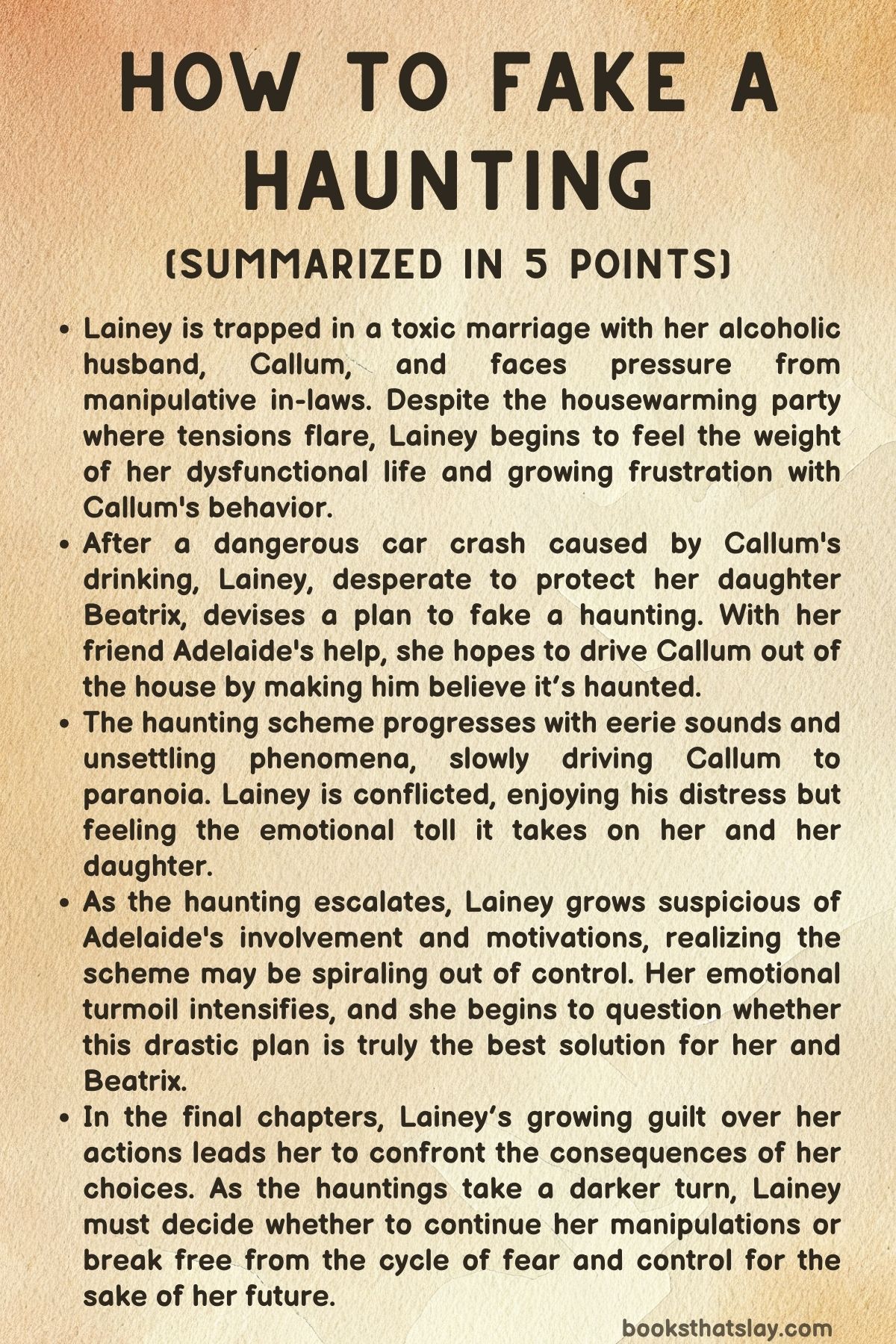
Summary
Lainey is stuck in a crumbling marriage with Callum, a man whose alcoholism is spiraling out of control. The couple has recently moved into a new house, a gift from Callum’s wealthy parents, but their life together is far from ideal.
Lainey’s frustration with Callum’s drinking only intensifies as the couple faces pressure from his manipulative and controlling parents, Rosalie and Dustin, who constantly undermine her. During a housewarming party, Lainey’s brother-in-law, Cody, makes a comment about Callum’s drinking, which triggers a wave of tension between Lainey and Callum.
Later, Lainey’s friend Adelaide, who works at the Preservation Society, confides in her about a new job. While talking, strange noises from upstairs lead them to find Callum drunk and behaving erratically, having destroyed a newly installed mirror in a fit of rage.
This incident marks the beginning of Lainey’s growing realization that her marriage is deteriorating beyond repair.
The situation worsens when Lainey attends a gala hosted by Callum’s parents, where Callum continues to drink excessively. Their argument over his behavior turns volatile, and when the night ends with Callum drunkenly crashing the car, Lainey’s fear for her daughter Beatrix’s safety grows.
Callum flees the scene, leaving Lainey and Bea behind. This is the final straw for Lainey, and she confides in Adelaide, who suggests they stage a haunting to drive Callum out of the house.
Adelaide proposes a series of eerie events designed to unsettle Callum and make him believe the house is haunted, in hopes that this will cause him to crack emotionally and leave. Though Lainey is initially hesitant, the constant strain of her marriage leads her to agree.
Lainey and Adelaide begin their plan, setting up strange noises, foul smells, and inexplicable events in the house. Adelaide even goes so far as to bring a ladder to access the attic, where they plan to further escalate the haunting.
Lainey reflects on how her relationship with Callum has become a problem she needs to solve, and that her emotional connection to him has completely evaporated. Her focus is now entirely on protecting her daughter, even if it means resorting to drastic, manipulative measures.
As the haunting continues, Lainey begins to notice the toll it is taking on Callum. He becomes disoriented, paranoid, and starts to believe that the house is haunted.
Lainey, while reassured that their plan is working, starts to feel conflicted. The haunting may be unraveling Callum, but it is also eroding her own sense of morality.
She struggles with feelings of guilt, especially as the impact on Beatrix becomes more apparent. Lainey is torn between the desire to protect Bea and the realization that their plan could have serious consequences.
The situation escalates when Lainey and Adelaide continue their haunting scheme. Lainey is increasingly disturbed by Callum’s breakdown, as his paranoia deepens, and he becomes convinced that supernatural forces are at play.
At the same time, Lainey is growing more comfortable with the manipulation and wonders whether she is becoming just as twisted as the man she is trying to escape. The haunting progresses with the introduction of new elements like unsettling knocking sounds and a mysterious song that further push Callum to the edge.
Lainey finds herself taking a twisted satisfaction in watching him unravel, though she can’t help but feel guilty for what they are putting him through.
As time passes, Lainey’s guilt deepens, especially after a meeting with a pair of ghost hunters, Joe and Morgan Tallow, who share their personal experiences with the supernatural. Lainey’s unease grows as she begins to see the haunting in a different light.
Morgan’s grief over her stillborn son and her connection to the paranormal make Lainey reconsider the path she is taking. Despite her growing doubts, Lainey feels trapped by her desire to protect Bea and the belief that the haunting is the only way out.
The plot takes a dark turn when Lainey sees a disturbing figure in the bathroom, one that seems to be an embodiment of a future that could await her—one marked by despair and guilt. Lainey confronts Adelaide, but tensions between them rise as Lainey suspects that Adelaide might be manipulating the situation for her own benefit.
As Lainey becomes more suspicious of her friend’s motivations, the haunting continues to escalate, and Lainey finds herself questioning whether she has gone too far.
In the final stages of the haunting, Lainey realizes the magnitude of what she has done. Callum’s breakdown is reaching its peak, and Lainey’s own emotional stability is hanging by a thread.
She is torn between continuing the plan and stopping it, but ultimately, she decides that she must protect her daughter at all costs. The haunting, once a tool to drive Callum out, has now become a dangerous force of its own.
Lainey seeks refuge at her parents’ house with Bea, hoping to escape the horrors of her own making. However, when Callum unexpectedly returns to the house, Lainey is confronted with the terrifying possibility that the haunting may have taken on a life of its own.
In the final moments of the story, Lainey makes a life-altering decision to confront Callum and end the toxic cycle that has defined their marriage. She resorts to extreme measures to ensure that Beatrix is safe, even if it means facing the terrifying consequences of her actions.
The book concludes with Lainey emerging from the ordeal, scarred but resolute, committed to creating a safer, healthier future for her daughter. The haunting comes to an end, and Lainey begins to rebuild her life, learning from the mistakes of the past and seeking redemption for herself and Beatrix.
Characters
Lainey
Lainey is the protagonist of How to Fake a Haunting, and her emotional and psychological journey is the core of the story. She is a complex character caught in a toxic marriage with Callum, a man whose alcoholism is progressively worsening, and she is desperate to find a way to protect herself and her young daughter, Beatrix, from the destructive environment he creates.
Lainey is portrayed as a deeply conflicted individual who struggles with feelings of resentment, guilt, and helplessness. Initially, she tries to manage her emotions and put up with Callum’s behavior, but as the narrative unfolds, her growing frustration leads her to take drastic measures, including orchestrating a fake haunting in their home.
This decision to stage the haunting with her friend Adelaide is driven by her desperation to break free from the emotional and physical abuse she’s enduring. Lainey’s character is defined by her overwhelming need to protect Beatrix, which leads her to manipulate Callum’s sense of reality.
However, her internal struggle becomes more apparent as the haunting escalates and she begins to question whether the path she’s chosen is the right one. Lainey’s emotional turmoil, guilt over her actions, and the eventual realization that the ghosts may be manifestations of her own unresolved issues with Callum and their fractured marriage, make her a dynamic and multi-faceted character.
By the end of the story, Lainey has undergone significant personal growth, facing her past actions and finding a new sense of control over her life, making peace with the ghosts of her past, both literal and metaphorical.
Callum
Callum, Lainey’s husband, is a central figure whose struggles with alcoholism and erratic behavior contribute to the tension and horror in the story. Initially, he comes across as a man who is out of control, frequently drunk and unresponsive to Lainey’s attempts to intervene.
His alcoholism is the root cause of the couple’s deteriorating marriage, and his defensiveness and erratic actions, such as damaging a mirror in a drunken stupor and driving under the influence, highlight his inability to cope with his inner demons. As Lainey and Adelaide execute their plan to drive him out of the house, Callum becomes increasingly paranoid, convinced that the house is haunted.
His behavior becomes more erratic, and he starts to lose his grip on reality, reflecting the breakdown of his mental state as he is affected by the eerie events Lainey and Adelaide are orchestrating. Despite his flaws, there are moments where Callum’s vulnerability emerges, showing that he may not be entirely beyond redemption.
His eventual return to the house after the haunting begins to take a darker turn marks a critical moment in the story, as Lainey is forced to confront the dangerous consequences of their actions. Ultimately, Callum’s character serves as a tragic reflection of the destructive power of addiction and how it can erode relationships and lives.
Adelaide
Adelaide, Lainey’s best friend, plays a crucial role in the story as both a confidante and a co-conspirator in the plan to manipulate Callum’s reality. Although initially introduced as a supportive friend who helps Lainey secure a job for her, Adelaide’s involvement in the haunting plan reveals a more morally ambiguous side to her character.
She encourages Lainey to carry out the scheme, suggesting increasingly elaborate ways to unsettle Callum, including the use of animal carcasses and strange phenomena. Throughout the plot, Adelaide is portrayed as pragmatic and somewhat detached from the emotional fallout of their actions, which contrasts sharply with Lainey’s growing sense of guilt and uncertainty.
As the haunting progresses, Adelaide’s motivations become more questionable, especially when she is shown to be interacting with Todd, a man connected to the supernatural elements of the plan. Lainey begins to suspect that Adelaide may have her own agenda, leading to a sense of betrayal.
Despite her support for Lainey, Adelaide’s actions raise questions about her true intentions and the cost of their scheme. She serves as a foil to Lainey, embodying a more ruthless and calculating approach to solving problems, even at the risk of causing harm.
Beatrix
Beatrix, Lainey and Callum’s young daughter, represents innocence and the emotional stakes of Lainey’s actions. Throughout the story, Beatrix is largely shielded from the worst of the chaos and dysfunction in the family, with Lainey doing everything in her power to protect her from the disturbing environment created by Callum’s behavior.
Beatrix’s presence serves as a motivating force for Lainey, who is willing to go to extreme lengths, including staging the haunting, to ensure Beatrix’s safety. Although Beatrix does not have a major role in the unfolding of the haunting itself, her vulnerability and need for protection are central to Lainey’s decision-making process.
The emotional impact of Lainey’s choices is magnified by Beatrix’s innocence, and Lainey’s ultimate goal is to provide a safer, more stable future for her daughter, even if it means confronting the ghosts of her own past and the toxic remnants of her marriage.
Rosalie and Dustin
Rosalie and Dustin, Callum’s wealthy and manipulative parents, are influential but somewhat peripheral characters in the story. They embody the pressure and control that Lainey feels from her in-laws, who exert a significant amount of influence over Callum’s life.
Rosalie, in particular, is portrayed as a domineering figure who makes Lainey feel belittled and insignificant, constantly undermining her in subtle ways. Dustin, while not as prominent, contributes to the toxic family dynamic, exacerbating the stress that Lainey already feels in her marriage.
The in-laws’ role is not to directly contribute to the supernatural events in the story, but their presence serves to highlight Lainey’s isolation and the emotional and psychological pressure she faces in her attempts to hold her family together.
Themes
Abuse and Toxic Relationships
The theme of abuse and toxic relationships plays a central role in How to Fake a Haunting. The narrative depicts Lainey’s gradual realization of the extent to which her marriage to Callum has become emotionally and psychologically damaging.
Callum’s alcoholism is a pervasive force in their household, shaping the dynamics of their relationship and Lainey’s sense of self-worth. The emotional toll on Lainey is compounded by the manipulation and control exerted by her in-laws, who seem to enable Callum’s destructive behavior.
Lainey is left feeling isolated and helpless as she grapples with both her husband’s deteriorating health and her own emotional decay. Her frustration is heightened by her inability to make Callum see the damage he is causing, not only to their marriage but also to their daughter, Beatrix.
This abusive cycle becomes more evident as Lainey takes drastic measures to protect herself and her child from Callum’s influence. The haunting scheme, which she and her friend Adelaide concoct, is a desperate attempt to force Callum out of the house and out of their lives, showing just how far Lainey is pushed by the toxic environment.
Through Lainey’s experience, the story powerfully highlights how toxic relationships can warp one’s reality, making it difficult to distinguish between what’s necessary for survival and what’s morally right.
Guilt and Self-Redemption
Guilt is a persistent undercurrent in How to Fake a Haunting, with Lainey constantly wrestling with her conscience throughout the story. Initially, Lainey is consumed by guilt over the state of her marriage, blaming herself for not being able to fix Callum’s alcoholism or their broken relationship.
Her internal conflict deepens as she moves forward with the haunting scheme. Despite knowing it’s manipulative and harmful, she justifies her actions by the extreme lengths she has to go to in order to protect her daughter.
The haunting, which she orchestrates with Adelaide, serves as a manifestation of Lainey’s guilt and her desire to absolve herself from the role she feels she played in the deterioration of her marriage. However, as the haunting escalates and real supernatural occurrences begin to manifest, Lainey’s guilt intensifies, and she questions whether she is perpetuating another cycle of harm, this time affecting Callum’s mental state.
As the haunting spirals out of control, Lainey realizes that her past choices, particularly her handling of Callum’s issues, have brought her to this point. This moment of realization becomes a pivotal turning point in her character arc, where she begins to understand that self-redemption lies not in manipulating others or avoiding the truth but in confronting the mistakes she has made.
The haunting, both literal and metaphorical, pushes her toward confronting these deep-seated feelings of guilt and ultimately finding a way to move beyond them.
Power and Control
Power dynamics are critical in How to Fake a Haunting, as Lainey and Callum’s relationship is marked by a constant battle for control. Callum’s alcoholism gradually takes away any sense of control Lainey may have had over her life, as she feels increasingly powerless in her marriage.
The influence of her in-laws, Rosalie and Dustin, exacerbates this sense of helplessness, as they seem to undermine her and Callum’s ability to function as an autonomous couple. The power imbalance in their marriage fuels Lainey’s resentment and frustration, especially when she realizes that her attempts to confront Callum’s behavior only result in him spiraling further into addiction.
The scheme to fake a haunting marks a shift in Lainey’s desire for control; by manipulating Callum into believing the house is haunted, she takes matters into her own hands, seeking to regain agency over her life and the future of her daughter. However, as the haunting escalates and more supernatural occurrences take place, Lainey starts to lose control of the situation.
The power struggle between her, Callum, and the paranormal forces within the house becomes symbolic of her internal struggle. Lainey’s attempt to exert control over her environment ultimately leads to further chaos, suggesting that power, when used in destructive ways, can have far-reaching consequences.
The narrative explores how power is often a fragile construct, especially when it is derived from manipulation or fear, and how it can be quickly lost when the lines between reality and illusion blur.
Parental Protection and Sacrifice
At the heart of How to Fake a Haunting is Lainey’s fierce desire to protect her daughter, Beatrix, from the destructive environment caused by her husband’s alcoholism. Lainey’s transformation throughout the novel is driven by her protective instincts as a mother.
Her decision to stage a haunting is a direct result of her fear for Beatrix’s safety, as she recognizes that staying in the toxic household would have long-lasting negative effects on her child. Lainey is willing to sacrifice her own peace of mind, morality, and emotional well-being in order to secure a better future for Beatrix.
This theme of parental sacrifice is emphasized through Lainey’s increasing discomfort with the actions she is taking against Callum. As she becomes more conflicted about the plan’s moral implications, her thoughts always return to Beatrix and her need to protect her from the chaotic, dangerous environment that Callum’s behavior has created.
Lainey’s journey reveals the lengths a parent will go to in order to shield their child from harm, even if those actions go against their better judgment or moral compass. By the end of the story, Lainey’s ultimate decision to take drastic steps to protect her daughter showcases the profound depth of a mother’s love and the difficult choices that come with safeguarding the ones you love.
The theme of parental protection emphasizes that love for one’s child can drive decisions that lead to personal growth, as well as painful, irreversible consequences.
The Supernatural as a Reflection of Internal Struggles
In How to Fake a Haunting, the supernatural elements serve as a reflection of the characters’ internal struggles, particularly Lainey’s emotional and psychological turmoil. Initially, the haunting is staged as a means of manipulating Callum, but as the ghostly phenomena intensify, Lainey begins to question the source of these events.
The manifestation of ghosts in the house, including wraith-like figures that mirror the couple’s potential futures, is symbolic of Lainey’s unresolved guilt and fear. The supernatural occurrences mirror Lainey’s inner conflicts, from her self-loathing and feelings of entrapment in her marriage to her growing fear of Callum’s potential death from alcoholism.
The house, which initially becomes a site for their manipulations, gradually transforms into a place of torment for Lainey, as she begins to see the ghosts not just as external forces but as manifestations of her own deep-seated emotions and fears. The psychological horror that unfolds reflects how the characters’ emotional states influence their perception of the world around them.
As Lainey’s psychological state deteriorates, she becomes more attuned to the paranormal, suggesting that the supernatural is not merely a haunting force outside of her control but a product of her own mind, shaped by her experiences and emotional struggles. The story ultimately reveals that the greatest horror is not the external forces within the house but the internal ghosts that haunt Lainey—her unresolved fears, guilt, and desires that have shaped her actions and relationships.