If the Dead Belong Here Summary, Characters and Themes
If the Dead Belong Here by Carson Faust is a deeply emotional and haunting novel that explores themes of grief, trauma, and the supernatural. Set in the rural town of Jordan, Wisconsin, the book centers around the disappearance of six-year-old Laurel Taylor, which sends her family into a spiraling journey of uncertainty, guilt, and unraveling mental states.
The story unfolds across multiple perspectives, focusing on the emotional turmoil of the Taylor family, especially the strained relationships between mother and daughter, as they grapple with their past and the mysterious events surrounding Laurel’s disappearance. The novel blends psychological depth with a chilling atmosphere, ultimately delving into the mysteries of family, the afterlife, and the boundaries between the two.
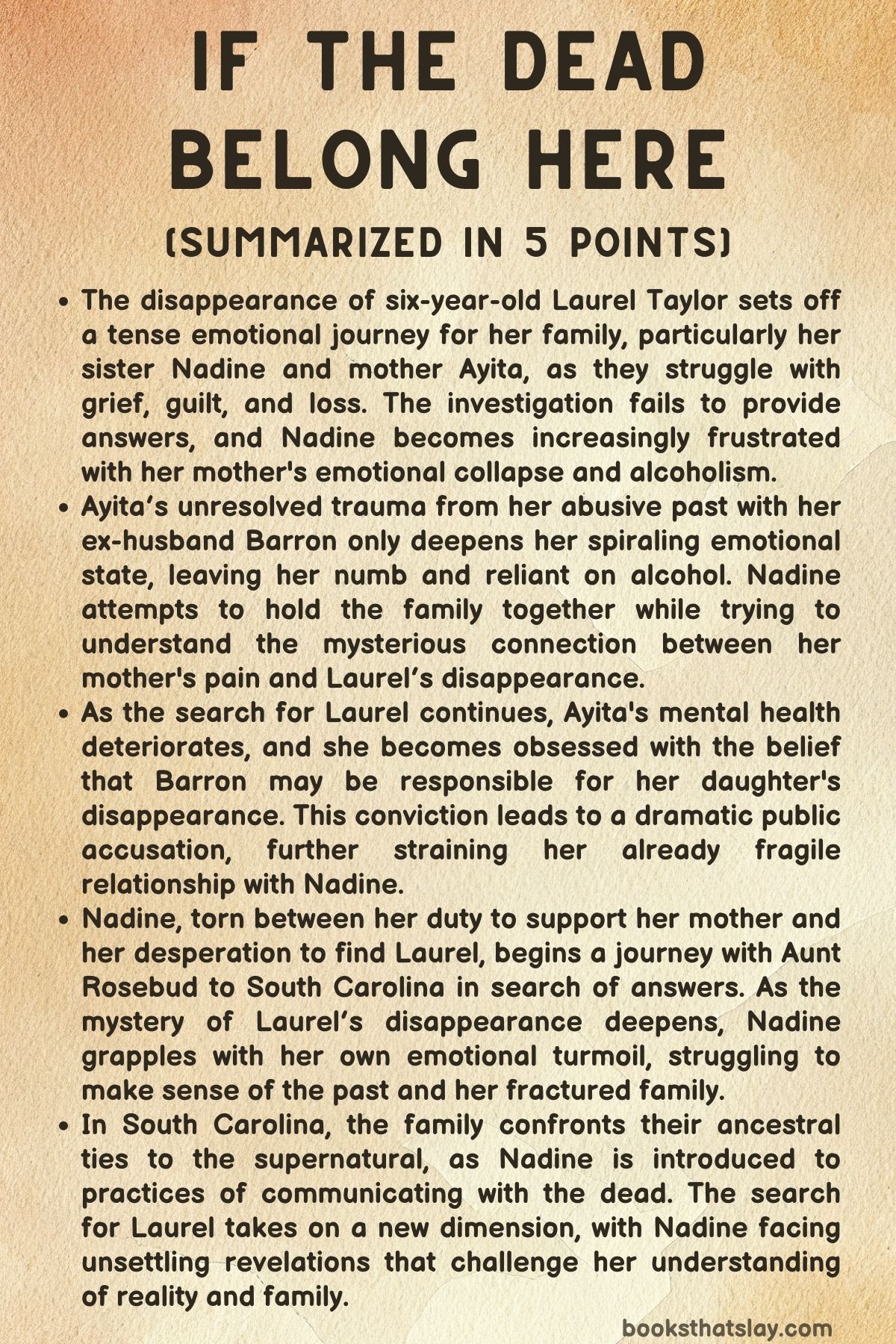
Summary
In If the Dead Belong Here, the story begins with a chilling scene at the Taylor family home in Jordan, Wisconsin, in 1996. Unseen intruders enter the house during the night, seemingly watching over young Laurel Taylor as she sleeps.
They believe they are protecting her, though their true intentions remain unclear. The next morning, Laurel is gone, and the family is thrust into a nightmare from which they cannot escape.
Laurel’s older sister, Nadine, wakes up to find her sister missing and the house suffocatingly silent. Panic sets in when her search of the house reveals Laurel’s empty bed.
Nadine’s aunt, Rosebud, confirms that Laurel is gone, and soon Nadine is calling the authorities. Despite their efforts, Laurel’s disappearance remains a mystery, with no leads or signs pointing to where she could have gone.
The family’s world begins to unravel as they struggle with their grief and the unbearable silence left in Laurel’s absence.
Nadine, feeling the weight of her sister’s disappearance, becomes the one holding the family together. Her mother, Ayita, is emotionally numb, unable to cope with the loss.
She has been struggling with addiction and the haunting memories of her abusive marriage to Barron, who left the family years ago. Ayita’s alcoholism worsens as she attempts to numb her pain, and she becomes increasingly detached from the search for her daughter.
Nadine becomes frustrated with her mother’s inability to act, and their relationship begins to fracture as Ayita’s emotional collapse deepens.
As the days stretch into weeks, Nadine finds herself increasingly isolated in her efforts to locate Laurel. Her mother’s withdrawal into herself leaves Nadine to organize search parties and try to keep the family afloat.
Meanwhile, Ayita’s mind becomes consumed by guilt, fear, and the unresolved trauma of her past. She experiences hallucinations, hearing the voice of Barron taunting her with the possibility that he might be involved in Laurel’s disappearance.
The search for Laurel continues, but Ayita’s mental state deteriorates, and the family is left to wrestle with the implications of her breakdown.
Throughout this, the story explores the complicated family dynamics, particularly Ayita’s unresolved trauma from her marriage to Barron. Ayita struggles with the emotional scars left by her abusive past, and this past becomes entwined with her present struggle to make sense of Laurel’s disappearance.
Could Barron have had something to do with it? Nadine cannot dismiss this possibility, though the authorities have ruled out his involvement.
Yet, Ayita’s guilt over her past choices and her self-destructive behavior tie her to the idea that Barron might have returned to hurt them again.
The narrative takes a darker turn as Ayita’s dependence on alcohol grows stronger. She begins to lose touch with reality, experiencing vivid visions of her lost daughter, and these hallucinations soon give way to a sense of supernatural connection.
Ayita becomes more determined to find Barron, convinced he holds the key to understanding Laurel’s disappearance. She goes so far as to publicly accuse Barron of kidnapping Laurel during an emotional media interview, hoping that someone will believe her.
Meanwhile, Nadine, still reeling from the loss of her sister, grapples with her feelings toward her mother. Despite her growing resentment toward Ayita’s passivity, Nadine tries to maintain some semblance of hope that Laurel will be found.
She becomes increasingly involved in trying to find answers, even as she faces her own emotional turmoil. Nadine’s relationship with Dallas, a boy from school, offers her brief solace, though she is often torn between her past and her present.
The investigation into Laurel’s disappearance brings Nadine face to face with Barron, now imprisoned for his violent actions. Their tense conversation reveals the brokenness of the family, but Barron’s explanations only add to the confusion.
Nadine feels a mix of anger and helplessness, and it becomes clear that no one knows what happened to Laurel, and the future seems uncertain.
As the search stretches on, Nadine, along with Aunt Rosebud, embarks on a journey to South Carolina to find answers. Aunt Rosebud, who has secretly coordinated this trip with her sister Talisa, believes that the key to understanding Laurel’s disappearance lies in the family’s connection to ancestral knowledge.
Nadine reluctantly joins her, leaving her mentally broken mother behind. The trip takes them to Rosebud’s childhood home, where they meet Talisa and Aunt Elgone, a healer with deep spiritual connections to the supernatural.
The family’s practice of communicating with the dead becomes a central element of the search, as Nadine comes to realize the full extent of her family’s mystical heritage.
In South Carolina, Nadine and Rosebud begin to explore the deeper layers of the mystery, learning about their family’s ability to commune with the spirits. The presence of Laurel is felt in every moment, but it’s unclear whether the girl they seek is the same as the one who disappeared.
The family prepares to ask the dead for answers, hoping that they can find some closure or a glimpse of the truth. But as the mystery deepens, Nadine grows more uncertain about the supernatural forces at play.
The narrative climaxes with a final, haunting encounter. Ayita, back in Wisconsin, continues to experience disturbing visions and sensations that seem to draw her into the spirit world.
As she walks toward a river, symbolizing the boundary between the living and the dead, she finds herself inexplicably connected to something greater than herself. The river serves as a gateway, and Ayita’s journey into this world culminates in the haunting realization that Laurel may no longer be the girl she once knew.
The novel ends with a bittersweet moment of peace, as Ayita’s grief gives way to the acceptance of loss and the cycle of life. The arrival of a new life marks a potential rebirth for Ayita and her family, suggesting that while they have suffered deeply, they are not beyond hope.
The mystery of Laurel’s disappearance may never be fully understood, but the family begins to embrace the complexities of love, loss, and the eternal ties that bind them.
Characters
Ayita Taylor
Ayita, the mother of Laurel and Nadine, is a deeply complex character whose life is defined by grief, loss, and an overwhelming need to escape her painful past. As a mother, Ayita is trapped between the fading memory of her abusive ex-husband, Barron, and the disappearance of her beloved daughter, Laurel.
Throughout the story, Ayita struggles with the emotional weight of her past trauma and her inability to cope with the loss of Laurel. Her alcoholism becomes a way for her to numb the pain, allowing her to retreat into a state of denial.
As the story unfolds, Ayita’s emotional collapse intensifies, and she becomes consumed by her anger and guilt, especially as she becomes convinced that Barron is responsible for Laurel’s disappearance. Despite her spiraling mental state, Ayita finds herself connected to something beyond the physical world, experiencing hallucinations and visions of Laurel and Barron.
This supernatural connection to her daughter and the unresolved trauma of her marriage to Barron pushes Ayita to a breaking point. Her journey is marked by both her spiraling descent into self-destruction and a quest for answers, ultimately leading her to a place of uneasy closure where she finds a sense of peace in the presence of her unborn child.
Nadine Taylor
Nadine, Ayita’s older daughter, is forced into a caretaker role, trying to hold her family together amidst the turmoil of Laurel’s disappearance and her mother’s emotional instability. Her relationship with her mother is fraught with tension, as Nadine struggles with her mother’s passivity and alcoholism, which she views as an inability to face the reality of Laurel’s absence.
Nadine’s internal conflict is amplified by her unresolved grief and the burden of taking on a central role in the search for Laurel. Although Nadine attempts to find solace in her relationship with Dallas, a boy from her school, she remains consumed by the unresolved mystery of Laurel’s disappearance.
Her interactions with Dallas, and later her trip to South Carolina with Aunt Rosebud, provide brief moments of escape, but they also force Nadine to confront her own pain and disillusionment. She wrestles with guilt, anger, and shame, struggling to understand the growing rift between her and her mother.
Despite this, Nadine’s hope for Laurel’s return persists, even as the mystery deepens, and she begins to uncover more about the complex forces at play in her family’s past.
Barron Taylor
Barron, the estranged father of Laurel, plays a secondary but crucial role in the story. Though initially a suspect in Laurel’s disappearance, Barron is soon ruled out by the authorities.
However, his unresolved anger and desperation to find his daughter lead him into violent confrontations, most notably with Felicia Dougherty, a woman who might know more about Laurel’s disappearance than she lets on. Barron’s actions reveal a man deeply broken by his past, with unresolved issues surrounding his abusive relationship with Ayita and the loss of his daughter.
His brief interactions with Nadine later in the story underscore his emotional turmoil and brokenness. Though he offers some insight into his own pain, Barron’s presence in the story highlights the deep-seated trauma within the family, and his failed attempts to protect or understand his daughter only add to the complexity of the narrative.
Rosebud
Aunt Rosebud is a central figure in the Taylor family’s search for Laurel, offering a grounded and steady presence amid the emotional chaos that surrounds them. Though she is not directly involved in the core conflict between Ayita and Nadine, Rosebud’s support for her niece and the role she plays in organizing the journey to South Carolina are pivotal.
Rosebud’s quiet wisdom and ability to remain calm in the face of overwhelming grief contrast sharply with Ayita’s spiraling breakdown and Nadine’s mounting frustrations. Rosebud’s deep connection to the family’s ancestral roots and her secretive efforts to uncover the truth about Laurel’s disappearance offer a link to the supernatural elements of the story, adding a layer of complexity to her character.
She is protective of Nadine, even when her own beliefs and actions seem shrouded in mystery. Rosebud’s journey with Nadine to South Carolina marks a shift in Nadine’s understanding of her family’s history and the supernatural forces that may be at play in Laurel’s disappearance.
Elgone Crowe
Elgone Crowe is the matriarch of the Crowe family in South Carolina and is a healer who practices traditional medicine passed down through generations. Elgone’s connection to the spiritual world is profound, and she serves as a guide for her daughters, particularly Talisa, in their practice of herbal healing and spiritual communication.
Her role in the story is rooted in the mystical and supernatural, as she reveals the family’s ability to communicate with the dead. Elgone’s character serves as a bridge between the earthly and spiritual realms, providing the knowledge and tools necessary for the search for answers regarding Laurel’s disappearance.
Though Elgone’s health is deteriorating, her wisdom and connection to the spirit world remain strong, offering a sense of guidance to Nadine and her family as they confront the unknown.
Talisa Crowe
Talisa, Elgone’s eldest daughter, is a key figure in the Crowe family and plays a significant role in guiding Nadine through the emotional and spiritual aspects of the journey. Talisa’s experience with her mother’s healing traditions is central to her character, as she continues to practice these traditions even as the family faces growing internal and external challenges.
Her presence in South Carolina adds depth to the exploration of family heritage, particularly as she reveals the impact of addiction and supernatural forces on the Crowe family. Talisa’s calm and composed demeanor provides a contrast to the emotional volatility of Nadine and Ayita, and she serves as a stabilizing force in the narrative.
As the family delves into the spiritual aspects of their quest to find Laurel, Talisa’s knowledge and connection to the supernatural world become crucial in unraveling the mystery of Laurel’s disappearance.
Themes
Grief and Loss
In If the Dead Belong Here, grief and loss are pivotal themes that shape the emotional landscape of the Taylor family. The sudden disappearance of young Laurel sends shockwaves through the family, leaving each member to cope with the overwhelming absence in different ways.
Nadine, the older sister, is plunged into a state of emotional turmoil as she grapples with the uncertainty of her sister’s fate. Her quest to find Laurel is driven not only by the need for closure but also by a profound sense of guilt and loss.
This grief is compounded by the deepening strain in her relationship with her mother, Ayita, whose inability to engage with the reality of the situation leads to further emotional isolation. For Ayita, the grief is not just about Laurel’s disappearance but is also tied to her past trauma, including her abusive marriage to Barron.
This unresolved pain manifests in her addiction and emotional numbness, preventing her from properly mourning or seeking help. As Ayita retreats further into her struggles, Nadine must carry the weight of the family’s emotional collapse, unable to lean on her mother for support.
The theme of grief is therefore not just about the loss of a loved one but about the breakdown of familial connections and the challenge of finding a way through immense emotional pain. The Taylor family’s experience reflects the complexity of loss—how it isolates, fragments, and distorts relationships, while also forcing individuals to confront their deepest fears and unresolved histories.
Addiction and Self-Destruction
Ayita’s descent into alcoholism serves as one of the book’s most compelling portrayals of addiction and its destructive effects on both the individual and the family unit. Her addiction is not just a coping mechanism but a means of numbing the overwhelming grief and trauma she has experienced in her life.
Throughout the story, Ayita struggles with the emotional scars left by her abusive marriage to Barron, and her addiction becomes a way for her to escape the haunting memories of the past. However, the more she indulges in alcohol to cope with her pain, the more her mental state deteriorates.
The relationship between Ayita and her daughters, particularly Nadine, becomes increasingly strained as Ayita’s dependency on alcohol isolates her from those who care about her. Her passive refusal to engage in the search for Laurel, combined with her erratic behavior, creates a chasm between herself and Nadine, who is desperate for her mother’s support.
Ayita’s journey reflects the heartbreaking cycle of addiction—how it starts as a means of escape but ultimately leads to greater isolation and self-destruction. The theme of addiction in the novel also serves as a backdrop to the family’s struggle with trauma.
While Ayita’s addiction is the most visible, it is clear that the entire family is struggling with their own forms of emotional paralysis. Addiction, in this case, is not just a personal failure but a symptom of a much larger, collective emotional crisis.
Family and Dysfunction
The complex dynamics within the Taylor family underscore the theme of familial dysfunction, which runs throughout If the Dead Belong Here. The disappearance of Laurel acts as a catalyst that exposes the fractures in the family’s relationships.
Nadine, who initially holds on to the hope of finding her sister, finds herself thrust into the role of the family’s caretaker. This shift occurs at a time when Ayita is spiraling deeper into addiction, and Aunt Rosebud, while supportive, is unable to heal the wounds left by years of emotional neglect.
Nadine’s growing frustration with her mother’s passivity highlights the rift between them, as Ayita becomes more emotionally distant and unreachable. Their relationship is strained by Ayita’s inability to face her own trauma and the overwhelming grief of losing Laurel.
The absence of Barron, who has long been estranged from the family, looms large over the narrative. His past abuse of Ayita continues to haunt their lives, and the possibility of his involvement in Laurel’s disappearance hangs in the air, although it remains unresolved.
The Taylor family’s dysfunction is portrayed as a result of generational trauma—Ayita’s struggles with Barron and her subsequent emotional withdrawal have a profound impact on her children, particularly Nadine, who is left to navigate her own turmoil without the support of a stable family structure. This theme emphasizes how familial relationships, especially those marked by trauma and neglect, can become destructive forces, preventing individuals from healing and moving forward.
Spirituality and the Supernatural
As the story unfolds, the theme of spirituality and the supernatural becomes increasingly prominent, particularly through Ayita’s connection to the spirit world. The visions and hallucinations that Ayita experiences, including her encounters with the spirit of Prentiss, create a sense of mysticism that pervades the narrative.
These supernatural elements represent Ayita’s attempts to make sense of the world and the loss of her daughter. Her spiritual experiences act as a way to connect with something beyond the physical realm, suggesting that there may be a greater force at play in the disappearance of Laurel.
Throughout the novel, Ayita’s journey towards the river, where she hopes to find answers, symbolizes the crossing between the living and the dead, a space where the boundaries between reality and the spirit world blur. The connection to ancestral knowledge, particularly through Aunt Rosebud and Talisa’s lineage of root doctors, further deepens the novel’s exploration of spirituality.
Nadine’s eventual acceptance of these supernatural forces and her willingness to join her family in seeking answers from the dead reflect the theme of understanding and reconciliation with the unknown. This theme underscores the idea that the search for closure, particularly after loss, may require a confrontation with forces beyond human understanding—whether through spiritual belief, ancestral practices, or a deepened awareness of the unseen realms.
The supernatural elements in the story provide a sense of hope and possibility, offering the characters a way to connect with their lost loved ones and seek resolution in a world where answers are elusive.