Joyride by Susan Orlean Summary and Analysis
Joyride by Susan Orlean is a thought-provoking and multifaceted memoir that touches on the author’s experiences navigating her career, her personal life, and the worlds of writing, journalism, and Hollywood. Through her own personal journey, Orlean reflects on the complexities of adapting her work for the screen, the evolution of her relationships, and the balance between her professional and personal life.
The narrative seamlessly weaves moments of self-reflection, humor, and insight, all while exploring the often unpredictable and transformative paths that life takes. Orlean shares her experiences, from dealing with personal struggles to exploring the quirks of her career, ultimately finding a sense of resolution and stability in a world that continuously shifts.
Summary
Joyride by Susan Orlean takes readers on an insightful journey through the author’s life as she balances the demands of writing, personal challenges, and unexpected experiences. The narrative spans Orlean’s evolution as a writer, from her early days in Portland to her rise in the literary world, where she engages with stories that capture the ordinary and extraordinary aspects of life.
A key turning point occurs when she becomes involved in the adaptation of her book The Orchid Thief into a Hollywood film. Initially resistant to the idea of portraying herself in the movie, she eventually agrees, only to see her personal life exaggerated and fictionalized in ways that both surprise and discomfort her.
Throughout the memoir, Orlean reflects on her personal struggles, including a difficult divorce, emotional challenges, and the intricacies of her identity. Her journey becomes intertwined with the film adaptation process of The Orchid Thief, which grows into Adaptation, a film written by Charlie Kaufman.
Orlean navigates the complexities of her life as her book transforms into a spectacle, with actors and producers reimagining her story for the screen. Her involvement in the film adaptation introduces her to new people and experiences, including a brief romance that complicates her life further.
Orlean’s life outside of writing also comes under scrutiny as she faces the demands of her professional career. As she continues writing for The New Yorker, she works on other pieces, including a fascinating story about the Shaggs, an obscure cult band.
However, her professional success doesn’t shield her from personal turmoil. She grows increasingly involved in the Hollywood scene, attending casting meetings and becoming an extra in the film, which forces her to confront her feelings about the creative liberties taken with her life story.
The process of watching her book become a film is a surreal experience, and Orlean grapples with her own sense of self as she sees her character, played by Meryl Streep, on the big screen.
Amidst her professional life, Orlean’s personal life continues to evolve. She marries a man named John, with whom she shares an intense connection and plans for a future together.
Their relationship includes travels, deep conversations, and eventual plans for family. However, their wedding is delayed by the tragic events of September 11, 2001.
As life goes on, Orlean navigates the complex world of personal growth, emotional highs and lows, and the balancing act between her public persona and private self.
As Adaptation reaches completion and gains success, Orlean is faced with a mixture of pride and discomfort. While Meryl Streep’s portrayal of her character is met with acclaim, the film’s divergence from her original material sparks mixed reactions from the audience.
Some new readers are drawn to her work, but they are also confronted with the creative liberties that were taken. Despite the film’s success, Orlean finds herself both connected to and disconnected from the story it tells, wondering where the line between truth and fiction lies.
In the midst of all these professional and personal changes, Orlean finds herself working on a new book about the legendary dog Rin Tin Tin. She continues to navigate the intersection of her writing and her evolving life, all while dealing with the pressures of being a public figure.
This period is also marked by the experience of motherhood, which adds another layer of complexity to Orlean’s life. Her relationship with her husband deepens, and together they settle into a rural life that offers them a sense of peace and stability.
The final part of Orlean’s story delves into her work on a new column for The New Yorker, titled Afterword. The column focuses on writing obituaries for a diverse array of subjects, ranging from notable people to trees and even objects.
The seemingly lighthearted task of writing obituaries proves to be more challenging than Orlean expected, adding pressure to her already demanding career. During this time, she is struck by a personal health crisis when she contracts COVID-19, followed by a diagnosis of lung cancer.
The discovery of cancer brings an unexpected shift to her life, forcing her to confront her own mortality. She undergoes surgery, which proves successful, but the experience leaves her with a lingering sense of uncertainty.
While Orlean works through this difficult period, she and her partner settle into life in Los Angeles, a city they had once viewed as temporary. They sell their house in the Hudson Valley and adjust to the realities of city life, which includes the high cost of living and growing issues like homelessness.
Despite these challenges, Orlean learns to appreciate the beauty of the city and its contradictions.
Later, in 2025, Orlean faces the terrifying prospect of wildfires in Southern California, as fires threaten their home. The uncertainty of evacuation and the tension in the air as fires ravage different parts of the city reflect the volatile nature of life.
Even after the immediate danger passes, Orlean is left with a deep sense of unease, as the ongoing risks of living in such an unpredictable environment weigh heavily on her.
Throughout the memoir, Orlean continues to reflect on her career, her life, and the process of telling stories. She contemplates how her writing has evolved, especially as she navigates the intersection of personal experience and professional success.
Her work continues to be a way of exploring the world, documenting her experiences, and connecting with readers. However, she realizes that no story truly ends.
Instead, the act of writing is ongoing, with each story leaving its mark on both the writer and the reader. This realization serves as the foundation for the memoir, as Orlean shares her journey with her audience, inviting them to see her life through the lens of the stories she tells.
In sum, Joyride is an introspective and deeply personal memoir that explores the highs and lows of Orlean’s writing career, her personal relationships, and her reflections on life, death, and the unpredictable nature of the world around her. It is a story of navigating change, finding purpose, and grappling with the way personal and professional identities intersect, ultimately leading to a deeper understanding of what it means to live a meaningful life.
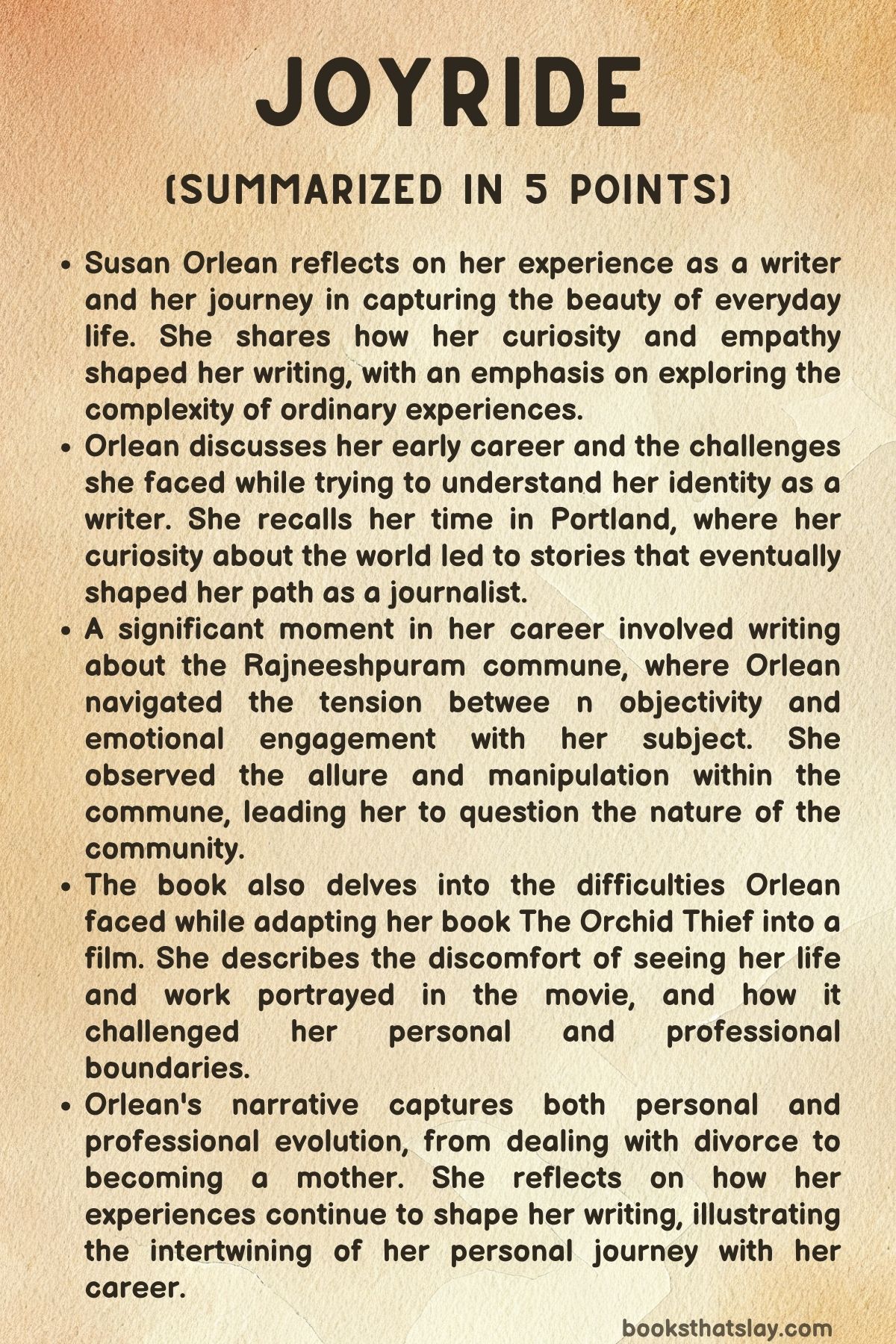
Key People
E.B. White
E.B. White, as portrayed in Joyride by Susan Orlean, is a reflective and deeply introspective character whose journey through life and writing is characterized by a blend of excitement and fear. White’s writing career is driven by an inherent curiosity about the world and the complex beauty of everyday life.
He views writing not as a mere job, but as a calling, one that offers both purpose and a sense of belonging. White’s passion for writing is evident in how he meticulously explores the nuances of the ordinary, seeking the poetry hidden within the mundane.
His personal journey, shaped by his early experiences in literature and the formative road trip he took after college, illustrates how travel and exploration have been fundamental to his understanding of the world. Throughout his career, White has been motivated by a quest for deeper meaning, and his writing process is a constant reflection of this mission to reveal hidden truths in the seemingly ordinary.
His ability to trust his instincts, approach subjects with empathy, and pay attention to life’s subtle details is what has made his work so impactful. Despite his success, White’s personal challenges, particularly his strained relationship with his father and the obstacles he faced early in his writing career, have shaped his resilience and determination.
Susan Orlean
Susan Orlean, the author of Joyride, is a multifaceted character who embarks on a personal and professional journey throughout the narrative. Orlean’s life is marked by her deep passion for writing and the complexities of adapting her work into film, as well as her evolution in understanding both herself and the world around her.
While navigating a challenging divorce and a new relationship, she remains focused on her writing career, working through personal turmoil and the public spectacle of her life being adapted into film. The transition from the book to the screen, especially with the film Adaptation, introduces Orlean to an entirely new realm of artistic expression and self-exploration.
Despite her initial reluctance, she grows intrigued by the film process and the portrayal of her own life and work on the big screen. Orlean’s relationship with her readers and the public is also explored, particularly in how her personal and professional experiences blend, making her writing more than just an external observation of the world but also a deeply personal exploration.
Her evolution as a writer, mother, and public figure showcases her resilience, adaptability, and the tension between her private and public identities. Her experiences reveal a woman grappling with the complexities of identity, both in her personal life and her role in the literary world.
Bhagwan Shree Rajneesh
Bhagwan Shree Rajneesh, as introduced in Joyride, is portrayed as a charismatic yet controversial figure whose influence extends over a vast community in Rajneeshpuram. His role in the narrative is central to understanding the complexities of belief systems and the ways in which they can be manipulated for power.
Rajneesh presents himself as a spiritual leader, attracting thousands of followers with his promise of enlightenment, guilt-free living, and happiness. His presence is marked by a luxurious lifestyle, symbolized by his fleet of Rolls-Royces and extravagant rituals.
However, beneath the surface of his peaceful teachings, there are darker undertones, including manipulation, control, and surveillance of his followers. Rajneesh’s character, especially as seen through the eyes of the reporter in the narrative, evokes both skepticism and intrigue.
His ability to captivate his followers, including the media, speaks to the power of charisma and the dangers of blind devotion. Despite his spiritual veneer, Rajneesh’s actions reveal a complex figure, one who balances between the realms of a spiritual guide and a controversial leader whose methods raise ethical questions about authority and control.
Ma Anand Sheela
Ma Anand Sheela, Bhagwan Shree Rajneesh’s second-in-command, plays a crucial role in the dynamics of Rajneeshpuram. In Joyride, she is depicted as a fierce, outspoken, and manipulative figure whose controversial actions leave a lasting impact on the narrative.
Known for her bold, provocative remarks about money, politics, and the local government, Sheela is both a charismatic leader and a polarizing figure within the Rajneesh movement. Her leadership style contrasts with Bhagwan’s more passive presence, as she actively engages with the media and public figures, often stirring controversy.
Her brash attitude and willingness to speak her mind create a striking contrast to the serene image projected by the commune, revealing the internal tensions and complexities that characterize Rajneeshpuram. Sheela’s role is pivotal in the narrative, as she represents the darker side of the movement—one of manipulation, power struggles, and exploitation.
Despite her controversial nature, she is a character who commands attention, embodying the contradictions inherent in the Rajneesh movement.
Cathy Cheney
Cathy Cheney, the reporter’s photographer colleague in Joyride, serves as a counterbalance to the fascination and allure of Rajneeshpuram. Unlike the reporter, who oscillates between skepticism and intrigue, Cheney is quick to suspect that the Rajneesh movement is not as benign as it appears.
Her suspicion that their hotel room might be bugged, which is later confirmed, reveals her critical and observant nature. Cheney’s role in the story underscores the unease that comes with the realization that something sinister might be lurking beneath the surface of a seemingly perfect community.
She serves as a voice of reason, highlighting the darker, manipulative aspects of Rajneeshpuram, and her observations add layers to the narrative’s exploration of the complexities of belief and power.
John
John, the author’s partner in Joyride, is a steady and supportive presence in Orlean’s life. Their relationship provides a sense of stability amid the chaos of Orlean’s professional and personal struggles.
The couple’s journey together is marked by deep conversations, shared experiences, and plans for a family, culminating in their eventual marriage. John’s role in Orlean’s life is that of a grounding force, someone who helps her navigate the turbulence of her career and personal challenges.
His presence contrasts with the more chaotic and unpredictable elements of Orlean’s life, such as her divorce and the pressures of being a public figure. John’s character represents the stability and support that Orlean needs during times of transition, and their relationship offers a sense of personal fulfillment that complements her evolving career.
Themes
The Complexity of the Writing Journey
Writing, as explored in Joyride, is presented not merely as a profession, but as a profound journey filled with personal discovery, challenges, and moments of exhilaration. For the author, it becomes a way to navigate and make sense of the world.
Writing is not just about chronicling events, but about interpreting them, connecting to the emotional layers of life, and understanding the complexity of human existence. The process of writing is portrayed as both a personal and public act.
The act of creating and shaping narratives is often intertwined with the writer’s own life, serving as a tool for both self-expression and empathy. In the memoir, the author also reflects on the role that curiosity plays in becoming a successful writer.
It is this inherent desire to explore the unknown, to see the world through a fresh lens, that allows the author to deeply engage with different subjects, whether it is a child’s life, a commune, or a personal journey. This constant quest for new experiences, both intellectually and emotionally, challenges the writer to stay engaged with their work and evolve their voice, while maintaining an understanding of the broader world around them.
The writing process, however, does not come without its own frustrations and uncertainties. There are moments of doubt, especially when the writer encounters a subject or story that seems particularly elusive.
Ideas might come easily, but others require patience, experimentation, and creative courage. The memoir details the intense commitment to the craft, demonstrating that writing involves confronting the mundane, finding extraordinary insights in ordinary moments, and trusting one’s instincts in the process.
In the end, writing becomes an ongoing conversation between the self and the world, a continuous journey of exploration, learning, and discovery.
The Struggle for Identity and Public Perception
Throughout Joyride, the author grapples with the complexities of identity, especially in the context of their public persona. Writing as a journalist and author often requires a degree of personal exposure, but this also creates tension with the desire for privacy and personal autonomy.
In particular, the process of adapting their work into a film—Adaptation—becomes a pivotal moment in understanding the conflict between one’s true self and the portrayal of that self in public spaces. The author’s resistance to being portrayed on screen is emblematic of a larger struggle with how one’s life is shared with the world.
While the film adaptation of The Orchid Thief allows for creative liberties and shifts in narrative, it also distorts the author’s image and personal life for the sake of storytelling. This dissonance between the author’s reality and how others interpret or represent it raises questions about the ethics of adaptation and the difficulty of controlling one’s own narrative.
The transformation of personal experiences into art also brings a sense of vulnerability, as the author navigates not only the expectations of others but their own understanding of their role in the world. It becomes clear that even though the writer’s work might resonate with the public and attract new readers, the process of watching their life fictionalized can feel alienating.
The author also explores the way that being publicly known changes one’s relationship with self-identity. With the release of the film, there is a shift in how the author is perceived—not just as a writer, but as a character in a larger, more complex narrative.
This theme examines the tension between the private self and the public self, and the author’s efforts to reconcile the two as they continue their work in the spotlight.
The Impact of Personal Life on Creative Work
In Joyride, the author’s personal life is intricately woven into their creative work, showcasing how life events often influence the stories one tells. The narrative of the author’s professional journey is intertwined with deeply personal moments, such as a difficult divorce and a new romantic relationship.
These experiences are reflected in the writer’s work and contribute to the lens through which they perceive the world. The memoir touches on how emotional turmoil—whether through personal loss, the ending of a marriage, or even the upheaval brought about by a significant life change—can fuel creativity and inspire new writing.
While writing provides an avenue for processing these emotions, it also creates a platform for reflection. The author’s involvement with Adaptation and the complex feelings surrounding the adaptation process are influenced by their ongoing emotional struggles and their own journey toward self-discovery.
These life events often shape the writer’s voice, providing both the content and the emotional depth required to connect with readers on a personal level.
In addition to personal growth, the author also navigates the relationship between work and life. The memoir highlights how the demands of writing—constant deadlines, the pressure of producing meaningful content—can conflict with one’s need to process personal challenges.
At times, writing serves as a means of escape or a therapeutic outlet, helping the author make sense of their changing circumstances. However, the act of writing also requires a certain distance, a way of objectifying the raw emotions of daily life to create something larger and more universally resonant.
This duality of creative work—where personal experiences both influence and challenge the work itself—forms a core theme in the memoir, with the author continually reflecting on the impact of their evolving emotional landscape on their writing.
The Intersection of Life, Death, and Writing
A prominent theme in Joyride is the relationship between life, death, and the act of writing. This theme is explored through the author’s work on the obituary column titled “Afterword” and the reflections surrounding the deaths of various people, animals, and objects.
The writer is tasked with capturing the essence of lives and things that are no longer present, forcing them to confront the impermanence of existence. The seemingly simple act of writing an obituary becomes a profound reflection on how lives are remembered and the meaning attributed to them after death.
The juxtaposition of life and death, particularly in the author’s exploration of everyday occurrences—like the passing of a beloved wolf or the bankruptcy of an object like the Instant Pot—forces the writer to grapple with the transient nature of everything.
While this theme brings an air of melancholy, it also highlights the power of storytelling. The author’s ability to memorialize, to write with care and attention to detail, allows for the continued existence of something or someone beyond their physical demise.
It’s a meditation on how stories, even those about objects or fleeting moments, live on long after the subject itself is gone. In this way, the author demonstrates how writing connects individuals to something greater than themselves, allowing them to transcend mortality.
Writing, then, becomes a way to preserve life, to give meaning to death, and to reflect on the cyclical nature of existence—where endings are just the beginning of another story.