King Sorrow Summary, Characters and Themes
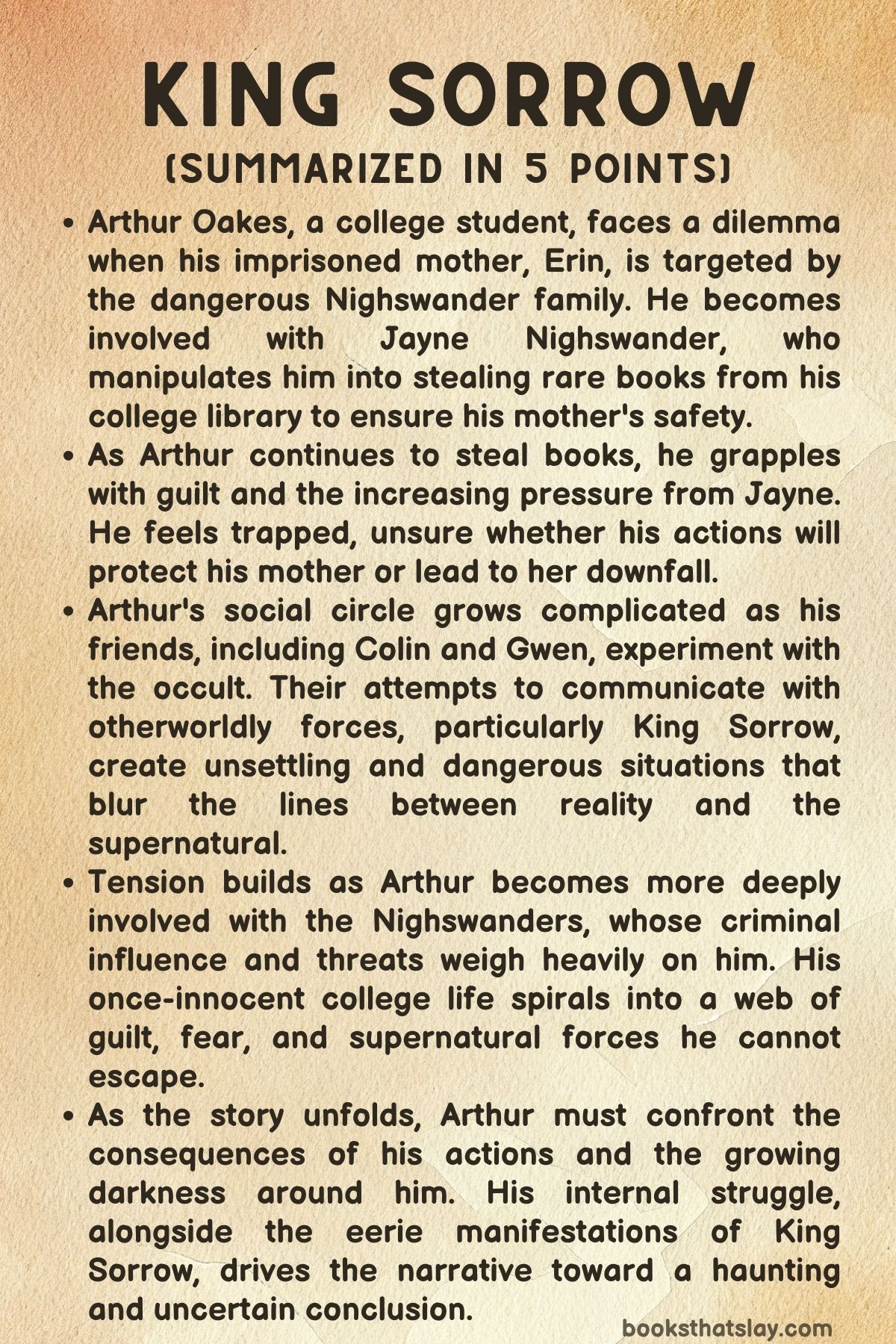
King Sorrow by Joe Hill is a haunting and intricate tale that explores the themes of guilt, manipulation, supernatural forces, and the human cost of engaging with dark powers. The novel follows Arthur Oakes, a college student who is caught in a world of crime, occult rituals, and blackmail, all while trying to save his incarcerated mother.
As Arthur becomes further entangled with the Nighswander family, particularly Jayne Nighswander, he finds himself stealing rare books under threat, leading him deeper into a nightmarish journey that blurs the lines between reality and the supernatural. The story explores how one’s actions, when coerced by fear and desperation, can spiral into consequences beyond one’s control, ultimately forcing Arthur to face the sinister force he has unwittingly unleashed.
Summary
Arthur Oakes, a college student, finds himself caught in a perilous situation when he visits his mother, Dr. Erin Oakes, who is incarcerated at the Black Cricket Women’s House of Correction. Erin, a former theologian and professor, is serving time for manslaughter.
Arthur’s visit is marked by tension when he encounters the Nighswander family, particularly Tana and Jayne, who have a contentious history with his mother. During this visit, Arthur inadvertently becomes involved in a confrontation when Tana’s mother, Daphne, throws coffee at Erin, leading to a chaotic scene that ends the visit prematurely.
As Arthur grapples with his mother’s situation, he seeks comfort in his college friends, including Van McBride and Colin Wren. Colin, along with his twin sister Donna, shares an interest in the paranormal, and soon Arthur finds himself immersed in their experiments with psychic phenomena.
However, his personal life takes a darker turn when he is coerced by Jayne Nighswander into stealing rare books from the college library. Jayne pressures Arthur by threatening his mother’s safety, revealing that her connections with corrupt prison guards could put Erin’s life at risk if Arthur does not comply.
Arthur begins to steal valuable first editions and rare manuscripts, handing them over to Tana, who acts as a go-between for Jayne. He struggles with guilt and the fear that his actions are endangering his mother, but he feels trapped by the threats of violence hanging over her.
As the weeks pass, the tension grows, and Arthur’s mental state begins to deteriorate under the weight of his choices. His friends, including Gwen Underfoot, continue their experiments with Colin, exploring psychic abilities and the potential to connect with otherworldly forces.
The story takes an unsettling turn when Arthur is invited to a séance at Colin’s house, where a recording of a ritual meant to contact a ghost named Elwood Hondo is shown. The séance quickly spirals into chaos, with strange and disturbing occurrences that unsettle the group.
The experience leaves Arthur shaken, and his involvement with the Nighswanders becomes more complicated. He is torn between continuing to steal for Jayne to protect his mother and the increasing fear that he is caught in something far darker and more dangerous than he realizes.
As the pressure mounts, Arthur’s interactions with his friends, especially Gwen and Colin, take on a more ominous tone. Gwen, in particular, becomes increasingly concerned about the influence of the occult and the sinister force lurking behind the rituals.
The group’s fascination with the supernatural, particularly their attempts to contact a dark entity called King Sorrow, deepens the mystery. Arthur’s fear grows as he realizes that the rituals they have been engaging in might be bringing something far more dangerous into the world.
Meanwhile, the Nighswanders continue to manipulate Arthur, using his guilt and fear to further control him. Jayne’s demands for more rare books escalate, and Arthur becomes further isolated, unable to escape the hold they have on him.
The threats against his mother become more direct, and the reality of the situation hits Arthur hard as he realizes the full extent of the danger she is in. He begins to question his own moral compass, wondering if there is any way out of the spiral of manipulation and fear he is caught in.
The story reaches its climax when Arthur, in an effort to free himself from the grip of the Nighswanders and the dark forces they have unleashed, must confront the true nature of King Sorrow. This malevolent entity, tied to the occult rituals and the mysterious past of the McBride family, is not just a force of destruction but a reflection of the guilt and darkness that Arthur has been trying to escape.
As he faces the consequences of his actions, Arthur must navigate the line between reality and the supernatural, unsure of what is real and what is merely a product of his troubled mind.
Arthur’s journey is one of internal conflict, as he is forced to reckon with the consequences of his actions and the manipulation he has suffered. The narrative explores themes of guilt, the abuse of power, and the ways in which the human mind can become ensnared by fear and shame.
As the story unfolds, Arthur’s sense of self unravels, and he is left chasing shadows, unsure of whether he will ever escape the forces that control him.
In the final moments of the story, Arthur is left confronting the aftermath of his choices, the broken relationships, and the dark entity that has been unleashed into the world. The fate of his mother and the true nature of King Sorrow remain uncertain, leaving the reader with a lingering sense of dread.
The story ends on a note of ambiguity, with Arthur trapped in a cycle of guilt, fear, and supernatural forces beyond his control. The lines between the real world and the paranormal have blurred beyond recognition, leaving Arthur to wonder if there is any escape from the shadow that looms over him.
King Sorrow is a dark exploration of how the past can haunt us, how manipulation can warp our choices, and how the supernatural can shape our reality in ways we cannot comprehend. Joe Hill crafts a tale that is both unsettling and thought-provoking, leaving the reader to question the power of the forces that govern our lives, both human and supernatural.
Characters
Arthur Oakes
Arthur Oakes is the central figure in King Sorrow, a college student struggling to balance his academic aspirations with the overwhelming weight of his family’s troubled past and the sinister pressures placed on him by the Nighswander family. A son of Erin Oakes, who is imprisoned for manslaughter, Arthur finds himself embroiled in a dark web of manipulation and moral dilemmas.
At the start of the story, Arthur seems to have a promising future, with aspirations to attend Oxford and an interest in psychic phenomena. However, his life takes a turn when he is coerced into stealing rare books for Jayne Nighswander, who threatens the safety of his mother.
This conflict drives Arthur into a spiral of guilt and fear, as he feels increasingly trapped by Jayne’s demands and the threats against his mother. Arthur’s emotional journey is marked by a growing sense of helplessness and anxiety, especially as he grapples with his involvement in the occult rituals surrounding King Sorrow.
His struggles with moral choices, loyalty to his mother, and his deepening involvement with dangerous forces form the emotional core of the narrative.
Erin Oakes
Erin Oakes, Arthur’s mother, is a complex figure caught between her past as a respected theologian and professor and her present as an inmate in the Black Cricket Women’s House of Correction. She was convicted of manslaughter, a crime that casts a shadow over her relationship with her son.
Despite her conviction, Erin remains composed and strong, even starting a book club in prison, which highlights her resilience and desire to maintain a sense of purpose. Throughout the story, Erin’s interactions with Arthur reveal her attempts to guide him through his challenges, offering wisdom and calm in contrast to the chaos around them.
Erin’s tragic situation makes her a sympathetic character, and her ongoing struggle for parole underscores her desire to rebuild her life. Her quiet strength in the face of her imprisonment also reflects a sense of maternal love, as she wishes to protect Arthur, even though her own freedom is uncertain.
Jayne Nighswander
Jayne Nighswander is a manipulative and ruthless character who plays a pivotal role in Arthur’s moral downfall. As the older sister of Tana Nighswander, Jayne is both a direct threat and a source of pressure on Arthur.
Her aggressive tactics, including coercing Arthur into stealing books to protect his mother from harm, reveal her willingness to exploit those around her for personal gain. Jayne’s actions throughout the story create a chilling atmosphere of fear and manipulation, as she uses Arthur’s sense of duty and his fear for his mother to control him.
Her relationship with Arthur is characterized by tension, as she constantly reinforces her hold over him, making it clear that there are severe consequences if he does not comply. Her connection to corrupt prison guards and her ability to threaten Erin’s safety make her a dangerous adversary, and her role in the story escalates as she becomes the primary antagonist in Arthur’s world.
Tana Nighswander
Tana Nighswander is a secondary antagonist in King Sorrow, whose role is closely tied to the Nighswander family’s dark dealings. A pizza delivery girl with a troubled background, Tana becomes involved in the blackmail scheme against Arthur, assisting Jayne in collecting the stolen books.
Her behavior is erratic and unpredictable, reflecting the unstable environment she inhabits. Tana’s involvement with drugs and her blatant defiance of authority, exemplified by her rebellious choice to wear a controversial Guns N’ Roses shirt, highlight her rebellious nature.
While she is not as overtly menacing as Jayne, Tana’s role in Arthur’s downfall is significant, as she further entrenches him in the dangerous world of the Nighswanders. Despite her more passive role in the conflict, Tana’s interactions with Arthur are marked by a mix of intimidation and occasional moments of camaraderie, making her a complex and unpredictable character.
Van McBride
Van McBride is one of Arthur’s closest friends and a pivotal character in the larger narrative surrounding King Sorrow. Van is characterized by his deep bond with his twin sister, Donna, and his involvement in the occult experiments that spiral out of control in the story.
Van’s addiction to alcohol and drugs becomes a central theme in his character arc, as it serves as both a physical and psychological struggle that he must confront while being held captive by Joe Valentine and his team. His involvement with the dark entity, King Sorrow, is indirect but crucial, as he is forced to endure extreme physical and emotional torture while uncovering the true power of King Sorrow.
Despite his struggles, Van remains loyal to his sister and to those who care about him, showcasing a deep sense of familial responsibility. His character is marked by resilience in the face of intense suffering, and his eventual realization that Valentine and his team are in more danger than they realize adds an element of suspense and tension to the story.
Donna McBride
Donna McBride, Van’s twin sister, is a fiercely independent and complex character who, despite her resistance to authority, becomes an essential part of the narrative. Her connection to King Sorrow is both a curse and a source of immense power, as she inadvertently brings the creature into the world through a strange mark on her body.
Donna’s resilience is evident throughout the story, particularly in her refusal to give in to the demands of her captors. Her relationship with Van is one of mutual protection, as they fight to resist the psychological and physical torture inflicted upon them by Joe Valentine and his team.
Donna’s defiance is a central theme in her character, as she refuses to betray her family despite the intense pressure placed upon her. However, her actions also carry a heavy price, as she faces increasingly dangerous encounters with King Sorrow and its manifestations.
Donna’s journey is marked by her internal struggle between resistance and the growing realization of the power that lies within her, making her a pivotal character in the unfolding events.
Gwen Underfoot
Gwen Underfoot is another important character in King Sorrow, who finds herself drawn into the battle against the destructive forces unleashed by King Sorrow. Her character is defined by her determination to confront the entity, even at the cost of her own well-being.
Pregnant and dealing with a grave injury, Gwen’s physical and emotional struggles highlight her strength and resilience. Despite her deteriorating health, Gwen remains steadfast in her decision to face King Sorrow, unwilling to let her friends face the creature alone.
Her relationship with Donna is one of transformation, as the two women move from antagonism to mutual respect and cooperation, working together to summon Arthur in an attempt to defeat the dark entity. Gwen’s role as a leader and protector in the final battle against King Sorrow is marked by her willingness to sacrifice herself for the greater good.
Her physical deterioration during the battle against the dragon-like force emphasizes the stakes of the conflict and the emotional toll it takes on her. Despite the losses and pain she endures, Gwen’s ability to find peace in the aftermath, reflecting on her past and the battles fought, shows her growth as a character and her acceptance of the scars—both physical and emotional—that remain.
Joe Valentine
Joe Valentine is a shadowy and manipulative figure who plays a central role in the story’s darker undercurrents. Leading a team that seeks to control King Sorrow, Valentine is ruthless and driven by a desire for power, willing to go to great lengths to harness the creature’s destructive potential.
His interactions with Van and Donna are marked by cruelty and manipulation, as he attempts to extract information about the creature from them. Valentine’s obsession with King Sorrow grows as the story progresses, revealing his willingness to sacrifice anyone and anything in pursuit of this dark entity.
Despite his apparent control, Valentine begins to lose grip on the situation as the power of King Sorrow threatens to overwhelm him and his team. His ultimate downfall comes when he underestimates the true power of the creature he seeks to control, leading to a tense and chaotic climax.
Valentine’s character is defined by his ruthlessness and his obsession with power, which ultimately leads to his demise at the hands of the very entity he sought to manipulate.
Themes
Guilt and Redemption
Arthur’s journey in King Sorrow is deeply defined by his inner struggle with guilt and the search for redemption. From the very beginning, Arthur feels the weight of his mother’s past actions, especially her manslaughter conviction, and as he grows entangled with the Nighswanders, his sense of guilt only deepens.
The pressure to comply with Jayne’s demands, coupled with his fear for his mother’s safety, pushes him into actions that compromise his moral integrity. Stealing rare books from the library, Arthur is fully aware that these actions will lead to harm, yet he feels powerless to refuse.
This moral conflict weighs heavily on him, as he becomes consumed by the consequences of his choices. His involvement with Jayne forces him into a downward spiral, where each stolen book, each new demand, makes it harder for him to escape.
Redemption, in his case, is elusive. Even when he confides in his friends, seeking some form of emotional release, the burden of his actions hangs over him.
His pursuit of redemption is constantly undermined by the looming threat of King Sorrow and the manipulation by Jayne. The moral quandary Arthur faces is a classic example of the inner turmoil that often accompanies the quest for redemption, especially when the cost of one’s actions cannot be undone.
Power and Manipulation
One of the key themes in King Sorrow is the abuse of power and the ways in which individuals manipulate others for personal gain. Jayne’s role in the story exemplifies this dynamic.
She uses her knowledge of Arthur’s vulnerable situation to coerce him into stealing books from the library. The threat against his mother’s life becomes her leverage, and Arthur, filled with dread, feels cornered into submission.
The way Jayne controls him reveals the extent to which people can be manipulated when they are placed under duress. Her ability to exploit Arthur’s weaknesses, particularly his love for his mother, demonstrates the destructive impact of power when it is used to control and intimidate.
Similarly, the presence of King Sorrow, a dark entity capable of manipulation on a supernatural level, introduces another layer to the theme of power. The rituals and occult practices that the group engages in show how vulnerable individuals can be when they seek to control forces beyond their understanding.
Whether through physical threats or supernatural means, manipulation in this story is both a personal and cosmic force, showcasing the human tendency to exploit others in the pursuit of self-preservation or power.
The Supernatural and Reality
In King Sorrow, the boundaries between the supernatural and the real world blur as the characters experience increasing encounters with dark forces. The inclusion of psychic phenomena, occult rituals, and the powerful entity known as King Sorrow creates an atmosphere where the supernatural isn’t just a background element but a driving force that influences the characters’ lives.
Arthur’s exposure to the occult, especially his involvement with Colin’s psychic experiments and the séance, brings him face-to-face with forces that challenge his understanding of reality. The merging of the ordinary world—college life, mundane interactions with friends and family—with the extraordinary—ghosts, séances, and dark rituals—creates an unsettling atmosphere that leaves characters questioning what is real.
For Arthur, the supernatural becomes inescapable. His fear and guilt, already overwhelming, are compounded by the strange and eerie events he witnesses, forcing him into a world where the line between what is imagined and what is real no longer exists.
The entity of King Sorrow serves as a symbol of the unknown, representing the darker aspects of human nature and the universe. As the characters become increasingly entangled with these otherworldly forces, they must confront the consequences of their actions in both the physical and metaphysical realms.
Friendship and Loyalty
The relationships between the characters in King Sorrow are tested in various ways, with loyalty and friendship playing pivotal roles in shaping the course of events. Arthur’s bond with his friends, especially his interactions with Van, Donna, and Gwen, highlights the complexities of human connection in times of crisis.
While Arthur is weighed down by guilt and fear, his friends continue to provide him with a semblance of normalcy. However, these friendships are not without strain.
As Arthur becomes involved in the dangerous dealings with the Nighswanders, he isolates himself from his peers, torn between his loyalty to his mother and the fear of betraying those he cares about. Gwen, too, experiences the difficulties of friendship under extreme stress, especially as she battles with her personal demons while preparing to confront King Sorrow.
Her friendship with Donna, once strained and antagonistic, evolves as they work together to fight against the dark forces. The group’s collective resolve to face the terror of King Sorrow speaks to the strength of their loyalty to one another, despite the dangers they face.
The sacrifices made by characters like Gwen and Donna further illustrate the theme of loyalty, as they put their lives on the line for each other. Ultimately, friendship and loyalty provide moments of strength and hope in a world increasingly overshadowed by guilt, manipulation, and supernatural forces.
Fate and Free Will
In King Sorrow, the tension between fate and free will is explored through the characters’ choices and the consequences of their actions. Arthur’s story, marked by a series of decisions that lead him deeper into moral and supernatural entanglements, reflects the struggle between his desire for agency and the pressure of external forces.
His theft of books and his involvement with Jayne may seem like choices, but they are also reactions to the manipulation and threats he faces, raising questions about how free will operates when someone is coerced. The characters, particularly those dealing with King Sorrow, experience a sense of inevitability, as though their destinies are written and they are merely playing their parts.
The presence of King Sorrow itself embodies this theme, as it represents a force beyond human comprehension, one that seems to determine the fates of those it touches. Despite Arthur’s attempts to make choices that could redeem or protect him, his involvement in the occult and his eventual confrontation with King Sorrow suggest that fate may be too powerful to escape.
For other characters, such as Gwen and Donna, their struggles with King Sorrow also seem dictated by forces beyond their control, as though they are mere vessels for a darker purpose. The narrative raises the unsettling question of whether free will truly exists, or if everything is controlled by an unseen hand guiding them toward a tragic end.
The Consequences of Actions
The theme of consequences is central to the narrative of King Sorrow, as the characters grapple with the fallout from their decisions. Arthur’s theft of books, which he sees as a necessary evil to protect his mother, has a cascading effect on his life.
Each stolen book increases the stakes, pulling him further into a web of guilt and fear. The consequences of his actions extend beyond his personal feelings of responsibility, affecting the people around him and ultimately leading to the unleashing of dark forces.
Similarly, Gwen’s decision to engage in dangerous occult rituals in an attempt to summon her deceased love, Arthur, also brings about severe consequences. Her actions lead to the manifestation of King Sorrow, which unleashes chaos and destruction.
Throughout the story, characters are forced to confront the aftermath of their choices, whether it is the emotional toll of betrayal, the physical consequences of violence, or the supernatural destruction they’ve unleashed. The consequences of their actions are inescapable, highlighting the theme that choices, no matter how small, can have far-reaching and irreversible effects, especially when one is dealing with forces beyond understanding.