Gone Before Goodbye Summary, Characters and Themes
Gone Before Goodbye by Reese Witherspoon and Harlan Coben is a medical conspiracy thriller centered on Maggie McCabe, a gifted reconstructive surgeon whose career collapses after grief and prescription drug misuse lead to a disastrous operation.
When a secretive billionaire offers her millions to perform an illegal procedure, Maggie enters a world of hidden clinics, stolen organs, artificial hearts, altered identities, and international corruption. Her search for the truth forces her to reconsider everything she believed about her dead husband, his closest friend, and the humanitarian organization they created together. The story combines medical suspense with questions about grief, loyalty, consent, professional ambition, and the destructive consequences of secrecy.
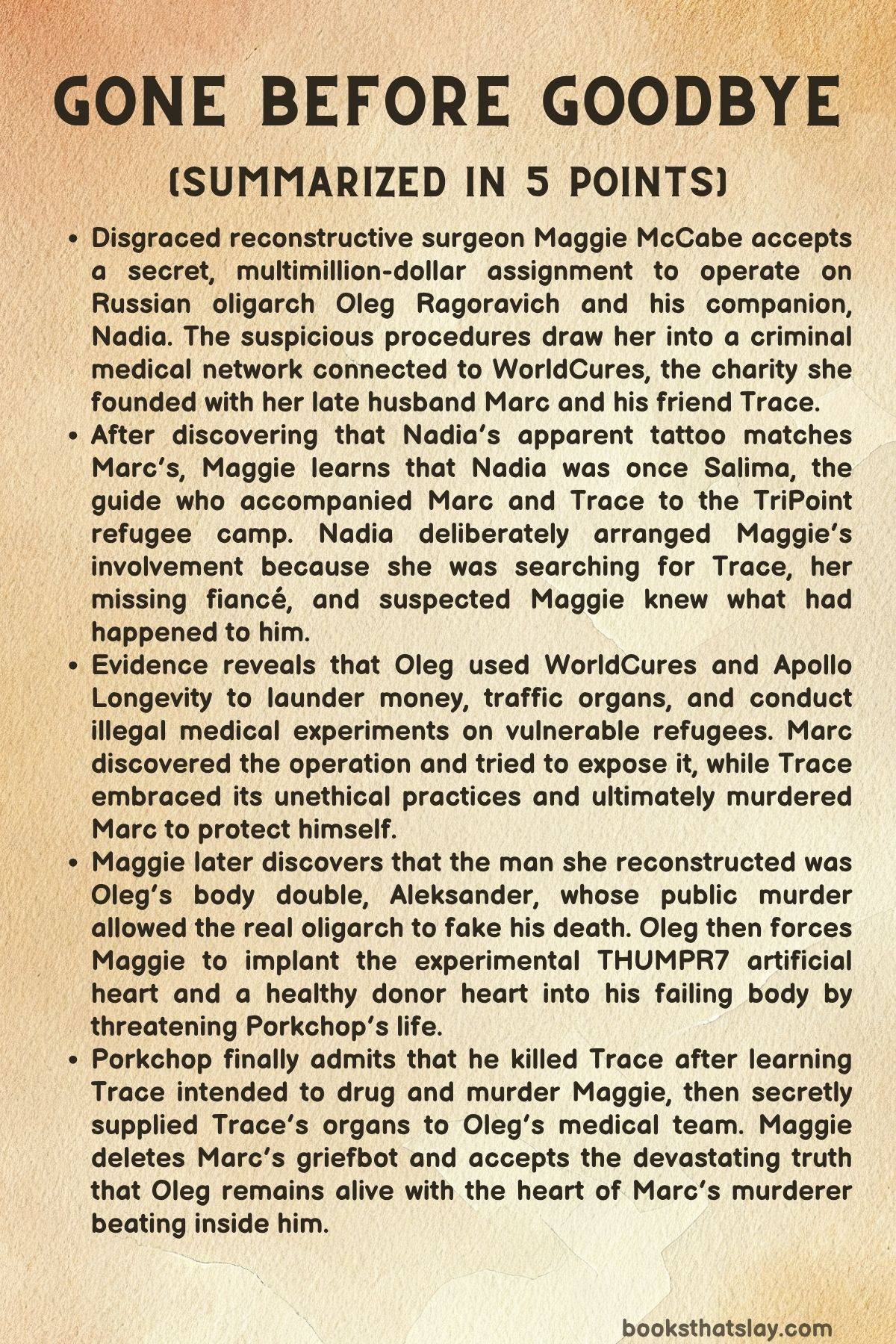
Summary
Cardiothoracic surgeon Marc Adams travels with his closest friend, Trace Packer, and a guide named Salima to the TriPoint refugee camp in North Africa. As militants attack the camp, Marc refuses to abandon a fifteen-year-old patient whose chest remains open on the operating table.
Marc orders Trace and the other medical workers to escape while he completes the procedure. Armed men eventually enter the operating room, and Marc closes his eyes while thinking of his wife, Maggie McCabe, believing that he is about to die.
One year later, Maggie remains emotionally and professionally shattered. Once a celebrated reconstructive surgeon, she has lost her medical license after operating while impaired by prescription medication, an addiction that developed following the deaths of Marc and her mother.
Maggie attends a scholarship ceremony honoring her mother at Johns Hopkins but is treated as a disgrace by former colleagues. Her former mentor, billionaire cosmetic surgeon Evan Barlow, privately offers her twenty thousand dollars merely to attend a secret meeting in New York.
Maggie now lives with her sister, Sharon, and Sharon’s son, Cole. Sharon is an artificial-intelligence developer who has created a highly advanced digital version of Marc using his messages, recordings, online activity, private data, and surveillance history.
Maggie regularly speaks to this griefbot as though Marc were still alive. The program reproduces his humor, personality, habits, and emotional reactions, but it also reproduces the lies and secrets he kept during his lifetime.
In New York, Maggie visits Trace’s apartment, which she has been maintaining during his supposed humanitarian work abroad. Among his mail, she discovers a bill for three safe-deposit boxes, including one so large that it could hold medical machinery or a human-sized object.
Barlow takes Maggie to a secret clinic where she meets Ivan Brovski, the representative and physician of Russian oligarch Oleg Ragoravich. Ivan offers to eliminate Maggie’s debts, pay Sharon’s financial obligations, settle Maggie’s malpractice case, and give Maggie ten million dollars in exchange for performing confidential surgery at Oleg’s estate.
The money is transferred almost immediately, leaving Maggie trapped before she has time to reconsider. She is flown to a heavily guarded palace, where Oleg asks her to reconstruct his face and perform cosmetic surgery on his young companion, Nadia.
The operating theater has been built as an exact copy of Maggie’s former room at Johns Hopkins. Oleg’s requested facial changes also appear unusually specific, as though he wants to resemble someone shown in two old photographs rather than simply look younger.
Nadia privately reveals that she speaks English, though she has hidden this from Oleg. She insists that she consents to her cosmetic procedure, but Maggie learns that Nadia has only one kidney and becomes suspicious of her explanation that she donated it to a sick brother.
At a lavish ball, Maggie meets American surgeon Charles Lockwood, who warns her to observe everything carefully. He reveals that Oleg secretly funded WorldCures Alliance, the humanitarian medical organization Maggie created with Marc and Trace.
Nadia eventually admits that she sold her kidney as a teenage refugee. Brokers arranged the operation in exchange for money, new identities, and a safe future for her mother and brother, while Nadia remained behind.
Maggie begins to suspect that WorldCures and Apollo Longevity, an exclusive international medical clinic, were involved in organ trafficking. Oleg denies meaningful involvement with WorldCures, but his evasiveness convinces Maggie that his medical network extends far beyond legal cosmetic treatment.
Maggie successfully operates on Oleg and Nadia. During Nadia’s recovery, however, Maggie notices a serpent-and-halo tattoo on her thigh identical to a tattoo Marc carried in the same location.
Nadia claims that a white surgeon called the Snake marked her when her kidney was removed. She also says that Trace was present during the operation and tried to intervene, connecting Maggie’s husband and his closest friend directly to Nadia’s past.
At the same time, Oleg disappears, valuable paintings vanish, and the estate’s security forces begin evacuating people. Ivan returns Maggie’s phone and claims that his technicians deleted the Marc griefbot, but Sharon’s hidden protections allow Maggie to reactivate it.
The digital Marc recognizes Ivan’s voice and Oleg’s name, proving that the real Marc knew both men. When Maggie explains that she altered Oleg’s face, the griefbot warns that Oleg’s men will kill her because she can identify his new appearance.
Maggie escapes through a bathroom window and steals one of Oleg’s Ferraris. After a gunfight and pursuit, the car crashes into a ravine, but Charles’s intelligence team receives her emergency call and rescues her before Ivan’s guards can reach her.
Charles reveals that Oleg used WorldCures to launder money through inflated expenses, shell organizations, and fraudulent charitable transactions. Marc and Trace became trapped in the scheme, and Oleg threatened to kill them when they attempted to leave.
Marc secretly began supplying information to Charles. His death may have resulted from the TriPoint attack, an assassination arranged by Oleg, or an attempt to disappear, although Maggie’s father-in-law, Porkchop, rejects the idea that Marc would willingly abandon his family.
Charles takes Maggie to Dubai, where WorldCures, Apollo Longevity, and Oleg’s medical network once overlapped. Maggie’s presence is intended to attract the attention of anyone connected to Trace’s disappearance.
Using unpublished photographs taken at TriPoint, Maggie discovers that Nadia was actually Salima, the guide who accompanied Marc and Trace to the refugee camp. When Maggie confronts her, Nadia admits that she deliberately requested Maggie as her surgeon and used a temporary tattoo to provoke a reaction.
Nadia explains that she later reunited with Trace in Dubai and fell in love with him. Trace proposed to her, but five months earlier, he received what he claimed was an urgent call from Maggie, flew out of Dubai, and disappeared.
Nadia initially believed Maggie might have harmed Trace. She became close to Oleg, searched his files, and arranged Maggie’s recruitment to test whether she knew more than she admitted.
Maggie and Nadia agree to cooperate, though neither fully trusts the other. Their investigation is interrupted when Oleg appears at a Dubai nightclub with his face bruised and bandaged, claiming that people are trying to kill him.
Masked attackers surround Oleg, and Maggie sees him stabbed in the chest. His body is carried away through the dancing crowd, while one of his security men attacks Maggie and disappears.
At Apollo Longevity, Maggie and Nadia question Steve Schipner, a cosmetic surgeon and Maggie’s former classmate. Steve reveals that Trace broke into the clinic five months earlier, stole the experimental THUMPR7 artificial heart developed by WorldCures, and supposedly flew toward Washington.
Maggie realizes that the oversized safe-deposit boxes may have been intended to hide the stolen equipment. She also remembers that the THUMPR7 had once been implanted in a dying refugee named Kabir before the technology was ready, prolonging his life for only twenty-one painful days.
Police arrive at Apollo after Oleg’s body is discovered, forcing Maggie and Nadia to escape. Maggie flies to London, where Sharon finds old photographs showing that the facial features Maggie created during surgery came from a military portrait of Oleg.
Maggie realizes that the surgery may not have transformed Oleg into another person. Instead, it may have transformed another man into Oleg, allowing the real oligarch to arrange a convincing public death.
After meeting Porkchop in London, Maggie travels with him to a fortified vineyard near Bordeaux. Underground construction, armed security, and Ivan’s location suggest that the stolen THUMPR7 and Trace’s activities are connected to the estate.
Inside the vineyard’s secret medical complex, Maggie meets the real Oleg. The man she operated on was Aleksander, Oleg’s cousin and longtime body double, whom she altered to resemble a younger version of Oleg.
Oleg arranged Aleksander’s public appearance and murder so that the world would believe the oligarch was dead. He now reveals that his medical network purchased organs from vulnerable refugees for transplantation, research, and experimentation.
Oleg claims that Trace personally removed numerous organs because he considered ethical restrictions an obstacle to medical progress. Oleg’s own heart is failing, and he orders Maggie to perform an unprecedented operation using the THUMPR7 and a healthy donor heart.
Maggie is threatened with Porkchop’s torture and death if she refuses. During the operation, she works beside a masked surgeon whose disguised voice and familiar skill make her wonder whether Trace or another person from her past is present.
The operation succeeds when the THUMPR7 begins supporting the transplanted heart. The unidentified surgeon disappears before Maggie can discover who it was, and Oleg’s staff refuses to provide answers.
Nadia later confronts Maggie after discovering that Maggie lied about contacting Trace. Maggie admits that she called him after learning that he had returned to TriPoint while Marc was still alive, but Trace vanished before reaching Baltimore.
Porkchop then confesses that he killed Trace. After Trace landed in Washington, Porkchop’s biker friend Pinky followed him and discovered that he had purchased a gun and carried drugs that could be used to sedate Maggie and make her death appear to be suicide.
During interrogation, Trace admitted that he intended to murder Maggie before she could expose him. Nadia also admits that Trace hired the Child Army to kill Marc before they reached TriPoint, but she persuaded the armed teenagers to spare them.
Trace later returned during the attack on the camp. Marc had uncovered the organ-harvesting operation and intended to reveal it, which would have destroyed WorldCures and sent Trace to prison.
The evidence leads Maggie to the truth that Trace murdered Marc during the chaos. Her husband died because his closest friend wanted to hide the medical crimes they had committed together.
Back in Baltimore, Maggie asks Sharon to delete the Marc griefbot because it has prolonged her attachment rather than helping her accept Marc’s death. Porkchop eventually admits that he had been secretly cooperating with Ivan after killing Trace.
Porkchop recovered the THUMPR7 and exchanged it for money, protection, and an agreement that brought Maggie to France. He believed he was protecting her from becoming Trace’s killer because Maggie had armed herself before Trace’s expected arrival and had intended to kill him.
The final revelation is that Porkchop arranged for Trace’s organs to be harvested after his death. The healthy heart Maggie placed inside the THUMPR7 belonged to Trace, meaning that Oleg survives with the heart of the man who murdered Marc beating inside his chest.
Characters
In Gone Before Goodbye, the characters are connected by medicine, grief, secrecy, and competing ideas about loyalty. Their decisions repeatedly blur the line between protecting someone and controlling what that person is allowed to know.
Maggie McCabe
At the center of Gone Before Goodbye, Maggie is a gifted reconstructive surgeon whose sense of identity is almost completely tied to her ability to operate. Surgery gives her order, focus, authority, and relief from emotional pain, which explains why the loss of her license leaves her feeling that she has lost more than a career.
Her downfall begins in grief rather than simple carelessness. The deaths of Marc and her mother drive her toward prescription medication, but her decision to enter an operating room while impaired remains a serious violation of responsibility that she cannot excuse.
Maggie’s acceptance of Oleg’s offer shows how desperation can weaken judgment. The money would rescue her family, but the opportunity to operate again is equally powerful, and she ignores obvious warning signs because she wants to recover the part of herself that once felt valuable.
Her greatest strength is her refusal to abandon difficult truths once she begins uncovering them. Even after learning that Marc deceived her, Trace betrayed everyone, and Porkchop manipulated events, she continues searching because she cannot accept a comforting version of the past built on lies.
Maggie also possesses a strong belief in patient consent. Her insistence on speaking privately with Nadia shows that professional disgrace has not erased her ethical instincts, though later events force her to recognize that consent becomes complicated when poverty, coercion, fear, and survival limit a person’s available choices.
Her final decision to delete the griefbot marks emotional progress. She recognizes that preserving Marc’s digital personality cannot restore their marriage or provide genuine closure, because the program repeats both his affection and his dishonesty without offering the possibility of change.
Marc Adams
Marc is initially presented as a courageous physician who refuses to abandon a patient during an armed attack. His willingness to remain in the operating room while others escape establishes his devotion to medicine and his belief that doctors must treat patients without judging their politics or history.
Later revelations complicate this heroic image. Marc concealed his connections to Oleg, Ivan, organ trafficking, and the financial corruption inside WorldCures, leaving Maggie with an incomplete understanding of both their marriage and his humanitarian work.
Unlike Trace, Marc eventually tries to expose the criminal system. His cooperation with Charles suggests that guilt, fear, and moral responsibility pushed him to oppose the organization even though he had already benefited from it.
Marc’s secrecy may have been intended to protect Maggie, but it also prevented her from making informed choices about her own safety. His character demonstrates how protective intentions can become a form of betrayal when one person decides that another cannot be trusted with the truth.
The griefbot preserves Marc as Maggie remembers him rather than as he fully was. Its inability to confess his hidden history emphasizes the limits of digital reconstruction: data can imitate personality, but it cannot force honesty from a person who spent his life concealing important facts.
Trace Packer
Trace is the central betrayer of the story, but he is not portrayed as a simple criminal motivated only by money. He is an ambitious physician who becomes convinced that medical advancement justifies violating consent, law, and basic human dignity.
His participation in organ harvesting reflects a dangerous belief that ethical restrictions interfere with progress. Trace treats refugees and vulnerable people as sources of biological material, reducing human beings to organs, experimental opportunities, and obstacles that can be removed.
Trace’s friendship with Marc makes his actions especially destructive. Rather than accept exposure and punishment when Marc prepares to reveal the truth, he arranges for the Child Army to kill him and later uses the TriPoint attack as an opportunity to complete the murder himself.
His relationship with Nadia reveals his ability to separate affection from accountability. He may have genuinely loved her and proposed marriage, yet he never honestly confronted the fact that he participated in the system that exploited her body.
Trace’s plan to drug and murder Maggie confirms that self-preservation has replaced every remaining loyalty. By the end, he is willing to kill Marc’s widow, stage her death, and continue hiding crimes that began under the language of humanitarian medicine.
The use of Trace’s heart in Oleg’s transplant creates a final moral reversal. The surgeon who treated bodies as medical resources becomes a resource himself, although Porkchop’s revenge repeats the same violation of bodily autonomy that made Trace’s crimes so horrific.
Porkchop
In Gone Before Goodbye, Porkchop is Marc’s father and a fiercely protective presence in Maggie’s life. His rough manner, biker identity, and extensive network conceal a man whose loyalty to his family is absolute but whose methods often become violent and controlling.
He correctly rejects Maggie’s hope that Marc voluntarily disappeared. Porkchop understands his son well enough to know that Marc would never abandon his wife and father, even to protect them.
His murder of Trace can be understood as an attempt to stop an immediate threat to Maggie. Trace had arrived with a gun and sedatives, and Porkchop believed that killing him was the only certain way to prevent Maggie’s death.
However, Porkchop does more than defend Maggie. He conceals evidence, negotiates with Ivan, transfers the THUMPR7, participates in Oleg’s plans, and allows Maggie to enter danger without knowing his role.
His decision to harvest Trace’s organs transforms revenge into calculated cruelty. Although he tells himself that he is protecting Maggie and honoring Marc, his actions show how grief and rage can make punishment resemble the crime being punished.
Porkchop remains loving, but his love does not make him morally innocent. He repeatedly decides what Maggie should know, what burdens she should carry, and what risks she should face, reproducing the same pattern of protective secrecy practiced by Marc.
Nadia beziehungsweise Salima
Nadia is one of the most complex characters because she occupies several identities at once. She is Oleg’s companion, the refugee once known as Salima, Trace’s fiancée, an organ-trafficking survivor, and an investigator pursuing the truth about the man she loved.
Her decision to sell a kidney at sixteen cannot be evaluated as an ordinary commercial choice. Poverty and danger limited her options, yet she refuses to describe herself only as a victim because the transaction allowed her mother and brother to begin safer lives.
Nadia is intelligent, patient, and skilled at manipulating the expectations of powerful people. She hides her English from Oleg, gains access to his private information, requests Maggie as a surgeon, and uses a temporary tattoo to create a psychological trap.
Her deception of Maggie is cruel, but it grows from grief and suspicion. Trace disappeared after claiming Maggie had called him, giving Nadia a plausible reason to believe that Maggie might be connected to his fate.
Nadia’s love for Trace also reveals the difficulty of accepting that someone can be affectionate in private while committing terrible acts elsewhere. She must reconcile the man who proposed to her with the surgeon connected to the theft of her kidney and the murder of Marc.
Her eventual cooperation with Maggie is based less on trust than on necessity. Both women understand that they have been manipulated by the same network, and both need the other’s knowledge to uncover what happened.
Oleg Ragoravich
In Gone Before Goodbye, Oleg is a billionaire whose wealth has produced fear rather than security. He collects rare cars, stolen art, medical technology, and human loyalty, yet remains convinced that enemies are always preparing to destroy him.
His criminal network turns medicine into a private service for the powerful. Refugees supply organs, charities provide financial cover, elite clinics conduct illegal procedures, and physicians are rewarded for placing technical ambition above human rights.
Oleg’s use of Aleksander as a body double demonstrates his willingness to treat even relatives as disposable. He has Aleksander surgically transformed, publicly displayed, and murdered so that Oleg can escape his identity while the world accepts a false death.
His failing heart exposes the irony beneath his power. The man who can purchase institutions, silence witnesses, and command surgeons remains dependent on the vulnerable human body he has spent years exploiting.
Oleg’s threat against Porkchop forces Maggie to reproduce the unethical system she is trying to expose. He understands that fear is often more effective than money because it turns a skilled professional into an unwilling participant.
Ivan Brovski
Ivan serves as Oleg’s physician, representative, fixer, and enforcer. His calm professional behavior makes him more unsettling because he treats bribery, kidnapping, surveillance, and threats as ordinary administrative tasks.
He researches every detail of Maggie’s career and personal life before approaching her. By paying her debts and transferring millions immediately, he removes the illusion that she can freely reconsider the offer.
Ivan understands both medicine and human weakness. He knows that Maggie wants money, but he also recognizes that the deeper temptation is the chance to enter an operating room again.
His loyalty to Oleg is never fully transparent. Maggie and Charles consider whether Ivan might be plotting against his employer, but his primary commitment appears to be maintaining the network and controlling anyone who could threaten it.
Ivan represents institutionalized wrongdoing rather than uncontrolled violence. He does not need to appear furious or cruel because the system already gives him the resources to isolate, pressure, transport, and silence people.
Sharon McCabe
Sharon is Maggie’s sister, a brilliant programmer, and the creator of the Marc griefbot. Her work begins as an attempt to give Maggie comfort and perhaps help her find answers that ordinary memories cannot provide.
The griefbot demonstrates Sharon’s extraordinary technical ability. It resists deletion, tracks Maggie’s location, responds to danger, and reproduces Marc with enough accuracy to recognize voices and names he concealed from his family.
Sharon’s creation also raises ethical concerns. She gives an artificial system access to deeply private information and creates a simulation so convincing that Maggie becomes emotionally dependent on it.
Financial hardship influences Sharon’s decisions throughout the story. Her former husband stole intellectual property and left her heavily indebted, making Ivan’s sudden payment of her debts both a rescue and a sign that Maggie has entered a dangerous agreement.
Sharon remains one of Maggie’s most reliable allies. Once she detects the attempt to delete the griefbot, she immediately seeks Porkchop’s help and uses her technical skills to trace locations, search photographs, and uncover hidden connections.
Charles Lockwood
In Gone Before Goodbye, Charles presents himself as a wealthy and charming cardiothoracic surgeon, but he is also connected to an intelligence network investigating Oleg. His medical status allows him to operate inside the same international circles that conceal illegal clinics and private research.
He rescues Maggie after her escape from Oleg’s estate and provides essential information about WorldCures. Through him, Maggie learns that Marc had become an informant and that Trace may have disappeared while investigating or concealing the same crimes.
Charles is helpful, but he is not completely trustworthy. He sends Maggie into Dubai under a false identity and uses her presence to provoke responses from hidden participants, placing her at considerable risk.
His methods resemble those of the people he investigates because he controls information and reveals only what serves the immediate operation. Maggie’s suspicion of him is therefore reasonable even when his actions contribute to her survival.
Steve Schipner
Steve initially appears to be an arrogant cosmetic surgeon whose nickname and behavior make him easy to dismiss. His employment at Apollo Longevity also places him close to the medical network connected to Maggie’s downfall.
However, Steve proves more morally complicated than his reputation suggests. He preserves DNA records and sometimes works with a charity to help women who have been trafficked or abandoned by wealthy clients.
Steve provides vital information about Trace’s theft of the THUMPR7 and the security response that followed. His cooperation helps Maggie connect Trace’s disappearance to the artificial heart and the secret facility in France.
He is not presented as heroic, but his actions show that imperfect people can still make meaningful ethical choices. His concern for exploited women contrasts with the behavior of physicians who use wealth and privacy to avoid accountability.
Evan Barlow
Barlow is Maggie’s former mentor and one of the world’s wealthiest cosmetic surgeons. His past affection for Maggie’s mother creates a personal connection that makes his recruitment of Maggie feel like concern rather than exploitation.
He accepts two million dollars from Ivan to arrange the meeting. Although he claims that he believed the job was safe and wanted to solve Maggie’s financial problems, he ignores obvious signs that the assignment is secretive and dangerous.
Barlow’s guilt comes from moral cowardice rather than direct cruelty. He allows wealth, professional influence, and self-interest to silence the questions he should have asked before delivering a vulnerable former student to Ivan.
His character reflects the respectable outer layer of corrupt systems. International crimes often depend not only on violent enforcers but also on prestigious professionals willing to avoid examining where the money comes from.
Cole McCabe
Cole is Sharon’s son and Maggie’s nephew. Although he occupies a smaller role, his concern for his mother reveals the financial and emotional pressure affecting the McCabe household.
He attempts to protect Sharon from additional stress, showing that the family’s problems have forced him to become unusually aware of adult burdens. His presence also gives Maggie another reason to consider Ivan’s money, because accepting the offer seems capable of saving more than her own future.
Pinky
Pinky is a member of Porkchop’s motorcycle network and one of the people willing to act outside formal institutions. He follows Trace after the surgeon lands in Washington and helps uncover the gun and sedatives Trace intended to use against Maggie.
His loyalty enables Porkchop to protect Maggie, but it also supports secrecy and extrajudicial violence. Pinky’s role shows how Porkchop’s biker community functions as a private intelligence and enforcement network based on personal loyalty rather than law.
Viking Bob
Viking Bob supervises Maggie’s security in Dubai while she works under Charles’s cover arrangement. He is practical, cautious, and aware that Maggie’s unauthorized medical status could expose the entire operation.
His efforts to restrict Maggie’s movements are partly protective, but they also remind her that Charles’s organization controls her almost as closely as Oleg’s people did. He represents the uneasy boundary between security and confinement.
CinderBlock
CinderBlock is one of Oleg’s violent security operatives in Gone Before Goodbye. He pursues Maggie during her escape from the Russian estate and later appears among the masked attackers at the Dubai nightclub.
His physical power and obedience make him a direct instrument of the conspiracy. Unlike Ivan, who controls people through planning and leverage, CinderBlock enforces the network’s decisions through intimidation and violence.
Alena
Alena is a Ukrainian hostess at the Dubai club who allows Maggie to borrow a phone. Her small act of cooperation gives Maggie an opportunity to contact Porkchop without Charles’s team monitoring the conversation.
Although she is not deeply involved in the central conspiracy, Alena represents the ordinary people whose brief choices can affect dangerous events. Her sympathy gives Maggie a moment of independence inside an environment where nearly every movement is controlled.
Kabir Abargil
Kabir is the dying refugee on whom Maggie, Marc, and Trace tested the THUMPR7 before it was ready. He survives for only twenty-one painful days, making his case one of the clearest examples of their early ethical failure.
His suffering remains important because it exposes the ambition beneath WorldCures’ humanitarian language. Even when the surgeons believed they were advancing medicine, they used a vulnerable patient as an experimental subject without being able to offer a reasonable chance of recovery.
Themes
Grief, Memory, and Digital Resurrection
Grief in Gone Before Goodbye is not shown as a feeling that naturally fades with time. Maggie’s mourning becomes an active force that changes her career, judgment, relationships, and understanding of reality.
The Marc griefbot gives her temporary access to his voice, humor, affection, and habits. Because it responds convincingly, Maggie can postpone the final recognition that her husband is gone, but every conversation also strengthens her dependence on a version of Marc that cannot grow, confess, or take responsibility.
The program’s limitations are especially important. It knows details Marc concealed, yet it initially repeats his familiar lies because a digital copy built from a person’s behavior preserves deception along with love.
Porkchop rejects the griefbot but maintains his own symbolic attachment through Marc’s motorcycle. Sharon turns to technology, Maggie turns to simulation, and Porkchop turns to revenge, showing that each character constructs a different method of remaining connected to the dead.
Maggie’s decision to delete the program is therefore not a rejection of Marc’s memory. It is an acceptance that preserving an imitation of his personality prevents her from forming an honest relationship with what happened.
Healing begins when she stops demanding that the dead provide answers and accepts that closure must come from confronting evidence, betrayal, guilt, and her own choices.
Medical Ethics and the Corruption of Expertise
Medical skill carries enormous power because patients surrender their bodies to professionals they must trust. The story repeatedly shows what happens when surgeons begin valuing innovation, prestige, wealth, or personal ambition more than the people under their care.
Trace represents the most extreme version of this corruption. He treats ethical rules as barriers to progress and participates in organ removal, illegal experimentation, and murder because he believes his medical goals justify violating individual lives.
Maggie’s history provides a less deliberate but still serious example. Her grief and addiction explain why she operated while impaired, but they do not remove her responsibility for placing a patient at risk.
The THUMPR7 also symbolizes the uncertain boundary between discovery and exploitation. It may transform cardiac medicine, yet its development is built on Kabir’s suffering, stolen equipment, illegal research, and a transplant performed under threat.
Oleg’s network succeeds because it does not rely on one corrupt doctor. Wealthy investors, prestigious surgeons, charitable foundations, private clinics, security teams, brokers, and political protection all contribute to a system that transforms medical care into an unregulated market.
The novel argues that technical brilliance cannot replace ethics. A successful operation may preserve life, but success becomes morally empty when the heart, research, patient, or surgeon has been obtained through coercion.
Loyalty, Betrayal, and Protective Secrecy
Nearly every important relationship is damaged by someone claiming that secrecy is necessary for protection. Marc hides the truth from Maggie, Porkchop conceals Trace’s murder, Nadia manipulates Maggie, Charles withholds intelligence, and Maggie keeps her own discoveries from those closest to her.
These secrets are often motivated by genuine concern. Marc may believe that ignorance keeps Maggie safe, while Porkchop believes that killing Trace prevents Maggie from becoming either a victim or a murderer.
However, protection becomes betrayal when it removes another person’s ability to understand danger and choose a response. Maggie is repeatedly placed at risk because people who love her decide that they alone should control the truth.
Trace presents the complete collapse of loyalty. He betrays Marc, Nadia, Maggie, WorldCures, and the principles of medicine whenever those loyalties threaten his freedom.
Porkchop’s revenge complicates the distinction between devotion and possession. His love for Marc and Maggie is sincere, but it leads him to kill, conceal evidence, trade medical technology, and arrange the harvesting of Trace’s organs.
The story suggests that loyalty without honesty can become destructive. True protection requires respecting another person’s judgment, while secrecy often preserves the power of the protector more than the safety of the protected.
Identity, Consent, and Ownership of the Body
In Gone Before Goodbye, physical identity is repeatedly altered, hidden, purchased, or stolen. Oleg uses surgery to transform Aleksander into a younger version of himself, allowing one man’s face and death to protect another man’s life.
Nadia’s missing kidney exposes the limits of consent under extreme poverty. She agreed to the procedure and insists that it saved her family, but her circumstances make it impossible to treat the transaction as an equal bargain between free individuals.
Cosmetic surgery creates a related conflict. Nadia consents to the operation because pleasing Oleg improves her position, yet Maggie questions whether a choice shaped by financial dependence and an unequal relationship can be completely voluntary.
The organ-trafficking network treats bodies as collections of interchangeable resources. Refugees become kidneys, corneas, hearts, tissue, and research material, while wealthy clients gain the ability to extend or disguise their lives.
Trace’s posthumous organ harvesting creates a disturbing reversal. He once denied bodily autonomy to others, and Porkchop later denies it to him, turning punishment into a repetition of the original abuse.
The final transplant brings every aspect of the theme together. Oleg receives Trace’s heart inside an artificial device, carries the biological remains of Marc’s murderer, and survives through a procedure created by people whose identities, motives, and consent have all been manipulated.