Never Over Summary, Characters and Themes | Clare Gilmore
Never Over by Clare Gilmore is a contemporary romance set against the vibrant backdrop of Nashville’s music scene. It follows Paige Lancaster, a shy and overlooked young woman from Tennessee who dreams of becoming a songwriter but struggles to express her emotions through her work.
When her songs are criticized for lacking depth, she’s forced to confront her past and the heartbreak she’s never written about—her lost love, Liam Bishop. As Paige reunites with Liam years later, their rekindled connection sparks a journey of rediscovery, love, and artistic truth. The novel explores creativity, vulnerability, and the courage it takes to transform pain into art.
Summary
Paige Lancaster lives a quiet life in Nashville, balancing shifts at a restaurant with her dream of becoming a songwriter. As the youngest of five sisters from rural Tennessee, she’s long felt overshadowed by others—especially her charismatic friend, Maisy Morgan.
At twenty-five, Paige’s career hasn’t taken off, and her soft-spoken nature makes even waitressing a challenge. Her life changes when she receives an email from Paul Friedman, a respected executive at Stillwater Music, responding to a demo she’d sent months earlier.
Encouraged by her sister Folly, she dashes out of work to meet him.
At Stillwater’s modest office, Paige is welcomed by Paul’s teenage daughter, Emily, before sitting down with Paul himself. He listens to her songs and is impressed by her raw talent but senses she’s holding something back.
When he learns she has one song she won’t play—the twelfth track—he encourages her to revisit whatever inspired it. Paul offers her three options: sign a small contract, collaborate with another lyricist, or rewrite her songs with more emotional honesty.
Paige chooses to rewrite, determined to prove herself. As she leaves, Paul advises her to start with the person who inspired that hidden song: Liam Bishop.
Liam was once Paige’s great love—the subject of her most emotional but secret song. Years earlier, they’d met in a Knoxville bookshop, forming a connection that turned into a deep romance before ending painfully.
After years apart, Paige decides she must face him to reignite her creativity. With her sister’s and friend’s encouragement, she goes to the CMA Fest, where Liam now works as a concert manager.
Spotting him near the stage, she impulsively climbs a barrier, only for security to stop her. Liam steps in to help, stunned to see her after so long.
When he asks why she’s there, she replies that she needs him to “break her heart.”
Their reunion is awkward but charged with old emotion. Liam, though guarded, agrees to meet her after work.
When they reconnect, their conversation is full of nostalgia, regret, and lingering chemistry. Paige explains her creative struggle and the strange idea driving her: she needs to fall in love again—specifically with him—to rediscover her songwriting depth.
Liam refuses at first, unwilling to intentionally hurt her, but her persistence and vulnerability move him. Eventually, he agrees—on one condition: they’ll approach it honestly, without promises of heartbreak.
He suggests she join him as his assistant on an upcoming tour with singer Penelope Parker. They set rules to protect themselves—no physical intimacy and complete honesty.
Paige agrees, seeing it as both an artistic challenge and a second chance at understanding him.
On tour, they rebuild their connection slowly. Old patterns resurface, but both have changed.
Liam has found stability as a tour manager after losing his baseball career to injury, while Paige begins to gain confidence as a songwriter. Their long drives and backstage moments rekindle affection, yet they remain cautious.
Paige begins to write new songs inspired by their journey, including “Never Over” and “Little Ripple, Big Wave,” both reflections on enduring love and personal growth. They joke about a “love score,” tracking how much she’s falling for him again, and their relationship deepens naturally.
Flashbacks reveal their first love story: Paige and Liam met when she was unsure of her path, and he was a college athlete grieving his father’s death. Their bond grew through letters, music, and shared vulnerability.
But when Liam’s baseball career ended after an injury, his sense of purpose collapsed. Out of misguided love, he forged her application to a songwriting program, believing she needed a push.
Paige saw it as betrayal, interpreting it as proof he didn’t believe in her independence. They broke up, each wounded and lost.
In the present, their time on tour feels like healing what was once broken. Paige thrives creatively, collaborating with other musicians and discovering her authentic voice.
Liam supports her, proud but secretly insecure, haunted by fears of inadequacy. Their relationship becomes both romantic and artistic—a partnership built on trust, though fragile.
Paige performs one of her songs live for the first time, realizing she loves writing more than performing. Liam admires her courage but struggles with jealousy, feeling overshadowed by her rising success.
Tensions resurface when Paige receives offers from publishers. Her mentor Paul advises her to protect her rights, and she signs with Stillwater, securing her future.
But when Liam learns she hasn’t sold the songs inspired by their relationship, he urges her to release them publicly. Paige refuses, feeling their story is too personal.
Their disagreement spirals into a painful confrontation about self-worth and ambition. Liam confesses he still ties his value to success, while Paige admits she hides from vulnerability.
They part temporarily, recognizing how their love mirrors their fears.
Flashbacks reveal more of Liam’s past: after his injury, he sank into depression, and Paige had been his anchor. She visited him in the hospital, comforting him through grief and medication-fueled confessions of love.
She hadn’t said the words back then, too scared to make them real. That unspoken love haunts both of them years later.
After the tour, Paige meets Maisy again, the friend who once lied to keep her from Liam. Their honest conversation helps Paige see how much they’ve both grown.
Maisy admits her jealousy and insecurity, and Paige forgives her, realizing that sharing art and love means letting go of control. This encounter gives Paige clarity—she’s ready to release her songs, not for fame but for truth.
Returning to Liam, Paige tells him she’s decided to record everything. They talk openly about their past and the future they want.
Liam reveals he’s reconnected with his family and plans to coach baseball again, finally finding peace with who he is. Paige understands that their love isn’t about constant heartbreak—it’s about the courage to begin again.
The novel closes with an epilogue showing Paige’s success as a songwriter. Years later, she wins a Grammy for Songwriter of the Year, while Liam proudly supports her as a high school coach.
Their journey, once marked by separation and pain, becomes proof that love—like music—can evolve without ending. Through honesty and forgiveness, they discover that some stories aren’t about breaking hearts but mending them, and that creativity, like love, is never truly over.
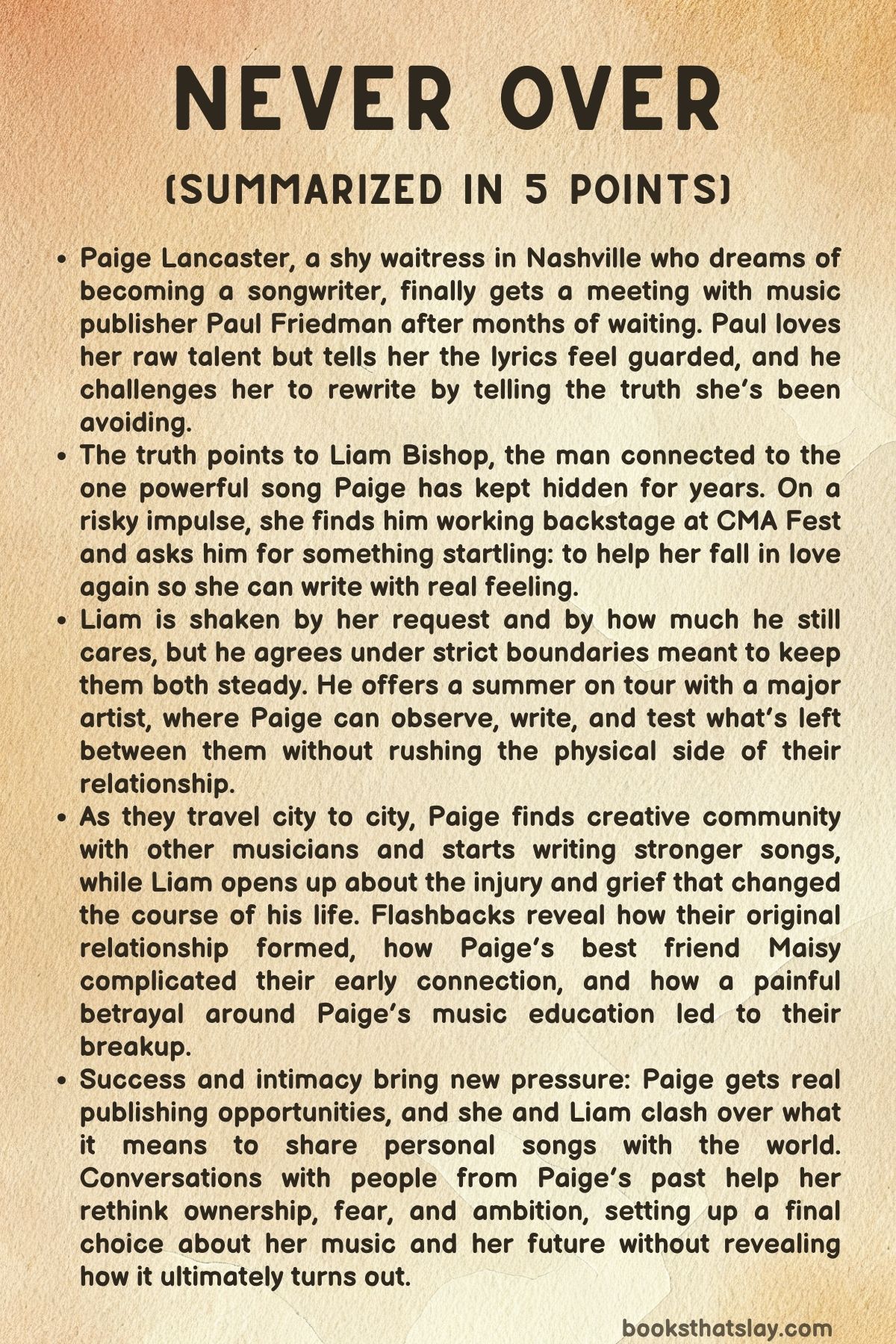
Characters
Paige Lancaster
Paige Lancaster, the protagonist of Never Over, is a young woman defined by quiet resilience, deep introspection, and a journey toward self-acceptance. Growing up as the youngest of five sisters in a vibrant family, she internalizes a sense of invisibility that shapes her adult life.
Her soft-spoken nature and self-doubt conceal a sharp emotional intelligence and an unacknowledged creative fire. Working as a waitress in Nashville, she balances practicality with her dream of becoming a songwriter.
Her struggle to find artistic authenticity parallels her emotional repression—her reluctance to write from pain mirrors her fear of truly feeling it. Paige’s evolution begins when she confronts her past with Liam Bishop, the man whose love and loss first revealed her creative voice.
Through him, she learns that vulnerability is not weakness but the foundation of meaningful art. By the end of the novel, Paige emerges as a self-assured woman who channels her heartbreak, love, and personal history into songwriting that transforms both her life and others’.
Her Grammy win symbolizes not fame, but the triumph of sincerity and courage over fear and invisibility.
Liam Bishop
Liam Bishop stands as both Paige’s counterpart and catalyst in Never Over. Once a college baseball prodigy, his life veers off course after a devastating shoulder injury ends his athletic dreams.
Haunted by lost potential and burdened by guilt toward his family, Liam reinvents himself in the world of music management—a field he only entered because of Paige’s earlier encouragement. His journey mirrors hers: both must learn to measure self-worth beyond achievement.
Emotionally, Liam is complex—charming, loyal, and protective, yet guarded and self-critical. His relationship with Paige oscillates between passion and restraint, marked by their shared fear of being consumed by love.
When Paige reenters his life years later, he is steadier but still nursing old wounds. His willingness to help her “fall in love again,” despite knowing it could reopen his own scars, reveals his enduring devotion and emotional maturity.
By the end, Liam’s growth is quiet but profound: he embraces a simpler, grounded life as a coach, finding peace in purpose and love rather than external validation.
Folly Lancaster
Folly Lancaster, Paige’s pregnant sister and confidante, embodies warmth, humor, and grounded wisdom. As a pragmatic foil to Paige’s sensitivity, she provides emotional stability throughout the story.
Her relationship with Paige is deeply affectionate but occasionally exasperated—she sees her sister’s talent long before Paige does and pushes her toward self-belief. Folly’s role extends beyond support; she represents the ordinary joys and sacrifices of womanhood, reminding Paige that fulfillment can take many forms.
Through her domestic contentment and unwavering loyalty, Folly anchors the narrative’s emotional stakes, symbolizing the steady love of family amid the turbulence of romance and ambition.
Paul Friedman
Paul Friedman, the discerning executive at Stillwater Music, plays a pivotal role in awakening Paige’s artistic depth. Blunt, analytical, and emotionally astute, Paul serves as both critic and mentor.
His early confrontation with Paige’s tendency to write “safe” lyrics forces her to confront her own emotional evasions. His guidance—particularly his challenge to rewrite her songs from raw experience—sparks the story’s central journey of creative rebirth.
Paul is a man of integrity who values authenticity over marketability, and his mentorship becomes a surrogate form of fatherly care. His presence reinforces one of the novel’s themes: that art’s truest form emerges not from polish but from vulnerability.
Maisy Morgan
Maisy Morgan, Paige’s former best friend, is a study in insecurity and rivalry disguised as charisma. Glamorous and confident, she exerts magnetic influence over others, yet her friendship with Paige is fraught with unspoken envy and dependence.
Her early deception—lying to Liam about Paige having a boyfriend—stems not from malice but from fear of losing her place in Paige’s world. Maisy’s later confession and departure mark a turning point for both women: their friendship, though broken, becomes a lesson in independence and forgiveness.
In adulthood, Maisy’s reappearance allows Paige to reconcile her past and recognize how envy, love, and fear often intertwine in relationships between women.
Harry
Harry, Paige’s musician friend, offers comic relief and creative companionship. With his easygoing humor and insight, he bridges the gap between Paige’s artistic insecurity and the boldness required in Nashville’s music scene.
His teasing suggestion that Paige “get her heart broken again” inadvertently sets the plot in motion, making him an unintentional catalyst for her transformation. More importantly, Harry represents artistic community—the idea that creation thrives not in isolation but in shared vulnerability.
His belief in Paige’s potential underscores one of the novel’s quiet truths: that encouragement from genuine friends can change the course of a life.
Penelope Parker
Penelope Parker, the singer whose tour brings Paige and Liam back together, is both a symbol of success and a mirror for Paige’s growth. Confident, talented, and driven, Penelope initially seems to represent everything Paige is not.
Yet as the tour unfolds, she becomes a mentor figure who validates Paige’s talent and reminds her that authenticity, not fame, defines artistry. Penelope’s professionalism and generosity contrast with the industry’s competitive nature, and her willingness to share the stage with Paige marks an important milestone in Paige’s evolution from hesitant writer to empowered creator.
Emily Friedman
Emily, Paul Friedman’s perceptive teenage daughter, injects youthful sincerity into the world of seasoned professionals. Her enthusiasm for Paige’s music and her instrumental role in getting her father to listen to the demo highlight the power of genuine emotional connection over cynicism.
Emily’s belief in Paige’s songs—before the music industry validates them—symbolizes the purity of art’s impact on listeners. She serves as an emblem of hope, intuition, and the simple joy of discovering beauty in authenticity.
Zara Lancaster
Zara, one of Paige’s older sisters, represents both the independence Paige envies and the family bond that sustains her. Having moved to New York to pursue her own ambitions, Zara encourages Paige to take risks, yet their relationship is tinged with the distance of diverging life paths.
Through Zara, the novel explores the complexity of sibling dynamics—how love and comparison coexist. Her presence in Paige’s flashbacks reminds readers that self-definition often begins by stepping out of familial shadows.
Carlos
Carlos, Liam’s close friend, offers quiet emotional support during Liam’s lowest moments. His brief but significant appearances—particularly in the hospital after Liam’s injury—reveal a loyalty and care that ground Liam’s world.
Carlos functions as a stabilizing force, representing male friendship that is tender rather than competitive. His character reinforces the theme that healing often comes not just from romantic love, but from the consistent kindness of friends.
Themes
Being unheard, being unseen, and learning to take up space
Paige’s early life conditions her to speak softly in every sense: her actual voice is too quiet for the chaos of a restaurant, and her inner voice is trained to stay polite, agreeable, and easy to overlook. Growing up as the youngest of five sisters, she learns that attention is a limited resource and that her role is to accommodate the louder personalities around her, including the best friend whose confidence fills any room.
That history doesn’t just make Paige shy; it teaches her that visibility is risky, because being noticed can invite judgment, conflict, or abandonment. So she builds a life where she can pursue music from the sidelines, keeping her songs universal and her identity protected.
The problem is that the same strategy that keeps her safe also keeps her stagnant. Her work at the restaurant becomes a daily reenactment of invisibility—she is physically present, constantly serving others, but rarely heard, and her quietness becomes a professional disadvantage that mirrors her deeper fear of claiming space.
Paul’s critique forces Paige to confront how her self-erasure has seeped into her art. When he calls her lyrics emotionally hollow, he isn’t only talking about craft; he’s pointing at the gap between the person Paige is and the person she allows herself to be on the page.
The pressure to write honestly becomes pressure to exist honestly. Paige’s decision to revisit Liam isn’t just romantic nostalgia; it’s a bold attempt to reclaim the parts of herself she locked away, especially anger, longing, and grief.
Over the tour, Paige gradually practices visibility in manageable doses: collaborating with other writers, speaking up about what she wants, stepping onstage once to confirm that performing isn’t her dream, and then owning that preference without shame. By the end of Never Over, her growth isn’t defined by becoming louder.
It’s defined by becoming clearer—about what she feels, what she wants, and what she refuses to apologize for—so that her presence stops depending on other people granting her permission.
Emotional honesty as craft, and the cost of protecting the self
Paige’s songwriting begins as a shield. She wants her songs to “connect universally,” which is a sincere artistic value, but it also doubles as a way to stay hidden.
General lyrics prevent listeners from tracing the lines back to her private life, and that anonymity feels like control. Paul challenges that logic by treating emotional specificity not as oversharing, but as the engine of art that actually reaches people.
His push exposes a central tension: Paige fears that telling the truth will make the songs smaller and more personal, while the story shows that truth makes them bigger because it gives them weight. The song about Liam, the one she refuses to share, proves the point.
It is accusatory, raw, and unguarded, and it terrifies her precisely because it works. That track shows Paige what she has been avoiding: not skill, but permission to feel.
This theme becomes complicated once success arrives. Paige’s resistance to “monetizing their story” isn’t only romantic purity; it’s fear of contamination, fear that turning love into product will cheapen what saved her.
Liam’s insistence that she record is not simple ambition either; he believes the songs can matter to strangers, and he also wants proof that their relationship has value beyond the private bubble they’ve built on tour. Their conflict reveals how creative work can become a proxy battlefield for deeper needs: Paige wants to keep love safe from public consumption, while Liam wants to stop feeling small next to her talent and legacy.
The meeting with Maisy helps Paige accept a hard truth about art: once a song is shared, it stops belonging exclusively to its maker, and that loss of control is also a kind of freedom. Paige’s final decision to record reframes vulnerability as choice rather than exposure.
She isn’t surrendering herself to an industry; she is deciding that her experiences—messy, tender, imperfect—can help people without reducing her to a commodity. In Never Over, emotional honesty becomes both a craft lesson and a life lesson: truth is not a performance for others, it’s a relationship with the self that makes connection possible.
Autonomy, “help,” and the lines between support and control
A major relationship fault line is the difference between believing in someone and deciding for them. Paige is surrounded by people who push her: Folly’s “act now, think later” is loving momentum, Harry’s teasing dares are messy but meant to spark courage, Paul’s blunt critique is professional pressure with real opportunity attached.
Each kind of push asks Paige to choose whether it expands her agency or replaces it. Her history makes that question loaded.
When your selfhood has been shaped by being the agreeable one, even well-meant encouragement can feel like force, because it suggests your instincts are not enough.
The sharpest expression of this theme is Liam forging Paige’s application to a songwriting program. His action is rooted in admiration and urgency—he sees her talent and can’t bear watching her hide—but it crosses a personal boundary that matters more than his intention.
Paige’s reaction isn’t an overreaction; it’s her identity fighting for ownership. If her career begins because someone else dragged her into it, then even success would feel like being managed rather than self-directed.
The breakup that follows is not simply a romantic rupture; it is Paige choosing dignity over comfort, choosing the pain of separation over the quiet resentment of being “handled.”
In the present, their relationship becomes a laboratory for learning new rules. Liam proposes the tour arrangement, but Paige consents with eyes open, negotiating a situation that is strange but explicitly chosen.
The “no kissing, no sex” rule, which might look like restraint, functions as a protection of autonomy: it slows them down so emotions can be examined rather than overridden by chemistry. Even the “love score” joke operates like a tool for consent, giving Paige language to express shifting feelings without being cornered into declarations.
The story keeps returning to the idea that love and support are only healthy when they honor the other person’s right to decide, even if the decision is slower, scarier, or less efficient. Paige’s eventual professional signing, her decision to keep certain songs unsold, and later her decision to record are all framed as victories of agency: she becomes a person who can accept help without surrendering control of her life.
Healing after loss, depression, and the search for worth beyond achievement
Liam’s storyline confronts the emotional wreckage that can follow when a life plan collapses. A baseball injury doesn’t just end a sport; it ends a self-concept built on being exceptional, being needed, being defined by performance.
Layered on top of his father’s death, the injury creates a volatile mix of grief, guilt, and emptiness, and the book treats that darkness as more than a background detail. Liam’s depression affects how he loves: he clings, withdraws, tries to prove his value, and fears becoming replaceable.
Paige sees both the version of him that felt lost and the version that becomes capable on tour, and her pride in him is not about him being impressive; it’s about him being alive to his own future again.
Paige’s healing runs in parallel, though it looks different. Her anxiety in college, her period of depression after the breakup, and her years of waiting tables while dreaming quietly all show a pattern of endurance without self-trust.
She keeps going, but she keeps small. When opportunity finally arrives, it threatens to expose her.
That exposure is part of healing: not a cure, but a shift from coping through hiding to coping through honest choice. The tour becomes a moving environment where both characters practice being more than their past failures.
Liam finds purpose in leadership and logistics, a version of competence that doesn’t depend on being the star. Paige finds confidence in creative community, discovering that her talent is not a private quirk but a real skill that can hold space among professionals.
Their argument about recording reveals how unhealed wounds can shape values. Liam’s jealousy and fear of feeling purposeless, and Paige’s fear of exploitation and visibility, are symptoms of old injuries reaching for control.
Resolution comes when both articulate the deeper problem: they have been measuring worth through outcomes—fame, approval, being chosen—rather than through character and connection. By the epilogue, the contrast is deliberate: Paige achieves public recognition, but it’s no longer the thing that makes her real; Liam chooses a quieter path as a coach, and it’s no longer a consolation prize.
Never Over treats healing as redefining what a meaningful life looks like when the original dream breaks, and it insists that people are still whole even when their identities have to be rebuilt.
Love as a negotiated partnership, not a rescue mission
The romance is powered by a risky premise: Paige asks Liam to break her heart on purpose so she can write better. That request is shocking because it turns love into a tool, but the story doesn’t leave it as a gimmick.
It becomes a way to examine how people use relationships to solve personal problems they are afraid to face alone. Paige wants the intensity of heartbreak because it gave her access to honesty; Liam is terrified of repeating the past because he knows pain will not stay neatly contained.
Their eventual agreement is not a fairy-tale reunion; it’s a contract with boundaries, expectations, and clear outcomes. That structure signals a healthier kind of love than the one they had when they were younger, because it acknowledges risk instead of pretending passion is enough.
The “no physical intimacy” rule matters here because it challenges a common romantic shortcut: letting desire cover up unresolved issues. By forcing themselves to spend time together without immediately collapsing into old patterns, Paige and Liam are required to talk, to witness each other’s lives, and to confront the reasons the relationship failed the first time.
Their tenderness grows through ordinary care—breakfasts, long drives, shared work, mutual encouragement—so love is shown as daily choice rather than constant intensity. When Liam panics at the thought of Paige leaving and declares “all or nothing,” the moment is romantic, but it’s also an exposure of his fear.
The story doesn’t present that fear as charming; it presents it as something he has to understand and manage.
The partnership becomes real when they stop treating each other as solutions. Paige stops using Liam as a guaranteed source of pain to fuel art, and Liam stops using Paige’s success as a measurement of his own value.
Their reconciliation is built on honest admissions: that both have tried to protect themselves by controlling the narrative, and that love requires allowing the other person to change. By the end of Never Over, love is not framed as rescue—Paige is not saved by Liam, and Liam is not fixed by Paige.
They become people who can stand on their own and still choose each other, which makes the romance feel like a partnership rather than a lifeline.
Friendship, betrayal, and the grief of outgrowing old roles
Maisy’s presence is a reminder that first heartbreak isn’t always romantic. Paige’s bond with her best friend is foundational to how Paige understands herself: Maisy is the confident one, the magnetic one, the person who can speak for both of them.
That dynamic gives Paige companionship, but it also locks her into a smaller identity. When Paige learns Maisy lied—claiming Paige had a boyfriend and then pursuing Liam herself—it exposes a betrayal rooted in insecurity and control.
Maisy’s confession is unusually honest: she didn’t do it because Paige was weak, she did it because Paige growing up threatened the friendship’s structure. If Paige changed, Maisy would lose the version of Paige who needed her.
This theme explores the ugly underside of “protectiveness.” Maisy frames her actions as looking out for Paige, but the real motive is preserving a relationship where Maisy holds the power. Paige’s instinct to defend Maisy shows how deeply she has normalized being managed, and how hard it is to admit that someone you love benefitted from your smallness.
Their breakup is written as a necessary grief. It hurts like loss because it is loss: not only of a person, but of a shared story that defined Paige’s adolescence.
The later reunion in the park offers a different kind of closure than romantic reconciliation. Maisy has done some growing, Paige has done some growing, and the conversation doesn’t erase the harm.
Instead, it acknowledges that they hurt each other by freezing each other in place. That recognition helps Paige accept the broader truth that creativity, love, and identity cannot be protected by refusing to evolve.
When Paige finally chooses to record and release her songs, it’s connected to this lesson: she can’t control how others receive her work any more than she could control Maisy’s choices. Letting go of the desire to keep everything safe becomes a sign of maturity, not carelessness.
Never Over treats outgrowing old roles as painful but necessary, and it suggests that the healthiest relationships—romantic or platonic—are the ones that can survive growth without needing anyone to stay small.