Pickle Perfect Summary, Characters and Themes
Pickle Perfect by Ilana Long is a contemporary romantic comedy about second chances, messy public mistakes, and the way old promises can echo for years. Lulu Gardner once had a clear path: tennis, ambition, and a future that felt mapped out.
Life interrupts, and she ends up juggling single motherhood, teaching, and the constant pressure to hold everything together. When an embarrassing blunder threatens her job, Lulu takes a rare break to Costa Rica—only to run straight into Tyler Demming, the childhood rival-turned-first love who disappeared when she needed him most. What follows is a sunny, chaotic reset with real emotional stakes.
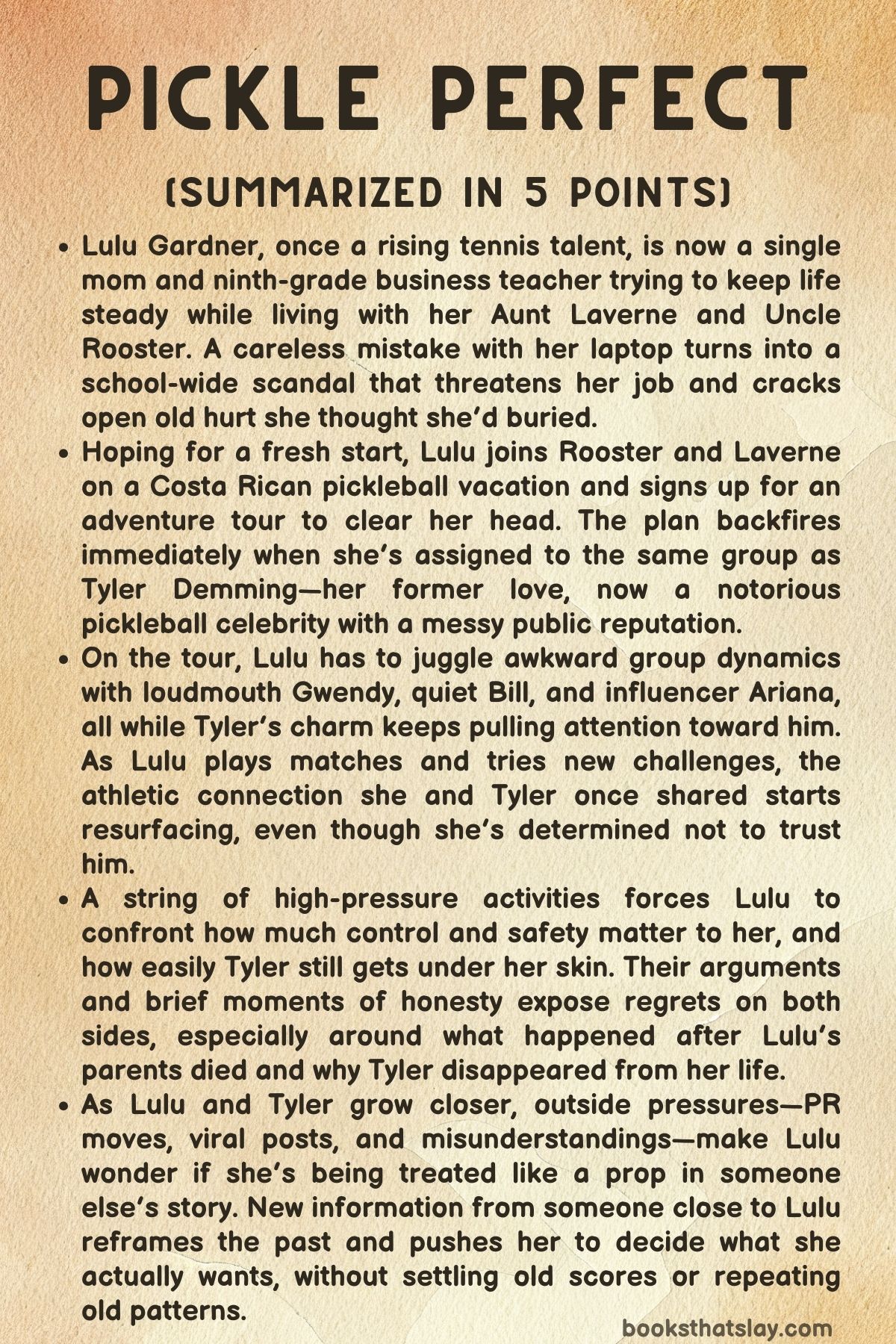
Summary
Fifteen years earlier on Bainbridge Island, Washington, Lulu Gardner is awakened late at night by a thud against her bedroom window. Outside is Tyler Demming, newly twenty and about to leave for the professional tennis circuit.
Lulu’s parents already distrust Tyler’s influence on her future, so she sneaks out anyway, thrilled and nervous. Tyler takes her to Strawberry Hill Park, where they climb a fence to an empty tennis court.
Instead of trying to beat each other, they rally in a smooth, cooperative rhythm that feels like a secret language. When Tyler finally mishits and sends the only ball into the trees, they turn off the lights and sit close on the court, acknowledging that what they have has shifted into something bigger than rivalry or friendship.
Lulu kisses him, and he promises he’ll always be there for her. She believes him completely.
In the present, Lulu’s life looks nothing like the one she imagined. She’s a ninth-grade business teacher living with her Aunt Laverne and Uncle Rooster while raising her three-year-old daughter, Zoe, alone.
Rooster and Laverne are preparing for a Costa Rican pickleball vacation, and the house is loud with packing and chatter while Lulu tries to grade assignments at her laptop. She’s exhausted, distracted, and mortified to discover she has accidentally posted instructions to her students containing a typo that turns “public sector” into “pubic sector.” It’s the kind of mistake that would be funny if she weren’t already running on fumes.
Lulu’s exhaustion is tied to grief and the way her plans collapsed after her parents died in a car accident at the end of her senior year. Her tennis dreams fell apart, and she rebuilt her life in survival mode: teaching, motherhood, and trying to be stable for Zoe.
While Lulu and Laverne are grading together, they come across a student’s work mentioning Tyler “The Rocket” Demming—no longer a tennis player, but a famous pickleball star with a reputation for stunts. Rooster pulls up a video of Tyler joking around as he bandages pickleball paddles, lights them on fire, and juggles them for a camera.
The stunt goes wrong and sparks a fire, and the clip’s captions note he won gold but was kicked off the tour and charged with reckless endangerment and property damage. Seeing him makes Lulu’s old wound flare: after her parents’ funeral, Tyler never showed up, despite his promise, and he vanished during the period when she needed him most.
Furious, Lulu launches into a profanity-laced rant—unaware she hits record on her laptop and sends it to all 153 students. Parents complain immediately.
Lulu’s principal calls, and she apologizes, but she’s suspended pending a school board review after spring break. Panic sets in: she can’t afford to lose her job, and she can’t stop reliving the hurt Tyler left behind.
Needing distance from the disaster, Lulu asks to join Rooster and Laverne on their Costa Rican pickleball trip, bringing Zoe along. At the resort, she finally gets sleep, Zoe settles into a better routine, and Lulu begins learning pickleball with Rooster.
She meets fellow guests Gwendolyn “Gwendy,” her subdued husband Bill, and Gwendy’s influencer daughter Ariana Mora, who is filming content. A booking mix-up means Lulu’s family is placed in the wrong suite and there are no extra rooms available.
The resort director, Carmen Echandi, offers Lulu a free spot on a trial pickleball adventure tour in exchange for feedback, while Zoe stays with Rooster and Laverne. Lulu agrees, hoping the week will help her reset.
In the lobby, Lulu’s attempt to grab snacks turns into a comedy of small disasters: spicy salsa, guacamole down her clothes, and a jamáica drink dispenser that soaks her and the floor while she swears under her breath. Then a familiar voice offers her a drink.
Lulu turns to see Tyler Demming in person, amused by her chaos. Carmen introduces them and confirms Lulu will be on Tyler’s tour.
Lulu is horrified. Her quiet getaway has turned into a week trapped with the man who broke her heart.
The tour begins with their guide Alejandro, along with Gwendy, Bill, and Ariana. During introductions and van rides, gossip about Tyler’s public fall circulates, and Lulu tries to stay invisible.
Tyler, charming and unbothered, makes jokes and slides easily into the role of center-of-attention. Lulu can’t stop her mind from flashing back to their teenage closeness—moments that still feel vivid despite everything.
In a rural village called Tres Equis, the group plays pickleball with locals. Lulu is cautious and organized, trying to focus on learning the game rather than watching Tyler.
But Tyler is magnetic on the courts, coaching locals with ease. When he invites Lulu to rally, their old athletic timing returns instantly.
The physical familiarity unsettles her. He praises her calm focus and gives gentle coaching that feels uncomfortably intimate.
Then he steps away to take a phone call and greets someone named Olivia, reminding Lulu that she may be falling into old patterns of caring too much.
Over lunch, Lulu opens up to Ariana about her suspension and the video that got sent to students. Ariana responds with sympathy and reframes Lulu’s crisis as a possible turning point.
Their friendship grows, offering Lulu a safe space to be honest. Lulu is also impressed by Tyler’s patience with kids during clinics, until Ariana reveals that Tyler’s good deeds are part of a planned image repair strategy.
That revelation hardens Lulu again; she refuses to be another prop in his comeback.
Alejandro later announces a mystery adventure at Diamond Devil Falls, where the group does a blindfolded trust hike guided by a rope. Lulu struggles with surrendering control.
When she stumbles and feels Tyler failed to warn her, years of resentment spill out. Trying to prove herself, she takes charge and leads the group off trail, forcing everyone into a longer trek before they find the correct path.
At the waterfall, the next challenge is rappelling down a 150-foot drop. Lulu wants to prove she’s brave, but panics when she thinks Tyler is focused on the camera instead of her safety.
She slips and ends up dangling before guides lower her down. Humiliated and shaking, she blames Tyler for her fear and for everything he represents.
Late one night, away from the others, Lulu and Tyler finally talk without an audience. Tyler admits his career is uncertain after the tour scandal and shares that his marriage to sportscaster Sapphire Roe ended because they wanted different lives—she prioritized her career, while he wanted a family.
Lulu, emboldened by the honesty, shares her own mess: the suspension, her uncertainty about teaching, and the loneliness of raising Zoe after Zoe’s father left when he learned about the pregnancy. Their vulnerability builds a new closeness, and they kiss, letting years of unfinished feelings surface—until an unexpected interruption arrives.
Sapphire appears at their cabin in the jungle, composed and glamorous, greeting Tyler casually. Lulu assumes the worst and retreats in embarrassment.
The next morning, Sapphire addresses the group and explains that she and Tyler have been divorced for two years and her appearance was not romantic. She shuts down gossip and makes it clear she doesn’t want online attention.
Lulu is relieved, but still wary of how easily she spiraled.
As the tour continues, Tyler shows consistent kindness at outreach stops, coaching children and bringing energy to the group. Lulu feels her own love of teaching stir again, not as a job she’s clinging to, but as something that still matters to her.
Their connection grows, including a night out dancing near La Fortuna and a later zip-lining adventure that goes wrong when Lulu panics midair. Tyler chooses to hike with her on a long maintenance trail rather than leave her behind.
On the hike, they speak plainly about regret. Tyler admits he failed her after her parents died, though he struggles to explain his younger self’s fear and confusion.
He asks for forgiveness, and Lulu begins to consider that the story she’s told herself for years may not be complete.
Back at the resort, Lulu learns Ariana has posted clips of Lulu and Tyler online, turning their private moments into viral content. Lulu feels exposed and decides she should go home.
Reuniting with Zoe steadies her, and she finds calm at the beach. Ariana apologizes sincerely, and Lulu accepts, realizing she can’t keep living as if every mistake must end in exile.
A new complication appears when Lulu discovers the resort is fully booked and the only available space is a connected suite reserved for Tyler. A mortifying balcony mishap leads to an argument, but Lulu learns Tyler didn’t hoard the extra room for comfort.
It was gifted by the family of a sick girl named Olivia—the same Olivia from the phone call—because Tyler had helped fulfill her wish even though it contributed to his public downfall. Lulu’s assumptions crack.
Then Laverne reveals the truth that changes everything: after Lulu’s parents died, Laverne told Tyler to stay away from the funeral, believing Lulu needed space and fearing Tyler’s presence would intensify her guilt. Tyler hadn’t abandoned Lulu; he’d been pushed away.
Lulu’s anger shifts into grief, then relief, then the complicated work of forgiving both Tyler and herself.
Lulu goes to find Tyler, and a beach moment turns into an absurd rescue when she thinks he’s drowning. He insists he was calling out about the waves, not asking for help, and Lulu’s fury dissolves into laughter.
Back in his suite, they finally speak openly. Lulu apologizes for misjudging him.
Tyler admits he didn’t fight hard enough to reach her and that fame covered a lot of insecurity. He reveals that his ex-wife struggled with how deeply Tyler still carried Lulu in his life—down to a tattoo of Lulu’s name on his arm.
The gesture isn’t a grand speech; it’s proof that Lulu was never a phase for him.
By the farewell pickleball event, Lulu, Tyler, Zoe, and her family feel like an accidental team. Tyler receives news about an invitation back to the professional circuit, but he tells Lulu he doesn’t want to lose her again.
Lulu shares that she’s been offered a tutoring job that would travel with the pickleball tour, blending her teaching skills with a new kind of life. Together, they choose a future that isn’t about fixing the past perfectly, but about showing up—clearly, consistently, and on purpose.
Characters
Lulu Gardner
Lulu Gardner is the emotional center of Pickle Perfect by Ilana Long, defined by a lifelong tug-of-war between control and vulnerability. As a teenager on Bainbridge Island, she’s intensely alive in motion—tennis isn’t just a sport to her, it’s language, identity, and a way to feel seen—yet she’s also shaped by the pressure of watchful parents and the fear of wanting something that might be taken away.
In the present, Lulu’s life is built on responsibility: she’s a ninth-grade business teacher, a single mother to Zoe, and a woman running on fumes while trying to do everything “right.” Her suspension after the accidental profanity recording exposes how close to the edge she’s been living, and it becomes the crack that forces truth to spill out—about her exhaustion, her shame, and the old wound she’s carried for fifteen years. On the Costa Rica trip, Lulu’s arc is not just romantic; it’s a reclamation of self.
Her discomfort with surprises, her need to plan, and her tendency to interpret abandonment as proof she isn’t worth staying for all trace back to the moment she lost her parents and believed Tyler broke his promise. As she confronts embarrassment after embarrassment—public mishaps, physical fear, viral exposure—she slowly stops performing competence and starts choosing honesty, eventually realizing her anger has been protecting her from grief and self-blame.
By the end, Lulu isn’t “fixed” by love; she’s steadied by clarity, finally able to forgive, accept support, and imagine a future where she doesn’t have to sacrifice either her identity or her security to feel joy.
Tyler Demming
Tyler Demming, “The Rocket,” is presented as a charismatic spectacle—reckless, famous, and always mid-performance—but Pickle Perfect by Ilana Long gradually reveals that his showmanship is armor for guilt and longing. In the past, Tyler is all heat and momentum: a young athlete about to launch into a professional career, confident enough to sneak Lulu out for midnight tennis yet tender enough to make promises that feel absolute.
In the present, his flamboyant public persona has curdled into controversy, with his flaming-paddle stunt embodying both his impulsiveness and his addiction to being watched. What makes Tyler compelling is the friction between how he appears and what he wants.
He jokes, flirts, and deflects, but underneath he’s a man haunted by the ways he failed at the most important moment of Lulu’s life, and a man who has discovered too late that fame is a poor substitute for intimacy. His confession about wanting a family, his remorse about his choices, and his willingness to stay beside Lulu through fear (even when she lashes out) show someone trying to become dependable after years of being celebrated for unpredictability.
The Olivia storyline reframes his “recklessness” as devotion taken to extremes—he can be impulsive, but not always selfish—and the tattoo reveals a depth of attachment that borders on obsessive in the most romantic, aching way: he never truly moved on from Lulu, even when his life looked like it had. Tyler’s growth is learning to stop hiding behind charm and to speak plainly—about regret, about love, about choosing a life that isn’t just loud but real.
Zoe
Zoe, Lulu’s three-year-old daughter, functions as both anchor and mirror in Pickle Perfect by Ilana Long. She embodies Lulu’s fiercest love and the practical reality that prevents Lulu from indulging in fantasy; every decision has weight because someone small depends on it.
Zoe’s presence also exposes Lulu’s emotional truth—Lulu’s exhaustion, her guilt about not being “enough,” and her yearning for rest become undeniable whenever she’s caring for Zoe. Importantly, Zoe is not used as a prop to create sympathy; she’s the living proof of Lulu’s resilience, the reason Lulu keeps going even when she’s burned out and humiliated.
When Lulu leaves for the tour, the goodbye isn’t just sentimental—it shows Lulu’s internal split between the need to breathe and the fear of being judged for wanting space. Zoe also becomes an inadvertent catalyst in Tyler’s characterization: Tyler’s attention to Lulu’s farewell, his reactions, and his eventual inclusion with Lulu’s family suggest he isn’t just attracted to Lulu but drawn to the life she has built.
By the end, Zoe symbolizes a future that isn’t a reset to teenage romance but a reimagined family shape—one rooted in responsibility, tenderness, and choice.
Aunt Laverne
Aunt Laverne is the story’s quiet power broker in Pickle Perfect by Ilana Long, initially appearing as comic relief and household chaos—well-meaning, meddling, and accidentally disastrous with technology—before revealing herself as the keeper of a pivotal truth. Her personality is bold and practical, the kind of adult who tries to fix problems quickly, sometimes clumsily, and she often pushes Lulu toward letting go of rigid self-reliance.
The most important aspect of Laverne’s character is her complicated protectiveness: she loves Lulu enough to make a choice that she believes will prevent further harm, even if it risks being misunderstood forever. When she admits she told Tyler not to attend the funeral, the entire emotional architecture of Lulu’s resentment collapses, and Laverne transforms from eccentric aunt into tragic guardian—someone who carried the burden of that decision while watching Lulu suffer in silence.
Her reveal is also an act of repair; she doesn’t demand forgiveness, she offers the truth so Lulu can finally stop punishing herself and stop misreading Tyler’s absence as cruelty. Laverne’s role in the ending reinforces her deeper function: she is the family member who makes space for messy humanity, who believes love includes forgiveness, and who helps Lulu step into a life that isn’t built entirely around endurance.
Uncle Rooster
Uncle Rooster is the stabilizing warmth in Pickle Perfect by Ilana Long, a figure who turns family support into something lived rather than merely stated. He’s playful, enthusiastic about pickleball, and often comedic in the way he engages with life, but his real importance is the sense of safety he provides Lulu and Zoe.
Rooster’s presence in the home creates a buffer against Lulu’s isolation; he’s part of the reason Lulu can keep working, keep parenting, and still have any thread of self left. On the Costa Rica trip, Rooster becomes a bridge between Lulu’s guarded independence and the possibility of receiving care without shame, especially as he and Laverne take on Zoe so Lulu can try something for herself.
Rooster also acts as a subtle emotional barometer: he sees more than he says, he notices tensions, and he supports Lulu without interrogating her choices. In a story full of public spectacle and private hurt, Rooster represents uncomplicated loyalty—family that stays, not because it’s dramatic, but because it’s natural.
Gwendolyn “Gwendy”
Gwendy is an accelerant character in Pickle Perfect by Ilana Long, bringing social pressure, gossip, and competition into every room she enters. She’s loud, aggressive, and status-attentive, the kind of person who treats group dynamics like a sport and uses commentary as a way to stay in control.
Her fascination with Tyler’s scandal and her eagerness to broadcast it reflect her role as an external force that amplifies Lulu’s humiliation and keeps the tour feeling like a stage rather than a refuge. Yet Gwendy isn’t purely villainous; she represents a recognizable type of social dominance that thrives on narrative control, which contrasts sharply with Lulu’s desire for privacy and emotional safety.
By placing Gwendy near Lulu, the story makes Lulu’s growth harder and therefore more meaningful: Lulu must learn not only to manage her own fear but also to exist without shrinking under other people’s scrutiny. Gwendy’s presence also highlights the difference between performance and authenticity, one of the novel’s core tensions, because Gwendy is constantly performing social power while Lulu slowly learns to stop performing composure.
Bill
Bill, Gwendy’s subdued husband, is a study in quiet erasure within Pickle Perfect by Ilana Long. He appears as someone dimmed by the force of his partner’s personality, often present but not fully participating, which makes him a subtle commentary on relationships where one person takes up all the oxygen.
His reserve serves multiple purposes: it makes Gwendy’s intensity more vivid, it adds texture to the tour’s social ecosystem, and it mirrors Lulu’s fear of being overshadowed or dismissed. Bill’s quietness can read as patience, resignation, or a learned strategy for survival in a marriage dominated by someone else’s narrative.
Even without major plot turns, he deepens the story’s theme that not all partnerships are built on mutual visibility; some are built on endurance, and the question becomes whether that endurance is love or habit.
Ariana Mora
Ariana is the modern foil to Lulu in Pickle Perfect by Ilana Long, embodying boldness, visibility, and the messy ethics of living online. As an influencer, she approaches experience as content, which makes her simultaneously charming and dangerous to someone like Lulu who craves anonymity and control.
Ariana’s friendliness pulls Lulu out of isolation at the exact moment Lulu is spiraling—job loss, embarrassment, emotional whiplash from Tyler—and she offers Lulu a reframing tool: that catastrophe can also be pivot. Yet Ariana’s biggest impact comes when she crosses a boundary by posting Lulu and Tyler, turning private vulnerability into public spectacle.
That betrayal is not framed as malice so much as immaturity and cultural habit, which makes Ariana’s apology and Lulu’s eventual forgiveness feel like an earned lesson rather than a convenient fix. Ariana ultimately becomes a catalyst for Lulu’s growth in two ways: she forces Lulu to articulate what she will and won’t tolerate, and she demonstrates that friendship can survive conflict when accountability is real.
Ariana is also the character who most clearly exposes Tyler’s PR machinery, complicating Lulu’s perception of his kindness and keeping the romantic arc honest.
Carmen Echandi
Carmen Echandi is the resort-side orchestrator in Pickle Perfect by Ilana Long, equal parts hospitality professional, flirtatious impresario, and narrative catalyst. She’s the one who turns a booking disaster into an opportunity, placing Lulu onto the adventure tour and thereby forcing the central confrontation with Tyler.
Carmen’s personality leans performative—she enjoys chemistry, optics, and excitement—which makes her an embodiment of the story’s broader theme: how environments built for leisure can still become arenas for image management. While Carmen’s role is mostly logistical, she’s significant because she strips Lulu of the illusion of control.
Lulu arrives wanting anonymity; Carmen, with a bright smile and a program clipboard, effectively hands her the exact opposite. In doing so, Carmen becomes an agent of change, not through deep emotional intervention but through the simple act of rearranging circumstances so that avoidance is no longer an option.
Alejandro
Alejandro, the tour guide, functions as structured challenge and cultural lens in Pickle Perfect by Ilana Long. He’s welcoming, confident, and skilled at shaping group experience, but his real narrative function is to create scenarios that test Lulu’s relationship with fear, control, and trust.
The blindfold hike and the mystery adventure aren’t just activities; they’re pressure chambers that expose Lulu’s need to anticipate danger and Tyler’s tendency to assume charm can smooth everything over. Alejandro’s leadership style—encouraging, slightly theatrical, and rooted in experiential learning—pushes the group into vulnerability, making personal dynamics impossible to ignore.
He also acts as a stabilizing adult presence who keeps the tour safe even when emotions escalate, which is crucial during Lulu’s rappel panic and the later walkie-talkie mishap. Alejandro represents the story’s idea that growth often arrives disguised as inconvenience, and that guidance doesn’t always look like therapy—it can look like a rope line, a trail, and a gentle insistence that you take the next step.
Sapphire Roe
Sapphire Roe is a disruption with polish in Pickle Perfect by Ilana Long, arriving like a glamorous hallucination in the jungle and instantly triggering Lulu’s deepest insecurity: that Tyler will always choose someone else, or that she will always be an embarrassing detour. Sapphire’s public-facing identity as a sportscaster pairs neatly with the novel’s obsession with image, making her presence feel like the ultimate embodiment of controlled narrative.
What makes Sapphire interesting is how she refuses to play the role Lulu expects. Instead of weaponizing the moment, she clarifies the truth to the group, shuts down gossip, and manages the story with authority, suggesting a woman who understands public spectacle and has learned how to contain it.
Her cryptic, pointed attention to Lulu reads as deliberate recognition—less rivalry and more assessment—implying that Sapphire knows exactly what she’s doing and is comfortable with her place in Tyler’s life. Sapphire’s role ultimately helps separate Lulu’s fear from reality, forcing Lulu to confront that the threat isn’t Sapphire herself but Lulu’s unresolved pain and mistrust.
In that sense, Sapphire becomes an unexpected ally to the romance, not by encouraging it, but by removing illusion and demanding that people stop feeding on drama.
Fernando
Fernando, the older local player Lulu partners with, provides gentle grounding in Pickle Perfect by Ilana Long. He’s affable, welcoming, and patient, offering Lulu a low-stakes connection at a moment when she feels exposed and out of place.
Through Fernando, Lulu gets to be simply a person playing a game—learning language, laughing at mistakes, and participating without the heavy baggage of Tyler or her job crisis. Fernando’s presence also highlights the tour’s intended purpose: community, movement, and joy, all of which Lulu has forgotten she’s allowed to experience.
Even briefly, he represents the kind of human kindness that isn’t strategic or performative, which contrasts sharply with Lulu’s suspicion that Tyler’s generosity is a PR maneuver. Fernando helps restore Lulu’s trust in the environment long enough for her to keep engaging rather than retreating.
Olivia
Olivia is the offstage heart of Pickle Perfect by Ilana Long, a character whose impact is defined not by page-time but by what her existence reveals about Tyler. As a sick girl whose family gifts Tyler the extra suite after he helps fulfill her wish, Olivia reframes Tyler’s public scandal into something more morally complicated: he didn’t just burn down goodwill for attention, he sacrificed stability to keep a promise that mattered to someone vulnerable.
Olivia’s role is crucial because she forces Lulu—and the reader—to reconsider the simplicity of the “reckless celebrity” label. She becomes the hinge that turns Lulu’s jealousy into self-awareness, exposing how quickly Lulu assumes the worst because she’s trained herself to expect disappointment.
Olivia also reinforces a major theme of the novel: promises are not romantic lines, they are choices with consequences, and sometimes the same trait that ruins you publicly is the trait that makes you loyal privately.
Themes
Love and Second Chances
In Pickle Perfect, love emerges not as a static ideal but as a journey shaped by time, memory, and forgiveness. Lulu and Tyler’s story spans from youthful infatuation to mature reconciliation, illustrating how love transforms through experience and pain.
Their teenage romance, once bright with promise, is derailed by tragedy and misunderstanding. When they meet again years later in Costa Rica, both carry emotional scars—Lulu’s rooted in loss and betrayal, Tyler’s in regret and public disgrace.
Their reconnection forces them to confront the difference between the love they remember and the love they are capable of now. This shift reveals the novel’s central argument: that second chances in love require courage to see the other person anew rather than through the lens of the past.
The Costa Rican setting—vivid, unpredictable, and full of natural challenges—becomes a mirror for this rediscovery, demanding vulnerability and honesty. Through each encounter, from awkward confrontations to moments of tenderness, Lulu learns that forgiveness is not simply about absolving Tyler but about freeing herself from the weight of what might have been.
Tyler, once reckless and self-assured, grows into a man capable of accountability and sincerity. Their final union does not promise a perfect ending but signifies emotional maturity—the recognition that love endures not because it forgets pain but because it learns to exist alongside it.
The theme underscores that true connection requires confronting one’s past, taking responsibility, and accepting imperfection as part of love’s texture.
Identity and Reinvention
The question of who one becomes after failure drives the emotional core of Pickle Perfect. Both Lulu and Tyler face crises of identity shaped by lost dreams and public humiliation.
Lulu’s life as a teacher and single mother represents a retreat from the ambitious tennis future she once envisioned. Her accidental viral scandal and suspension from school strip away the safe structure she has built, forcing her to confront the gap between her current self and the girl who once played under the floodlights.
Tyler’s journey mirrors hers through a different lens—his fall from fame as a professional athlete exposes the fragility of identity built on public validation. When their paths intersect again, both are adrift, seeking meaning beyond titles, trophies, or expectations.
The pickleball tour, marketed as leisure, becomes a metaphorical quest for self-definition. Each challenge—from blindfolded hikes to teaching local children—forces Lulu and Tyler to rediscover capabilities long buried under guilt and insecurity.
The theme expands beyond personal growth to examine how people reshape their sense of self after public mistakes and private disappointments. Reinvention here is not about erasing the past but about reclaiming one’s agency to define a new story.
Lulu’s eventual decision to merge teaching with travel, and Tyler’s choice to return to competition with humility, signify selfhood regained through authenticity rather than performance. The novel suggests that identity is not a fixed destination but a series of choices made in the aftermath of loss.
Forgiveness and Emotional Healing
Forgiveness in Pickle Perfect is portrayed not as a single act but as an evolving process that liberates both the forgiver and the forgiven. Lulu’s resentment toward Tyler for abandoning her after her parents’ deaths forms the emotional spine of her guardedness.
For years, she interprets his absence as betrayal, using it to justify her mistrust and fear of intimacy. The revelation that her aunt, not Tyler, was responsible for keeping him away reconfigures everything she believed about that period of her life.
This moment of clarity dismantles the false narrative she has carried and opens space for genuine healing. The theme operates on multiple levels—Lulu must forgive Tyler, her aunt, and most importantly, herself.
The narrative suggests that holding onto anger can feel safer than confronting grief, yet true peace requires facing painful truths. Tyler’s journey toward forgiveness is subtler but equally transformative; he must accept his own fallibility and the harm caused by his recklessness.
When both characters reach emotional transparency, their reunion becomes possible not because the past is erased but because it is finally understood. Forgiveness, then, functions as the bridge between regret and renewal.
It restores not only their relationship but also Lulu’s self-respect and Tyler’s moral compass. The story frames forgiveness as an act of strength, the only means through which people can reclaim joy after betrayal and loss.
The Weight of Regret and the Passage of Time
Regret saturates the lives of both protagonists, shaping how they perceive themselves and each other. In Pickle Perfect, time becomes both a wound and a healer.
The fifteen-year gap between Lulu and Tyler’s teenage bond and their reunion magnifies the cost of choices left unmade. Lulu’s regret stems from what she views as the collapse of her potential—the squandered tennis career, the unfulfilled promise of first love, the years spent surviving instead of thriving.
Tyler’s regret is defined by impulsiveness and the emptiness that fame cannot fill. Their reencounter forces them to confront how the passage of time does not erase emotion but preserves it in altered form.
Regret in the novel is not depicted as paralyzing but as instructive—it pushes both characters toward introspection and accountability. Costa Rica, with its humid air and unpredictable terrain, reflects the disorienting nature of revisiting the past after time has transformed it.
The narrative uses memory as both obstacle and catalyst; only when Lulu learns the truth about Tyler’s absence does she see how much time has distorted her understanding of events. The final scenes, where they find new purpose together, imply that time can redeem what it once destroyed if one is willing to confront its lessons.
Regret becomes the price of wisdom, teaching the characters to cherish the imperfect present rather than mourn the unchangeable past.
Courage and Personal Liberation
At its heart, Pickle Perfect is a story about reclaiming one’s power after fear and disappointment have narrowed life’s possibilities. Lulu’s evolution from cautious teacher to adventurous traveler symbolizes the courage to re-enter life’s unpredictable arena.
Throughout the novel, she struggles with control—over her emotions, her image, her daughter’s safety, and her own vulnerability. The adventure tour challenges her to surrender that control, testing her willingness to trust others and herself.
Her missteps—falling during the blindfold hike, panicking on the zip-line, and confronting public humiliation—become crucibles for growth rather than moments of defeat. The theme of courage extends beyond physical feats to emotional bravery: admitting love, accepting imperfection, and embracing uncertainty.
Tyler’s redemption arc parallels this; his decision to take responsibility for his past and risk emotional honesty marks a departure from the bravado that once defined him. The novel suggests that liberation is not achieved through escape but through confrontation—of fear, of truth, and of the self.
In the end, Lulu’s acceptance of a new, mobile career and partnership with Tyler signifies freedom not from responsibility but from the paralysis of self-doubt. Her journey reflects the empowerment that comes from forgiving, risking, and choosing to live fully again.
The theme concludes the book’s emotional journey with a message of resilience: that courage is not the absence of fear but the decision to move forward despite it.