Realm of Wind and Vines Summary, Characters and Themes
Realm of Wind and Vines by Maria Blackwood is a fantasy novel that explores power, guilt, and redemption through the eyes of Selena, a fae woman whose magic manipulates emotions. Trapped between the warring Seelie and Unseelie Courts, she seeks freedom while grappling with her past choices—especially the enchantment that bound her dragon-shifter mate, Draven, in false hatred.
The story moves through dangerous alliances, magical wars, and the collapse of ancient systems, blending political intrigue with emotional conflict. Blackwood’s world of dragons, dryads, and fae is one where the cost of magic is as heavy as the weight of forgiveness, and where freedom demands confronting one’s darkest self. It’s the 4th book in the Flame and Thorns series.
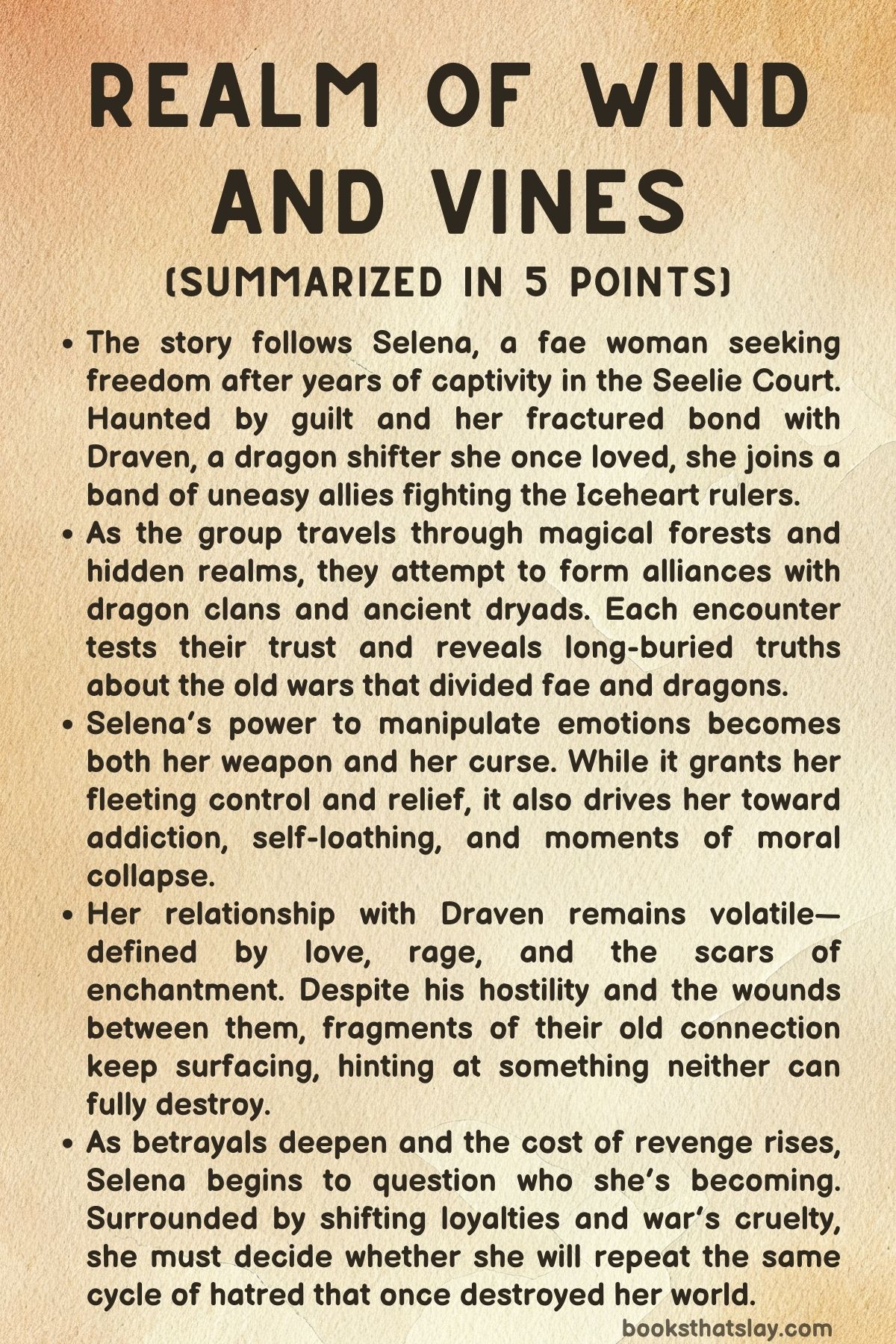
Summary
The story begins with Selena, a fae woman recently freed from years of captivity in the Seelie Court. Standing on a cliff before the sea, she tastes freedom for the first time.
Her peace is shattered when Draven—a dragon shifter and her former lover—appears behind her with a knife. His hatred is not his own; Selena once magically forced him to hate her to save his life, and now he lives under that curse.
Though he threatens her, his conflicting emotions reveal that part of him still remembers their bond. When Alistair, their companion, calls them back, Draven withdraws, leaving Selena determined to restore what was lost between them.
The group they travel with—Draven, Alistair, Lyra, Galen, Isera, Orion, and Grey—represents a fragile alliance between fae and dragons. They move through a portal to the thorn forest near the Seelie city, where memories of Selena’s imprisonment and the cruelty of the Iceheart rulers resurface.
As they traverse the forest, tensions rise between Draven and Orion, the Unseelie king, whose rivalry hints at deep political and personal friction.
The travelers reach a stone wall where Selena and Draven once shared intimacy. She recreates the moment, hoping to stir his memories.
For an instant, the bond between them flickers—proof that not all is lost. Their journey then takes them into the hidden realm of the dryads, ancient spirits who live among colossal trees.
The dryad queen rejects their plea for alliance against the Icehearts, explaining her people’s near extinction. Though she refuses to fight, she offers shelter.
That night, Selena’s attempt to reconnect with Draven turns cruel. He pretends to yield to her, only to humiliate her and leave her bound in the dark.
Isera finds and frees her, and by morning, the group prepares to move on. They agree to seek other dragon clans, hoping to revive old alliances that once united dragons and fae.
The first stop is the Green Dragon Clan. At their sealed mountain gates, the group waits fruitlessly.
When Lavendera, a silver dragon leader once loyal to the Icehearts, arrives with her forces, the Green Clan refuses to open even for her. Draven decides to retreat and target another clan first—the Orange Clan.
The next journey brings them through a stormy forest toward the floating islands of the Orange Clan. There, Draven confesses his violent history with their leader, Rin Tanaka, whose rebellion he once crushed.
The reunion turns hostile when Rin attacks under the Icehearts’ orders, revealing that she is controlled by enchanted dragon steel. A chaotic battle unfolds—Draven wounded, Selena shot, and Orion injured.
Selena uses her power to manipulate enemy emotions, turning fear into a weapon. Ultimately, they flee on Draven’s dragon back, but he collapses from his wounds.
In a cave, Selena tends to him through the night, using her magic to ease his pain. When he wakes, they perform a healing ritual through a kiss that rekindles fragments of their mate bond.
The intimacy between them briefly resurfaces before Draven recoils, terrified of the emotions it awakens.
Their next destination is the Purple Clan. In a dense forest, they are ambushed by animal warriors led by Diana Artemisia, the clan’s leader.
Draven convinces her they share a common enemy, and she reluctantly agrees to aid them later, once he gathers more support. She warns that the Icehearts are searching for the lost Gold Clan and that Lavendera is involved in the hunt.
The alliance strengthens, but tragedy soon follows. The Icehearts capture Bane, and Jessina, one of their generals, kidnaps Draven.
Desperate to save him, Selena tortures Bane through his emotional bond with Jessina, forcing her to stop hurting Draven. When Jessina demands a hostage exchange—Draven for Bane—Selena agrees despite Isera’s protests.
The trade is a trap. Jessina murders Selena’s parents before her eyes, severing the last of her innocence.
In the aftermath, Selena’s grief transforms into vengeance. She vows to destroy the Icehearts and hunts Lavendera, their dragon-steel enforcer.
Consumed by rage, she begins crossing moral lines, using her magic to kill enemies by manipulating their emotions until their hearts fail. Even her allies grow wary of her darkness.
Selena’s turning point comes when she almost kills innocent civilians out of anger. Realizing she is becoming like Jessina—using pain to justify power—she forces herself to stop.
With Alistair’s help, she channels her rage into purpose, not destruction.
The group then infiltrates the Icehearts’ city under glamour, posing as Jessina and Bane to access the royal library. Their deception barely holds, and when guards resist, Selena uses despair magic to force them to reveal the key phrase that opens the gates.
Inside, they find the building empty—it’s a trap meant to lure them in. Soldiers descend, and chaos erupts.
As they fight their way out, Selena discovers Kander von Graf, leader of the Green Clan, imprisoned and broken. She frees him, burning her hands on iron chains that weaken fae magic.
The rescue quickly unravels into another battle when Lavendera attacks. During the fight, Selena links her pain to Lavendera’s, turning the enemy’s magic against her.
With Isera’s ice and Alistair’s fire, they finally subdue Lavendera.
Once safe, Lavendera confesses a buried truth: she is the Seelie Queen’s second daughter, fused with the Mother Dryad during an ancient war. This bond created the thorn forest and bound her immortality to the forest’s life.
The Icehearts have controlled her for centuries, promising to find the Soul of Trees—the only relic that can separate her from the Mother Dryad without killing them both.
As the dryad queen appears to protect Lavendera, the fragile alliance between fae, dragons, and dryads begins to form anew. But peace is fleeting.
Diana of the Purple Clan attacks under dragon-steel control, revealing the Icehearts’ deeper plan. They never wanted Lavendera—they wanted the Green Clan’s archives, which contain the power to alter memories.
Selena’s use of despair magic earlier accidentally helped them break the protective wards.
The final chaos erupts as Kander, now controlled by the Icehearts, turns on them. Selena saves Isera from his attack but is struck in her place.
In that moment, her memory falters—she forgets her own name as the spell begins to rewrite reality. The story closes in confusion and loss, as the lines between magic, memory, and identity blur, setting the stage for what may come next in this battle for freedom and truth.
Characters
Selena
Selena, the fae narrator of Realm of Wind and Vines, stands as a complex embodiment of power, guilt, and emotional duality. Born with emotion-manipulating magic, she carries both the blessing and curse of her abilities—able to alter others’ feelings while simultaneously addicted to the pleasure her magic gives her.
Years of imprisonment in the Seelie Court leave her yearning for freedom but also fractured within. Her journey is not merely physical but profoundly internal: she battles her trauma, her dependency on power, and the morality of her choices.
Selena’s relationship with Draven is the heart of her turmoil—he is her former lover turned enemy by her own magic. Through him, readers witness her desperate attempts to reclaim love, even when faced with hatred she inadvertently caused.
Her later transformation—from guilt-ridden survivor to wrathful avenger—marks her descent into the same vengeance-driven path she once despised. Yet, by the end, when she recognizes her growing resemblance to Jessina, Selena confronts her darkness and redefines her sense of justice.
She becomes a mirror for moral corruption and redemption, proving that even those touched by darkness can seek light again.
Draven
Draven, the dragon shifter and Selena’s mate, is a study in contradiction—wrath battling love, loyalty at war with trauma. Once gentle and protective, he becomes a weapon of fury after Selena’s magic forces him to love her and later forces him to hate her to save his life.
This manipulation tears his identity apart, leaving him trapped between genuine affection and imposed emotion. His inner conflict drives much of the novel’s emotional tension.
Though he often acts with cruelty—mocking, restraining, or abandoning Selena—his small moments of hesitation and reluctant protection reveal the remnants of the man he once was. Draven’s suffering under dragon steel and centuries of Iceheart control deepen his bitterness, yet they also humanize him.
He becomes a tragic figure, struggling to regain agency over his emotions and destiny. His reluctant acceptance of Selena’s healing and his eventual defense of her suggest that his buried love endures, even beneath the layers of manipulation and pain.
Draven’s arc is a slow unraveling of pride and fear, ultimately reflecting how trauma reshapes love into something both destructive and enduring.
Orion
Orion, the King of the Unseelie Court, offers a sharp contrast to the other characters’ emotional volatility. Intelligent, sardonic, and often manipulative, he plays the role of strategist and moral skeptic.
His power over nightmares mirrors his psychological depth—he understands fear intimately and wields it not through rage but through precision. Orion’s dynamic with Selena and Draven is multifaceted: he provokes Draven to expose weakness, yet he also protects Selena in her most vulnerable moments.
His leadership is tinged with arrogance, but beneath it lies a weary pragmatism. Orion’s disdain for emotional recklessness masks a quiet sense of responsibility; he is the realist in a world driven by passion.
By the later stages of the story, his growing frustration with Draven’s instability and Selena’s thirst for vengeance underscores his awareness of how quickly righteousness decays into obsession. Though not the emotional core of the story, Orion acts as its intellectual and moral compass—often cynical, sometimes cruel, but always necessary.
Isera
Isera embodies cold calculation and suppressed rage. As one of the group’s most competent members, she is defined by control—over her ice magic, her emotions, and her loyalty to Orion.
Yet beneath her calm exterior lies a deep wound: the loss of her mother to Bane and the Icehearts. Her composure cracks when confronted with opportunities for revenge, revealing the burning grief beneath her icy demeanor.
Isera’s relationship with Selena oscillates between sisterly alliance and pragmatic distance; she saves Selena when others would abandon her but rarely offers comfort. Her later act of torturing Bane demonstrates how vengeance consumes even the most disciplined souls.
However, her eventual restraint—stopping her revenge when confronted with its consequences—shows a rare strength of character. Isera’s arc parallels Selena’s but diverges in outcome; where Selena succumbs to hatred, Isera learns to contain hers.
She becomes a symbol of strength through self-control rather than destruction.
Lyra
Lyra serves as the story’s much-needed source of levity and emotional warmth. Her playful humor and relentless optimism provide balance amid the group’s tension and trauma.
Though often underestimated, Lyra’s cheerfulness hides resilience; she uses laughter as armor against despair. Her ability to diffuse conflict—whether between Draven and Orion or among the group during perilous moments—demonstrates emotional intelligence.
Lyra represents the fading innocence of their fractured world and the hope that compassion can survive war. She is not untouched by grief or fear, yet her insistence on joy stands as quiet defiance against the surrounding darkness.
Through her, the story shows that lightheartedness can be as brave as fury.
Alistair
Alistair is the pragmatic moral anchor within the group. His calm reasoning and quiet compassion ground the others, particularly Selena, whose spiraling guilt and rage often need steady guidance.
His honesty—sometimes bordering on bluntness—reveals a man who understands moral grayness. His admission about once committing cruelty himself gives Selena perspective on her own moral decay.
Alistair’s empathy does not stem from purity but from experience; he knows what it means to lose oneself and return changed. His friendship with Selena is understated yet profound, providing emotional stability when all else falters.
In a narrative filled with passion and vengeance, Alistair embodies quiet redemption.
Lavendera
Lavendera is one of the most enigmatic and tragic figures in Realm of Wind and Vines. Initially portrayed as a ruthless lieutenant of the Icehearts, she evolves into a character of immense complexity.
Her immunity to Selena’s magic and mastery of nature make her seem almost inhuman, and for good reason—she is revealed to be the Seelie Queen’s second daughter, fused with the Mother Dryad. This revelation redefines her earlier cruelty, framing it as servitude under the promise of freedom.
Her actions, once seen as purely malicious, become desperate attempts to reclaim autonomy. Lavendera personifies the price of survival in a world ruled by power and deceit.
Bound to her duty yet longing for release, she becomes a haunting reflection of Selena’s own captivity. When freed, her fear and confusion make her briefly sympathetic, showing that even monsters are made, not born.
Diana Artemisia
Diana, leader of the Purple Dragon Clan, embodies the moral burden of leadership under corruption. Initially perceived as an antagonist when she attacks Draven, she later reveals herself to be a victim of dragon-steel control—a puppet forced to act against her conscience.
Her fierce independence, wisdom, and loyalty to her people drive her choices, even when they lead to violence. Once freed, she becomes a crucial ally, offering both counsel and a reminder of the Icehearts’ reach.
Diana’s character arc highlights the theme of enslavement versus free will, echoing Draven’s and Lavendera’s struggles. Her resilience and sense of duty mark her as one of the narrative’s most quietly heroic figures.
Jessina
Jessina, the cruel and calculating enforcer of the Icehearts, serves as both mirror and warning to Selena. Once a victim of abuse and powerlessness, she transforms into an agent of terror, inflicting on others the suffering once imposed upon her.
Her sadistic control over Draven, her manipulation of Bane, and her eventual murder of Selena’s parents illustrate how vengeance can erase empathy entirely. Jessina’s story parallels Selena’s trajectory—both women are shaped by pain and seek retribution—but where Selena hesitates at the brink, Jessina crosses it fully.
She is not evil by nature but by corruption, her humanity consumed by the illusion of control. In the end, Jessina’s downfall lies in her inability to distinguish justice from revenge, a line Selena struggles desperately not to cross.
Bane
Bane stands as the cold intellect of the Icehearts, the embodiment of methodical cruelty. Unlike Jessina’s emotional sadism, Bane’s malice is detached, analytical, and rooted in ideology.
He believes in dominance and control as natural law, and his manipulation of Jessina and the dragon-steel soldiers demonstrates his belief that morality is weakness. Bane’s interactions with Selena expose his philosophical cruelty—he sees her empathy as folly and her defiance as proof of the fae’s inferiority.
Yet his capture and torture reveal the cracks in his logic: when faced with his own despair, he is as breakable as anyone. Bane functions as the ideological antithesis of Selena, showing the destination of unchecked pragmatism without compassion.
Kander von Graf
Kander von Graf, leader of the Green Dragon Clan, represents the tragic consequence of knowledge turned against itself. Once the guardian of the world’s memories and histories, he becomes a shattered prisoner, his mind broken by torture and manipulation.
His role in the climax—being used by the Icehearts to destroy the Green Clan’s wards—illustrates how wisdom, when corrupted, can become the greatest weapon of all. Kander’s madness and fragmented identity serve as a warning about the fragility of truth under tyranny.
Through him, Realm of Wind and Vines underscores that memory and knowledge are not merely power—they are responsibility.
Themes
Freedom and Captivity
Throughout Realm of Wind and Vines, the longing for freedom defines both the emotional and moral center of the story. The protagonist’s first encounter with the sea symbolizes an awakening—a realization that freedom is not merely physical escape but an act of reclaiming identity.
Her years in the Seelie Court have conditioned her into obedience and guilt, and even after her escape, she remains bound by invisible chains: the trauma of control, the manipulation of emotions, and the loss of autonomy through magic. The novel explores captivity as a layered concept—physical imprisonment, emotional dependency, and moral entrapment.
Draven, too, embodies this conflict, having been enslaved by dragon steel and later by the forced emotions that distort his love into hatred. The dynamic between them becomes a struggle for liberation from each other’s control, suggesting that true freedom demands confronting one’s inner prisons.
The contrast between the wild landscapes—the sea, forests, and mountains—and the cold rigidity of the Seelie and Unseelie courts reinforces this theme. Even the dryads’ refusal to fight echoes a different form of captivity: the paralysis of fear and the price of survival.
By the novel’s end, freedom is redefined not as escape from power but as the courage to wield it responsibly. The protagonist’s decision to stop mirroring her oppressors and to draw moral boundaries marks her transformation from victim to agent, showing that liberation must begin within before it can change the world outside.
Love, Betrayal, and Emotional Corruption
Love in Realm of Wind and Vines is portrayed as a volatile force that borders on destruction. The relationship between the narrator and Draven is built on a foundation of manipulation, guilt, and yearning.
Their mate bond, once sacred, becomes corrupted by the magical interference that twists affection into rage. Every interaction between them carries both intimacy and violence, revealing how power and love can intertwine until they are indistinguishable.
The forced emotions that save lives at one moment also destroy trust, exposing how manipulation, even when well-intentioned, poisons genuine connection. The protagonist’s emotional magic parallels this corruption—her ability to control others’ feelings reflects her own fractured understanding of love.
When she uses her power to create joy or instill fear, she experiences pleasure herself, blurring the line between compassion and addiction. The story gradually transforms love from a possession into a moral test: whether one can love without control, and whether forgiveness is possible after such deep violation.
Draven’s inner conflict—his hatred clashing with residual affection—becomes the emotional battleground for this theme. Their relationship, wounded yet persistent, questions whether redemption can exist when affection has been weaponized.
By the end, love no longer represents comfort or unity but truth—the painful acknowledgment of what they have done to each other and the fragile hope of beginning anew without the shadow of enchantment.
Power, Morality, and Responsibility
Power in Realm of Wind and Vines operates as both salvation and corruption. Every major character wrestles with the consequences of wielding power—magical, political, or emotional.
The protagonist’s gift of altering emotions becomes an allegory for ethical temptation: the ability to change others’ minds without consent challenges the boundaries of right and wrong. The Icehearts’ domination through dragon steel mirrors this theme on a grand scale, showing how control masquerades as order.
Draven’s past as an enslaved general exposes the cost of obedience and the moral decay that comes from survival under tyranny. The narrative continually asks whether noble intentions justify cruel actions.
When the protagonist begins to use her magic for revenge, her moral decline parallels Jessina’s, forcing her to confront how easily victims can become oppressors. Even Orion and Isera, despite their loyalty, manipulate and threaten to achieve their ends, suggesting that power inevitably distorts even the purest motives.
The turning point arrives when the protagonist chooses restraint—refusing to harm innocents despite rage and loss. This decision redefines strength as accountability rather than dominance.
By contrasting coercive magic with emotional integrity, the novel presents power as a test of character, insisting that the measure of morality lies not in victory but in the choices made along the way.
Memory, Identity, and the Weight of the Past
The search for truth within Realm of Wind and Vines is deeply tied to memory and identity. The characters’ memories—altered, suppressed, or stolen—shape their present selves and determine their loyalties.
The Green Clan’s archives and the lost history of fae-dragon alliances symbolize how erasure of the past sustains oppression. The protagonist’s fractured recollections of her parents and her uncertain role in their hatred reveal how personal identity becomes inseparable from inherited guilt.
Draven’s centuries of enslavement under dragon steel leave him haunted by memories that are both his and not his, turning recollection into a form of torment. As the story unfolds, memory becomes a weapon—the Icehearts manipulate it to rewrite history, while the heroes fight to preserve it as a source of truth.
The theme also manifests emotionally: the protagonist’s attempt to make Draven “remember” their bond parallels her own struggle to remember who she was before trauma defined her. The loss of memory at the novel’s climax, when Selena forgets her own name, encapsulates the ultimate violation of self.
Yet within that loss lies renewal—the possibility of rediscovering identity free from the burdens of manipulation and violence. The novel suggests that memory, while painful, is essential to healing; to forget is to surrender to tyranny, but to remember is to reclaim existence.
Revenge and Redemption
Revenge dominates the latter half of Realm of Wind and Vines, transforming the protagonist’s grief into a consuming fire. After witnessing her parents’ murder, her need for vengeance becomes her only compass.
The narrative examines revenge not as simple justice but as a seductive path that mirrors the cruelty it seeks to punish. Her power, once used to heal or inspire, becomes a weapon of psychological torture.
Each act of vengeance distances her further from empathy, until she begins to resemble the very enemies she swore to destroy. The moral disintegration that follows is not abrupt but insidious; every justified killing brings temporary satisfaction and deeper emptiness.
What makes the theme compelling is how the story links revenge to self-destruction—the more she avenges, the more she loses her identity and connection to others. Redemption arrives not through forgiveness but through awareness.
When she recognizes her reflection in Jessina’s cruelty, she realizes that revenge has become another form of captivity. The strength to stop, to set limits, and to define justice rather than perpetuate pain becomes her act of salvation.
The novel’s portrayal of redemption is raw and conditional—it does not erase guilt but transforms it into purpose. By choosing conscience over vengeance, the protagonist moves from destruction to restoration, proving that redemption lies not in erasing one’s past but in confronting it with honesty and restraint.