The Changeling Queen Summary, Characters and Themes
The Changeling Queen by Kimberly Bea is a captivating novel set in the mystical world of Faery, where the boundaries between the mortal realm and the magical world are blurred. The story weaves together themes of love, power, sacrifice, and identity as the protagonist, Bess Grieve, struggles with her dual heritage as a changeling.
As she navigates between both worlds, Bess is faced with difficult choices that challenge her understanding of herself and her place in the larger scheme of things. Filled with enchanting fae lore, the book explores the transformation of a young woman who must embrace her true nature, even at the cost of losing everything she loves. The story delves into the tension between the desires of the mortal heart and the inevitable call of the fae world.
Summary
The story of The Changeling Queen takes place in the enchanting world of Faery, a realm where magical creatures, powerful forces, and timeless rules govern every aspect of existence. The central character, a fae queen, is deeply torn by her past and her present duties.
Once, she had loved Tam Lin, a mortal man whom she saved from death. However, their love is complicated by the harsh realities of Faery.
Now, Tam Lin is bound by fate to die, and the queen is unable to reconcile her longing to keep him with the demands of her realm.
The queen’s struggle intensifies during the Samhain festival, when she and her procession of fae beings perform a sacred ritual marking the end of the harvest. However, the ritual is disrupted when a mortal woman named Janet arrives and pulls Tam Lin from his horse, claiming him as her own.
Enraged by this, the queen decides to use her fae magic to test Janet’s resolve. She transforms Tam Lin into several different forms—first a bear, then a serpent—trying to force Janet to let him go.
Yet, Janet holds firm, her love for Tam Lin unwavering, even when she faces the full force of the queen’s magical power.
Despite the queen’s attempts to weaken her, Janet does not relent. She even endures the pain of Tam Lin turning into a fiery brand.
Eventually, Janet manages to escape with him, reaching a well where she casts him into the water, breaking the spell. When Tam Lin emerges restored, the queen realizes that she has lost him.
The bitter sorrow that grips her heart reveals how much her feelings for him have grown despite her initial resistance. Though she orders her fae followers to retreat, the queen remains behind, secretly longing to reclaim Tam Lin.
The narrative shifts back in time, where the queen recalls her mortal upbringing in Selkirkshire, Scotland. Raised by a human woman named Mairi, the queen was unaware of her fae nature.
Mairi, a healer, had suffered from a mysterious affliction, which the queen later learns may have been caused by a fae curse. The queen’s memories of her mother’s sickness and disappearance continue to haunt her, as she begins to understand the connection between her fae heritage and her mother’s decline.
In the present, Janet’s determination to save Tam Lin mirrors the queen’s own internal conflict. Janet’s fierce love for Tam Lin and her resilience in the face of the queen’s power show the strength of human emotion, yet it also highlights her naïveté.
As the queen grapples with her feelings of attachment and the harsh reality of her role in Faery, she grows more vulnerable. The queen’s emotions become entangled with her duty, and she realizes that her power over Faery cannot prevent the course of fate.
In the end, Janet claims Tam Lin, and the queen is left to reflect on her place in both the mortal and fae worlds.
The story then shifts to Bess, a changeling who lives in the human world with her adoptive father, Eamon Grieve. Bess is aware of her fae heritage but has always felt torn between her mortal upbringing and the magic within her.
One day, she encounters Amadan, a fae lord known as the Dark Fool, who reveals his past relationship with Glenna Baker, a mortal woman pregnant with his child. Amadan mocks Bess for her fae lineage and dismisses her attempts to help Glenna.
However, Bess remains determined to aid Glenna, even as her own conflict with her fae nature grows.
Bess tries to help Glenna by providing herbs to induce an abortion, but Glenna mysteriously disappears, and Bess learns that Glenna’s father, Rufus, has become suspicious of her. Meanwhile, Bess begins to develop feelings for Thomas, a shepherd with a gentle nature who contrasts sharply with the fae world she is connected to.
As Beltane approaches, the veil between Faery and the mortal world grows thinner, heightening Bess’s internal struggle.
When Bess faces a terrifying vision of Faery’s decay, she contemplates her future. Her feelings for Thomas grow stronger, but she cannot ignore her obligation to Faery.
On Beltane Eve, Bess confronts a supernatural wolf, which she believes is linked to Amadan’s influence. After a fierce battle, Bess uses her fae powers to protect Thomas, solidifying their bond.
However, she is aware that their relationship is impossible, as her fae nature demands that she return to Faery.
Bess continues to struggle with her growing feelings for Thomas, attempting to use magic to make him forget the supernatural events he has witnessed. As she prepares to leave the mortal world behind, she is once again called to Faery.
On her journey, she encounters a fae portal, but Thomas’s cry for help pulls her back. She uses her powers to protect him from the Wild Hunt, a spectral group of fae hunters.
In this moment, Bess claims her true identity as the queen of Faery, confronting the leader of the Hunt and asserting her authority.
As Bess embraces her role as Faery’s queen, the land responds to her power. She has fully accepted her nature, forsaking her human connections and embracing her destiny.
The novel ends with Bess standing at the threshold of Faery, having made her final transformation. She is now the queen, her journey from mortal to fae complete.
However, as she steps into her new identity, she realizes the profound cost of her transformation, and the cold isolation that comes with ruling a realm that demands everything, even love and humanity, in exchange for power.
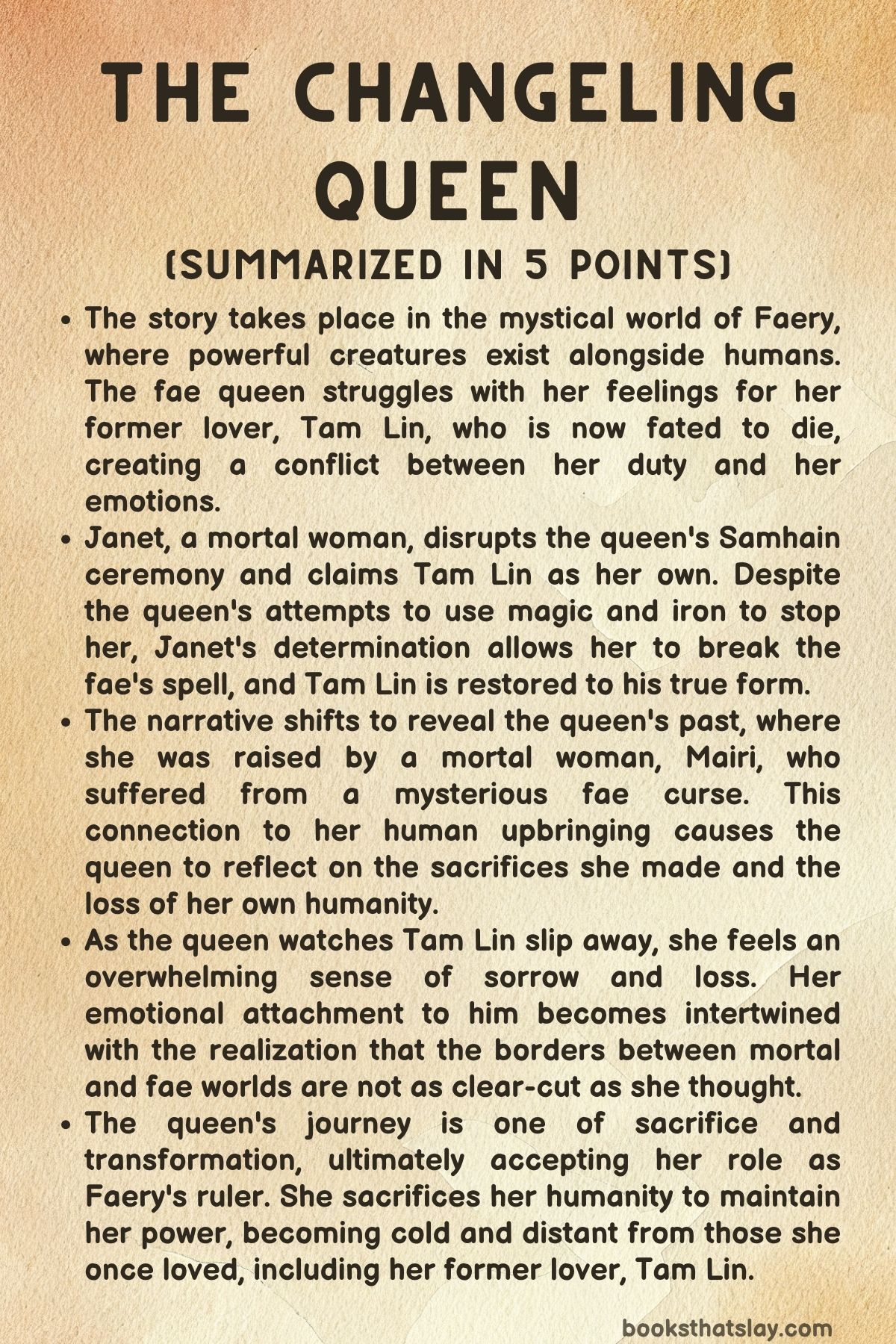
Characters
The Queen of Faery
The Queen of Faery is a powerful and complex character, driven by her deep internal conflict between her humanity and her fae nature. Once a mortal who loved deeply, she undergoes a profound transformation after sacrificing her lover, Thomas, as part of the Teind, a ritual offering to Faery.
This act marks her complete separation from her human self, as she begins to embrace her cold, calculated, and authoritative role as the queen of Faery. While she gains immense power, her transformation comes with an emotional cost.
The queen loses her ability to form meaningful connections, particularly with the mortals she once loved, such as her former companion Jamie and her lover Tam Lin. Her reign over Faery is marked by isolation, as she becomes increasingly detached from her own emotions and humanity.
The queen is also involved with Amadan, the Dark Fool, who plays both a seductive and manipulative role in her life. Although she finds temporary solace in her darker relationships, the queen struggles with her growing internal emptiness.
Ultimately, her sacrifice of her own soul to maintain the balance of Faery marks the tragic culmination of her journey, where she fully embraces the land of Faery, forsaking all ties to her mortal past. Her final confrontation with Janet, who represents mortal love, underscores the queen’s ultimate loneliness, as she realizes that her pursuit of power has severed all her emotional connections.
Janet
Janet is a mortal woman whose strength and determination define her role in the narrative. When she encounters the queen’s procession, she bravely claims Tam Lin, a man whom the queen once loved and now holds in her fae grip.
Despite the queen’s attempts to test Janet’s resolve by turning Tam Lin into various creatures, including a bear and a serpent, Janet refuses to let go, driven by her love for him. This unwavering determination to save Tam Lin is both her strength and her vulnerability, as she faces the wrath of the queen and the dangers of Faery.
Janet’s journey is marked by her fierce love and her willingness to endure immense suffering to secure a future with Tam Lin. Her ultimate success in breaking the queen’s spell and restoring Tam Lin’s true form is a triumph of mortal love over fae manipulation.
However, Janet is also marked by naivety, as she does not fully understand the complexities of the fae world and the price she will have to pay for her love. In the end, Janet claims Tam Lin for herself, leaving the queen to face her defeat, but the unresolved tension between the mortal and fae worlds remains.
Bess Grieve
Bess Grieve is a changeling, caught between the mortal world and the realm of Faery. Raised by her adoptive father, Eamon, and the local healer Mairi, Bess feels torn between her human upbringing and her fae heritage.
While she inherits some of Mairi’s healing abilities, Bess is constantly reminded of her difference, especially by Amadan, the Dark Fool, who mocks her for being a “half fae.” Despite his cruel remarks, Bess is drawn to him, though her primary focus remains on helping others, such as Glenna, a pregnant mortal woman. Throughout the story, Bess wrestles with her inner conflict, especially as the pull of Faery becomes stronger, particularly on Beltane, when the veil between the two worlds is thinnest.
Her growing connection with Thomas, a gentle and playful shepherd, further complicates her sense of belonging. As Bess’s connection to Thomas deepens, she feels the weight of her fae nature and the inevitable separation that looms.
When she is called back to Faery, Bess struggles to reconcile her growing love for Thomas with her duty to her true identity. Her journey ultimately leads her to embrace her role as the queen of Faery after a moment of realization where she claims her crown and asserts her authority over the fae realm.
In the end, Bess’s transformation from a conflicted changeling to the full realization of her power as Faery’s queen is both an acceptance of her destiny and a painful separation from the mortal world she had hoped to belong to.
Amadan, the Dark Fool
Amadan is a mysterious and dangerous fae lord known as the Dark Fool. He plays a pivotal role in Bess’s journey, acting as both a seductive and manipulative figure.
Amadan’s allure is undeniable, and though he mocks Bess for her changeling status, he also draws her into the complex web of Faery politics. His relationship with Bess is marked by tension, as he both tempts and challenges her, reminding her of her true nature.
Amadan’s role as the Dark Fool reflects the duality of Faery itself—beautiful yet dangerous, alluring yet destructive. Despite his cruel treatment of Bess, there is an undeniable connection between them, as he becomes a central figure in her transformation.
His influence extends beyond Bess, especially as he is the father of Glenna’s child, further intertwining his fate with the story’s unfolding drama. Amadan’s motivations are often unclear, but his actions, particularly his manipulation of Bess, highlight the complex dynamics within the fae realm, where power, love, and betrayal coexist.
Eamon Grieve
Eamon Grieve, Bess’s adoptive father, represents the last vestige of her human connections. Once a caring and strong figure in her life, Eamon’s decline reflects the overarching theme of mortality and the toll Faery’s influence can take.
Eamon’s inability to help with Glenna’s childbirth, coupled with his refusal to seek assistance, underscores his weakening state and his separation from the world that Bess is still trying to hold onto. His presence in the story is bittersweet, as Bess reflects on the man he once was and the version of him she must leave behind.
Despite the love he once showed her, Eamon’s inability to cope with the fae world and his slow deterioration serve as a stark contrast to Bess’s growing connection to her fae heritage and her eventual transformation into the queen of Faery.
Thomas Shepherd
Thomas Shepherd, a mortal shepherd, represents Bess’s connection to the mortal world and the love she yearns for but cannot fully claim. His gentle nature and affection for Bess provide her with a sense of comfort and stability, but his role in the story is one of tragic love, as Bess knows she cannot remain with him due to her fae nature.
Thomas’s character is defined by his simplicity and goodness, and his growing affection for Bess complicates her internal conflict. Despite the bond they share, Bess ultimately feels compelled to leave him, torn between her love for him and her obligation to return to Faery.
Thomas’s death, coupled with his eventual betrothal to Margaret, highlights the inescapable separation between Bess and the mortal world. His character serves as a poignant reminder of the life Bess can never fully embrace.
Themes
Power and Sacrifice
The Changeling Queen explores the complex relationship between power and sacrifice, where individuals must confront the cost of their ambitions. The central theme revolves around the queen’s transformation from a mortal girl to the ruler of Faery, highlighting how her ascent to power demands significant personal sacrifices.
Initially, the queen is a character bound by human emotions and relationships, but as she moves deeper into the realm of Faery, she is required to abandon her humanity, including the people and the love that once defined her. Her eventual sacrifice of her own soul, the killing of Bess Grieve, and her complete detachment from all personal connections reflect how the quest for power in the fae realm demands the most intense sacrifices.
The queen’s reign becomes increasingly isolating, as her power grows, but so does her internal conflict. She loses the ability to connect with her past self, including the relationships that once gave her life meaning.
This highlights the true cost of power in Faery: a loss of everything that makes one human. In a way, the story serves as a warning of the dangers of pursuing control at the expense of one’s emotional and personal integrity, showing that the pursuit of power can lead to ultimate loneliness and a disconnection from the very things that gave life meaning.
Identity and Belonging
A central element in the novel is the theme of identity and the struggle for belonging. The queen’s journey into the fae world is not only one of power but also one of self-discovery.
As she transforms from a mortal into Faery’s queen, she is forced to grapple with her sense of self. The tension between her human origins and her new identity as the queen of Faery creates a profound internal conflict.
The queen’s struggle is not just with the responsibilities and expectations placed upon her by her new role but with reconciling the remnants of her human identity with the demands of Faery. This is mirrored by Bess, who, though raised in the mortal world, is constantly reminded of her fae heritage and the inherent conflict of being a changeling.
For Bess, the desire to fit into the mortal world clashes with her natural pull to Faery, and the weight of this duality makes her feel like an outsider in both worlds. Similarly, the queen’s emotional detachment from her past relationships signifies a loss of her humanity, further emphasizing the theme of belonging.
Her struggle to find a place where she truly belongs leads to her ultimate resignation as Faery’s ruler, underscoring that true belonging can only be achieved by accepting both the light and dark aspects of one’s identity, regardless of the external pressures.
Love and Loss
The Changeling Queen offers a nuanced exploration of love, particularly the complex relationships between the queen, Tam Lin, and Janet. The queen’s deep, tragic attachment to Tam Lin reflects the theme of love’s transformative and sometimes destructive power.
While she once loved Tam Lin passionately, her relationship with him becomes intertwined with the burdens of Faery, and her inability to relinquish him demonstrates how love can consume and ultimately isolate. The queen’s sorrow after Tam Lin’s loss is not just about the man she once loved but about her own failure to reconcile the competing demands of love and power.
Janet, in her role as Tam Lin’s savior, represents the mortal world’s perspective on love: one that is grounded in sacrifice, perseverance, and the strength to hold on through hardships. Her struggle to save Tam Lin from the queen’s magic symbolizes the power of love to overcome even the most formidable forces.
However, the queen’s recognition of Janet’s love for Tam Lin introduces a tragic realization: the queen has lost what she once had, and in doing so, her capacity to love is diminished. The queen’s transformation into the embodiment of Faery comes at the cost of her ability to truly experience love, leaving her isolated in her cold, unyielding power.
This theme of love and loss underscores the emotional complexity of the novel, revealing that love, while a potent force, can also be a source of great pain and abandonment when left unfulfilled.
The Mortal vs. the Fae
The boundary between the mortal world and Faery is central to the narrative, and the story of The Changeling Queen blurs the lines between these two realms. The queen’s original human identity and her later transformation into Faery’s queen serve as a metaphor for the perpetual tension between the two worlds.
While Faery represents power, magic, and timelessness, the mortal world embodies human emotions, relationships, and mortality. This duality is explored through characters like Bess, who constantly oscillates between her desire to fit into the mortal world and the pull of her fae heritage.
The mortal realm, though limited by time and physical constraints, offers emotional connections and a sense of belonging that Faery cannot provide. Faery, in contrast, offers power and immortality but demands complete separation from human vulnerabilities.
The queen’s journey highlights how the mortal world, with all its limitations and fleeting moments, holds something Faery cannot: the warmth of human connection. This contrast becomes particularly evident in the queen’s struggle to maintain her grip on Tam Lin, a mortal who represents the innocence and purity of the human world.
In the end, the queen’s defeat and her recognition of Janet’s victory illustrate the inherent tension between the two realms, showing that the forces of love, mortality, and sacrifice cannot be contained by the rigidity of Faery’s immortal rules.
Fate and Free Will
Fate plays a significant role in The Changeling Queen, especially in the queen’s internal conflict and the events surrounding Tam Lin and Janet. The idea of fate is represented by the queen’s initial inability to free herself from the past and her attachment to Tam Lin, whose death seems destined.
Despite her power and control over Faery, she cannot escape the influence of fate, a force that dictates the lives of both mortals and fae alike. The queen’s struggle with this predestined outcome symbolizes the limitations that even the most powerful rulers face when confronted with forces beyond their control.
Janet, on the other hand, represents free will. Her determination to save Tam Lin, despite the overwhelming odds, highlights the power of human choice and the strength to defy fate.
Janet’s refusal to relinquish Tam Lin, even when he is transformed into terrifying forms by the queen’s magic, challenges the inevitability of fate, showing that love and willpower can change the course of events. The queen’s eventual resignation to fate, while still harboring her secret desire to reclaim Tam Lin, underscores the duality between fate and free will.
While the forces of fate may seem inescapable, it is the choices made by individuals, driven by love and determination, that shape the future in unexpected ways.