The Damned by Harper L. Woods Summary, Characters and Themes
The Damned by Harper L. Woods is a dark fantasy novel set in a world where magic, demons, and witches collide. The protagonist, Margot, is a witch caught in a complex struggle involving powerful archdemons, dangerous magic, and her own conflicted feelings.
As she navigates this treacherous world, she finds herself entangled with Beelzebub, a formidable archdemon who becomes both her protector and the source of intense emotions. The story delves into her internal battles, the manipulation by her mother, and her struggle to reclaim control over her own fate. At the heart of it all lies a passionate and forbidden connection with Beelzebub, making it an emotional, turbulent journey toward self-discovery. It’s the 3rd book in the Coven of Bones series.
Summary
In The Damned, Margot, a witch with unusual dark powers, finds herself caught in a world where the Coven controls magic, and her life has been shaped by manipulation and control. Raised under the oppressive rule of her mother, Fritha, who is part of the powerful Erotes Tribunal, Margot has always felt isolated.
Her magical abilities are different from others in her Coven, and she resents the expectations placed on her. Margot has been promised a future with Keane, a kind but uninspiring witch, though she has no desire to marry him.
Her world is shaken when she encounters an archdemon, Beelzebub, drawn to her through a haunting melody.
One night, while walking through the courtyard, Margot unintentionally ensnares an archdemon with her magical song. She doesn’t realize who he is until her mother identifies him as Beelzebub, Lucifer’s second-in-command.
Fritha sees this as an opportunity to manipulate Beelzebub for power, urging Margot to control him. However, Margot is repulsed by the idea of using her magic for manipulation, especially on someone like Beelzebub, who represents the enemy.
Despite her mother’s pressure, Margot begins to feel an undeniable pull toward Beelzebub. Their interactions grow more intense, as Beelzebub, despite being an archdemon who should despise witches, feels drawn to Margot in ways he can’t explain.
As their relationship develops, Margot struggles to keep a distance, torn between the loyalty she feels for her mother and her growing feelings for Beelzebub.
Margot’s life becomes even more complicated when she learns the truth about the spell that altered her magical abilities. The binding spell cast by Itan, a member of the Tribunal, stripped Margot of her light magic and left her with dark powers instead.
This revelation pushes Margot to confront her past and the sinister role her mother and the Coven have played in shaping her future. She seeks help from Willow, a close ally, to undo the bindings that have kept her trapped in this dark future.
The situation escalates when Margot is captured by Michael, an archangel, and held hostage. She learns of a deeper betrayal by Iban, a former friend who has sided with those who wish to control the Coven.
In a desperate fight for survival, Margot witnesses the death of Iban, which shifts the power dynamics and forces her to confront the dangers lurking within her world.
Beelzebub risks his life to save Margot from the archangels, and the two are thrust into a brutal battle in the demonic realms. Their bond deepens as they fight together, but Margot remains conflicted, unsure whether her feelings for Beelzebub are genuine or merely a result of her magic.
The intensity of their shared trauma forces Margot to examine her feelings, and she starts to acknowledge the emotional pull she has toward Beelzebub.
In the aftermath, Margot must confront the chaotic nature of her existence in the Coven and the demonic realms. She faces trials in the Circle of Wrath, where she navigates a dangerous game of power and control.
Her mother continues to push her to manipulate Beelzebub for their advantage, while Margot fights to regain her autonomy and free herself from the manipulations of her past.
As Margot journeys deeper into Hell, she encounters more trials that test her resolve. In the Second Circle of Hell, she must confront the dangers of lust and the manipulative magic of Asmodeus.
Despite her discomfort, she uses her magical abilities to protect herself, but the situation grows more intense when she inadvertently forces Beelzebub into a dangerous position. The escalating tension between them causes Margot to question the ethics of her powers and the emotional connection she shares with Beelzebub.
Their relationship is tested when Margot learns that Beelzebub is immune to her magical influence. This realization shakes both of them, as it becomes clear that his feelings for her go beyond mere manipulation.
However, Margot continues to resist acknowledging her feelings, fearing the consequences of acting on their attraction. The emotional strain leads Margot to confront her own insecurities and the fear of losing control over her powers.
As Margot’s journey continues, she faces more challenges, including trials in the Circle of Violence and the Circle of Fraud. These trials force her to confront her past traumas and the lies she has told herself about her feelings for Beelzebub.
In the Circle of Fraud, Margot is forced to admit her love for Beelzebub, and their bond grows even stronger. However, their connection is complicated by the dangerous circumstances surrounding them.
The climax of Margot’s journey occurs in the Circle of Treachery, where she is betrayed by Satanus, a demon who has been tasked with protecting her. In a brutal confrontation, Margot is fatally wounded by Satanus, leaving her on the brink of death.
In her final moments, Margot expresses her belief that Beelzebub is worth her sacrifice. Her death marks a poignant moment in her journey, with the haunting implication that her death may only be the beginning of a new chapter in her life.
Throughout The Damned, Margot’s journey is one of self-discovery and empowerment as she navigates the complexities of her magical abilities, the manipulation by her family, and her growing connection with Beelzebub. Her emotional and physical struggles are intertwined with a deep sense of betrayal, but through it all, she learns to fight for her autonomy and reclaim control over her destiny.
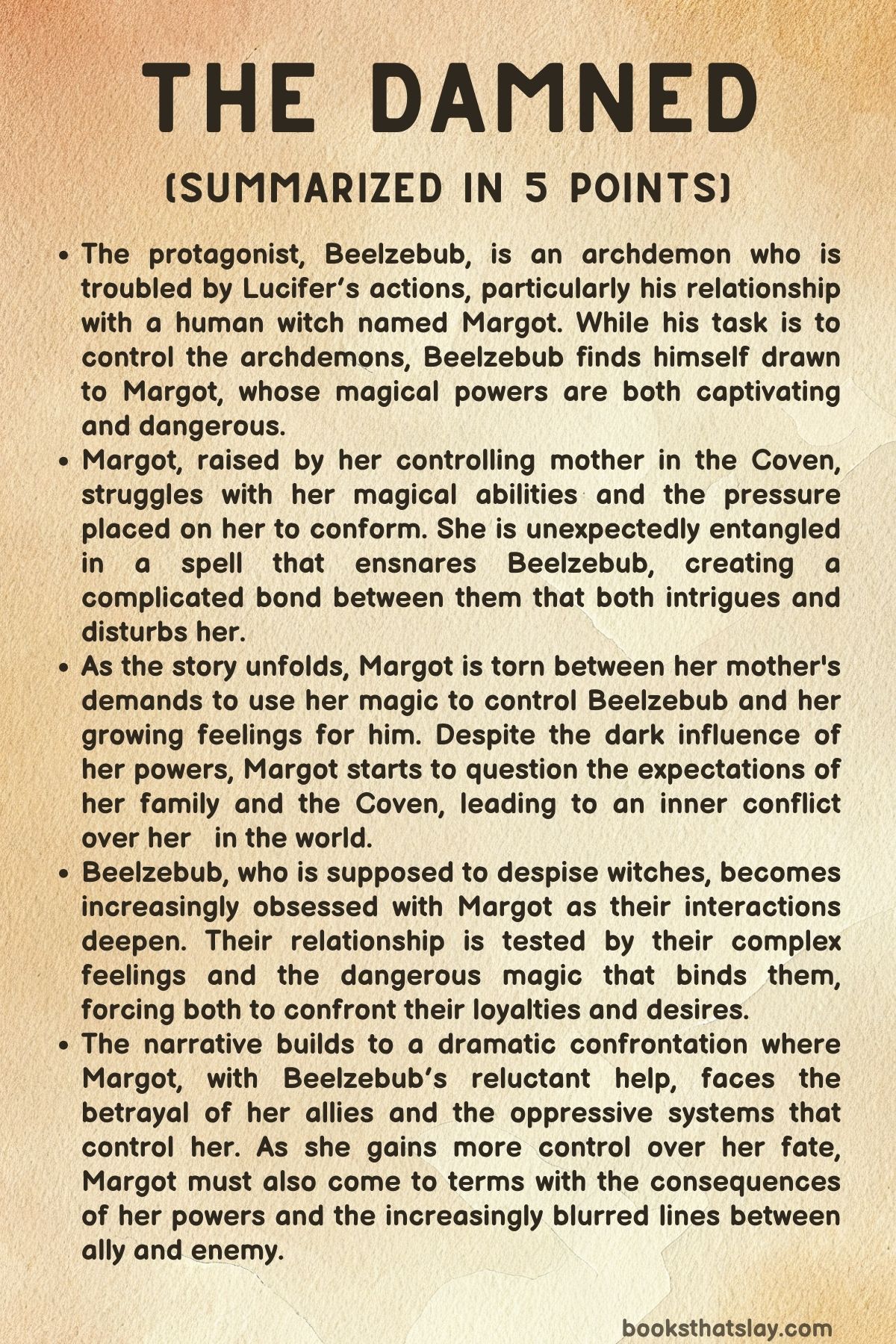
Characters
Beelzebub
Beelzebub, Lucifer’s second-in-command, is an archdemon whose complex emotions and evolving relationship with Margot form a significant part of the narrative in The Damned. Initially, Beelzebub is portrayed as a powerful and intimidating figure, bound by his loyalty to Lucifer and his role in maintaining order among the archdemons.
His natural inclination to despise witches is put to the test when he becomes inexplicably drawn to Margot, a witch with a magical song that ensnares him. Beelzebub’s attraction to her complicates his duties and forces him to confront his internal conflict between his loyalty to Lucifer and the powerful pull he feels toward Margot.
Despite the danger she represents, he finds himself seeking her out, unable to resist her magical influence. Throughout the story, Beelzebub’s relationship with Margot deepens, revealing his vulnerability and the emotional complexities that lie beneath his fierce exterior.
His protection of Margot, even when faced with significant danger, showcases a side of him that goes beyond the typical coldness of an archdemon. The final stages of the book show Beelzebub’s unwavering commitment to Margot, as he helps her navigate the treacherous circles of Hell, proving that his feelings for her are genuine, not just a consequence of her magic.
Margot
Margot, the witch whose magical abilities and complicated relationship with her mother form a central aspect of the plot, is a character marked by internal conflict and personal growth in The Damned. Raised under the oppressive influence of her mother, Fritha, Margot is burdened with expectations and a lack of autonomy, which drives much of her resentment toward the Coven and the world that seeks to control her.
Her magic is unique, darker than other witches, making her feel isolated and misunderstood. This isolation is compounded by her strained relationship with her betrothed, Keane, who represents everything she feels she is supposed to desire but does not.
When Margot accidentally ensnares Beelzebub with her magic, her internal conflict intensifies. Torn between her mother’s manipulative schemes and her own sense of morality, Margot struggles to come to terms with her power and the consequences it has on those around her, especially Beelzebub.
As the story progresses, Margot’s journey becomes one of self-discovery, as she confronts her past, her powers, and the manipulations of the Coven. Her emotional growth is significant, particularly in her evolving relationship with Beelzebub, which shifts from one of reluctant connection to a deep and conflicted love.
Margot’s struggles to reclaim control over her magic, her identity, and her future are pivotal to her character arc, making her journey one of both external and internal liberation.
Fritha
Fritha, Margot’s mother, is a powerful member of the Erotes Tribunal and a key figure in The Damned. As a matriarch of the Coven, Fritha represents the rigid expectations and control that Margot seeks to escape.
She embodies the ruthless and manipulative aspects of the Coven, placing power and control above personal bonds or compassion. Fritha’s relationship with Margot is strained, with Fritha continuously pushing her daughter to embrace her powers for the Coven’s gain, including using her magic to manipulate Beelzebub.
Her cold, calculating demeanor and unyielding drive for control are in stark contrast to Margot’s growing desire for independence. Fritha is not a character who shows vulnerability or empathy, instead using her daughter as a pawn in her pursuit of greater power within the Tribunal.
Her role in Margot’s life is that of both a mentor and an antagonist, challenging Margot’s values and forcing her to confront the darker aspects of her heritage. Fritha’s influence looms large throughout the story, even as Margot begins to break free from her manipulations.
Keane
Keane, Margot’s betrothed, serves as a symbolic representation of the life Margot feels trapped in, one devoid of passion or real emotional connection. In The Damned, Keane is portrayed as kind but ultimately uninspiring, embodying the expectations placed upon Margot by her mother and the Coven.
Though he is well-intentioned, Keane’s inability to truly understand Margot or spark any real desire in her highlights the emotional distance between them. His role in the story underscores Margot’s internal conflict, as she grapples with the pressures of duty versus the pull of her own desires and powers.
Keane’s character serves as a foil to Beelzebub, with whom Margot forms a much more intense and complicated connection. Despite his good qualities, Keane’s presence in Margot’s life only intensifies her sense of isolation and dissatisfaction with her fate.
Itan
Itan, a member of the Tribunal, is a character whose actions significantly shape the plot of The Damned. Initially presented as a trusted figure, Itan is eventually revealed to be one of the main antagonists, manipulating Margot and others for his own gain.
His role in Margot’s life is that of a manipulator, using his position to alter Margot’s magic and shape her destiny according to the Tribunal’s dark plans. Itan’s role in the binding ritual that strips Margot of her light magic is a turning point in the story, setting in motion her transformation into someone capable of drawing dark power.
His actions reflect the corrupt and oppressive nature of the Tribunal, and his manipulation of Margot serves as a catalyst for her rebellion against the forces that seek to control her. As the story progresses, Itan’s true nature is revealed, and his betrayal of Margot becomes a significant moment in the narrative, pushing her further toward her ultimate goal of self-liberation.
Asmodeus
Asmodeus, the demon lord who rules over the Second Circle of Hell, plays a pivotal role in The Damned by testing Margot’s resolve and challenging her sense of self. He embodies the darker, lustful aspects of Hell, forcing Margot into a situation where she must prove her control over desire to move forward.
Asmodeus represents the forces of temptation and indulgence, which are in direct opposition to Margot’s quest for autonomy and self-definition. His actions lead Margot to confront her own powers and desires, testing her moral boundaries.
Despite his overwhelming presence and the challenges he poses, Asmodeus’s role is crucial in Margot’s growth, forcing her to reckon with the consequences of her powers and her interactions with Beelzebub.
Belphegor
Belphegor, Beelzebub’s brother, adds another layer of complexity to the dynamics within The Damned. Although he has remained in the Circle of Heresy, Belphegor shares a deep bond with Beelzebub, reflecting the familial ties that bind the archdemons.
His relationship with Beelzebub is one of shared creation and understanding, yet Belphegor’s role in the story also highlights the contrasts between the archdemons. While Beelzebub is drawn to Margot and ultimately supports her, Belphegor’s presence serves as a reminder of the weight of their existence as creations of Lucifer.
His interactions with Margot provide insight into the complexities of Beelzebub’s character, and his connection with his brother underscores the emotional depth of Beelzebub’s struggles.
Satanus
Satanus, a demon tasked with escorting Margot to safety, represents the conflicting loyalties and dangers that Margot faces in The Damned. Though ostensibly there to protect her, Satanus’s actions are marked by a sense of betrayal and violence.
His confrontation with Margot and the fatal blow he delivers are key moments in the story, as they underscore the constant peril Margot faces from those who would manipulate or harm her. Satanus’s betrayal is particularly devastating, as it forces Margot to confront the fragility of her position and the ever-present danger surrounding her.
His actions serve as a harsh reminder of the treachery that pervades the world of Hell, where loyalty is often a fragile illusion.
Themes
Power and Control
In The Damned, the struggle for power is a central theme that permeates the narrative, influencing the relationships and actions of the characters. At the heart of this power struggle is the Coven, which holds sway over the magical abilities of its members.
Margot, born into this environment, has always felt trapped by the expectations of her mother and the binding magic placed upon her. The Coven’s control over her life, specifically through the dark rituals that have stripped her of her connection to light magic, symbolizes a broader theme of manipulation and dominance.
Margot’s internal conflict intensifies as she navigates the tension between her desire for autonomy and the unyielding forces of control in her life. She is constantly pulled between her mother’s demands and her own desires, representing the broader theme of individual freedom versus the weight of societal and familial expectations.
Beelzebub’s own struggle for control over his destiny is another crucial element in this theme. Though an archdemon and second-in-command to Lucifer, Beelzebub is not immune to being manipulated, particularly by Margot’s powerful magic.
His growing obsession with her, despite his better judgment, reflects a loss of control over his own emotions and actions. The tension between the characters shows how power is not only a physical force but an emotional one, capable of ensnaring even the most powerful beings.
Margot’s magic, which ensnares Beelzebub and drives his actions, becomes a metaphor for the seductive nature of power – it is both captivating and dangerous, offering fleeting moments of satisfaction at the cost of personal freedom. As the story unfolds, both Margot and Beelzebub must grapple with the effects of these power dynamics, questioning how much of their actions are their own and how much are influenced by external forces beyond their control.
Morality and Self-Identity
The theme of morality and self-identity plays a significant role in Margot’s journey throughout The Damned. Initially, Margot is a young woman trapped by the expectations of her mother and the Coven, constantly made to feel that her worth is tied to her magical abilities and the role she plays within the family structure.
As she gains greater awareness of her powers, particularly the darker magic she has been forced to wield, Margot begins to question her morality and what kind of person she wants to be. Her internal struggle deepens as she faces the harsh reality of her heritage and the manipulations that have shaped her destiny.
The choices she makes, particularly in relation to Beelzebub, force her to confront her own sense of right and wrong, revealing the complex nature of morality in a world governed by powerful beings and magical forces.
For Beelzebub, his interactions with Margot challenge his understanding of loyalty and duty. As an archdemon bound by his loyalty to Lucifer, he has always been guided by a strict code, one that expects him to despise witches and their influence.
However, his growing feelings for Margot cause him to question this long-held belief, forcing him to reckon with the idea that morality is not always black and white. His relationship with Margot is fraught with moral ambiguity, as he struggles with the pull of his emotions and the necessity of his duties.
Both characters are forced to redefine their sense of self, as their interactions expose the moral gray areas in which they find themselves.
Freedom and Entrapment
The theme of freedom versus entrapment is explored through the characters’ struggles to break free from the chains that bind them, whether these are literal, emotional, or societal. Margot is physically bound by the magic placed upon her by the Coven, limiting her ability to access light magic and forcing her into the role of a darker, more dangerous witch.
This restriction serves as a metaphor for the broader entrapment that many of the characters experience, especially in the context of familial duty and the constraints of tradition. Margot’s desire for freedom is a driving force in her character’s development, as she seeks to reclaim control over her life and destiny.
Her internal battles and the external forces that attempt to keep her in line highlight the difficulty of breaking free from the expectations placed upon her, especially when those around her, like her mother and the Coven, have a vested interest in keeping her bound.
Beelzebub, too, is entrapped by his loyalty to Lucifer and his role within the demonic hierarchy. Though he possesses immense power, his sense of duty limits his freedom of choice, especially in his interactions with Margot.
His desire to protect her, despite the dangers she presents, reveals the complexity of his own struggle for autonomy. Over time, he must confront the limitations of his position and decide whether his loyalty to Lucifer outweighs his personal desires.
Both characters, in different ways, are caught in webs of control, with their freedom tested by their relationships, their powers, and their roles in a world that seeks to define them.
Love and Desire
Love and desire are central to the emotional tension in The Damned, serving as both a source of strength and conflict for the characters. Margot’s powers, which include the ability to enchant others through her song, become a metaphor for the way love and desire can manipulate and control.
She is deeply conflicted by the attraction she feels toward Beelzebub, as their bond grows stronger and more complicated over time. Margot’s desire for autonomy conflicts with her growing affection for Beelzebub, leading to moments of emotional turbulence.
She fears that her magic is pushing her toward him, making her question whether her feelings are genuine or a result of the enchantment. This tension between emotional sincerity and magical influence is a key part of the story’s exploration of love.
For Beelzebub, love is equally complicated. As an archdemon, he is supposed to view witches with disdain, yet his growing feelings for Margot challenge this perception.
His relationship with her is built on a foundation of both magical manipulation and emotional depth, making it difficult for him to discern where his true feelings begin and where the influence of Margot’s powers end. The theme of love is explored not just as a romantic force but as something that can complicate decisions, blur moral boundaries, and challenge the characters’ sense of identity and duty.
Ultimately, the bond between Margot and Beelzebub represents the complicated nature of desire – it is both an alluring and dangerous force, capable of both healing and destruction.
Betrayal and Loyalty
Betrayal and loyalty are pervasive themes that drive much of the conflict in The Damned, as characters constantly navigate shifting allegiances and broken trusts. Margot’s betrayal by her mother, who uses her as a pawn in the Coven’s power struggles, is a key turning point in her journey.
The manipulations of her family, particularly her mother’s cold and calculating nature, create a deep sense of betrayal that Margot must overcome. This betrayal forces her to reevaluate her sense of loyalty and her personal ties to the Coven.
She realizes that her loyalty to her family has been misused, and she must find a new path that aligns with her own values.
Beelzebub’s journey is similarly defined by loyalty and betrayal. His loyalty to Lucifer has always been unquestioned, but his feelings for Margot put him in direct conflict with this allegiance.
As he becomes more emotionally entangled with her, he faces the ultimate question of whether loyalty to his master or to Margot is more important. His struggle reflects the complex nature of loyalty, showing how it can both anchor and isolate individuals in a world where power dynamics are constantly shifting.
Throughout the novel, both Margot and Beelzebub grapple with the question of loyalty, finding that true loyalty is not always clear-cut, and sometimes it requires difficult decisions that may ultimately lead to betrayal.