The Devil Is a Southpaw Summary, Characters and Themes
The Devil Is a Southpaw by Brandon Hobson is a profound exploration of despair, isolation, and spiritual dissonance. Set in the late 1980s, the story follows Matthew Echota, a troubled young boy at a juvenile detention facility, who begins experiencing strange, prophetic visions and unsettling behavior.
His life, marked by family tragedies and a hauntingly enigmatic existence, unfolds through a series of journal entries and interactions with his peers. As the narrative shifts between his eerie past and the lives of those around him, Hobson delves into the complexities of youth, suffering, and the relentless search for meaning in a harsh and indifferent world. This dark, reflective tale grapples with themes of fate, death, and the haunting legacy of the past.
Summary
In the spring of 1988, Matthew Echota, a gifted and troubled boy, vanishes from Tophet County Juvenile Correctional Facility. His disappearance sets off a search through the nearby woods, a journey that takes a strange and unsettling turn.
Matthew’s odd behavior at the facility had already made him a mysterious figure. He had run away once before, claiming that he sought clarity for his mind, a notion that perplexed those around him.
Over time, Matthew had started making eerie predictions, often about disasters and deaths, which seemed to come true, further alienating him from his peers and the staff.
Matthew’s mysterious nature is highlighted by his journal entries, which reveal his deep thoughts on life, death, and his impending doom. He often spoke of dreams involving lepers and forests haunted by spirits, and his sister, Nora, confirmed that he frequently mentioned seeing signs of death.
Despite the growing concern from others, Matthew’s behavior grew even more cryptic. He believed he was being watched by a supernatural force, hearing voices and seeing spirits.
However, when questioned, he dismissed these occurrences as mere coincidence. His oddities, combined with his disturbing predictions, created an unsettling atmosphere among those who knew him.
The search for Matthew in the woods leads to increasingly bizarre and terrifying experiences. The group encounters eerie figures they believe to be spirits or “little people” that dwell in the forest, known to capture and devour children who venture too far.
As they move deeper into the woods, they stumble upon signs of death and decay, including bodies of lepers and the strange figure of a man chanting an ominous phrase about the “Devil’s Lost Playground.”
Amid this journey, Nora reveals that Matthew had once described a vision of a horse-drawn carriage driven by Death itself, a haunting image that troubled him deeply. Eventually, the group reaches a clearing and finds Matthew’s body floating lifeless in the water.
His death is met with a mixture of disbelief and sorrow, as those who searched for him realize that the enigmatic boy, who seemed destined for something greater, was consumed by his own strange fate. Nora’s emotional breakdown upon discovering her brother’s body underscores the tragedy of his life.
Parallel to Matthew’s final days, the narrative also dives into his backstory in Old Dublan, a town steeped in poverty and hardship. From a young age, Matthew had shown extraordinary artistic abilities, garnering praise from teachers, but also resentment from his peers who envied his talent.
His family history was riddled with tragedy, with his father, George Echota, a failed baseball player, and his grandfather who had committed suicide after becoming blind. Matthew’s life seemed destined for misfortune, weighed down by the legacies of his ancestors and his own inner struggles.
The novel also explores the grim reality of life at the juvenile detention facility, a place of torment and abuse for its young residents. The guards and staff are portrayed as cruel and indifferent, subjecting the boys to a harsh regime of physical labor, isolation, and emotional cruelty.
While some residents, like Ace, find comfort in the structure of the facility, others, like Matthew, seem to be doomed from the start. Their lives, filled with abuse and neglect, set the stage for their eventual despair.
As Matthew’s story unfolds, it becomes clear that his fate was shaped by a combination of internal and external forces. His time in detention served to amplify his strange behavior, as the oppressive atmosphere of the facility mirrored his own mental torment.
Despite the harshness around him, Matthew found solace in his writing, using it as an outlet for his thoughts and fears. However, this retreat into his inner world only distanced him further from those around him, making him more of an enigma to his fellow residents.
His obsession with writing about their lives, noting down their personalities in a novel, fueled curiosity and suspicion among the others, but Matthew remained secretive about his work.
Matthew’s time in detention also intersects with the broader struggles of the other boys, many of whom harbor dreams of escape. Though some, like Matthew, reject the notion of freedom, others fantasize about breaking free from the oppressive confines of the facility.
A severe storm and a surreal event in which frogs fall from the sky further highlight the bizarre and unsettling nature of the detention center. The staff’s indifference to the suffering of the boys during the storm contrasts sharply with their usual cruelty, adding to the overwhelming sense of hopelessness that pervades the facility.
Matthew’s descent into isolation continues as he becomes increasingly alienated from his fellow residents. His interactions with the staff become more strained, as they mock his stutter and label him as odd.
His time in the basement, a place of punishment, symbolizes his internal struggles and growing sense of alienation. Despite this, Matthew remains determined to continue his writing, using it as a form of self-expression amidst the constant abuse and torment.
The residents, meanwhile, continue to endure the oppressive conditions of the facility. While some briefly bond over shared moments of rebellion and dreams of escape, the reality of their situation remains unchanged.
The narrative juxtaposes these fleeting moments of solidarity with the grim, unrelenting nature of their confinement, highlighting the emotional toll it takes on the boys. Despite their harsh reality, they continue to cling to small pieces of hope, finding solace in daydreams and fantasies of freedom.
Through the lens of Matthew’s life, The Devil Is a Southpaw explores the devastating effects of isolation, neglect, and the harsh realities of growing up in an unforgiving world. His mysterious death serves as a tragic reminder of the darkness that can envelop a young life when left unchecked by love, guidance, or understanding.
As the residents of the detention center face their own struggles, they are left to grapple with the emotional scars of their pasts, uncertain of their futures and the possibility of redemption.
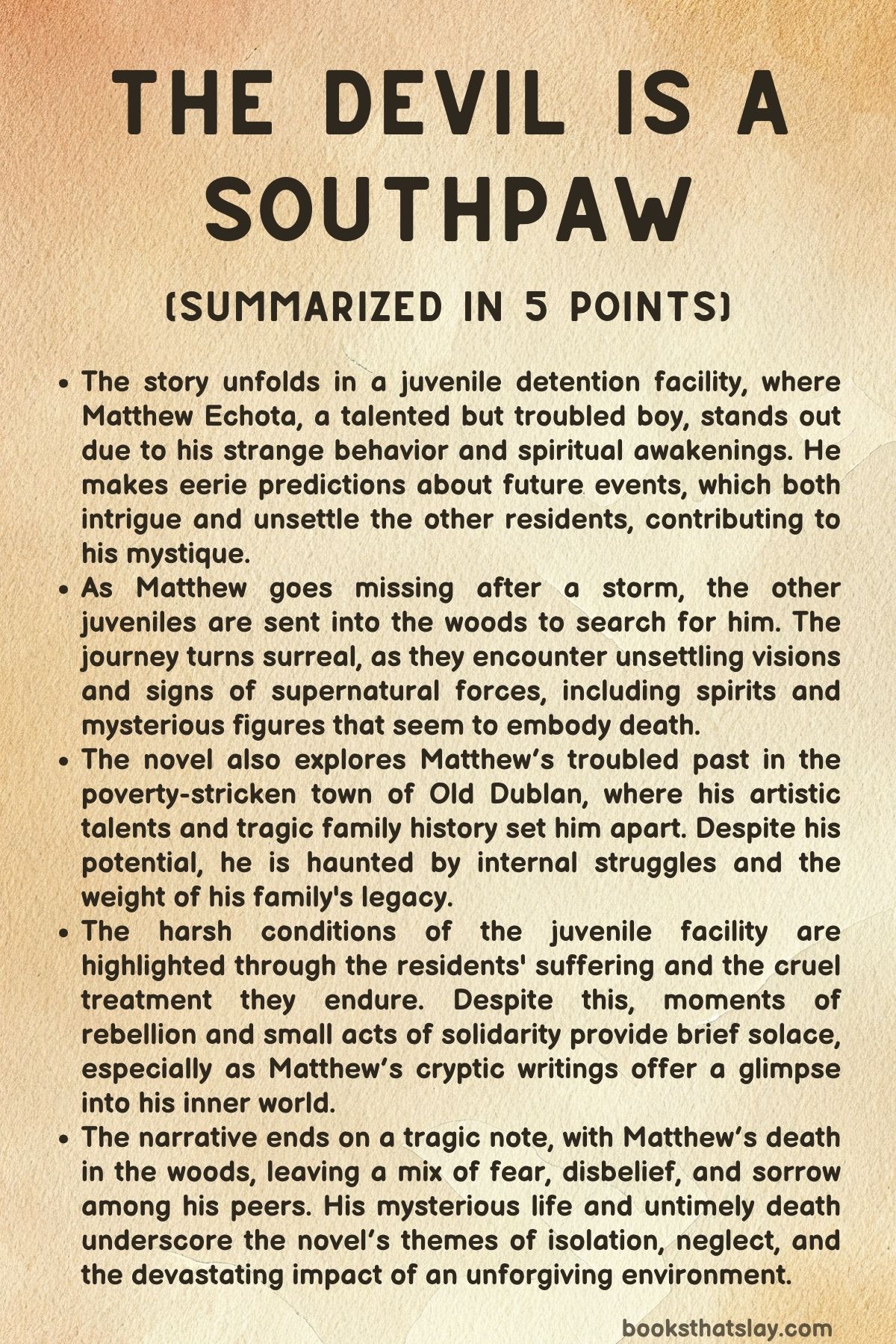
Characters
Matthew Echota
Matthew Echota, the central figure of The Devil Is a Southpaw, is a complex and enigmatic character whose life is marked by both extraordinary talents and deep psychological turmoil. A boy of great artistic ability, Matthew gains the attention of teachers and peers alike for his exceptional skills.
Despite his artistic success, he faces significant emotional struggles, compounded by a family history filled with tragedy. His father, George Echota, a failed baseball player, and his grandfather, who committed suicide after becoming blind, loom over his life, casting long shadows of despair and inevitability.
These familial legacies seem to weigh heavily on Matthew, contributing to his internal conflict and sense of foreboding.
Matthew’s behavior is marked by an increasing sense of alienation, both from the other residents at the juvenile facility and from reality itself. His cryptic journal entries and his eerie predictions about the future, including disasters and deaths, create a mystique around him, making him a figure of both fascination and fear.
He speaks of visions, strange dreams, and encounters with supernatural forces, all of which add to the sense that he is on the brink of something profound, yet ultimately tragic. His belief that his death is imminent, coupled with his increasingly erratic behavior, reflects his internal struggle with mortality and a sense of impending doom.
Matthew’s journey in the woods, his eventual death, and his family’s sorrowful history all point to a boy marked by the heavy weight of both fate and his own fragile mental state.
Nora Echota
Nora Echota, Matthew’s sister, serves as a poignant emotional anchor in the story, particularly in the aftermath of Matthew’s disappearance and death. Her relationship with Matthew is marked by both concern and a deep sense of helplessness, as she attempts to understand her brother’s increasingly bizarre behavior.
Nora’s insights into Matthew’s dreams and his sense of predestination offer a glimpse into the troubled world he inhabited. Her emotional breakdown at the discovery of Matthew’s body reflects the profound impact of his death on her, underscoring the tragic nature of his life.
She is a character defined by her emotional sensitivity, caught between the desire to protect her brother and the crushing reality of his untimely demise.
Milton Muleborn
Milton, the narrator of The Devil Is a Southpaw provides a window into the harsh realities of life at the Tophet County Juvenile Correctional Facility and the psychological toll it takes on its residents. His introspective nature and inner turmoil mirror many of the struggles faced by the other boys, particularly Matthew.
Milton’s reflections on his own experiences with bullying, isolation, and his troubled relationship with his family serve to paint a broader picture of the bleak environment in which the story unfolds. His bond with Matthew, filled with both admiration and jealousy, highlights the complexity of their friendship.
As Matthew’s artistic talents surpass his own, the narrator grapples with feelings of inadequacy and rivalry, which only add to his growing sense of alienation.
Throughout the novel, the narrator struggles with a deep sense of guilt, loneliness, and the emotional scars of his past. His relationships with his father, who is emotionally distant and morally flawed, and his brother, Walt, whose suicide leaves an indelible mark on him, are fraught with tension.
These personal battles are mirrored by the larger struggle for freedom and self-identity that Matthew represents. Ultimately, the narrator’s introspective journey is one of self-discovery, as he seeks to reconcile the pain of his past with his desires for redemption and artistic expression.
Ace
Ace is one of the other juvenile residents of the facility, and while his role in the story is secondary, he plays an important part in illustrating the dynamics within the group of boys. Ace finds some measure of solace in the rigid structure of the facility, which provides a semblance of order amidst the chaos.
His ability to adapt to the harsh conditions contrasts sharply with Matthew’s more detached and fragile nature. Ace’s character highlights the theme of survival within the confines of the detention center, where some find comfort in routine and discipline, while others, like Matthew, are broken down by the oppressive environment.
Anna Darko
Anna Darko’s role in The Devil Is a Southpaw is more mysterious and complex. As a guide leading the group through the unsettling underground hypogeum, she serves as both a symbol of hope and a source of confusion.
Her motivations, initially centered on her desire to save others, particularly Matthew, blur the line between selflessness and manipulation. Her past experiences at an animal shelter, where she witnessed the suffering of dogs, influence her desire to help those in distress, yet her actions in the hypogeum suggest deeper, more ambiguous intentions.
As the group follows her through increasingly surreal and disturbing environments, Anna’s character remains enigmatic, never fully revealing her true nature. Her actions spark suspicion among the group, particularly when they encounter strange beings and unsettling sights in the hypogeum and beyond.
Despite her cryptic behavior, Anna becomes a pivotal figure in the group’s journey, leading them toward what they hope is an escape, but ultimately toward a confrontation with their own fate.
Sergeant Ambrose
Sergeant Ambrose represents the oppressive authority figures that torment the residents of the juvenile facility. His laughter, which echoes eerily throughout the novel, becomes a symbol of the cruel and indifferent nature of the guards and staff.
The tension between the residents and the staff, especially figures like Sergeant Ambrose, serves as a reminder of the constant surveillance and emotional abuse that permeate the facility. His presence adds to the sense of fear and helplessness that the boys experience, reflecting the broader themes of control and dehumanization within institutional systems.
Trusty John
Trusty John is a minor yet significant character who serves as the narrator’s friend and accomplice in his early criminal activities. His friendship with the narrator is marked by their shared sense of rebellion and dissatisfaction with their lives.
However, Trusty John’s involvement in the narrator’s descent into criminal behavior also highlights the broader struggles of youth caught in cycles of neglect and misdirection. While Trusty John is not as deeply developed as other characters, his role in the narrator’s life underscores the importance of friendships and the ways in which such relationships can influence one’s choices and path in life.
His involvement in the narrator’s arrest for drug distribution marks a turning point in both of their lives, pushing the narrator into the harsh environment of juvenile detention.
Themes
The Struggles of Isolation and Alienation
In The Devil Is a Southpaw, the theme of isolation and alienation is explored through the experiences of the characters, particularly Matthew, who seems to be trapped in a world where he cannot truly connect with those around him. From the very beginning, Matthew’s behavior is portrayed as unusual, leading others to distance themselves from him, both out of fear and confusion.
His introspective nature, along with his fascination with spiritual and existential matters, sets him apart from his peers. His isolation deepens as he rejects the idea of escape or freedom from the juvenile detention center, focusing instead on his personal journey.
The emotional distance that Matthew creates between himself and the others contributes to his alienation, but it also reflects the larger theme of individuals becoming trapped in their own worlds of suffering. This theme of alienation is not confined to Matthew alone.
The other residents of the facility, while initially drawn to Matthew, are also deeply isolated in their own right, each struggling with their own personal demons. Their isolation is compounded by the oppressive and neglectful environment of the detention facility, where they face harsh treatment from both the staff and their peers.
The characters’ struggles with isolation are not merely physical but also emotional and psychological, as they grapple with feelings of abandonment, fear, and confusion. Ultimately, the theme of isolation in the novel emphasizes the harsh reality of growing up in an environment where connection and empathy are scarce, leaving the characters to cope with their inner turmoil in isolation.
The Impact of Family and Legacy
The theme of family and legacy plays a significant role in shaping the lives of the characters in The Devil Is a Southpaw. Matthew’s complex relationship with his family, particularly with his father and grandfather, highlights the generational struggles that can weigh heavily on an individual.
Matthew’s father, George, is a failed baseball player who carries his own burdens of failure and regret. His inability to reconcile with his past casts a long shadow over Matthew’s life, and the cycle of disappointment seems to perpetuate itself through the generations.
Matthew’s family history is marked by tragedy, including his grandfather’s suicide and the strained relationship he shares with his parents. These family dynamics contribute to Matthew’s sense of disconnection and his inability to find peace, both within himself and in his relationships.
His father’s controlling and punitive behavior mirrors the way the characters in the detention facility are treated—harshly and without compassion. Similarly, the narrator’s experiences reflect the devastating influence of family, particularly the emotional abuse inflicted by his father.
The speaker’s strained relationship with his family becomes a significant part of his emotional turmoil, and the ongoing effects of his family’s dysfunction are evident throughout his life. The weight of legacy is also seen in the narrator’s feelings of inadequacy and jealousy toward Matthew, whose success as a poet seems to outshine the narrator’s own artistic endeavors.
The theme of family and legacy, in both Matthew’s and the narrator’s stories, underscores the impact of one’s upbringing on personal identity and the long-lasting effects of familial trauma.
The Search for Meaning and Spiritual Awakening
In The Devil Is a Southpaw, the theme of searching for meaning and spiritual awakening is central to Matthew’s journey. His time in the juvenile detention center sparks a series of reflections and spiritual insights, as he begins to have visions and premonitions about death and the future.
These supernatural experiences suggest that Matthew is on a quest for clarity and understanding, one that leads him to believe in a deeper, perhaps even cosmic, order. His belief that he is being watched by some supernatural force and his tendency to see spirits and hear voices contribute to the sense that he is in the midst of a spiritual awakening.
However, his visions are not merely religious but also deeply existential, as he grapples with the idea of his own death and the fate that awaits him. This spiritual journey, while unsettling, gives him a sense of purpose and direction, even if it leads him toward a tragic end.
The theme of spiritual awakening is not limited to Matthew alone. The narrator’s own struggles with identity and purpose suggest that the search for meaning is a universal experience.
The harsh conditions of the detention facility, along with the emotional trauma of their pasts, force the characters to confront the deeper questions of life, death, and existence. In a place where hope seems almost nonexistent, the characters find solace in their personal reflections and dreams of something greater.
Through Matthew’s journey, the novel suggests that even in the bleakest of circumstances, there is a search for meaning that can offer some form of understanding and peace, even if it is fleeting or illusory.
Death and the Imminent Sense of Doom
The theme of death looms large in The Devil Is a Southpaw, particularly in Matthew’s life. From the beginning, Matthew exhibits a preoccupation with death, believing that his own demise is imminent.
His visions of lepers, haunted forests, and death itself contribute to the eerie atmosphere of the novel. His constant references to death and the supernatural create a sense of foreboding, as if he is always on the edge of an unknown, darker fate.
His predictions, written down in his journal, seem to come true, reinforcing the sense that death is an unavoidable force in his life. His experiences are often marked by an awareness of his own mortality, which contrasts sharply with the other characters’ more mundane concerns.
For Matthew, death is not just an abstract concept but a tangible, ever-present reality. This looming sense of doom is not confined to Matthew alone but affects the other residents as well, who live in constant fear and dread, trapped in a cycle of violence, abuse, and hopelessness.
The theme of death extends beyond the physical, as it also represents the emotional and spiritual death that the characters experience. The oppressive environment of the detention center strips them of their dignity and humanity, leaving them to navigate a world that seems devoid of hope.
The journey through the woods, which begins as a search for Matthew, becomes a metaphor for the characters’ own confrontation with death and the unknown. Ultimately, the theme of death in the novel highlights the fragility of life and the inevitability of fate, as the characters struggle to make sense of their existence in a world that seems to offer no answers.
Rebellion and the Desire for Freedom
Rebellion and the desire for freedom are central themes in The Devil Is a Southpaw, as the characters, especially the residents of the juvenile detention center, yearn for escape from their oppressive circumstances. The tension between the desire for freedom and the harsh realities of confinement is palpable throughout the novel.
The residents, trapped in the detention center, fantasize about escape and freedom, using their imaginations as a means of coping with the bleakness of their lives. Matthew, however, dismisses these fantasies, focusing instead on his inner journey and writing.
His refusal to engage in the same escape fantasies as the others highlights his sense of alienation, as he seems to be pursuing a different kind of freedom—one that is spiritual and personal, rather than physical. Despite his rejection of physical escape, Matthew’s internal rebellion against the system that confines him becomes a form of resistance, as he refuses to conform to the expectations placed upon him.
For the other residents, the desire for freedom is more tangible and rooted in their desire to escape the physical and emotional abuse of the detention center. The novel suggests that while the characters may be physically confined, their inner rebellions and desires for freedom remain unbroken.
Even in the face of overwhelming odds, the characters continue to hold on to the hope of escape, whether through dreams of a better life or through the act of defying the system that oppresses them. This desire for freedom serves as both a source of strength and a source of frustration, as the characters struggle to reconcile their need for personal autonomy with the harsh limitations imposed upon them.