The Everlasting Summary, Characters and Themes
The Everlasting by Alix E. Harrow is a captivating tale that blends elements of fantasy, history, and myth, exploring the cyclical nature of heroism, sacrifice, and manipulation. The story centers around Una, a legendary warrior, and Owen Mallory, a historian who becomes entangled in her complex, repeated life.
Set in a world filled with magic and political intrigue, the narrative weaves through time, with Una’s quest to escape the manipulations of a powerful queen, Vivian. As Una and Owen journey together, their fates intertwine in a world shaped by both ancient forces and personal decisions. The novel delves into themes of identity, legacy, and the cost of eternal recurrence, asking what it means to be free from a story that has already been written.
Summary
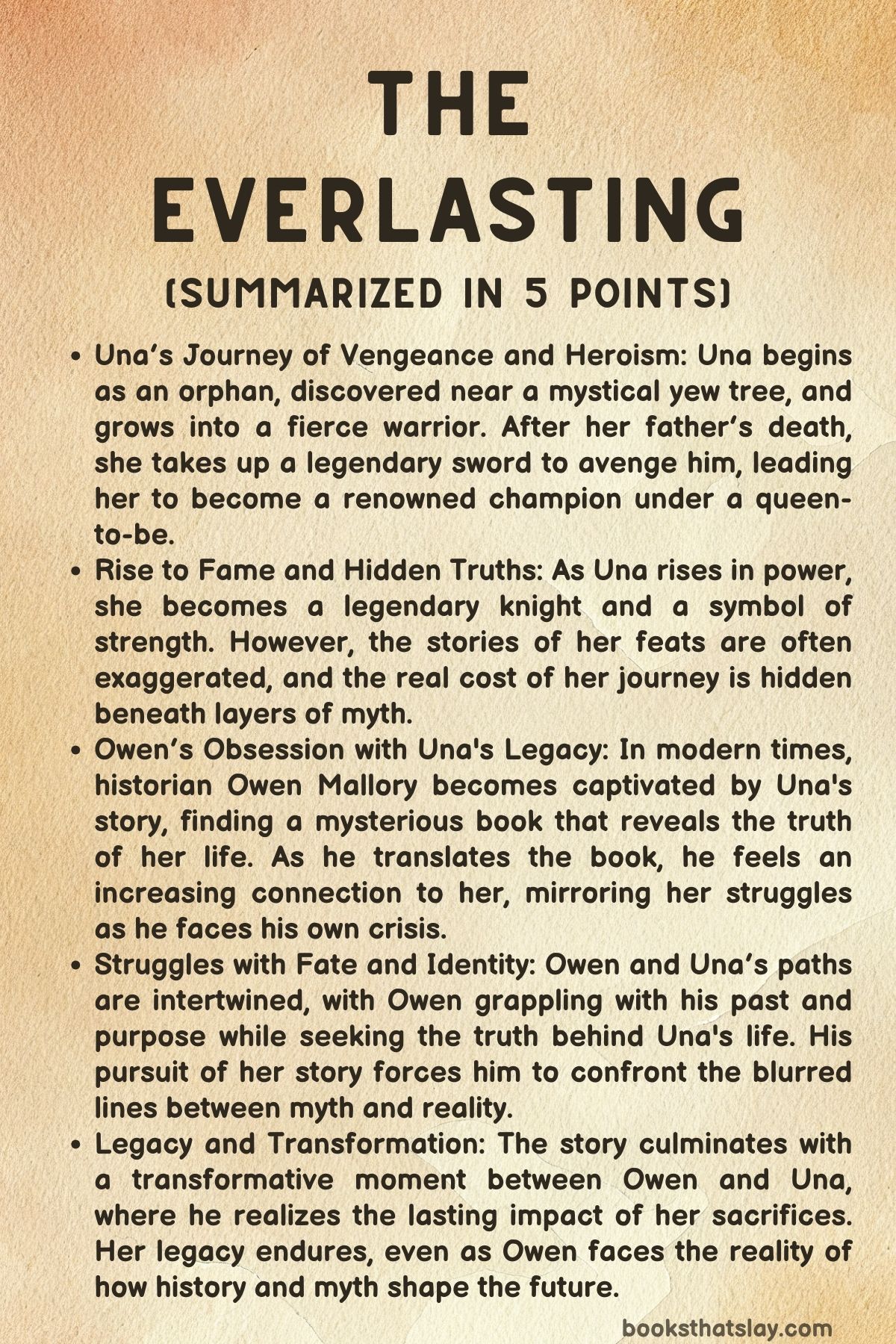
The story begins in a war-torn world where time flows strangely, especially beneath the ancient yew tree. A young girl, abandoned as an infant near this tree, is found by a woodcutter.
She is raised in the wilds, becoming a skilled and powerful woman with the ability to move unseen through the woods. Despite her remarkable abilities, she feels like a nobody—an orphan without a past or a future.
Her life takes a drastic turn when, at the age of twelve, her father is killed by the Brigand Prince, a ruthless bandit leader. Fueled by grief and anger, she wields a legendary sword embedded in the yew tree, a weapon known for its invincibility.
With this sword, she takes revenge on the Brigand Prince and his men, killing them in a bloody battle.
The queen-to-be, not yet crowned, witnesses this event and asks the girl for her name. The girl responds that she is no one, and the queen offers her a place at her side.
The girl, still raw with grief, agrees, pledging loyalty to the queen. She is given the name Sir Una and begins to rise in prominence, becoming a renowned knight under the queen’s rule.
She leads armies, fights battles, and earns a legendary status. However, much of what is told about her is distorted; the truth of her life is buried beneath a mythologized version, filled with exaggerations and simplified tales of heroism.
In reality, Una’s journey is filled with loss, pain, and difficult truths.
The story shifts to a modern-day historian, Owen Mallory, who becomes obsessed with Una’s legend. Owen works at Cantford College and has long been fascinated by the hero of Dominion, Una Everlasting.
When a mysterious book arrives in his possession, detailing Una’s life, Owen begins translating it, becoming deeply immersed in the narrative. The book is said to be the true account of Una’s life, written by a companion who traveled with her.
As Owen works through the story, he begins to feel a profound connection to Una, as if her struggles and battles mirror his own.
Owen’s life has been marked by his experiences as a soldier, and he struggles to find meaning in the aftermath of war. His search for truth about Una’s life becomes a personal journey, not just an academic pursuit.
The deeper he dives into Una’s past, the more he uncovers about the society she fought for, the queen she served, and the emotional toll her battles took on her. His exploration of Una’s story blurs the line between history and myth, and he becomes more and more absorbed in uncovering the reality of her life.
As Owen continues his investigation, he finds himself drawn into a personal encounter with Una, who exists in both the past and the present. He faces her beneath the yew tree, where her legacy lives on.
This encounter becomes a surreal and transformative experience for Owen, forcing him to confront the raw humanity of Una and the weight of her sacrifices. The ending leaves Owen in a moment of profound realization, understanding that the past and the present are inextricably linked, and that Una’s story, though wrapped in myth, continues to influence the future.
The narrative continues as the historian joins Una on her journey to find the last dragon and the holy grail. Despite her legendary status, Una is no longer the confident and powerful hero of old.
She now lives in a secluded hut, withdrawn from her past glories, a shadow of the person she once was. The narrator, who seems to have traveled back in time, is fascinated by Una’s legend but frustrated by her detachment.
They try to remind her of her past victories and the importance of her quest, but Una remains unmoved, burdened by the deaths and sacrifices she has made for the greater good of Dominion.
The narrator’s persistence eventually convinces Una to resume her quest, and together they embark on a journey to find the last dragon. Along the way, they encounter various challenges, and the narrator learns more about Una’s inner turmoil.
Though they form a connection, the distance between them remains, as Una struggles with the weight of her destiny and the emotional toll of her past.
The journey leads them to Cloven Hill, where the last dragon resides. After a fierce battle, Una defeats the dragon and retrieves the grail.
She brings it back to the queen, ensuring her healing and the stability of Dominion. Yet, despite the completion of her quest, Una’s soul remains unsettled.
She grapples with the realization that her life, though marked by victories, has been shaped by a series of tragic events and sacrifices.
As Una and the narrator make their way to Cavallon Keep, the final destination of their journey, Una’s internal struggle intensifies. She is torn between her love for the narrator and the realization that her role as a legendary hero is fraught with pain.
At Cavallon Keep, the final confrontation occurs, where Una faces Vivian, the queen who has manipulated her life. Vivian offers Una a chance to restore what she has lost, but Una refuses to continue serving her.
In a surprising twist, Vivian’s power begins to unravel, and Una ultimately breaks free from the cycle of violence and manipulation.
In the aftermath of the confrontation, Una and the narrator face the consequences of their actions. They have lived through countless cycles of death and rebirth, but now they must find a way to break free from the past.
Their efforts to destroy the magical seed that sustains Vivian’s control are met with resistance, and the very fabric of their existence begins to unravel.
The story concludes with a quiet moment of peace. Una’s legacy, though forgotten by most, endures through the people who remember her.
The yew tree, a symbol of life, death, and rebirth, stands as a testament to Una’s journey. As the narrator reflects on their time with Una, they realize that her story, though shaped by tragedy, has left an indelible mark on the world.
The cycle may have ended, but Una’s influence lives on, not just in the pages of history, but in the hearts of those who remember.
Characters
Una Everlasting
Una is the central character in The Everlasting, a legendary warrior who transcends the roles of both hero and martyr. Her journey begins as an abandoned child, found near the mystical yew tree, where she is raised in solitude and grows into a fierce, skilled fighter.
Despite her strength and abilities, she remains an orphan without any heritage or claim to a future. Her transformation into Sir Una, a revered champion, occurs after she avenges the death of her father at the hands of the Brigand Prince, a moment that sparks her rise to power under the queen’s reign.
Her character is shaped by both grief and vengeance, and as she becomes a symbol of strength, the realities of her life—filled with loss, sacrifice, and violence—are often hidden behind the myths constructed by others.
Una is a woman trapped between the expectations of her legendary status and the haunting memories of her past. While she serves her queen and fights battles that solidify her place in history, Una is constantly burdened by the toll of her sacrifices.
The contradictions in her character—her raw emotional state and her polished mythological persona—define her internal struggle. As the story progresses, she finds herself at odds with the legacy that others have built around her, struggling to reconcile her true identity with the distorted image of her heroism.
The weight of destiny, loss, and her complicated relationship with power makes Una both a tragic and admirable figure, whose journey transcends time and space, leaving a lasting impact on those who encounter her.
Owen Mallory
Owen Mallory is a modern-day historian and a key figure in The Everlasting, whose academic obsession with Una’s story eventually draws him into a deeper connection with the legendary warrior. Initially, Owen is portrayed as a soldier turned scholar, living a life far removed from the battles that shaped Una’s legendary persona.
His emotional and intellectual journey mirrors Una’s in many ways, as he too is caught in a cycle of searching for meaning and purpose in a world marked by conflict and loss. Owen’s obsession with Una’s story evolves into a quest for personal redemption, as he seeks not only to uncover the truth behind her myth but to understand his place in the world.
Owen is a man who feels disconnected from his own identity and is trapped by his own past. Throughout the novel, his academic pursuit of Una’s true story transforms into a more intimate exploration of his own existential struggles.
As he unravels the details of Una’s life, Owen grapples with the blurred line between reality and myth, and with the consequences of his actions in rewriting history. His encounter with Una, particularly as he uncovers deeper truths about her life, forces him to confront his own role in the manipulation of time and history.
Ultimately, Owen’s relationship with Una is a complex one, shaped by admiration, guilt, and the desire to redeem not just her legacy, but his own fractured existence.
Vivian
Vivian is the powerful and manipulative queen in The Everlasting, who controls not only Una’s fate but the very fabric of history itself. Her power is tied to a magical book that allows her to rewrite the past, ensuring that the narrative of Dominion always serves her interests.
Vivian uses Una as a tool to maintain her rule, creating a legend around her that reinforces the queen’s control. Though she is portrayed as a figure of authority and cunning, Vivian’s role in the story is one of a villain who exploits and twists Una’s life to secure her own power.
Vivian’s manipulation of Una’s story and the cycle of death and resurrection that Una endures is central to the novel’s exploration of control, fate, and free will. Vivian’s motives are driven by a desire to maintain an unchallenged reign, but her actions come at a great cost—both to Una and to the stability of the world.
As the story unfolds, Vivian’s hold over Una begins to weaken, revealing the cracks in her seemingly absolute power. Her ultimate downfall is marked by a confrontation with Una, in which the queen’s power is revealed to be less secure than it first appeared.
Vivian’s complex character embodies the themes of manipulation and power, and her downfall is a pivotal moment in the narrative, challenging the very nature of the historical cycle she has created.
Yvanne
Yvanne, the queen-to-be in The Everlasting, plays a key role in shaping Una’s rise to prominence. Though her character is less central than Vivian’s, Yvanne represents the idealistic vision of leadership that Una initially serves.
Yvanne offers Una a place at her side after Una’s act of vengeance against the Brigand Prince, thus becoming a mentor and a symbol of power for Una. Yvanne’s rule is intertwined with Una’s story, and the queen’s leadership is both a source of strength and a reflection of the burdens Una must bear.
However, Yvanne’s authority is not without complications, and her relationship with Una is marked by both loyalty and the challenges that come with such a close and complicated bond.
Yvanne’s leadership style contrasts with the manipulative tactics of Vivian, as she appears more genuine in her desire to shape Dominion for the better. However, as Una’s journey unfolds, the true cost of loyalty to such a ruler becomes evident.
Yvanne, while supportive, is also a part of the larger system that contributes to Una’s cycle of sacrifice, ultimately leaving Una to contend with the moral complexities of her service to the crown. Yvanne’s role as queen is significant in Una’s development, but it is also marked by the eventual realization that even the noblest leaders are entwined in the larger webs of power and myth.
Themes
The Burden of Heroism and Sacrifice
Throughout The Everlasting, Una’s journey embodies the weight of heroism and the sacrifices that often accompany it. From her humble beginnings as an orphan to her rise as a legendary figure, Una’s story highlights how the pursuit of greatness is not without its emotional and physical toll.
She is a woman who becomes a symbol of strength, but that strength comes with the loss of her personal identity and the constant struggle between duty and personal desires. The weight of her responsibilities is magnified by the demands of the queen and the larger societal expectations placed on her, turning her into a mere tool for those in power.
Despite the respect she commands as a warrior, Una is haunted by the lives she has taken, the people she has failed, and the internal cost of becoming the hero everyone expects her to be.
Her story emphasizes that heroism often involves tremendous sacrifice, not only in terms of battles fought but also in the personal losses endured along the way. Her transformation from an orphan to a feared warrior is accompanied by a deep sense of isolation.
Even as she achieves legendary status, she remains a person burdened by her past, disconnected from the very people she fought to protect. The theme of sacrifice is further highlighted when Una is forced to question her place in the world, her connection to her past, and whether her acts of heroism were worth the personal cost.
The constant cycle of death and rebirth, imposed by the manipulations of Vivian, also reinforces the idea that heroism is not a final state but a repeated burden, with each act of sacrifice leading to further pain and uncertainty.
The Manipulation of History and Power
At the heart of The Everlasting lies a poignant exploration of how history is shaped and controlled by those in power. Vivian’s ability to manipulate time and rewrite history through her magical book serves as a metaphor for the manipulation of collective memory and the rewriting of narratives to suit the needs of those in control.
The lives of characters like Una and Owen are not their own but are shaped by Vivian’s strategic intervention, ensuring that their stories serve her broader agenda. Through her manipulation, Vivian ensures that Una’s heroism remains central to the stability of the kingdom, but at a great cost: the erasure of Una’s true self in favor of a mythologized version of her life.
The manipulation of history in this context raises significant questions about the nature of truth and the power structures that dictate how stories are told. As Owen delves deeper into Una’s story, he realizes that his own understanding of the past has been shaped by forces outside of his control.
He becomes acutely aware of how those in positions of power can control the narratives of history, often obscuring uncomfortable truths in favor of more palatable versions that serve their purposes. This theme resonates on a broader scale, reflecting real-world issues of political propaganda, the rewriting of history to maintain dominance, and the manipulation of public perception.
By the end of the novel, Owen’s realization that history is not a series of unchangeable facts, but rather a narrative that can be controlled, underscores the power that comes with controlling the past.
The Cyclical Nature of Time and Destiny
The Everlasting offers a profound meditation on the cyclical nature of time, where history repeats itself, and characters are trapped in patterns they struggle to escape. This theme is central to Una’s life, which is defined by cycles of death and resurrection, orchestrated by Vivian for her own purposes.
Una’s repeated returns to life are not a form of salvation, but a constant reminder of the futility of trying to escape the roles that others have assigned to her. The cycle of life, death, and rebirth creates a sense of inevitability that permeates Una’s existence, and despite her many attempts to break free, she is always pulled back into the same patterns.
Owen, too, becomes entangled in this cyclical existence. His role as a historian is marked by his inability to escape the stories that have already been written, and he is condemned to relive the same events time and again.
As he comes to terms with his past lives, Owen realizes that even his own actions are dictated by the cyclical nature of history. This realization is both a source of liberation and despair—he understands that while history may be written by the victors, it is also a series of choices that can be manipulated by those who understand its patterns.
The cyclical nature of time in the novel is not merely a plot device but a reflection on the human condition itself. The characters’ struggles to break free from their predetermined fates mirror the ways in which people often feel trapped by societal expectations, historical legacies, or personal choices.
The novel suggests that true freedom may lie in recognizing the cycles we are trapped in, and in learning to accept or challenge them. Ultimately, Una’s story ends with her breaking the cycle, offering a glimmer of hope that even within the most rigid of patterns, there is room for change and renewal.
Identity and the Search for Self
In The Everlasting, the theme of identity is explored through the characters of Una and Owen, both of whom struggle with their sense of self in a world that imposes roles and expectations upon them. Una’s journey is defined by her search for her true identity, a journey complicated by the legends that have been built around her.
From the moment she becomes Sir Una, she is defined not by who she is but by the role others expect her to play. The warrior, the hero, the savior—these are the identities thrust upon her, but they fail to capture the complexities of her true self.
As Una rises through the ranks and becomes a symbol of strength, she loses touch with the person she once was, trapped in a narrative that is not her own. This theme speaks to the ways in which societal roles and expectations can strip individuals of their true selves, forcing them to conform to prescribed identities.
Owen, on the other hand, grapples with his own identity as a historian who becomes obsessed with Una’s story. His fixation on her life and legacy blurs the boundaries between his own reality and the myths he studies.
He is haunted by his inability to separate his personal identity from the historical figures he studies, and his search for Una becomes, in part, a search for his own sense of purpose. As he uncovers more about Una’s past and the manipulations that shaped her, he begins to question his role in the larger narrative.
Like Una, Owen’s identity is shaped by forces beyond his control, and his struggle to understand himself is mirrored by Una’s own quest for authenticity.
Ultimately, the theme of identity in the novel highlights the tension between the roles that others impose upon us and our internal sense of who we truly are. Both Una and Owen must come to terms with the fact that their identities have been shaped by external forces, and their journeys are, in many ways, a quest to reclaim control over who they are and who they want to be.