The Hong Kong Widow Summary, Characters and Themes
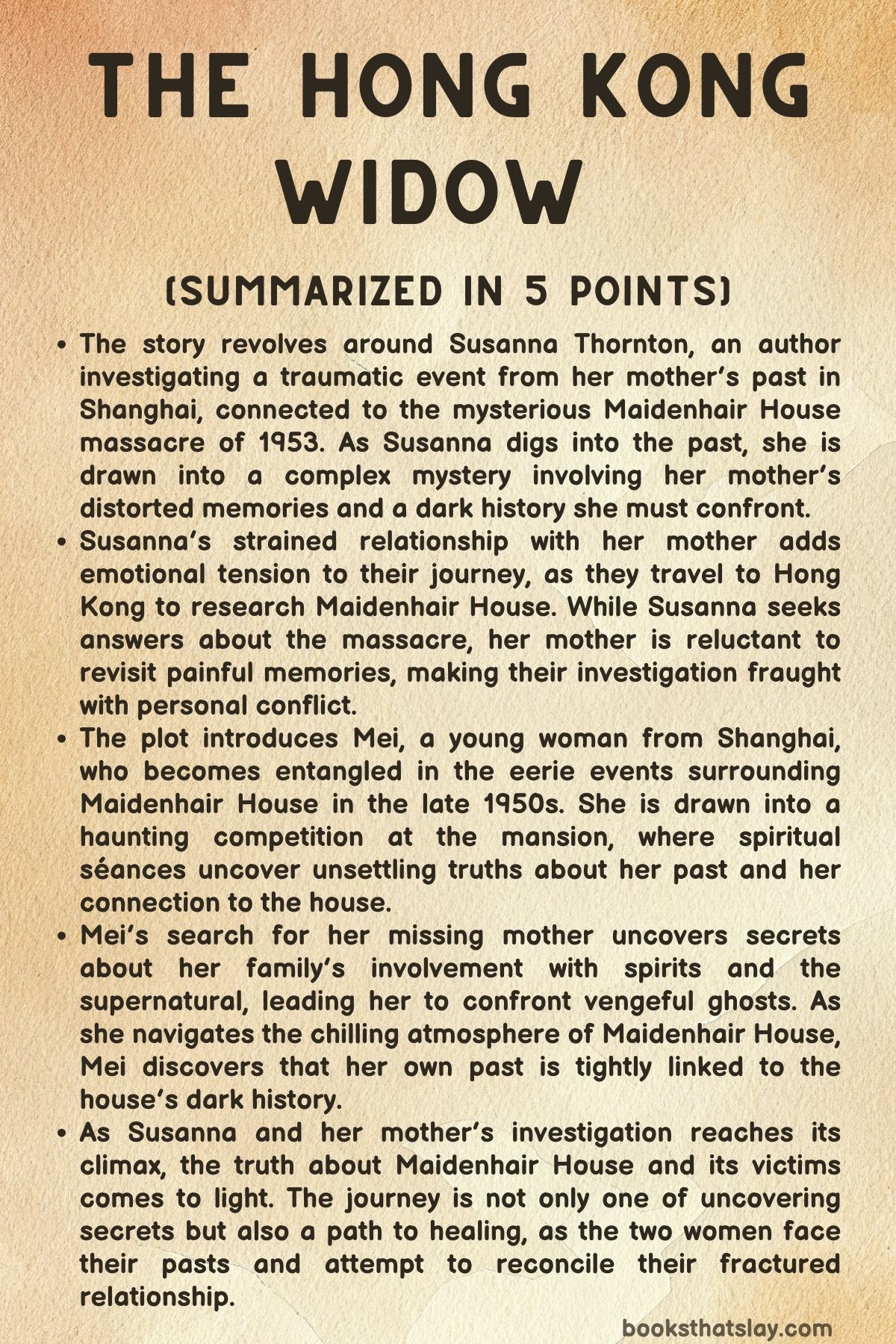
The Hong Kong Widow by Kristen Loesch is a gripping historical fiction novel that blends mystery, family secrets, and supernatural intrigue. The story centers around Susanna Thornton, a contemporary author, who seeks answers about the dark past of her mother, particularly a traumatic event tied to the Maidenhair House massacre in Hong Kong in 1953.
The investigation into this tragedy uncovers long-buried memories, revealing complex family dynamics, unsettling secrets, and the haunting presence of spirits. As Susanna digs deeper, the narrative intertwines with Mei’s past in 1930s Shanghai, where ghosts and spiritual forces play a pivotal role in uncovering the truth. The novel is a tense exploration of personal grief, unresolved family history, and the eerie connections between the living and the dead.
Summary
The novel begins with Susanna Thornton, an accomplished author, interviewing her mother about a traumatic incident from her past in Shanghai. The mother recalls a violent attack she suffered, where she woke up with a bizarre and confusing memory—experiencing the attack from the perspective of the assailant rather than the victim.
This memory, coupled with the mother’s reluctance to revisit the past, becomes the key to uncovering a dark chapter in history: the Maidenhair House massacre that occurred in Hong Kong in 1953. A group of women, refugees from the Chinese Revolution, had disappeared after a night at Maidenhair House, and the police dismissed it as a collective hallucination.
Despite her mother’s initial resistance, Susanna presses on, eager to solve the historical mystery and understand her mother’s fractured memory.
As Susanna and her mother engage in their investigation, they confront unresolved tensions in their relationship. Susanna, grieving the recent loss of her husband Dean, becomes obsessed with uncovering the truth about Maidenhair House.
Her mother, however, is reluctant to relive those memories, which are painful and tied to dark, personal history. Despite the friction, Susanna books a trip to Hong Kong, hoping to get to the bottom of the mystery, and her mother, with a mix of sarcasm and concern, decides to join her.
In Hong Kong, the mother’s memories of Maidenhair House begin to resurface, though they are shrouded in uncertainty. The mother insists that the location Susanna believes is the original Maidenhair House is not the true site, though the photographs Susanna has suggest otherwise.
As they visit the house, the mother’s past with George Maidenhair, the powerful businessman who once owned the property, starts to take shape. Their deep connection to the house and its eerie history come to light, and Susanna begins to understand the complex web of relationships that surrounded the tragedy.
The narrative shifts to Mei, a young woman who lived in Hong Kong in 1953, and her involvement with Maidenhair House. Mei works at a curio shop run by Mrs. Volkova, a Russian woman, and is haunted by her past in Shanghai, particularly her brief and ill-fated relationship with George Maidenhair.
After fleeing the Chinese Revolution, Mei tries to escape her association with George, but Maidenhair House continues to haunt her. One day, Holly Zhang, George’s wife, visits the shop and invites Mei to participate in a series of séances at Maidenhair House.
Holly believes that the séances might reveal the truth behind the mysterious deaths associated with the house. Mei is initially hesitant but agrees, fearing the consequences of refusal.
As Mei prepares for the séance, she learns that the house is not just a place of mystery but also of danger. Mei’s own past in Shanghai, marked by the disappearance of her mother, begins to resurface.
She becomes drawn into a dark circle of spirits, supernatural forces, and unanswered questions about her family’s history. Despite warnings from a local shopkeeper, Mr. Sim, Mei feels compelled to follow the trail that leads to Maidenhair House, desperate to uncover the truth about her mother’s disappearance.
Meanwhile, Susanna, still investigating the events surrounding Maidenhair House with the help of urban explorers, receives an anonymous letter that suggests the Maidenhair Murders were real and implicates her mother in the deaths. This letter deeply unsettles Susanna, as it claims her mother was involved in the killings.
As the trip to Hong Kong progresses, Susanna’s obsession with the case grows, and she confronts her mother about her past. The tension between the two women deepens as they both struggle with their grief and their complex relationship.
Eventually, Susanna and her mother visit Maidenhair House, and the investigation takes a personal turn. The truth behind the mysterious deaths and the house’s dark history begins to unfold, with both women facing the ghosts of their own pasts.
The journey to uncover the truth becomes a process of reconciliation and confrontation with their own unresolved feelings.
In another twist, Mei is drawn into a competition held at Maidenhair House by Holly, where six contestants, all spirit mediums, are asked to perform séances to communicate with the spirits that haunt the mansion. The competition, however, takes a sinister turn as Mei experiences disturbing visions and encounters with spirits from her past.
As the séances progress, Mei uncovers unsettling secrets about her mother’s involvement with the house and its supernatural history. The competition becomes not only a test of her abilities but also a fight for her survival and understanding of her family’s past.
Mei’s investigation into her family’s history leads her deeper into the world of séances, spirits, and family secrets. She learns that her mother, Ma, may have been involved in darker rituals and spiritual practices than she ever realized.
As Mei gets closer to uncovering the truth, she confronts not only the spirits of Maidenhair House but also the complex, painful history of her family and the forces that have shaped her destiny.
As the final séance approaches, Mei’s determination grows, and she realizes that her past is inextricably linked to the events unfolding at Maidenhair House. She must confront the spirits of the house, including the ones that have haunted her family for generations, and uncover the truth about her mother’s disappearance before it’s too late.
The novel ends with Mei confronting the past, accepting the truth about her mother, and stepping into the future with newfound strength.
Characters
Susanna Thornton
Susanna Thornton, the protagonist of The Hong Kong Widow, is a determined and persistent woman whose personal grief and unresolved relationships shape much of her actions. She is deeply committed to uncovering the truth behind the Maidenhair House massacre, despite the emotional and physical toll it takes on her.
Throughout the story, Susanna is driven by a need for closure regarding the mysterious disappearance of the women involved in the massacre, especially her mother. Her obsession with the truth becomes almost all-consuming, overshadowing her ability to connect with her own emotions and heal from the recent loss of her husband, Dean.
Her relationship with her mother is strained and fraught with tension, as the two women have differing views on revisiting the past. Susanna’s determination to seek answers about Maidenhair House pushes her to travel to Hong Kong, dragging her reluctant mother along, despite the personal cost it takes on both of them.
Her journey is as much about uncovering the dark past of Maidenhair House as it is about confronting her own personal demons and learning to reconcile with the past.
Mei
Mei is a pivotal character in The Hong Kong Widow, a young woman whose life has been marked by loss, mystery, and a deep connection to the supernatural. Born in Shanghai and raised during the tumult of the Chinese Revolution, Mei has always been searching for answers about her mother’s mysterious disappearance.
This search takes her on a journey filled with spirits, séances, and disturbing revelations. Mei’s involvement with Maidenhair House is central to her character’s development, as she is drawn into the eerie and dangerous world of spiritual mediums, ghostly hauntings, and hidden family secrets.
Her role in the mysterious competition at Maidenhair House, where she competes against other mediums to contact spirits, reveals her deep sensitivity to the supernatural world. Mei’s ability to see and communicate with spirits makes her a key player in unraveling the mysteries surrounding Maidenhair House, but it also exposes her to grave dangers.
Throughout the narrative, Mei’s inner conflict intensifies as she uncovers disturbing truths about her family, including her mother’s possible involvement in dark rituals and her father’s twisted connection to the house. Mei’s character is marked by a constant battle between seeking answers and protecting herself from the dark forces that seem to haunt her family and the house itself.
Her journey is one of self-discovery, as she comes to terms with her own powers and her family’s involvement in the supernatural events surrounding Maidenhair House.
Holly Zhang
Holly Zhang is a mysterious and haunting character in The Hong Kong Widow, whose role as both a socialite and a spirit medium places her at the center of the eerie events at Maidenhair House. Holly is initially introduced as a wealthy woman who invites Mei to participate in a series of séances at Maidenhair House.
Despite her outwardly charming demeanor, Holly harbors dark secrets and manipulative intentions. Her true motives are slowly revealed as the story progresses, particularly in her interactions with Mei.
Holly’s involvement in the house’s supernatural occurrences is not just passive; she is deeply entangled in the dark forces at play, and her manipulations are revealed to be part of a larger plan to control the spirits of Maidenhair House. Her obsession with power and control is evident in her desire to possess Mei’s body and use her spiritual abilities for her own gain.
Holly’s role as a spirit-possessing entity adds a layer of horror to her character, as she is revealed to be a puppet master orchestrating the tragic events at the mansion. Holly’s descent into madness and her eventual confrontation with Mei becomes a pivotal moment in the story, with her true nature exposed as a dangerous force willing to manipulate everyone around her to maintain control.
George Maidenhair
George Maidenhair, the enigmatic and powerful businessman who owns Maidenhair House, is a central figure in the dark history surrounding the mansion. Though his direct presence is not as frequently felt in the narrative, his influence looms large over the events that unfold.
George is revealed to be a man obsessed with control, power, and the supernatural. His connection to Mei, both personal and professional, is a key part of the story’s unfolding mystery.
George’s manipulation of the spirits and the house itself reveals his twisted desires and the extent to which he is willing to go to achieve his goals. His obsession with spirits and spiritual control becomes a key factor in the tragic events that take place within Maidenhair House.
As the story progresses, the depth of George’s involvement in the lives of Mei, Holly, and others becomes clearer, exposing a man who is not only tied to the house’s history but is also responsible for much of its haunting legacy. His obsession with puppets and the darker aspects of his own psyche culminates in the revelation of his role in the deaths and the manipulations that transpired in the house.
Mistress Lau
Mistress Lau, one of the spirit mediums participating in the séances at Maidenhair House, plays a crucial role in The Hong Kong Widow as a guide to Mei through the supernatural realm. Her experience and knowledge of the spiritual world make her a valuable, though somewhat foreboding, presence in the story.
As a seasoned medium, Mistress Lau’s role in the competition reveals the complex dynamics between the participants and the spirits they attempt to communicate with. Despite her initial wisdom and composure, Mistress Lau is eventually revealed to be one of the victims of the mansion’s dark forces, adding to the growing sense of danger surrounding the house.
Her mysterious past and involvement in the house’s spiritual rituals suggest that she, too, may be part of a larger, more tragic web of deceit and supernatural manipulation.
Themes
Grief and Loss
In The Hong Kong Widow, grief and loss are central themes that shape the characters’ actions and motivations. The novel explores how different characters cope with the death of loved ones, and how their past losses linger and influence their decisions.
Susanna Thornton’s journey, for example, is driven by the grief of losing her husband, Dean. She uses her obsession with the Maidenhair House massacre to distract herself from her pain, seeking answers to a historical mystery while ignoring her personal suffering.
Her strained relationship with her mother is further complicated by her grief, as Susanna tries to understand the emotional distance between them.
The mother’s grief is also significant. She is reluctant to revisit the traumatic memories of her past, which include the loss of loved ones in Shanghai and the horrors of her time at Maidenhair House.
Her decision to finally share her memories with Susanna is rooted in her desire for reconciliation and the need to confront the emotional scars that have haunted her for years. Both characters’ struggles highlight the long-lasting effects of grief, and the ways in which unresolved pain can prevent healing and hinder relationships.
Mei, another key character, deals with the grief of losing her mother and the emotional trauma of her family’s past. Throughout the story, she searches for the truth about her mother’s disappearance, which becomes a journey of both literal and emotional discovery.
Mei’s grief leads her to explore the supernatural, hoping that uncovering her mother’s secrets will provide closure. In this way, grief is not just an internal struggle for these characters but also an external force that propels them into dangerous and transformative situations.
Memory and the Distortion of the Past
Memory plays a critical role in The Hong Kong Widow, with characters often grappling with distorted or unreliable recollections of their pasts. The mother’s memories of the Maidenhair House massacre, in particular, are fragmented and clouded by trauma.
She recalls the violent attack from the perspective of the attacker rather than the victim, a memory that becomes central to Susanna’s investigation. This distortion suggests that traumatic events can alter one’s perception of reality, making it difficult to distinguish between truth and falsehood.
The mother’s recollection of events is not only affected by her own mental and emotional state but also by the passage of time, which has blurred the lines between what she experienced and what she might have imagined or suppressed.
Susanna’s quest to uncover the truth about the massacre is shaped by her own interpretation of the past. Her obsession with solving the mystery of Maidenhair House leads her to question her mother’s memories and ultimately confront the possibility that her mother may be hiding something.
This tension between what is remembered and what is real forces Susanna to reassess her understanding of the past, ultimately revealing that memory itself is unreliable and that the search for truth is often more complicated than it appears.
Mei’s story further explores the theme of memory as she delves into the secrets of her family’s past. As she uncovers her mother’s involvement in supernatural events, Mei struggles with the blurred lines between memory and illusion.
The strange occurrences surrounding her mother’s disappearance suggest that the past is not just a series of events but a shifting, malleable entity. The theme of distorted memory in the novel serves as a reminder of how the past, even when it seems clear, is often colored by emotions, biases, and time.
The Supernatural and Spirituality
The supernatural is a recurring theme in The Hong Kong Widow, influencing both the narrative and the characters’ lives. The novel presents an eerie and unsettling atmosphere, particularly surrounding Maidenhair House, a mansion with a reputation for being haunted.
The house becomes a symbol of the supernatural forces that haunt the characters, particularly Mei, who is drawn into a world of séances, spirits, and mysterious happenings. As she participates in the spiritual competition at Maidenhair House, Mei must confront the ghosts of the past—both literal and metaphorical.
The novel suggests that the supernatural is not merely a collection of ghost stories but a powerful force that shapes the characters’ fates. Mei’s connection to the spiritual world is not just a gift but also a curse, as she becomes entangled in the spirits’ demands and the dangerous secrets of Maidenhair House.
Her search for her mother’s truth is deeply tied to the supernatural, as she uncovers her mother’s involvement in rituals and séances that blur the line between life and death. The house’s dark history and its connection to powerful figures like George Maidenhair and the spirits they seek to control create an atmosphere of dread and inevitability.
In addition to the spirits, the novel also examines the cultural beliefs surrounding the supernatural. Mei’s experiences with séances and ghostly visions are rooted in traditional Chinese spiritual practices, which contrast with the Western influences at play in Hong Kong.
The clash of these different belief systems adds depth to the novel’s exploration of the supernatural, showing how different cultures interpret and interact with the forces beyond the physical world.
Identity and Self-Discovery
The Hong Kong Widow explores the theme of identity and the journey toward self-discovery, particularly through the characters of Susanna, her mother, and Mei. Each of these characters is searching for answers about who they are and how their pasts have shaped them.
For Susanna, her investigation into the Maidenhair House massacre is not just a quest for historical truth but also a personal journey to understand her mother’s secretive past and, by extension, her own identity. The strained relationship between Susanna and her mother highlights the generational divide in their understanding of the past, as Susanna’s need for closure contrasts with her mother’s desire to forget.
The theme of self-discovery is also evident in Mei’s story. Throughout her journey, she unravels the truth about her family’s dark past, which ultimately forces her to confront her own identity.
Her search for her mother becomes a metaphor for her own journey to understand herself and her place in the world. As she uncovers more about her family’s supernatural history, Mei must come to terms with her own powers and the role she plays in the larger forces at work.
The spiritual elements in her journey further complicate this process, as her connection to the supernatural world forces her to reconcile with parts of her identity that she may have previously denied or feared.
For all three characters, the theme of identity is tied to the past—whether it is the trauma of their experiences, the ghosts that haunt them, or the secrets they uncover. The novel suggests that self-discovery is not just about uncovering facts but also about confronting the parts of oneself that are hidden or repressed.
In the end, each character must face their own truth, accepting who they are and what their past means for their future.
Power and Manipulation
In The Hong Kong Widow, the theme of power and manipulation runs through both the personal relationships and the larger political and supernatural forces at play. George Maidenhair, a powerful businessman, represents the corrupting influence of power.
His control over Maidenhair House and his ability to manipulate the people around him—especially Mei and her mother—highlight the dangers of unchecked power. George’s descent into madness and his obsession with the spirits in the house demonstrate how power, when abused, can lead to destruction.
The manipulation in the novel is not limited to George’s actions but extends to the supernatural realm as well. Mei finds herself manipulated by the spirits she encounters, each of them with their own agenda.
The competition at Maidenhair House, orchestrated by Holly Zhang, is itself a form of manipulation, as she uses the contestants to serve her own mysterious purposes. Holly’s manipulation of Mei and the other contestants illustrates the ways in which power can be exerted even in the most seemingly innocent or benign circumstances.
On a more personal level, the manipulation between Susanna and her mother is also significant. The mother’s reluctance to share her past with Susanna, coupled with Susanna’s obsessive need to uncover the truth, reflects the dynamics of control in their relationship.
The power struggle between them is not just about the past but also about how each of them seeks to control the narrative of their lives. Ultimately, the novel suggests that power is not just about external forces but also about the ways individuals exert control over one another, shaping their relationships and the course of their lives.