The Mist Thief Summary, Characters and Themes
The Mist Thief by L.J. Andrews is a romantasy about power, politics, and the cost of being labeled dangerous. Skadinia, an elven princess with feared mist-magic, is ordered into a marriage meant to lock her power down and end a war.
Jonas, the alver prince she’s forced to wed, treats the match like a strategy—until living beside Skadinia makes the “enemy princess” story fall apart. Set across sea-fae courts, harsh port cities, and a living isle with its own will, the novel follows two unwilling partners as duty turns into loyalty, and loyalty turns into something neither of them planned. It’s the 3rd book in The Ever Seas series.
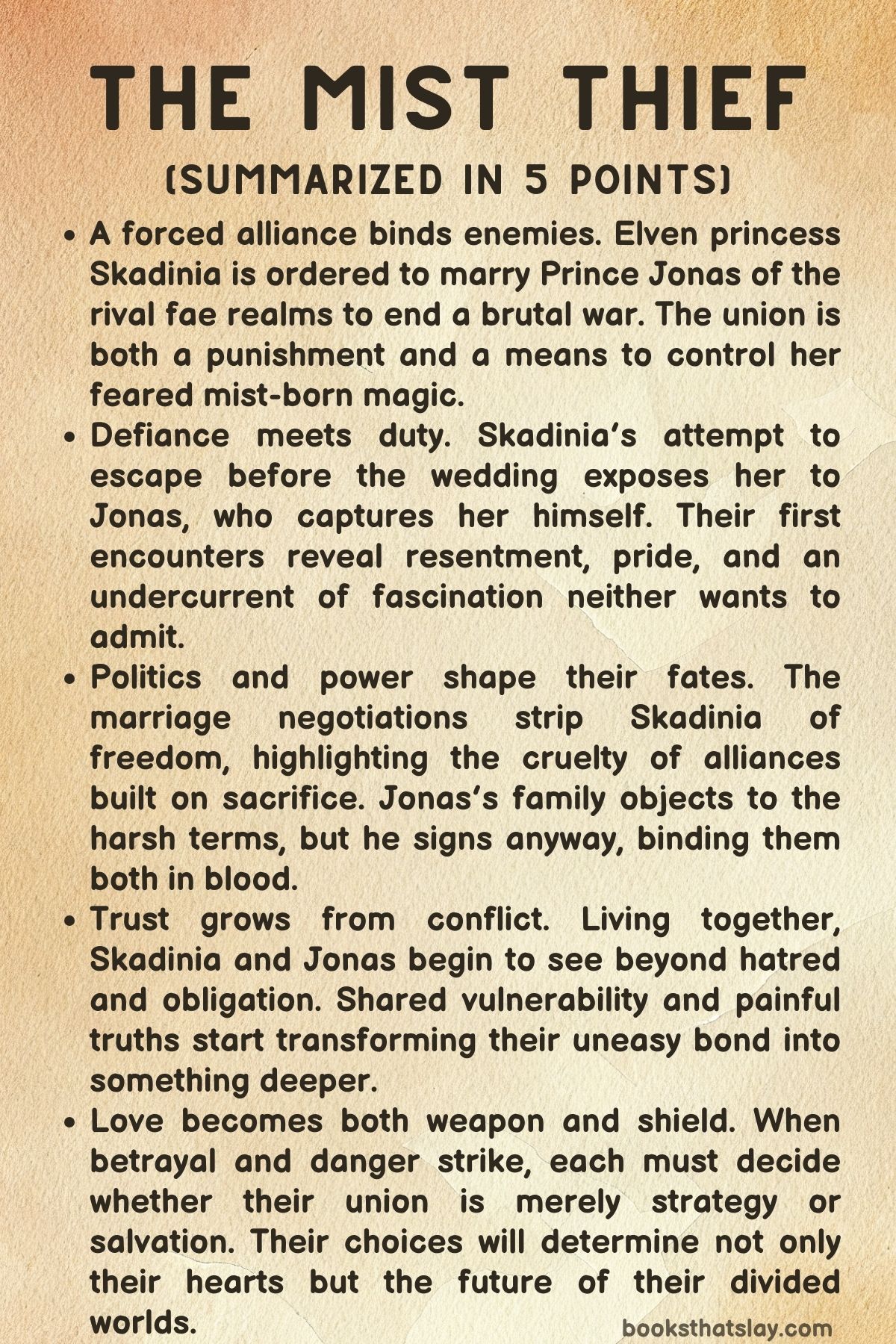
Summary
Skadinia, elven princess of Natthaven, is told by her grandfather and ruler, Eldirard, that she must marry within the week. The groom is Jonas of House Eriksson, an alver prince from rival fae realms.
The marriage is framed as peace, but Skadinia understands the real purpose: her mist-like magic terrifies everyone, and the vows will bind her power so it cannot harm her husband or his people. She isn’t being honored—she’s being contained.
On the night before the wedding, Skadinia grabs a few stolen hours of freedom. Disguised as a sea-fae woman, she slips into a coastal tavern crowded with sailors and pirates, determined to feel like a person instead of a bargaining chip.
Her disguise doesn’t hold. The man she’s been speaking to, amused and watchful, reveals himself as Jonas.
Worse, the tavern is part of a setup: his men are everywhere, and even the barkeep has been paid to keep her in place. Jonas taunts her for trying to run and for pretending she feels nothing, then calls her “wife” with sharp satisfaction as Eldirard’s guards drag her back.
Jonas, for his part, has no romantic story to offer. He proposed the alliance to stop the next round of slaughter between their realms.
He believes a blood-bound marriage is the surest barrier against future war, especially because elven vows cannot be broken lightly. Skadinia’s power once nearly killed his twin brother, Sander, and Jonas hasn’t forgotten the image of her in battle—ferocious, untouchable, and treated like a monster.
He tells himself the marriage is only politics, even as his interest in her refuses to fade.
In the sea-fae palace, negotiations turn brutal. Jonas’s parents clearly despise the arrangement, and the contract Eldirard presents is vicious: clauses that reduce Skadinia to property, including terms that imply she must accept whatever is demanded of her.
Jonas feels the sting of shame reading it. His mother refuses to sign, furious at the insult to any future queen.
His father backs her, insisting no ruler of their line keeps mistresses or silences his wife. Eldirard, startled by their defiance, is forced to soften the language.
Even so, Jonas steps forward, cuts his finger, and signs the blood contract himself. The alliance is sealed, whether either of them wants it or not.
After the signing, Eldirard quietly warns Jonas that the agreement hides a razor: within the first turn of the vows, Skadinia can annul the bond if she believes she’d have more peace returning to her former betrothal with Prince Arion of the Ljosalfar. Arion knows this.
Jonas takes the message as a threat dressed as advice and decides he’ll have to keep Skadinia from choosing that exit.
Skadinia and Jonas clash immediately. On a balcony overlooking the sea, Jonas pushes at her silence, trying to force her to show anger, fear, anything real.
Skadinia refuses to offer him her heart; she promises obedience, not warmth. Jonas answers with a vow of his own: he intends to strip away her cold mask and see what burns underneath.
It’s not kindness, exactly—it’s a challenge neither of them can ignore.
They travel to Natthaven for formal vows under the gaze of powerful fae royals. Skadinia learns just how dangerous Jonas’s bloodline can be: Jonas carries mesmer magic that feeds on fear, Sander can twist memories into nightmares, the sea-fae queen can steal memories, and the alver king can make fears take lethal shape.
Skadinia is dressed in a bodice set with heart glass, a magical material that reveals emotion whether she wants it to or not. During the ceremony, she teases Jonas by “translating” ancient vows into exaggerated demands about spoiling a bride, trying to regain control with humor.
When the kiss comes, Jonas doesn’t rush it. The heart glass flares gold, exposing Skadinia’s racing pulse to everyone—and to Jonas, who notices and later needles her for it.
At the vow feast, Jonas drinks too much, jealousy simmering as he watches Skadinia navigate strangers and court politics. When he finally reaches her, his possessiveness turns reckless.
Skadinia hauls him away, gets him safely to bed, and mocks his bravado once he’s helpless with drink. The next morning, she forces a bitter tonic on him to keep him steady for travel, and they leave for Jonas’s homeland.
Skadinia arrives in Klockglas, a rough port city full of smoke, brine, crowded streets, and hard edges—nothing like the polished sea-fae court. Jonas calls her “Fire,” half provocation, half praise, and asks what she thinks of the place he calls home.
The distance between them shifts in small steps: conversation that doesn’t feel like a trap, touch that isn’t demanded, moments where Skadinia forgets to armor herself. One night, intimacy becomes real, and afterward they share a quiet bath where Jonas insists she is not merely a treaty to him.
Skadinia, who has been traded and managed her entire life, doesn’t know what to do with tenderness that asks for nothing.
Then Jonas collapses into a fever and a nightmare so violent it nearly kills him. Skadinia wakes to his eyes turned black with mesmer, his body burning, his words broken and desperate.
Sander rushes in and explains: Jonas’s own magic can turn against him, trapping him inside visions shaped by his deepest fear—losing the people he loves. Their parents arrive with a potion and magic that pulls him toward happy memories until the fever breaks.
Skadinia stays at his side through all of it, refusing to leave.
When Jonas finally wakes, he admits the nightmare that triggered the attack: he saw Skadinia captured and tortured, and he couldn’t save her. The confession hits harder than any court speech.
Skadinia promises she won’t abandon him, and what they share shifts from reluctant partnership into trust.
That trust is tested by a letter from Natthaven. Cara warns Skadinia that the annulment clause is real and that Arion wants her back.
Pain spikes through Skadinia’s certainty—what if Jonas’s care has been strategy, a way to keep her from walking away? She rides out alone, shaken, and is caught by a storm.
In the woods, she falls into a hidden troll burrow, trapped in darkness and mud. Jonas, frantic, searches through the rain until he finds her and carries her out, wrapping her in his cloak and whispering her safe.
The next day, Jonas kneels before her and tells her plainly that his feelings aren’t duty. To prove it, he offers a vial containing a memory of his nightmare.
Skadinia drinks it and experiences his terror from inside his mind—his helplessness, his panic, his love. The truth lands without debate.
She forgives him, and Jonas calls her Eriksson, giving her his house name as a public claim and a private promise.
Their bond strengthens. Jonas even remakes a forgotten study into a library for Skadinia, filling it with books and comforts that echo her homeland.
For the first time, she believes she can have both power and safety. But peace doesn’t last.
Back on Natthaven, Eldirard crowns Skadinia with her true name, Sannhet, marking her as rightful queen with blood magic and a hidden constellation branded on her brow. Ljosalfar royals—King Gerard and Prince Arion—arrive demanding control, and betrayal erupts.
Eldirard is stabbed, dying in Skadinia’s arms after naming her queen. Gerard orders Skadinia imprisoned in Arion’s chambers.
Skadinia manages to send a distress call before she’s locked away. Jonas and his allies respond with a fleet and an army, led by his parents and supported by sea-fae forces.
Inside the palace, two “guards” bring Skadinia food—and reveal themselves as Jonas’s companions in disguise. They kill the real guards and free her, joining with Queen Malin’s shadow magic to open a path for the invasion.
As battle crashes through the isle, Natthaven itself fights back, shifting trees and soil against the invaders who betrayed it.
Skadinia and Jonas reunite in the chaos, fierce and relieved, and fight side by side toward the throne room. Gerard and Arion try to flee by sea, but allied ships rise to block escape.
Skadinia faces Arion and overwhelms him with her mist and wrath. Jonas and Sander break Gerard’s mind with nightmare mesmer until he collapses, and Skadinia ends him with her darkness.
With the Ljosalfar rulers dead, the battle stops.
Afterward, the Dokkalfar accept Skadinia’s rule. Natthaven becomes allied with the alver clans, and Skadinia declares she will end the old divisions between elven and fae.
When someone tries to name Jonas sole ruler beside her, Jonas refuses, insisting Skadinia’s blood and voice make her queen. Together, they command Natthaven to shift its place in the world, anchoring the living isle beside Klockglas so their peoples can rebuild as one.
In a final ceremony, Skadinia and Jonas renew their vows before allied realms, binding heart and power with alver blood magic. Peace finally feels possible—until a last message arrives: Princess Mira and Tait Heartwalker have vanished at sea during a storm, hinting that the next danger is already moving.
Characters
Skadinia Sannhet
Princess Skadinia is the heart of The Mist Thief, a figure of both immense power and profound vulnerability. Born an elven princess with a mist-like magic feared across realms, her life is defined by control and manipulation from those who see her as a weapon rather than a woman.
From the outset, Skadinia is trapped within political machinations—her forced marriage to Prince Jonas is intended to pacify kingdoms and restrain her destructive gift. Yet beneath her stoic exterior lies a deep well of courage, intelligence, and suppressed emotion.
Her transformation throughout the narrative—from a reluctant pawn to a self-possessed queen—marks her as one of LJ Andrews’s most layered creations. Initially resigned to obedience, Skadinia’s cold demeanor hides a yearning for freedom and acceptance.
Her interactions with Jonas gradually expose her empathy and strength, revealing her capacity for both tenderness and ferocity. By the novel’s end, she embraces her identity fully, claiming her heritage as Sannhet and wielding her mist magic not as a curse but as a divine gift of creation and destruction.
Her journey is one of reclamation—of her body, her magic, and her will.
Prince Jonas Eriksson
Prince Jonas stands as a complex figure caught between duty, morality, and passion. In The Mist Thief, he begins as a pragmatic ruler, willing to sacrifice his own happiness to ensure lasting peace between the fae and elven realms.
His decision to marry Skadinia is rooted in politics, yet his internal conflict becomes the driving force of his character arc. Jonas’s mesmer magic, which feeds on fear, symbolizes his constant battle with darkness—both within and around him.
His encounters with Skadinia challenge his disciplined resolve, gradually softening his perspective on love, loyalty, and vulnerability. The man who once viewed marriage as a weapon of diplomacy evolves into a husband bound by genuine affection and respect.
Jonas’s humanity is further explored through his nightmares and fevers, manifestations of his emotional intensity and fear of loss. His ability to confront these weaknesses and open himself to Skadinia’s light becomes the core of his redemption.
Ultimately, Jonas emerges not only as a ruler of peace but as a man capable of profound devotion, defined less by his power and more by his willingness to love fiercely despite fear.
King Eldirard
King Eldirard, Skadinia’s grandfather, embodies the cold ambition and political ruthlessness of the old elven order. In The Mist Thief, he orchestrates Skadinia’s marriage as a calculated move to restore his realm’s influence and cement his legacy.
His affection for Skadinia is complex—rooted in pride and possession rather than compassion. Eldirard represents the generational mindset that prioritizes empire over emotion.
Yet, beneath his iron control, there exists a glimmer of belief in his granddaughter’s strength. His final act—crowning Skadinia as queen and naming her heir before his death—reveals a measure of faith and redemption, though it comes too late to erase a lifetime of manipulation.
Eldirard’s death becomes the symbolic end of an era, allowing Skadinia to step out of the shadow of patriarchal control and shape her destiny on her own terms.
Prince Arion
Arion, Skadinia’s former betrothed, is the shadowed mirror of Jonas—a prince corrupted by power and obsession. In The Mist Thief, he functions as both antagonist and cautionary symbol.
Arion’s pursuit of Skadinia is not born of love but of possession, reflecting the same political hunger that once defined Eldirard. His arrogance and cruelty serve as reminders of the toxic cycles of conquest that the union between Skadinia and Jonas was meant to end.
Arion’s inability to understand Skadinia’s autonomy or the nature of true strength marks his downfall. When he finally confronts her in the climax, her victory over him signifies not merely the triumph of good over evil but the reclamation of power from those who sought to use her.
His death closes the chapter on the old world of dominance and deceit, paving the way for unity through empathy and equality.
Sander Eriksson
Sander, Jonas’s twin brother, provides emotional contrast and grounding throughout The Mist Thief. Where Jonas is serious and burdened by leadership, Sander is irreverent and warm, often using humor to defuse tension.
Beneath his teasing lies a deep loyalty to his family and a perceptive understanding of love and pain. His power—transforming memories into horror—serves as both a curse and a metaphor for the cost of war.
Sander’s compassion for Skadinia, particularly in moments when she doubts Jonas’s sincerity, shows his role as emotional mediator. He bridges the gap between the human and the divine, the political and the personal.
His protective nature and unyielding faith in his brother make him one of the novel’s moral anchors. Sander’s presence throughout the story reminds readers that redemption and forgiveness are communal acts, not solitary ones.
Queen Malin and King Kase
The alver monarchs, Malin and Kase, embody a duality of wisdom and power within The Mist Thief. Malin, with her memory-altering magic, represents emotional intelligence and quiet strength.
Her guidance shapes both Jonas and Skadinia, teaching them the subtleties of control and compassion. Kase, on the other hand, embodies raw force and unyielding justice.
His ability to manifest fears into reality mirrors his role as a ruler unafraid to confront darkness. Together, they form a balanced partnership that models the harmony Jonas and Skadinia eventually achieve.
Their intervention during the final battles and their faith in Skadinia’s leadership demonstrate their growth from skeptical monarchs to allies in a new age of unity. Through them, the story reinforces that true strength in governance comes from trust and shared purpose rather than domination.
Cara
Cara, Skadinia’s tutor and confidante, is a subtle yet significant presence in The Mist Thief. She represents the voice of caution and survival in a world ruled by treachery.
Her stern demeanor conceals deep affection for Skadinia and an unspoken fear of losing her to political games. Through her lessons and warnings, Cara instills in Skadinia the awareness necessary to navigate the dangers of court life.
Her letter later in the story—revealing the annulment clause—becomes a pivotal moment, forcing Skadinia to question love, loyalty, and manipulation once again. Though her actions inadvertently cause pain, Cara’s loyalty remains unquestionable.
She symbolizes the burden of wisdom—the knowledge that protection sometimes requires deception.
Ash and Bloodsinger
Ash and Bloodsinger, the loyal companions of Jonas, enrich The Mist Thief with camaraderie and depth. Ash, a Rifter and soldier, embodies resilience and steadfastness, his quiet loyalty providing stability amidst chaos.
His courage during Skadinia’s rescue from Natthaven elevates him from mere guard to heroic ally. Bloodsinger, more volatile and fierce, represents the untamed warrior spirit that both supports and challenges Jonas’s leadership.
Together, they form the backbone of Jonas’s circle, demonstrating that loyalty in the world of fae and elves transcends bloodlines. Their unwavering support reflects the broader theme of chosen family—a recurring motif that defines both Jonas’s reign and Skadinia’s newfound sovereignty.
Themes
Power and Control
Power in The Mist Thief functions as both a political and personal weapon, dictating nearly every choice made by the characters. Skadinia’s mist-born magic symbolizes a force that others seek to dominate rather than understand.
Her grandfather Eldirard’s manipulation of her fate—forcing her into marriage for political gain—reveals how authority is exercised through control over bodies and bloodlines. The alliance between Skadinia and Jonas is not born from diplomacy but coercion, a transactional arrangement designed to contain power under the guise of peace.
The magical vows that bind Skadinia’s abilities reflect a deeper truth about control: society fears what it cannot tame. Jonas too is bound, not by external compulsion but by his sense of duty.
His decisions are measured against the expectations of kingship and family, showing how power demands sacrifice even from those who wield it. Throughout the story, control manifests in physical, emotional, and magical forms—whether through Eldirard’s political schemes, Jonas’s mesmer that feeds on fear, or Skadinia’s constant suppression of her own nature.
Yet as the narrative progresses, true power emerges not from dominance but from mutual respect and vulnerability. When Jonas and Skadinia finally share equality in both love and leadership, they redefine power as partnership, dissolving the old hierarchies that had shaped their lives.
The union that began as a cage becomes the foundation of liberation, proving that control without compassion corrodes, while shared strength rebuilds what tyranny destroys.
Duty and Sacrifice
Every major relationship in The Mist Thief is framed by duty, where personal desires must yield to collective survival. Skadinia’s submission to marriage is not a romantic act but an obligation—a sentence of atonement for her people’s role in the war.
Her compliance, however reluctant, reveals how duty can strip identity and transform a person into a political symbol. Jonas embodies a parallel struggle.
His decision to marry his enemy is a sacrifice of freedom and reputation, a burden carried for peace he may never live to see. Both are heirs to expectations that demand self-erasure in service of others.
Their evolving relationship questions whether duty should ever require the loss of self. When Skadinia begins to act not as a pawn but as a queen, reclaiming her right to choose, she transforms duty into agency.
Jonas’s eventual recognition of her autonomy marks his own liberation from inherited expectations. Their sacrifices—of pride, independence, and at times, trust—culminate in a partnership where devotion no longer equates to servitude.
Even secondary figures reflect this tension: Eldirard sacrifices morality for ambition; Sander sacrifices peace for loyalty; Queen Malin risks her realm for her son’s happiness. The novel treats sacrifice as an inevitable currency in a fractured world, yet it also exposes the cost of unquestioned obedience.
True duty, it argues, lies not in submission but in the courage to redefine allegiance when love and conscience demand it.
Love as Redemption
Love in The Mist Thief emerges from the ruins of distrust and bloodshed, evolving from suspicion into salvation. At first, affection seems impossible between Skadinia and Jonas—two beings bound by hatred, political deceit, and centuries of enmity.
Yet it is precisely within these wounds that love takes root. Their relationship begins as a forced alliance, but through shared vulnerability, it becomes a rebellion against every expectation placed upon them.
Skadinia’s capacity to love despite betrayal challenges the perception that her heart is “frozen.” Her emotional awakening parallels Jonas’s struggle to reconcile power with empathy. His nightmares, manifestations of his fear of loss, expose how love demands surrender to weakness—a form of strength his militarized upbringing never allowed.
Their union becomes an act of defiance against the systems that use marriage as a means of control. Love does not erase their pain; it transforms it into connection.
By the time they renew their vows at the novel’s end, love has evolved into redemption—not just personal but collective. It heals the rift between races, restores faith in unity, and proves that reconciliation is possible even after devastation.
The tenderness between them, expressed through small gestures and shared silences, carries a quiet revolutionary power. Love in this story is not sentimental—it is restorative, binding not by magic but by choice, redeeming both hearts and kingdoms alike.
Identity and Transformation
Identity in The Mist Thief is constantly challenged by expectation, lineage, and disguise. Skadinia’s journey from a controlled princess to a sovereign queen charts the reclamation of self from external definitions.
Born with a power others deem monstrous, she spends much of her life performing compliance, concealing both her magic and her emotions. Her disguise as a sea fae early in the story foreshadows her lifelong struggle with authenticity—her true self always hidden beneath imposed masks.
Jonas too faces identity conflicts: a prince forced to balance compassion with cruelty, haunted by the fear that leadership demands the abandonment of humanity. Their transformations are not sudden but earned through pain and confrontation.
When Skadinia accepts her darkness not as a curse but as part of her essence, she redefines identity as integration rather than denial. Jonas’s acceptance of his flaws mirrors hers, binding them as equals rather than opposites.
Even the realm itself mirrors this metamorphosis; Natthaven’s fading and eventual relocation to Klockglas represents renewal through change. By the novel’s conclusion, both characters have shed inherited titles to forge identities grounded in authenticity and choice.
The transformation theme asserts that identity cannot be dictated by bloodlines, magic, or social hierarchy—it must be forged in the crucible of self-awareness. Skadinia’s final act as queen unites elven and fae not by power but by understanding, proving that transformation is the truest form of victory.
The Legacy of War and Reconciliation
The entire narrative of The Mist Thief unfolds in the shadow of war, where peace is treated as both a hope and a negotiation. Every scar in the story—emotional or physical—traces back to violence between realms.
The alliance marriage is a peace treaty written in blood, its vows echoing the despair of civilizations exhausted by conflict. For Skadinia, the war has cost her identity and reputation; she is remembered as the weapon that almost destroyed nations.
For Jonas, the war has stolen innocence, forcing him to believe that peace can only be secured through control. Yet the novel refuses to let peace remain a political concept—it becomes a personal endeavor.
The love that grows between the two protagonists mirrors the broader healing of their peoples. When Skadinia and Jonas fight side by side to defend Natthaven, the battle becomes symbolic: destruction repurposed into protection.
The deaths of tyrannical figures like Arion and Gerard mark the end of leadership built on fear, allowing a generation shaped by empathy to rise. The reconciliation of elven and fae realms culminates in the physical merging of their lands, a literal and symbolic unification.
War’s legacy does not vanish; it lingers as memory and warning. Yet through forgiveness and cooperation, the characters prove that reconciliation is not the erasure of conflict but the choice to build something stronger from its ashes.