The Salvage by Anbara Salam Summary, Characters and Themes
The Salvage by Anbara Salam is a dark, atmospheric novel set in 1962 that follows Marta, a professional diver, as she is assigned to survey a historic shipwreck, the HMS Deliverance, near the isolated island of Cairnroch. While working on the project, Marta is pulled into a web of local superstitions, the secrets of the shipwreck, and a growing sense of dread.
As she uncovers missing artifacts, mysterious happenings, and her own personal turmoil, Marta’s journey becomes a psychological battle between professional duty, moral choices, and her fear of a haunting curse tied to the wreck. The novel explores themes of guilt, loss, and the complexities of human relationships against a chilling, mysterious backdrop.
Summary
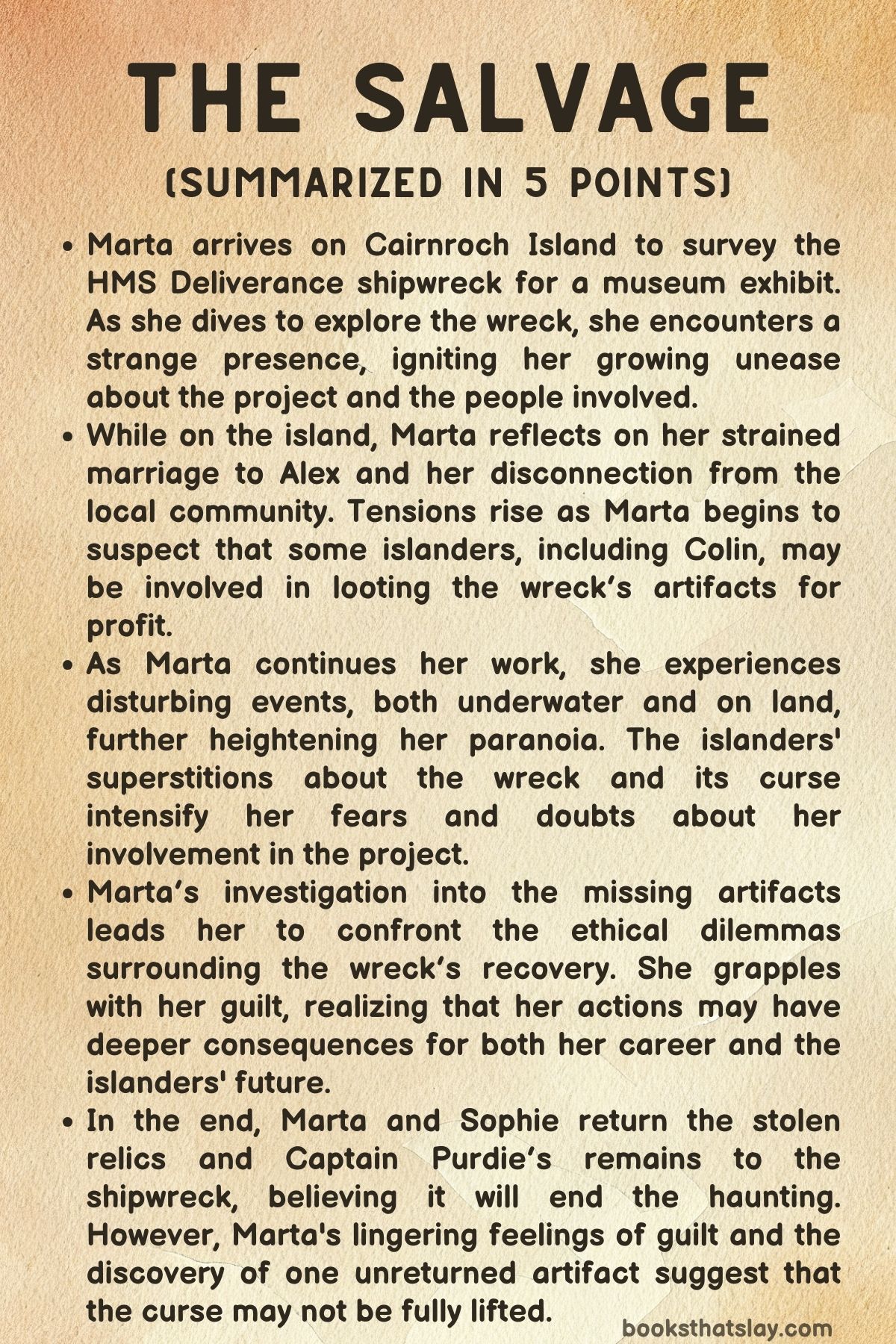
Marta, the protagonist, arrives at the isolated Cairnroch Island on October 20, 1962, for a professional diving mission. She is tasked with surveying the wreck of the HMS Deliverance, a ship that sank centuries ago.
As Marta prepares for her dive into the icy waters, she encounters Colin, a fisherman who will be assisting her, but their interaction is brief and distant. The weather is harsh and cold, and Marta senses the curiosity of the island’s inhabitants as she readies her equipment.
With determination, she plunges into the water and begins her exploration of the well-preserved wreck.
The wreck, submerged in frigid Arctic waters, is remarkably intact, and Marta documents the ship’s various items, including the captain’s quarters. Here, she discovers the remains of Captain Purdie, the ship’s captain, along with personal artifacts.
However, as she explores, Marta begins to feel an eerie presence within the wreck, as though she is not alone. Despite her rising panic, she completes the dive, attaching a buoy to the wreck and taking photographs of her findings.
When she returns to the boat, Colin expresses skepticism about her findings, but Marta brushes off his doubts, more focused on her work than his opinions.
Later that evening, Marta develops the photographs and reflects on her complicated personal life. Her marriage to Alex, a man who has recently told her he is involved with someone else, continues to weigh heavily on her.
The strain between them has been ongoing, and her trip to the island is a temporary escape from the emotional turmoil back home. At the same time, she is reminded of the island’s strange history, including the legend surrounding Captain Purdie and the significance of the shipwreck to the local community, who view it as a source of potential income.
The following day, October 21, Marta dives again. As she continues to explore the wreck, she becomes more attuned to the sense of being watched.
A sense of paranoia sets in as she photographs more items from the ship, including a golden ring and a coin. She begins to suspect that someone is stealing from the wreck, and her anxiety grows as she contemplates the consequences of such thefts on her career and the moral implications of her involvement.
On October 22, Marta’s dive becomes more pressured as locals, including Lord and Lady Purdie, watch her every move. She retrieves Captain Purdie’s remains but finds that some of the items she had previously discovered, such as the ring and coin, are missing.
Marta becomes convinced that Colin and the other islanders are involved in looting the wreck. As the situation unfolds, she realizes that the people she is working with may be profiting from the stolen artifacts, compounding her sense of betrayal.
After a conversation with Elsie, a hotel employee, Marta begins to piece together the timeline of events surrounding the thefts. Despite the mounting anxiety, Marta tries to maintain her professionalism.
However, her unease intensifies as the islanders’ obsession with the wreck and their superstitions about it weigh on her. The community’s fixation on the shipwreck, coupled with the pressures of the job, leaves Marta feeling isolated and uncertain about her place in this strange world.
The situation reaches a boiling point when a fire breaks out at the lighthouse, symbolizing the chaos that is beginning to unravel on the island. Marta feels trapped between her professional duties and her personal doubts, caught in a situation where the ethical dilemma of her involvement in the wreck’s recovery grows more complicated.
The fire only deepens her sense of dread, and she begins to question the role she has played in the exploitation of the shipwreck and its artifacts.
As the islanders prepare to bury Captain Purdie’s remains, Marta’s guilt grows. Despite the celebrations around the event, she is consumed by thoughts of the stolen artifacts and the moral cost of her involvement in the project.
The story begins to reveal the emotional and psychological toll the island and its superstitions have taken on Marta, leaving her with a profound sense of guilt and confusion about her place in the world.
Throughout her time on the island, Marta reflects on her personal relationships, particularly with Alex and Elsie. The latter offers Marta a chance at emotional comfort, but Marta’s inner turmoil keeps her from fully embracing it.
The island’s isolation, combined with the strained relationships and looming uncertainty about the wreck’s future, leads Marta to a realization that she is at a moral crossroads. She is no longer sure of what the right path is, nor what the cost of her actions will be.
The final days on the island are filled with strange occurrences, as Marta experiences increasingly disturbing visions and sensations of being watched. These manifestations culminate in an encounter with a figure she believes to be the spirit of Captain Purdie.
Marta realizes that the artifacts she has taken from the wreck might be cursed, carrying with them a presence that haunts anyone who comes into contact with them. As the snow begins to fall heavily, Marta is left to grapple with the implications of this haunting and her role in the island’s dark history.
In a final attempt to resolve the situation, Marta and Sophie, a fellow investigator, work together to retrieve the stolen items and return them to the sea. They dig up Captain Purdie’s remains and bury them in the ruins of Rathdunon Castle, hoping to put an end to the curse.
Despite their efforts, Marta is unable to fully escape the sense of dread and guilt that has plagued her throughout the journey. As she makes her final dive to return the artifacts to the wreck, she hears a door creak open once again, signaling that the curse may never truly be lifted.
The novel concludes with Marta returning to shore, feeling a sense of relief, but her unease is far from gone. The objects she failed to return, particularly the captain’s coin, remain with her, and she is left questioning whether the curse will ever be broken or whether she will continue to be haunted by her own past mistakes.
The story ends with Marta’s future uncertain, but the lingering presence of the wreck and the island’s superstitions leave her haunted by the consequences of her actions.
Characters
Marta
Marta is the protagonist of The Salvage, and her character is defined by her internal conflict, sense of isolation, and mounting paranoia. She arrives at Cairnroch Island to oversee the excavation of the wrecked HMS Deliverance while grappling with the collapse of her marriage to Alex, who is involved with a colleague, Sophie.
This personal turmoil manifests throughout her interactions with the islanders, her mounting fear about the missing artifacts, and her growing suspicion of those around her. Marta’s journey is both professional and personal, as she navigates the ethics of her work and the consequences of her involvement in what seems to be a morally dubious project.
Her sense of guilt, particularly regarding the death of a man named Lewis, weighs heavily on her, and she struggles with a deep sense of shame. As the mystery of the stolen artifacts unfolds, Marta becomes obsessed with the idea of a curse linked to Captain Purdie’s remains and objects, leading to her ultimate decision to return the stolen relics to the sea.
Her evolution throughout the novel speaks to themes of guilt, redemption, and the human desire for resolution.
Sophie
Sophie is a pivotal character in The Salvage, offering both a contrasting and complementary presence to Marta. While Marta is consumed by her personal guilt and struggles with paranoia, Sophie provides a more grounded, yet equally complicated, viewpoint.
Initially, Sophie appears as a calm and intellectual figure, one who is more in control of her emotions than Marta. However, as the story progresses, Sophie’s own secrets and desires come to the forefront.
She is not just a passive observer but an active participant in the recovery of Captain Purdie’s belongings, even resorting to manipulation and theft to achieve her goals. Sophie’s relationship with Marta becomes a blend of camaraderie and tension, as the two women navigate their shared sense of guilt over their involvement with the artifacts.
Sophie is also a mirror to Marta, in that her calm exterior hides deep-seated insecurities and desires, particularly regarding her place in the excavation and her complicated relationships with the Purdie family and other characters. Her willingness to engage in morally questionable actions, such as stealing from Morag Gilles, further underscores the ethical grayness that permeates the novel.
Despite this, Sophie provides Marta with the reassurance she needs, even as they face supernatural forces together, making her a significant and enigmatic figure in the story.
Elsie
Elsie is one of the more empathetic and grounding characters in The Salvage. She works at the hotel where Marta stays and becomes an important confidante as Marta navigates the mystery surrounding the shipwreck and the missing artifacts.
Elsie’s role is significant in offering Marta emotional support, especially when Marta’s paranoia grows. Unlike many of the islanders, who are wrapped up in their superstitions and isolation, Elsie is more pragmatic and skeptical, offering a rational perspective on the events that unfold.
Her relationship with Marta deepens over the course of the novel, with their emotional connection growing despite the tense and surreal atmosphere on the island. Elsie plays a key role in helping Marta confront her feelings of guilt and loss, even as she remains somewhat removed from the supernatural elements haunting the island.
While Marta becomes increasingly consumed by the mystery of the artifacts and the curse, Elsie provides a calm counterbalance, trying to convince Marta that the strange occurrences can be explained rationally. Elsie’s love and support for Marta form a quiet, enduring foundation amidst the chaos and paranoia surrounding them.
Colin
Colin, the fisherman who accompanies Marta on her dives, serves as a more peripheral, yet essential, character in The Salvage. He remains a somewhat enigmatic figure throughout the novel, his skepticism about Marta’s findings and his aloof demeanor casting him as a potential antagonist.
While he is outwardly supportive of Marta’s work, his actions and attitude suggest that he may have ulterior motives, especially regarding the missing artifacts. His presence in the story adds an element of tension and distrust, as Marta begins to suspect that Colin, along with others on the island, might be involved in the looting of the wreck.
Despite his seemingly harmless role, Colin’s interactions with Marta create a sense of unease, contributing to the growing feeling that no one on the island is as innocent as they appear. His character underscores the themes of deception and moral ambiguity that are central to the narrative.
Lord and Lady Purdie
Lord and Lady Purdie, members of the wealthy family tied to the history of Cairnroch Island and the wreck of the Deliverance, embody the intersection of privilege and secrecy. Their presence in The Salvage represents the more traditional, aristocratic forces on the island, whose fortunes are bound to the recovery of the wreck’s artifacts.
Throughout the story, they are depicted as deeply entwined with the island’s history and the ongoing excavation, with their behavior suggesting a mix of entitlement and possessiveness over the legacy of Captain Purdie. Their role in the story is further complicated by the romantic tension and scandal involving Lester, their curator, which adds a layer of intrigue and dysfunction to their characterizations.
Despite their wealth and status, Lord and Lady Purdie are not immune to the island’s dark, superstitious atmosphere, and their actions contribute to the sense of foreboding that pervades the narrative. Their involvement in the artifacts’ recovery and the eventual revelation about their ties to the stolen items highlight the themes of exploitation and moral corruption that run throughout the book.
Auld James Purdie
Though Auld James Purdie, the captain of the Deliverance, is deceased, his presence looms large throughout The Salvage. His cursed legacy, marked by the tragic fate of his ship and crew, serves as a central motif in the novel.
The mystery surrounding Captain Purdie is intertwined with the supernatural elements of the story, as his ghost seems to haunt those who come into contact with his belongings. The narrative suggests that the artifacts linked to Purdie—such as his ring, horn cup, and personal effects—carry a curse that follows anyone who possesses them.
The eerie and malevolent presence tied to Purdie’s remains and possessions drives much of the novel’s tension, as Marta and Sophie become increasingly convinced that the curse is real and must be undone by returning the items to the shipwreck. Purdie’s tragic fate, sealed by betrayal and isolation, symbolizes the broader themes of guilt, retribution, and the consequences of human actions, making him a pivotal, if intangible, force in the story’s unfolding drama.
Themes
Guilt and Redemption
Throughout The Salvage, guilt permeates the protagonist, Marta’s, emotional and psychological landscape. Her internal struggle begins with the unresolved issues in her personal life, particularly with her husband Alex, and intensifies as she confronts her role in the theft of valuable artifacts from the shipwreck.
Marta is consumed by her guilt over her involvement in the unethical excavation and her failure to prevent the looting of the wreck. Her sense of responsibility only deepens when she begins to suspect that her actions have unleashed something sinister, an inescapable force that seems tied to the artifacts and the very essence of Captain Purdie’s legacy.
The islanders, with their superstitions and long-held beliefs, create an environment where guilt is not easily escaped. Even as Marta seeks to atone for her actions by returning the stolen items, she cannot shake the feeling that she has inadvertently cursed the island by disturbing the shipwreck and its tragic history.
This theme is explored through Marta’s psychological unraveling, as she oscillates between her desire for redemption and the belief that she cannot escape the consequences of her past mistakes. Despite her efforts, the haunting presence that follows her serves as a constant reminder that some transgressions are too great to be easily forgiven, and redemption may not always be attainable.
The Supernatural and Folklore
In The Salvage, the island’s dark folklore and the supernatural events tied to Captain Purdie’s shipwreck are central to the narrative. The chilling occurrences that Marta experiences, including the sense of being watched both above and below the water, serve to build an atmosphere of dread and uncertainty.
The islanders’ belief in the curse of Captain Purdie and the supernatural manifestations of his spirit reflect a deep-rooted connection between the community and the mysteries of the past. The presence that Marta feels is not merely a psychological manifestation but a tangible, malevolent force that seems to transcend human understanding.
The relics of Captain Purdie, which Marta attempts to recover and return, are believed to be the key to ending the haunting, but this belief in the power of objects underscores the theme of the supernatural’s pervasive influence on the characters. As Marta and Sophie attempt to break the curse, they confront the idea that their actions may not only disrupt the balance of the island but also awaken something darker and more dangerous than they had anticipated.
The tension between superstition and reality adds a layer of complexity to the narrative, questioning whether the supernatural events are truly a result of Captain Purdie’s vengeful spirit or simply the product of the islanders’ collective paranoia and fear.
Isolation and Alienation
Isolation is a recurring theme in The Salvage, and it manifests in both physical and emotional dimensions. Marta’s journey to Cairnroch Island begins with a sense of personal detachment, as she is grappling with a crumbling marriage and a sense of estrangement from her husband.
As she interacts with the insular community of the island, her feelings of alienation deepen. The islanders’ cold and judgmental attitudes toward Marta, coupled with their insular nature, create a stark contrast between her and the locals, intensifying her sense of being an outsider.
Her professional mission, which should ideally provide a sense of purpose, only exacerbates her emotional isolation, as she becomes increasingly aware of the moral ambiguity surrounding her work. The physical isolation of the island, especially as the weather worsens and the snow traps everyone, mirrors Marta’s inner isolation.
She feels increasingly distanced from both the islanders and her own sense of self. Her paranoia about the missing artifacts and the supernatural events makes her distrustful of those around her, further deepening her alienation.
Even in her attempts to uncover the truth, Marta finds herself isolated in her quest for answers, unable to share her suspicions or confront her own guilt in a meaningful way. The island itself, with its harsh environment and mysterious folklore, becomes a metaphor for Marta’s internal state—one of emotional desolation and a yearning for connection that she cannot quite achieve.
Morality and Exploitation
The theme of morality and exploitation is at the heart of The Salvage, as the characters navigate the complexities of their roles in the recovery of Captain Purdie’s remains and the surrounding artifacts. From the outset, Marta’s professional duties to uncover the wreck’s history are overshadowed by the realization that her work may be part of a larger exploitative operation.
The island’s reliance on the wreck for economic survival leads to tensions between personal ethics and the drive for financial gain. As Marta uncovers the truth behind the theft of artifacts and the involvement of the locals in the illicit trade, the ethical lines blur.
Marta herself, while initially oblivious, becomes complicit in the exploitation of Captain Purdie’s legacy, as she helps to unearth and recover valuable relics without considering the moral ramifications. This exploitation is not confined to the artifacts alone but extends to the islanders, whose lives are intertwined with the curse and the wreck.
As Marta’s suspicions about the looting grow, she is forced to confront the consequences of her actions and her involvement in a project that may have been built on deceit. The moral ambiguity of the situation reflects a broader critique of historical exploitation, where the pursuit of profit often comes at the expense of human dignity and integrity.
By the end of the novel, Marta’s realization that the island’s revival comes at a moral cost underscores the theme that the pursuit of progress, whether personal or societal, is often fraught with ethical dilemmas that cannot be easily resolved.