The Tattered Cover Summary, Characters and Themes
The Tattered Cover by Ellery Adams is a cozy mystery set in Miracle Springs, a small town where books and community form the center of daily life. Nora Pennington, who owns Miracle Books, is trying to keep moving forward after a painful past and a recent streak of local violence.
When she begins hosting author events to bring new energy to her shop, a Halloween program featuring a famous psychic draws an uneasy mix of curiosity, skepticism, and old grudges. What starts as a festive night in the bookstore becomes a deadly case that pulls Nora, her friends, and Sheriff Grant McCabe into a frightening search for the truth. It’s the 8th book in the Secret, Book, & Scone Society series.
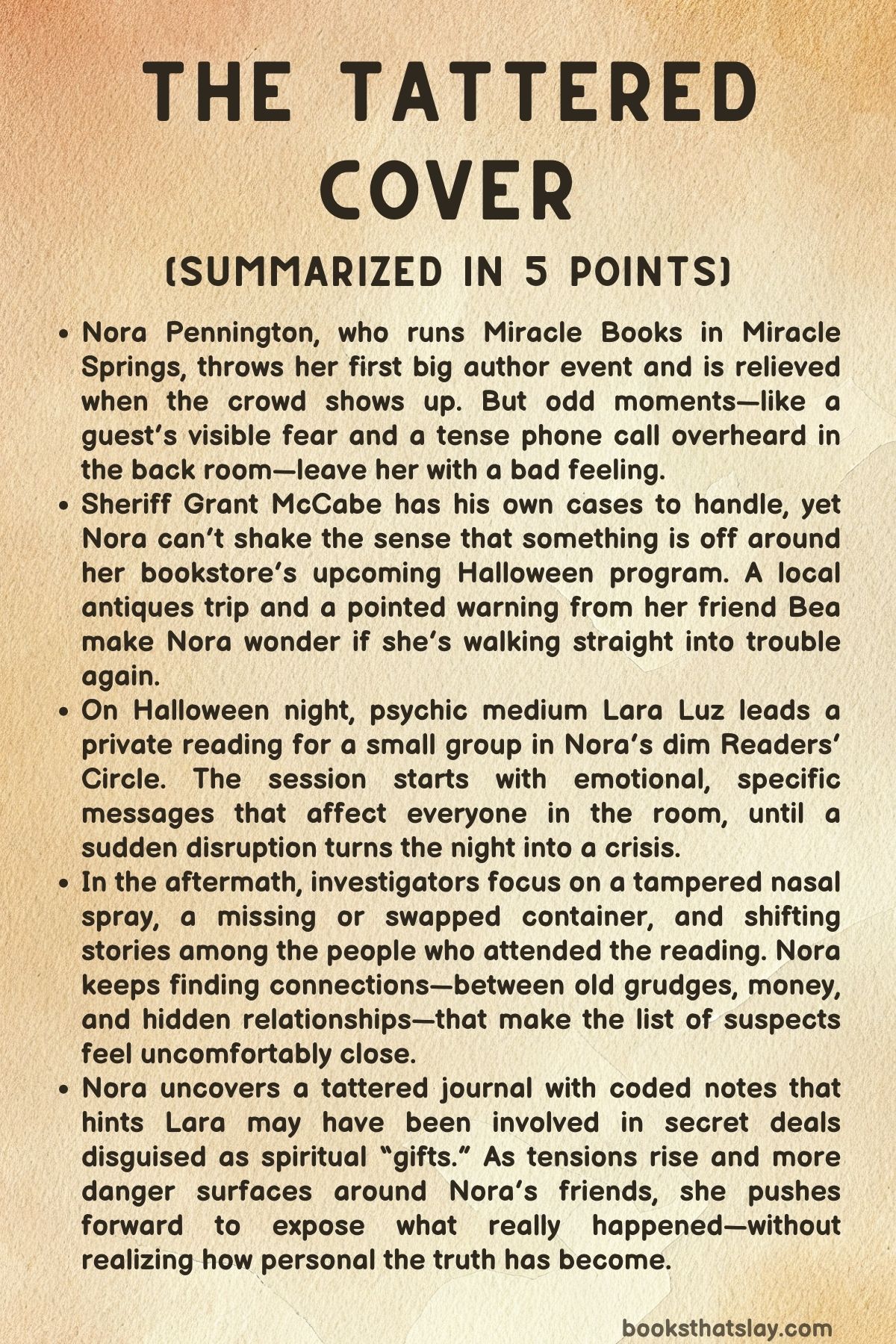
Summary
Nora Pennington is preparing Miracle Books for its first major author event, hosting cozy mystery writer Allie Kennedy. Nora worries no one will show up, but her friends and her young employee, Charlie, help her turn the store into a welcoming space with treats, displays, and a warm atmosphere.
The turnout is better than she hoped. Guests crowd the aisles, Allie performs beautifully, and the shop sells plenty of books.
Yet Nora senses something off. She accidentally overhears Allie crying in the back room, angry on the phone and insisting she will not let someone “ruin everything again.” Later, a browsing customer lingers over a memoir by psychic medium Lara Luz, who is scheduled to appear at the bookstore on Halloween.
When Allie notices the book’s cover, she reacts with visible alarm. Shortly afterward she bolts from the shop, leaving Nora unsettled as she locks up for the night.
The next morning, Nora wakes at the home of her partner, Sheriff Grant McCabe. Over breakfast, he mentions a separate case: someone has been dumping construction waste along the Appalachian Trail.
Witnesses reported a van marked by a Porky Pig sticker. McCabe heads out to speak with a park ranger, while Nora plans a quiet Sunday looking for antiques and decorations she calls “shelf enhancers” for the bookstore.
At the Miracle Springs flea market, Nora meets Bea, a blunt antiques dealer who has become one of Nora’s strongest supports since Nora rebuilt her life in town. Nora’s history still weighs on her: years ago she caused a drunk-driving crash that left her badly burned and nearly killed a mother and child.
She fled her former life and started over in Miracle Springs, trying to make amends through the steady work of her shop and the friendships she has formed. Bea knows this history and has never treated Nora like a spectacle or a cautionary tale.
While they talk, Nora mentions Lara Luz’s upcoming Halloween event and her concern that the shop’s fortune-telling window display might be taken the wrong way. Bea reacts sharply, warning Nora to stay away from Lara, insisting trouble follows that kind of person and hinting that Nora has already endured too much.
Halloween arrives with a sudden cold snap. Nora prepares Miracle Books for “Fun and Fright Night,” which includes a children’s reading followed by a private session with Lara Luz.
Guests include Nora’s friends Hester and Estella, a grieving widower named Terry Rowe, nurse Grace Kim, an unfamiliar woman, and Deputy Paula Hollowell, a tense presence in Nora’s life and someone Nora has never trusted. The first part of the evening goes smoothly as children’s author Maeve Sullivan reads to a small crowd.
Then Lara Luz arrives with her boyfriend, Enzo. Lara looks ill but insists she can continue.
Lara addresses the group and describes a childhood lightning strike that led to a near-death episode and, according to her, awakened her ability to hear messages from the dead. The store lights flicker during her talk, amplifying the mood.
Nora tries to stay calm, but Bea’s warning echoes in her head. Allie Kennedy also appears in the audience, and Nora notices Allie’s hostility toward Lara that doesn’t match a casual interest in the event.
After the public portion ends, Nora closes the shop for the private reading in the Readers’ Circle. Lara explains her method: she takes someone’s hands and speaks whatever impressions come through.
Enzo stands nearby, watchful. Lara begins with Hester, urging her to release the burden of her past.
Next she reads Terry. Lara delivers details that seem specific and personal, including a nickname only someone close to Terry’s late wife might know, and Terry breaks down in tears.
Then Lara reads Grace, offering reassurance and mentioning Grace’s son Charlie, including a hopeful hint about financial help for his future. The tone in the room changes from skepticism to fragile comfort.
Lara announces a short break. Moments later, the lights go out and panic erupts.
Nora uses her phone flashlight and finds Lara collapsed, clutching her chest and struggling to breathe. Enzo shouts for help.
Nora calls 911. Deputy Hollowell takes control and performs CPR while Nora tries to keep order.
In the chaos, Enzo is frantic and, during a scuffle, shoves Nora into furniture, knocking her unconscious. When Nora comes to, paramedics are arriving, but it’s too late.
Lara Luz is declared dead. Hollowell begins treating the bookstore like a crime scene, collecting evidence with an intensity that feels strange even under the circumstances.
One item stands out: Lara’s nasal spray, which Hollowell suggests may have been tampered with.
At the hospital, Nora wakes bandaged and shaken, surrounded by concerned friends. McCabe tells her the investigation is underway and that Hollowell has been documenting the scene for hours.
He also shares the initial finding: the nasal spray appears altered, its label damaged, the container possibly switched. Nora can’t stop replaying the night, especially Hollowell’s presence at the event and the way she seemed positioned to take charge.
As McCabe digs deeper, he uncovers a major revelation: Allie Kennedy is actually Lara’s estranged daughter, Aubrey Luz, living under a pen name. Nora and her friends confirm it through online research and local discussion.
The discovery reframes Nora’s earlier observations—Allie’s emotional phone call, her reaction to Lara’s book cover, and her tension during the reading. Allie’s motive, at least on the surface, looks personal.
McCabe later reports another disturbing detail: the altered spray is connected to Narcan, an opioid antidote that can be dangerous for someone with serious heart issues. The evidence is confusing—some findings suggest a setup, others suggest a direct attempt to harm Lara.
Nora’s unease grows. She also learns Hollowell attended the reading using someone else’s ticket, supposedly to “surprise” Nora, an explanation that doesn’t fit Hollowell’s usual hostility.
Back at Miracle Books, Nora tries to return to normal routines, but the case follows her into the aisles. While cleaning and rearranging, she discovers a tattered purple journal hidden beneath the chair where Lara collapsed.
Inside are cryptic notes, symbols, and abbreviations that look like records of private sessions. Nora keeps the journal close, believing it could explain who Lara met, what she learned, and what she was doing in town beyond a simple event booking.
Not long after, Nora suffers a sudden migraine that drops her to the floor in pain. Her friends rally around her, and life briefly swings toward happier news when Estella announces her upcoming wedding.
The community tries to hold onto celebrations even as fear lingers.
As Nora recovers, Grace Kim confides something important: during a session, she gave Lara a valuable white jade archer’s ring that belonged to her late husband’s family. Nora realizes Lara may have been receiving expensive items from clients.
She studies the purple journal more carefully and believes certain markings indicate meetings where valuables changed hands. When she shares this with McCabe, he confirms another suspicious link: Enzo runs a pawnshop.
That connection makes Nora wonder whether Lara’s readings were tied to a scheme where emotional vulnerability led people to give away heirlooms.
Nora and her friends compare notes and suspect other expensive gifts were involved, including pearls connected to Terry’s late wife. They also uncover something even more alarming: Deputy Hollowell’s past overlaps with Lara’s.
Hollowell previously worked in the same region where Lara and Enzo lived, and records suggest Hollowell lived close to Lara’s childhood area as well. Nora begins to suspect Hollowell didn’t just stumble into this case—she may have followed Lara for years.
McCabe, frustrated and worried about Nora’s health, tells her to stop investigating. Nora feels dismissed but refuses to ignore what she’s seeing.
Then the case darkens further: Enzo goes missing. Soon his body is found near a hiking trail creek, dumped and concealed.
The murder suggests someone is cleaning up loose ends.
Evidence points in multiple directions. McCabe questions people with access to medical supplies and Narcan, including those with healthcare or pharmacy knowledge.
Tension builds around suspects: Terry, Grace, Allie, and Hollowell. Allie returns to town and finally tells Nora the truth: she is Lara’s daughter and came intending to expose her mother’s fraud, not to kill her.
She describes Lara’s long pattern of manipulation and the damage it caused. Nora believes Allie’s anger, but not that she crossed into murder.
Meanwhile, McCabe’s “Midnight Dumper” case collides with the murder investigation when the suspected illegal dumper is found with Enzo’s expensive watch. The man appears frightened and refuses to talk, worried about immigration consequences.
Nora and her friends suspect he may be a pawn rather than the planner.
Just as the town tries to refocus on Estella’s wedding and holiday events, crisis hits again: Estella goes missing. Her car is found with her purse inside, and no one can reach her.
Nora’s fear spikes immediately, especially when McCabe shares a new detail from Grace’s family: Lara once said she was afraid of a police officer with a Doberman. That description matches Hollowell’s history as a K9 officer.
Worse, Hollowell cannot be located.
A deputy recalls a secluded cabin Hollowell once used near Paint Rock by the French Broad River. McCabe and his team move in, and Nora insists on helping.
While waiting near the scene, Nora spots an ATV racing down a trail. Hollowell is driving, with Estella in front of her.
Nora runs after them despite the danger. Moments later Estella stumbles back toward Nora, soaked, terrified, and in pain.
Hollowell has released her but continues fleeing. Estella goes into early labor as the rain falls, and paramedics rush her to the hospital.
McCabe pursues Hollowell, who escapes across the river into Tennessee, but she is soon captured after a rapid search.
With Hollowell in custody, the full story comes out. Hollowell’s childhood was defined by trauma: orphaned young, raised by a grandmother consumed by spiritualism, and shaped by neglect, instability, and anger.
Over time, Hollowell’s resentment focused into hatred for psychics, seeing them as predators like the figures who drained her grandmother’s life. That hatred turned into violence.
She murdered Lara using stolen Narcan and staged her actions during the crisis to hide what she had done. When Enzo became a threat, she killed him too, then manipulated a construction worker into moving evidence and tried to frame him.
When the net tightened, she kidnapped Estella to buy time and create leverage for escape.
In the aftermath, Miracle Springs begins to breathe again. Estella delivers a healthy baby girl named Lulu, surrounded by friends who have become family.
McCabe secures a confession, helped by the one attachment Hollowell still has—her K9 partner. As Christmas approaches, Nora looks around Miracle Books and sees the town reclaiming its rhythm: grief acknowledged, danger removed, and the bonds between friends strengthened by everything they survived.
Characters
Nora Pennington
Nora Pennington stands at the emotional and moral center of The Tattered Cover, embodying themes of redemption, resilience, and self-forgiveness. Once burdened by a tragic past marked by a drunk-driving accident that scarred her physically and emotionally, Nora rebuilds her life in the small town of Miracle Springs.
Through her bookstore, Miracle Books, she becomes a quiet healer—helping others find solace in stories even as she seeks her own peace. Nora’s empathy and intuition drive much of the narrative; her connection to others allows her to sense the hidden pain and secrets that pervade the town.
Despite her trauma, she exhibits remarkable courage—whether uncovering the truth behind Lara Luz’s death or standing up to Deputy Hollowell. Her relationship with Sheriff Grant McCabe deepens her emotional growth, showing her capacity for trust after loss.
Ultimately, Nora’s journey from guilt to grace mirrors the novel’s core belief in the restorative power of community and literature.
Sheriff Grant McCabe
Sheriff Grant McCabe represents integrity, patience, and the often uneasy balance between duty and love. As Nora’s partner, he serves as both protector and skeptic, grounding her intuition with rational investigation.
His struggle lies in reconciling professional detachment with personal involvement—especially as Nora’s instincts challenge his faith in the justice system and his own colleagues. McCabe’s moral compass remains strong, yet he’s not immune to error; his misplaced trust in Deputy Hollowell and initial dismissal of Nora’s suspicions reveal his human vulnerability.
His relationship with Nora also underscores a quiet tenderness—he values truth but fears the cost of uncovering it. By the novel’s end, McCabe’s confrontation with Hollowell and his emotional honesty with Nora reaffirm him as a man shaped by both law and love, standing as a symbol of moral clarity amid chaos.
Deputy Paula Hollowell
Deputy Paula Hollowell emerges as one of the most complex and tragic figures in The Tattered Cover. Initially portrayed as cold, competitive, and antagonistic toward Nora, she gradually transforms into the novel’s chilling antagonist.
Hollowell’s backstory of orphanhood, an unstable upbringing, and her grandmother’s obsession with psychics provides the psychological framework for her eventual descent into violence. Her hatred for Lara Luz, born from resentment toward spiritual frauds who exploited her grandmother, evolves into a lethal obsession.
Beneath her disciplined exterior lies a fractured soul driven by rage, loneliness, and a warped sense of justice. Hollowell’s manipulation of evidence, calculated murders, and final unraveling at the cabin reveal how unresolved trauma can curdle into cruelty.
Yet, in her final moments, when confronted by McCabe and her K9 partner, she becomes almost pitiable—a reminder that even monsters can be made, not born.
Lara Luz
Lara Luz, the psychic medium whose death ignites the novel’s central mystery, is a figure shrouded in paradox. To some, she is a gifted spiritualist offering comfort to the grieving; to others, she is a manipulative charlatan exploiting faith for profit.
Her near-death experience as a child lends her an aura of mysticism, yet her business dealings—accepting valuable heirlooms in exchange for “readings”—reveal moral ambiguity. Lara’s strained relationship with her daughter Allie Kennedy underscores her emotional contradictions: a woman torn between belief and deception, motherly love and ambition.
Her murder, ultimately at the hands of Hollowell, transforms her into both victim and catalyst. Through the revelations following her death, readers see how greed, guilt, and generational trauma intertwine—making Lara less a villain or saint than a tragic embodiment of flawed humanity.
Allie Kennedy (Aubrey Luz)
Allie Kennedy, who conceals her identity as Lara Luz’s estranged daughter Aubrey, embodies the pain of abandonment and the hunger for closure. A successful mystery writer, she enters Nora’s world under false pretenses, seeking to confront her mother’s deceit rather than to reconcile.
Her duplicity—attending the author event as Allie while hiding her true connection to Lara—creates one of the story’s most emotional turning points. Allie’s bitterness toward her mother is matched by deep-seated guilt and longing, and her eventual confession to Nora reveals her vulnerability.
Unlike her mother, she channels truth through fiction, using writing as both escape and therapy. By the end, Allie’s confrontation with loss allows her to rediscover empathy and self-understanding, symbolizing how truth, though painful, can liberate.
Enzo
Enzo, Lara’s loyal partner and accomplice, is defined by devotion and moral compromise. His affection for Lara seems genuine, yet his involvement in her questionable practices—trading clients’ valuables and possibly pawning them—casts doubt on his integrity.
He straddles the line between love and exploitation, protector and participant. When Lara dies, his grief spirals into rage, culminating in reckless actions that lead to his own death.
Enzo’s tragic fate exposes the collateral damage of greed and blind loyalty. Though not inherently evil, he is a man consumed by forces he cannot control—Lara’s charisma, Hollowell’s manipulation, and his own desperation for love and stability.
Bea
Bea, Nora’s blunt yet deeply compassionate friend, functions as a stabilizing force in The Tattered Cover. A seasoned antiques dealer with a weathered exterior and a warm heart, she represents wisdom born of hardship.
Having helped Nora rebuild her life after the accident, Bea stands as both mentor and mirror—pragmatic, grounded, and unafraid to challenge Nora’s doubts. Her belief in intuition and her warnings about “bad things coming in threes” reveal her as someone who straddles practicality and superstition.
Bea’s friendship reminds readers that healing often requires truth-telling and emotional resilience, even when comfort is hard to find.
Grace Kim
Grace Kim exemplifies grace under grief. A nurse and widow raising her son, Charlie, she embodies quiet strength and compassion.
Her kindness toward Lara Luz—gifting her a valuable heirloom during a séance—reflects both generosity and naivety, making her inadvertently part of the tragedy. Grace’s nurturing nature balances the story’s tension, offering a glimpse of hope and moral steadiness amidst turmoil.
She represents the novel’s broader theme that love, even when it leads to loss, remains a vital force of healing.
Hester, Estella, and June
These three women—Hester, Estella, and June—form the emotional sisterhood at the heart of Miracle Springs, the “Secret, Book, and Scone Society.” Each carries personal wounds but finds strength in solidarity. Hester, the baker with a complicated romantic past, uses food to heal others’ pain.
Estella, the spirited salon owner whose kidnapping and pregnancy anchor the book’s climax, symbolizes rebirth and resilience. June, the nurturing nurse and mediator, provides emotional grounding, often guiding the group’s moral discussions.
Together, they represent community as sanctuary—women bound not by blood but by shared survival and compassion.
Charlie
Charlie, Grace’s teenage son and Nora’s new bookstore employee, adds youthful sincerity to the story. His earnestness and curiosity contrast with the darker adult themes surrounding him.
Despite limited involvement in the central mystery, Charlie’s presence highlights the generational continuity of hope—the idea that even amid tragedy, life renews itself through the young. His relationship with Nora underscores the redemptive influence she has on those who cross her path, reinforcing her role as both mentor and maternal figure within the Miracle Springs community.
Themes
Redemption and Healing
Nora Pennington’s journey in The Tattered Cover is anchored in her unrelenting pursuit of redemption. Her life before Miracle Springs was marked by a tragic drunk-driving accident that left her disfigured and burdened with guilt.
Opening Miracle Books becomes her path toward emotional and moral restitution. The bookstore is more than a livelihood; it is a sanctuary that allows her to facilitate healing for others as she continues to mend her own fractured sense of self.
Through her empathy and intuition, Nora transforms literature into therapy, matching people with books that mirror their pain and guide them toward peace. Yet, her redemption is not linear.
The reemergence of trauma—first through the arson of her home, then through the deaths of Lara Luz and Enzo—forces her to confront the fragility of the life she has rebuilt. Each challenge becomes a test of resilience, reaffirming that healing does not mean erasing the past but learning to coexist with it.
Nora’s guilt gradually gives way to acceptance as she realizes that redemption is an ongoing process of kindness, forgiveness, and courage. Her relationships—with Bea, Hester, Estella, and McCabe—form a network of emotional repair that mirrors her own evolution.
By the novel’s close, she reclaims her life not by forgetting her mistakes but by transforming them into sources of compassion and strength.
Secrets and Deception
Throughout The Tattered Cover, secrets operate as both protection and poison. Nearly every character conceals something vital—whether it is Nora’s hidden past, Allie Kennedy’s false identity as Lara’s daughter, or Deputy Hollowell’s buried trauma.
These layers of deception form the scaffolding of suspense but also explore the moral ambiguity of truth. Nora’s own concealment of her past demonstrates that secrets can serve as a form of self-preservation, allowing one to start anew.
However, the book also reveals how deception corrodes trust and breeds tragedy. Lara Luz’s career as a psychic rests on illusion, and though she may believe in her abilities, her manipulative exchanges of jewelry for “healing stones” expose the blurred line between belief and deceit.
Hollowell’s secrets are the darkest of all—rooted in psychological wounds that curdle into hatred and violence. Her facade of authority hides a volatile obsession that leads to multiple deaths.
The narrative suggests that while some secrets are born of shame or pain, others become weapons of destruction. Ultimately, truth, however painful, emerges as the only path toward genuine connection.
Nora’s decision to face her past openly contrasts sharply with the secrecy that destroys Hollowell, underscoring the novel’s assertion that honesty, though difficult, is the foundation of redemption.
The Power of Female Friendship
One of the novel’s most uplifting dimensions is its portrayal of women supporting one another through adversity. The Secret, Book, and Scone Society—a circle of women bound by trust and empathy—embodies the healing potential of female solidarity.
Nora, Hester, June, Estella, and later Grace form a collective resilience that offsets the darkness surrounding Miracle Springs. Their friendship is built not on perfection but on shared vulnerability; each woman has endured trauma, loss, or betrayal.
Through their honesty and mutual care, they create a space where judgment is suspended and emotional wounds can be confronted safely. When tragedy strikes—whether in the form of Lara’s mysterious death, Enzo’s murder, or Estella’s kidnapping—their unity becomes the moral compass of the story.
They approach each crisis with courage and collaboration, proving that healing thrives in community. The novel resists portraying female relationships as competitive or fragile; instead, it celebrates them as transformative and sustaining.
Even the most independent characters, like Nora, learn that strength does not mean isolation. The final scenes, filled with laughter, childbirth, and renewal, affirm that friendship can be both a refuge and a catalyst for growth, turning pain into purpose.
Justice and Moral Responsibility
Justice in The Tattered Cover extends beyond legal retribution to encompass personal accountability and ethical awakening. Sheriff Grant McCabe represents the procedural side of justice—methodical, bound by evidence—but the novel insists that moral justice often requires intuition and empathy, qualities embodied by Nora.
Her persistent curiosity, though risky, uncovers truths that formal authority overlooks. The tension between Nora’s moral drive and McCabe’s professional restraint creates a compelling dynamic that questions how justice should be pursued in a flawed world.
The book also critiques systems of authority through Hollowell, whose abuse of power turns justice into vengeance. Her crimes are not merely legal violations but moral failures rooted in unresolved trauma.
Nora’s investigation, driven by conscience rather than jurisdiction, restores balance where institutional mechanisms falter. By confronting her fears, protecting her friends, and refusing to let evil fester, she demonstrates that justice requires moral courage, not just procedure.
In the end, Hollowell’s capture brings closure, but the deeper justice lies in the restoration of safety, trust, and truth within the community. Miracle Springs becomes whole again, not through punishment alone, but through the reaffirmation of empathy and accountability as guiding principles.
The Intersection of Faith, Fraud, and the Supernatural
The tension between genuine belief and exploitation of faith forms one of the most thought-provoking threads in The Tattered Cover. Lara Luz’s career as a psychic medium invites questions about the boundaries between the spiritual and the deceptive.
Her séances, which promise healing through contact with the dead, bring comfort to some but mask a transactional greed that ultimately fuels her downfall. The book never confirms whether Lara’s abilities are real; instead, it focuses on the human need to believe in something beyond the visible.
Through her character, Ellery Adams examines how faith, when commodified, can become dangerous. Hollowell’s violent reaction against Lara stems from the same sphere—her grandmother’s obsession with psychics left her destitute, planting in Hollowell a hatred that festers into fanaticism.
This duality shows that both blind faith and absolute cynicism can be destructive. Nora’s stance provides the middle ground: she acknowledges the mystery of life and death without surrendering her reason.
Her approach reflects the novel’s moral stance that belief must be tempered by integrity and empathy. In blending mystery with metaphysical questions, the story turns the supernatural into a mirror of human longing—the desire to heal, to connect, and to find meaning in loss.
Rebirth and Renewal
The novel concludes with an atmosphere of restoration that affirms the endurance of hope even after trauma. Every major character undergoes a form of renewal—Nora reclaims her peace after confronting danger and guilt, Estella gives birth to new life after enduring terror, and Miracle Springs itself transitions from a site of violence to one of celebration.
The changing seasons, particularly the movement from autumn’s decay to the brightness of Christmas, symbolize this transformation. Renewal in The Tattered Cover is not portrayed as naïve optimism but as hard-earned serenity born from suffering.
The act of rebuilding—homes, friendships, and faith—represents resilience as a communal process rather than an individual triumph. The town’s rebirth mirrors Nora’s inner evolution: once broken and self-punishing, she emerges capable of love, forgiveness, and leadership.
The closing scenes in the bookstore, illuminated by laughter and the arrival of baby Lulu, encapsulate the novel’s belief that healing is cyclical. No matter how tattered one’s past, the possibility of renewal endures when compassion and courage prevail.
Through this message, Ellery Adams reinforces that life, like a well-loved book, can always be repaired, re-read, and rediscovered anew.