The Witching Moon Manor Summary, Characters and Themes
The Witching Moon Manor by Stacy Sivinski is a mystical tale set in a world where magic intertwines with everyday life. The story centers around Anne Quigley, a Diviner for the witch council in Chicago, and her two sisters, Beatrix and Violet.
They run a teahouse called the Crescent Moon, which is also a haven for the magical community. As Anne struggles with her magic and the consequences of a powerful unfinished Task left behind by the ghost of Mr. Crowley, the sisters must work together to uncover secrets, heal past wounds, and restore balance before the city’s magical fabric unravels. Their journey of self-discovery, love, and sacrifice unfolds amidst a world of enchantment, spirits, and deep emotional bonds. It’s the 2nd book in The Spellbound Sisters series by the author.
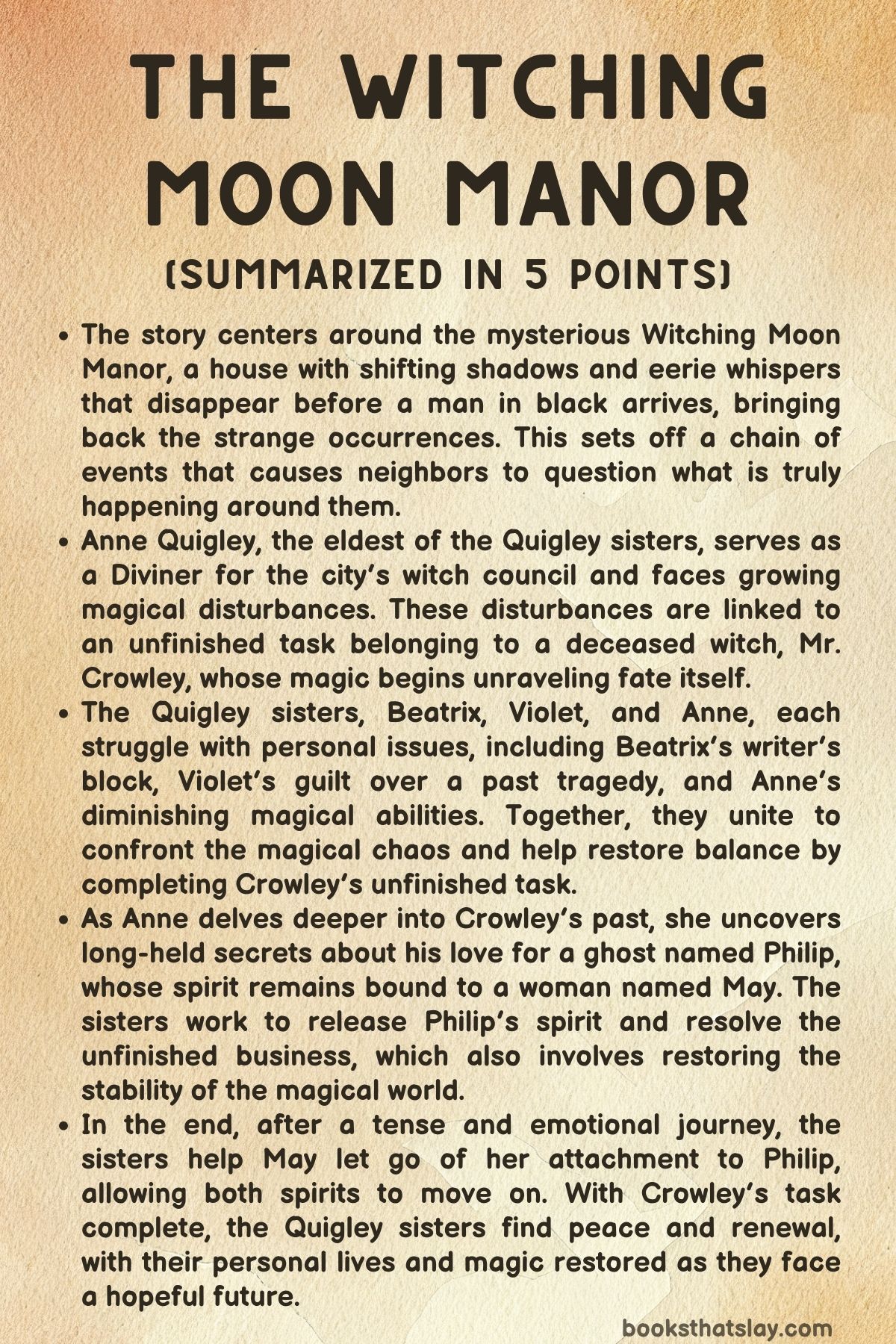
Summary
The story begins with a mysterious house at the center of a street, known for its strange occurrences. The house casts odd, shifting shadows, and whispers seep from its windows.
The neighbors notice these strange events but dismiss them as flights of fancy, and life continues as usual. However, the house eventually falls silent, no longer filled with whispers or moving shadows.
This silence stirs unease among the neighbors, who are now aware that something has changed.
One evening, a man with white hair and dressed in black approaches the house, causing a stir among the neighbors. As he walks toward the door, shadows seem to follow him, and when he opens the door, the long-lost whispers return, much to the neighbors’ confusion.
He steps inside, and the silence outside deepens, leaving the neighbors with even more questions.
The narrative then shifts to a tearoom, the Crescent Moon, run by Anne Quigley. The shop is filled with nostalgia as it prepares for the new year, with decorations that evoke memories of the past.
Anne’s life has recently changed, as she has taken on the role of Diviner for the city’s witch council, a responsibility that has brought new challenges. The shop, however, seems to have a life of its own, making changes that Anne did not anticipate.
The house expands, adding a second floor with vaulted ceilings and stained-glass windows.
Anne’s friends, Katherine and Celeste, visit the shop, where they discuss Anne’s new responsibilities. Anne reflects on her past year, especially her work with a man named Mr. Crowley, a ghost who wanted to finish an unfinished task before he passed on.
Despite Anne’s help, Mr. Crowley eventually passed away, leaving Anne to focus on her new duties. However, Anne’s own magic feels increasingly strained, as her visions and abilities grow less distinct.
Meanwhile, Anne’s sisters, Beatrix and Violet, are also facing challenges in their lives. Beatrix, a writer, has struggled with her new novel, feeling as though her ability to write has been fading.
She hasn’t been able to produce any meaningful work since signing a contract for a third book. Violet, who had been traveling with the circus, returns home to the Crescent Moon, and the sisters reunite, sharing the news of their separate journeys.
The Quigley sisters’ reunion brings comfort, but there is a sense of unease hanging over the house. Beatrix struggles with her inability to write, and Anne becomes more aware of the shifting boundaries between the past, present, and future.
During a meeting with the council, Anne senses something is wrong in the city, as strange incidents have been occurring. Her fears are confirmed when Nathanial, a member of the council, reveals that the reports of these incidents are growing rapidly and may be difficult to contain.
As the Quigleys settle into the rhythm of their lives at the Crescent Moon, Anne continues to feel the weight of her responsibilities. Her powers as Diviner have allowed her to glimpse the future, but she is troubled by the lack of clarity she now experiences.
The house, sensing her unease, reacts in subtle ways, adding to the sense of something amiss.
The story explores the personal struggles of the Quigley sisters and the mysterious happenings surrounding the Crescent Moon. Anne, as the Diviner, learns that the strange magical disturbances in the city—like trains reversing direction, flowers blooming in snow, and footsteps appearing before they’re made—are the result of an unfinished Task.
During a tense meeting with fellow council members, Anne realizes the Task belongs to Mr. Crowley, a witch thought to possess only middling abilities. It turns out he had concealed immense power and left his Task undone to remain with Philip, the ghost he loved.
His hidden magic has begun unraveling the web of fate itself.
To restore order, Anne must identify the owner of Crowley’s enchanted ring and complete the Task, even though doing so would separate Crowley and Philip forever. Bound by duty, Anne reluctantly accepts the responsibility while the council disperses to contain magical chaos across the city.
Afterward, Anne returns home, exhausted and frightened. Her sisters comfort her, but Anne’s magic surges unexpectedly, cracking a mirror in the parlor.
This creates hundreds of tiny key-shaped fractures—a symbol of help in hardship.
Trusting the omen, Anne decides to share the council’s secret with her sisters. She explains that Crowley’s unfulfilled Task is destabilizing fate.
Violet protests that finishing it would condemn Crowley’s spirit to move on without Philip, but Beatrix proposes an alternative: if they can discover what binds Philip to the mortal world and free him, they could complete Crowley’s Task without separating the lovers. Anne agrees, and the sisters decide to work together to reunite the lovers and restore balance before the city unravels.
As they continue their investigation, Violet has a dream about her time in the circus, where she feels guilty over an accident that left her partner, Emil, injured. This deep unrest leads her to return home, seeking peace.
Meanwhile, Beatrix is unable to focus on her writing and is distracted by her editor, Jennings. Their interaction hints at an unspoken affection.
Anne devotes herself to divination, seeking clues about Crowley’s past and the missing ring’s owner. After a vision, she senses that Crowley’s lonely childhood and forbidden friendship with Philip shaped his fate.
A mysterious voice interrupts her vision, and Anne realizes that she must look deeper into Crowley’s origins. She also uncovers that Vincent, Crowley’s nephew, is a powerful necromancer who may hold answers to the mystery.
The Quigleys visit the Crowley mansion, where they find clues about Crowley’s past and the unfulfilled Task. Vincent is initially hostile but eventually agrees to help.
They also visit a bookstore, where Beatrix finds inspiration to continue her writing, and Violet discovers a crucial clue about Philip’s attachment to the mortal world.
As they work together, the sisters uncover more secrets, including May, a woman tied to Philip’s ghost. May reveals that she has kept Philip’s spirit near her since his death, unable to let go.
The Quigleys, with the help of Vincent, work to release Philip and Crowley from their bonds. In a final act of magic, May lets go of Philip, allowing him to pass on peacefully.
The story ends with the Quigley sisters finding balance in their lives. Violet overcomes her fear of performing, Beatrix completes her novel, and Anne finds happiness with Vincent.
The family shop is revitalized, and the sisters’ magical bond strengthens as they embrace the changes ahead, knowing that their story, like the seasons, continues.
Characters
Anne Quigley
Anne Quigley is the eldest of the Quigley sisters and serves as a Diviner for the city’s witch council. She is a character driven by a deep sense of duty and responsibility.
As a Diviner, she is attuned to the magical disturbances around her, yet she struggles with the growing tension within herself as her powers become more strained. Anne’s ability to see glimpses of the future comes with a heavy burden.
As she faces an unfinished magical task involving the ghostly Mr. Crowley, she must grapple with the difficult choice of completing a task that will forever separate two souls in love. This internal conflict reveals Anne’s compassionate nature, as she seeks to prevent harm, even if it means sacrificing her own desires.
Her relationship with her sisters, particularly their unwavering support, highlights her role as the anchor of the family, even when faced with overwhelming challenges. Throughout the story, Anne is forced to confront her fears, her responsibilities, and the complexity of her powers, leading her on a journey of self-discovery and growth.
Beatrix Quigley
Beatrix, the second Quigley sister, is a writer who is struggling with a creative block that prevents her from finishing her new novel. Her inability to write has become a source of frustration, as she feels disconnected from her muse and the magic that once flowed freely through her.
Beatrix is portrayed as someone deeply in tune with the world around her, especially when it comes to her love for books. Her sensitivity to the magical environment of the Crescent Moon teahouse is evident as she is drawn to the neglected bookstore opposite the Crowley mansion.
The bookstore, with its forgotten stories, awakens a spark within her, allowing her to reconnect with her creativity. Beatrix’s internal journey reflects her struggle to overcome personal doubts and the pressure of her career.
Her interactions with Jennings, her editor and confidant, also hint at a romantic subplot that helps her rediscover her passion for writing. Through her journey, Beatrix learns the importance of embracing the past and letting go of what no longer serves her, culminating in her completion of her own magical task.
Violet Quigley
Violet, the youngest of the Quigley sisters, is a character defined by her past trauma and guilt. She had once been part of a circus, where an accident during a trapeze act left her with a deep sense of regret over the injury of her partner, Emil.
This guilt has haunted her and led to her return home, where she seeks solace in the Crescent Moon tearoom. Violet’s arc centers around her struggle with forgiveness—both of herself and of others.
As she confronts her own fears, including the haunting memories of her time in the circus, she finds comfort in the magical environment around her, particularly in the mystical influence of the Crescent Moon house. Her encounter with Celeste, a former seer who has lost her magic, offers Violet a sense of hope, reminding her that life can still hold meaning even when one’s gifts are gone.
Violet’s compassion and desire to help others, especially when it comes to the ghosts of Crowley and Philip, show her inner strength. Her ability to finally let go of her guilt, as well as her courage to perform again, marks a significant moment of healing and growth.
Vincent Crowley
Vincent Crowley, the nephew of the ghostly Mr. Crowley, is a powerful necromancer with striking white hair, a physical mark of his magical abilities. He is introduced as a somewhat antagonistic figure, initially distrustful of Anne and her motives.
However, his role in the story evolves as he becomes an essential ally in solving the mystery of Mr. Crowley’s unfinished task. Vincent’s connection to his uncle, as well as his own struggles with the past, add layers of complexity to his character.
He is deeply affected by the bond between Mr. Crowley and Philip, two souls bound by love and unfulfilled desires. Although Vincent initially resists the idea of working with Anne, their relationship gradually transforms from mutual distrust to a tentative, yet magnetic, attraction.
As the story unfolds, Vincent’s protective nature and his understanding of the spirits and their needs become more apparent. His relationship with Anne offers both tension and tenderness, as they confront their personal demons while working together to resolve the magical imbalance caused by Crowley’s unfinished task.
May Schultz
May Schultz, also known as Mrs. Margaret Hall, is a pivotal character whose unresolved grief plays a crucial role in the story’s climax. She is the sister of Philip, the ghost who has remained bound to the mortal world due to her inability to let go of their past.
May’s love for her brother, while deep and heartfelt, has kept him trapped as a spirit, unable to move on. Her guilt over their last argument, where Philip disapproved of her choice of partner, has led her to cling to his memory, refusing to let him go.
May’s arc is one of emotional liberation, as she must face the reality that holding on to the past is preventing both her brother and herself from finding peace. When she finally accepts the need to release Philip, it marks a moment of profound transformation for her.
May’s journey reflects the theme of letting go, and her eventual peace with Philip’s passing brings closure to the story’s central conflict. Her connection to Beatrix, who helps her find the strength to release her brother, highlights the importance of family and love in healing emotional wounds.
Themes
The Interplay of Love and Loss
In The Witching Moon Manor, the theme of love and loss is intricately woven into the lives of the characters, particularly through the relationships between the ghosts of Crowley and Philip, and May’s attachment to her brother. The love between Philip and May is central to the haunting that consumes their lives.
May’s inability to let go of her brother after his tragic death results in his spirit lingering in the mortal realm. Their relationship is not only characterized by love but also by the emotional consequences of unhealed wounds and unfinished business.
Crowley, too, is bound by his love for Philip, as he allows his magical task to remain incomplete, choosing to stay in the realm of the living out of love rather than fulfilling his responsibilities. The deep connection between these characters illustrates how love can transcend death, but also how clinging to love can cause great distress.
May’s eventual decision to release her brother’s spirit is an important moment of healing, as it reflects the necessity of letting go for the sake of personal peace. The book suggests that true love is not about holding on, but about allowing the freedom of release, and that in doing so, peace and closure can be found for both the living and the dead.
The ghosts’ lingering presence and their eventual release underline the idea that love can be a force both binding and liberating, often requiring painful sacrifice.
The Burden of Responsibility
Throughout the narrative, Anne Quigley is confronted with the weight of responsibility, not just as a Diviner for the witch council, but also as a sister and protector. Anne’s role as Diviner requires her to interpret the future and manage the delicate balance of magic in her city.
As she navigates these duties, she faces the challenge of maintaining control over her own powers, which have become increasingly unstable. The sense of responsibility grows more intense as she realizes that her actions—or inactions—can have far-reaching consequences, especially as she attempts to finish Mr. Crowley’s unfinished Task.
Anne’s struggle reflects the difficulty of reconciling personal desires with the greater good. The responsibility of resolving the magical disturbances in the city, while simultaneously navigating her personal relationships and the growing tensions within her family, weighs heavily on her.
The book explores the complexity of leadership and the isolation that can come with it, particularly when the stakes are as high as the fate of the city. Anne’s eventual decision to confront her fears and embrace her magic shows that taking on responsibility often requires not just strength but the willingness to accept vulnerability and the support of loved ones.
The Power of Family and Sisterhood
The bond between the Quigley sisters—Anne, Beatrix, and Violet—is a defining theme in The Witching Moon Manor. Despite the challenges they face in their personal lives and magical pursuits, their relationship remains the bedrock of their strength.
The sisters’ unconditional support for each other serves as a powerful counterbalance to the chaos surrounding them. Anne’s burden of being the Diviner is alleviated by the counsel and love of Beatrix and Violet, who, though dealing with their own struggles, stand by her through every difficulty.
Beatrix, who has been grappling with her creative block, and Violet, burdened by guilt over past mistakes, both offer insights and emotional grounding for Anne as she navigates the complexities of her magical duties. The theme of sisterhood highlights the importance of emotional support, shared history, and mutual trust.
The Quigley sisters’ ability to work together, despite their personal challenges, proves that familial bonds are not just about love, but also about collaboration, strength, and resilience. Their collective efforts to help Anne complete Crowley’s Task, and later to release the spirits of Philip and Crowley, demonstrate that the unity of family can overcome even the most daunting of obstacles.
In this way, the book emphasizes that the power of family is not merely about blood relations but the emotional and magical connection that binds individuals together.
The Struggle Between Fate and Free Will
In the novel, the tension between fate and free will plays a crucial role in the unfolding events. The theme is explored through the mysterious occurrences that destabilize the city, all tied to Mr. Crowley’s incomplete Task.
Anne is thrust into a position where her actions can either restore the balance of fate or unravel it completely. The Task, left undone by Crowley, threatens the fabric of reality itself, showing how unfinished business can distort time and space.
Anne’s struggle lies in deciding whether to adhere strictly to the council’s expectations or to take a more personal approach to solve the problem. As Anne confronts her own limitations and fears, she begins to question how much control she truly has over her destiny.
The book suggests that while fate may set the stage, individuals still possess the power to shape their own paths. Anne’s eventual decision to confront the truth about Crowley’s past and to find a way to release the spirits, even at great personal cost, signifies her ability to assert her will over the forces of fate.
However, it is also clear that free will does not operate in isolation. The novel underscores the idea that choices are often interconnected with larger forces, and personal freedom can be both liberating and burdensome when it intersects with the broader design of the universe.
The Nature of Magic and Transformation
Magic in The Witching Moon Manor is not just a tool for supernatural feats, but a transformative force that shapes the characters’ lives in profound ways. The magic within the story operates both as a source of power and a potential danger, as seen in the increasingly unstable magical disturbances caused by Crowley’s unfinished Task.
For Anne, magic is a gift and a responsibility, one that she has learned to harness but finds increasingly difficult to control. Her powers are depicted as being deeply tied to her emotional state, which reflects the idea that magic is not simply an external force, but something that is intertwined with the individual’s inner being.
As Anne’s magic grows weaker, so does her sense of self, and it is only by embracing her vulnerability and accepting help from her sisters and Vincent that she is able to restore her power. Similarly, Beatrix’s struggle with writer’s block is depicted as a form of magical paralysis, where her creativity and the ability to transform words into stories are stifled.
Her eventual breakthrough, aided by the rediscovery of the abandoned bookshop, symbolizes the renewal of her own magical energy. Magic in the novel is also tied to healing and transformation, particularly when the sisters work together to release the spirits of Philip and Crowley.
The act of freeing the spirits is a symbolic act of redemption and change, both for the characters involved and for the balance of the magical world they inhabit. Ultimately, the theme of magic in the story reflects the idea that true transformation requires not just power, but the ability to adapt, evolve, and sometimes let go.