The Women of Wild Hill Summary, Characters and Themes
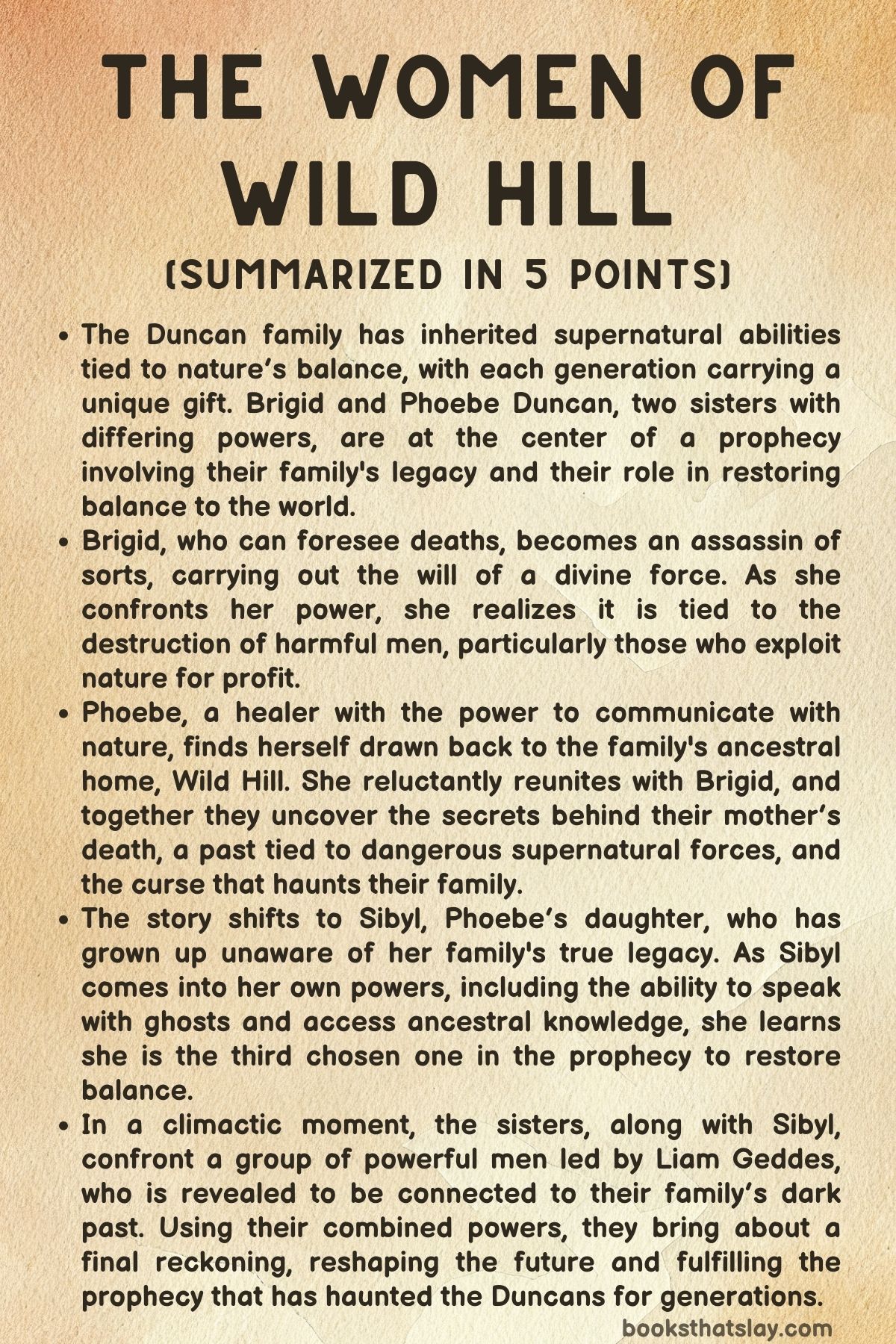
The Women of Wild Hill by Kirsten Miller is a dark and compelling tale that explores the supernatural and the legacy of powerful women within a family bound by ancient forces. At its core, the story delves into the lives of the Duncan women, descendants of a mystical bloodline that connects them to the Old One, an ancient being responsible for maintaining the balance between life and death.
The novel weaves together elements of witchcraft, family secrets, and fate, as the sisters Brigid, Phoebe, and their niece Sibyl grapple with their inherited powers. Set against the backdrop of the mysterious Wild Hill estate, the women must confront their past and destiny, navigating the dangers tied to their supernatural gifts.
Summary
In a remote cottage, a young girl is raised by her mother, a healer known for her potent remedies. The mother warns her daughter about the family’s dangerous legacy, revealing that her own sister was executed for witchcraft by the king.
She teaches her daughter about the family’s special gift—an inherited power tied to the bloodline, passed down through generations. This gift, while a blessing, is also a curse, and the girl is destined to watch over the Duncan family’s bloodline until a powerful heir emerges.
Her role is to wait for a moment in the future when a descendant will rise, fulfilling a prophecy.
Brigid Laguerre, an actress whose life has been marked by turmoil, begins experiencing strange events following the death of her mother’s former lover, Calum Geddes. Struggling with unusual emotions, she notices three ravens, which signify death, and soon encounters an intruder on her property.
She discovers the man has been stalking her and confronts him, eventually knocking him unconscious with a poisoned drink. This encounter sets off a chain of events, including her learning more about Geddes’s death and a cryptic message from a raven.
Brigid embarks on a journey, uncovering dark secrets tied to her past, while also discovering that her life is once again inextricably linked to danger.
Meanwhile, Brigid’s estranged sister, Phoebe Duncan, leads a quiet life in Texas, using her gift to communicate with nature. She is visited by a large pig and her piglets, who urge Phoebe to visit Brigid, though she is reluctant.
The pig’s arrival is a sign of things to come, and after experiencing strange visions and unsettling events, Phoebe finally agrees to visit her sister. Along her journey, Phoebe encounters even more signs of the supernatural and realizes that her destiny is tied to the family’s ancient legacy.
Kayleigh Williams, a woman in an abusive marriage, seeks help from a healer who directs her to Phoebe. In a desperate bid to escape her circumstances, Kayleigh arrives at Phoebe’s homestead, where Phoebe offers her assistance, helping her find an alternative solution to her unwanted pregnancy.
However, Kayleigh’s past catches up to her when her abusive husband tracks her down. In a shocking twist, Kayleigh’s husband meets his end at the hands of the pig that led Phoebe to Brigid’s home.
As the story progresses, Brigid and Phoebe find themselves drawn into a larger supernatural force that forces them to confront their family’s legacy. The pig, whose presence has been a guiding force, urges the sisters to reconcile their differences and face their shared fate.
Together, they begin to uncover the deep secrets surrounding their family’s powers, discovering that their lineage holds the key to restoring the balance between life and death. They realize they are connected to Wild Hill, the ancestral estate that holds the answers to their powers and their place in the grand scheme of the Old One’s plans.
Brigid begins to accept her power to foresee death, a gift passed down through her family. Her aunt Ivy teaches her that this power is not just about taking life, but restoring balance in nature.
The Duncans, witches who wield great power, are part of a larger cosmic force that seeks to right the wrongs done by mankind’s destruction of the earth. Brigid is tasked with using her gift to ensure that nature’s balance is preserved, though she struggles with the morality of taking lives.
When her aunt Ivy dies, Brigid begins to understand the true purpose of her gift.
Flora, Brigid and Phoebe’s mother, plays a pivotal role in their upbringing. She teaches them about the natural world, storms, and wildfires, seeing these as nature’s immune response to human destruction.
The prophecy surrounding the Duncan family speaks of “The Three”—three powerful descendants who are destined to restore balance. Flora believes that she, Brigid, and Phoebe are The Three, though Brigid harbors doubts about this fate.
As the family’s legacy unfolds, Brigid begins to feel the weight of their responsibilities. She is torn between her personal desires and the demands of her gift.
When Flora dies, Brigid is forced to confront her own role in fulfilling the prophecy. She begins to see the dark path that lies ahead, especially when she realizes that the family’s ties to Wild Hill are deeper and more dangerous than she ever imagined.
Phoebe, who possesses the gift of healing, is reluctant to take part in this destiny. She has spent years living a peaceful life in Texas, far from the complexities of her family’s legacy.
But when the signs and omens become too powerful to ignore, Phoebe reluctantly agrees to join Brigid at Wild Hill. Together, they confront the dark forces at play, uncovering the truth about their family’s history and the supernatural presence that haunts Wild Hill.
As the three women—Brigid, Phoebe, and their niece Sibyl—are drawn together, they begin to piece together the dark secrets of their family’s past. Sibyl, who has grown up unaware of her true heritage, discovers her connection to the Duncan bloodline and the immense power she holds within her.
The women must face their shared destiny, confronting the dark legacy of their ancestors and the supernatural forces that have shaped their lives.
The family’s connection to Wild Hill becomes undeniable, and they must navigate the treacherous path that lies ahead. As they confront the ghosts of their ancestors and the ancient power of the Old One, they realize that the fate of their family—and the world—rests in their hands.
The Women of Wild Hill must come together to restore balance and fulfill their destiny, despite the dangers and sacrifices that await them.
Characters
Brigid Duncan
Brigid Duncan is a complex character, grappling with the dark legacy of her family’s supernatural powers. As a member of the Duncan family, she possesses the ability to foresee death, a gift that connects her to the ancient and powerful Old One, an entity that governs the forces of life and death.
Brigid initially finds herself horrified by the implications of her gift, especially when she realizes that her role may involve taking lives to restore balance. Over time, she becomes increasingly accepting of her role as an assassin for the Old One, performing killings as a necessary part of maintaining nature’s balance.
However, her personal journey is marked by internal conflict, particularly when she finds herself torn between the duty imposed by her powers and her own desires, especially in matters of love. Her complicated relationship with her family, particularly with her sister Phoebe, is central to her development.
Brigid’s path is further complicated when she meets Liam Geddes, the son of a man connected to her family’s tragic past, sparking both romantic and existential tension. Brigid is ultimately faced with the realization that her family’s legacy is far more complicated and dangerous than she ever anticipated, leading her to question whether she can continue to fulfill her role in the face of the Old One’s demands.
Phoebe Duncan
Phoebe Duncan is another central figure in The Women of Wild Hill, and her character provides a stark contrast to Brigid’s darker, more accepting view of their family’s supernatural powers. Phoebe is a healer with the unique ability to communicate with nature, a gift that allows her to sense and heal the wounds of the world around her.
Unlike Brigid, Phoebe has a deep resistance to the bloodline’s legacy and the prophecies surrounding it. She values peace and tranquility, and her life in Texas, where she raises her daughter Sibyl, is a testament to her desire to escape the darker elements of her heritage.
However, Phoebe is inevitably drawn back into the family’s fate, particularly when she learns that her daughter is tied to the prophecy of “The Three.” Despite her reluctance, Phoebe’s strength as a healer and her role as a mother to Sibyl becomes crucial as the family confronts the forces of the Old One. Her emotional journey is one of acceptance, as she is forced to reconcile her desire for a quiet life with the overwhelming responsibility of her family’s supernatural mission.
Throughout the novel, Phoebe’s inner conflict and her protective love for her daughter shape her actions, ultimately leading her to play a pivotal role in the family’s destiny.
Sibyl Duncan
Sibyl Duncan is the youngest member of the Duncan family and a character who evolves dramatically over the course of The Women of Wild Hill. At the beginning of the story, Sibyl is unaware of her family’s supernatural legacy, believing herself to be an ordinary girl.
However, as she begins to experience strange dreams and visions, she slowly uncovers the truth about her powers and her connection to the ancient forces that govern her family. Sibyl’s gift is the ability to communicate with ghosts and step into the minds of her ancestors, gaining their knowledge and experiences.
Her journey is one of self-discovery, as she learns to harness her abilities and accept her role as the third and final member of “The Three,” a prophecy that will restore balance to the world. Sibyl’s relationship with her mother, Phoebe, and her aunt, Brigid, is complicated by the family’s dark history and the weight of their powers.
As the story unfolds, Sibyl embraces her destiny and plays a critical role in the family’s final confrontation with the forces of evil. Her growth is marked by her increasing understanding of her family’s legacy and the power she wields, ultimately culminating in her use of the family’s mystical gifts to right the wrongs of the past.
Bessie Duncan
Bessie Duncan is a ghostly figure whose influence spans centuries, serving as a guiding force for the Duncan family. As an ancestor, Bessie’s presence is felt throughout the novel, particularly in her interactions with Phoebe, Brigid, and Sibyl.
Bessie represents the deep, mystical roots of the Duncan family’s legacy, acting as both a protector and a reminder of the family’s tragic past. Her role as a spectral guide is crucial in leading Sibyl to understand her powers and the importance of the family’s mission.
Bessie’s ghostly appearances serve as a bridge between the living and the dead, revealing hidden truths and urging the family to confront their inherited responsibilities. Her connection to the Old One and the supernatural forces that shape the Duncans’ lives is central to the plot, as she helps to unravel the mysteries surrounding their powers and their purpose.
Despite her death, Bessie’s influence remains a constant force, guiding the family members to fulfill their roles and face their destinies.
Calum Geddes
Calum Geddes is a pivotal antagonist in The Women of Wild Hill, whose actions set in motion much of the family’s conflict. As the former lover of Flora Duncan, Brigid and Phoebe’s mother, Calum’s influence on the Duncan family is both personal and far-reaching.
He represents a corrupting force, exploiting the family’s mystical abilities for his own gain. His manipulation of Flora and his eventual turn to evil create a rift within the Duncan family, leading to tragedy and betrayal.
Calum’s role in the story is to serve as a catalyst for the family’s reckoning, as his actions and legacy challenge the family’s role in restoring balance to the world. His death, and the subsequent revelations about his connections to the ruling class, reveal the extent of his influence and the danger he posed to the family.
Through his interactions with Brigid, Phoebe, and Sibyl, Calum’s legacy becomes a haunting presence that shapes the family’s actions and ultimately forces them to confront the darkness within their own bloodline.
Liam Geddes
Liam Geddes, the son of Calum, is a mysterious figure whose arrival at Wild Hill marks a turning point in the story. While initially appearing as a charming and magnetic figure, Liam’s true role in the family’s destiny is gradually revealed.
His connection to Calum and his inherited power make him a significant player in the family’s struggle. Although Liam’s initial intentions seem to be driven by personal curiosity, his involvement with Brigid and his eventual role in the family’s supernatural reckoning suggest that his fate is intertwined with theirs.
As a member of the Geddes family, Liam represents the legacy of corruption and manipulation that his father instilled in him, yet he also struggles with the weight of that inheritance. His relationship with Brigid becomes a key emotional and moral conflict, as their attraction to each other complicates the family’s mission.
Liam’s ultimate fate is a crucial aspect of the novel, representing the difficult choices the Duncan family must make in order to restore balance and break free from the destructive forces of the past.
Themes
Family Legacy and Ancestral Power
The theme of family legacy is central to The Women of Wild Hill, where the Duncan family’s mystical abilities are passed down through generations. This legacy is marked by both a gift and a curse, as it imbues the family members with supernatural powers while also drawing them into a world of danger and conflict.
The characters, particularly Phoebe, Brigid, and Sibyl, grapple with the weight of their heritage, which includes not only powerful abilities like healing, death foresight, and communicating with spirits, but also a deep connection to Wild Hill, their ancestral estate. The family’s bloodline is tied to the Old One, a supernatural force that demands balance, and this legacy dictates the destiny of its members.
However, the knowledge of their family’s powers is a double-edged sword: while it offers immense potential for good, it also places them in direct opposition to a world that seeks to exploit or destroy their gifts. The tension between embracing and rejecting their lineage forms the emotional core of the story, especially as each generation of women must confront the past, including the dark secrets and unresolved conflicts that accompany their powers.
The motif of ancestral influence weaves throughout the narrative, with characters like Brigid and Sibyl being forced to face the unfinished business of their foremothers. For them, the responsibility to restore balance between humanity and nature weighs heavily, and their individual journeys reflect the internal and external battles that come with being part of a powerful bloodline tied to such profound forces.
Death and the Supernatural
Death is a pervasive and unavoidable theme in The Women of Wild Hill, appearing in both literal and metaphorical forms. Brigid’s ability to foresee death is not just a power, but a curse that forces her to confront the fragility of life on a constant basis.
Her gift allows her to predict and even influence death, but it also places her in a moral quandary, as she is sometimes called to take a life to restore balance. This power is connected to the Old One’s will, which dictates that death is as vital as life in maintaining the world’s equilibrium.
Throughout the narrative, characters struggle with their understanding of death, with Brigid’s role as an assassin-like figure embodying the complex relationship the family has with the end of life. The supernatural aspect of death is not merely about the cessation of life but also about the continuation of the soul, as evidenced by the spirits of ancestors like Bessie, who guide the living toward fulfilling their destinies.
The women of the Duncan family are tasked with maintaining the balance between life and death, and their actions often result in confronting or even facilitating death in various forms, from poisonings to natural disasters. The idea of death as a necessary force contrasts with human resistance to it, making it both a tragic and sacred aspect of the characters’ lives.
Brigid’s emotional and psychological growth is marked by her increasing acceptance of death as an integral part of existence, as well as her evolving understanding of her role within the cosmic cycle of life and death.
Power and Corruption
The theme of power and corruption is intricately explored through the characters’ interactions with both their inherited abilities and the external world. The Women of Wild Hill portrays how power—whether mystical or political—can corrupt those who are not grounded in their values.
The Duncans’ powers, derived from their connection to the Old One, are meant to be used to restore balance and protect nature. However, the abuse of such power is exemplified by Calum Geddes, whose rise to media empire dominance is rooted in manipulation, exploitation, and moral decay.
His control over the narrative and the world events serves as a stark contrast to the Duncan family’s pure intentions. Geddes represents the human tendency to use power for personal gain, disregarding the larger consequences.
The struggle between the Duncans’ righteous use of their gifts and the corrupting influence of those who seek to control or destroy them is central to the plot. Brigid, in particular, finds herself torn between love and duty, as her attraction to Liam Geddes, Calum’s son, symbolizes the pull of corruption.
Liam, like his father, embodies the darker side of power—his association with a group of powerful men who manipulate global events highlights how greed and ambition can overshadow ethical considerations. As the women of the Duncan family uncover the corruption surrounding them, they must come to terms with the fact that power can only be wielded effectively when it is used in accordance with the greater good, and that unchecked power inevitably leads to destruction.
This theme invites readers to reflect on how power can be a force for change, but also how it can become a destructive force if it is not tempered by wisdom and responsibility.
Nature and the Environment
The connection between the Duncan family and the natural world is a powerful theme that runs throughout The Women of Wild Hill. The family’s abilities, including Phoebe’s healing powers and Brigid’s role in restoring balance through death, are deeply intertwined with nature.
The Old One, the force that governs their powers, is a symbol of nature’s innate balance, and the family’s mission is to protect it. The narrative emphasizes the idea that nature is not just a backdrop but a living, breathing entity that reacts to the actions of humanity.
The women of the Duncan family are not only healers and protectors but are also keepers of nature’s balance, tasked with righting the wrongs caused by human interference. This is particularly evident in Brigid’s evolving understanding of death, where she comes to see it not as a malevolent force, but as part of nature’s cyclical process.
The family’s powers are presented as a natural response to humanity’s impact on the environment, with characters like Flora and Brigid learning that disasters like storms and wildfires are Earth’s immune response to human corruption. The connection to nature also manifests in the supernatural elements of the story, such as the ravens, who serve as messengers of death, and the pig that guides Phoebe to Brigid, symbolizing the animalistic, untamed aspect of the natural world.
The theme of nature’s dominance is further explored in the final scenes, where Sibyl’s action in releasing a rogue wave symbolizes nature’s ultimate power and its ability to cleanse the world of corruption. The theme underscores the need for a symbiotic relationship with nature, one that respects its power and seeks to restore balance rather than exploit it.