The Wrath of the Fallen Summary, Characters and Themes
The Wrath of the Fallen by Amber V. Nicole is a fantasy novel that immerses readers in a world filled with power struggles, ancient beings, and intense emotional battles. The story follows a group of individuals whose lives are intertwined with the fate of entire realms.
With a mix of political intrigue, supernatural creatures, and deep personal conflicts, the book explores themes of love, betrayal, power, and sacrifice. As the characters navigate through dangerous realms and face overwhelming odds, they must grapple with their past decisions and the consequences of their actions, all while trying to prevent an impending apocalypse. It’s the 4th book in the Gods & Monsters series.
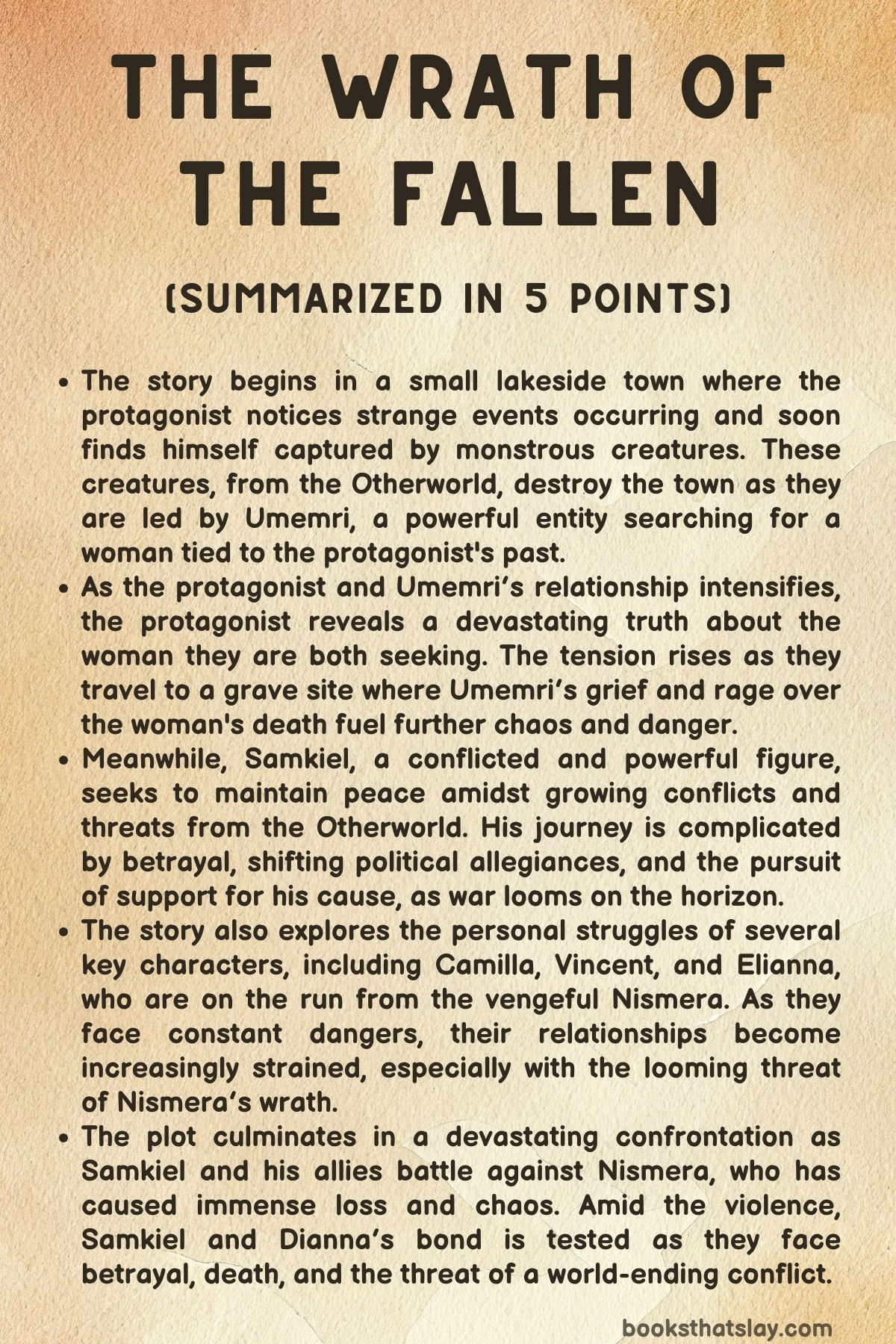
Summary
The story begins with a protagonist working the night shift in a lakeside town. One evening, he notices something strange—the lake, usually teeming with moonkrests, is unusually quiet.
This oddity becomes more alarming when his boss mysteriously disappears, and the protagonist is suddenly attacked by monstrous creatures. These creatures drag him to the town, now in chaos, as forces from the Otherworld led by Umemri, the King of the Otherworld, begin their invasion.
The protagonist is taken captive by these creatures, who are wreaking havoc on the town.
Umemri interrogates the protagonist, searching for a woman who is somehow linked to the destruction. It is revealed that this woman is the protagonist’s murrak, and Umemri detects her scent in the town.
When the protagonist confesses that his murrak is dead, it triggers an emotional outburst from Umemri, escalating the violence. This revelation causes Umemri to press further, seeking information about a woman who was in the company of Samkiel, a significant figure from the Otherworld.
The protagonist identifies her as an Ig’Morruthen, a species tied to the catastrophic events unfolding. As the tension mounts, the protagonist’s life hangs in the balance, but he offers to lead Umemri to the burial site of his murrak, hoping to save himself.
The journey to the grave site is fraught with danger. Once there, Umemri uses his dark powers to summon the murrak’s head, and upon seeing it, his grief and fury overwhelm him.
The protagonist is left in a perilous situation, navigating the increasingly dangerous circumstances while trying to avoid further destruction. Meanwhile, Samkiel, a powerful and conflicted figure, is struggling with the loss of his position and the chaos that continues to spread across the realms.
His interactions with influential figures like Lord Iver only complicate matters, as Samkiel’s desire to prevent war is challenged by the growing loyalty to his sister, Nismera, and her political ambitions.
Samkiel and his companions, including his ally Dianna, travel across realms to rally support. However, their efforts are met with resistance and even betrayal, as many factions remain loyal to Nismera.
In the city of Shorerock, Samkiel and Dianna are greeted by Lord Iver, who dismisses Samkiel and shows no respect for his authority. Tensions rise, but Samkiel confronts Iver, asserting his rightful place.
Along the way, the group faces the ever-present threat of the creatures from the Otherworld, which have decimated many towns. Despite their attempts to assist those in need, many of the towns have already been destroyed, leaving the group demoralized.
As their journey continues, the conflict between the realms intensifies, with Nismera’s rule threatening to upset the delicate peace Samkiel hopes to preserve. Even in places where they once expected support, Samkiel and his group are met with betrayal and unyielding loyalty to Nismera.
They are forced to contend with the harsh realities of their mission and the growing unrest that surrounds them. Despite creating a safe haven for the people in some places, the threat of war looms larger with each passing day.
Back at their home, Samkiel and Dianna reflect on the challenges ahead. While they have made some progress, they are still far from achieving their goals, and the threat of Nismera’s actions continues to cast a long shadow over their efforts.
As they struggle with the weight of their responsibilities, they are also confronted by internal conflicts and the ever-present danger from the Otherworld.
In parallel, the narrative also shifts to the journey of Camilla, Vincent, and Elianna, who are trying to escape Nismera’s wrath. The trio stows away on a cargo ship, disguised as older men, with Camilla using her magical abilities to help them blend in.
Vincent is protective of Camilla, especially after her hands had recently healed from using her magic. Their journey is marked by constant fear of being discovered by Nismera, who is actively hunting them.
Throughout the journey, Camilla and Vincent grow closer, despite the tension with Elianna, who harbors deep resentment toward Kaden. Elianna’s bitterness stems from her love for Kaden and his death, which she cannot seem to reconcile with the actions of those around her.
As the group travels, they face numerous challenges, including the ever-present threat of Nismera’s vengeance and the looming danger of a confrontation they cannot avoid.
As their journey continues, the group learns about a medallion with immense magical power that could bring catastrophic consequences if it falls into the wrong hands. Camilla’s encounter with a mysterious witch further reveals the medallion’s dangerous potential.
Meanwhile, Samkiel faces his own struggles as he grapples with the aftermath of Kaden’s death and the complex relationships with those around him. His bond with Dianna is tested as they face the threat of a powerful ancient being, Gathrriel, who has taken control of Dianna’s body to fulfill his revenge.
The plot shifts between personal struggles and the overarching cosmic conflict, as the characters navigate their tumultuous journeys. The group faces constant threats from the Otherworld, but their quest for survival and a semblance of peace continues to drive them forward.
However, the looming threat of Nismera’s wrath and the challenges that arise from personal betrayals complicate their path. The story culminates in a final confrontation that will alter the course of their fates forever, as the lines between love, betrayal, and power become increasingly blurred.
Characters
Umemri
Umemri, the King of the Otherworld, is a powerful and emotional entity whose motivations are intricately tied to grief and loss. His primary goal throughout the novel is to find out the truth behind the death of the murrak, a figure whose connection to him drives much of his actions.
His emotional vulnerability, revealed through his intense reaction to the news of the murrak’s death, adds a complex layer to his character. Umemri is not just a tyrant but also a being struggling with deep personal grief, which manifests as fury and an unrelenting need for answers.
His powers are immense, and his ability to summon the dead and manipulate others makes him a formidable force. However, it is his emotional fragility and the loss he experiences that shape his decisions, and his eventual confrontation with the protagonist and others reveals both his ruthless nature and his susceptibility to manipulation.
Samkiel
Samkiel is a key figure in The Wrath of the Fallen, defined by his immense power, particularly his connection to Oblivion, a dark force that he struggles to control. His journey is marked by his internal conflict, as he grapples with the weight of his power and its consequences on his relationships, especially with Dianna.
Throughout the narrative, Samkiel is portrayed as a tragic hero, struggling to balance his love for Dianna with the destructive potential of his abilities. His past, marked by the manipulation of others, particularly by Death, shapes much of his current struggles.
Samkiel’s deep connection to Oblivion and his complex relationship with his brothers, Isaiah and Kaden, add layers of conflict to his character. Despite his desire to avoid war and his struggle with his dark nature, Samkiel finds himself at the center of a growing conflict, torn between his duty to protect those he loves and the ever-present danger of his own power consuming him.
His relationship with Dianna, fraught with emotional and physical challenges, adds depth to his character as he faces the destruction caused by his uncontrollable powers and the betrayal of those close to him.
Dianna
Dianna is a character who is both a victim and a warrior, her journey marked by immense suffering and the loss of loved ones. From her imprisonment and brutal treatment at the hands of Nismera to her eventual role in the final confrontation, Dianna’s story is one of survival, vengeance, and love.
As Samkiel’s true love, she shares a deep, often tumultuous bond with him, complicated by the power dynamics and manipulation from figures like Unir and Death. Dianna’s role as a protector and fighter is underscored by her determination to avenge the death of Reggie, someone who sacrificed his life for her.
Throughout the narrative, Dianna is forced to confront her past actions, particularly her connection to Kaden and the ways in which her decisions have led to the tragic events unfolding around her. Her eventual death at the hands of Nismera and the devastating impact it has on Samkiel solidify her as a central figure in the story, a symbol of sacrifice and the destructive power of grief.
Elianna
Elianna is a complex character, driven by a mix of resentment, love, and betrayal. Once a member of the council, she harbors deep bitterness toward Kaden, especially regarding his death.
Her relationship with Camilla and Vincent is strained, and her grief manifests as hostility toward those she holds responsible for Kaden’s fate. Elianna’s bitterness over Kaden’s death reveals her vulnerability, and her complicated feelings towards the group she travels with add layers of conflict to the narrative.
Despite her outward animosity, Elianna’s journey is also one of self-discovery, as she grapples with her past love for Kaden and the choices that led to the fractures in her relationships. Her internal struggles are a reflection of the larger themes of betrayal and loss that pervade the story, making her a character who, despite her flaws, is deeply human in her desire for justice and understanding.
Camilla
Camilla plays a significant role in The Wrath of the Fallen, her magical abilities being both a blessing and a curse. As she and her companions try to escape from Nismera’s wrath, Camilla is often seen using her powers to blend in and protect the group.
Her relationship with Vincent is one of growing connection, despite the tension between the trio, particularly with Elianna. Camilla’s magical abilities are a double-edged sword, especially when Vincent expresses concern about her overuse of her powers, particularly after her hands had recently healed.
Throughout their journey, Camilla is forced to confront her role in Kaden’s death and the consequences of her powers. Her internal struggle, coupled with the constant threat of Nismera, creates a tense atmosphere around her character.
As the story progresses, Camilla’s connection to Vincent deepens, and their shared struggles lead to an emotional bond that will play a key role in the events to come. Her encounter with a witch and the revelations about the medallion she helped mend add another layer to her character, as she must face the catastrophic potential of the forces she has unwittingly helped unleash.
Nismera
Nismera is the antagonist who drives much of the conflict in The Wrath of the Fallen. Created by Unir to prevent apocalyptic destruction, she ultimately becomes a monster whose hunger for power and revenge knows no bounds.
Her manipulation of those around her, including her father Unir, is central to her character. Nismera’s ruthlessness is evident in her actions, particularly in her brutal treatment of Dianna and her manipulation of the gods.
Her ability to shift forms and her immense power make her a formidable adversary. Throughout the story, Nismera reveals herself to be a tragic figure, created without love and consumed by a desire for control.
Her complex relationship with Unir, particularly in their confrontations, highlights the tension between creation and destruction, love and power. Nismera’s ultimate goal is to reign over the realms, and her actions, which involve betrayal, manipulation, and violence, push the story toward its devastating climax.
Her ability to resurrect and regenerate, particularly after being destroyed by Samkiel, underscores her terrifying nature and the unrelenting threat she poses to the world.
Unir
Unir, the god who created Nismera, is a character driven by fear, regret, and a desperate desire to protect the world from destruction. His creation of Nismera, intended to prevent apocalyptic events, ultimately leads to unforeseen consequences.
Throughout his interactions with Dianna, Unir’s true motivations are revealed, especially his guilt over his actions. His relationship with Samkiel is particularly complicated, as he views Samkiel as the key to peace but is terrified of the darkness within him.
Unir’s manipulation of Samkiel’s power, particularly his decision to suppress Samkiel’s memories of Oblivion, reveals his deep fear of his son’s potential. However, Unir’s actions also stem from a sense of protection, as he sought to shield Samkiel from the other gods who would have destroyed him.
Unir’s character is a blend of remorse and determination, and his ultimate realization of the consequences of his actions, particularly in regard to Nismera, marks a pivotal moment in the story. His final confrontation with Nismera, where he admits his regret, highlights the tragic nature of his character, as he grapples with the destructive power of the beings he has created.
Themes
The Struggle for Power and Control
The central theme of The Wrath of the Fallen revolves around the constant battle for power and control among its characters and realms. Power manifests in various forms throughout the narrative—political, supernatural, and personal—each character striving to assert their dominance or to maintain the balance of power.
At the heart of this struggle lies Samkiel, who wields the powerful and dangerous force of Oblivion. His powers are a source of fear, conflict, and manipulation, as they hold the potential to destroy entire realms.
The dynamics between Samkiel and his allies, particularly his relationship with Dianna, showcase the difficulties of wielding such immense power. Their love is a constant tug-of-war between the need for personal connection and the consequences of the power they both harbor.
The manipulations of figures like Nismera further complicate the struggle, as she seeks to use her influence and power to dominate the gods and realms.
On a grander scale, the book presents the tension between the gods, Primordials, and the mortal realm, highlighting the destructive potential of unchecked power. Unir, in particular, is shown to have used his authority to manipulate others, including his creation of Nismera, who was designed to bring peace but instead became an instrument of destruction.
This theme of power is closely tied to betrayal, as characters like Nismera betray those who once believed in them, demonstrating the ease with which power can corrupt even the noblest of intentions. The ultimate question of whether power should be controlled or freely expressed echoes throughout the plot, as the characters navigate their fates and struggle to come to terms with their immense abilities.
Betrayal and Deception
Betrayal is a pervasive theme in The Wrath of the Fallen, shaping the interactions and relationships between the characters. From the manipulation of Samkiel and Dianna by Death to the disloyalty within alliances, the narrative paints a picture of a world where trust is fragile and often broken.
Nismera’s betrayal of Unir, the very god who created her, is a pivotal moment in the story. Despite being born from Unir’s hope for peace, she grows into a force of destruction, manipulating those around her to fulfill her desires for dominance.
Her betrayal is not only personal but also cosmic in its scale, as it sets off a chain of events that leads to the downfall of entire realms.
The emotional core of the book is the betrayal Samkiel faces as he is constantly forced to confront the lies and manipulations that shape his existence. His father, Unir, hides the truth about his powers, fearing the destructive potential of Samkiel’s connection to Oblivion.
This manipulation of Samkiel’s destiny creates a conflict within him, as he seeks to understand who he truly is and whether he can control the darkness within him. Dianna’s role in this is equally significant, as her past actions and relationships with Kaden complicate her bond with Samkiel, highlighting the human side of betrayal.
As the story progresses, the characters are forced to navigate their own personal betrayals, both internal and external, that ultimately shape their destinies.
The Consequences of Love and Loss
The theme of love and loss runs deeply through The Wrath of the Fallen, particularly in the relationship between Samkiel and Dianna. Their love is tested by numerous external forces, from Samkiel’s internal struggles with Oblivion to the manipulation and threats posed by powerful beings like Death and Nismera.
Their connection is strained by the constant shadow of danger, but their bond remains a crucial aspect of the narrative. Samkiel’s grief over Dianna’s death, and the resulting unleashing of Oblivion’s destructive power, underscores the devastating consequences of loss.
This loss is not just emotional but also physical, as it brings about the disintegration of entire cities and realms.
Dianna’s role is pivotal in exploring the effects of love and sacrifice. Her willingness to offer herself in place of Reggie, a gesture that ultimately leads to his death, speaks to the depth of her love and the burdens it places on her.
The tragic nature of love in the story is encapsulated in the moments of sacrifice, as characters continuously face difficult choices between personal desires and greater responsibilities. Dianna’s eventual death at the hands of Nismera is a heart-wrenching moment that not only represents the personal toll of the conflict but also acts as a catalyst for Samkiel’s transformation into Oblivion.
The narrative presents love as a double-edged sword: a force that provides strength but also leaves characters vulnerable to immense pain and destruction.
The Battle Between Good and Evil
The Wrath of the Fallen presents a complex and nuanced depiction of the eternal struggle between good and evil. This dichotomy is explored not as a simple conflict between virtuous and wicked forces but as a battle where characters constantly shift between these extremes.
Unir’s attempt to create beings powerful enough to prevent an apocalypse highlights the moral ambiguity of his actions. His creation of Nismera was intended to bring peace, but her immense power led to her corruption, turning her into a force of evil rather than the savior he had hoped for.
This raises the question of whether the end justifies the means, particularly when the line between good and evil becomes increasingly blurred.
Samkiel, despite being a figure associated with destruction through his power over Oblivion, struggles with his role in the larger battle between good and evil. His quest for peace is marred by the destructive potential of his abilities, and the choices he makes throughout the story reflect his internal conflict.
Is he a hero or a villain? His actions, particularly the rampage he goes on after Dianna’s death, suggest a shift toward vengeance and destruction, but his underlying desire to protect those he loves keeps him tethered to the idea of goodness, even if it is expressed through violence.
On the other side, figures like Nismera embody pure malevolence, driven by a thirst for power and a desire to dominate those around her. Her rise to power and her manipulation of others further complicate the black-and-white view of good versus evil.
The story forces readers to question whether true evil exists or whether it is simply a result of circumstances, choices, and the consequences of power. This complexity in the depiction of good and evil adds depth to the narrative, highlighting that moral purity and corruption are often not clear-cut but are shaped by individual actions and motivations.
The Impact of Fate and Prophecy
Fate and prophecy play a crucial role in shaping the events of The Wrath of the Fallen, as the characters grapple with the idea of predestination versus free will. The concept of prophecy is introduced through Unir’s creation of Nismera and the foretelling of an apocalypse, which he desperately tries to prevent.
This sets the stage for a series of actions meant to alter or control the outcome of a future that seems inevitable. However, the characters’ attempts to escape or change their fates often lead to unintended consequences, suggesting that fate cannot be easily avoided or altered, no matter how hard one tries.
Samkiel’s connection to Oblivion is another aspect of fate that he struggles to understand and control. Despite his efforts to deny or resist the darker aspects of his nature, he is repeatedly drawn into situations that force him to confront his destiny.
His journey highlights the tension between self-determination and the inescapable pull of fate. The eventual death of Dianna serves as a tragic turning point, revealing the futility of escaping one’s fate and the profound impact it has on the world around them.
The idea that the future is already written—no matter how much the characters fight against it—adds a layer of inevitability to the narrative, making the characters’ struggles feel both poignant and tragic.