At Midnight Comes the Cry Summary, Characters and Themes
At Midnight Comes the Cry by Julia Spencer-Fleming is a compelling novel that explores complex social issues, personal struggles, and the intertwining lives of a small-town community. The story delves into the aftermath of a racist incident during a holiday parade and the investigation of a missing officer involved in undercover work.
As former police chief Russ Van Alstyne and Reverend Clare Fergusson navigate their changing lives and their community’s tensions, they uncover unsettling truths about domestic terrorism, extremist groups, and personal sacrifice. The novel explores themes of loyalty, identity, and the challenges faced by those who stand against injustice. It’s the 10th book in The Rev. Clare Fergusson & Russ Van Alstyne Mysteries series.
Summary
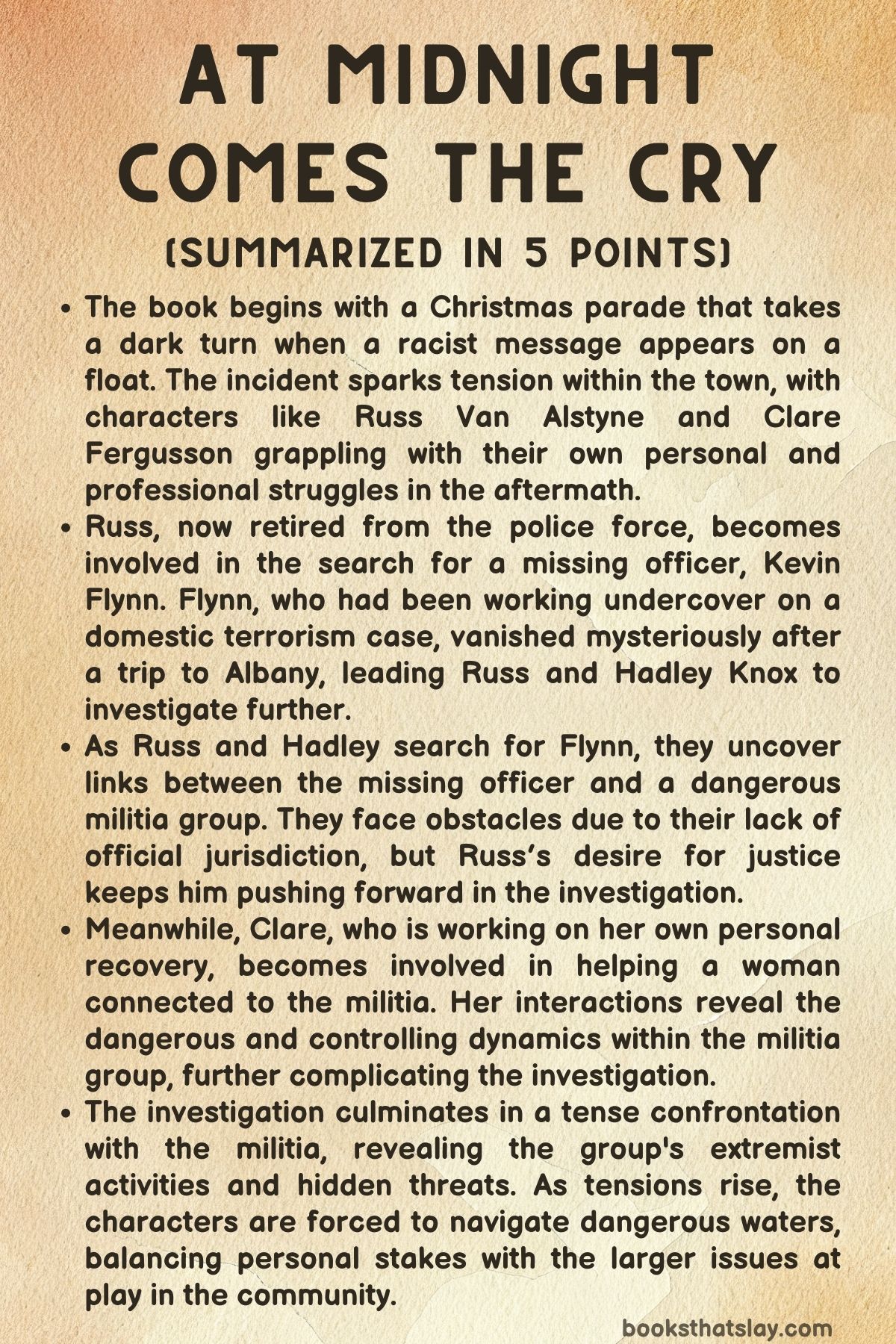
The story begins with a shocking incident at the Greenwich Annual Lighted Tractor Parade. A float, meant to spread Christmas cheer, instead displays a racist message urging people to “Keep America’s Christmas White.” PJ Adams, the local animal control officer, hosts an open house during the parade, where her guests include Reverend Clare Fergusson and her husband Russ Van Alstyne, the recently retired police chief.
As the parade unfolds, a confrontation occurs between Ron Tucker, a mechanic, and men associated with the racist float. Russ intervenes to de-escalate the situation, and the police confiscate the offensive banner.
Despite the resolution of this altercation, the tensions within the town continue to grow as discussions on racism and divisive ideologies take center stage.
In the days following the incident, Russ struggles with his transition to civilian life. Having spent most of his adult life as a cop, he feels lost without his role as police chief.
Clare, who has a history of battling sobriety issues, is now focusing on her ministry and her family. Both Clare and Russ reflect on their pasts, trying to make sense of their current lives and the challenges ahead.
As the town grapples with the aftermath of the parade incident, the community is forced to confront uncomfortable truths about racism and division.
Russ is approached by Hadley Knox, the acting chief of the Millers Kill Police Department, about a missing officer, Kevin Flynn. Flynn had taken a leave of absence from the Syracuse PD and has been missing for two months.
Hadley is concerned for his well-being, and Russ, despite being retired, agrees to help. As the investigation unfolds, Russ learns that Flynn had been working undercover for a domestic terrorism task force and had been investigating militia groups involved in extremist activities.
Flynn’s disappearance after a trip to Albany raises questions, and Russ and Hadley begin to piece together his whereabouts.
Russ’s investigation into Flynn’s disappearance brings back memories of Flynn’s time as an eager young officer. The absence of recent contact with Flynn is troubling, and Russ becomes increasingly drawn to the case.
Though he is no longer an official member of the police force, he cannot ignore his sense of duty. He also works with Lyle MacAuley, the current acting chief, who struggles with leading the department and contending with political resistance to hiring new officers.
As Russ and Hadley dig deeper, they uncover more about Flynn’s last known activities and the broader conspiracy he may have been investigating.
At the same time, Clare continues her own personal journey. After reaching 30 days of sobriety, she faces the complexities of her past and her role in the community.
She reaches out to various individuals, including a woman from the parade with controversial views, trying to foster understanding and dialogue. Her efforts highlight the tension between her desire to help and the deep divisions in the town.
As the investigation progresses, Russ and Hadley travel to Albany, where they meet with Doug Harrison, an official involved in Flynn’s previous investigation. They learn that Flynn had been working on a domestic terrorism case involving militia groups, which had been abruptly shut down.
Hadley and Russ meet Joy Zhào, a young assistant attorney who had been involved with Flynn during the investigation. Zhào reveals that Flynn had been emotionally distressed over the cancellation of the investigation and had planned to leave Syracuse.
She also hints at a lawsuit Flynn was involved in, which added to his turmoil.
Zhào eventually provides a cryptic message from Flynn, leading Russ and Hadley to Rensselaer, where they suspect Flynn may be hiding. At a local diner, they learn more about Flynn’s work with militia groups and his ongoing investigation into illegal activities like gun trafficking and extremism.
The investigation uncovers the involvement of a man named Aaron Kaspertzy, who had worked with Flynn. However, the real breakthrough comes when they discover Calvin March, a militia member with ties to a white supremacist group, who may be connected to Flynn’s disappearance.
Russ and Hadley decide to travel upstate to investigate further. Upon arriving in the Adirondacks, they encounter locals who are wary of outsiders.
As they try to gather information, Russ and Hadley suspect that the militia members are more entrenched in the community than initially realized. Meanwhile, Clare works to build a rapport with Tiny March, the wife of Calvin March, in hopes of gaining insight into the militia’s operations.
Clare learns of the abusive relationship between Tiny and Calvin, as well as Calvin’s violent past.
The investigation into the militia group intensifies, with Russ and Hadley uncovering new leads and connections to Flynn’s undercover work. They discover that the group is attempting to create an all-white enclave in the region, further complicating the investigation.
Meanwhile, Clare continues her efforts to help Tiny escape from her abusive husband, Calvin. The tension rises as Russ and Hadley prepare to confront the militia members, leading to a dangerous standoff that threatens not only their safety but the stability of the community.
As the investigation unfolds, the characters are forced to confront their personal struggles while dealing with the broader social issues at play. The threat of violence looms over the community, and Russ and Hadley’s efforts to locate Flynn and expose the militia group’s illegal activities bring them into direct conflict with dangerous extremists.
Clare’s role as a supportive partner to Hadley and a spiritual guide for the community adds another layer of complexity to the narrative.
The story reaches its climax as Russ, while captured by the militia, learns more about their operations and their plans. Hadley and the team work tirelessly to track down Russ and protect the community from the growing threat.
In a tense and action-filled finale, the group must face the militia head-on to prevent further violence.
At Midnight Comes the Cry explores the intersection of personal lives and larger societal issues, including racism, domestic terrorism, and extremism. It weaves together the personal sacrifices of its characters with the intense action of the investigation, creating a narrative filled with suspense, moral dilemmas, and unexpected twists.
The story is a powerful commentary on the challenges faced by those who stand against hatred and injustice in a deeply divided world.
Characters
Russ Van Alstyne
Russ Van Alstyne is a central figure in At Midnight Comes the Cry, embodying the struggles of a man transitioning from a life of duty to one of civilian challenges. As the former police chief of Millers Kill, Russ is a man deeply embedded in the fabric of law enforcement, but his resignation has left him in a state of personal turmoil.
He grapples with his loss of purpose, unsure how to navigate life outside of the force. His complex relationship with Clare Fergusson adds another layer to his character; despite their shared history and love, he is caught between his role as a public servant and his more personal aspirations.
As the investigation into Kevin Flynn’s disappearance unfolds, Russ’s natural instincts as a former officer re-emerge, even as he works outside the boundaries of his former job. His connection to the case, combined with his internal struggle about his past career, drives him to take actions that put him in dangerous situations, such as confronting a militia group.
Russ’s determination and grit come through as he works to resolve his feelings of inadequacy while also seeking justice in an increasingly divided world.
Clare Fergusson
Clare Fergusson is a powerful and multifaceted character in At Midnight Comes the Cry. As a reverend, she is dedicated to her ministry, but her journey is far from simple.
Having once struggled with alcohol addiction, Clare’s story is one of recovery and personal redemption. Her past battles with sobriety constantly linger in her thoughts, adding emotional weight to her role as a spiritual leader.
While she provides guidance and solace to others, Clare is often seen questioning her own purpose and place in the world. Her relationship with Russ is complex; they share a deep bond, but her life as a reverend takes her in a different direction, leaving her to juggle her faith, family, and the challenges of helping those around her.
Clare’s involvement in the investigation, particularly when it comes to the situation with Tiny March and the militia, illustrates her ability to empathize and connect with people in even the most difficult circumstances. She is an unwavering support for those in need, driven by a desire for peace and understanding in a community torn apart by divisive ideologies.
Hadley Knox
Hadley Knox, the acting chief of the Millers Kill Police Department, is a determined and dedicated officer, thrust into a leadership role under difficult circumstances. She has a strong sense of duty, but her personal history with Kevin Flynn complicates her emotions during the investigation into his disappearance.
Hadley’s relationship with Flynn, which was once secret and complicated, adds an emotional layer to her determination to find him. As the investigation intensifies, Hadley is forced to confront her own feelings of guilt and loss, while also balancing her responsibility as a law enforcement officer.
Her tenacity is evident as she partners with Russ, navigating the challenging and dangerous world of domestic terrorism and militia groups. Despite the emotional weight of her past connection with Flynn, Hadley remains focused on the task at hand, using her skills to help uncover the truth.
Throughout the story, her resilience shines through, showcasing her ability to lead under pressure, even when her personal feelings are at odds with her professional duties.
Kevin Flynn
Kevin Flynn is a character whose disappearance sets much of the plot in motion. A former officer at the Millers Kill Police Department, Flynn had been working undercover on a domestic terrorism case involving militia groups when his life took an unexpected turn.
His emotional turmoil, stemming from the premature cancellation of the investigation and a potential lawsuit, weighs heavily on his actions. Kevin’s decision to continue his investigation despite being removed from the case demonstrates his commitment to uncovering the truth, even if it means working alone.
His relationship with Hadley Knox adds an element of personal complexity to his character, as it suggests that his motivations were not only professional but also intertwined with his feelings for her. Flynn’s journey is one of disillusionment and defiance, as he tries to make sense of the world around him and continue his dangerous work, even as he becomes entangled with dangerous extremist groups.
His story highlights themes of loyalty, justice, and the cost of uncovering uncomfortable truths.
Calvin March
Calvin March is a significant antagonist in At Midnight Comes the Cry, and his involvement with a militia group brings a dangerous and divisive element to the story. A member of a white supremacist militia, Calvin embodies the toxic and violent ideologies that are gaining traction in the community.
His role as a controlling and abusive husband to Tiny March, along with his involvement in criminal activities, paints a picture of a man who is deeply entrenched in hatred and violence. As the investigation into the militia group intensifies, Calvin’s personal and ideological motivations become clearer.
His relationship with the group and their goals of establishing an all-white enclave in the Adirondacks make him a central figure in the story’s exploration of extremism. Calvin’s actions, particularly his efforts to manipulate those around him, serve as a stark contrast to the characters like Clare and Russ, who strive for understanding and justice.
His unyielding belief in his cause and his ability to control others creates a tension that propels the plot forward, leading to dangerous confrontations and revelations about the militia’s activities.
Tiny March
Tiny March is a character who represents the complexity of relationships within extremist environments. As Calvin’s wife, she is caught in an abusive and controlling relationship, unable to escape the grip of her husband’s violence.
Clare Fergusson’s interactions with Tiny reveal a woman who is struggling to find her voice and break free from the oppressive forces around her. Tiny’s troubled past and the hold Calvin has over her make her a sympathetic figure, as she seeks refuge and understanding from those around her.
Her involvement in the militia’s activities, albeit reluctantly, highlights the power dynamics at play within extremist groups, where individuals like Tiny are often trapped in situations of manipulation and coercion. Clare’s efforts to support Tiny and help her navigate the challenges of her abusive relationship with Calvin provide a glimmer of hope, showing the power of empathy and community in healing wounds caused by violence and hatred.
Sue Hansen
Sue Hansen is the somewhat secretive innkeeper in the Adirondacks, where Russ and Hadley continue their investigation. Her role, though not as prominent as some of the other characters, is crucial in providing insight into the local dynamics and the distrust that outsiders face in the region.
Sue’s hints about the militia’s presence in the area contribute to the sense of danger and uncertainty that permeates the investigation. Her interaction with Russ and Hadley highlights the tension between the local population and those seeking to uncover the truth about the militia group.
Sue’s character, while not heavily involved in the investigation, adds to the overall atmosphere of suspicion and unease that the protagonists must navigate in their quest for justice.
Rabbi Oppenheim
Rabbi Oppenheim’s role in At Midnight Comes the Cry is pivotal in the tension-filled Hanukkah celebration scene. As a figure of authority within the Jewish community, Rabbi Oppenheim tries to reassure others that security measures have been taken to prevent an attack.
However, his confidence is tested when the group discovers the hidden IED. The Rabbi represents the theme of faith and leadership in times of crisis, showing that even spiritual leaders must confront real-world dangers.
His interactions with Russ and the others underline the importance of vigilance, even in spaces meant for celebration and peace. Though his actions are less directly impactful to the plot, Rabbi Oppenheim’s presence underscores the communal effort to protect and defend against extremism, tying together the story’s broader themes of resistance and unity against hate.
Themes
Racism and Divisive Ideologies
At Midnight Comes the Cry confronts the deeply rooted issues of racism and divisive ideologies within a small town setting. The story begins with a shocking incident during the Greenwich Annual Lighted Tractor Parade, where a float promoting “Spreading Christmas Cheer” is marred by a racist message that calls for “Keep America’s Christmas White.” This act serves as a catalyst for the town’s reflection on its internal divisions and the larger societal issues at play.
The offensive banner exposes the prevalence of white supremacist views and highlights how such ideologies can persist even in seemingly innocent public events. The reactions to the parade incident reflect a community divided between those who believe in traditional values and those who are fighting against such backward beliefs.
Throughout the narrative, the characters, especially Russ and Clare, grapple with their own roles in addressing racism, both within the town and within themselves. Russ, in particular, is forced to confront his past as a police chief and his personal reflections on justice and the implications of systemic discrimination.
The theme of racism is further explored through the character of Calvin March, a militia member involved with a white supremacist group, whose past and present actions reinforce the dangers of ideological extremism. Ultimately, the novel paints a picture of a society struggling with its darker history and grappling with how to move forward in an increasingly polarized world.
Personal Transformation and Identity
Another central theme in At Midnight Comes the Cry is the journey of personal transformation and the search for identity. Russ Van Alstyne, a former police chief, is in the midst of a profound personal crisis as he adjusts to life after his resignation.
Having spent the majority of his adult life in law enforcement, Russ now faces the challenge of navigating civilian life, questioning his purpose and role within the community. His struggle is compounded by his lingering connection to the police force, making it difficult for him to entirely separate himself from his former identity.
His attempts to find meaning in his new life are mirrored by Clare Fergusson, the reverend who is dealing with her own transformation after overcoming alcoholism. Clare’s personal journey involves finding balance between her faith, her ministry, and her family, as she wrestles with her past and tries to reconcile it with her present.
Both Russ and Clare are confronted with the complexities of personal growth, dealing with their past mistakes, and finding a new path forward. Their experiences demonstrate that identity is not static; it is something that constantly evolves as individuals face life’s challenges and learn from their experiences.
This theme of transformation underscores the novel’s deeper exploration of the self and how it intersects with larger societal forces.
Loyalty, Duty, and Sacrifice
The theme of loyalty, duty, and sacrifice is a driving force in At Midnight Comes the Cry, particularly through the lens of personal and professional relationships. Russ’s decision to help locate Kevin Flynn, despite his retirement, reflects a deep sense of duty that he cannot shake, even after stepping down from his position as chief.
His personal commitment to solving the case of a missing officer is intertwined with his lingering responsibility to the community and the law enforcement profession. This sense of loyalty is tested further as Russ navigates his interactions with the acting police chief, Hadley Knox, and his efforts to help his former colleagues, despite no longer holding an official position.
Russ’s sacrifice is not just in terms of his time and effort, but also in terms of emotional and physical risk, as he willingly puts himself in dangerous situations to uncover the truth. Clare’s role in the investigation also reflects a sense of loyalty, not only to the mission but also to the individuals involved.
Her willingness to engage with difficult people, like Tiny March, and to confront her own personal demons showcases her commitment to the community and her moral responsibility as a minister. The characters’ loyalty to their friends, family, and professional obligations underscores the sacrifices they are willing to make, even when the stakes are high and the path is fraught with danger.
This theme is pivotal in the characters’ personal growth, as they are constantly tested by their circumstances and forced to choose between duty and personal safety.
Gender and Power Dynamics
At Midnight Comes the Cry also tackles the theme of gender and power dynamics, particularly through the roles and experiences of Clare Fergusson and Hadley Knox. Clare, as a reverend, occupies a traditionally male-dominated role within the church, where her leadership is often challenged or undermined due to her gender.
Yet, her strength, faith, and ability to lead make her an influential figure, showing how women can defy societal expectations and make an impact in spheres of power traditionally reserved for men. Hadley, as the acting chief of police, also faces the challenges of working in a male-dominated field, where she is often forced to prove herself in a system that may question her authority and competence.
Both Clare and Hadley’s professional and personal lives intersect with the theme of gender, as they navigate the complexities of power and authority in a society that often diminishes the voices of women. Throughout the novel, the power dynamics at play are explored through their struggles to assert control in situations that threaten to undermine their positions.
This theme is further reflected in the toxic relationship between Calvin and Tiny March, where gender-based power imbalances and abuse are evident. Tiny’s struggle to break free from her controlling husband’s oppressive grip serves as a critical commentary on the darker side of gender relations, and the novel underscores the importance of challenging these dynamics both personally and socially.
Extremism and Political Corruption
Extremism and political corruption are central themes in At Midnight Comes the Cry, as the novel delves into the dangerous undercurrents of domestic terrorism and militia groups. Kevin Flynn’s investigation into militia groups involved in illegal activities, such as gun trafficking and extremism, highlights the growing threat of radical groups operating under the guise of patriotism.
These groups, often fueled by racist and anti-government ideologies, pose a significant threat not just to individuals but to the fabric of society as a whole. The narrative examines the broader social implications of these ideologies and the ways in which they can infiltrate communities, manipulate individuals, and provoke violent actions.
The uncovering of Flynn’s investigation into these extremist groups reveals the deep political corruption that enables such movements to thrive, as financial and political pressures often shut down investigations that could expose these dangerous activities. The theme of extremism is also explored through the character of Calvin March, whose ties to a white supremacist group further complicate the investigation.
The novel portrays how personal beliefs can intertwine with larger political movements, showing the devastating effects of ideological extremism on both individuals and society. Through the investigation into Flynn’s disappearance and the growing threat posed by these groups, the book underscores the urgency of addressing extremism and corruption in order to protect communities and safeguard justice.