Between Two Kings Summary, Characters and Themes
Between Two Kings by Lindsay Straube is a fantasy romance about love, loyalty, power, and the painful cost of impossible choices. The story follows Temperance “Tem” Verus, a half-human, half-basilisk woman caught between two rulers: Caspen, the basilisk king she has married, and Leo, the human king she still loves.
Set against rising tensions between humans and basilisks, the book explores political unrest, dangerous magic, clan rivalry, and desire shaped by duty. Tem’s journey is not just about choosing between lovers; it is about understanding who she is, what power demands, and what sacrifice can mean.
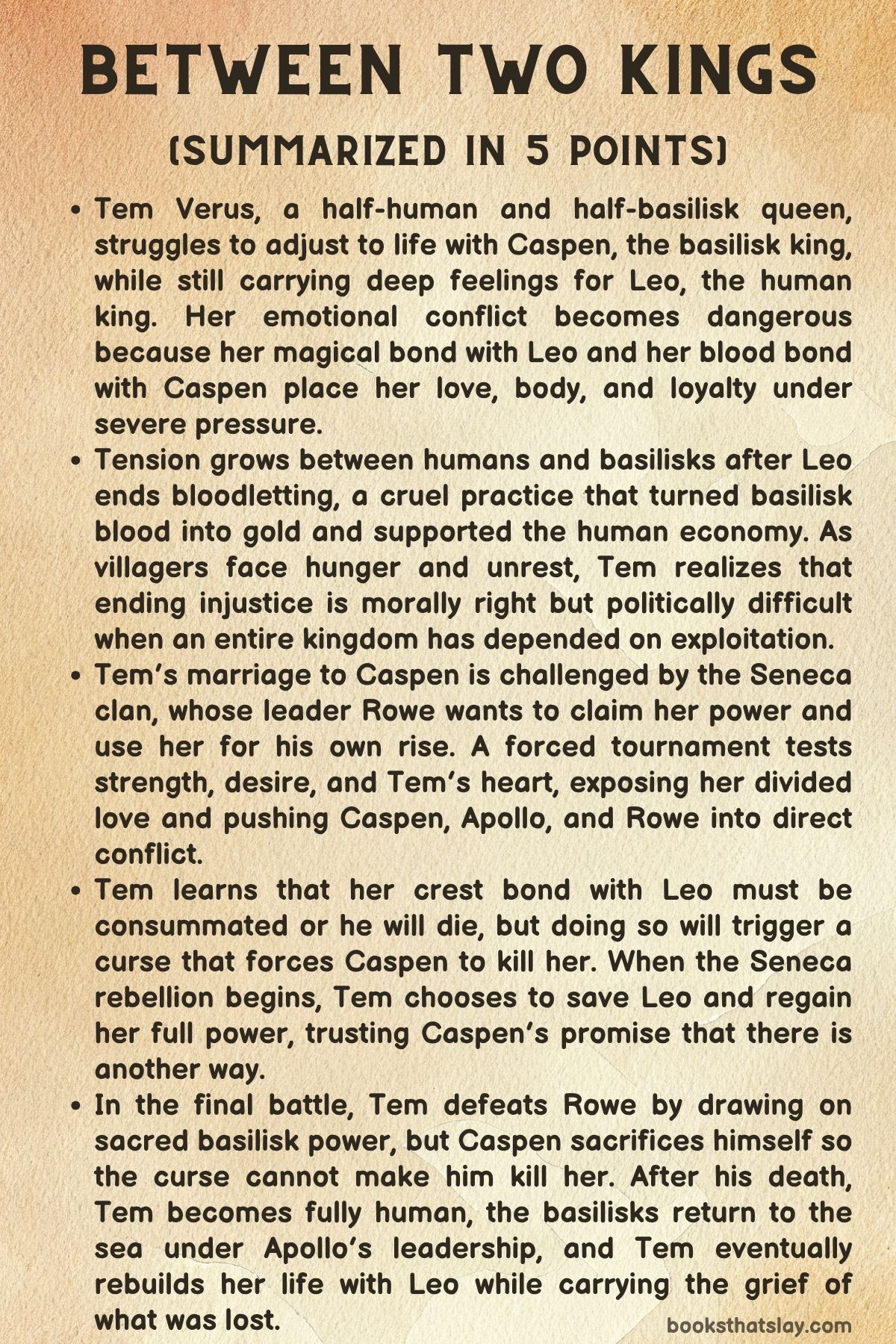
Summary
Tem Verus begins the story trying to settle into her new life as the wife of Caspen Drakon, king of the basilisks. As a hybreed, half human and half basilisk, she belongs fully to neither world.
Her marriage to Caspen has placed her in the center of basilisk society, but she is still learning how to live with her new body, her powers, and the fierce customs of her husband’s people. Her transformations into basilisk form remain difficult to control, and her heightened physical desires leave her frustrated and ashamed.
Caspen reassures her that mastery will take time, but Tem’s inner conflict runs deeper than her powers.
Tem is still legally married to Leo, the human king. She once loved him deeply and still does, even though she has bonded herself to Caspen.
Through a magical ritual called cresting, she also created a bond with Leo that makes him vulnerable to her influence. To protect him and secure his happiness, she had pushed him toward Evelyn, his first love.
When Leo summons her to the castle, Tem expects him to ask for an annulment so that he can marry Evelyn. He does exactly that.
The annulment is signed in the dungeon by Maximus, Leo’s imprisoned father, and Tem is left mourning the life she might have had with Leo.
Back among the basilisks, Tem tries to commit herself fully to Caspen. Their relationship is passionate, but basilisk customs unsettle her.
Caspen explains that basilisks separate the heart from the body, allowing physical freedom while treating emotional betrayal as unforgivable. This frightens Tem because she still loves Leo.
Her father, Kronos, warns her that loving two people can be dangerous in basilisk culture. Tem already suspects that sending Leo back to Evelyn did not resolve anything.
Instead, it may have made her feelings harder to bear.
Tem’s world becomes more complicated when she meets Apollo, Caspen’s brother. Apollo is confident, provocative, and openly drawn to her.
Caspen explains that if he dies, Apollo has a traditional claim to marry her, which makes sexual compatibility between them a recognized possibility in basilisk society. Tem insists she has no intention of sleeping with Apollo, but his presence begins to affect her.
At the same time, she learns that her marriage has created political anger. The Seneca clan, connected to Tem through her father, sees her power as something that should belong to them.
Their leader, Rowe, wants revenge and may seek to claim her.
The political tension between humans and basilisks is also worsening. Leo ended the bloodletting system, in which basilisk blood was drained and turned into gold.
Morally, this decision protected the basilisks, but economically it has hurt the human villagers. Food shortages and poverty spread, while the palace still appears wealthy.
Tem’s best friend Gabriel helps organize a protest, and Tem witnesses villagers crying out against hunger and writing “Feed us” on the church steps. She realizes that many humans never cared about basilisk suffering; they cared only about survival.
The end of bloodletting has exposed how deeply the kingdom depended on cruelty.
Weekly dinners between Tem, Caspen, Leo, and Evelyn become emotionally painful. Evelyn plans an extravagant wedding to Leo on Mother’s Night, a sacred basilisk holiday, while the kingdom struggles.
Tem finds Evelyn selfish and suspects that her story about leaving Leo years ago is false. Evelyn claims Maximus forged a letter that made her believe Leo no longer wanted her, but Tem doubts her explanation.
Leo also begins to question it. His relationship with Evelyn grows colder, while his bond with Tem remains powerful and unresolved.
Tem encourages Leo to write letters to her as a private outlet, though she does not read them at the time.
Tem’s relationships with Caspen and Apollo grow more charged. Apollo teases and tempts her, while Caspen both resents and responds to the rivalry.
During basilisk rituals and gatherings, Tem becomes more confident in her sexuality and her role as queen, but she often feels used in games of dominance between the brothers. Apollo later offers to teach her how to petrify humans, a power Caspen refuses to teach because he does not want her burdened by killing.
Tem eventually accepts Apollo’s help. They petrify an elderly man who is already close to death, and Tem is shaken by the experience.
She learns that taking a life fills basilisks with power and desire. Apollo helps her through the aftermath, and he shows her a hidden chamber filled with petrified humans, which he frames as justice for the basilisks who were taken for bloodletting.
Tem’s choices strain her marriage. Caspen is hurt that Apollo taught her something he withheld, but the conflict is interrupted by a larger crisis.
The Senecas formally contest Tem and Caspen’s marriage, forcing a tournament that will determine who has the right to claim her. Tem is horrified because she cannot simply refuse.
Rowe and his brother Eros enter the contest, as do Caspen and Apollo. The tournament will test strength, seduction, and the call of Tem’s heart.
Tem fears that her heart might not choose Caspen alone. It may call to Leo, or even Apollo.
Before the tournament, Tem learns a devastating truth from Kronos. Because she crested Leo while loving him, the bond must be consummated.
If she does not sleep with Leo, her basilisk powers will continue to fail and Leo will weaken until he dies. But if she does sleep with Leo, her blood bond with Caspen will trigger a curse that forces Caspen to kill her.
Tem is trapped between saving Leo and preserving her life with Caspen. She hides this truth for a time, but Apollo discovers it when he temporarily removes her love for Leo during the tournament so that her heart can choose Caspen.
His act allows Caspen to win her, but the solution cannot last. Tem’s love for Leo returns, and Apollo warns that she must face the problem.
The tournament exposes both danger and desire. Rowe defeats Caspen in combat through forbidden magic and later taunts Tem with his knowledge of her love for Leo.
Apollo protects her during the final stage and becomes an emotional confidant as well as a source of temptation. After the tournament, Tem finally confesses to Caspen that she loves Leo and that the crest must be consummated.
Caspen feels betrayed, especially because Apollo knew before he did. His fury turns toward Leo, but the crisis deepens when they discover that Rowe has used a bite wound to siphon Caspen’s strength.
Rowe is growing more powerful and preparing for rebellion.
Meanwhile, the human side of the conflict becomes deadly. Villagers release a weasel into the basilisk caves, knowing its scent can kill basilisks.
Tem, as a hybreed, is able to hunt and kill it, but forty-six basilisks die. The loss devastates the colony.
Later, Tem learns that Rowe helped orchestrate the attack by using human resentment for his own purposes. Evelyn also reveals her true nature.
She admits Maximus paid her to leave Leo years earlier and makes clear that once she is queen, she intends to restore bloodletting and end peace efforts. Leo eventually learns enough to understand that Evelyn does not truly love him.
She leaves, and Leo begins looking for a way to save his kingdom without returning to exploitation.
Caspen arranges for Leo to come to the basilisk caves to apologize for the weasel attack, but Tem realizes there is another reason. The Seneca revolt is beginning, and Caspen wants Leo and Tem to consummate the crest so that Tem’s full power will return before the battle.
Tem fears the curse, but Caspen insists there is another way. Trusting him, she goes with Leo.
They finally make love, confessing their enduring love and saving Leo’s life. Tem’s basilisk powers return in full, but so does the danger of the blood bond.
Caspen is now magically compelled to kill her.
As the caves fall into violence, Tem sends Leo and Gabriel away with Damon and goes to face Rowe. Rowe admits he used the weasel attack as part of his plan.
Tem attacks him but is overpowered. Caspen arrives under the curse’s command, torn between saving and killing her.
Apollo holds Caspen back while Tem draws on the sacred lake and channels the goddess Kora’s power. She defeats Rowe by taking back the strength he stole and killing him.
But the curse remains. Apollo reveals that Caspen made him promise to kill him if necessary, because Caspen’s death is the only way to break the bond and save Tem.
Apollo bites Caspen, and the curse breaks.
Caspen dies in Tem’s arms. Before his death, he tells her that Leo is her true love and that she will not be alone.
He had found Leo’s letters and understood the depth of Leo and Tem’s love. Rather than let the curse destroy her, he chose to sacrifice himself.
Apollo takes Caspen’s remaining power, and Tem’s basilisk side dies with the broken bond. She becomes fully human, though she keeps some minor abilities.
After Caspen’s funeral, the basilisks decide to return to the sea under Apollo’s leadership, accepting that peace with humans may not be possible in the human realm. Apollo and Damon formally give up their claims to Tem.
Tem says goodbye to Apollo and returns to Leo. She and Leo marry quietly at her parents’ cottage, with Gabriel and Damon present.
Life continues with grief, healing, and change. Leo removes the gold from the castle and refuses to rebuild his kingdom on bloodletting.
Tem later receives Leo’s letters and discovers that the first letter is from Caspen. In it, he explains how reading Leo’s words showed him that Tem and Leo’s love was real.
His final act becomes one of love, release, and sacrifice.
Characters
Temperance “Tem” Verus
Tem is the emotional and political center of Between Two Kings, and her character is shaped by division from the beginning. She is half human and half basilisk, married to Caspen while still bound emotionally and magically to Leo.
This split identity gives her unusual power, but it also makes her vulnerable to competing worlds that both want something from her. Among humans, she is viewed with suspicion because she is now tied to the basilisks.
Among basilisks, she is a queen, a hybreed, a potential vessel of divine power, and a target for clan ambition. Her personal conflict reflects this larger instability.
She wants to be loyal to Caspen, but her love for Leo does not vanish simply because she made a choice. Her struggle is not presented as shallow indecision; it is rooted in duty, magic, guilt, desire, and the consequences of earlier choices.
Tem’s development comes through painful education. At first, she often reacts emotionally and impulsively, whether by pushing Leo toward Evelyn, volunteering for bloodletting, bringing Gabriel into the basilisk caves, or seeking Apollo’s help behind Caspen’s back.
Yet these actions are not meaningless mistakes. They show her trying to solve political and emotional problems before she fully understands their depth.
She gradually learns that good intentions can cause harm when they ignore truth. Her decision to reunite Leo with Evelyn nearly destroys him.
Her attempt to bridge humans and basilisks exposes Gabriel to danger but also helps him understand basilisk life. Her desire to protect herself by learning petrification forces her to confront the moral weight of killing.
By the end of the book, Tem is stronger not because she becomes untouched by guilt, but because she accepts responsibility for choices that cannot be made cleanly.
Tem’s power is also tied to love, which makes her especially complicated. Her basilisk abilities are weakened because the crest with Leo remains incomplete, and her heart is divided between two men who both love her in different ways.
The story repeatedly asks whether love can be controlled by law, ritual, marriage, or magic. Tem proves that it cannot.
Her love for Leo survives annulment, separation, and even her marriage to Caspen. Her love for Caspen is equally real, built on passion, trust, and the life they create together among the basilisks.
This dual love places her in danger because basilisk magic punishes emotional betrayal with death. Tem’s tragedy is that her heart does not follow the rules of either kingdom.
Her final survival comes at an enormous cost: Caspen’s sacrifice, the death of her basilisk side, and the need to rebuild herself after losing one of the people she loves most.
Caspen Drakon
Caspen is the basilisk king, Tem’s husband, and one of the book’s most powerful figures. He is commanding, possessive, sensual, and deeply shaped by basilisk law.
As ruler, he carries the weight of a people who have been exploited by humans through bloodletting. His refusal to allow bloodletting to resume is not only personal; it is a political and moral line that he will not let anyone cross.
This makes him appear cold when human villagers suffer from poverty and hunger, but his hardness comes from knowing that human prosperity has long depended on basilisk pain. Caspen’s leadership is therefore built on protection, memory, and distrust.
He understands the cost of human cruelty, and he does not easily separate innocent humans from the system that harmed his people.
In his marriage to Tem, Caspen is both tender and controlling. He loves her intensely and often reassures her, protects her, and helps her adjust to basilisk life.
Yet he also withholds knowledge, especially about petrification, because he believes he knows what pain she should be spared. His refusal to teach her comes from love, but it denies her agency.
He also fails to fully accept the depth of her love for Leo until the truth becomes impossible to ignore. Caspen can tolerate physical openness because basilisk culture allows it, but emotional rivalry wounds him.
This contrast makes his jealousy complex. Apollo’s pursuit of Tem excites his competitive instincts, but Leo’s place in her heart threatens the foundation of their bond.
Caspen’s tragedy lies in loving Tem while belonging to a magical system that cannot tolerate the full truth of her heart.
Caspen’s final sacrifice reveals the deepest part of his character. Once he reads Leo’s letters, he understands that Leo’s love for Tem is not weak, false, or temporary.
He also understands that Tem cannot survive unless the curse is broken. Rather than let the blood bond turn him into her killer, he arranges the only solution he believes will save her.
His death is not a defeat of love but an act of painful clarity. He gives Tem the future he cannot share with her, and in doing so, he moves beyond possessiveness into selfless devotion.
Caspen remains a king until the end, but his final act is not about ruling. It is about releasing the person he loves from a bond that would otherwise destroy her.
Leo
Leo is the human king and Tem’s first great love. In the book, he represents both emotional longing and the burden of flawed human rule.
When the story begins, he is trying to move forward with Evelyn after Tem pushes him back toward her through the crest. At first, his coldness toward Tem seems like rejection, but it is also a defense against pain.
He is still drawn to her, still hurt by her choices, and still unaware of how deeply she has influenced him through magic. Once he learns that Tem used the crest to compel him, his anger is justified.
Leo’s love has been manipulated, even if Tem acted from a desire to protect him. This makes their relationship morally difficult, because their bond contains real love as well as magical coercion.
As king, Leo is more compassionate than his father, but he is not always strong. His decision to end bloodletting is morally right, yet he fails to prepare his kingdom for the economic collapse that follows.
The villagers suffer while the palace remains visibly privileged, and this gap fuels rebellion. Leo wants to be better than Maximus, but he is surrounded by the consequences of old systems and his own hesitation.
His relationship with Evelyn exposes his fear of abandonment. Even after suspecting she is dishonest and greedy, he struggles to break away from her because he is afraid of being left again.
This weakness does not make him cruel, but it does make him vulnerable to manipulation.
Leo’s letters reveal his truest self. In them, he admits the pain of seeing Tem with Caspen, the constant pull of the crest, and his growing recognition that Evelyn is not the woman he imagined.
His love for Tem is patient, anguished, and deeply human. Unlike Caspen, Leo does not possess supernatural strength or a ruling culture that validates his desire.
He can only wait, write, suffer, and hope. When he enters the basilisk caves to apologize, he shows courage and humility.
When he chooses not to reinstate bloodletting, he begins to earn moral authority. By the end, Leo becomes not merely the man Tem returns to, but a king who must rebuild his realm without exploiting the basilisks.
His future with Tem is born from loss, but it also carries the possibility of a more honest life.
Apollo
Apollo is Caspen’s brother, Tem’s pursuer, and one of the most unpredictable figures in the story. At first, he appears reckless, flirtatious, and dangerous.
He enjoys provoking Caspen and unsettling Tem, and his sensual confidence makes him seem like a threat to the marriage. Yet as the book develops, Apollo becomes far more than a rival.
He understands basilisk customs, power, and desire with a clarity that Tem often lacks. He teaches her what Caspen refuses to teach, including petrification, and though this choice is morally troubling, it also gives Tem knowledge she needs.
Apollo is willing to cross boundaries that Caspen avoids, which makes him both risky and necessary.
Apollo’s relationship with Tem shifts from seduction to genuine care. He respects certain limits even while testing others, and he becomes one of the few people who knows the full danger of her love for Leo.
During the tournament, he protects her from Rowe and temporarily removes her love for Leo so her heart can call to Caspen. This act is invasive, but it is also done to prevent immediate disaster.
Apollo often operates in morally gray spaces, making choices that are hard to defend but easy to understand within the danger around him. He is not innocent, but he is loyal in his own fierce way.
His bond with Caspen is equally important. The brothers compete, argue, and wound each other, yet Apollo ultimately honors Caspen’s final request.
Killing Caspen to break the curse is an unbearable act, but Apollo does it because he loves his brother and understands the necessity. After Caspen’s death, Apollo becomes the basilisk leader and chooses to take his people back to the sea.
His farewell to Tem shows restraint and maturity. He gives up his claim to her and accepts that his role in her life is not to possess her.
Apollo begins as temptation and danger, but he ends as a guardian of memory, duty, and survival.
Evelyn
Evelyn is one of the clearest examples of self-interest hidden beneath romance. She returns to Leo claiming that a forged letter drove her away years earlier, but the truth is that Maximus paid her to leave.
Her reunion with Leo is therefore built on deception. She presents herself as a lost love restored, but her behavior quickly reveals that she is more interested in status, wealth, and the comforts of queenship.
Her impatience with financial hardship, her desire for an extravagant wedding, and her willingness to consider renewed bloodletting all show a character guided by ambition rather than love.
Evelyn’s danger lies in her ability to read weakness. She understands Leo’s fear of abandonment and uses it.
She understands Caspen’s jealousy and tries to exploit it by leaving Leo’s letters where he can find them. She understands Tem’s guilt and attempts to make truth seem useless or cruel.
Unlike Rowe, Evelyn does not rely on physical violence. Her weapon is manipulation.
She positions herself as practical, but her practicality is morally empty. She is willing to sacrifice basilisk lives for gold and dismisses the dead from the weasel attack as possible resources.
This coldness makes her one of the story’s most disturbing human figures.
Evelyn also serves as a contrast to Tem. Both women are connected to Leo, but Tem is tormented by the consequences of her choices, while Evelyn avoids accountability until it benefits her to speak plainly.
Tem may make serious mistakes, yet she suffers over them and tries to repair the damage. Evelyn sees people as routes to security.
Her departure after Leo learns the truth confirms that she never had the devotion he wanted to believe in. She is not merely a romantic obstacle; she represents the old human appetite for wealth without concern for the suffering that produces it.
Gabriel
Gabriel begins as Tem’s best friend from the human village, and his role is important because he stands between ordinary human anger and the possibility of understanding. At first, he is part of the unrest caused by poverty and hunger.
He helps organize protest because he has seen the contrast between royal comfort and village suffering. His anger is not baseless.
The villagers are hungry, and the end of bloodletting has changed their lives without giving them an alternative means of survival. Yet Gabriel also shares the villagers’ indifference toward basilisk suffering at first.
He is sympathetic, but not morally complete.
His visit to the basilisk caves changes him. Instead of seeing basilisks as monsters, he sees their society, their intimacy, their customs, and their capacity for tenderness.
His connection with Damon is especially transformative. Through love, Gabriel begins to reject the hatred spreading through the village.
This does not erase his loyalty to humans, but it gives him a more complex view of the conflict. He becomes proof that contact can change prejudice, although the larger political conflict remains too violent for one friendship or romance to solve.
Gabriel’s importance also lies in how he reflects Tem’s past. He knows who she was before queenship, before basilisk politics, before the impossible triangle of Caspen and Leo.
Their friendship gives her a link to her human life. When that friendship strains under political pressure, Tem feels the cost of becoming a figure rather than simply a person.
Gabriel’s eventual bond with Damon creates a bridge between worlds, but it is a fragile bridge. By the end, he lives partly within the basilisk future, showing that personal love can survive even when societies fail to make peace.
Damon
Damon, Caspen’s youngest brother, brings warmth and gentleness into a family often defined by power and rivalry. Unlike Caspen and Apollo, he does not dominate the story through danger, authority, or seduction directed at Tem.
His importance comes through openness. When he meets Gabriel, their connection is immediate and affectionate, offering one of the book’s clearest examples of love that is not built on competition.
Damon’s relationship with Gabriel shows a softer side of basilisk culture, one based on choice, pleasure, and mutual comfort rather than political claim.
Damon also helps humanize the Drakon family. Caspen is burdened by kingship, and Apollo is shaped by rivalry and risk, but Damon suggests another possibility for basilisk masculinity.
He is not weak, but he is less consumed by dominance. His tenderness toward Gabriel helps Gabriel see basilisks as people rather than enemies.
That emotional shift matters because it counters the dehumanizing language used by the villagers and by Evelyn. Damon’s presence quietly challenges fear.
By the end, Damon’s decision to waive his claim to Tem also shows respect for her autonomy. He has no desire to trap her in basilisk custom, and his future with Gabriel suggests that love can continue outside the central political tragedy.
Damon is not the most powerful character, but he is one of the most emotionally stabilizing. He represents trust, acceptance, and the possibility of bonds that do not require possession.
Adelaide
Adelaide is Tem’s guide to basilisk society and one of the few characters who offers her steady support without trying to claim her. She helps Tem understand customs, rituals, clan politics, and the meaning of the tournament.
Her knowledge is essential because Tem enters basilisk life without the upbringing that would make its rules feel natural. Adelaide often explains what others assume Tem should already know.
In this sense, she is both mentor and protector.
Her friendship matters because Tem is frequently surrounded by people who desire, need, or fear her. Adelaide gives her companionship that is less possessive.
She defends Tem against hostility, advises her during moments of confusion, and stands with her during public trials. She also understands the spiritual dimension of Tem’s power, especially the possibility that Tem can channel Kora.
Adelaide’s role is therefore not only social but sacred. She recognizes that Tem’s significance reaches beyond marriage politics.
Adelaide also represents the continuity of basilisk culture. She understands its beauty and its cruelty, its rituals and its laws.
She does not always free Tem from those laws, but she helps her survive them. At the end, when the basilisks prepare to leave, Adelaide’s presence reinforces the sense of a society carrying its traditions into exile.
Her character gives the story a voice of wisdom, loyalty, and cultural memory.
Rowe
Rowe is the central violent antagonist within the basilisk world. As a Seneca leader, he sees Tem not as a person with her own will but as a source of power that should belong to his clan.
His desire to claim her is political, sexual, and magical. He is driven by resentment toward Caspen and by the belief that Tem’s strength can restore or elevate Seneca dominance.
This makes him dangerous because he combines personal revenge with a larger factional cause.
Rowe’s body itself becomes a sign of corrupted ambition. After being punished by Caspen for violating Tem, he creates a golden replacement using blood-based power, breaking sacred limits and making himself stronger.
This act reflects his willingness to deform law, body, and tradition for advantage. During the tournament, he cheats, bites Caspen, and later uses the wound to siphon power.
He does not seek victory through honor but through theft. His methods reveal the hollowness of his claim to leadership.
Rowe’s use of the human rebellion shows his strategic cruelty. He helps turn human hatred into a weapon against the basilisks, leading to mass death through the weasel attack.
He does not care about human suffering or basilisk unity; he cares about power. His final confrontation with Tem brings the story’s conflicts together: clan rivalry, stolen strength, gendered control, and the danger of treating a woman as a prize.
Tem’s defeat of Rowe is therefore not only physical. It is a rejection of the idea that her power belongs to any man, clan, or political faction.
Kronos
Kronos, Tem’s father, is a quieter but highly important character because he gives Tem knowledge that others withhold or overlook. As a basilisk who lives outside the center of court politics, he offers a different kind of wisdom.
He understands both the danger of basilisk customs and the emotional complexity of Tem’s situation. When he warns her that loving two people is dangerous, he is not being judgmental.
He is speaking from knowledge of how basilisk law turns emotion into life-or-death consequence.
His most important role is revealing the truth about the crest. Tem learns from him that her bond with Leo must be consummated or Leo will die and her own basilisk nature will fail.
This revelation changes the entire direction of the story. Kronos’s knowledge forces Tem to stop treating the Leo problem as purely emotional.
It is magical, bodily, and urgent. He becomes the messenger of a truth that no one can avoid.
Kronos also represents parental shelter. Tem visits her parents when basilisk life overwhelms her, and their home gives her a rare space away from royal duty and sexual politics.
Yet even that shelter cannot protect her from consequence. Kronos can explain the rules, but he cannot save her from them.
His role is loving but limited, which makes him realistic. He gives Tem truth, and then she must decide what to do with it.
Maximus
Maximus is Leo’s imprisoned father and the former human king. Even from the dungeon, his influence remains strong because the systems he helped maintain continue shaping the kingdom.
He represents the old order: bloodletting, political control, class imbalance, and the use of people as tools. His imprisonment does not erase the damage caused by his rule.
The economic crisis after the end of bloodletting proves how deeply the kingdom depended on exploitation.
His conversation with Tem about Evelyn reveals another side of his power. He did not send a forged letter; he paid Evelyn to leave Leo.
This act was cruel and manipulative, but it also exposes Evelyn’s greed. Maximus’s truth-telling is not moral redemption.
He is still cynical, and he argues that cycles of violence and inequality cannot truly be broken. His worldview is bleak because he understands systems better than he understands love.
Maximus functions as a warning to Leo. Leo wants to be different from his father, but he inherits a kingdom built on his father’s choices.
Every decision Leo makes is measured against Maximus’s legacy. If Leo restores bloodletting, he becomes like him.
If he refuses, he must face hunger, unrest, and political instability. Maximus is therefore more than a villain in a cell.
He is the shadow of inherited power and the voice of the belief that cruelty is practical.
Eros
Eros, Rowe’s brother, plays a smaller role, but his presence matters within the Seneca challenge. He enters the tournament as part of Rowe’s strategy, and Adelaide suspects that Rowe would use him only as a temporary tool if he won.
This makes Eros a figure caught inside Rowe’s ambition. He is not developed with the same depth as Apollo or Damon, but his role shows how clan politics can reduce even family members to instruments.
Tem’s dismissive treatment of Eros during the tournament also reveals her resistance to the process. She does not want to belong to him, Rowe, or any contender chosen by political force.
Eros becomes part of a ritual that threatens her autonomy, and her brief encounter with him reflects her refusal to emotionally surrender to that system. His character helps fill out the danger of the tournament: even those who are not the main threat still participate in a structure that treats Tem’s body and future as prizes to be won.
Vera
Vera represents the human rebellion’s turn toward vengeance. Her connection to Jeremy, whose brother was killed by Caspen, places her close to the villagers’ anger.
When she warns that Caspen should watch his back, she signals that the conflict has moved beyond protest into planned retaliation. Her involvement in the weasel attack makes her part of one of the story’s deadliest acts against the basilisks.
What makes Vera important is that she is not acting in isolation. She is influenced by larger anger in the village and manipulated by Rowe’s agenda.
This does not excuse her, but it shows how grief and resentment can be redirected into atrocity. Vera’s actions reveal how easily victims of one system can become agents of another form of violence.
Through her, the book shows that suffering does not automatically create compassion. Sometimes it creates a hunger to make someone else suffer.
Themes
Love as Choice, Bond, and Sacrifice
Love in Between Two Kings is never simple feeling alone. It is tied to vows, magic, bodies, law, and death.
Tem’s love for Caspen and Leo creates the central emotional conflict because both attachments are real, yet the world around her demands singular loyalty. The basilisk blood bond treats emotional betrayal as a fatal violation, while the crest makes her bond with Leo physically necessary for his survival.
This means love cannot remain private. It becomes political, magical, and dangerous.
Caspen’s final sacrifice changes the meaning of love in the story. At first, his love often appears possessive, shaped by jealousy and fear of losing Tem.
Yet when he reads Leo’s letters, he recognizes a love that exists beyond rivalry. His decision to die so Tem can live and Leo can survive turns love into release.
Tem’s journey also shows that choice does not erase grief. She ends with Leo, but not because Caspen meant less.
The story presents love as something that can be true in more than one direction, even when life refuses to allow every truth to survive.
Power and the Cost of Exploitation
The conflict between humans and basilisks is rooted in the use of bodies as resources. Bloodletting turns basilisk suffering into human wealth, making the kingdom’s economy dependent on hidden violence.
When Leo ends the practice, he makes a morally necessary decision, but the consequences expose how thoroughly exploitation supported ordinary life. Villagers go hungry, protests rise, and resentment shifts toward the basilisks rather than the rulers who built the system.
This theme is powerful because it avoids an easy solution. Ending cruelty does not immediately create justice; it reveals the damage that cruelty was covering.
Evelyn’s desire to restore bloodletting shows the temptation of returning to a profitable evil when reform becomes difficult. Maximus’s cynicism also reflects the old belief that inequality is unavoidable and that power must feed on someone.
Against this, Leo’s final refusal to reinstate bloodletting matters. He must find a future that does not depend on stolen blood.
The story argues that a society built on suffering cannot be healed merely by stopping one practice. It must rebuild its values, economy, and imagination.
Identity Between Two Worlds
Tem’s hybreed identity places her at the center of two societies that do not fully accept each other. Humans increasingly see her as one of the basilisks, while basilisks see her as queen, weapon, symbol, and possible vessel of Kora.
Her body carries this division. She struggles to transform, loses and regains power, and eventually becomes fully human after Caspen’s death.
These changes are not only magical events; they reflect her unstable place between worlds. Tem wants to protect humans from basilisk retaliation and basilisks from human violence, but both sides place impossible expectations on her.
Her friendship with Gabriel, her marriage to Caspen, and her love for Leo all pull her in different directions. The tragedy is that being between worlds gives her insight but not safety.
She understands each side’s pain, yet that does not mean she can make them understand each other. Her final loss of her basilisk side is bittersweet because it gives her a more settled future with Leo but takes away part of who she had become.
The book treats identity as something shaped by blood, culture, love, and choice, but also by losses that cannot be undone.
Autonomy Against Claim and Control
Tem is repeatedly treated as someone to be claimed. Caspen’s marriage, Apollo’s first rights, Rowe’s challenge, the Seneca demand, Leo’s crest, and basilisk tournament law all place pressure on her body and future.
Even when characters love her, they sometimes make choices on her behalf. Caspen withholds knowledge to protect her.
Apollo removes her love for Leo during the tournament. Tem herself uses the crest to influence Leo’s life.
The story is deeply concerned with consent, control, and the danger of deciding for someone else in the name of love or necessity. Rowe is the clearest violation of autonomy because he sees Tem as power to seize.
Yet the more interesting conflicts come from characters who care for her while still limiting her choices. This makes Tem’s struggle for agency complicated.
She is not simply escaping villains; she is trying to define herself within relationships where love and control can sit painfully close together. Her decision to face Rowe, consummate the crest, and trust Caspen’s hidden plan all show her reclaiming action under impossible pressure.
The story suggests that true love cannot be proven by possession. It must finally allow the beloved person to live freely, even when freedom breaks the one who gives it.