Bottom of the Pyramid Summary and Analysis
Bottom of the Pyramid by Nia Sioux is a candid memoir that chronicles the author’s journey as a dancer on the hit reality show Dance Moms. Nia Frazier takes readers through her experiences of growing up in the limelight, navigating the intense pressure of the dance world, and overcoming the obstacles that came with being a Black dancer in a predominantly white environment.
The book dives into the complexities of her relationships with her teammates, the toxic environment created by coach Abby Lee Miller, and the racial challenges she faced both on and off the stage. Nia’s story is one of perseverance, resilience, and the eventual empowerment that comes from finding her own voice and embracing her true identity.
Summary
Nia Frazier was introduced to the world of competitive dance at a young age when she joined the Abby Lee Dance Company (ALDC), a prominent studio led by the notoriously tough coach Abby Lee Miller. Nia’s early passion for dance was simply a hobby, but she soon joined the competition team, where the stakes were higher, and the pressure to perform increased dramatically.
Her family, especially her supportive father and mother, who balanced her career and doctoral studies, played an instrumental role in her journey, ensuring Nia had the resources and encouragement she needed. However, their support would be tested as Nia’s involvement with Dance Moms thrust her into a spotlight that would challenge her both personally and professionally.
The show Dance Moms filmed at ALDC, turning Nia’s life into a public spectacle. As a part of the competitive team, she was regularly placed at the bottom of Abby Lee Miller’s “pyramid,” a ranking system used to determine the dancers’ weekly placement.
Being at the bottom signified that Nia was the least favored and often left her facing harsh criticisms from Abby. These criticisms, which included attacks on Nia’s appearance, her dance abilities, and her body, were not only demoralizing but also affected her sense of self-worth.
Abby repeatedly told Nia she needed to change her looks to fit in better with the rest of the team, particularly targeting her body and skin tone, which added a racial dimension to the insults.
Despite her hard work, Nia struggled with the constant comparisons to her fellow dancers, particularly Maddie Ziegler, who was often at the top of the pyramid and received most of the solos and attention. Nia found herself increasingly sidelined, and her efforts seemed to go unnoticed.
The constant public scrutiny and lack of recognition caused her to doubt herself and her place on the team. The pressure from Abby and the environment at ALDC began to take a toll on Nia, exacerbating her feelings of isolation and unworthiness.
The situation worsened as Nia’s health took a hit. She developed Reflex Neurovascular Dystrophy (RND), a condition that caused her intense pain and made it difficult to walk or dance.
The diagnosis forced Nia to take extended breaks from the studio, and when she returned, she found herself struggling to catch up with the other dancers, many of whom had moved on to other things. Yet, Nia’s determination remained intact.
She pushed through the pain and tried to regain her place on the team, despite feeling increasingly overlooked and undervalued.
In addition to the pressure from Abby, Nia faced the competitive environment of the dance team, where friendships were often overshadowed by rivalry and jealousy. Though Nia found solace in friendships, especially with Chloé Lukasiak, the atmosphere of constant competition and manipulation left her questioning her role on the team.
Her struggles with Abby’s favoritism, combined with the toxic environment, made it clear that she was not the priority at ALDC. As Nia continued to deal with the challenges of the show, she found herself increasingly dissatisfied with her treatment and began questioning her future in dance.
Despite the emotional and physical challenges, Nia’s determination to succeed did not waver. She started to take control of her narrative, moving beyond the confines of the show to explore opportunities outside of Dance Moms.
This included a turning point when she was offered a role in the off-Broadway show Trip of Love. Nia was not only able to perform in the 1960s-themed musical, but she also thrived in this professional setting, working with Broadway stars and showcasing her talent in an ensemble.
This experience marked a significant moment in Nia’s career as she began to rediscover her love for dance and performance, free from the constraints of Dance Moms.
The show’s filming schedule and constant drama had prevented Nia from having a normal childhood, but her success in Trip of Love helped her realize that she was capable of pursuing a career beyond the show. Nia also explored other creative outlets, including music.
She recorded her debut single, Star in Your Own Life, which was a reflection of her personal experiences and a way to express her identity. This new passion gave Nia a renewed sense of purpose and confidence as she navigated the complexities of growing up in the public eye.
As Dance Moms progressed, Nia began to experience even more challenges, including confrontations with Abby and the introduction of new dancers to the team. Despite the tension and Abby’s continued favoritism towards other dancers, Nia found support from new choreographers, such as Laurieann Gibson, whose guidance helped restore Nia’s confidence.
She also bonded with new team members like Camryn Bridges, although Abby’s racially insensitive comments continued to affect the group dynamics. Still, Nia remained focused on her personal growth and improvement, finding strength in her journey of self-discovery.
Eventually, Nia made the decision to leave Dance Moms, choosing to prioritize her mental and emotional well-being over the toxic environment of the show. This decision marked the beginning of a new chapter in her life, where she pursued acting, music, and other creative projects.
Nia’s transition from reality TV star to actress and activist was marked by her growing involvement in political advocacy and social justice initiatives. Her work with figures like Michelle Obama and Kamala Harris helped Nia use her platform to promote important causes, including voting rights and mental health awareness.
In addition to her activism, Nia launched her own series, Dance with Nia, which focused on empowering dancers with disabilities. Through this project, Nia continued to use her love for dance to inspire others and create meaningful change.
Her work in college, where she excelled academically and became involved in her sorority, further demonstrated her multifaceted growth. By the time she graduated, Nia had fully established herself as a talented performer, activist, and content creator, no longer defined by her time on Dance Moms.
Nia’s journey from the bottom of Abby’s pyramid to a successful career in entertainment and advocacy is a testament to her resilience and determination. Her story shows how adversity can be transformed into empowerment, and how one can rise above the limitations imposed by others to define their own path.
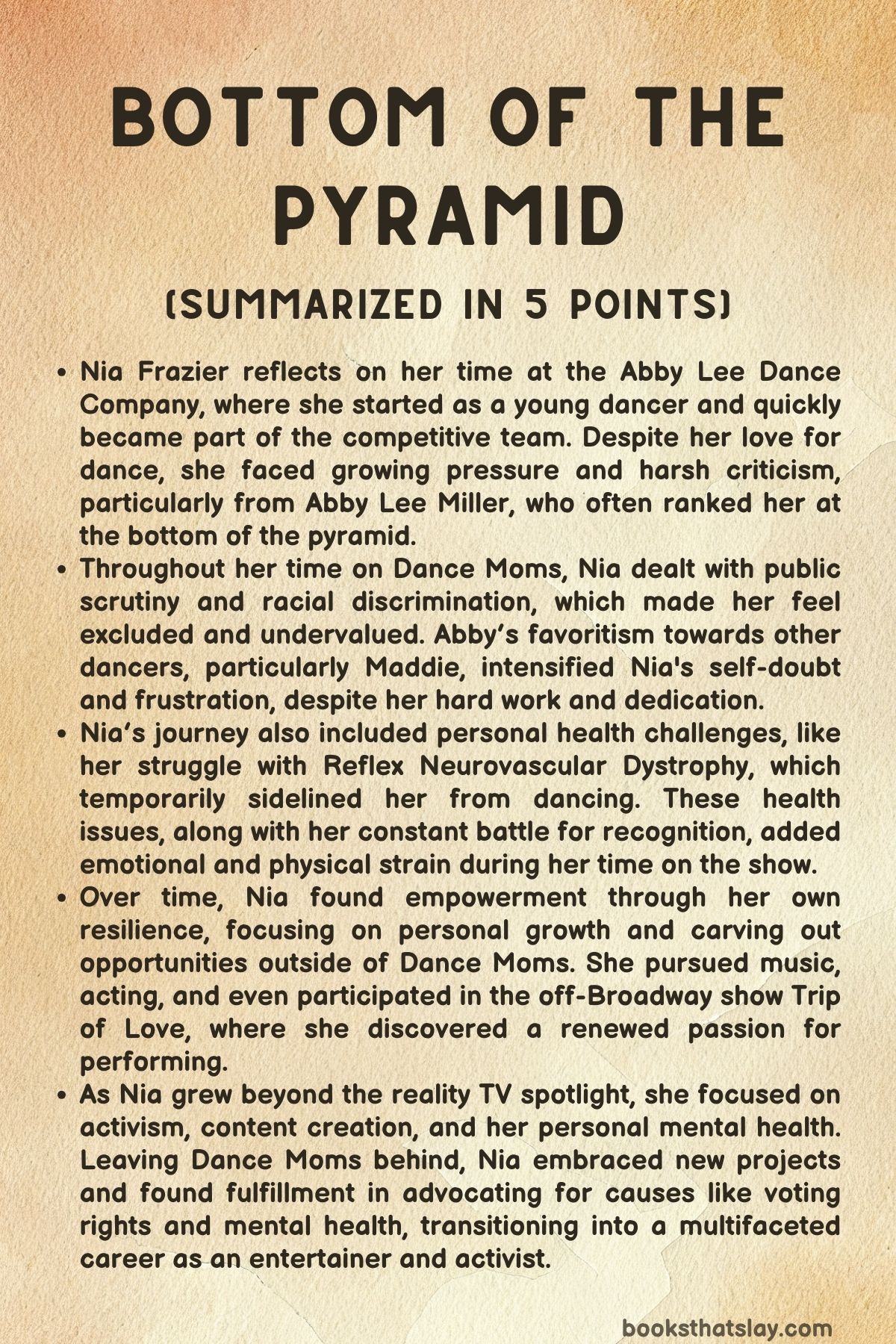
Key People
Nia Frazier
Nia Frazier is the central character of Bottom of the Pyramid. She begins her journey in the world of competitive dance at a young age, joining Abby Lee Dance Company (ALDC) with a passion for dance that quickly turned into a full-fledged career.
Initially, Nia joined the competition team for the joy of dance, but as she progressed, the intensity of training and high expectations created immense pressure. Throughout her time on Dance Moms, Nia was often placed at the bottom of Abby Lee Miller’s pyramid, a symbol of being the least favored dancer on the team.
This constant positioning led to harsh criticism from Abby, and Nia frequently found herself overlooked, despite her hard work and dedication. A central theme in Nia’s journey is her struggle against Abby’s favoritism towards other dancers, especially Maddie Ziegler, who often topped the pyramid.
Nia’s challenges were compounded by racial discrimination, with Abby making insensitive remarks about her skin tone and body type, which led to Nia internalizing these criticisms. Her journey is one of self-doubt, resilience, and empowerment as she navigates the toxic environment of Dance Moms while simultaneously dealing with public scrutiny and a personal health issue, Reflex Neurovascular Dystrophy (RND), which temporarily sidelined her from dancing.
Despite these obstacles, Nia’s resolve grew stronger as she fought for her place, not only on the team but also in her career. Her experiences helped her develop into a more confident individual, and she ultimately found empowerment in stepping away from the show and reclaiming her narrative through a memoir.
Nia’s perseverance became a defining trait as she moved forward into acting and music, proving her worth and showing others the importance of standing up for oneself in the face of adversity.
Abby Lee Miller
Abby Lee Miller is a central, antagonistic figure in Bottom of the Pyramid. As the head coach of ALDC and the central force behind the team’s success and drama, Abby’s treatment of Nia and other dancers on the show became a major part of Nia’s experience.
Abby is known for her harsh teaching style, favoring certain dancers while openly criticizing others. Nia, as a Black dancer, faced racial microaggressions and verbal abuse from Abby, with Abby’s remarks about Nia’s appearance, especially her body, being particularly damaging.
Abby’s favoritism towards dancers like Maddie Ziegler and her tendency to overlook Nia created a sense of exclusion and inadequacy for Nia, who struggled to gain recognition for her hard work and talent. Abby’s role in Nia’s story is pivotal, as her manipulative tactics and lack of support were key obstacles that Nia had to overcome in order to succeed outside of the Dance Moms environment.
Abby’s impact on Nia’s mental and emotional well-being cannot be overstated, as her actions led Nia to internalize many negative feelings about her abilities and appearance. However, Nia’s eventual decision to step away from Dance Moms and pursue other opportunities was influenced by her desire to escape Abby’s oppressive environment and find validation in places that truly recognized her worth.
Gia Martello
Gia Martello is another important figure in Bottom of the Pyramid, playing the role of assistant choreographer at ALDC. Though she initially had a harsh and critical relationship with Nia, over time, Gia and Nia developed mutual respect.
Gia’s dedication to the success of the dance routines was evident, as she worked tirelessly to perfect the team’s performances. Nia came to appreciate Gia’s commitment and the long hours she invested in the dancers’ training.
However, Gia’s treatment of Nia in the early years was not without its challenges, as she too was part of the intense, competitive atmosphere that pervaded ALDC. Despite these early tensions, Gia became an important figure in Nia’s development as a dancer, and their evolving relationship highlighted Nia’s growth as she learned to navigate the often turbulent dynamics within the team.
Gia’s role as a mentor figure became more apparent as Nia’s journey progressed, offering a sense of support in an otherwise toxic environment.
Chloé Lukasiak
Chloé Lukasiak plays a supportive role in Nia’s life throughout their time on Dance Moms. The two share a strong friendship, which becomes a significant source of solace for Nia amidst the constant drama and competition that marked their time on the show.
Chloé, like Nia, often found herself overshadowed by Abby’s favoritism towards other dancers, which created a bond between the two as they navigated their struggles together. Chloé’s presence provided Nia with emotional support during difficult times, and their friendship became one of the few positive aspects of Nia’s otherwise challenging experience on Dance Moms.
Despite their shared experiences of being overlooked, Chloé and Nia’s friendship offered a sense of normalcy and understanding in the highly competitive world of reality TV dance.
Maddie Ziegler
Maddie Ziegler, often positioned at the top of Abby Lee Miller’s pyramid, serves as both a foil and a source of frustration for Nia. Dance Moms portrayed Maddie as the favored dancer, frequently receiving solos and accolades, which only amplified Nia’s feelings of being overlooked.
Maddie’s success, while deserved, highlighted the disparity between her treatment and Nia’s, making Maddie’s character a source of both admiration and resentment for Nia. As Nia struggled with Abby’s favoritism, Maddie’s frequent top-ranking and solo performances contributed to Nia’s feelings of inadequacy and her ongoing battle to prove herself.
However, Maddie also represented the kind of validation that Nia longed for but could never fully attain while under Abby’s reign. Maddie’s role in Nia’s story is less about direct interaction and more about the underlying tension between the two, shaped by Abby’s preferential treatment.
Camryn Bridges
Camryn Bridges, a new addition to the ALDC team in later seasons of Dance Moms, plays a significant role in Nia’s story, particularly in the final seasons of the show. As a new dancer, Camryn’s arrival added another layer of tension to the already competitive team dynamics.
Nia found common ground with Camryn, as both had been marginalized in different ways, especially in terms of race. However, the introduction of Camryn also led to further tensions, particularly due to Abby’s racially insensitive comments about Camryn’s skin color, which mirrored the treatment Nia had endured.
Through their interactions, Camryn’s character offered a reflection of Nia’s own struggles with being overlooked and stereotyped. Camryn’s role highlighted the ongoing issues of race and favoritism that plagued the team, while also providing Nia with another avenue of connection and understanding in the midst of adversity.
Laurieann Gibson
Laurieann Gibson, a new choreographer in Dance Moms, plays a pivotal role in Nia’s growth during the later seasons of the show. Her presence brought a breath of fresh air to the toxic atmosphere at ALDC, providing Nia with validation and much-needed support.
Laurieann’s choreography was a turning point for Nia, as it gave her a new perspective on dance and helped her regain her confidence after years of being undermined by Abby. Laurieann’s nurturing and professional approach stood in stark contrast to Abby’s harsh and often discouraging tactics, making Laurieann an important figure in Nia’s personal and professional development.
Under Laurieann’s guidance, Nia was able to explore her talents more fully, finding new ways to express herself through dance while gaining a renewed sense of self-worth. Laurieann’s influence helped Nia realize that there was more to her dance journey than the confines of Dance Moms, ultimately leading to her decision to step away from the show and pursue other opportunities.
Themes
Struggles with Self-Worth and Validation
Nia’s journey throughout Bottom of the Pyramid revolves heavily around her struggle with self-worth, particularly in the context of Abby Lee Miller’s favoritism and harsh criticism. Being constantly placed at the bottom of the pyramid on Dance Moms, Nia found herself undervalued despite her hard work and dedication.
This ranking system was more than just a reflection of performance; it symbolized the deep-rooted favoritism and bias that permeated the environment. Nia’s self-esteem took a significant hit as Abby’s repeated critiques of her body, dance ability, and appearance shaped how she saw herself.
The public nature of the show added another layer of pressure, as Nia not only had to contend with Abby’s views but also with the opinions of viewers who often compared her to her more favored teammates, like Maddie Ziegler. This led to Nia internalizing the idea that her worth was dependent on others’ validation, a damaging belief that lingered throughout her time on the show.
The constant cycle of being overlooked created a sense of isolation for Nia. She found herself questioning her place on the team and even in the dance world at large.
Abby’s favoritism often overshadowed Nia’s accomplishments, leaving her feeling invisible. This theme of seeking validation was not just about being recognized as a dancer but also about feeling accepted for who she was, especially in a space that often undermined her identity and contributions.
The intense scrutiny Nia faced from both Abby and the public exacerbated her sense of insecurity, making it harder for her to believe in her value outside of the context of the show. Nia’s eventual decision to step away from the pyramid and reclaim her narrative by writing her memoir and pursuing other career opportunities became a turning point.
It was through this process that she began to realize that true validation comes from within and not from the external expectations placed upon her.
Racial Discrimination and Microaggressions
A significant theme in Bottom of the Pyramid is the racial discrimination and microaggressions that Nia faced during her time on Dance Moms. As one of the few Black dancers on a predominantly white team, Nia constantly dealt with the challenge of fitting into an environment that did not always acknowledge her identity or value her as a Black dancer.
Abby’s comments about Nia’s appearance, particularly her body and skin tone, were laced with racial undertones that made Nia feel as though she was being pigeonholed into stereotypes. The issue became even more pronounced as Abby continued to favor lighter-skinned dancers, drawing a clear line between how she treated Nia and others based on their race.
Nia was often subjected to comments that questioned her place on the team, like being referred to as “a Tootie,” which implied that she did not meet the aesthetic standards set by the team. These remarks reflected a deeper issue within the dance world and society at large—an underlying bias that dictated who could be celebrated and who had to conform.
Throughout her time on the show, Nia faced constant microaggressions that not only questioned her ability as a dancer but also cast doubt on her authenticity. She was subjected to stereotypical roles in dance routines, often being relegated to performances that reflected narrow perceptions of Black identity, rather than being allowed to express her full range of talents.
The microaggressions were not always overt but were deeply ingrained in the way Abby and the producers treated her. They made Nia feel as though her worth as an artist was limited by the color of her skin.
This theme of racial discrimination is particularly impactful because it shows how deeply embedded these issues are in even seemingly neutral spaces, like dance, where talent should be the primary focus. Nia’s eventual rise beyond these limitations—through her work in acting, music, and other ventures—marked a reclamation of her identity, where she was able to define herself outside of the constraints of racial bias.
Family Support and Personal Growth
A theme that runs through Bottom of the Pyramid is the unwavering support of Nia’s family and how their encouragement shaped her personal and professional growth. Throughout her time on Dance Moms, Nia’s family was her anchor.
Her parents, particularly her mother, were deeply involved in her journey, with her father taking her to classes and her mother balancing her academic pursuits with supporting Nia’s dance career. This strong family dynamic provided Nia with a sense of stability amidst the chaos of the show and the pressures of competition.
When Nia faced criticism from Abby, her family stepped in to provide emotional support, helping her process the harsh realities of the dance world and encouraging her to continue pursuing her passion. Their involvement was a key element in her ability to persevere through the difficult environment of Dance Moms.
Beyond their support in the dance world, Nia’s family also encouraged her to explore other interests, which ultimately led to her branching out into acting and music. Her family’s unwavering belief in her potential allowed Nia to continue pursuing her dreams despite feeling sidelined and undervalued in the competitive dance world.
Nia’s personal growth can be attributed not only to her own resilience but also to the love and encouragement she received from her family. As she began to carve out her own path beyond Dance Moms, she found that her family’s support helped her gain the confidence to make decisions that aligned with her true self, whether it was through her decision to step away from the show, pursue music, or advocate for causes she believed in.
This theme of family support and personal growth highlights how crucial a solid support system is in helping individuals navigate challenging environments and stay true to their values.
Breaking Free from Toxicity and Finding Empowerment
One of the most empowering themes in Bottom of the Pyramid is Nia’s ability to break free from the toxic environment of Dance Moms and take control of her narrative. Throughout her time on the show, Nia faced an overwhelming amount of negativity, from Abby’s favoritism to the toxic dynamics between the dancers and their families.
Despite this, Nia’s resilience allowed her to push through and eventually reclaim her sense of agency. Her decision to leave the show and step away from Abby’s manipulation was a crucial turning point in her journey.
By taking control of her story through writing her memoir and focusing on her own career, Nia found the empowerment she had been searching for throughout her time on Dance Moms.
This theme of empowerment also extends to Nia’s pursuit of a career beyond the constraints of reality TV. After stepping away from the competitive dance world, Nia found new opportunities in acting and music, which allowed her to define herself on her own terms.
Her involvement in social advocacy, including voter rights and mental health initiatives, also showed that Nia had moved beyond the negative impact of her earlier experiences. She used her platform to amplify voices that were often silenced, including those of dancers with disabilities.
Nia’s story is ultimately one of self-discovery, where she overcame the toxicity of her past environment and found strength in forging her own path, both personally and professionally. By reclaiming her narrative, Nia not only empowered herself but also became a source of inspiration for others who may be struggling with similar challenges.