Empire of the Dawn Summary, Characters and Themes
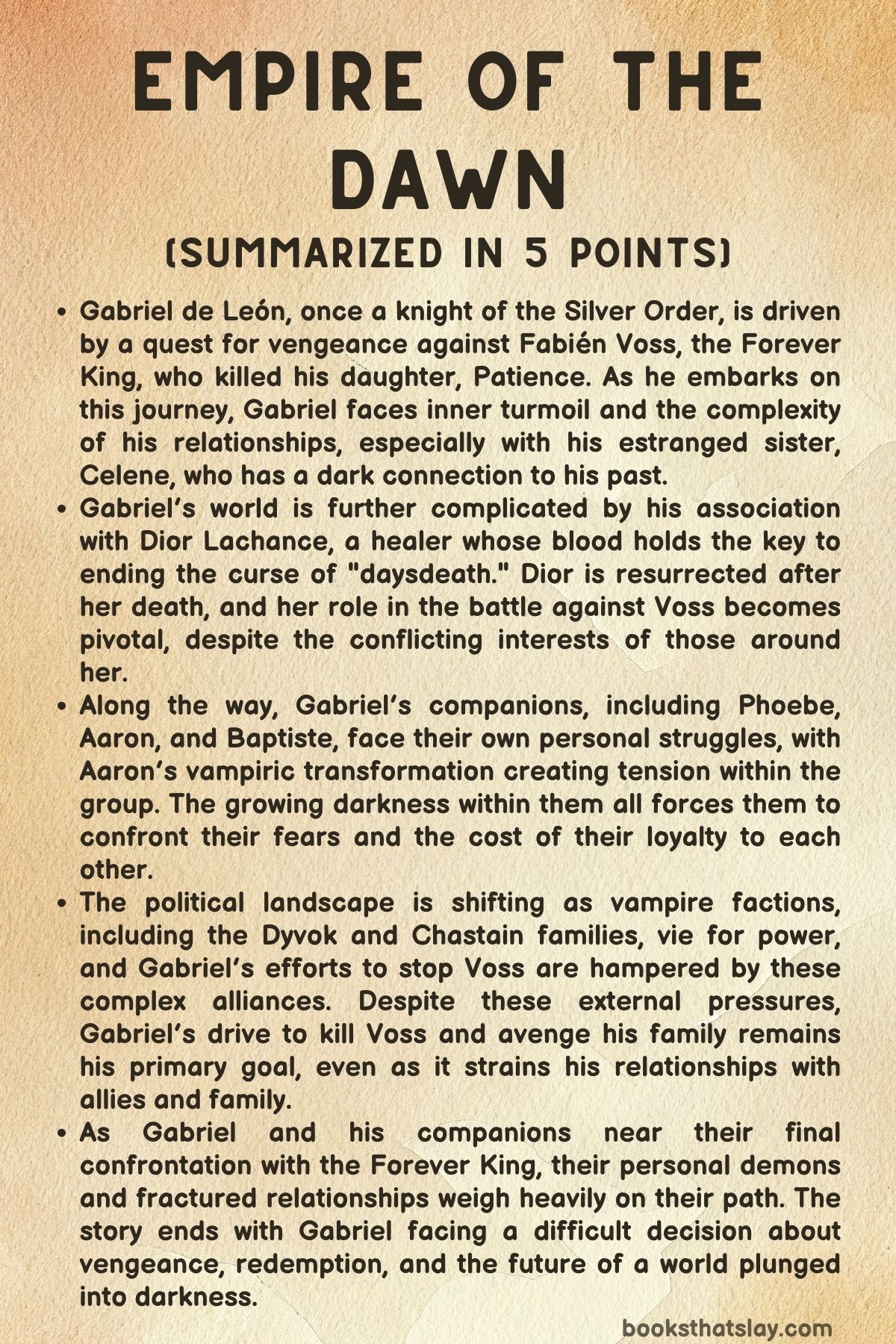
Empire of the Dawn by Jay Kristoff is a dark fantasy novel set in a world of vampires, betrayal, and ancient prophecies. The story follows Gabriel de León, the Last Silversaint, as he embarks on a journey of vengeance and redemption against the Forever King, Fabién Voss, who killed his daughter.
Amidst a war between vampire factions, the quest becomes one of survival, and Gabriel’s past, his relationships, and his sense of identity are tested. With a blend of emotional turmoil, political intrigue, and mystical elements, the novel explores the consequences of vengeance, the complexities of familial ties, and the battle against an eternal darkness. It’s the 3rd book in the Empire of the Vampire series.
Summary
The plot of Empire of the Dawn revolves around Gabriel de León, the Last Silversaint, a paleblood knight with a tortured past. Gabriel is determined to seek vengeance on the Forever King, Fabién Voss, who killed his daughter, Patience.
Gabriel was once a member of the Silver Order, a group of elite knights, but his fall from grace began when he fell in love with Dior Lachance, a woman with the ability to heal any wound. Gabriel, after being disgraced by the Order, spent years protecting Dior, believing she held the key to ending “daysdeath,” a curse that has plunged the world into an eternal night.
Dior, revealed to be the descendant of the Redeemer, a holy figure, carries a destiny to end this curse.
Gabriel’s efforts to protect Dior were complicated by his sister Celene, who had once hunted Dior as part of her loyalty to the Forever King. Celene’s betrayal of Gabriel was personal and deeply painful, particularly since Gabriel held her responsible for their father’s death.
Despite this betrayal, Gabriel was determined to protect Dior. Along the way, he assembled an army of dusk dancers from the Highlands, who would help him in his battle against the vampire forces that served the Forever King.
However, Dior’s death at the hands of a vampire, Lilidh Dyvok, sent Gabriel into a spiral of grief and anger. To his surprise, Dior was resurrected by her holy blood, reigniting his hope that she could fulfill her destiny.
In addition to the threat of vampires like Lilidh Dyvok and her brother Nikita, Celene’s own fate took a dark turn. After being mutilated by the Forever King’s forces, she was turned into a vampire herself.
Despite their complicated relationship, Celene ultimately helps Gabriel rescue Dior, though the tension between them lingers due to her past actions. A new figure, Maryn, an ancient vampire, becomes central to their quest, as it is believed she holds the secret to ending the curse of daysdeath.
Alongside Gabriel’s quest for revenge, Phoebe, a duskdancer with the ability to change between human and animal forms, plays a key role in protecting Dior. Phoebe’s tragic loss of her husband, Connor, adds complexity to her character, especially when it is revealed that Connor was turned into a thrall by Lilidh.
Through their complicated journey, Phoebe and Gabriel find solace in one another, becoming lovers despite the turmoil and betrayal that surrounds them.
The vampire world itself is embroiled in political conflict. Margot Chastain, the Empress of the Blood Chastain, an ancient vampire family, is locked in a power struggle with the Dyvok family and other factions.
Margot captures Gabriel, seeking his knowledge of the Grail, a relic tied to Dior’s power. The Grail, which might hold the key to ending the curse, becomes a central part of the struggle for survival.
As Gabriel grapples with his own feelings of guilt and loss, he is reunited with old friends like Baptiste, a former blacksmith, and Aaron, a fellow paleblood who had been turned into a vampire. Together, they plan to confront Fabién Voss, but Gabriel’s personal demons and Aaron’s growing bloodlust complicate matters.
Their journey leads them toward León, where Gabriel must face painful memories of his estranged grandfather, the Baron of León, while they attempt to mend Gabriel’s broken sword, Ashdrinker.
The group’s journey is fraught with peril, as they are beset by dangers such as the Wretched, terrifying creatures that prey on the living. Gabriel’s increasing thirst for blood and Aaron’s struggles with his vampiric nature create tension within the group.
In León, Gabriel’s strained relationship with his cousin, Charlotte de León, comes to the forefront. Charlotte, a fierce hunter of vampires, views Gabriel as a disgrace and the source of many of her own tragedies.
As they clash, Gabriel is forced to confront his family’s dark legacy and his complicated feelings toward his bloodline.
In León, the situation worsens when Gabriel and his companions are imprisoned by Charlotte’s men. Gabriel’s efforts to mend Ashdrinker and continue his fight against Voss are complicated by his unresolved family issues.
Charlotte, embittered by her family’s history with vampires, sees Gabriel’s return as a betrayal, which only fuels the conflict between them. Despite these personal battles, Gabriel remains determined to stop the Forever King, who wields immense power over life and death.
The plot builds toward a climactic confrontation with the Forever King, who has manipulated events from the shadows. As Gabriel’s army marches toward San Maximille, the stronghold of Voss, tensions within the group rise.
Gabriel’s obsessive desire for vengeance threatens to overshadow the group’s greater mission: to end the reign of darkness. During the battle at Voss’s stronghold, Gabriel faces off against the Forever King in a final, desperate attempt to bring an end to the madness.
Voss, immortal and terrifying, taunts Gabriel with knowledge of his family’s tragic past.
In the end, Gabriel’s quest for vengeance proves futile. Despite his rage and sorrow, he is unable to defeat Voss in battle.
Gabriel must then choose between continuing his pursuit of vengeance or walking away from the battle to save those he cares about. As the story reaches its conclusion, Gabriel stands at a crossroads, torn between the past that haunts him and the uncertain future that awaits.
The story ends with the question of whether vengeance is worth the cost and what sacrifices are necessary to achieve redemption.
Characters
Gabriel de León
Gabriel de León, known as the Last Silversaint, is a complex character torn between duty, vengeance, and redemption. A paleblood (half-vampire), Gabriel’s journey is primarily driven by the traumatic loss of his daughter, Patience, at the hands of Fabién Voss, the Forever King.
His past as a once-revered knight in the Silver Order is marred by disgrace, stemming from his love for Dior Lachance, a girl with the ability to heal. Gabriel’s devotion to Dior, whom he believes is the key to ending the world’s curse, “daysdeath,” adds layers of emotional conflict to his mission.
His internal struggle between his thirst for vengeance and his desire to protect those he loves shapes his actions throughout the narrative. Gabriel’s leadership is tested when he assembles an army of dusk dancers and allies, facing personal betrayals, his own vampiric nature, and the ultimate choice between saving his world or seeking vengeance on Voss.
Despite his many flaws and a tortured past, Gabriel’s complex emotions, relationships, and unresolved grief offer a multifaceted look at a man constantly struggling with his sense of identity and morality.
Dior Lachance
Dior Lachance, a healer with a pivotal role in the narrative, is one of the key figures around whom Gabriel’s quest revolves. Initially revealed to be a descendant of the Redeemer, Dior is believed to be the key to ending the eternal night that plagues their world.
Her resurrection after being killed by the vampire Lilidh Dyvok complicates matters, as Gabriel’s grief over her death is followed by a shocking realization that she may be more powerful than ever before. Dior’s deep connection to Gabriel, once a protector and lover, is fraught with both tenderness and tension.
While Gabriel seeks to protect her, Dior herself becomes more entangled with the forces that seek to use her for their own agendas. Her mysterious and holy blood gives her unique abilities, making her an essential player in the battle to stop the Forever King.
Dior’s character is defined by her resilience, her transformation from victim to powerful leader, and her role as a beacon of hope amidst the chaos. Yet, as her resurrection unfolds, she is forced to reckon with her purpose and the implications of her powers in a world full of betrayal and darkness.
Celene
Celene, Gabriel’s sister, is a character defined by her dark and tumultuous relationship with him. A vampire herself, Celene’s powers and cursed existence make her both a formidable ally and a dangerous foe.
Her betrayal of Gabriel, particularly in her pursuit of Dior, adds a layer of complexity to their sibling bond. Though she initially works against Gabriel, her actions are revealed to be part of a larger and more tragic web of family secrets.
Her painful past, including the mutilation she suffered at the hands of the Forever King’s forces, shapes her motivations. As the story progresses, Celene is forced to confront her own identity and the consequences of her past choices.
Despite their deep personal differences and Gabriel’s anger toward her, Celene’s eventual alliance with him is a testament to the enduring, though fractured, family bond between the two. Her actions, while often harsh, are driven by a mixture of survival instincts and the need to reconcile with the man she once called her brother.
Her internal conflict, particularly after the loss of their father and the painful sacrifices she makes, underscores her complexity as a character caught between vengeance and redemption.
Phoebe
Phoebe is a duskdancer with the ability to transform between human and animal forms, offering a unique perspective on the conflict that unfolds. Her strength, both physically and emotionally, makes her an important figure in Gabriel’s journey.
Although her loyalty to Gabriel is unwavering, Phoebe’s own personal history, including the loss of her husband, Connor, shapes her character and adds depth to her motivations. As she becomes romantically involved with Gabriel, her relationship with him is marked by tension and sacrifice, as she is torn between her love for him and her belief that Dior’s powers may be the ultimate key to saving their world.
Her struggles with grief and loss, especially when she learns of her husband’s transformation into a thrall by Lilidh Dyvok, add to the emotional weight of her journey. Phoebe’s character represents both vulnerability and strength, and her role as a protector of Dior underscores her commitment to the greater cause, even as her personal turmoil complicates her choices.
Aaron
Aaron, once a friend of Gabriel, becomes a tragic figure as his transformation into a vampire leads to significant tension within the group. His descent into vampirism, after being captured by Nikita Dyvok, adds complexity to the dynamic between him, Gabriel, and the rest of their allies.
Aaron’s increasing bloodlust strains his relationships, particularly with Baptiste, his partner, who struggles to cope with the changes in Aaron. Despite his growing instability, Aaron is determined to prove himself and stand by Gabriel.
His struggle with his vampiric nature and his thirst for blood mirrors Gabriel’s own inner conflict, as both men try to retain their humanity amidst the darkness that threatens to consume them. Aaron’s character arc is one of tragic loss, as he battles the growing darkness within himself while also confronting his past mistakes.
His relationship with Baptiste adds a poignant layer to his character, highlighting the complexity of love and loyalty in a world full of betrayal.
Baptiste
Baptiste, a former smith, is one of Gabriel’s most loyal companions. His unwavering support for Gabriel, despite the challenges and emotional turmoil that surround them, establishes him as a figure of steadfast loyalty and resilience.
Baptiste’s relationship with Aaron, his partner, becomes increasingly strained as Aaron’s vampiric transformation worsens. Baptiste’s character, defined by his unwavering sense of duty, also serves as a moral compass for Gabriel, reminding him of the cost of their actions and the personal sacrifices they must make to achieve their goal.
Baptiste’s deep emotional connection to Aaron, coupled with his desire to see the greater good achieved, adds a layer of complexity to his otherwise strong and stoic persona. His presence in the story provides a counterbalance to the more volatile characters, offering a voice of reason and compassion amidst the chaos of the group’s quest.
Margot Chastain
Margot Chastain, the Empress of the Blood Chastain, plays a key role in the shifting political landscape of the vampire world. As a member of an ancient vampire line, she is a powerful figure whose actions and decisions are driven by both ambition and survival.
Margot’s involvement in the power struggle with the Dyvok and other vampire factions reveals her cunning and strategic mind. Her capture of Gabriel and her interest in Dior’s potential reveal a darker side to her character, as she seeks to manipulate the events for her own benefit.
Margot’s interactions with Gabriel and the other characters highlight her ruthless nature and willingness to use others as pawns in her quest for dominance. However, as the narrative progresses, Margot’s true motivations and the fragility of her power become clear, adding a layer of complexity to her otherwise domineering presence.
Her character serves as a reminder of the brutal politics that govern the vampire world and the lengths to which even the most powerful will go to maintain control.
Fabién Voss
Fabién Voss, the Forever King, is the central antagonist whose presence looms over the entire narrative. As a vampire of immense power, Voss controls both life and death, manipulating the world around him to maintain his dominance.
His motivations, driven by a desire for eternal life and control, set him at odds with Gabriel and his companions. Voss’s ability to read minds and anticipate his enemies’ moves makes him a formidable foe, and his taunting of Gabriel throughout their confrontations only adds to the emotional stakes of the story.
Despite his overwhelming power, Voss’s ultimate downfall is linked to his arrogance and his inability to fully understand the complexities of the world he seeks to control. His character is a study in the corrupting influence of power, as he manipulates both mortals and immortals in his pursuit of eternal rule.
His tragic fate serves as a cautionary tale about the price of immortality and the dangers of seeking control over forces that are beyond one’s understanding.
Charlotte de León
Charlotte de León, Gabriel’s cousin, emerges as a bitter and vengeful character whose hatred for vampires defines her actions throughout the story. Once a revered vampire hunter, Charlotte’s crusade against vampires is personal, fueled by the loss of her family at their hands.
Her transformation into the “Ashen Lioness” marks her as a powerful and ruthless figure in the battle against the undead. Her disdain for Gabriel, whom she views as a failure, is central to the conflict between them.
Charlotte’s actions, particularly her role in hunting Gabriel and his companions, showcase her deep-seated anger and her belief that she must rid the world of vampires to avenge her family. However, as the story progresses, Charlotte’s motivations are revealed to be more complex than simple revenge, as she grapples with the moral implications of her actions and the cost of her single-minded quest for justice.
Her confrontation with Gabriel forces both characters to confront their pasts and question their respective roles in the ongoing battle between vampires and mortals.
Themes
Vengeance and Redemption
Gabriel de León’s journey is defined by an overwhelming desire for vengeance against Fabién Voss, the Forever King, whose actions led to the tragic deaths of his wife and daughter. This quest for vengeance becomes a consuming force, shaping Gabriel’s every decision and relationship throughout the narrative.
At first, his rage is the driving force, pushing him to confront powerful enemies and challenging circumstances in his path. However, as Gabriel progresses through his journey, vengeance begins to take on a more complicated role.
His desire for retribution constantly clashes with moments of self-reflection and guilt, particularly as he navigates the resurrection of his daughter, Patience, and the relationship he shares with her and his other allies. Redemption, on the other hand, emerges as a counterbalance to Gabriel’s thirst for vengeance.
Over time, it becomes clear that in order to truly heal, Gabriel must confront his past mistakes and the choices that led him down this destructive path. The tension between vengeance and redemption is highlighted by Gabriel’s relationships with others, particularly his sister Celene, who is both an antagonist and an ally, embodying the complexities of betrayal, guilt, and forgiveness.
Gabriel’s ultimate realization—standing at the crossroads of continuing his quest for vengeance or accepting the futility of it—forms the crux of the narrative’s exploration of these themes. This struggle to reconcile past choices with the possibility of a future beyond revenge encapsulates the painful but necessary journey toward redemption.
Gabriel’s eventual confrontation with the Forever King is not just a battle of physical strength but an internal conflict over his legacy, his capacity for forgiveness, and his understanding of what it truly means to heal.
Betrayal and Trust
Betrayal weaves through the story, particularly in the relationships between Gabriel, his sister Celene, and his allies. Celene’s betrayal is central to Gabriel’s emotional turmoil, especially when he learns that she was involved in the death of his father.
This initial act of betrayal sets the stage for a larger narrative about trust, loyalty, and the emotional scars caused by betrayal. Celene’s transition from betrayer to a reluctant ally reflects the complexity of human relationships, where betrayal is not always permanent, and forgiveness, while difficult, is a possible path toward reconciliation.
The tension between Gabriel and Celene, charged with anger and betrayal, complicates their ability to trust one another, and this animosity bleeds into other relationships, especially with those closest to Gabriel. His relationship with Phoebe, for instance, is marked by doubts and misunderstandings, further fueling the emotional conflict that defines his journey.
As Gabriel faces betrayal from multiple fronts, including his enemies and allies, the theme of trust becomes a pivotal question. Who can Gabriel truly rely on?
And what does it mean to trust in a world where everyone has their own agenda? By the story’s conclusion, Gabriel learns that trust must be earned and that true loyalty is often forged through shared sacrifices and understanding.
Betrayal, while it fractures bonds, also presents an opportunity for growth and personal transformation, as characters must confront their actions and the consequences that follow.
Sacrifice and Loss
Sacrifice and loss permeate the narrative, shaping the characters’ motivations and actions at every turn. Gabriel’s journey is marked by immense personal sacrifice—from the loss of his family to the decisions that lead him to ally with individuals who are just as haunted by their pasts.
The ultimate sacrifice Gabriel faces is the potential loss of everything he holds dear, including his life and the lives of those he loves. This theme is closely tied to the tragedy of Dior’s death and resurrection, which underscores the fragile nature of life and the unpredictability of fate.
The resurrection itself raises questions about the costs of life and death, as Dior’s return is not without its own price. The constant theme of death and resurrection challenges the characters’ understanding of what they are willing to sacrifice for a cause or for personal gain.
Gabriel’s internal struggle with loss is reflected in his journey toward acceptance, as he faces the reality of what he has already lost and what he is still willing to risk. Through the narrative, it becomes clear that loss is not simply a physical absence; it is a profound emotional void that shapes the identities of the characters.
Gabriel, for example, must grapple with the ghosts of his past—the loss of his family, his betrayal by his sister, and the impact of his past decisions on those around him. As the characters confront the emotional toll of their sacrifices, the theme of loss evolves into a form of resilience, suggesting that true strength lies in the ability to endure, adapt, and ultimately transcend the pain of what has been lost.
Power and Corruption
The corrupting influence of power is explored through various factions within the story, including the vampire families, such as the Dyvok and Chastain bloodlines, and the rule of the Forever King. Power is shown as both a seductive force and a destructive one, as characters like Fabién Voss wield it without regard for the suffering it causes.
The Forever King’s reign is marked by manipulation, control, and the exploitation of others, especially those he deems expendable. This theme is not confined to the vampire world but extends to the human characters, such as Gabriel and his companions, who struggle with their own desires for power and control.
Gabriel’s own vampiric nature symbolizes this conflict, as his bloodthirst grows stronger, and his increasing power threatens to consume him entirely. The theme of power and its potential for corruption is also reflected in the political intrigue surrounding the vampire factions, each vying for supremacy.
The Chastain family’s thirst for dominance and the Dyvok family’s scheming demonstrate how power becomes a tool for furthering personal agendas, often at the expense of others. As characters wrestle with the allure of power, the story paints a picture of its inevitable decay—where the pursuit of power for its own sake can destroy even the most well-intentioned individuals.
Gabriel, once a knight bound by honor, is not immune to the temptation of using power to achieve his goals, yet his internal struggle highlights the moral dangers of this pursuit. Ultimately, the narrative suggests that true power lies not in domination or control, but in the ability to resist its corruptive influence and make choices that prioritize the greater good.
Family and Identity
The complex dynamics within Gabriel’s family form a critical backdrop to the entire narrative, with themes of legacy, identity, and the struggle to reconcile one’s past with the person they wish to become. Gabriel’s strained relationship with his sister Celene is a reflection of the fractured nature of their family, marked by betrayal, loss, and a legacy of violence.
Their shared history, filled with pain and resentment, forces them to confront difficult truths about themselves and each other. Gabriel’s identity is shaped by the bloodlines he belongs to, both human and vampiric, and by the expectations placed upon him by his family.
His internal conflict between his past as a knight and his present as a half-vampire underscores his struggle to define who he truly is. This tension between the man he once was and the creature he has become is a central theme in Gabriel’s journey.
His quest for vengeance, while personal, is also an attempt to reclaim his identity from the shadows of his past, a past defined by loss and betrayal. Celene’s own journey is equally intertwined with her struggle to come to terms with her cursed existence and the brutal choices she has made in pursuit of power and survival.
The theme of family extends beyond Gabriel’s immediate bloodline to the relationships he forms with his companions. As Gabriel’s alliances shift, he begins to form surrogate families, such as the bond with Phoebe and Aaron.
These relationships challenge his notions of loyalty and love, forcing him to reconsider what it means to belong to someone or something greater than himself. The theme of family and identity in Empire of the Dawn is a reflection on how our pasts shape us and the ongoing struggle to find peace with who we are amidst the shadows of who we were.