Eternal Ruin by Tigest Girma Summary, Characters and Themes
Eternal Ruin by Tigest Girma is an intense, dark fantasy novel that explores the themes of power, betrayal, and the complex relationships between vampires, humans, and the ancient artifacts that govern their world. The protagonist, Kidan Adane, is a young woman caught in a battle to save her sister and reclaim her family’s legacy.
As she struggles with the intricate political and emotional landscapes of Uxlay, the world she inhabits, Kidan must face the consequences of betrayal and her own ambitions. The novel delves into her journey of self-discovery, where the lines between human and monster blur, and the cost of power is laid bare. With an intricate web of family, loyalty, and secrets, Eternal Ruin promises a deep exploration of personal sacrifice and the dangers of unchecked power. It’s the 2nd book in the Immortal Dark Trilogy.
Summary
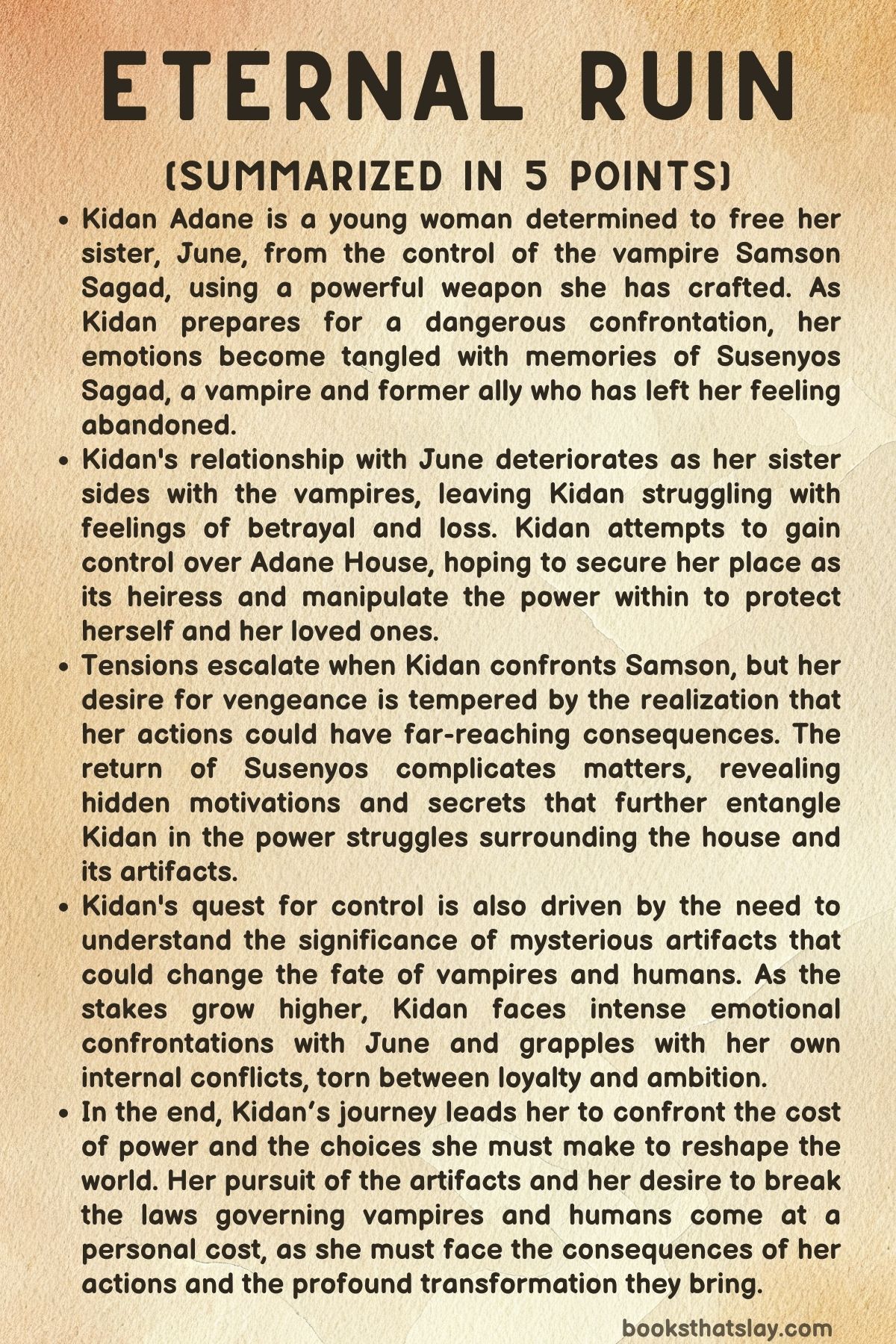
The story revolves around Kidan Adane, a determined young woman on a mission to kill Samson Sagad, a vampire who has gained control over her sister June. Kidan is working on crafting a weapon made from impala horn, preparing herself for the inevitable confrontation with Samson.
Her mind, however, is often clouded by memories of Susenyos Sagad, a vampire who was once close to her but now finds himself entangled in her complex emotions. While Kidan strives to focus on her goal, her feelings for Susenyos—who is both an ally and a source of emotional turmoil—complicate her journey.
Kidan’s relationship with her sister, June, has deteriorated. June, who once shared a close bond with Kidan, has chosen to side with Samson and is now allied with the very vampires Kidan seeks to destroy.
This betrayal weighs heavily on Kidan, who still seeks to protect her sister but is simultaneously driven by feelings of anger and betrayal. Her attempts to reconcile with June are hindered by their differing priorities, with June more focused on the power the vampires can offer than on her sister’s well-being.
In the pursuit of her mission, Kidan ventures into Adane House, the family estate, which houses crucial artifacts. Among these is a mask believed to have the power to free vampires from their restrictions.
As Kidan navigates the complexities of the house, she becomes more deeply entangled in its laws and magic. She hopes to use the house’s power not only to control the circumstances around her but also to secure her place as the rightful heiress to the house.
However, Kidan’s journey takes a violent turn when she finally confronts Samson. In the heat of their confrontation, Kidan is filled with fury, yet she hesitates to strike the fatal blow, knowing the severe consequences of killing him.
This moment marks a turning point as Kidan realizes that vengeance may not bring the closure she seeks. As the confrontation continues, she must navigate the complex moral landscape of freedom, power, and the consequences of her actions.
Susenyos, who reappears in Kidan’s life, adds further complications to her emotional state. As their relationship deepens, Kidan becomes more aware of the intricate web of power struggles surrounding the artifacts and the supernatural forces at play.
Susenyos’s past, along with his motivations, slowly come to light, revealing a man who is not only driven by personal ambition but also by a deep sense of guilt and responsibility toward those he has wronged. His presence in Kidan’s life forces her to confront her own desires and fears, making her realize that control over the artifacts may come at a high cost.
The growing tension between Kidan and June becomes more apparent as the story progresses. Their relationship reaches a breaking point when Kidan confronts June about her alliances and the choices she’s made.
In a fiery confrontation, Kidan confronts the painful truth that June no longer shares the same values or desires. This emotional standoff reveals the deep wounds that have formed between them, and Kidan is forced to accept that her sister’s priorities have shifted.
As Kidan becomes more involved with Adane House and its magic, her focus shifts from seeking revenge to understanding the true power that lies within the artifacts. The power to alter the world, to break the ancient laws, and to gain control over the supernatural beings that inhabit Uxlay becomes a central theme.
Kidan’s growing obsession with mastering the house and its power begins to overshadow her emotional conflicts, pushing her further down a path of personal sacrifice and moral ambiguity.
As the story draws to a close, Kidan’s journey reaches its most intense moment. With the mask artifact in her grasp and the possibility of breaking the Three Binds—the laws that govern vampires—within reach, Kidan faces a decision that will change the fate of Uxlay and its inhabitants forever.
The choices she makes will determine whether she can break free from the cycle of violence and power struggles or if she will be consumed by them.
The novel concludes with a powerful transformation. Kidan, in her quest for power, has become something other than human, a being bound to the artifacts she sought to destroy.
Her actions, while freeing the vampires from their bloodlust, have come at a personal cost, leaving her to confront the heavy consequences of her decisions. As Kidan stands at the crossroads of a new world order, she realizes that her destiny is irrevocably tied to the very forces she sought to control.
Characters
Kidan Adane
Kidan Adane is the central character of Eternal Ruin, embodying the themes of power, betrayal, and transformation. Throughout the story, she grapples with her responsibility as the heiress of Adane House and her desire to protect her sister, June.
Kidan is driven by an intense need to reclaim control over her family’s legacy, even if it means facing the dark and complicated truths of her past. Her complex emotions are most evident in her relationships—particularly with her sister and Susenyos.
Kidan’s journey is marked by a series of internal struggles as she seeks both revenge for her parents’ deaths and the power to alter the laws governing her world. Despite the cold, calculating exterior she presents, Kidan is deeply haunted by the betrayals she’s experienced, particularly from her sister, June, whose decisions continue to challenge Kidan’s sense of loyalty and justice.
The weight of her family’s legacy presses on her as she slowly begins to realize that mastering the house comes with a personal cost—one that might strip her of her humanity. This internal conflict is a driving force in her character arc, leading her to question the very essence of who she is and who she has become in the pursuit of power.
Susenyos Sagad
Susenyos is a vampire whose motivations are shrouded in mystery, which makes him both a companion and an adversary to Kidan. His character is complex, torn between his desire for power and his lingering attachment to Kidan, with whom he shares a deep history.
Unlike Kidan, Susenyos is not driven solely by revenge but by an ambition to control Adane House, believing that mastery over the house’s artifacts will allow him to reshape the world. However, his pursuit of this power often leads to strained interactions with Kidan, as he is unwilling to fully align with her in their shared struggle.
His emotional distance, particularly during their volatile interactions, creates an aura of mistrust, and Kidan struggles to determine whether Susenyos is an ally or a rival. As the story unfolds, Susenyos’s past resurfaces, revealing the extent of his guilt over his choices, including his betrayal of his people.
His relationship with Kidan remains a focal point of tension, as they constantly navigate the thin line between trust and betrayal. Susenyos’s character embodies the theme of ambition versus loyalty, and his struggle with these conflicting desires adds depth to his role in the story.
June
June, Kidan’s sister, plays a pivotal role in Eternal Ruin as a figure of both support and betrayal. Initially, June is Kidan’s closest ally, yet her allegiance to Samson, a vampire whose influence has shaped her decisions, leads to a profound rupture in their sisterly bond.
June’s decision to side with the vampires and pursue the mask artifact symbolizes her shift away from Kidan’s protective influence and into a world of manipulation and self-interest. Despite Kidan’s efforts to protect her, June’s growing autonomy and moral ambiguity create an emotional divide between them.
June’s motivations are complex; she is not purely an antagonist but rather a character caught between familial loyalty and her own desire for power. Her willingness to betray Kidan in favor of securing her own place among the vampires is a major source of Kidan’s pain and conflict.
However, June’s character is not one-dimensional; her actions, though driven by self-preservation, are also influenced by her own traumas and struggles with the world around her. This complex portrayal makes June a tragic figure whose decisions have far-reaching consequences for both herself and her sister.
Samson Sagad
Samson Sagad is the antagonist who embodies the ruthless, power-hungry nature of the vampires in Eternal Ruin. His primary goal is to gain control over the artifacts that could free vampires from their bloodlust and restrictions, making him a formidable opponent to Kidan and others who seek to maintain the balance.
Samson’s character is defined by his menacing presence and willingness to manipulate those around him, including June, whom he uses as an ally in his quest. His ruthless demeanor is contrasted by his strategic mind, as he constantly seeks to undermine Kidan and turn situations to his advantage.
Despite his antagonistic role, Samson is not a purely evil character; he operates from a place of necessity, believing that his actions are justified in the larger context of vampire survival. His desire to break free from the cycle of violence and control the vampires’ hunger places him at odds with Kidan, who views him as a threat to her family’s legacy.
Samson’s character is both a symbol of the chaotic power struggles in Uxlay and a catalyst for the transformations Kidan undergoes throughout the story.
Arin
Arin, a former ally of Susenyos, represents the theme of guilt and responsibility within Eternal Ruin. His character is defined by a deep sense of betrayal, particularly towards Susenyos, whom he accuses of abandoning his people.
This conflict between Arin and Susenyos highlights the vampire’s complicated relationships with loyalty and authority. Arin’s bitterness and anger towards Susenyos underscore the internal fractures within the vampire world, where past alliances are often broken under the pressure of ambition and survival.
His accusations against Susenyos add emotional depth to Susenyos’s character, shedding light on the vampire’s internal struggles and the consequences of his choices. Arin’s presence in the story is a reminder of the long-lasting effects of betrayal and the difficulty of reconciling past actions with the future.
Etete
Etete, the cook at Adane House, serves as an important secondary character who is deeply connected to Susenyos’s past. Though initially presented as a mere servant, Etete’s involvement in the power struggles within the house adds layers to the political intrigue of the story.
His role is amplified when Samson threatens him to manipulate Kidan into betraying Susenyos, drawing out Kidan’s cold, calculating side. Despite his subservient position, Etete is not without his own agency.
His connections to Susenyos and the larger vampire world make him a key player in the tensions that drive the narrative. Through Etete, the themes of loyalty and manipulation are further explored, as his actions are shaped by the power dynamics at play.
These characters, each with their own motivations, desires, and flaws, create a richly woven narrative that examines themes of power, betrayal, and the pursuit of control. As the story progresses, their individual arcs interlace, leading to a final resolution that tests their relationships, their loyalties, and their understanding of themselves in a world dominated by supernatural forces.
Themes
Power and Control
In Eternal Ruin, the theme of power and control is woven deeply into the narrative, influencing the characters’ motivations and actions. Kidan’s journey is largely driven by her need to gain control over Adane House and the artifacts that reside within it.
This quest for control is not just about possessing the house or its resources but about mastering the forces that define her world. Kidan’s constant battle against the limitations imposed by the Adane House law reflects her desire to break free from her mother’s influence, which she perceives as a constraint on her independence and power.
This struggle to reshape her identity is central to her evolution, as she grapples with the cost of power and the human elements that resist her transformation.
The narrative also explores how power dynamics shape relationships, especially through Kidan’s complex interactions with Susenyos and June. Kidan’s attempts to control those around her are met with resistance, and she finds herself in a precarious balance between using others to gain strength and recognizing the personal toll it takes.
Her alliance with Susenyos and her desire for dominance over the house reveal the thin line between control and manipulation. Meanwhile, Susenyos, too, seeks to wield power over the artifacts and the house, showing that power struggles are not merely between individuals but also between ideologies, legacies, and destinies.
Power is not only confined to Kidan’s personal goals but extends into the political landscape of Uxlay, where the battle for control of the supernatural order intensifies. The struggle over Adane House’s position and the manipulation of the law systems within the world emphasize how control can dictate the fate of entire communities.
Kidan’s journey underscores the cost of power—both the sacrifices required to obtain it and the inevitable consequences of its pursuit. Ultimately, it is through her confrontation with the law of Adane House and the decision to alter its very fabric that she challenges the balance of power in Uxlay, setting the stage for a new world order, albeit at a steep personal cost.
Betrayal and Loyalty
Betrayal is a recurring and pivotal theme in Eternal Ruin, shaping the characters’ relationships and their sense of trust. Kidan’s personal experiences of betrayal, particularly by her sister June, are central to the emotional intensity of the plot.
June’s decision to side with Samson, despite Kidan’s efforts to protect her, leaves Kidan feeling deeply abandoned. The complex emotions between Kidan and June, rooted in shared history and family bonds, are marked by painful decisions and misunderstandings that drive the central conflict of the narrative.
This betrayal is not just an external conflict but a deep internal struggle for Kidan, who finds herself torn between love, loyalty, and the desire for revenge.
Kidan’s relationship with Susenyos is another key aspect of this theme, as their mutual ambitions for power and control lead to a delicate trust that is frequently tested. While they both share a common goal of mastering the artifacts and Adane House, the underlying tension of betrayal looms large.
Kidan’s suspicion of Susenyos’s motives, coupled with his refusal to fully align with her, creates a volatile dynamic that is further complicated by their shared history and the weight of their past actions. The tension between them highlights the fragility of loyalty in a world where power is a constant driving force, and each character’s pursuit of their own interests risks undermining the trust that could otherwise unite them.
The theme of betrayal also extends beyond individual relationships to the broader societal structures of Uxlay. The characters are caught in a world where trust is easily broken, and allegiances shift in the face of personal ambition.
Kidan’s discovery of the larger conspiracy involving the dean’s role in her parents’ death further reinforces the idea that betrayal is a tool wielded by those in power to maintain control. Ultimately, betrayal in the story is a catalyst for transformation, forcing Kidan to confront not only the betrayal of those she loves but also the darker aspects of herself that are awakened in the pursuit of power and justice.
Family and Identity
Family and the search for identity are central to Eternal Ruin, particularly in the context of Kidan’s journey. Her relationship with her sister June is marked by deep emotional conflict, shaped by both love and resentment.
Kidan’s desire to protect June from the vampires clashes with her sister’s decision to ally with them, leading to a painful estrangement. This fractured relationship is symbolic of the broader theme of family, as Kidan wrestles with feelings of abandonment and betrayal.
Her memories of their past and the bond they once shared are contrasted with the painful reality that June has chosen a different path, one that betrays their shared history and connection. Kidan’s quest to protect her sister, even as June distances herself, reflects the complexity of family dynamics and the difficulty of reconciling love with conflicting ideals.
Kidan’s personal identity is also deeply tied to her family legacy. As the heiress of Adane House, Kidan is burdened with the weight of her mother’s laws and expectations.
Her struggle to redefine herself outside of her mother’s shadow becomes a central aspect of her journey. The law of Adane House, which ties her to a dark and powerful heritage, is both a source of strength and a constant reminder of the familial responsibilities that constrain her.
Kidan’s desire to sever these ties and reshape her identity is symbolized by her struggle to control the house and its artifacts. However, the more she seeks to break free from her past, the more she becomes entangled in its power, ultimately realizing that her family’s legacy cannot be easily discarded.
The theme of family is not limited to Kidan’s relationship with June and her parents. It extends to her interactions with Susenyos, who is also dealing with the fallout from his own fractured relationships.
His past, marked by guilt and abandonment, mirrors Kidan’s own feelings of loss and betrayal. Their bond, though strained, becomes a way for both characters to navigate their respective identities and find some semblance of belonging in a world that continuously challenges their sense of self.
Through their struggles, Eternal Ruin illustrates how family shapes not only personal identity but also the choices that define a person’s destiny, even when those choices are fraught with conflict and betrayal.
Sacrifice and Consequences
Sacrifice is a pervasive theme in Eternal Ruin, driving the characters to make difficult decisions that often come with painful consequences. Kidan’s journey is marked by a series of sacrifices, from the loss of her parents to the painful decisions she must make in her pursuit of power.
Her desire to break the laws that govern her world requires her to give up something precious, highlighting the idea that power cannot be obtained without cost. Kidan’s sacrifice of her own humanity in her efforts to master the artifacts is a powerful reminder that the pursuit of control and freedom often requires one to forfeit what they hold most dear.
This theme is also explored through the character of Susenyos, whose own sacrifices are tied to his complex relationship with Kidan and his past. As he navigates his desire for power and his guilt over his previous actions, Susenyos is forced to confront the consequences of his choices.
His bond with Kidan is both a source of strength and a reminder of the emotional and moral sacrifices they both must make to achieve their goals. The story suggests that the pursuit of power often leads to the loss of innocence, and the more one seeks to control their fate, the more they must sacrifice in the process.
The consequences of sacrifice are not always immediately apparent but reveal themselves as the story unfolds. Kidan’s decisions to manipulate and control those around her, while driven by a desire to protect her loved ones, come at a cost.
As she alters the laws governing Uxlay and confronts the supernatural forces that shape her world, Kidan realizes that the changes she seeks may come with irreversible consequences. The story ultimately suggests that while sacrifice can lead to empowerment, it also brings with it the inevitability of loss, forcing the characters to reckon with the choices they have made and the futures they have created.