Evil Bones by Kathy Reichs Summary, Characters and Themes
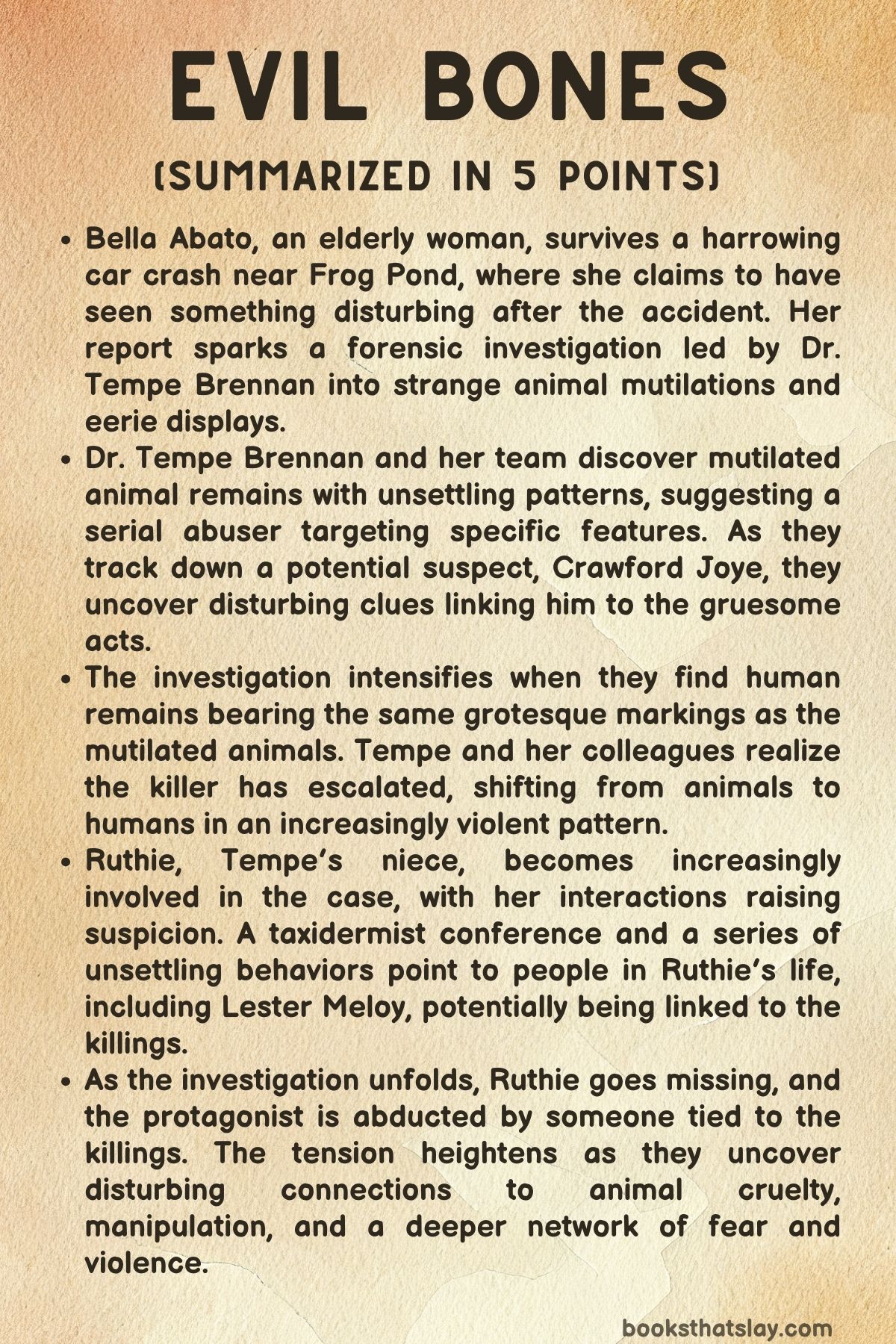
Evil Bones by Kathy Reichs is a gripping crime thriller that follows forensic anthropologist Dr. Tempe Brennan as she navigates a chilling series of crimes involving mutilated animal remains, escalating violence, and a growing fear that the killer may eventually target humans. As Tempe uncovers disturbing patterns and connects the dots between animal mutilations and human disappearances, she is pulled into a world where the line between human and animal suffering becomes dangerously blurred.
Through her meticulous investigation, Reichs weaves a tense narrative of suspense and forensic science, keeping readers on edge as the mystery unfolds.
Summary
The story begins with Bella Abato, an elderly woman who experiences a terrifying storm while driving on a dark, unfamiliar road. As she struggles to maintain control of her vehicle, she becomes increasingly anxious.
She feels guilty for not being more prepared for the storm, but despite her fear, she pushes forward. Eventually, the storm subsides, and she spots familiar landmarks, including a horse named Glenda and a large oak tree.
However, as she attempts to pull over to the side of the road, she loses control of her car and crashes into the oak. Bella briefly loses consciousness, and when she regains her senses, she claims to have seen something horrific in the tree.
Emergency responders are bewildered by her story, but the discovery of a strange and disturbing sight – a human head nailed to the tree – catches the attention of forensic anthropologist Dr. Tempe Brennan.
Tempe is at the Mecklenburg County Medical Examiner’s office when she is interrupted by her boss, Dr. Samantha Nguyen. Bella’s crash near the town of Frog Pond is of particular interest, especially after the truck driver who arrived at the scene mentions seeing the human head nailed to a tree.
The bizarre nature of the incident piques Tempe’s curiosity, and she is asked to investigate. She heads to Stanly County, where she meets Deputy F. Torgeson, a young officer, and the two of them visit the crash site.
The scene is unsettling: a tree with a human-like head nailed to it, accompanied by mutilated animal remains nearby. The remains have been altered in strange ways, such as having feathers and glitter added to them, leading Tempe to suspect that these are not isolated incidents but part of a disturbing pattern of animal mutilations.
She theorizes that someone may be intentionally harming and altering animals for some dark purpose.
Back at the Medical Examiner’s office, Tempe works alongside Detective Skinny Slidell to investigate the animal remains. She recalls a similar case from the past and shares her findings with Slidell.
They contact Ralph Balodis, a retired veterinarian, to help identify the species and breed of the animals involved. Balodis is initially reluctant, but he agrees to help after some persuasion.
As they examine the bodies, they uncover disturbing patterns: the animals appear to have been chosen for specific features and altered in ways that suggest a methodical approach.
The investigation takes a darker turn when they discover a new animal corpse – a Boykin Spaniel named Bear. The animal has been mutilated even more than the others, and upon scanning for microchips, they find that Bear belongs to a man named Crawford Joye.
Tempe and Balodis visit Joye’s home to inform him of the grim discovery, but his reaction raises suspicions. His response suggests that he may be hiding something, and as they continue to dig deeper, Tempe begins to wonder if Joye is involved in the grisly acts of animal mutilation.
The investigation leads Tempe to uncover an increasingly twisted pattern of violence. The mutilations continue, and the disturbing details about Joye’s past raise further red flags.
As the case progresses, Tempe fears that the perpetrator’s violent tendencies are escalating and that humans may be next on the list. The more she investigates, the more she suspects that the mutilations are not random but part of a deliberate plan.
Each new discovery only deepens the mystery, and Tempe begins to feel that she is racing against time to prevent even worse atrocities.
Meanwhile, an elderly woman, Ruthie’s aunt, becomes involved in the case. Ruthie is planning to stay with her aunt, but the investigation soon pulls them into a deeper web of intrigue.
At a taxidermist conference, Ruthie’s aunt and Slidell meet with various attendees who may have information about the growing string of murders. Ruthie’s mood begins to shift, and she starts to act strangely, leaving her aunt to question her behavior.
After a suspicious incident involving Ruthie, her aunt becomes more concerned about her safety. It becomes apparent that Ruthie’s life may be connected to the larger case in a way that no one had anticipated.
As the investigation continues, it is revealed that the killer is not only targeting animals but may be escalating to human victims. At the same time, Ruthie’s aunt begins to connect the dots between various people in her life, including Ruthie’s new friend, Lester Meloy, and the mysterious behavior of several individuals involved in the investigation.
Meloy’s past is called into question, as unsettling details emerge about his previous experiences with animals, further deepening the mystery.
The search for the killer intensifies as new bodies are discovered. In one chilling scene, a set of human remains is found, marked with the same disturbing symbols and alterations as the animal corpses.
This discovery confirms the worst fears of the investigators: the killer has moved from animals to humans. A sense of urgency spreads through the investigation as they work tirelessly to identify the remains and track down the killer before more lives are lost.
Ruthie’s aunt and Slidell continue to follow leads, uncovering more clues that suggest a link between the mutilations, the taxidermy conference, and the disturbing pattern of violence. As they investigate further, they begin to unravel a network of connections that points toward the killer’s identity.
But with each new lead, the case becomes more complicated, and the danger to those involved grows more immediate.
The final revelation comes when the protagonist, who has been investigating the strange occurrences surrounding Ruthie’s disappearance, realizes that the puzzle they’ve been piecing together is far more complex than they had originally thought. The connections between the past and present begin to surface, revealing a pattern of psychological manipulation and escalating violence that has led to the terrifying events they are now facing.
The killer’s true identity is finally uncovered, but not before more lives are endangered, and the protagonist is forced to confront their own fears and the dark forces at play.
As the investigation comes to a close, the chilling realization sets in: the horrors are far from over, and the impact of the killer’s actions will continue to reverberate long after the case is solved.
Characters
Bella Abato
Bella Abato is an elderly woman who finds herself at the center of a terrifying incident in Evil Bones. Her character is defined by a mix of vulnerability and a sense of foreboding that becomes apparent from the very beginning.
Bella, while driving in a storm, struggles against both the elements and her own fear, exhibiting a level of anxiety that is natural for someone of her age. Her worries about not being prepared for the storm show her deep-seated concern for safety and control, making the subsequent crash all the more jarring for her.
After the crash, Bella’s account of seeing a “sign from Satan” points to an underlying fear of the unknown and an emotional vulnerability, which contrasts sharply with the mysterious and disturbing nature of the events she witnesses. Her character serves as a catalyst for the investigation, though she is more a passive victim caught in the storm of events unfolding around her.
Dr. Tempe Brennan
Dr. Tempe Brennan is the protagonist of Evil Bones, a forensic anthropologist who embodies intelligence, professionalism, and a strong sense of justice. Tempe’s role in the novel is pivotal as she delves into the investigation of animal mutilations that eventually lead her to a more complex case involving human victims.
She is methodical in her approach to forensic analysis, approaching the grotesque discoveries with a clinical detachment that allows her to push forward despite the disturbing nature of her work. Her character is also marked by a deep sense of empathy and a desire to solve the case, even when it becomes more dangerous.
Tempe’s relationship with Detective Skinny Slidell and retired veterinarian Ralph Balodis shows her ability to collaborate with others while maintaining a sharp, analytical edge. However, she is not without personal conflict, as her work often forces her to confront her own fears about the escalating violence she uncovers.
Detective Skinny Slidell
Detective Skinny Slidell is a seasoned law enforcement officer who works alongside Tempe in investigating the disturbing animal mutilations and subsequent human deaths. His character is shaped by years of experience in dealing with crime, yet he initially struggles to grasp the psychological motives behind the killings.
Slidell’s initial skepticism about the possibility of a sexual or psychological motive in the case reflects his pragmatic, no-nonsense approach to law enforcement. However, as the investigation progresses, his willingness to entertain more unusual theories and follow increasingly strange leads demonstrates his adaptability and growth as a detective.
His interactions with Tempe are sometimes marked by a mix of professional respect and personal tension, but over time, it is clear that Slidell values Tempe’s expertise, even if it challenges his own preconceived notions about crime.
Ralph Balodis
Ralph Balodis, a retired veterinarian, plays a crucial role in helping Tempe analyze the mutilated animal remains. Despite his professional expertise, Ralph’s character is marked by a sense of reluctance and personal turmoil.
He agrees to assist Tempe, though his troubled past, including a history of emotional trauma, clouds his judgment and complicates his role in the investigation. His expertise proves invaluable, yet his hesitation in fully engaging with the case reveals his inner conflict.
Ralph’s reluctance to face certain aspects of his past makes him a complex character, torn between his desire to help and his unwillingness to confront darker parts of his own history.
Crawford Joye
Crawford Joye, the owner of the mutilated dog named Bear, becomes a key figure in the investigation. His character is marked by a mixture of grief and suspicion, especially when he becomes the prime suspect in the animal mutilation case.
Joye’s reaction to the news of Bear’s death is one of shock and confusion, leading the investigators to wonder whether he is hiding something. Despite his outward distress, Joye’s past involvement in a violent divorce case with Jerome Sunday adds a layer of complexity to his character.
His potential connection to the killings becomes a focal point in the investigation, and his behaviors raise questions about his true role in the narrative.
Ruthie
Ruthie is a character whose role evolves throughout Evil Bones as she becomes increasingly entangled in the investigation. Initially, she seems to be a secondary character, connected to the protagonist and the larger plot through her familial ties.
However, as the story progresses, Ruthie’s behavior begins to take on a darker, more suspicious tone. Her interactions with Lester Meloy, her strange mood swings, and her eventual disappearance suggest that she may be more involved in the sinister happenings than initially thought.
Ruthie’s transformation from an innocent bystander to a possible victim—or even perpetrator—adds a layer of complexity to the narrative, leaving readers questioning her true nature.
Lester Meloy
Lester Meloy is introduced as Ruthie’s new friend, whose academic background in Dante Alighieri’s Divine Comedy and studies of evil add an intellectual layer to the investigation. However, as the story unfolds, his character becomes more enigmatic and increasingly suspicious.
His unsettling past, particularly his connection to the death of a dog he was forced to shoot, raises red flags about his potential involvement in the unfolding violence. Lester’s behavior and past interactions suggest a man with a deeper connection to the disturbing events than he initially lets on, adding a layer of ambiguity to his role in the plot.
Danielle Hall
Danielle Hall is a more mysterious figure in Evil Bones, whose involvement in the abductions and killings becomes clearer as the story progresses. She is initially a background figure, but as the protagonist is abducted, Danielle’s role in the darker events begins to take shape.
Her connection to the series of murders, particularly the way she becomes entangled with the protagonist’s captivity, adds a layer of intrigue. Danielle’s involvement is initially unclear, but her actions and motivations reveal a chilling connection to the murders, complicating the protagonist’s understanding of the situation.
Themes
Justice and Morality
The theme of justice and morality is prevalent throughout the narrative, particularly as Tempe Brennan uncovers a string of horrific events. Tempe’s journey into the investigation reveals a complex interaction between the idea of what is legally right versus what is morally just.
Throughout the book, characters wrestle with the idea of responsibility and the pursuit of justice in the face of violent acts. The brutal mutilations of animals and the eventual transition to human victims force the characters, especially Tempe, to confront the darker aspects of humanity.
The investigation into the gruesome displays of violence presents a stark contrast between the procedural approach of law enforcement and the deeper moral implications of the crimes.
As Tempe works through the intricacies of the case, she must navigate the legal system’s limitations in dealing with a killer whose motivations are not easily understood or classified. The challenge lies not just in uncovering the identity of the perpetrator but in confronting the moral implications of such acts of violence.
The nature of these crimes — mutilations that are both psychologically disturbing and physically gruesome — forces Tempe and her colleagues to ask difficult questions about the essence of human cruelty and how society responds to such aberrant behavior. The book ultimately challenges the reader to think about the limits of justice and the boundaries between right and wrong, particularly when the law fails to bring clarity to the situation.
Furthermore, the relationships between the characters — such as the investigative team, Ruthie, and Lester Meloy — all highlight a struggle between personal desires and the pursuit of justice. These interactions reveal the tensions between individuals who are trying to seek moral clarity and those who may have their own, perhaps skewed, ideas of what is right.
In the face of escalating violence, the concept of justice becomes even more complicated, leaving the characters questioning whether they can deliver true justice, or if they are merely trying to survive a world filled with evil.
Psychological Trauma and Its Effects
The psychological impact of trauma on the characters is another crucial theme explored throughout the book. The trauma caused by witnessing or being involved in violent acts profoundly shapes the actions and behaviors of several characters.
Tempe Brennan, as a forensic anthropologist, is particularly affected by the violence she encounters in her work. The disturbing nature of the mutilations, combined with the increasing number of victims, leaves a psychological imprint on her.
The psychological trauma that Tempe faces is not just from her professional encounters but also from the emotional toll of dealing with the constant reminder of human depravity.
Ruthie’s psychological state also becomes central to the story as her actions and emotions begin to mirror the anxiety and fear experienced by the other characters. Her relationships and her interactions with Lester Meloy highlight how trauma and fear can manifest in more subtle ways.
The tension between Ruthie and Meloy, especially as the investigation intensifies, suggests a deeper psychological strain that can occur when one is surrounded by darkness and violence. The trauma experienced by the characters is not only physical but also emotional and mental, which plays a critical role in how they navigate their lives.
The book further explores how individuals cope with psychological trauma, whether it is through repression, avoidance, or direct confrontation. As the narrative progresses, it becomes clear that the psychological scars left by witnessing or being subjected to violent acts are not easily healed.
For some characters, like the veterinarian Ralph Balodis, these psychological effects manifest in a reluctance to engage with the case. Others, like Tempe, use their professional training to compartmentalize their emotions and push through, yet the mental toll is undeniable.
This theme raises questions about how trauma can shape one’s perception of the world and alter one’s behavior, pushing them toward different coping mechanisms — or, in some cases, into the depths of madness.
The Power of Fear and Its Control
Fear is another powerful theme that runs throughout Evil Bones, driving many of the actions and reactions of the characters. Fear plays a central role in both the plot and the psychological development of the characters.
Bella Abato’s initial fear when driving through the storm sets the tone for the book, as her encounter with the bizarre and terrifying event escalates the sense of dread. Fear manifests not only as a reaction to the immediate threats, such as the looming presence of the killer but also as a pervasive emotion that paralyzes characters and affects their decision-making.
The killer’s ability to instill fear is also central to their method of operation. The mutilated animal remains, the head nailed to the tree, and the disturbing pattern of violence indicate that the killer is using fear as a weapon.
The display of power and control over their victims, especially through the gruesome and symbolic displays, is a way of asserting dominance over both the animals and the humans. This manipulation of fear is not just physical; it is psychological as well, drawing out the primal fear of violence and death from everyone involved.
The killer’s ability to remain elusive, operating in the shadows while leaving behind unsettling clues, serves to heighten the terror felt by the investigators and those connected to the case.
Tempe herself becomes a victim of fear as the investigation deepens. She begins to fear not only for her own safety but for the well-being of those around her, especially Ruthie.
The fear becomes all-encompassing, affecting both the professional and personal lives of the characters. This fear eventually drives some characters to make decisions that put them in greater danger, such as Ruthie’s increasing association with Lester Meloy, whose actions stir suspicion.
Fear is shown to be a controlling force, one that can paralyze individuals or push them into action. The way it shapes behavior and alters perceptions of reality is an ongoing tension throughout the novel.
The Nature of Evil and Its Perception
One of the most central themes in Evil Bones is the nature of evil itself and how it is perceived by those who encounter it. The novel explores different perceptions of evil, both personal and societal, through the lens of various characters.
At the core of the book is a series of disturbing acts of violence, and the question arises as to what motivates such acts. Is the perpetrator inherently evil, or are they the product of an environment that fosters darkness within them?
Lester Meloy’s academic study of Dante Alighieri’s Divine Comedy is an interesting point of discussion for the theme of evil. Through their dinner conversation, the book delves into philosophical discussions about evil, good, and the complex interplay between the two.
The characters in the book each interpret evil in different ways. Tempe, as a forensic anthropologist, tries to rationalize the killer’s actions through psychological and behavioral analysis, while others, like Detective Slidell and Ruthie’s aunt, view it through a more pragmatic, investigatory lens.
The narrative doesn’t offer an easy answer to the question of evil, instead presenting a layered exploration of its many facets.
The disturbing violence that permeates the book underscores the idea that evil can manifest in various forms — as the result of personal traumas, societal influences, or even as a deeply ingrained part of one’s identity. By examining the motivations behind the murders and the killer’s unsettling need to display their victims, Evil Bones forces the reader to consider what defines evil and whether it can ever be truly understood or eradicated.
In the end, the investigation becomes as much about understanding the nature of evil as it is about capturing the perpetrator, with no clear resolution on whether the killer’s actions are rooted in innate malice or external influences.
The Escalation of Violence
The progression from animal mutilation to the targeting of human victims reflects a critical theme of escalating violence. The narrative emphasizes how the perpetrator’s actions become more extreme and disturbing as time goes on.
The mutilation of animals is horrifying in its own right, but it is clear that the killer is not satisfied with merely causing harm to animals. The transition to human victims signals an increase in the perpetrator’s appetite for violence and control, leading to greater fear among the investigators and the general public.
This escalation of violence becomes a key motivator for the characters, particularly Tempe and Detective Slidell, who begin to race against time to prevent further bloodshed. The discovery of human remains that bear the same signs of the animal mutilations adds a sense of urgency to the case, with the investigators realizing that they are dealing with someone whose capacity for cruelty is growing.
The book underscores how the escalation of violence can reflect a pathological need for power, control, and recognition, often linked to deeper psychological issues.
Through this theme, Evil Bones touches on the chilling reality that perpetrators of such crimes are often not content with stopping at one type of victim. The need to escalate is driven by a sense of dissatisfaction, perhaps rooted in the desire to feel more powerful or to gain more attention.
This pattern of increasing brutality hints at the potential for even more horrific acts, which drives the tension throughout the investigation and highlights the dangers of underestimating the potential for violence in someone who is just beginning their path of destruction.