Last Call at the Savoy Summary, Characters and Themes
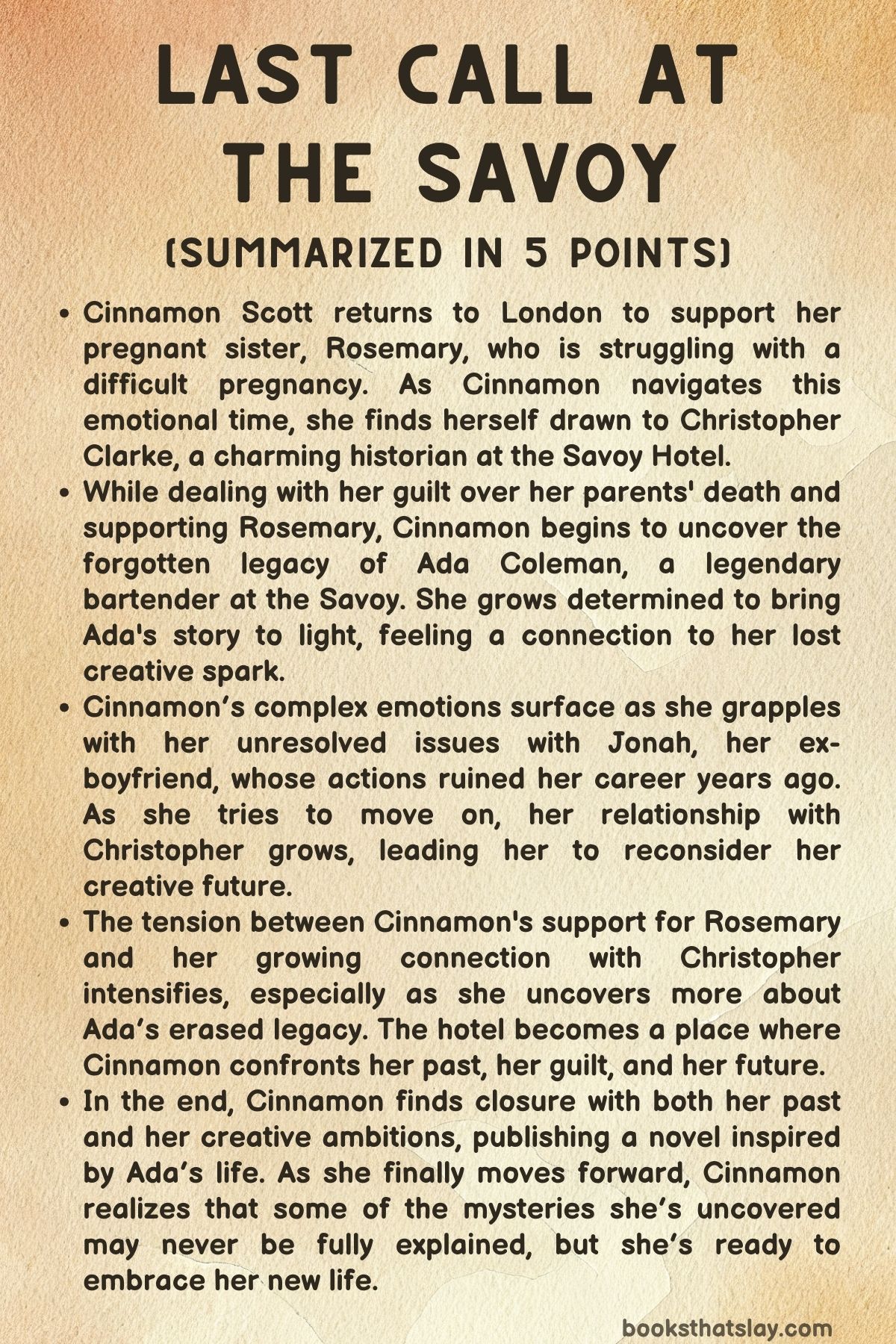
Last Call at the Savoy by Brisa Carleton is a compelling tale of self-discovery, love, and the pursuit of forgotten legacies. The story follows Cinnamon Scott, a woman grappling with personal tragedy and creative block, as she navigates a complex relationship with her sister Rosemary, who is pregnant with twins.
Their shared family history, marked by the tragic death of their parents in a plane crash, still haunts Cinnamon, especially when she finds herself drawn into a journey to reclaim the story of Ada Coleman, a pioneering bartender at London’s iconic Savoy Hotel. As Cinnamon uncovers Ada’s neglected legacy, she confronts her own grief and unresolved guilt, ultimately finding healing through writing and acceptance.
Summary
Ten years ago, the Scott family celebrated Christmas at the luxurious Savoy Hotel in London, marking a significant change in their lives after selling their family bakery. At this festive gathering, the family celebrated personal milestones—Rosemary’s successful completion of her first year in law school and Cinnamon’s victory in a national short story contest.
The atmosphere was filled with optimism and joy, symbolizing a bright future for each member. However, the present finds Cinnamon, the younger daughter, in a very different state of mind.
Waking up with a hangover in an unfamiliar apartment and a handsome stranger, Cinnamon is jolted back into reality by her sister Rosemary’s urgent call, reminding her of her flight to London. Rushing to the airport, she barely makes her way to the city where she is immediately drawn into supporting Rosemary, who is pregnant with twins and struggling to balance her career and health.
Cinnamon settles into the suite at the Savoy Hotel with her sister, hoping to distract her from the pressures of her pregnancy.
As Cinnamon takes on the role of caretaker, she finds herself increasingly frustrated with Rosemary’s husband Everett, who is preoccupied with work and absent from the scene. Her time in London becomes more tangled with Christopher Clarke, a historian and former bellman at the Savoy.
Despite an initial reluctance, Cinnamon is drawn to him as their interactions become more frequent and flirtatious.
One evening at the hotel bar, Cinnamon faces an uncomfortable encounter with a man who disrespects her boundaries. Christopher steps in to protect her, claiming Cinnamon as his wife to get the man to back off.
This leads to an invitation to high tea, where they bond over Christopher’s research on the Savoy Hotel. While Cinnamon continues to support her sister, she struggles with unresolved grief and guilt surrounding her parents’ death in a plane crash years earlier, a tragedy she blames herself for.
Cinnamon’s emotional turmoil deepens as she becomes more involved with Christopher, but she also wrestles with a deep-seated fear about writing. A promising writer in her youth, she stopped after the death of her parents, believing that her creativity had caused their demise.
Her relationship with Christopher, however, begins to spark the dormant desire to write again. Rosemary, noticing Cinnamon’s hesitations, encourages her to reconnect with her creative passions, suggesting that it could be a path toward healing.
The emotional complexities continue as Cinnamon becomes more attuned to her sister’s struggles. Rosemary’s condition becomes more delicate, and Cinnamon juggles her emotional baggage while trying to be there for her sister.
Meanwhile, her feelings for Christopher continue to grow, further complicated by her overwhelming guilt and her refusal to confront her past.
As Cinnamon’s connection with Christopher deepens, she visits the hotel bar where she encounters Joe, the bartender who tells her stories about Ada “Coley” Coleman, a trailblazing bartender at the Savoy in the early 1900s. Ada’s story fascinates Cinnamon, especially as she learns that Ada’s legacy was erased, and another bartender took credit for her creations.
The more Cinnamon uncovers about Ada, the more she feels connected to her, even seeing Ada as a symbol of forgotten genius.
Cinnamon becomes determined to uncover Ada’s story, even as she struggles to manage her own life. As she explores the Savoy Hotel and spends time with its staff, her creative spark begins to resurface.
She takes it upon herself to ensure that Ada’s legacy is no longer buried in obscurity.
Meanwhile, Rosemary’s pregnancy continues to be a source of tension, and Cinnamon’s frustration with her brother-in-law Everett mounts. The emotional strain between the sisters is evident as Cinnamon grapples with her desire to help Rosemary while dealing with her own unresolved trauma.
As Cinnamon’s relationship with Christopher continues, they share moments of vulnerability, but Cinnamon’s hesitance to trust fully holds her back.
Cinnamon’s feelings of inadequacy surface when she learns that Jonah Hunter, her ex-boyfriend, has released a debut novel. Jonah was once responsible for stealing Cinnamon’s college work, leading to a plagiarism scandal that ruined her life.
This revelation triggers a mixture of anger, guilt, and grief for Cinnamon, who still blames herself for her parents’ fatal accident that occurred shortly after the scandal. As she struggles to move on, Rosemary encourages her to confront Jonah, but Cinnamon’s reluctance to engage with him leads to an emotional breakdown.
Throughout the novel, Cinnamon’s journey becomes one of healing and self-discovery. Her relationship with Christopher grows, and her exploration of Ada’s history serves as a catalyst for Cinnamon’s own journey back to writing.
She finds solace in the stories of Ada’s resilience and her quiet defiance against the injustice of being overlooked.
The tension reaches a peak when Rosemary goes into labor unexpectedly, forcing Cinnamon to confront her fears head-on. Amid the chaos of her sister’s delivery, Cinnamon’s emotional journey takes a turn, and she begins to find peace with her grief and unresolved emotions.
Eventually, Cinnamon decides to take control of her own narrative. With her sister’s encouragement, she moves forward with writing and publishes a novel based on Ada Coleman’s life.
At a book launch at the Savoy Hotel, Cinnamon confronts her past and embraces her future. When she reconnects with Christopher, she realizes that she no longer needs to carry the burden of guilt from the past.
In the end, Cinnamon’s transformation is complete. She finds purpose not only through her creative endeavors but also in her support for Rosemary, who has finally gained independence from her neglectful husband.
Cinnamon’s journey ends on a note of acceptance as she reflects on Ada’s legacy and her own path toward healing and redemption.
Characters
Cinnamon Scott
Cinnamon Scott, the protagonist of Last Call at the Savoy, is a woman grappling with deep emotional turmoil, complicated relationships, and a search for personal healing. The novel explores her internal struggles, particularly her guilt over her parents’ tragic death in a plane crash, which she blames on herself.
This guilt has profoundly affected her, including her creative endeavors—once a promising writer, she has abandoned her passion, believing that writing may somehow have been the catalyst for the tragedy. Throughout the narrative, Cinnamon is forced to confront not only her emotional scars but also her responsibilities toward her pregnant sister, Rosemary.
As she assists Rosemary in navigating the complexities of pregnancy and marital strain, Cinnamon begins to open up to the idea of reclaiming her creativity. Her relationship with Christopher Clarke, a charming historian, acts as a catalyst for Cinnamon’s emotional journey.
Their growing attraction challenges her reluctance to engage with the world, and she begins to heal through her connection with him. Her journey is about finding closure with her past, particularly with her ex-boyfriend Jonah, whose betrayal destroyed her career.
Ultimately, Cinnamon’s path leads her to rediscover her writing voice, inspired by Ada Coleman’s forgotten legacy, and embrace her own potential for the first time in years.
Rosemary Scott
Rosemary Scott, Cinnamon’s older sister, is a central figure in the novel who balances her personal and professional life while coping with a difficult pregnancy. Rosemary’s story revolves around her struggle to manage her demanding job, her relationship with her emotionally distant husband, Everett, and the physical and emotional toll of carrying twins.
While she is incredibly supportive of Cinnamon throughout the novel, it is clear that Rosemary is facing her own set of challenges. Her vulnerability becomes more apparent as her pregnancy progresses and she grapples with loneliness and isolation, exacerbated by Everett’s neglect.
Despite her own hardships, Rosemary’s love for her sister is unwavering, and she plays a significant role in encouraging Cinnamon to face her past and rediscover her creative abilities. The deep bond between the sisters is a core element of the story, as Rosemary serves as both a source of support and a reminder of the strength that lies within Cinnamon.
As her marriage falls apart, with Everett choosing to leave for New York, Rosemary is forced to confront her own identity and her future as a mother. The novel ends with her finding strength in her sister’s growth, marking the beginning of a new chapter in her life.
Christopher Clarke
Christopher Clarke, a former bellman turned historian at the Savoy, is a key figure in Last Call at the Savoy, and his relationship with Cinnamon brings both comfort and conflict to her emotional journey. Initially, Christopher appears as a charming and intellectual figure, offering Cinnamon an escape from the weight of her own struggles.
His deep knowledge of the Savoy’s history and his intellectual curiosity serve as a contrast to Cinnamon’s emotional chaos, and he acts as a grounding force in her life. As their connection deepens, Christopher becomes a catalyst for Cinnamon’s healing, gently encouraging her to open up about her past and reconsider her belief that her creativity led to tragedy.
Through their interactions, Christopher’s attentiveness and kindness help Cinnamon navigate her unresolved guilt and the possibility of rekindling her passion for writing. However, Christopher is not without his own complexities.
His flirtations with Cinnamon initially feel harmless, but his growing feelings for her complicate the relationship, as Cinnamon is unsure whether she can truly let go of her past and embrace a future with him. Christopher’s character represents both the allure of new beginnings and the challenges of facing emotional vulnerability, making him an essential part of Cinnamon’s journey of self-discovery.
Everett Scott
Everett Scott, Rosemary’s husband, plays a significant but peripheral role in Last Call at the Savoy, acting as a source of tension within Rosemary’s life. His emotional neglect and workaholic tendencies contribute to Rosemary’s sense of isolation during her pregnancy, and his absence during critical moments exacerbates the strain on their marriage.
Though his character is less developed than others, his role is crucial in highlighting the emotional burden that Rosemary bears. His failure to be present for his wife—especially during the challenging time of her pregnancy—ultimately leads to his departure from the family, leaving Rosemary to fend for herself.
Everett’s exit from the story marks a pivotal moment in Rosemary’s growth, as she is forced to face her own loneliness and find strength in herself and her sister. Everett’s departure, though painful, acts as a catalyst for Rosemary to reclaim her agency, setting the stage for her eventual reconciliation with Cinnamon.
Joe (Bartender)
Joe, the elderly bartender at the Savoy, is a mysterious and intriguing figure who becomes Cinnamon’s confidant throughout the novel. Though his role as a storyteller is initially lighthearted, recounting tales of Ada Coleman, the legendary bartender, Joe’s significance deepens as he serves as a guide for Cinnamon’s emotional journey.
His stories about Ada, a woman whose genius was erased by history, inspire Cinnamon to confront her own struggles with creativity and self-worth. Joe is the one who encourages Cinnamon to take ownership of her story and to stop hiding from her past.
His cryptic remarks and wise counsel help Cinnamon understand that she has the power to shape her own legacy, just as Ada never had the opportunity to do. By the end of the novel, Joe’s mysterious disappearance leaves Cinnamon with a sense of peace, suggesting that his presence was more than just a chance encounter.
His impact on her is lasting, pushing her to embrace her potential and telling her that the answers she seeks are within her all along.
Jonah Hunter
Jonah Hunter, Cinnamon’s ex-boyfriend, is a character who embodies both betrayal and redemption in Last Call at the Savoy. As Cinnamon’s former lover, Jonah plays a pivotal role in her emotional history, representing the source of much of her unresolved grief.
Jonah’s betrayal—stealing Cinnamon’s writing and leading to her academic ruin—has haunted her for years, as she connects his actions to the tragic death of their parents. Initially, Jonah is painted as a villain in Cinnamon’s mind, someone who has destroyed her career and contributed to her emotional downfall.
However, when they meet again at his book launch, Cinnamon is forced to confront the fact that Jonah is no longer the man she once knew. His casual demeanor and revelation about his own troubled relationship with his father shift Cinnamon’s perception of him.
Instead of being the antagonist she once believed him to be, Jonah becomes a more complex character, a flawed individual who acted out of desperation rather than malice. This realization marks a turning point for Cinnamon, as she finally lets go of the anger that has defined her for so long, finding closure and peace.
Piper
Piper, Cinnamon’s best friend, provides a contrasting yet supportive role in Last Call at the Savoy. A character who lives life with spontaneity and humor, Piper is a refreshing presence for Cinnamon, especially during the difficult times she faces in London.
Her free-spirited nature and lighthearted attitude offer a stark contrast to Cinnamon’s introspective and often heavy emotional state. While Piper’s role is primarily to support Cinnamon and provide moments of levity, she also serves as a reminder of the different paths life can take, one of openness and joy versus Cinnamon’s tendency to retreat into her grief.
Piper’s support, even when she doesn’t fully understand Cinnamon’s emotional turmoil, is a steadying force in the novel, and her presence helps to bring Cinnamon back to life, particularly when she encourages her to confront Jonah and rediscover her voice. Through Piper, the novel explores the importance of friendships that can offer both comfort and the courage to face difficult truths.
Themes
Family Dynamics and Sisterhood
The bond between Cinnamon and Rosemary is central to the narrative of Last Call at the Savoy. Despite the complexity of their individual lives and struggles, the story reveals how family can act as both a source of support and tension.
The novel places great emphasis on the care and responsibility Cinnamon feels towards her pregnant sister, Rosemary. This sense of duty often overrides Cinnamon’s personal struggles, particularly her deep-seated guilt from the past, which stems from the tragic death of their parents.
The dynamic between the sisters reflects the deep emotional connection that often arises from shared experiences of loss and trauma.
Throughout the book, Cinnamon becomes the emotional anchor for Rosemary, especially when her sister’s husband, Everett, neglects his responsibilities. This imbalance creates friction, as Cinnamon begins to feel the weight of carrying her sister’s burdens alone.
Despite these strains, their connection remains strong. Rosemary provides not only emotional support but also acts as a mirror to Cinnamon, reminding her of her own talents and encouraging her to reconnect with her creative passions.
The two sisters are caught in an intricate dance between selflessness and self-assertion, which shapes their journey together. In a way, their relationship highlights how family ties can sometimes become a trap for one’s personal growth, yet they also serve as a platform for healing and redemption.
This familial bond underscores the complexity of caregiving, especially in times of crisis. The story is a testament to how sisterhood can simultaneously be a place of solace and strain, offering a glimpse into the delicate balance of supporting others while grappling with one’s unresolved past.
Guilt and Redemption
Cinnamon’s internal struggle with guilt plays a significant role in her character development. The weight of her parents’ death, for which she blames herself, becomes a driving force behind much of her actions and thoughts.
This burden has led to a creative block, particularly around her writing, as she believes her art is connected to their demise. In Last Call at the Savoy, this overwhelming guilt is both a personal obstacle and a barrier to Cinnamon’s healing.
Her journey is marked by an ongoing attempt to reconcile with her past, and much of her internal conflict is framed around the notion that her creativity may have led to tragedy.
As Cinnamon interacts with those around her, especially her sister and the charming historian Christopher, she is confronted with the possibility of moving beyond her past. Christopher, in particular, acts as a catalyst for change, challenging Cinnamon’s belief that her creativity is cursed.
He encourages her to explore her interests and pursue writing again, gradually shifting her perspective on her artistic identity. In this sense, his role is pivotal in helping Cinnamon see that redemption is not necessarily about erasing the past, but about coming to terms with it and choosing to live fully despite it.
The novel explores the idea that redemption is not a linear path. Cinnamon’s journey towards self-forgiveness and reconnection with her writing reflects the broader theme that redemption often requires confronting the very things one fears most.
By the end of the novel, Cinnamon’s decision to write a novel based on Ada’s life represents not only a reclaiming of her creative voice but also an acknowledgment of her past without letting it define her future.
Identity and Legacy
The theme of identity and the pursuit of legacy is deeply interwoven into the plot of Last Call at the Savoy. Cinnamon’s journey is not only about rediscovering her creative voice but also about finding her place in the world and asserting her own story.
This theme is paralleled in her obsession with the forgotten legacy of Ada Coleman, the pioneering bartender at the Savoy, whose contributions were erased from history. Just as Cinnamon struggles to reclaim her own identity and voice, she becomes determined to recover Ada’s lost legacy, seeing it as a symbol of the silencing of female achievement throughout history.
Ada’s story is a crucial element of Cinnamon’s personal growth. As she delves deeper into Ada’s history, she draws parallels between Ada’s struggles to be recognized for her work and her own battle with guilt and self-doubt.
Both women face the challenge of having their contributions overlooked, with Ada’s legacy being erased by a male-dominated world and Cinnamon’s creative potential being stifled by her own trauma. This connection fuels Cinnamon’s drive to bring Ada’s story to light, as it offers her the opportunity to assert her own identity while giving a voice to those silenced by history.
Through Ada, Cinnamon learns that legacy is not about waiting for recognition but about creating something that will stand the test of time, regardless of external validation. This realization propels her toward writing her novel, not just as a way to recover her past but also as a means of securing her own place in history.
The novel explores the tension between personal identity and societal legacy, questioning how we define our worth and how the world remembers us.
Love and Relationships
Love and the complexities of romantic relationships feature prominently in Last Call at the Savoy, where Cinnamon’s interactions with both her past and potential romantic interests reveal her emotional vulnerability and growth. The tension between Cinnamon and Christopher Clarke is one of the novel’s key emotional arcs.
While Cinnamon is initially drawn to Christopher, she resists the idea of being involved with him due to her emotional baggage and unresolved grief. The push and pull of her feelings towards him represent her broader struggle with connection and emotional intimacy.
Christopher’s role in Cinnamon’s life goes beyond that of a romantic interest; he becomes a mirror for her emotional healing. Their relationship is built on intellectual connection, shared interests in history, and mutual respect, allowing Cinnamon to see that love can be a source of support and growth rather than a distraction from her pain.
The novel contrasts this relationship with her past relationship with Jonah, whose betrayal marked the end of her previous emotional and creative ambitions. Jonah’s actions serve as a catalyst for Cinnamon’s emotional withdrawal, making it harder for her to trust or engage with anyone romantically.
As Cinnamon begins to open up to Christopher and confront her unresolved emotions, she learns that love doesn’t always have to be tied to trauma or guilt. Her growing affection for Christopher serves as a reminder that love can also be a healing force, one that encourages growth, vulnerability, and the possibility of emotional renewal.
By the end of the novel, Cinnamon’s relationship with Christopher symbolizes her ability to move beyond the past and embrace a future where love is no longer a source of pain but a potential source of happiness and fulfillment.