Lightbreakers Summary, Characters and Themes
Lightbreakers by Aja Gabel is a thought-provoking and emotionally intense novel that blends science, grief, and the human desire for connection. At the heart of the story are Maya, an art lover, and Noah, a physicist, whose relationship is deeply influenced by the tragedy of losing Noah’s daughter, Serena.
The novel explores the complexities of their love and how Noah’s involvement in a cutting-edge scientific project, the Janus Project, begins to tear at the fabric of their life together. The book delves into the emotional and psychological consequences of trauma, the quest for healing, and the intersections of memory, identity, and time.
Summary
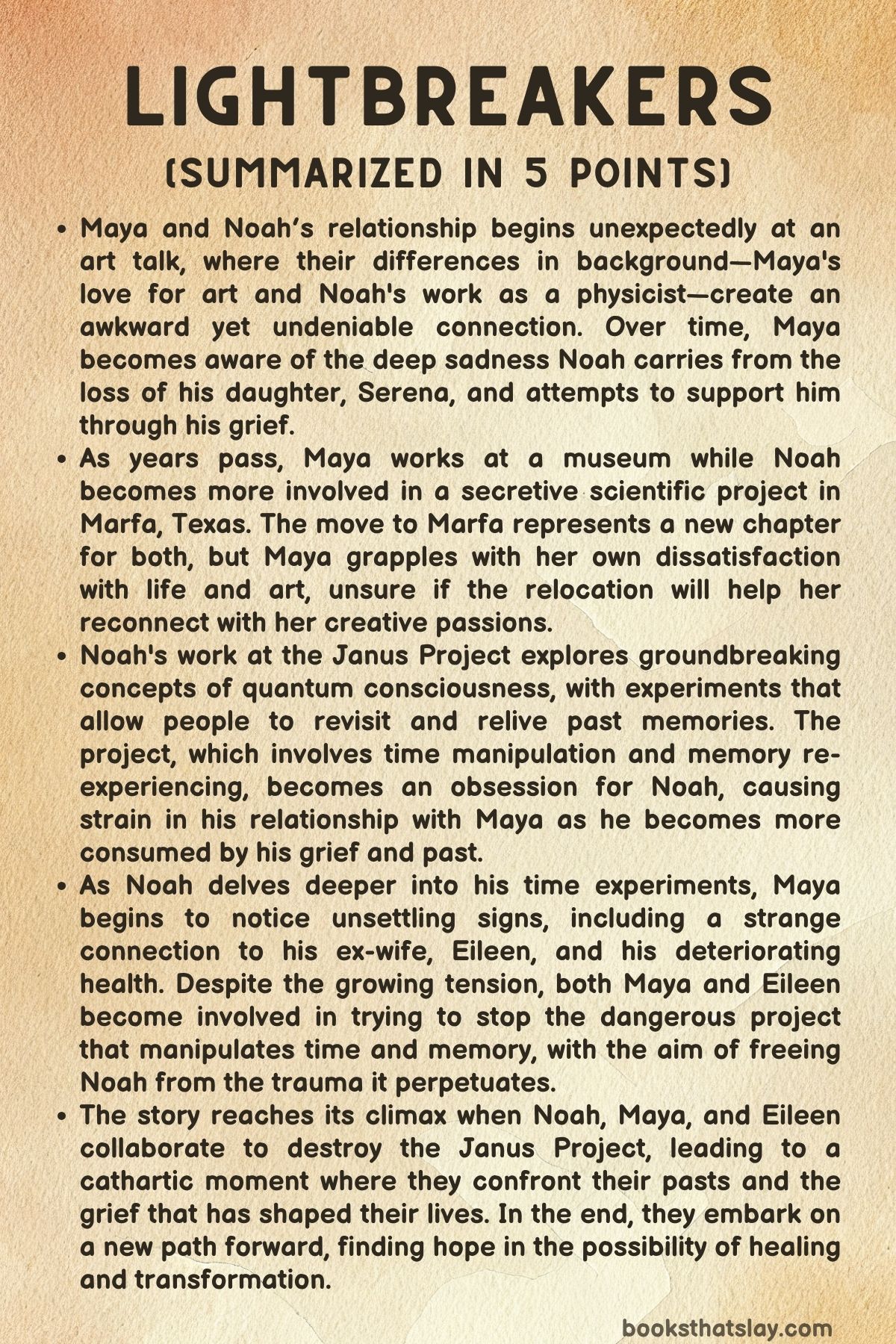
The story begins with Maya reflecting on how she first met Noah, a physicist at JPL, during an art talk. Their initial conversation was awkward, but a connection quickly formed, and they began to spend more time together.
Over time, Maya learned that Noah carried the heavy burden of grief from the death of his daughter, Serena, who had passed away from a rare heart condition. Maya, who had always been drawn to caretaking, tried to support Noah in his healing journey, but she didn’t fully understand the depths of his pain at first.
As their relationship continued, Maya found herself working at a museum, but the work didn’t bring her the same satisfaction that art once had. She felt disconnected from her passion for painting, and this weighed heavily on her.
At a cocktail party, she found herself questioning her life with Noah. Although they still shared love, their marriage had become tainted by Noah’s lingering grief.
Maya’s friend Caroline suggested she take time off work to rediscover her artistic side, and Maya considered this advice, even though it made her more aware of the personal and professional disconnect she felt.
Noah’s involvement in a new scientific project led by a reclusive billionaire, Klein Michaels, created further complications. Klein offered Noah a position at his secretive lab, which would require them to move to a remote town in Marfa, Texas.
While Maya supported Noah’s career move, she felt conflicted. The move could offer her the chance to reconnect with her art, but it would also bring them to a new place filled with uncertainty.
She began to reflect on her past, including a former relationship with an artist named Ren. The contrast between her carefree past with Ren and her more complex life with Noah made her wonder if she was truly ready to move forward with Noah in their new life.
After the move to Marfa, Maya and Noah settled into a house that Noah seemed to have replicated from his previous life with his ex-wife, Eileen. Despite her efforts to make the house her own, Maya struggled to embrace her new surroundings.
She began to work with a local gallery, but she still felt lost in her artistic identity. Meanwhile, Noah became increasingly absorbed in Klein’s secretive research, and Maya realized that their new life in Marfa would require them to confront the unresolved pain of their pasts.
Maya’s sense of unease deepened after an encounter with a pronghorn that died after charging against a concrete sculpture, an experience that left her shaken. Meanwhile, Noah began his work with the Janus Project, where he was tasked with conducting groundbreaking experiments in quantum mechanics and consciousness.
Klein’s lab had discovered a way to map and even replay memories using nanoparticles, allowing people to relive moments from their past. This technology, called “Episodic Folding,” involved entangling a person’s consciousness with their past memories, allowing them to experience those memories as if they were happening again.
The idea of folding time deeply fascinated Noah, though it also caused him emotional turmoil.
Noah became a subject in the Janus Project, participating in experiments that allowed him to relive memories, including the painful moments leading up to Serena’s death. He was initially reluctant to participate but grew more involved as he discovered the potential of the technology.
As Noah continued his experiments, he became obsessed with revisiting his memories of Serena, and the emotional weight of these experiences began to take a toll on his relationship with Maya.
Maya’s emotional turmoil mirrored Noah’s as she struggled with her identity and her feelings of isolation. Her connection with Noah became strained as he spent more time immersed in the project.
She felt disconnected from her own desires and from Noah, who seemed lost in his grief and his work. One day, she revisited an old photograph of Noah and her from their past and reconnected with her former lover, Ren, over the phone.
This connection stirred something inside her, reminding her of the vibrant life she once had.
As the story unfolded, Maya and Noah’s relationship was tested in unimaginable ways. Maya felt the weight of Noah’s grief as he spiraled deeper into the Janus Project’s experiments, which allowed him to revisit not only Serena’s death but also earlier moments from his life with Eileen.
These experiences brought him face-to-face with his past, but they also created a rift between him and Maya, who struggled to find her place in his world.
The tension in their relationship reached a breaking point when Maya learned of the dangers of the Janus Project and the moral implications of its experiments. Klein and his team had been exploiting trauma for data, and Noah was slowly unraveling as he pushed the limits of the fold.
Maya, along with Eileen, decided to take action to shut down the project. They sabotaged the lab’s machinery, bringing an end to the dangerous experiments that had consumed Noah’s life.
The novel concludes with Maya and Noah driving away from Marfa, leaving behind the chaos and uncertainty of the Janus Project. They were ready to start anew, but they both understood that the trauma of their past would never truly leave them.
However, they had learned to transform that pain into something more bearable, and with this newfound understanding, they could finally look toward the future with a sense of hope and possibility.
Characters
Maya
Maya is a thoughtful and introspective woman who has spent much of her life navigating the tension between her artistic identity and her personal life. In the beginning of Lightbreakers, Maya is introduced as someone who is deeply committed to art, but over time, she finds herself distancing from her creative passions as she focuses on her job at a museum.
Her relationship with Noah, while filled with love, is overshadowed by the unresolved grief he carries from the death of his daughter, Serena. This constant emotional weight from Noah’s past creates a strain in their marriage, and Maya begins to question her role in his healing process.
As the story unfolds, Maya is confronted with her own desires and sense of identity. Her connection with Noah brings her both fulfillment and uncertainty, especially as they move to Marfa and her artistic identity feels increasingly unclear.
Throughout the novel, Maya reflects on her past relationships, especially with Ren, and wonders if her life with Noah is the one she truly wants. Maya’s inner conflict deepens as she grapples with her longing for a creative outlet and her devotion to Noah.
Her emotional journey becomes one of self-discovery, as she learns to reconcile her love for Noah with her need for personal fulfillment.
Noah
Noah is a brilliant but grief-stricken physicist whose life is shaped by the tragic loss of his daughter, Serena. In Lightbreakers, Noah’s intellectual prowess is balanced by the emotional weight of his past.
His connection with Maya begins in a somewhat awkward encounter, but over time, it becomes clear that Noah’s charm hides a profound sadness. His grief over Serena’s death is not something he easily shares, and his emotional scars affect his relationship with Maya, making it difficult for them to move forward.
As Noah embarks on a new scientific venture with the Janus Project, his work becomes increasingly entangled with his grief, as the experiments suggest the possibility of interacting with past memories. Noah’s journey is one of both professional ambition and emotional turmoil.
His decision to engage with the Janus Project, despite its moral and physical dangers, highlights his desperate desire to confront the past, specifically his memories of Serena. His internal conflict deepens as he uses the project’s technology to revisit his past, including revisiting moments with Serena and even his former wife, Eileen.
Noah’s quest for closure ultimately leads him to a painful realization about the impossibility of reversing time and the permanence of loss. His relationship with Maya becomes complicated as he continues to secretly revisit the past, and his obsession with the folds ultimately strains their bond.
Through Noah’s character, Lightbreakers explores themes of grief, memory, and the human desire to reclaim lost moments.
Eileen
Eileen, Noah’s ex-wife, is a complex character whose grief over the death of their daughter, Serena, is just as profound as Noah’s. However, unlike Noah, Eileen seems to have found a way to move forward, both personally and professionally.
She rebuilds her life in Northern California, and although she still feels the pain of their loss, she has learned to cope with it in a way that Noah has not. Eileen’s reappearance in the narrative brings a new layer of emotional depth, as she confronts Noah’s unresolved trauma and the unfinished business between them.
When she returns to Marfa, she finds herself not only revisiting their past but also grappling with Noah’s increasingly dangerous experiments. Eileen’s relationship with Noah was once filled with passion and potential, but the loss of their daughter fractured it beyond repair.
Eileen’s return to Noah’s life highlights the different ways that grief manifests, and her ability to move on contrasts sharply with Noah’s inability to let go. She becomes a grounding presence in the narrative, helping Maya understand the complexities of her relationship with Noah and offering a different perspective on love, loss, and healing.
Eileen’s quiet strength is revealed as she helps to dismantle the Janus Project, ultimately taking an active role in ensuring that Noah and Maya can move forward in a healthier way.
Ren
Ren is an artist who was once Maya’s lover, and his presence in her past serves as a point of reflection for Maya as she navigates her current relationship with Noah. Ren represents the artistic freedom and spontaneity that Maya once had in her life, before she became consumed by her role as Noah’s caretaker.
Their relationship ended when Ren moved to New York for a prestigious career, but the bond between them never fully dissipates. Ren’s reappearance in the narrative serves as a catalyst for Maya’s self-discovery, as she compares her life with Noah to her past with Ren.
Their interactions are tinged with nostalgia and a sense of what could have been, but Maya comes to realize that her path with Noah, despite its complexities, is the one that she has chosen. Ren’s artwork, which is inspired by their past together, serves as a symbol of the fleeting nature of their relationship, and his presence in the novel invites Maya to reflect on the themes of love, memory, and the passage of time.
Klein Michaels
Klein Michaels is the wealthy and enigmatic leader of the Janus Project, a secretive scientific initiative that becomes a central element in the novel. His character is mysterious and somewhat unsettling, as his motivations are not fully revealed until later in the story.
Klein is the one who offers Noah the opportunity to join the project, and his obsession with quantum mechanics and human consciousness serves as the driving force behind the experiments that Noah becomes entangled in. Klein’s role in the story is that of a manipulator, pushing Noah to explore the limits of time and memory, often with little regard for the ethical implications.
His desire for scientific advancement, no matter the cost, represents the dangers of unchecked ambition and the moral compromises that come with it. Klein’s influence on Noah and his willingness to exploit trauma for data highlight the ethical dilemmas at the heart of Lightbreakers, forcing the characters to confront the consequences of tampering with memory and time.
Caroline
Caroline is Maya’s friend and confidante, who serves as a voice of reason and support throughout the narrative. While Maya is grappling with her own sense of identity and the complexities of her relationship with Noah, Caroline offers practical advice, encouraging Maya to take time off from her museum job and reconnect with her art.
Caroline’s role in the story is relatively minor, but she plays an important part in helping Maya regain perspective and consider what truly matters to her. Her friendship with Maya provides a grounding influence, reminding her that her happiness and creative fulfillment are just as important as her relationship with Noah.
Caroline’s concern for Maya’s well-being and her understanding of Maya’s inner turmoil underscore the themes of personal growth and self-realization that run throughout Lightbreakers.
Themes
Grief and Loss
Grief is a profound and persistent theme in Lightbreakers, intricately shaping the lives and relationships of its characters. Noah’s overwhelming grief, stemming from the death of his daughter Serena, is the emotional core of the novel.
This sorrow permeates every aspect of his life, influencing his decisions, his work, and his relationships. It is a grief that is not simply mourned but carried, a heavy burden that Noah tries to process through science, art, and memory manipulation.
Maya, too, is affected by this grief, as she lives with Noah and attempts to help him heal, yet often feels overwhelmed by the weight of his unspoken sorrow. The way both characters grapple with loss—Noah through his scientific obsession and Maya through her internal struggle—creates a poignant exploration of how loss can become a part of one’s identity.
For Noah, his grief is linked to his inability to move forward, and for Maya, it creates a sense of isolation and disconnection, leading her to question her own role in their relationship. The novel examines how grief can distort time and memory, with Noah’s work at the Janus Project—aimed at revisiting the past—serving as a metaphor for the impossibility of escaping the shadows of lost loved ones.
Even when the past is brought back to life, it is never the same, and the pain of loss remains unresolved, proving that grief is not something one can simply move on from, but something one must learn to live with.
Identity and Self-Discovery
The journey of self-discovery is central to Lightbreakers, particularly through Maya’s eyes. As she faces the complexity of her relationship with Noah, she finds herself questioning her own identity, both as an individual and within the context of her marriage.
Maya’s connection to her art, which once defined her, fades as she immerses herself in her role as a caretaker and partner to Noah. Her struggle to rediscover her artistic passion highlights a deeper conflict: the tension between personal fulfillment and relational sacrifice.
Maya’s sense of self is tested when she moves to Marfa, a place that symbolizes both the promise of new beginnings and the anxiety of confronting her unresolved emotions. This relocation forces Maya to face the person she was before Noah and the person she has become since their lives merged.
Throughout the narrative, Maya’s introspection and her interactions with others, such as her mother and her former lover Ren, push her to reevaluate her path. Her eventual realization that she needs to reconnect with her art and redefine her identity is a powerful exploration of how self-understanding can evolve through love, grief, and time.
The Interplay Between Science and Art
In Lightbreakers, the juxtaposition between the logical world of science and the emotional realm of art serves as a profound commentary on human experience. Maya’s career as an art professional contrasts sharply with Noah’s work as a physicist, and yet, their relationship thrives on the connection between these seemingly disparate worlds.
The novel suggests that while science seeks to explain the universe through reason and empirical evidence, art offers a more subjective, emotional interpretation. This dynamic plays out in their relationship, where Maya tries to understand Noah’s scientific world, and Noah, in turn, is drawn to the emotional and intuitive aspects of art.
The Janus Project, with its groundbreaking research into memory and consciousness, further amplifies this tension, blurring the lines between scientific fact and human emotion. The concept of folding time and revisiting memories through the use of technology challenges the nature of perception and reality, invoking questions about the role of art in capturing moments and emotions.
Maya’s painting, which combines video and memory, becomes a literal manifestation of this theme, as it layers the past and present, light and darkness, symbolizing the way art and science both attempt to capture and interpret the fleeting, ineffable moments of human experience.
Time, Memory, and the Past
The manipulation of time and memory stands as a central theme in Lightbreakers, particularly through the Janus Project’s experiments that allow individuals to revisit and relive memories. This concept of time folding raises questions about the nature of reality and the consequences of altering the past.
For Noah, the desire to relive moments with his daughter Serena represents his desperate attempt to reverse time and undo the pain of her death. However, his repeated journeys back into the past only reinforce the idea that time cannot be manipulated without consequences.
The novel explores how the past, no matter how vividly it can be recalled or relived, is always altered by the present, and that our memories are never static. Maya’s experience with the pronghorn, witnessing the animal’s death in the Judd sculptures, mirrors the theme of time’s destructive and transformative power.
The tension between trying to preserve memories and the inevitable decay of those moments speaks to the emotional and existential struggle that both Maya and Noah face. The past, though revisitable, remains unreachable in its purest form, and the more one attempts to capture it, the more elusive it becomes.
This exploration of time as both a physical and emotional force suggests that healing is not about returning to the past but learning to live with its imprint on the present.
The Ethics of Scientific Innovation
The moral implications of the Janus Project’s experiments present a crucial theme in Lightbreakers. As Noah becomes more involved in the project, he begins to confront the ethical boundaries of manipulating human consciousness and memory.
The technology developed by Klein and his team, which allows people to relive and even alter past experiences, raises profound questions about the integrity of human experience. The project’s ultimate goal of revisiting traumatic moments, such as the death of a loved one, highlights the dangers of tampering with the natural flow of time.
The novel questions whether such interventions could truly offer healing or whether they would cause further harm by distorting reality. Noah’s decision to participate in the experiments, despite the risks and moral dilemmas, reflects his deep internal conflict and his inability to accept the loss of Serena.
The project’s clandestine nature, including Klein’s manipulative control over the research, underscores the ethical dangers of unchecked scientific progress. As Noah’s involvement intensifies, the novel critiques the pursuit of knowledge without regard for its emotional and moral consequences, questioning the price one must pay for the ability to control memory and time.