Love You, Mean It Summary, Characters and Themes
Love You, Mean It by Laura Pavlov is a heartfelt romance novel that explores the complexities of relationships, personal growth, and family dynamics. It centers around Violet Beaumont, who is navigating a tumultuous period in her life, including a strained relationship with her family and a chaotic living situation.
Violet’s world is further complicated by her interactions with Charlie Huxley, a contractor who is renovating her flooded house. What starts as a professional relationship filled with tension gradually evolves into a deep emotional connection. As Violet and Charlie’s bond grows, they learn to confront their pasts and embrace the possibility of a future together, creating a new sense of belonging and family. It’s the 2nd book in the Blushing series.
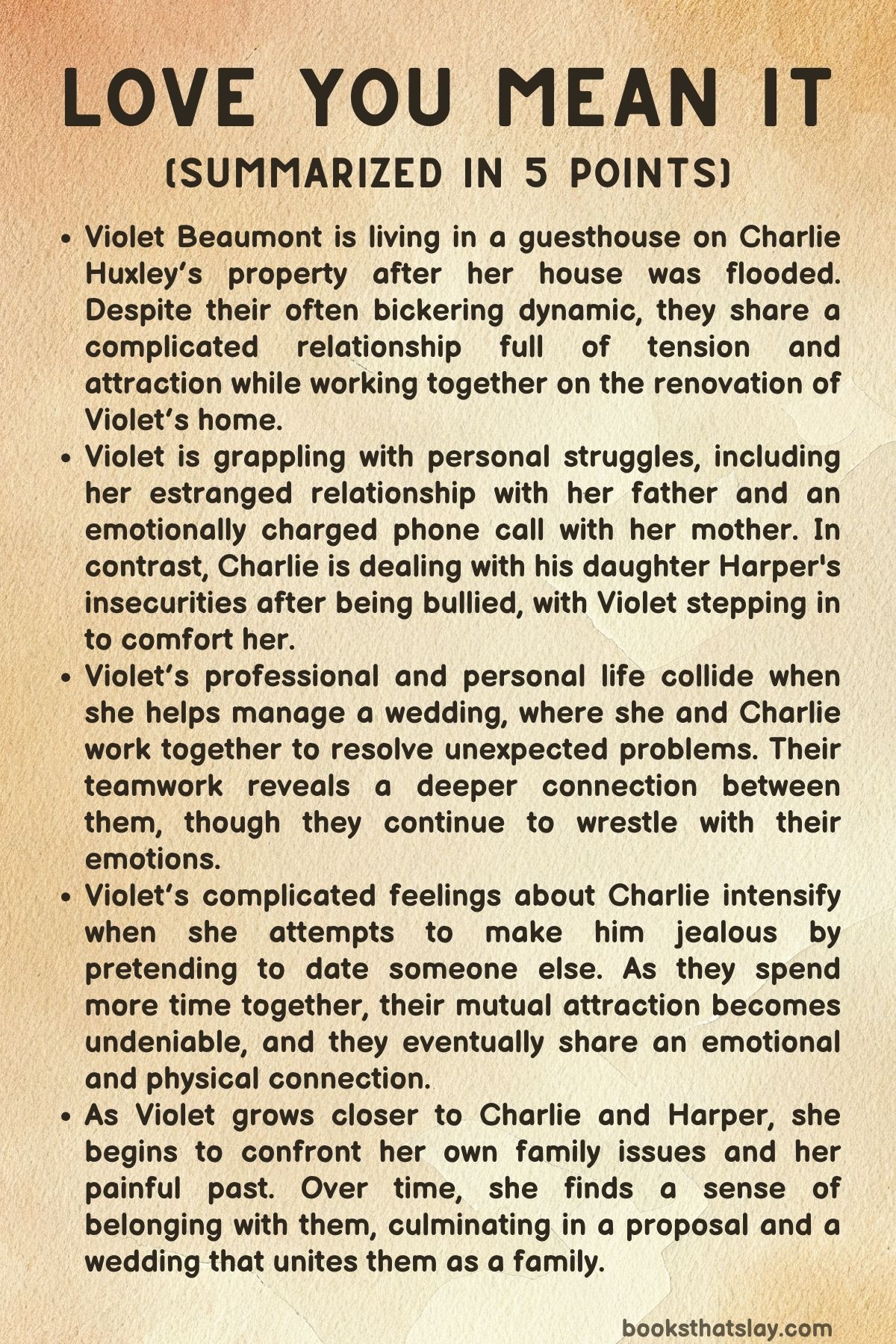
Summary
Violet Beaumont’s life is full of frustration and isolation. After her house was flooded, she’s forced to live in a guesthouse on Charlie Huxley’s property.
Charlie, who is also the contractor renovating her home, and Violet have a contentious relationship, marked by sarcastic exchanges, bickering, and an undeniable attraction. Violet’s constant changes to the design plans only add to the tension, leaving both of them exasperated.
The situation becomes more complicated when Violet receives an email from her estranged father, reminding her that she’s excluded from the family’s anniversary trip. This exclusion adds to her already heavy feelings of isolation.
Despite her frustrations, Violet finds comfort in her interactions with Charlie, who steps in to help when her smoke detector malfunctions. Their relationship remains professional, but there’s an undeniable spark between them that neither can ignore.
Violet also becomes a support system for Charlie’s daughter, Harper, who is dealing with emotional struggles at school after a classmate makes cruel comments about her appearance. Violet offers Harper a compassionate ear, and Charlie begins to recognize that Violet might be the source of comfort and stability his daughter needs.
One day, Violet and Charlie find themselves at a wedding where chaos erupts. Violet takes on her usual role of managing the event’s details, handling everything with calm and precision.
She and Charlie work together to resolve issues that arise, and through the process, their bond deepens. Afterward, Charlie pressures Violet to attend a party with him, but tension still lingers between them.
Charlie meets Dean Walker at a bar, and it becomes clear that Dean is interested in Violet, who is living in Charlie’s guesthouse. To protect Violet, Charlie exaggerates her desire for a traditional relationship, telling Dean that she’s planning for marriage and a large family.
Dean, misled by this, treats it as a challenge and begins to pursue Violet aggressively. When Violet goes to buy a car, Dean’s behavior becomes inappropriate, and Violet confronts him, ending the deal and storming out.
Enraged, she confronts Charlie, throwing his lunch at him in anger. Charlie admits that he lied to scare Dean off but acknowledges that his actions were wrong.
Violet, in turn, demands that he fix his mistake.
As their connection grows more intense, Violet’s feelings for Charlie continue to complicate matters. She’s drawn to him, yet she struggles with her own fears of commitment and vulnerability.
She goes on a date with Brayden, a lawyer she met at the diner, but her mind keeps wandering back to Charlie. Their flirtations increase, and eventually, Violet and Charlie share a passionate kiss, though both try to convince themselves it was just a one-time lapse.
The growing tension between them finally reaches a breaking point when Violet confronts her difficult family dynamics. She faces her father, stepmother, and siblings while navigating the wedding preparations for her sister Velveteen.
A series of confrontations and misunderstandings lead to Violet and her family finally beginning to reconcile. Violet finds herself in a new emotional space, one that allows her to consider a future with Charlie.
Things take another turn when Violet’s family drama surfaces once again. After a distressing call from her mother, Violet is emotionally exhausted, and Charlie steps in to offer support.
When Violet finally breaks down, Charlie confesses his feelings for her, telling her that he sees her for who she truly is. They share an intimate and vulnerable moment, and their connection deepens further.
Soon after, they share a night together that changes everything. Both Charlie and Violet realize that their relationship is more than just physical attraction; it’s about finding a real connection and support system.
As the weeks pass, Charlie and Violet grow closer, spending more time together with Harper. Violet’s house is nearing completion, and she’s forced to face the realities of her past.
She attends her sister’s wedding, and her father shows up unexpectedly, signaling the beginning of Violet’s healing journey. She realizes that her relationship with Charlie has given her a sense of belonging that she never had before.
A turning point occurs when Violet takes Harper to the park, and Harper is injured after being bullied by a classmate. Charlie is furious, and Violet is consumed by guilt, questioning her place in their family.
However, Charlie reassures her, reminding her that she’s not to blame. Over time, their bond grows even stronger, and Violet’s insecurities begin to fade as she realizes that she has found a family in Charlie and Harper.
Charlie and Violet’s relationship continues to flourish as they navigate the ups and downs of life together. Violet, who had always felt like an outsider, finally finds a place where she feels loved and accepted.
When Charlie proposes to Violet, she says yes, and they move forward together, embracing their future as a family. Their journey culminates in a small, intimate wedding, where Violet, Charlie, and Harper finally become a family in every sense of the word.
The story ends on a hopeful note, with Violet realizing that she’s found not just love but also a home.
Characters
Violet Beaumont
Violet Beaumont is a complex and multifaceted character who experiences both emotional vulnerability and resilience. She is grappling with a variety of personal issues, such as her strained relationship with her estranged father and the toxic dynamics with her alcoholic mother.
These challenges leave Violet feeling isolated, unsure of where she truly belongs. Despite her emotional struggles, she is resourceful, practical, and compassionate, often stepping in to help others.
This is seen when she comforts Charlie’s daughter, Harper, during difficult moments, showing a side of her that is nurturing and empathetic. At the same time, Violet has a sharp wit and a tendency to protect herself with sarcasm and tough exterior, especially when dealing with the men in her life, like Charlie and Dean.
She is fiercely independent, but through her connection with Charlie and Harper, she begins to soften and allow herself to feel loved and valued. Over the course of the story, Violet transforms from someone burdened by the past to a person who starts to believe in the possibility of a future filled with love and belonging.
Charlie Huxley
Charlie Huxley is a compassionate and dedicated father, trying his best to navigate the complexities of single parenthood while managing his professional responsibilities. He is protective of his daughter, Harper, and deeply affected by her emotional struggles.
Charlie’s relationship with Violet is marked by a mixture of tension and attraction. While their interactions often involve bickering and sarcasm, there is a growing emotional connection between them that neither can ignore.
Charlie is also a man who carries his own emotional baggage, stemming from his difficult past in foster care and the abandonment of his daughter’s mother, Caroline. His vulnerability shines through his conversations with Violet, especially when he opens up about his struggles to set boundaries with Harper’s mother.
Charlie is also protective of Violet, as seen in his attempts to shield her from the advances of Dean, a man who treats her with disrespect. Throughout the story, Charlie’s deep care for Violet and Harper evolves into a love that is genuine, patient, and unwavering.
His relationship with Violet brings him healing and allows him to open up to the idea of a family again.
Harper Huxley
Harper Huxley is a young girl who plays a central role in the emotional development of both Charlie and Violet. Despite her young age, Harper is perceptive and sensitive, especially when it comes to her own feelings of insecurity about her appearance and the absence of her mother.
Harper’s relationship with Violet is one of mutual support and understanding. Violet steps in as a comforting figure when Harper struggles with school bullies, showing that she is capable of offering the love and care that Harper’s mother, Caroline, has not.
Harper’s bond with Violet deepens as they spend more time together, and Harper begins to see her as an integral part of her life, even referring to her as someone who feels like family. Harper’s transformation from a sad and lonely child to a more confident and secure one is largely due to Violet’s nurturing presence.
Through their interactions, Harper teaches Violet what it means to be a part of something real and lasting, pushing Violet to confront her own feelings of belonging and family.
Montana
Montana is Violet’s friend and confidante, providing much-needed support and comic relief throughout the story. She is a grounded and loyal character, always there to listen and offer advice, especially when Violet is struggling with her emotions or her complex relationships with Charlie and her family.
Montana’s perspective on Violet’s romantic struggles adds a layer of humor to the story, especially when she encourages Violet to embrace her feelings for Charlie. Montana is also an important source of strength for Violet as she works through her insecurities and emotional pain.
Their friendship is one of the few constants in Violet’s life, and Montana’s no-nonsense attitude helps Violet find clarity during times of uncertainty. Montana also plays a crucial role in helping Violet navigate her own emotional growth, reminding her to embrace the love and joy that she is capable of receiving.
Blakely
Blakely, like Montana, is a key member of Violet’s support network. While she offers a more subdued presence than Montana, Blakely’s role in the story is equally vital.
She is the voice of reason and emotional support, always encouraging Violet to be true to herself and to confront her fears. Blakely’s friendship with Violet is built on a foundation of trust and understanding, and her calm demeanor helps to balance the more chaotic elements of Violet’s life.
Blakely is also instrumental in supporting Violet through her tumultuous relationship with Charlie, offering advice when needed but also respecting Violet’s autonomy. Her steady friendship allows Violet to process her emotions and make difficult decisions about her future.
Dean Walker
Dean Walker is a secondary character who plays a crucial role in highlighting Violet’s strength and boundaries. As a salesman who tries to manipulate Violet into a romantic encounter, Dean represents everything Violet despises: arrogance, disrespect, and entitlement.
He initially believes he can easily win Violet over, but his behavior becomes increasingly inappropriate and offensive. Violet’s reaction to his advances shows her ability to stand up for herself, refusing to let him treat her in the way he expects.
Dean’s role in the story serves as a catalyst for Violet’s further development, particularly in her growing sense of self-worth and her rejection of men who don’t respect her. Charlie’s intervention to protect Violet from Dean also serves to strengthen the bond between him and Violet, as she begins to see him as someone who genuinely cares for her well-being.
Missy Beaumont
Missy, Violet’s stepmother, represents a toxic and unsupportive maternal figure in Violet’s life. Missy’s bitterness toward Violet stems from a long-held resentment of Violet’s mother and her role in the family dynamic.
She frequently criticizes Violet, undermining her efforts and casting blame for things that are beyond Violet’s control. At the wedding reception, Missy’s disapproval is evident, as she complains about Violet’s handling of the event and criticizes her for everything that goes wrong.
However, Missy’s behavior eventually comes into question when Violet’s siblings, Paris, Huntington, and Brenton, confront her and expose the deeper issues within their family. Missy’s strained relationship with Violet underscores the emotional distance that Violet has felt throughout her life and her ongoing struggle for acceptance and validation from her family.
Velveteen Beaumont
Velveteen, Violet’s sister, plays a pivotal role in Violet’s growth. Initially, Velveteen is distant and influenced by Missy’s negative view of Violet.
However, after a confrontation and a vulnerable conversation between the sisters, Velveteen’s attitude softens, and she begins to see Violet in a different light. The sisters’ relationship is a complicated one, marked by misunderstandings and years of distance, but it ultimately evolves into a more honest and supportive connection.
Velveteen’s acknowledgment of the way she has treated Violet and her apology mark a turning point in their relationship, signaling the possibility of healing and deeper family bonds.
Ralph Parker
Ralph, Velveteen’s husband, provides a moment of comedic relief and chaos during the wedding reception. His drunken antics and disregard for the event’s decorum result in a messy scene that Violet must step in to resolve.
Despite his disruptive behavior, Ralph’s role is essential in showcasing Violet’s ability to handle crisis situations with grace and determination. His actions at the reception, though frustrating, ultimately reinforce Violet’s role as the one who can manage chaos and ensure things are brought back under control.
William Beaumont
William, Violet’s father, plays a minor but significant role in the story. He is emotionally distant and neglectful, having abandoned Violet before her birth.
Their relationship is fraught with tension, and his inability to provide the emotional support Violet needs only deepens her sense of abandonment. However, toward the end of the story, there is a slight shift in William’s behavior.
He begins to show a degree of remorse for his past actions, even asking to see Violet’s renovated home. This gesture, though small, marks a potential turning point in their strained relationship.
Themes
Family and Belonging
In Love You Mean It, the theme of family and belonging is explored through Violet’s complex relationships with her biological family and the connection she finds with Charlie and his daughter Harper. Violet’s struggle with her own family, particularly with her estranged father and her alcoholic mother, has left her with deep emotional scars, and she feels like an outsider in her own life.
The emotional abandonment from her parents makes her yearn for a sense of belonging, something that seems impossible as she navigates through the fractured bonds of her family. However, the relationship that forms between Violet and Charlie provides a stark contrast to her previous experiences.
As Violet spends more time with Charlie and Harper, she begins to experience what it feels like to be a part of a family, to have unconditional support and love, something she had been missing for most of her life. Charlie’s openness with her, his protective instincts for Harper, and the deepening affection between them create a space where Violet finally feels like she can be herself.
This theme extends to Violet’s interactions with Harper, where the two bond over personal struggles and vulnerabilities, forming a familial connection that provides emotional healing for Violet. Over time, this new family dynamic allows Violet to heal from the wounds of her past, leading to her realizing that the love and belonging she had sought all her life was not just a dream but a reality she was now living.
Healing from Emotional Wounds
Violet’s emotional journey in Love You Mean It is significantly shaped by her painful past, particularly her strained relationship with her parents. The theme of healing from emotional wounds runs throughout the narrative as Violet grapples with feelings of abandonment, guilt, and low self-worth.
Her interactions with her mother, who constantly belittles her, and her father, who is distant and indifferent, have made her feel unworthy of love and support. However, her relationship with Charlie serves as the catalyst for her emotional healing.
His ability to comfort and listen to her when she opens up about her past allows Violet to slowly let go of the toxic beliefs about herself that she had carried for years. The support she receives from Charlie and the way he validates her feelings give her the strength to face the pain of her past head-on.
This emotional healing extends beyond Violet’s relationship with Charlie, as she also finds solace in her bond with Harper. By stepping into a motherly role and offering Harper emotional support, Violet is able to heal part of herself as well, realizing that she is capable of offering the love and care she never received as a child.
This journey of emotional healing reflects the novel’s exploration of how relationships, trust, and genuine care can help individuals recover from deep emotional scars.
Personal Growth and Self-Discovery
Throughout Love You Mean It, Violet’s journey toward personal growth and self-discovery is a central theme. Initially, Violet is depicted as a woman weighed down by insecurities and fears, largely shaped by her toxic family dynamics and her tendency to sabotage her own happiness.
Her relationship with Charlie begins with tension and resistance, as Violet tries to keep her emotional distance due to her fear of vulnerability. She is hesitant to trust anyone, particularly men, because of her past experiences.
However, as the narrative unfolds, Violet begins to shed her layers of emotional protection, confronting the very fears that had kept her from embracing love and happiness. Her interactions with Charlie force her to reevaluate her boundaries and challenge her preconceived notions about relationships.
As she allows herself to be more vulnerable, Violet begins to understand her own desires, needs, and capacity for love. This self-discovery is further highlighted by her personal growth when she steps into the role of a mentor and comforter for Harper, showing her nurturing and empathetic side.
By the end of the novel, Violet’s growth is apparent as she not only opens herself up to Charlie but also recognizes her own worth and ability to create her own future, free from the toxic influences of her past.
Trust and Vulnerability in Relationships
The theme of trust and vulnerability plays a critical role in Love You Mean It, particularly in the development of Violet and Charlie’s relationship. Both characters come into the relationship with baggage and hesitations.
Charlie, having experienced his own set of emotional struggles, including his daughter’s abandonment by her mother, is initially reluctant to open himself up to Violet fully. Violet, on the other hand, carries deep emotional wounds from her family’s abandonment and feels unworthy of love.
Their relationship begins with playful bickering, but beneath the surface, there is a growing sense of mutual respect and attraction. However, the path to true intimacy is not easy.
Violet’s difficulty with vulnerability often causes her to retreat or react defensively, as seen in the heated argument between them when Violet is upset about Charlie’s interference with her date with Dean. Over time, both characters learn to trust each other more deeply, slowly allowing themselves to be vulnerable with one another.
Charlie’s patience and understanding, coupled with Violet’s willingness to open up, pave the way for a relationship built on trust and mutual respect. This evolution of their relationship highlights the importance of vulnerability in creating authentic connections.
The willingness to be open, to share one’s fears and flaws, is what ultimately strengthens their bond and allows them to move forward together.
The Role of Compassion and Empathy
In Love You Mean It, compassion and empathy emerge as powerful tools for personal growth and connection. Violet’s development as a character is partly shaped by her ability to empathize with others, particularly Charlie’s daughter, Harper.
Violet’s kindness and willingness to help Harper navigate her emotional struggles demonstrate the power of compassion in healing relationships. She offers Harper the emotional support that Charlie sometimes struggles to provide, helping the young girl navigate her insecurities.
In turn, Violet’s actions reflect her own need for emotional healing and belonging. As Violet becomes more involved with Harper and begins to understand the complexities of Charlie’s own struggles, she realizes that empathy and understanding can foster growth and connection in her own life as well.
The theme of compassion also extends to Charlie’s character, as he shows a deep empathy for Violet’s pain and tries to support her without pressuring her. The emotional support he offers her helps her to face the demons of her past and finally accept that she deserves love and happiness.
Ultimately, the theme of compassion in the novel highlights the importance of understanding and emotional support in building meaningful relationships, especially when individuals are dealing with personal trauma and challenges.