Otherwise Engaged Summary, Characters and Themes
Otherwise Engaged by Susan Mallery is a contemporary romance about two women the same age whose lives collide because of a decision made before either of them could speak. Victoria Rogers is a fearless stuntwoman nursing serious injuries and an even bigger wound at home: she’s never felt fully seen by her polished, controlling mother, Ava.
Shannon Van Horn seems steadier on the surface, but she’s stuck in her mother Cindy’s orbit and secretly engaged to her boyfriend, Aaron. When Ava and Cindy meet again after twenty-four years, old secrets surface, forcing everyone to rethink love, motherhood, and the choices that shape a family.
Summary
Victoria Rogers, twenty-four, lands in the hospital after a stunt goes wrong and she’s thrown from a moving truck. With a broken leg and other injuries, she’s forced to pause the tough, independent life she’s built.
Her father, Milton, a longtime movie studio executive, insists she recover at the family home in Bel Air. Victoria resists but gives in, already bracing for conflict with her mother, Ava.
Ava runs her world with precision—appearances, schedules, expectations—and Victoria has spent years pushing back, partly out of personality and partly because closeness with Ava feels impossible. During recovery, Victoria tries to work on a screenplay she’s been writing in secret, but pain, frustration, and old memories make every day feel like a test.
Across Los Angeles, Shannon Van Horn is also twenty-four and also stuck, though in a different way. She works for her mother, Cindy, at the family real estate business after leaving college, and she can’t shake the fear that she has no direction of her own.
Shannon’s boyfriend Aaron, successful and steady, listens to her spiral and then surprises her by proposing. Shannon says yes, thrilled and terrified at the same time.
She keeps the engagement quiet, tucking the ring onto a chain, because her mother is planning her own wedding to Luis, a wealthy partner, and Shannon can already hear Cindy’s excitement about turning it into a shared celebration. Cindy is loving and generous, but she’s also deeply involved in Shannon’s life—so involved that Shannon sometimes can’t tell where her own wants end and her mother’s begin.
The two households collide at a coastal estate that both families are visiting for different reasons: Ava and Victoria are scouting a location for Milton’s sixtieth birthday party, while Cindy and Shannon are touring a garden bungalow for Cindy’s wedding. In an instant, the atmosphere shifts from polite strangers to shock.
Ava and Cindy recognize each other, and the past they never discussed snaps into the present. Cindy was once a pregnant seventeen-year-old who had planned to place her baby for adoption.
Ava and Milton, unable to have children, were the couple she chose. During the pregnancy, Cindy and Ava grew close, almost like sisters.
Then Cindy went into labor early while Ava was away, held her baby, and couldn’t let her go. Cindy vanished rather than face Ava, returned gifts through her father, and ended the relationship without explanation.
Ava’s loss wasn’t only the baby—it was the bond she thought would last.
Shannon is stunned to learn her mother had ever considered adoption, and she’s equally shaken by the realization that this couple standing in front of her once expected to raise her. Cindy, overwhelmed by guilt and old fear, runs from the confrontation.
Shannon follows, trying to understand how such a huge part of her origin story was kept from her. Cindy finally tells Shannon the truth: she was young, scared, under pressure, and convinced adoption was the responsible choice—until she met her daughter and couldn’t go through with it.
The shame of hurting Ava kept Cindy silent for decades.
For Victoria, the encounter detonates something she has carried quietly for years. She has always known she was adopted, but she believed she was wanted from the start.
Earlier, she discovered documents suggesting her biological mother was a maid in Ava’s home and that the adoption was not the neat, planned story she’d been told. Seeing Shannon makes the timeline unmistakable: Shannon was the baby Ava expected, and Victoria came later.
Victoria feels like the substitute who arrived when Ava’s first plan fell apart. The thought burns, and when she learns Ava has been spending time with Shannon and showing her keepsakes from Cindy’s pregnancy, it becomes unbearable.
Victoria demands to see the memory box. Inside are photos of Ava and pregnant Cindy, notes, nursery plans, and baby items—some even labeled with the name “Victoria,” a family name Ava insists she always intended to use.
To Victoria, the details feel like proof that a life was prepared for someone else, and she was slotted into it after the fact. She throws the box’s contents onto the floor and leaves, convinced she will never be anyone’s first choice.
The damage spreads. Milton, usually the calm bridge between mother and daughter, is furious with Ava for keeping the box and for letting Shannon into that private history.
Ava is left staring at the truth she has avoided: she never fully released her grief, and her distance from Victoria has had consequences. Still, the sudden connection between the two families also creates an unexpected friendship.
Victoria and Shannon begin spending time together, comparing their mothers and their own fears. Shannon envies Victoria’s blunt confidence, while Victoria notices Shannon’s tendency to apologize for simply having needs.
Their honesty helps each of them name what they want: Shannon wants a life that isn’t an extension of Cindy’s, and Victoria wants to stop living in permanent defense against being hurt again.
Shannon’s secret engagement becomes the next fault line. Ava, meaning well but moving too fast, confronts Shannon about hiding it and then blurts the truth to Cindy during a visit.
Cindy is crushed—not just because Shannon kept a secret, but because she thought she and her daughter shared everything. Cindy retreats with Luis to lick her wounds, while Shannon is left to face how avoiding conflict has become her default.
With Aaron’s support, Shannon starts building a plan: she admits she loves helping with Aaron’s landscaping work, especially the design side, and researches an environmental horticulture program at a technical college. For the first time in years, she feels like she’s choosing something for herself, not drifting into the next expectation.
Victoria, meanwhile, fights through writer’s block and emotional exhaustion. Javiar—Luis’s son, Shannon’s roommate, and now connected to Victoria through this complicated new family web—shows up with steady attention and an obvious interest in more than casual flirting.
Victoria tries to keep it purely physical, repeating that love isn’t for her after a past relationship left her bruised. But her reactions say otherwise.
When she pushes Javiar away during a moment that feels too real, she regrets it almost immediately.
The mothers also shift. Cindy begins to see how her constant involvement may have kept Shannon from growing up, even as it came from love and guilt.
Ava faces her own unfinished grief and finally makes a different choice: she reads Victoria’s screenplay, covers it with thoughtful notes, and gives it back not as criticism but as proof that she sees her daughter’s talent. That act lands harder than any apology.
Victoria recognizes that Ava is trying, not performing, and she allows a real conversation—about the story, about the past, and about the way Victoria has built her identity by rejecting anything Ava might approve of.
By the end, Shannon confronts Cindy directly, explaining that she needs separation and space, not because she loves her mother less, but because she wants to become an adult. Cindy listens, hurt but willing.
They agree on a compromise that honors both weddings without turning them into a single shared event: Shannon and Aaron will marry quietly just before Cindy’s ceremony, with a small, personal feel. Victoria, inspired by Ava’s support and by Shannon’s willingness to risk honesty, rewrites her screenplay around a bold new turn and finishes the work with renewed drive.
Then she takes her own risk: she goes to one of Javiar’s open houses and asks him out on a real date. Javiar agrees—interested, cautious, and pleased—and Victoria shows up ready to try again, not as a replacement for anyone else, but as herself.
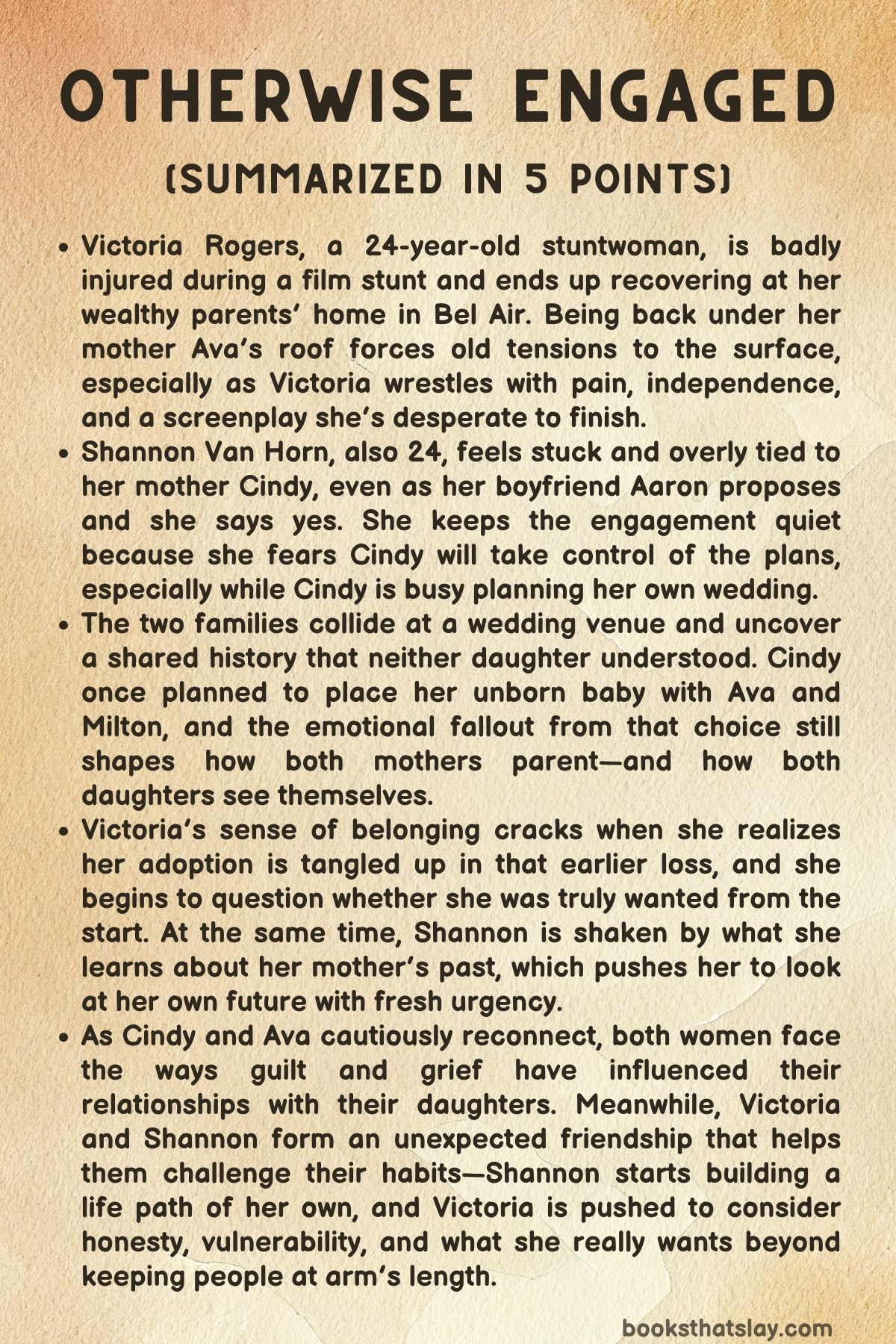
Characters
Victoria Rogers
Victoria Rogers, a 24-year-old stuntwoman, is a complex character shaped by her tumultuous relationship with her adoptive mother, Ava, and her desire for independence. After a near-fatal accident during a film stunt, Victoria is forced to recover at her parents’ home, which brings her into closer contact with the emotional turmoil she’s been avoiding.
Although she tries to maintain a facade of rebellion and detachment, Victoria’s internal conflict reveals her deep-seated insecurities and unresolved pain. She feels like the “replacement baby,” always aware that she was adopted but initially believing it was a heartfelt decision.
The discovery that she was seen as a consolation prize by her adoptive mother, Ava, shatters her, leading to a confrontation that exposes the deep emotional scars she carries. Despite her bitterness, Victoria is also a writer, working on a screenplay that reflects her struggles with identity and family.
Over the course of the novel, she gradually learns to confront her past and her relationships, ultimately finding the courage to open herself up to love and connection.
Shannon Van Horn
Shannon Van Horn is a 24-year-old woman who, much like Victoria, is struggling with the weight of her family’s expectations. Though she is not as outwardly rebellious as Victoria, Shannon feels trapped in a life she didn’t choose.
She works for her mother, Cindy, at a real estate company and has been unable to find her own path, despite her deep love for her fiancé, Aaron. Throughout the novel, Shannon experiences a major emotional awakening.
She is forced to confront the reality of her relationship with her mother, who has been overly involved in her life, leaving Shannon unable to grow independently. Her secret engagement to Aaron, which she hides from her overbearing mother, is a reflection of her desire for autonomy.
However, Shannon struggles to communicate her own needs and desires, especially when it comes to breaking away from Cindy’s influence. Through her interactions with Victoria, she starts to realize that she needs to take control of her future, both personally and professionally.
This realization leads her to pursue a new career path in horticulture, signaling her first steps toward independence.
Cindy Van Horn
Cindy Van Horn, Shannon’s mother, is a warm but overbearing figure in the story. Her relationship with Shannon is intense, almost to the point of enmeshment, as she treats her daughter more like a best friend than a child.
Cindy’s over-involvement in Shannon’s life has been a source of both comfort and strain, especially as Shannon grows into adulthood. Cindy’s own story of choosing to keep Shannon despite being pressured to give her up for adoption adds layers of guilt and sacrifice to her character.
Throughout the novel, Cindy wrestles with her overwhelming love for Shannon and her desire to keep her close, even as she begins to recognize that Shannon needs more space. The revelation that she nearly gave Shannon up for adoption decades ago leaves her with a deep sense of regret, which she struggles to reconcile.
Despite her emotional turmoil, Cindy shows great strength, particularly in her efforts to maintain a relationship with Ava and move forward with her life, including her upcoming marriage to Luis. Cindy’s journey is one of acceptance—learning to let go of the past and allow her daughter to grow on her own terms.
Ava Rogers
Ava Rogers is a controlling and polished woman who struggles to connect with her daughter, Victoria, despite deeply loving her. Ava’s tension with Victoria is rooted in the pain of a past loss—she had once been in line to adopt a child, only for that opportunity to slip away when the birth mother, Cindy, chose to keep her baby.
This unresolved grief has colored Ava’s relationship with her adopted daughter, and much of her emotional energy is spent trying to repair what she perceives as a flawed bond. Ava’s work in charity, particularly with youth and animal welfare, provides her with a sense of purpose and fulfillment that contrasts with her fraught personal life.
However, her relationship with Victoria remains strained, as she struggles to understand her daughter’s impulsive nature and rebellious streak. Ava’s difficulty in letting go of the past—specifically, the loss of the baby she almost adopted—prevents her from fully embracing the love and connection with Victoria that is so desperately needed.
Her journey throughout the novel is one of self-reflection and, ultimately, reconciliation. She learns to confront her mistakes and open herself up to a more authentic relationship with Victoria, finally letting go of her emotional baggage.
Milton Rogers
Milton Rogers is the calm, steady presence in the novel, acting as a mediator between Ava and Victoria. A senior movie studio executive, he deeply loves both women but finds himself torn between his wife’s controlling nature and his daughter’s impulsive tendencies.
Milton’s role as a peacemaker is crucial in maintaining the fragile balance within the family. He is aware of the emotional pain that both Ava and Victoria harbor and often finds himself caught in the middle of their disputes.
Despite his role as a buffer, Milton is not without his own emotional depth. He understands the gravity of the family’s unresolved grief—both Ava’s heartbreak over losing the chance to adopt Cindy’s child and Victoria’s hurt at feeling like a replacement for that lost baby.
Milton’s approach to resolving conflict is gentle, but he is also a man who values honesty. He encourages Ava to reach out to Cindy and try to heal old wounds.
His quiet strength and compassion ultimately help bring about a resolution in the family, though it is clear that his own emotional journey is shaped by years of mediating the conflicts between his wife and daughter.
Themes
Family Dynamics and Mother-Daughter Relationships
The relationship between mothers and daughters is a central theme in Otherwise Engaged. At the heart of the narrative are the complex and often strained connections between the mothers, Ava and Cindy, and their daughters, Victoria and Shannon.
Ava’s relationship with Victoria is marked by tension, rooted in her controlling nature and emotional distance. Despite Ava’s deep love for Victoria, her inability to connect with her adopted daughter leads to feelings of inadequacy and resentment.
Victoria’s sense of being a “replacement child” exacerbates her detachment, as she struggles with her belief that she was never truly wanted. The tension is further compounded by Ava’s failure to recognize how her actions, such as keeping a memory box from her time with Cindy, unintentionally reinforce Victoria’s feelings of being the substitute for the child Ava lost.
On the other hand, Cindy’s relationship with Shannon is also fraught with complexity. Although Cindy is warm and over-involved, her deep need to protect and guide Shannon causes the latter to feel stifled and unable to assert her own independence.
The comparison between Ava’s emotionally distant relationship with Victoria and Cindy’s overly protective dynamic with Shannon highlights the contrasting approaches to motherhood, showcasing how both mothers’ desires to love and protect can sometimes manifest in damaging ways.
Adoption and Identity
Adoption plays a significant role in shaping the identities of both Victoria and Shannon, though their experiences differ greatly. Victoria’s journey is marked by the revelation that she was not the child Ava and Milton had originally planned for, but rather a substitute after Cindy decided to keep Shannon.
This knowledge shakes Victoria’s sense of self, leading her to feel as though she was never truly chosen or loved in the way she had believed. Her adoption story, initially framed as a loving decision, is revealed to be more complicated and filled with guilt, grief, and unhealed wounds from Ava’s past.
This exploration of adoption raises questions about identity and belonging, as Victoria struggles to reconcile her place within a family that is not defined by a biological connection. Meanwhile, Shannon’s own adoption story is never explicitly mentioned, but her mother’s actions and over-involvement suggest a different kind of identity struggle.
For Shannon, the tension lies in balancing her own desires and goals with the overwhelming expectations and desires of her mother. Both women grapple with the idea of what it means to truly belong and whether familial love can overcome the complexities of adoption and personal history.
Love, Heartbreak, and Emotional Vulnerability
The theme of love, particularly the vulnerability that comes with it, is explored through both Victoria’s and Shannon’s relationships. Victoria’s belief that love is too painful and risky stems from a past heartbreak that left her emotionally scarred.
This fear of vulnerability manifests in her casual approach to relationships, pushing people away, including Javiar, whom she genuinely likes. Victoria’s reluctance to open up to love is a defense mechanism against the emotional pain of being hurt.
Her emotional walls are also a reflection of her complicated relationship with her mother, as she struggles with the idea of being loved and accepted unconditionally. On the other hand, Shannon’s approach to love is shaped by her need for approval, especially from her mother.
She finds herself torn between her love for Aaron and her fear of disappointing Cindy, which leads to her keeping her engagement a secret. As the story progresses, both women must confront their emotional vulnerabilities, with Victoria learning to embrace her feelings for Javiar and Shannon coming to terms with her own need for independence.
In both cases, love becomes a source of growth, pushing them toward deeper emotional honesty and self-acceptance.
Personal Growth and Independence
Both Victoria and Shannon are on separate paths toward self-discovery and independence, with their journeys serving as a critical aspect of the narrative. Victoria’s personal growth is reflected in her transition from a reckless stuntwoman to a more reflective and introspective individual.
Despite the wounds inflicted by her family’s history, she begins to find her voice as a screenwriter and confronts her fears of emotional vulnerability. Her struggle to connect with her mother forces her to examine her own desires, her career, and her beliefs about relationships, pushing her toward greater self-awareness.
Shannon’s growth, on the other hand, is driven by her need to break free from her mother’s overbearing influence. Initially lost and unsure of her place in the world, Shannon begins to assert her independence, first by secretly accepting her engagement and then by pursuing a career path outside of her mother’s expectations.
Her choice to enroll in a technical program reflects her desire for autonomy and a life that is more aligned with her own aspirations, rather than those imposed by Cindy. Both women’s stories highlight the importance of personal growth and independence, demonstrating that breaking free from the expectations and constraints of family can lead to a more fulfilling and authentic life.
Guilt, Regret, and Healing
Guilt and regret are powerful emotions that run throughout Otherwise Engaged, particularly in the context of family dynamics. Ava’s guilt over losing the child she had hoped to adopt, and the subsequent emotional distance between her and Victoria, drives much of the tension in their relationship.
Ava’s failure to fully address her unresolved feelings about Cindy and her baby continues to haunt her, even as she tries to love and support Victoria. Similarly, Cindy’s guilt over almost giving Shannon up for adoption weighs heavily on her throughout the novel, and she spends years avoiding the painful truths about her past.
Both women must confront these feelings in order to move forward in their relationships with their daughters. In contrast, Victoria and Shannon each must contend with their own guilt—Victoria over her emotional detachment and Shannon over her secret engagement.
The theme of guilt is tied to the broader theme of healing, as each character must come to terms with their past mistakes and emotional wounds in order to find peace. Ultimately, Otherwise Engaged illustrates how healing is a process that requires vulnerability, honesty, and the willingness to confront difficult emotions.